Introduction
A short herd lifespan is a significant economic cost to the dairy industry and has welfare implications for individual animals. Fertility has fallen in recent years: UK figures for first service conception rates were around 60% in the 1970s but only 40% by 2000 (Royal et al., Reference Royal, Darwash, Flint, Webb, Woolliams and Lamming2000). The average total annual culling rate in UK Friesian/Holstein dairy herds from 1990 to 1992 was 23.8%, with poor fertility accounting for over one-third of the cows culled. Of the disposals, 54% were culled by the end of their fourth lactation (Esslemont and Kossaibati, Reference Esslemont and Kossaibati1997). Few Holsteins cows in the US currently survive beyond their fifth parity and their average lifetime parity number has fallen over the past 20 years from 3.4 to only 2.8 (Nieuwhof et al., Reference Nieuwhof, Norman and Dickinson1989; Tsuruta et al., Reference Tsuruta, Misztal and Lawlor2005). Poor fertility is thus the major limiting factor determining longevity. Furthermore, the low number of offsprings produced per cow limits the availability of potential replacement heifers born within a herd whilst at the same time the decrease in fertility is increasing the requirement for more. In addition to poor conception rates in lactating cows, many potential replacement heifers fail to even reach their first lactation due to perinatal mortality, death as young stock, failure to conceive or due to abortion. One-third of all animals that do calve complete only a single lactation. This review will assess factors influencing survival rates, with data derived mainly from UK herds over the past 10 years. It will also outline possible predictors of future performance, which may enable better selection at a younger age of animals for breeding than is currently possible.
Timing and extent of pre- and postnatal losses
Prenatal
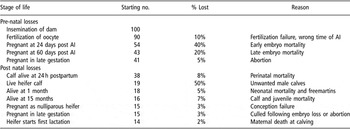
Dairy heifers start to generate income only once they enter their first lactation at about 2 years of age and hence become productive. Only a minority of animals conceived reach this point (see Table 1). The initial investment in producing a replacement heifer is at the cost of semen purchase and insemination. Calving rates to first insemination in the UK are currently about 40% (Royal et al., Reference Royal, Darwash, Flint, Webb, Woolliams and Lamming2000). Fertilisation failure probably accounts for the first 10% of losses, with the main cause being insemination at an inappropriate stage of the oestrous cycle. Around 40% of embryos die during the first 2 weeks post conception (Lucy, Reference Lucy2001; Santos et al., Reference Santos, Thatcher, Chebel, Cerri and Galvao2004). Work conducted in the 1970s based on milk progesterone profiles estimated that a further 12% of cows experienced later embryo loss at 1 to 2 months of gestation (Bulman and Lamming, Reference Bulman and Lamming1979). More recent studies have used ultrasound scanning to confirm the presence of an embryo at about 28 days post conception; these have shown that in some high-producing Holstein herds over 20% of cows pregnant at 28 days experience later embryo loss by 60 days, suggesting that the incidence of late embryonic mortality is increasing (Lucy, Reference Lucy2001; Santos et al., Reference Santos, Thatcher, Chebel, Cerri and Galvao2004). There are many possible reasons for these losses at both stages. Some will be due to poor semen quality or genetic defects. Available evidence suggests, however, that environmental factors that affect the quality of the oocyte and/or the maternal reproductive tract are of greater importance. For example, maternal nutrition, body condition, infectious diseases such as mastitis and heat stress can all affect embryo survival (Lucy, Reference Lucy2001; Wathes et al., Reference Wathes, Taylor, Cheng and Mann2003; Santos et al., Reference Santos, Thatcher, Chebel, Cerri and Galvao2004).
Summary of losses of potential replacement heifers from the time of maternal insemination until their own first calvingFootnote a

a See text for references.
A further 5% of cows experience abortion later in pregnancy. Infectious agents including Neospora caninum, Bacillus licheniformis, Leptospira hardjo and bovine virus diarrhoea virus account for some of these, but over half remain unexplained, with no evidence of lesions or infections (Deas, Reference Deas1981; Buxton et al., Reference Buxton, Caldow, Maley, Marks and Innes1997). Losses occurring later during pregnancy may go unnoticed by the farmer. Even if a return to oestrus is observed, re-insemination at this stage would often prolong the calving interval to a point where it becomes uneconomic to keep the cow or heifer, resulting in culling of the dam as well as loss of the calf. This gradual attrition of embryos and foetuses throughout pregnancy means that only about 40% of inseminations will actually result in the birth of a calf. Unless sexed semen is used, half of these offsprings will be male, and therefore will be of no use as dairy replacements.
Perinatal
Perinatal mortality is defined as stillbirths and deaths during the first 24 h post partum. In practice, it can sometimes be hard to distinguish whether death occurred shortly before or during calving. Calf mortality is often poorly documented and may be underestimated because a dead calf is not always recorded at farm level. Within the UK, Esslemont and Kossaibati (Reference Esslemont and Kossaibati1996) estimated the perinatal loss rate across 90 English herds as 7.8%. More recently, we have conducted a study across 19 commercial farms milking Holstein-Friesian cows in southern England (Brickell et al., 2007a). These provided a range of management practices representative of those commonly encountered in the UK. Details on all calves (male and female) born alive or dead were recorded over a 2-month period on each farm. Farm records were rigorously checked at regular site visits to ensure accuracy of the data. Overall perinatal mortality in this dataset of 1097 records of calves born was 7.9%, ranging from 3% to 14% on individual farms.
While the overall loss rate of about 8% in these two studies was remarkably similar, both showed considerable variability between farms. In addition to care of the cow at calving, the major direct cause of mortality is disproportion between the foetus and the dam causing dystocia. Calving difficulties are influenced by the dam’s age, relative maturity and pelvic width. Mortality rates, both during and after birth, are considerably higher for primiparous than nulliparous dams (e.g. 11% compared with 4.6%, Johanson and Berger, Reference Johanson and Berger2003). This may be due to inadequate skeletal maturity if the dam is too young, with the incidence rising if first calving occurs at <24 months (Hansen, 2004). Calf mortality is highest in offsprings with either a low or high body weight (Roy, Reference Roy1990; Johanson and Berger, Reference Johanson and Berger2003). Primiparous cows tend to produce smaller calves (see below). Small offsprings may be at risk postnatally due to limited body energy reserves, hypothermia and a less well developed immune system. Large offspring, maternal overfatness and milk fever can also cause dystocia. Other risk factors for mortality include sire, gestation length, calf gender, twinning, season of birth, herd size and adequacy of calving supervision (Svensson et al., Reference Svensson, Linder and Olsson2006).
Neonatal
Neonatal mortality is defined as calves born alive that die between 24 h and 28 days. Neonatal mortality with respect to dairy heifers in the UK has been variously estimated at 0% to 10% (reviewed by Mellor and Stafford, Reference Mellor and Stafford2004). In our study (Brickell et al., 2007a), neonatal mortality averaged 3.4%, ranging from 0% to 12% on individual farms. There was a trend for neonatal mortality to be lower in calves from multiparous than primiparous dams (hazard ratio 0.5, P = 0.12). The main causes of calf death during the first month of life are enteric diseases and pneumonia (Blowey, Reference Blowey2005). These in turn are affected by housing conditions, colostrum intake and feeding management. Around 2% of live-born heifer calves are freemartins, representing a further loss. These are generally culled soon after birth if identified at this stage, although some are not detected until the service period is reached.
Calf and juvenile
This covers calf mortality in the period from 1 to 6 months. Previous estimates from the UK of around 1% to 5% (Roy, Reference Roy1990; Blowey, Reference Blowey2005) were supported by a recent investigation using data derived from the UK Cattle Tracing System (Ortiz-Pelaez et al., 2008). This study found mortality rates ranging from 2% in Inverness to 6% in Cheshire. Our data from 19 herds found an average rate of 3.4%, but this was unduly influenced by a particularly high death rate of 29% on one farm, with the rate on the other farms ranging from 0% to 9%. Ortiz-Pelaez et al. (2008) also reviewed data from other countries, in which calf mortality rates were generally somewhat higher, for example, around 8% to 9%, covering the period from birth to weaning in three American studies cited. It is a widely held view that these rates could be reduced by better standards of animal welfare on farms. One influence in our UK study was milk quality, with whole milk posing a greater risk than milk replacement. Another important consideration was management around weaning, with the need to ensure that individual calves are of adequate weight and consuming sufficient dry food at this time.
Juvenile mortality is that occurring between 6 months of age and the start of the service period at about 15 months, a period that is rarely monitored on farms. We have estimated juvenile losses in two studies. The first involved consecutively born calves recruited on one farm, of which 3/114 (2.6%) died after 6 months of age but before service (Swali, 2004). The larger 19 farm study similarly found that 17 out of 489 calves present at 6 months of age had died or had been culled by 15 months (3.5%). Our data support Svensson et al. (Reference Svensson, Linder and Olsson2006) in concluding that accidents were the main cause of mortality in this age group.
Conclusions
Conception rates around the world have fallen consistently over the past 30 years. This fall is widely attributed to the increasing genetic gain for milk over this period. Fertilisation failure, embryonic mortality and abortion mean that only about 40% of inseminations result in the birth of a calf. Heinrichs and Radostits (Reference Heinrichs and Radostits2001) suggested that under good management conditions, perinatal mortality can be maintained at 1% to 3%, and neonatal mortality at 3%. The percentage of animals born dead in the UK has, however, remained at about 8% over the past 10 years. The continual attrition of live-born calves before they reach service at 15 months represents a further large loss of potential replacement dairy heifers. Systems need to be in place on farms to monitor the incidence of calf mortality, with the aim of reducing it by the introduction of improved management practices.
Age at first calving (AFC)
Factors affecting AFC
Dairy heifers are normally inseminated for the first time at about 15 months of age to calve at approximately 2-years of age. At 15 months, they reach only about 60% of mature body weight (Coffey et al., Reference Coffey, Hickey and Brotherstone2006). Age at first calving (AFC) is an important factor involved in rearing replacement heifers, as it can impact on subsequent productivity. The decision on when to start breeding is a management one, but it is generally influenced by nutrition and growth rate during the rearing period (Carson et al., Reference Carson, Dawson, McCoy, Kilpatrick and Gordon2002; Serjsen, Reference Serjsen2005). The fertility of the animals at this point will then affect the mean and distribution of the AFC on any particular farm. Whilst the goal in the UK is generally to calve heifers at 2 years, some American studies have suggested that earlier calving from 21 months onwards can reduce rearing costs without adverse influences (van Amburgh et al., Reference Van Amburgh, Galton, Bauman, Everett, Fox, Chase and Erb1998).
There is a perception in the industry that heifer fertility is not a problem, with difficulties only arising once cows are lactating. This is supported by the greater number of services per conception (S/C) needed in the same group of animals we monitored as both nulliparous (NP) heifers and again as primiparous (PP) cows: NP 1.6 ± 0.09 S/C, n = 112; PP 2.4 ± 0.18 S/C, n = 78 (Bourne et al., Reference Bourne, Swali, Jones, Potterton and Wathes2007). We have, however, found that some heifers fail to conceive at all. Of the 109 heifers served by artificial insemination (AI), over an initial 4-month service period from 15 months of age, 10 animals either did not conceive at all or aborted and were then re-inseminated some months later, so did not calve for the first time until they were nearly 3-years old. A further four aborted and were culled immediately.
In our more recent larger study, 3.3% of animals died or were culled between 15 months of age and time of expected calving, mainly due to infertility. The remainder calved at a mean AFC of 26 months, but with a wide range of 21 to 40 months. The long tail on this distribution mainly reflected the poor fertility of some animals. In the first study (Swali, 2004), animals that experienced delayed ovulation after first calving (>45 days) had required more services as a nulliparous heifer than those with a normal resumption of cycles after first calving as monitored using milk progesterone profiles (normal profile: 1.5 ± 0.11 S/C, n = 60; delayed ovulation 2.7 ± 0.45 S/C, n = 11, P < 0.01). This suggests that there may be a relationship between heifer and cow fertility.
We have investigated the effect of size, growth rates and various metabolic indices on AFC. Animals that failed to conceive at 15 months were lighter at 9 months of age than those that did conceive (259 ± 2.4, n = 112 cf 233 ± 8.1 kg, n = 10, P = 0.011) (Bourne et al., Reference Bourne, Swali, Jones, Potterton and Wathes2007). IGF-I is a mediator of growth and development, which is strongly influenced by nutrition. Pre-pubertal IGF-I concentrations were highly correlated with both the growth rate between 1 and 6 months and the body weight at 6 months (Brickell et al., Reference Brickell, Bourne, Bleach and Wathes2007b). Multiple regression analysis was used to investigate the influence of heifer-level variables on AFC with farm included as a clustered effect. This analysis showed strong negative relationships between both size measurements and IGF-I concentrations at 6 months with subsequent AFC (JS Brickell, N Bourne, Z Cheng and DC Wathes, unpublished observations). As an illustrative example of this effect, we grouped heifers retrospectively according to AFC as low (<700 days), medium (701 to 759 days), high (760 to 879 days) and late calvers (>880 days) (Brickell et al., Reference Brickell, Bourne, Cheng and Wathes2007c). Heifers with a low AFC had higher IGF-I values at 6 months (104 ± 36 ng/ml, mean ± s.d.) compared to the late calvers (69 ± 33 ng/ml) (P < 0.001). First calving at <700 days was also associated with an increased BW at 6 months (183 ± 36 kg) compared to the high AFC group heifers (162 ± 35 kg) (P < 0.001). These data show that the age at which animals calve is indeed affected by early growth rates and that animals that have difficulty in conceiving are often poorly developed at 6 to 9 months.
Relationships between AFC and subsequent cow performance
A number of studies show that AFC can have a significant effect on both milk production capacity and longevity (e.g. Pirlo et al., Reference Pirlo, Miglior and Speroni2000). Weight at calving is dependent on both age at conception and growth rate and some studies have shown that a higher body weight at calving has a positive affect on subsequent milk production (Keown and Everett, Reference Keown and Everett1986; Hoffman, Reference Hoffman1997). Most mammary gland development takes place prior to calving, so a younger AFC can potentially reduce the milk production capacity due to sub-optimal development of mammary tissue (Serjsen, Reference Serjsen2005). This is supported by Ettema and Santos (Reference Ettema and Santos2004) who found that first calving at <23 months compromised first lactation milk yields and milk composition and reduced subsequent conception rates to first service. Extending the AFC beyond 24 months did not result in improvements in lactation, reproduction or health, so the optimal AFC for US Holsteins in terms of the highest economic return was between 23 and 24.5 months of age.
Another approach is to manipulate heifer growth rates using different nutritional strategies to determine the effect of weight at calving on subsequent performance. Carson et al. (Reference Carson, Dawson, McCoy, Kilpatrick and Gordon2002) found that a group of Northern Irish cows calving at a relatively low weight (527 kg) and body condition score (BCS, 2.8) lost less weight in early lactation than three groups of heavier animals, which were all around 600 kg in weight with a BCS of about 3.5. All groups in this study calved at a similar age (24 to 25 months). The lighter cows at calving produced less milk in the first lactation, but had a shorter interval between the first and the second calving. This better fertility led to reduced feed costs over two lactations, such that the lighter group had the highest net milk value over two lactations.
Haworth et al. (2008) used lifetime records of 442 Holstein cows from one farm in tropical Queensland, Australia, collected over a 13-year period to evaluate the effects of AFC on milk production and longevity. There was no effect of AFC on lifetime days in milk or the number of parities per lifetime. For the majority of cows, which produced an average of <30 l/day in the first lactation, animals that calved later had a greater longevity (AFC <2 years, survived to 3.6 years of age; AFC of 2 to 3 years, survived until 4.7 years; and AFC > 3 years, survived until 5.8 years). However, no cow that produced an average of >30 l/day in the first lactation survived beyond two lactations. The optimal AFC for cows reared under tropical conditions was between 2 and 2.5 years, as these had the highest first lactation yield, highest estimated lifetime production and had the highest proportion of total life spent in active milk production.
We have drawn slightly different conclusions from our recent UK data. Faster growing animals generally had good juvenile fertility and therefore the lowest AFC (<24 months). Preliminary analysis of these data showed that such animals then tended to produce more milk in the first lactation, lost more body condition and took longer to conceive again than slower growing heifers with an AFC of 24 to 25 months. Both groups therefore reached the start of their second lactation at about the same age (N. Bourne, A. Swali and D.C. Wathes, unpublished observations). On the other hand, cows that failed to re-conceive after their first calving had inferior fertility as nulliparous heifers and hence were older at first calving. These fell into two contrasting groups. Some calved with a low BCS and BW and took a long time to resume oestrous cyclicity. Others did not calve until they were nearly 3-years old, by which time they were overweight and many experienced calving difficulties (Bourne et al., Reference Bourne, Swali, Jones, Potterton and Wathes2007).
Conclusions
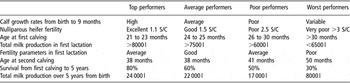
The effects of having a heifer calve at a particular age need to be considered in relation to her welfare at calving and her estimated lifetime milk production. Productivity, in turn, is influenced by the number of parities she achieves and her consequent longevity. A major factor in determining when heifers conceive is their pre-pubertal growth rate, which has both genetic and environmental components. Genetic selection has produced animals that grow fast and can calve at 22 months without major adverse consequences, although they will then take rather longer than average to get back to calve again. Poorly grown animals have low conception rates as both heifers and cows resulting in very poor lifetime productivity and are thus uneconomic to keep. These scenarios are summarised in Table 2.
Summary of lifetime performance in relation to early growth and fertility in typical UK Holstein/Friesian dairy heifers

Prenatal programming
Human epidemiological studies suggest that both the overall size and the relative proportions of weight to height of babies at birth can predict the prevalence of a variety of diseases in later life (Barker, Reference Barker1998). Reproductive performance can also be affected by a variety of influences acting at different stages of development, from before conception until after birth (Rhind, Reference Rhind2004). For example, undernutrition, either prenatally or in early postnatal life in the female lamb, can lead to reduced reproductive capacity of the adult, measured by a lower number of offsprings (Rhind, Reference Rhind2004). Whilst there is clearly a large genetic component controlling the somatotrophic axis, there is also evidence that it may be influenced by prenatal programming. In humans, low-birth-weight babies have increased growth hormone (GH) response to GH releasing factor (GRF), high baseline GH secretion in childhood and low GH secretion and increased levels of obesity in early adulthood (see Swali and Wathes, Reference Swali and Wathes2006 for references).
The embryo and foetus show considerable plasticity to modify their development in the light of prevailing circumstances in utero and this can result in permanent alterations to body structure and metabolism (Barker, Reference Barker1998). The most important factor is probably the placental capacity to deliver sufficient nutrients in late gestation (Bell, Reference Bell1995). Placental development in turn is influenced by maternal age, parity, size and nutritional status (McCrabb et al., Reference McCrabb, Egan and Hosking1992; Osgerby et al., Reference Osgerby, Gadd and Wathes2003, Wallace et al., Reference Wallace, Regnault, Limesand, Hay and Anthony2005). The maternal uterine environment has a greater influence on weight at birth than the paternal genotype, although the sire does influence gestation length and birth height (Swali and Wathes, Reference Swali and Wathes2006). Previous measurements of direct and maternal heritabilities of calf weight are quite low, calculated as 0.16 and 0.05, respectively (Hansen, 2004).
In dairy cows, the first pregnancy is carried while the dam is still physically immature. Coffey et al. (Reference Coffey, Hickey and Brotherstone2006) analysed the growth trajectories of dairy heifers from birth until the end of their third lactation and found that cows continued to grow throughout the entire period, although growth rates slowed once animals reached about 450 days of age. We hypothesised that this might lead to competition with the gravid uterus for nutrients, thus influencing calf development. Pregnant teenage human mothers and adolescent sheep both preferentially partition nutrients towards their own continued growth at the expense of the developing foetus (Frisancho et al., Reference Frisancho, Matos, Leonard and Yaroch1985; Wallace et al., Reference Wallace, Regnault, Limesand, Hay and Anthony2005). We found that offsprings of first calving cows were indeed significantly smaller at birth (weight, length, height, girth) than those born to multiparous dams (Swali and Wathes, Reference Swali and Wathes2007). These calves experienced early catch-up growth once they were no longer nutritionally restrained in utero, reaching a similar size as their peers within 3 months. Size at 3 months is therefore more highly related to genotype than size at birth and is a better predictor of adult stature. In humans, there is evidence that catch-up growth is associated with an increased risk of insulin resistance as an adult (Ong et al., Reference Ong, Ahmed, Emmett, Preece and Dunger2000).
Subsequent pregnancies in dairy cows are generally carried while the dam is lactating, which can also affect the endocrine environment in which the early embryo is developing (Wathes et al., Reference Wathes, Taylor, Cheng and Mann2003). To investigate this further, we tested the hypothesis that maternal age and milk yield during pregnancy may alter calf birth weight (Swali and Wathes, Reference Swali and Wathes2006). Concurrently born Holstein-Friesian heifers with multiparous dams were subdivided into three tertiles with low (LBW), average or high (HBW) birth weights. LBW calves were born 10 kg lighter than HBW calves and remained significantly lighter until the end of their first lactation, in this instance showing no indication of catch-up growth. They were more likely to have older dams (lactations 3 to 6) with higher peak yields (>42 kg/day). Maternal milk yield also influenced birth height, with a positive effect of 305-day yield and a negative effect of peak milk yield. This suggested that dams that are producing high yields during the early stages of embryo development may produce offspring with a shorter stature at birth. Milk production parameters of the offspring were, however, not different between the birth weight groups. Unexpectedly, the HBW offspring had the poorest fertility parameters, possibly in association with their greater weight at first calving. An American study of two lines of Holstein cows selected for large v. small body size also concluded that the smaller cows had similar production traits across parity, but the small cows utilised feed more efficiently and had a longer productive herd life (Hansen, Reference Hansen2000). Analysis of a much larger dataset of US Holsteins found that larger cows did produce more milk, but the genetic correlation between the two traits was low (Tsuruta et al., Reference Tsuruta, Misztal and Lawlor2004).
Conclusions
Data from the cow confirm results from other species in showing that maternal age during pregnancy can affect birth size and also suggest epigenetic effects of maternal milk yield on calf development in utero. Whilst very small calves are more likely to suffer calf mortality, we have, to date, found no adverse effects of a relatively low birth weight on subsequent fertility or productivity in the first lactation. Indeed, the trend in fertility was in the opposite direction. It remains to be determined whether these aspects will influence longevity.
Juvenile predictors of adult performance
In order to reduce the recent negative trends in dairy cow fertility, a major goal of modern livestock breeding is to select animals that have good fertility and longevity parameters in addition to production. Longevity can, however, only be measured at the end of a lifetime and its use as a selection criterion for replacement stock would thus reduce the rate of genetic progress. Given the high economic and environmental costs of rearing dairy replacements, it would be better if future lifetime performance could be identified while animals are still juveniles.
Genotypic analysis
Single nucleotide polymorphisms (SNPs) in many of the genes for both metabolic hormones and their receptors have been identified. For example, leptin is a hormone controlling appetite and body fatness. Cows carrying the leptin TT genotype produced more milk over an entire lactation in comparison with either the CT or CC genotypes (Buchanan et al., Reference Buchanan, Van Kessel, Waldner, Christensen, Laarveld and Schmutz2003). A mutation in the GH receptor has also been associated with milk yield and composition (Blott et al., Reference Blott, Kim, Moisio, Schmidt-Kantzel, Cornet, Berzi, Cambisano, Ford, Grisart, Johnson, Karim, Simon, Snell, Spelman, Wong, Vilkki, Georges, Farnir and Coppieters2003). A mutation in the enzyme acylCoA:diacylglycerol acyltransferase (DGAT1), which catalyses the last step in triglyceride synthesis, has a major effect on the milk fat content (Grisart et al., Reference Grisart, Coppieters, Farnir, Karim, Ford, Berzi, Cambisano, Mni, Reid, Simon, Spelman, Georges and Snell2002). There is a strong likelihood that these genetic variations will influence lifespan as well as productivity in dairy cows, although data on this is currently limited and a more extensive discussion of this subject is outside the scope of this review. In future, SNP analysis may offer the possibility of selecting bulls and breeding heifers on the basis of their genetic profile for important fertility traits.
Growth parameters and linear trait classification
Cattle conformation can be assessed using linear trait classification scores. As many linear type traits have medium to high genetic correlations with longevity, such traits have been incorporated into breeding indexes (e.g. Klassen et al., Reference Klassen, Monardes, Jairath, Cue and Hayes1992; Vukasinovic et al., Reference Vukasinovic, Schleppi and Kunzi2002). The linear classification traits included in the assessment of dairy strength (stature, chest width, body depth and angularity) define the overall frame size of the cow. Wall et al. (Reference Wall, Coffey and Brotherstone2007) found that there were negative relationships between stature and body depth throughout the first lactation and lifespan, so larger cows with deeper bodies had shorter lives. Chest width was negatively related to calving interval and non-return rate, implying that narrow animals had poorer fertility. Furthermore, angularity was negatively correlated to lifespan and positively related to both calving interval and non-return rate, suggesting that more angular/thinner cows have worse fertility, and this was partly independent of milk yield.
Classification normally takes place during the first lactation. Selection of animals for breeding could be made at an earlier stage if measurements made at a younger age are also predictive of future performance. We have measured young stock at 1, 6 and 15 months and found that frame classification scores in the first lactation were strongly related to several of the size measurements taken on heifers when juveniles. For example, stature was correlated to the skeletal measures of crown rump length and height made on the 1-month-old calves (Pearson correlations +0.25 and +0.36, respectively, both P < 0.001). Tall-stature cows (classification 7 to 9) were on average 6.6 cm longer and 3.4 cm taller than short-stature animals at this age. We have previously reported that height at birth is moderately heritable (h 2 = 0.43, Swali and Wathes, Reference Swali and Wathes2006), whereas the direct heritability of birth weight was only 0.16 (Hansen, 2004). Chest width, body depth, angularity and overall frame were not related to calf sizes measured at 1 and 6 months, but by 15 months they were all positively correlated with weight and girth (Pearson correlations +0.18 to +0.29, P < 0.01). Our data therefore suggest that measurements of skeletal size at birth and weight at 15 months of age could assist in selecting the best heifers for breeding.
Metabolic indices
Any hormonal or metabolic differences found in pre-pubertal heifers that related to subsequent fertility, milk production potential and/or longevity could be used to identify the best replacement heifers before first breeding, thus reducing the time needed in sire selection programmes. Genetic selection for increased milk yield has produced significant changes to the somatotrophic axis, comprising GH, insulin and IGF-I. Higher yielding cows experience greater BCS loss to support early lactation and this is accompanied by altered GH signalling and a major decline in circulating IGF-I concentrations after calving (Wathes et al., Reference Wathes, Fenwick, Cheng, Bourne, Llewellyn, Morris, Kenny, Murphy and Fitzpatrick2007). This produces an endocrine environment favouring tissue mobilisation. GH, insulin and IGF-I all have direct influences on ovarian function and on nutrient partitioning to the uterus, thus contributing to the poorer conception rates experienced by higher yielding cows (Wathes et al., Reference Wathes, Taylor, Cheng and Mann2003 and Reference Wathes, Fenwick, Cheng, Bourne, Llewellyn, Morris, Kenny, Murphy and Fitzpatrick2007). The somatotrophic axis is also of key importance in growth and pre-pubertal development. Between 1 and 6 months of age, we have found a strong positive correlation between IGF-I concentrations and growth rate in dairy heifers (Brickell et al., Reference Brickell, Bourne, Bleach and Wathes2007b). In growing bulls fed high, medium or low diets, the IGF-I concentration was similarly highly correlated with the body weight and back fat over the period from 10 to 70 weeks of age (Brito et al., Reference Brito, Barth, Rawlings, Wilde, Crews, Mir and Kastelic2007). This study suggested that IGF-I may act as a mediator of nutritional status to the hypothalamus, due to the relationship between IGF-I and LH pulsatile secretion.
Previous studies investigated the predictive use of GH secretagogue challenges in pre-pubertal dairy calves and found that the release of GH was related to genetic potential for milk yield (e.g. Løvendahl et al., Reference Løvendahl, Angus and Woolliams1991), although subsequent milk production was not recorded. We have monitored endogenous metabolic hormone profiles and the response to a GRF challenge in 6-month-old dairy calves and related these parameters to subsequent fertility and milk production over three lactations (Taylor et al., Reference Taylor, Beever, Bryant and Wathes2004). The calves that subsequently experienced delayed ovulation in their first lactation (monitored using milk progesterone profiles) had the lowest IGF-I concentrations at 6 months of age. They also tended to have a higher GH pulse amplitude during fasting, and did not show the anticipated decrease in circulating glucose concentrations following a post prandial rise in insulin. On the other hand, calves that experienced a period of prolonged luteal activity after first calving had had the highest IGF-I at 6 months and a significantly larger GH pulse amplitude and pulse area after feeding than cows with normal progesterone profiles. Only animals with a normal profile showed increased IGF-I production in response to the stimulated GH increase. Plasma IGF-I concentrations in pre-pubertal animals were positively correlated with their post-calving concentrations, whereas glucose concentrations had a negative correlation between these time periods.
In contrast to suggestions from earlier work, in our animals there were no significant relationships between any measures of pre-pubertal GH secretion and actual peak or 305-day milk yield in any of the first three lactations, although the height of the pre-pubertal GH peak was positively correlated to the 120-day milk energy values calculated in the first lactation (Taylor et al., Reference Taylor, Beever, Bryant and Wathes2006). This correlation between GH and milk energy was, however, only present in those cows that were culled after one or two lactations and was absent in the animals remaining in the herd for a third lactation. There were no significant relationships between pre-pubertal IGF-I and fed or fasted insulin or glucose concentrations and any subsequent measurement of yield. The relationship between pre-pubertal GH and milk composition was supported in a later study showing that the mean GH concentration measured at 6 months had a weak positive correlation to the milk fat production over the first 6 weeks of lactation (P < 0.04) (Swali, 2004).
Conclusions
High lifetime milk production is achieved by a combination of reasonable yields with good fertility and longevity. SNPs are being identified, which have marked effects on milk production and will almost certainly also affect longevity. Size and growth rate measurements made from birth until first breeding at 15 months of age predict aspects of both fertility and milk production. Pre-pubertal endocrine measurements related to the GH-IGF axis also show some relationship with subsequent fertility. Furthermore, our results suggest that cows with a high potential to partition energy into milk in early lactation may suffer reduced longevity and that it may be possible to predict this at 6 months of age. Although further work is required to substantiate these findings, results to date offer the promise that selection of the best dairy animals for breeding will in future be made on the basis of juvenile predictors through the use of genotyping coupled with phenotypic profiling of type traits and metabolic parameters.
Acknowledgements
We thank the Milk Development Council, Defra, the Wellcome Trust, BBSRC, Genesis Faraday and Holstein UK for supporting this work. We are extremely grateful to the many farm staff and veterinary surgeons who helped with the sample collection. We also acknowledge the scientific input received from many colleagues. In particular, we like to thank the following for their invaluable contributions: Dr Vicky Taylor, Professor David Beever, Professor Mike McGowan, Dr Emma Bleach and Mr Barney Jones.