1. INTRODUCTION
This article considers how the concept of Palimpsestic Listening can help to cast new light on layering sound in a climate where materiality is considered ‘one of the most contested concepts in contemporary art’ (Lange-Berndt Reference Lange-Berndt and Lange-Berndt2015: 12) due to the sidelining of physical materials in favour of digital technologies that propose limitlessness. In the discussion that follows, I propose this concept be considered as a means to interrogate how digital audio processing and contemporary listening activities are shaped by their relationships with sonic materiality, and how this connection is exteriorised through acts of hybridisation. Through critical exploration and practical endeavour, I aim to foreground thinking on the thresholds that paradoxically blur and demarcate sonic acts of past and present. I discuss sonic acts which create layered sonic temporalities that are historically distinct but are in many ways intimately nested. As McLuhan suggested, ‘the crossings or hybridisations of media release great new force and energy as by fission or fusion’ (McLuhan Reference McLuhan1964: 48). The significance of aligning contemporary ideas about sound and music practices with the palimpsest terrain is palpable when considering the well-established academic and artistic interests in materiality in digital times, specifically in relation to the apparent loss of physicality and the extent to which tangible sensory experiences are transliterated into the digital domain. Such processes arguably disrupt the order of time to create parallel realities where ‘there is never a succession of passing presents but a simultaneity of a present of past, a present of present and a present of future, which make time frightening and inexplicable’ (Deleuze Reference Deleuze2011: 98).
2. PALIMPSESTIC LISTENING
Scholarship on the palimpsest is rich and varied, questioning the nature of paradoxical processes where previously effaced material reoccurs and subsequently coexists with the surface writings. Dillon says that a ‘palimpsestous’ text evokes a fluid structure of relationality, where the interplay of disparate inscriptions and erasures, across a range of temporal coordinates, continually reframe the make-up of their material substrate. As such, a palimpsest mobilises uncanny tangling of temporalities that provoke an ‘involuted phenomenon where otherwise unrelated texts are involved and entangled, intricately interwoven, interrupting and inhabiting each other’ (Dillon Reference Dillon2007: 4). For Daughtry, the palimpsest can be used to cast light on the hidden layers of a sound text. He says the concept offers listeners opportunity to bring undercurrent auditory phenomena to the surface in the search of new meaning: ‘the palimpsest metaphor urges us to seek out and recover the hidden layers of agency and history and creativity and politics that underwrite and overwrite all sound experiences, and to understand that the acts of making and listening to music always involve both inscription and erasure’ (Daughtry Reference Daughtry2013: 24). In this light, a sonic palimpsest connotes a complex of auditory experiences in which both foregrounded and effaced sounds vie to be heard. Daughtry’s rendering of the concept highlights the importance of close listening strategies to uncover intra-textual and cross-sensory dynamics, where vast networks of sonic acts and agencies embed in sound objects and environments: ‘the palimpsest has come to figure as a capacious metaphor for all types of intertextuality, intermediality, layered history and embodiment’ (Daughtry Reference Daughtry2013: 9).
Hellier-Tinoco explores the qualities of the palimpsest through creative work that revisits bygone objects as artistic material as a means of generating ‘trans-temporal relationships with our predecessors, our prior selves, our environments and our pasts’ (Hellier-Tinoco Reference Hellier-Tinoco2019: 3). She suggests a ‘palimpsest is concerned with the essential ambiguity of bodies and of location. Both of these, like a palimpsest, have the surprising capacity to be home to more than one story at any given time. The surface of things resonates with the secrets of the unknown possibilities’ (Hellier-Tinoco Reference Hellier-Tinoco2019: 25–6). The palimpsest bodies explored in Tinoco’s work look critically at the agencies to recall the acts of the dead in the present, staging an opening for objects to perform trans-temporal intermediations. Moreover, her use of the concept in a live performance context foregrounds thought on the ambiguity of the temporalities extrinsic to digital spaces, where action often exists in continually shifting states of similarity/juxtaposition and reality/imagination:
Re-activating remains of bodies of history from images, texts, embodied repertoires and barely tangible traces connects personal lives with collective memories in composite environments. Through layering, accumulations and iterations, palimpsest bodies perform complex trans-temporal provocations and re-visions (Hellier-Tinoco Reference Hellier-Tinoco2019: 5).
Norman argues for the significance of considering the palimpsest-like dynamics in contexts that provoke fluidity between programmatic and idiosyncratic acts and for mobilising these forces as artistic material. She suggests developing experimental strategies to supplement our digital literacies that blur the lines between disparate materials to aid exploration of how objects of memory can paradoxically influence future practice:
Our cultural memories along with our technologies and artefacts are layered and ready to be reactivated: buried traditions can be effectively crafted and instantly brought back to life, to resurge and combine with recent practices … since our digital times are generating phenomena at scales that escape our usual reasoning abilities, we must in turn generate imaginative ways of dealing with them, of building new relations with them, including by resuscitating bygone practices that remain latent cultural forces. (Norman Reference Norman2016b: 6)
The notion that ‘sound studies has a focus on the materiality of sound, its embeddedness not only in history, society and culture, but also in science and technology and its machines and ways of knowing and interacting’ (Pinch and Bijsterveld Reference Pinch and Bijsterveld2004: 636) calls for strategies to better understand sonic materiality and its relationship with the legacies of past sonic acts in digital systems and archives. For as Steedman argues, ‘you’ll find nothing in the archive but stories caught half-way through: the middle of things; discontinuities’ (Steedman Reference Steedman2002: i). The democratisation afforded by digital audio, and the practices that seek to dissent against the fatigue caused by ‘overexposure to digital systems in our daily life’ (Kelly Reference Kelly2018: 54), encourage renewed conceptualisations of temporality where one actively plays with, and reappraises, the artefacts of time to find new meanings. As the dualities of writing and listening are coded in the genomes of digitised sound objects, the compliance of digital technologies to augment reality challenges our capacities to attune to the subtleties of sonic acts and savour their aesthetic potentialities.
Despite the palimpsest’s links with memory practices, interrogating this phenomenon in digital times is a complex issue due to ‘discrete’ approaches to saving and storing information. As Wilson suggests in relation to why digital information is encoded differently to analogue, ‘one moment we have one state, the next we have another. One moment the water is warm, the next it is cold. There is nothing in between. No process to speak of. In this sense the digital neatly seems to elide change. Nothing has been altered’ (Wilson Reference Wilson2014: 1). The nature of representation, vis-à-vis the relatability of digital rendering, signals a need to resist the inherent chaos of safeguarding artefacts of memory through digitisation. Schrag unpacks how digital processes play into our contemporary conceptualisations of memory:
Memory is a polysemic term whose uses rest on the tensions between duelling categories in continual contestation. It, like the term identity, comprises the particular and the universal, the natural and the artificial, the individual and the collective, the internal and the external. Historically construed as an art, practiced as a technique in oral societies, retained in objects and sites, today memory both mediates and is mediated by new analogies between the brain and the digital records of the hard drive. (Schrag Reference Schrag and Peters2016: 207)
By eschewing the technological idiosyncrasies and propensity to change inherent in ‘continuous’ analogue media, the ubiquity of digital computing casts a cloud over how acts of inscription, erasure and recursion, central to the palimpsest metaphor, relate to today’s recording practices where the processes of the codified back-end and the user-orientated front-end are ostensibly unable to blur. Although this logic seemingly plays up as problematic against the multiplicities of a palimpsest, there is fertile terrain to explore the extent to which digital technologies are impervious to the conditions of time due to their symbiotic relationship with the physical media they are bound to. As the anchoring of digital sound objects become affected by the drags of incumbent physicality, digital audio processing can too be read as being entangled with, and continually sculpted by, the rhythms of the physical world. Kelly suggests, ‘sound is created by tangible wave-making events that must always involve materials, and these materials carry with them a multitude of histories’ (Kelly Reference Kelly2018: 53). Vis-à-vis Norman, digital natives must question preconceived ideas of materiality to bridge disparate entities across temporal divides: ‘poetic ecosystems wrought by techno-informatic mythmaking must be cognised before they can be re-cognised, noted, notated, annotated’ for ‘normative concepts of space, time, species, presence fall short for the boundary hopping inhabitants of these systems whose performances translate infinite combinatorial operations, indices of incessant rebirthings and teratological mutations’ (Norman Reference Norman2016a).
3. SOUND OBJECTS IN DIGITAL TIMES
The hybridisation of sound materials through different technological domains is an important arena to interrogate as Palimpsestic Listening when considering that sonic materiality is somewhat spurious in an age of ubiquitous digital audio technologies. As Kelly says, ‘matter is at the centre of the most significant challenge of our time’ (Kelly Reference Kelly2018: 53). The technologies of phonography, with their ability to reframe live sound phenomena from ephemeral acts into infinitely repeatable sound objects, offer opportunity to play with the boundaries that define the logics of linear time. As such, digital audio technologies are significant in their capacities to generate new understanding of sound and its materialities ‘in a period in which matter truly does matter’ (Kelly Reference Kelly2018: 53). Thinking about the digitisation of physical things foregrounds a type of textuality that closely aligns with Bernard Stiegler’s concept of ‘discretization’ (see Stiegler Reference Stiegler1998, Reference Stiegler, Derrida and Stiegler2002). He suggests that traces of past action, segmented into distinct tertiary retentions (recordings, photographs etc.), are (re-)rendered by digital technologies that systematically categorise worldly content. The logic of discretizing the affordances of lived experience foregrounds questions about how digital objects process their information in relation to their analogue equivalents, calling for new strategies for us to listen closely to layers of sonic material in order to cast light on the agencies that provoke palimpsest-like dynamics to occur in the digital domain. As Dillon suggests, in its ‘persistent figurative power and its theoretical adaptability’ the palimpsestic artefact ‘determines how we view the past and the present, and embodies within itself the promise of the future’ (Dillon Reference Dillon2007: 21).
However, the extent to which digital audio technologies replay the qualities intrinsic to the materiality of sound objects is unclear, particularly when considering how the trajectory of digital technology connotes immediacy and non-linear temporal coordinates. Sterne asserts that digital media are more similar to, than they are different from, the objects that came before them due to their ties to physical anchoring:
The hard drive needs a mechanism to maintain a consistent spinning speed, and a head mounted on an arm (chew on those metaphors for a moment) to read the data on the spinning disc, somewhat like an old tape deck, gramophone, or optical soundtrack on a strip of celluloid film. It is thus possible to understand a hard drive, and the computer around it, as a mechanism as much as we would understand it as somehow primarily digital. (Sterne Reference Sterne and Peters2016: 35)
Barnet offers the notion of ‘retroactivity’ to define acts of technological recursion in digital media industries where ‘outdated or superseded machines re-appear with new designs, as if they were held in memory and only needed a certain innovation to burst into activity again’ (Barnet Reference Barnet2004: 3). These themes are commonplace when considering the heavy use of skeuomorphism, analogue emulation plugins and other retro-trends underpinning acts of remediation (Bolter and Grusin Reference Bolter and Grusin2000). The exterior forces steering this trajectory valorise the role the human agent plays in positioning how digital tools are coded to safeguard against forgetting and to generate idiosyncratic, trans-temporal modes of play: ‘keeping track, recording, retrieving, stockpiling, archiving, backing-up and saving are deferring one of our greatest fears of this century: information loss’ (Garde-Hansen, Hoskins, and Reading Reference Garde-Hansen, Hoskins and Reading2009: 5). Norman says, ‘ghosts that haunt today’s remix machines with echoes from multiple times and places, and exuberant interactions filling networks devoted to collaborative online creation, are but two manifestations of unprecedented, decidedly human energies that are seeping into and vitalising digital systems’ (Norman Reference Norman2006: 26). Her words, resonating closely with Massumi’s notion that the operations of digital materials are haunted by analogic process, echo thinking about remediation practices where digital technologies are rendered anthropotropically to provoke a sense of idiosyncratic, human-like authority deemed as more authentic; ‘digital processing becomes self-modulating: the running of the code induces qualitative transformation in its own loopy operation’ (Massumi Reference Massumi2002: 142). The ontological resonances of sonic materiality in the age of digitally driven devices are particularly salient when considering the resurgence of vinyl records and other outmoded music technologies and their uses in media archaeologyFootnote 1 practices advocating for the re-assessment of the role the sound object plays in generating digital-age aesthetics:
Digital cultural forms do not simply replace old forms of analogue culture; weblogs only partly overlap with the conventional use of paper diaries, laminated pictures are still printed despite the rise of digital photography, and MP3 files are not exactly replacing our tangible music collections. New practices gradually transform the way we collect, read, look at, or listen to our cherished personal items. (van Dijk Reference van Dijk2007: 49)
On the capabilities for mass-media technologies to rupture the linearity of perceived time, Walter Benjamin offers the notion of a ‘dialectical image’ to define the qualities of juxtaposition that construct meaning via ‘a constellation, (a montage) of elements that, in combination, produce a spark that allows for recognition, for legibility, for communication and critique’ (Highmore Reference Highmore2002: 71). Benjamin’s ‘constellation of now’, when put in the context of contemporary digital production, proposes a need to reassess assemblages of objects to successfully interrogate the dynamics of power that play out in the intersecting axes of different technological domains. These differences can be examined to explore how dialectical activity between past and present acts might signify the emergence of alternative, multilayered temporalities:
It’s not that what is past casts its light on what is present, or what is present its light on the past; rather, image is that wherein what has been comes together in a flash with the now to form a constellation … the relation of the present to the past is a purely temporal, continuous one, the relation of what-has-been to the now is dialectical: is not progression but image, suddenly emergent. (Benjamin and Tiedemann Reference Benjamin and Tiedemann1999: 426)
Musicking that uses bygone tools and methods bolsters the merits of dispelling narratives of nostalgia or technophobia tied up in the critiques for a (re)turn to the physical. By reframing the unsavoury operational issues experienced when using physical sonic media as idiosyncratic agencies, media archaeology practices such as this argue that the reactivation of objects deemed as e-waste engenders a push for more reflexive approaches to physical/digital hybridisation.Footnote 2 These endeavours support a renewed status for physical media in ubiquitous digital times. Kittler’s argument that ‘the question of how people operate upon media thus has to be complemented by the equally important question of how media operate on people’ (Kittler Reference Kittler1986: xxii) aligns closely with Peters’s comments on the abstraction of the word ‘digit’ from human to computational discourses. Peters says that ‘once rendered symbolically interoperable, digits combine computational and referential powers in ways that allow the stewards of digital systems to manipulate elements of that social reality’ (Peters, B. Reference Peters and Peters2016: 94). As such, the defamiliarisation of physical materials, and their supposed relegation to quasi-slave status by their digital successors, might suggest that a turn to the physical covets the agencies of latent physicality to re-occur in a digital domain through a methodology that ‘dislocates time and gives a new form to it, something that puts the flow of time out of joint and changes its direction’ (Dastur Reference Dastur2000: 182). The inherent contradictions of materiality enfolded in the boosterism of hard-drives can be extended to include Cloud technologies and other such digital archives that transform repositories of tertiary memory into places of longing and forgetting where ‘sound, motion, flow, process all became recordable and thus subject to time-axis manipulation’ (Peters, J. D. Reference Peters and Peters2016: 58) by digital natives.
With our digital stuff poised as readably malleable, and our data streams seen as infinitely repeatable and outside the logic of lived-time, the mobility of digital media, and its abilities to reference both itself and that which is exterior to it, suggest that a digital-age palimpsest both defies the rationality of material processes yet is entangled within them. As Blocker suggests, ‘any action is already a palimpsest of other actions, a motion set in motion by precedent motion or anticipating future motion or lateral motion’ (Blocker Reference Blocker, Jones and Heathfield2012: 201). Further, as digital denotes a binary, non-continuous process, its amorphous nature challenges our understanding of the acts that define the relational dynamics between materiality and temporality in contemporary times, and thus opens up a dialogue regarding the manipulation of their qualities; ‘at issue is more than just a relation between digital and analogue or discrete and continuous. The pivotal relation is rather between difference and difference that makes a difference’ (Wilson Reference Wilson2014: 4). The politics of indexing traces of the physical world proposes that digital media are too subject to the idiosyncrasies and the eminently ghostly matters of the palimpsest: ‘just as the internal systems digital media compute are finite, rational, and discrete, so too must the external world to which the same media point remain infinite, irrational, and approximate, and it is this difference that firmly insures against both the promise and the threat of total digital convergence’ (Peters, B. Reference Peters and Peters2016: 97–8).
4. COMPOSITIONAL METHODS
My sound installation D/ta Ro} – A Dialectical Trash Heap outlines a practical application of Palimpsestic Listening to interrogate sonic temporalities in sound assemblages that are ‘historically distinct nonetheless linked’ (Norman Reference Norman2016a). It draws on the trans-temporal characteristics explored in Hellier-Tinoco’s discussion of palimpsest bodiesFootnote 3 by foregrounding the dialectical resonances between the layers of physical and digital sound that materialise through acts of destruction and remediation. This piece explores the palimpsestic textuality of its sound objects in two ways. First, it looks at the processes of ‘erasure’ in regard to the materialities of a broken reel-to-reel tape recorder, an Apple iPhone, and a series of tape loops. Second, it looks at the metaphorical potentials of ‘time-stretching’ by resounding these sonic materials through practical interventions and the use of time-manipulation tools in a digital audio workstation (DAW).
The methods discussed in the following sub-sections unpack my efforts to produce a complex of sonic layers that generate a ‘spark in which such terms take on legibility through which listening and music renew each other’ (LaBelle Reference LaBelle2006: 16). The composition pays homage to creative works that use pre-existing magnetic tape recordings as raw material, such as Louis Andriessen’s Il Duce (1972) and William Basinski’s The Disintegration Loops (2002–03). Further, the composition recalls my preoccupations with the subject/object ambiguity and presence/absence dualities explored in artworks such as Robert Morris’s Box with the Sound of Its Own Making (1961), Alvin Lucier’s I Am Sitting in a Room (1969) and Mona Hatoum’s + and - (1994).
4.1. Erasure
The compositional process originated with the destruction of an Akai reel-to-reel tape recorder from the 1970s, a used reel of ¼ inch magnetic tape and an Apple iPhone. The process echoes the destructive characteristics of the palimpsest and the deconstructionist aesthetics that engage with erasing and re-purposing physical objects. Kelly denotes the aesthetic potentials of destructive practice in relation to musicking, where ‘the imagined transparent and passive mediating devices of storage and playback are transformed into generative technologies … breaking the linear flow of production and consumption’ (Kelly Reference Kelly2009: 59). Owing to the tape machine’s age and long periods spent in storage, the recording and playback mechanisms need repair. The audible artefacts of decay include temperature damage to the internal loudspeakers (a persistent, modulating hiss of white noise) and a sluggishness to the playback motor and record/erase heads (skips, crackles and pops), which cause the tape to audibly jump and stutter as it winds around the spool, foregrounding a range of interesting timbral and textural dynamics. Although with time and dedication the machine could potentially be brought back to full functionality, the damage serves as a fertile terrain to examine the musical qualities of degradation over time.
To capture the sounds of partial erasure produced by the decay, I began by playing the reel of tape through the tape machine’s playback speakers and used the voice memo app on the iPhone to record and digitally ‘archive’ the tape recordings. As Hirsch and Taylor contend, a digital archive connotes a ‘process of selecting, ordering and preserving the past. It is simultaneously any accessible collection that potentially yields data, and a site for critical reflection and contestation of its social, political, and historical construction’ (Hirsch and Taylor Reference Hirsch and Taylor2013). To produce digital erasure, I uploaded certain sound recordings captured on the iPhone onto my computer to be manipulated using a DAW. The process of selecting which recordings to upload evokes a sense of authorial arbitrariness akin to historical palimpsestic acts, choosing fragments based on their glitchy gestural and timbral characteristics. I then rendered the iPhone inoperable by various destructive acts to erase its presence as a functional device, culminating in a hole being drilled through the centre of the device in order to suspend it on the reel-to-reel, to later be re-animated in a live environment (Figure 1). The processes here seek to symbolise a palimpsestuous textuality where ‘the secrets of ages remote from each other have been exorcised’ (McDonagh Reference McDonagh1987: 208) into the apparatus of the present. Through this, I hope to invite reflection on the iPhone’s liminality as a presence that paradoxically signifies absence.Footnote 4 As it is no longer possible to turn the iPhone back on, the unarchived sounds remaining on it are no longer accessible, placing this data under erasure with its latent materiality ready for future action.
Generating erasure through acts of destruction: iPhone and corrosive materials stuck on the spools and tape transports.

Further, the work erases the bygone temporalities of the tape recordings by provoking destruction as the recordings play in the installation space. The first stage of this process involved cutting and splicing pieces of the tape reel into a series of short loops in an attempt to disrupt the linearity of the tape reel. To produce a state mutation, I glued sandpaper to the spools and the various tape transports and heads of the reel-to-reel. When a loop is played in the installation space, these preparations slowly decay the tape, highlighting the precarious nature of physical sound recordings and the permanence of the digital version. My practice here celebrates the idiosyncrasies of recording with analogue sound recording media, specifically the occurrence of mechanically rendered decay artefacts and ‘print-through’-like effects where past and present recordings start to occupy the same space. Porcello suggests that ‘by generating pre- and post-echoes, recorded print-through disrupts the continuity of the musical work’s inner time as conceived by the composer or performer. Fragments of a musical sound appear both before and after the sound’s real placement in the recorded work’s inner time, in which case perceptual instantiation no longer corresponds precisely to the inner flow of musical time’ (Porcello Reference Porcello1998: 487). The installation evokes the chaos of these bygone processes by directing listening to the changing dynamics of the soundscape as the effects of the physical destruction play out and the digital remediations of the tape recordings are brought into the foreground as the tape loop is silenced. This invites reflection on how we might use digital musicking to consider the differences between physical and digital acts of destruction and remediation.
4.2. Time-stretching
The piece explores the notion of ‘time-stretching’ not only in its literal (sound transformation) sense, but also as a metaphor for the conceptual infrastructures that seek to disrupt the linearity and manipulate the spatial properties of recorded sound stored on analogue sonic media. It considers how the processes of resounding digital versions of these recordings back through their original physical anchor can provoke trans-temporalities that are ‘active, dynamic, and changeable, rather than passive, inert, and immutable … a matter of setting up the experimental situation, the initial conditions that allow for multiple, unforeseen outcomes’ (Salter Reference Salter2015: 15).
I began by manipulating the digital audio files, captured on the iPhone, using a DAW. The audio underwent digital sequencing, editing and processing to produce a series of musical juxtapositions that intercut short fragments of sound with periods of noise and silence.Footnote 5 My goal was to spark dialogue around the materiality of physical sound objects and to ‘reveal the machine’s techné and enable critical sensory experience to take place around materials, ideologies and (aesthetic) structures’ (Menkman Reference Menkman2011: 33). I used the ‘Flex Time’ tool and the granular synthesis plugin ‘PaulStretch’ to manipulate the characteristics of the audio. I also made heavy use of convolution reverb and tape-emulation plugins to suggest a ghostly resonance of the remediation process. These effects aim to sonically signpost a disembodiment from their physical properties and highlight how digitisation might influence a change in the sound’s materiality in relation to its sense of spatial depth and temporal coordinates.
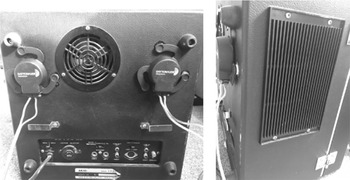
I explore the trans-temporal potentials of the archived iPhone recordings by re-sounding them using two Dayton Audio transducer speakers attached to the back of the tape machine. The transducers, connected to a laptop triggering the composed layers of digital audio, are glued to the surface of the tape machine and vibrate their substrate to amplify the disembodied sound files (Figure 2). The transducers create a sense that the digital audio – a trace of the tape reel – is becoming re-embodied back into the fabric of the tape machine, using the physicality of the object to provoke an interplay between the physical and the digital renderings of the recordings. Through the transducer speakers, the distinct, yet interlinked, layers interweave and transform over time as they play out in the sound environment. Recursions are engendered that both demarcate and blur the materiality of the tape loop through a nesting of distended temporalities that flitter between dis- and re-embodiment. The simple, low-tech qualities of the transducers allow for the illustration of the physical acts of transmitting the ‘interior’ actions of the digital audio and the manifestation of their presence via movement and vibration. Moreover, the process of exteriorising these disembodied presences specifically looks at the transductive actsFootnote 6 where sound materials undergo transformations that modulate between their own materiality and that of another. In this light, the assemblage of energies enacting in this installation piece suggests a fluid process that transcends the ‘dualities of form/content, pattern/substance, body/mind, and matter/spirit’ (Henriques Reference Henriques, Bull and Back2003: 468), offering listening as a means through which to consider how different sonic temporalities are nested in sound objects.
The transducers and the tape machine’s internal speakers.

To represent the time-stretching of the data lying dormant in the iPhone, the tape machine’s playback motor is used to propel the object into an intermittent, languorous spin, creating soft whirring textures as the broken glass wears away the plastic and rubber fastenings that once secured the right-hand spool. The preparations also cause the iPhone to spin idiosyncratically, sending a collection of signals and noises to the malfunctioning internal speakers. The tape loop undergoes a similar state mutation as it whirrs through the corrosive materials, warping the sonic character of the foreground layers playing through the internal speakers and provoking a shift in focus onto the background digital audio diffused through the transducers as the loop starts to degrade and eventually snaps. The manipulation of the iPhone and the tape loop creates a juxtaposition between the arbitrarily demarcated foreground and background sounds, interrogating the sonic resonance that ‘unscrolls itself, manifests itself within time, and is a living process, energy in action’ (Chion Reference Chion1994: 65). This somewhat uncanny rendering aims to arouse a dialogue between the different sonic energies enacting in the soundscape. The shifting topology of their interactions arouses a kind of temporal ambiguity where the different audio presences ‘mediate between different orders, to place heterogeneous realities in contact, and to become something different’ (McKenzie Reference McKenzie2002: 18). As Nelson suggests, the uncanniness that haunts the relationship between background and foregrounded presences ‘lies not exactly in the moment of hesitation between a natural and a supernatural interpretation … but rather in the visceral and simultaneous comprehension of both realities’ (Nelson Reference Nelson2001: 172–3).
The techniques used here seek to redirect notions of reduced listening from a process of ‘listening for the purpose of focussing on the qualities of the sound itself independent of its source or meaning’ (Chion Reference Chion1994: 223) towards listening to consciously uncover the many acts of erasure and inscription underpinning the transduction of the sonic presences from one domain to another. The sonic layers are reimagined as trans-temporal intermediations that flitter between the ‘fixed’ materiality of the sound objects and their digital simulacra haunted by the ghosts of an eminently analogical process.
Feedback received during and after the presentation of the piece was illuminating. Comments that the piece mobilises heavy sensory conditions ‘like a requiem’ and the soothing lament of a ‘tape-player in mourning’ seem to suggest an engagement with the presence/absence duality. Further, I received a range of questions regarding ‘What sound is coming from which bit?’, ‘What did the tape sounds sound like before?’ and ‘How is it still making the sounds I’m hearing now the tape has snapped?’, emphasising a level of ambiguity towards both the material and the temporal properties of the installation’s audio sources. These observations spark ideas about listening as a trigger to persuade bygone sonic acts to materialise in the present moment. Salter defines such dynamics as a ‘fluctuating interplay between a sensing “subject” and “things perceived” by that subject’, causing sites of intersensoriality and ambiguity where ‘encounter between perceiver and perceived is itself subject to flux and modulation’ (Salter Reference Salter2015: 173). Salter’s thoughts suggest that providing opportunities for active, close listening might open further dialogue around how and why assemblages of disparate sonic materials enact in hybridised sound environments in the ways that they do.
5. AFTERGLOW
Preconceived ideas of layering sound materials need to be (re)cognised to consider assemblages of trans-temporal qualities, particularly when looking critically at the audio tagged in digital systems. Because recursivity is coded in the fabric of digital tools, the sonic ghosts of bygone sound objects can too be read as aggregating in digital-age systems:
Analogue is spooky or spectral for the regime of [digital] rendering because, among other things, it depends upon the interplay of material forces and magnitudes … it is not wholly subsumable or predictable by programs and schemata, simply because the interplay of real magnitudes in space/time is fundamentally and even inexhaustibly contingent, creating a reservoir of complexity and contingency that is, in principle, inexhaustible. (Wolfe Reference Wolfe2008: 89)
The palimpsestic nature of layering sound seems to transcend the limitations of physicality bestowed to sound objects or the immediacy of data streams. By attuning to, and manipulating, the thresholds of musical time and space, the many acts of remediation that occur in contemporary times conjure up an analogic process pulling the strings of digital-age practice, suggesting a play of forces that seek to evade spatio-temporal strictures and periodising logic.
As striking a balance between materiality and immediacy in contemporary times continues to tread knotty terrain, abstract thinking is needed to unpick the rationales of palimpsest-like post-digital practices that paradoxically push for futurity while coveting the incessant saving and re-saving of past action via digitisation. As Norman contends:
Layers of bygone cultures explored with novel probes overflow with untapped findings. When forms long thought inert prove so prolifically fertile, how might our new cultures and their traces compose with such seething potentialities from the past? (Norman Reference Norman2016a)
The blurring of presence/absence and subject/object provoked by listening palimpsestically echoes anxieties that ‘longing for memories, for capturing, storing, retrieving and ordering them: this is what digital memory culture is all about’ (Garde-Hansen etal. Reference Garde-Hansen, Hoskins and Reading2009: 5). If analogic process does indeed haunt digital audio processing, then perhaps rummaging through the waste of bygone sonic temporalities via hybrid analogue/digital systems might offer opportunities to attune to the ghostly remains that are ‘intrinsically resistant to the contraction and homogenization of time’ (Fisher Reference Fisher2012: 19) in ways that are extrinsic to current digital-age logic.
SUPPLEMENTARY MATERIAL
To view supplementary material for this article, please visit https://doi.org/10.1017/S1355771821000145