Introduction
Since skills critical for driving safety are affected by dementia, there is consensus that people with dementia are likely to eventually have to stop driving (Carmody et al., Reference Carmody, Traynor, Iverson and Marchetti2013). Driving cessation is a difficult process with wide-ranging effects for people with dementia and their FC (Perkinson et al., Reference Perkinson2005; Liddle et al., Reference Liddle, Bennett, Allen, Lie, Standen and Pachana2013), imposing drastic changes to older adults’ daily lifestyles and roles (Curl et al., Reference Curl, Stowe, Cooney and Proulx2014). Driving cessation often signifies the loss of independent and flexible access to social and leisure activities (Gardezi et al., Reference Gardezi2006), and is correlated with increased depressive symptoms (Windsor et al., Reference Windsor, Anstey, Butterworth, Luszcz and Andrews2007) and earlier need for residential care (Freeman et al., Reference Freeman, Gange, Munoz and West2006). It has therefore been associated with negative consequences like social isolation, reduced community mobility, and feelings of sadness or helplessness (Gardezi et al., Reference Gardezi2006; Curl et al., Reference Curl, Stowe, Cooney and Proulx2014). Driving cessation can also threaten the self-worth and self-identity of people with dementia as it may be stigmatized and associated with declining function (Snyder, Reference Snyder2005).
FC are often more involved in the driving cessation process of people with dementia than of older adults without dementia (Adler, Reference Adler2010). Common driving-related responsibilities undertaken by caregivers include initiating discussions with HP, assisting people with dementia in making driving decisions, supporting retiring drivers to cope with the transition, and involvement with alternative transport or care (Jett et al., Reference Jett, Tappen and Rosselli2005; Adler, Reference Adler2010). It is also recognized that families may struggle with managing unlicensed or unsafe driving of their family member with dementia (Adler, Reference Adler2010; Byszewski et al., Reference Byszewski, Molnar and Aminzadeh2010). Together with other caregiving demands, driving-related responsibilities can lead to substantial emotional, psychological, financial, or physical burden (Taylor and Tripodes, Reference Taylor and Tripodes2001). Caregiver strain has been correlated with increased depressive and anxiety symptoms in caregivers of people with dementia (Truzzi et al., Reference Truzzi, Valente, Ulstein, Engelhardt, Laks and Engedal2012). Conversely, caregivers experiencing healthier interactions with their family members and better family communication and cohesion report higher life satisfaction and lower levels of depression and stress (Sutter et al., Reference Sutter, Perrin, Chang, Hoyos, Buraye and Arango-Lasprilla2014).
Driving cessation can create conflict and tension among families of people with dementia (Adler, Reference Adler2010), who often report receiving insufficient support and information about the process (Mezuk and Rebok, Reference Mezuk and Rebok2008). This is concerning because family conflicts have been shown to exacerbate family challenges relating to dementia care management and decision-making (Vernooij-Dassen et al., Reference Vernooij-Dassen, Joling, van Hout and Mittelman2010). People living with dementia and their families can experience strong emotional reactions to driving cessation, including anger and frustration (Byszewski et al., Reference Byszewski, Molnar and Aminzadeh2010), and family interactions often change during the process (Carmody et al., Reference Carmody, Traynor, Iverson and Marchetti2013). Consequently, it is critical to understand and support family interactions throughout the driving cessation process.
Various aspects of family experiences relating to driving cessation of people with dementia have begun to be explored. In addition to research about the above-mentioned family conflict, stress, and emotional reactions to driving cessation, strategies used by families and HP to promote driving cessation for cognitively impaired older adults have been qualitatively examined (Jett et al., Reference Jett, Tappen and Rosselli2005). Interviews with 68 participants including drivers, family members, and health or other relevant professionals revealed two contrasting action strategies commonly used to promote driving cessation. An involved action strategy encompassed family members and the driver discussing and agreeing on driving cessation, typically with positive family relationships maintained. In contrast, an imposed action strategy involved “necessary” deception as perceived by the family such as disabling the car, telling “therapeutic fibs” (Jett et al., Reference Jett, Tappen and Rosselli2005, p.114) like keys being lost, or covertly reporting the driver to licensing authorities. This could result in the driver directing anger towards family members, or relationships becoming damaged. Jett and colleagues acknowledged that while the involved strategy may be preferred, an imposed strategy may be necessary or more effective at times. While these two broad strategies facilitate understanding of how families promote driving cessation, driving cessation is recognized to be difficult with multiple approaches warranted (Adler, Reference Adler2010). Their study therefore encourages further exploration of families’ roles and their various approaches undertaken in managing driving cessation. Although family experiences and the driver-carer dynamic were not explored in-depth, their study findings suggest that these might be important to understand and support during driving cessation.
Driving cessation research on the needs of people with dementia has reported recommendations to facilitate the process, but these are not necessarily related to family experiences and mostly do not include perspectives of all key stakeholders (e.g. Croston et al., Reference Croston, Meuser, Berg-Weger, Grant and Carr2009; Carmody et al., Reference Carmody, Traynor, Iverson and Marchetti2013), including people with dementia, FC, and HP s (Byszewski et al., Reference Byszewski, Molnar and Aminzadeh2010). Each of these three key stakeholder groups can significantly influence family experiences during driving cessation (Croston, Reference Croston, Meuser, Berg-Weger, Grant and Carr2009). Yet no study, to the best of our knowledge, has explored in-depth family experiences and related needs that were identified by key stakeholders themselves. Since family-centered interventions intensively targeting the unique needs of people with dementia and their caregivers are more effective than providing general information and support (Vernooij-Dassen et al., Reference Vernooij-Dassen, Joling, van Hout and Mittelman2010), key stakeholders’ perspectives of specific family needs are warranted.
It is seen that family experiences and interactions form an integral part of the driving cessation experience, which can often present numerous challenges and adverse consequences for families. Therefore, family experiences should be understood and supported when designing tailored clinical interventions and systemic supports for driving cessation of people with dementia. Yet, existing literature lacks in-depth exploration of how families manage driving cessation and of their subsequent needs relating to family experiences. Therefore, this study aimed to explore the family experiences and related needs during management of the driving cessation process with people with dementia.
Methods
This study is part of a larger study exploring key stakeholders’ perspectives of the driving cessation process and its associated needs for people with dementia (Liddle et al., Reference Liddle, Bennett, Allen, Lie, Standen and Pachana2013). Driving cessation experiences and needs were explored via qualitative semi-structured interviews. Considering the limited research on driving cessation of this group, along with the desire to enhance clinical applicability by capturing a range of experiences and needs, a descriptive phenomenological method was applied (Langdridge, Reference Langdridge2007). This method was used to capture the key stakeholders’ subjective experiences, perceptions, and feelings regarding the driving cessation phenomenon (Langdridge, Reference Langdridge2007). Descriptive phenomenology is particularly useful in identifying shared features of multifaceted issues, which can make it valuable in understanding clinical issues and informing clinical practice (Langdridge, Reference Langdridge2007). Two main areas of findings arose from the data. The temporal processes of driving cessation and its related needs have been reported and published (Liddle et al., Reference Liddle, Bennett, Allen, Lie, Standen and Pachana2013). Findings relating to family dynamics, which formed an integral part of the experience, are described in this paper.
Local context
Within Queensland, Australia, the driver licensing authority (DLA) is the ultimate decision-maker regarding medical fitness to drive, while HP are involved in assessing fitness to drive. Licensing of people with dementia therefore involves both health and DLA systems, which differ from state to state. Drivers with dementia can only hold a conditional license that is reviewed at least yearly (Austroads, 2012). Within most states in Australia, including Queensland, the driver is responsible for declaring the presence of a medical condition which may impact on driving performance. HP are responsible for making patients aware of the potential impact of their medical conditions. Formal assessments of medical fitness to drive are conducted within the health system with results made available to doctors making licensing decisions. Within Queensland, HP do not have a formal requirement to report concerns about a person's driving safety to the DLA, but voluntarily do so as part of their duty of care if they feel the person poses an imminent risk to themselves or others. If they do report this information to the DLA, they are protected from civil and criminal liability (Austroads, 2012). There is no independent medical board as part of the DLA in Queensland. In larger metropolitan centers, disability-specific transport services and public transportation such as buses, trains, and taxis are more readily available than in rural and regional areas. Private vehicle driving remains widespread across Australia (Australian Bureau of Statistics, 2013).
Participants
Participants needed to belong to one of the three key stakeholder groups involved with driving cessation of people with dementia:
-
1. retired or retiring drivers with dementia (RD);
-
2. family caregivers (informal caregivers) (FC) involved in the driving cessation process of someone with dementia; and
-
3. health professionals (HP) with direct experience in the area.
The study was promoted through dementia and caregiver support organizations, HP networks, and local media. All participants self-selected and contacted the research team to indicate their interest. The inclusion criteria for retired or retiring drivers with dementia participants were: (1) self-reported diagnosis of dementia, (2) ceased or ceasing driving because of dementia, (3) able to provide informed consent to participate, (4) could communicate adequately to give consent, assent, and participate in the interview, and (5) had a family member who could attend their interviews and consent procedure. FC and HP needed to have lived experience with the driving cessation process of people with dementia and be able to participate in an audiotaped interview. FC could participate in the study with or without their family member with dementia.
The University of Queensland Behavioural and Social Science Ethics Review Committee granted ethical approval for this study (approval number 2009000196). Prior to participation and during interviews, participants were informed and reminded that the research team (registered HP) may have a duty of care to report to relevant medical or licensing authorities, behaviors raised during interviews if they were at risk of causing imminent harm to self or others. Informed consent was obtained and assent confirmed throughout the interview.
Data collection and procedures
Demographic data and descriptive information about the severity of dementia were gathered using questionnaires, prior to audiotaped interviews which were conducted using interview schedules. The Clinical Dementia Rating (CDR) (Berg, Reference Berg1988) is a five-point scale which characterizes six domains of cognitive and functional performance relating to dementia. Through interviewing people with dementia and FC, the CDR was used to collect information about the impact and severity of dementia symptoms based on the overall CDR score generated. Participants’ needs, preferences, and geographic location were considered in determining if the semi-structured interviews were conducted face-to-face or over the telephone. For ethical reasons relating to potential legal consequences and distress, all participants with dementia had face-to-face interviews with a caregiver in attendance. Caregivers could choose to be interviewed with the person with dementia present, or individually on another occasion. Interviews enquired about experiences of driving and driving cessation, needs throughout the process, and perspectives of an ideal driving cessation approach. To ensure consistency of interviews, an interview guide was utilized (Appendix I). This was developed from a body of driving cessation research (Liddle et al., Reference Liddle, Turpin, Carlson and McKenna2008; Gustafsson et al., Reference Gustafsson2011), in consultation with research and HP. Interviews lasted between 20 and 60 minutes (Mdn: 37 minutes) and were audiotaped and transcribed verbatim. Transparency of data analysis was promoted via use of a researcher's log throughout data collection and analysis. As part of the member checking process (Patton, Reference Patton2002), participants were invited to provide feedback about the accuracy and relevance of a given summary of key interview content. Seven participants provided additional details or updates post-interview, which were analyzed with the transcripts.
Data analysis
Transcripts, researchers’ logs, and the member checking responses were read through thoroughly. Initial analysis inductively indicated two relevant areas: the stages of driving cessation, and the family dynamics surrounding driving cessation. The paper reports the findings related to family dynamics only. Within a descriptive phenomenological framework (Langdrige, Reference Langdridge2007), analysis of the family dynamics in this paper involved JL and AT developing themes using a constant comparison method (Patton, Reference Patton2002). Each transcript was read and up to five key points generated for each transcript based on the essential and important meaning expressed by participants as they related to family dynamics and driving cessation. These key points were explored across transcripts and discussion between JL, AT, SA, SB, and PL identified all the needs and experiences related to family dynamics and driving cessation, which began to be grouped and organized into themes and subthemes. Development of working definitions, explaining, and defining themes and subthemes began at this stage and were continually refined throughout coding to better capture expressed meaning and these were used in application of the coding tree. This led to the development of codes (for thematic areas), which were generated inductively (Patton, Reference Patton2002), grouped into categories and subcategories, and reviewed for patterns – culminating in the development of a coding tree. Detailed, line-by-line coding was only applied to text relevant to family dynamics, identified in the earlier overall analysis (Liddle, Reference Liddle, Bennett, Allen, Lie, Standen and Pachana2013). Thematic analysis of the data (Langdridge, Reference Langdridge2007) was organized using the web-based software Dedoose, version 5.0.9 (Leiber & Weisner, Reference Leiber, Weisner, Tashakorri and Teddlie2010). Peer checking involving the team of experienced researchers occurred at multiple stages, with checking and discussion contributing to revision and condensation of the themes and categories. PL checked the advanced coding tree's applicability and definitions on eight transcripts (2 RD, 3 FC, 3 HP). Resolution of discrepancies (2 major and 23 minor) occurred mostly between PL and AT; four involved all researchers. SB then undertook peer checking of an overview of the results. Following further discussions, the findings: A continuum capturing family dynamics, and key contextual factors, reported in this paper were finalized. Pseudonyms were used and verbatim quotes illustrate key findings, and participants are identified by group and number, to enable tracking of nature of responses without endangering anonymity. The accuracy of quotations used were checked against the original transcripts by JL and AT.
Results
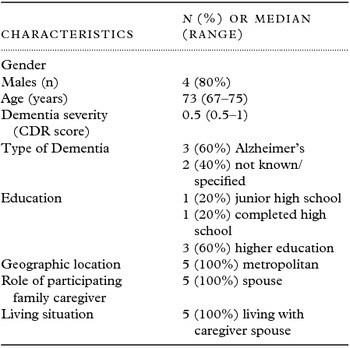
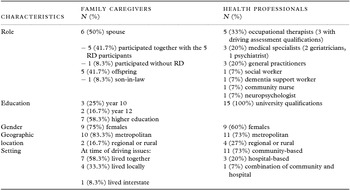
Participants were five people with dementia who had retired from driving with very mild to mild dementia (CDR 0.5–1), 12 FC, and 15 HP. One additional family dyad joined the study at a later stage after the initial analysis (Liddle et al., Reference Liddle, Bennett, Allen, Lie, Standen and Pachana2013). Participant characteristics are recorded in Tables 1 and 2. People with dementia and FC participants were at varying stages of the transition process, and HP participants reflected on a wide range of experiences of different family dyads. FC who participated alone described the driving cessation experiences of their family member(s) whose severity of dementia (CDR 2–3; moderate to severe dementia) were higher than that of participating people with dementia. HP participants had 4.5 years to over 40 years of experience working with people with dementia (Mdn: 15 years), involving interactions with an estimated five to over 100 people with dementia per year. Most of the HP participants (9) saw people with dementia within their clinical practices daily or at least weekly, with occupational therapy driving assessors (3) and General Practitioners (3) reporting less frequent interactions.
Characteristics of retired drivers (N = 5)

Characteristics of family caregivers (N = 12) and health professionals (N = 15)

One eligible family dyad withdrew from the study before interviews, reporting that the topic was too stressful. A potential retired driver was excluded as his driving cessation was attributed to a visual impairment and he had no formal diagnosis of dementia. All other study volunteers were included.
Findings reported in this paper focus on the family dynamics and interactions experienced throughout the driving cessation process of people with dementia. Key aspects of this phenomenon were: (1) Family dynamics: a continuum of interactions while experiencing driving cessation; (2) Context for driving cessation; and (3) Family needs: individualized approaches to support families.
Family dynamics: a continuum of interactions while experiencing driving cessation
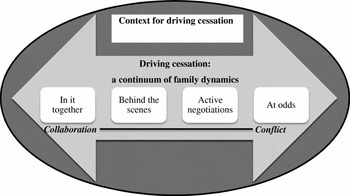
In describing the experiences and needs related to driving cessation, participants from all groups discussed events and approaches indicating a range of interactions between people with dementia and their families. The nature of these interactions could be thought of as a continuum of family dynamics involving varying levels of collaboration and open conflict: in it together, behind the scenes, active negotiations, and at odds.
In it together
In it together was a dynamic involving a person living with dementia and the FC supporting each other while collaboratively negotiating driving cessation. At this end of the continuum, family members shared the same perspective and information, working together on challenges and negotiating the health and licensing systems involved. Typically this involved both parties acknowledging the need for the person with dementia to cease driving with few disagreements ensuing:
Dulcie (FC8): I was plucking up the courage to suggest to him that it was time to stop when he just announced that he felt he should stop.
Interviewer: Okay. And so he arrived at that conclusion himself? And, what was your role through that process?
Dulcie: White knuckled passenger. . . It wasn't a drama or anything, he just felt it was time to do it and I agreed with him.
However, HP also described situations where the person with dementia and FC were in it together while collaboratively resisting driving cessation despite recommendations:
“The wife doesn't drive, so he would actually probably give up driving fairly easily but for his wife, [he's her] means of getting around and she doesn't want him to give up driving.” – Dana (HP2)
Behind the scenes
Behind the scenes captures the dynamic where the person with dementia and their family member work collaboratively on the surface towards ensuring daily activities and community mobility continues, while divergent perspectives and agendas began to emerge. This typically involved FC being concerned about driving difficulties and the need to stop, while the person with dementia remained less aware or unaware. While prioritizing the driver's well-being and independence, FC described making arrangements in order to enhance safety and minimize conflict. Covert approaches to subtly minimize opportunities or reasons for the person with dementia to drive were described. For example, family members offered to drive, organized activities with transport embedded, traveled with the person with dementia to help as a passenger, and reduced visibility of the car or car related items. While this happened, the person with dementia was described as actively involved in maintaining and choosing the destinations and activities, and responding to the changed transportation. While these strategies were undertaken, family members described striving to ensure community mobility and the dignity of the driver was preserved as much as much possible. Within this dynamic, families described minimal conflict and a focus on the person with dementia continuing to make decisions and express preferences. Where suggestion or discussion was not effective to dissuade unsafe driving, for example, family members would accompany the person with dementia on the trip, rather than argue or prevent the trip. While families worked together towards staying mobile, divergent agendas were expressed.
Nancy (FC11) described her father's covert management of her mother's cessation:
“So it was just the family's concern, or probably my father's concern for her. . .to remember where she was to be able to find her way back home. . .He ended up taking over doing the driving, without mum's real knowledge of that happening. He just went wherever she wanted to go. So he drove there. . . he was just. . . protecting her from having to realise that she was probably losing her memory more.”
Active negotiations
Within this dynamic, FC undertook open approaches in managing driving cessation challenges, with attempts to negotiate agreements with the person with dementia through discussions. As the person with dementia did not share similar perspectives or awareness of driving abilities, this involved some debate and disagreement, which, at times, offered opportunities for some compromise and resolution. FC often initiated negotiations on driving restrictions to local areas or during daylight, or on driving cessation by listing legal, medical, and other personal reasons. Such negotiations had varying levels of success, and were often repeated due to dementia's impact on memory difficulties in recalling agreements made and other changing circumstances. Keith (FC10) described his attempts to persuade his mother to stop driving:
“One of the arguments we tried to use was that her father voluntarily gave up driving at 80 and we were saying, “Look, you’re older than that now.”. . . We tried everything. . .I remember saying to Mum, “Look, it isn't one thing that actually makes me worry that you can't drive. It's your combination [that worries me].” I remember trying to list those things out for her. That argument didn't hold much water, I’m afraid. . .We really tried to again, just constrain her to daylight driving within the area that she knew well.”
At odds
At the furthest end of the continuum, significant conflict arose between people with dementia and their FC and often resulted in substantial anger, aggression, or resentment, especially if the FC had appeared to trigger the cessation process. Tanya (HP6) shared experiences of carers being “seen as the bad guy for instigating it,” causing the retired driver to “place a lot of the blame, direct a lot of their anger towards the carer.” She acknowledged that some people “just want to drive and drive. . . . and it's such a source of tension and aggression in some families.” Within this dynamic, driving cessation was described as a crisis with substantial opposition from the person with dementia despite FCs’ repeated attempts to dissuade them from driving. There was often no room for discussions, with no resulting compromise or resolution. Diana (FC5) related experiences of her father becoming physically aggressive when she tried to take his car keys away: “he grabbed my bag and held it close to him . . . and he said, ‘Now you know what it feels like to have something taken away from you.’. . . and at that point, he tried to hit me.”
Figure 1 below depicts the continuum of family dynamics involving varying levels of collaboration and conflict. While family dynamics for some dyads stayed mostly within one category of the continuum throughout the process, others experienced single or multiple dynamic shifts. These shifts occurred in either direction and could be from an extreme end of the continuum to the other. These either occurred abruptly due to triggers like visible reminders about driving, or gradually over time as issues were resolved or different approaches were attempted. At times, families concurrently utilized approaches involving more than one category. For example, whilst using active negotiations to reason with his mother about driving cessation, Keith (FC10) also used behind the scenes approaches: “If she ever wanted to go anywhere at night I’d take her, my brother would take her. . . So we managed to modify her driving.”
Framework to consider driving cessation of people with dementia: a continuum of family dynamics within the surrounding context for driving cessation.

Context for driving cessation
The fluid and shifting nature of the continuum could be attributed to the individual set of family circumstances. The context for driving cessation captures and illustrates the complexity of the multiple contextual factors that may influence family dynamics and individual family needs. These contextual factors included: identities relating to driving and relationships, the nature of dementia, visible reminders, and health and licensing systems. Some aspects of the individual context supported collaborative interactions, such as the availability and convenience of alternatives to driving, including public transport and community services. Other factors like reduced insight as a result of dementia tended to increase conflict within family dynamics.
Identities relating to driving and relationships
The identities related to driving and family relationships of individuals with dementia and their family substantially influenced family dynamics by affecting acceptance of and adjustment to driving cessation. For some, driving held symbolic meaning linked to valued roles and identities. Compared to those whose identities were not tied to the accessibility and independence afforded by driving, people with dementia who valued driving identities seemed to have exceptional difficulty adapting to alternatives, even if readily available. Diana (FC5) attributed the family conflict during cessation largely to the lifelong meaning that driving held for her father:
“To Dad, having a car was absolutely everything. It meant transport, it meant independence, but it was also something about the activity itself that was so important to him. . . the process of giving it up was an absolute disaster for him. . . so much so that he was able to construct all of these non-truths in order to continue to drive.”
Some people found it challenging to relinquish autonomy and control in losing the driver identity, whilst some FC were uncomfortable or anxious about taking on the driver identity within the relationship. This typically increased family tension and conflict. Moving from the role of driver to passenger was a transition for the driver that could hold many challenges. Some FC described open conflict resulting from the person with dementia's difficulty in adjusting to the changed role, and attempts to maintain the identity through critiquing the driving of family carers. Other family members used behind the scenes approaches to make the passenger role more active and appealing, thereby reducing conflict:
“We recently did a trip down to visit my old hometown. . .I rigged up a sound system in the car that gave Olive (RD3) the job of selecting what we were listening to and adjusting the volume. And because she had that to do while we were driving, she didn't get bored. I didn't get, “Are we nearly there yet?” – Don (FC3)
The nature of identities and shared life histories within parent-child or spousal relationships also influenced family dynamics. Adult children, more often than spouses, described struggling or being unsuccessful in active negotiations with their parent who had maintained an authoritative role. This led to situations of high conflict moving towards at odds, or behind the scenes approaches being adopted.
The nature of dementia
Characteristics of the impact of dementia that influenced family dynamics were identified. Differing levels of insight were an important influence. People with reduced insight often expressed anger towards family members due to disagreements in perceptions of driving ability. Conversely, people with dementia like Michael (RD5) who ceased driving with minimal family conflict seemed to demonstrate insight into the implications for driving:
“I knew I was Alzheimer-ish and I thought to myself, well that's not going to be very good for - I didn't know how it works and things like that, so stopping was dead simple.”
Memory impairments which caused people to forget previous agreements about driving cessation, or where the keys were, could shift family dynamics in either direction. For some people who forgot about their loss of license, family members sometimes worked behind the scenes to prevent them from driving. As Glennis (FC9) related: “He didn't realise he wasn't allowed to drive. He’d forget that. And we had to make sure all the keys would be hidden and things like that, so he didn't actually get and just go in the car somewhere.”
Additionally, participants reported that family dynamics involved less direct conflict as the person with dementia became more physically dependent, for example, when physically unable to access the car anymore, or when admitted into secure residential care where driving was no longer necessary or possible.
Visible reminders
Visible reminders about no longer being able to drive seemed to contribute to shifts towards combative family dynamics. For example, negative feelings may be elicited towards FC who started using the person with dementia's car, giving rise to conflict. Similar-aged peers visiting Fiona (FC4)'s father “caused problems when he saw them come in their car. . . that would start the whole driving argument all over again.” Elena (HP15) also described the car in the driveway being a visible reminder that triggered conflict:
“It's a constant reminder. . . that they can't drive anymore. . . We have had a lot of situations. . .where the husband has gone and jumped into the car, started it up, you know, because that's what they’ve always done, and then a battle has ensued with the carer.”
Health and licensing systems
People with dementia and FC described negotiating the health and licensing systems, including interactions with HP, as having a large influence on their own interactions during driving cessation. Participants experienced the licensing system as challenging, identifying a lack of knowledge about how to navigate the system, their responsibilities as drivers and how to access information and support. The intersection between health and licensing, where assessment of medical fitness to drive was available through the health system, and formal processes then occurred through the driver licensing authority, were described as particularly difficult. Participants also described receiving conflicting advice regarding their driving from different people and organizations within the systems. The systemic complexities, inadequate practical support and information, as well as conflicting advice from different HP often generated stress, tension, and conflict within families.
“I didn't know how to calm the situation other than to get angry myself. . . There wasn't a lot of support anywhere. . . I just feel the whole situation in retrospect now, all of us could have handled it better if we’d had a little bit of information or support. Something. . . on how I could handle Scott instead of just yelling back and him yelling at me and ending up you know being a total chaos” – Kath (FC1)
Consequently, participants recommended changes to the systems to support family dynamics – the use of objective tests to formally identify a need for cessation and therefore reduce blame on family perceived by the person with dementia; and recognition of families’ need for professional support and advice relating to driving cessation decision-making, monitoring, and adjustment.
Family needs: individualized approaches to support families
It was evident from the data that the needs relating to driving cessation were distinctly individual as they influenced family dynamics. Participants described the nature of the family dynamics and individual circumstances involved, with HP additionally noting a wide range of needs relating to family dynamics. The following details two examples of families experiencing contrasting dynamics as influenced by their unique contexts for cessation, each with their different identified needs and thus illustrating the individualized nature of interventions needed to meet these needs.
Victor (RD2) and Molly (FC2) were a couple who collaboratively worked through Victor's entire driving cessation to date. Although Molly had never driven and thus could not take over driving, they adapted well to alternatives like public transport or travelling on foot. Both described no unmet needs but acknowledged that some social or leisure activities may be restricted due to poor public transport accessibility to certain areas: “you sort of see something's on and you sort of think “Oh, I wouldn't mind seeing that,” then you realise you can’t” (Molly, FC2). Factors that they reported had facilitated their positive family dynamics include Molly's familiarity with public transport, convenient access to public transport and facilities around their home, their physical health status, and Molly obtaining the geriatrician's support regarding driving cessation.
Diana (FC5) described a much less collaborative experience with the driving cessation of her father (Thomas, non-participating RD). Diana experienced significant physical and verbal conflict and aggression as Thomas resisted cessation and continued to drive unlicensed despite her repeated attempts to discuss and negotiate. They eventually shifted away from being at odds when Thomas's physical deterioration resulted in him entering a nursing home where he no longer needed to or could drive. Diana expressed her unmet need for immediate emotional and practical support during the times she was dealing with the crisis. Specifically, she identified needs for having a carer support group to provide information, driving cessation support group for Thomas (including the option of sharing the grief and loss about driving), understanding and support from other family members, as well as HPs’ advice on practical problem-solving steps to take. Diana also reported that coordination and transport-related assistance to reduce Thomas's need or desire to drive may have reduced family conflict. However, Diana acknowledged that Thomas would likely have resisted cessation regardless of preparations and that “no possible way with Dad we’d have an easy time,” due to his strongly valued driving identity. Other factors that she felt contributed to their difficult family dynamics included Thomas's severely reduced insight, and his desire to drive to visit her mother who had just entered a nursing home. Diana also lived in a different state to Thomas and had to manage his driving cessation either remotely or intensively during her short visits – further complicating their interactions.
These two examples illustrate the contrasting family dynamics and individual needs of different families, influenced by the interaction of their unique contextual factors. However, even within the same family dyad, each individual in the dyad had different needs and challenges throughout the process, and their family dynamics could change either abruptly or over time. In managing Scott's (RD1) driving cessation, Kath (FC1) described moving from being at odds to in it together as they gradually resolved “the biggest problem [they’ve] ever had to face”:
Kath: Well, there was a lot of anxiety on my part and a lot of anger from Scott. Now my anxiety didn't help his anger, and his anger put me back 10 years as far as driving was, because I just didn't want to do it. It was bad for a while. It was really bad.
Interviewer: Okay . . . the next question is, could it have happened in a better way?
Kath:Yep, well as I say, a little bit more explanation, a little bit more counselling. . . .
I would like to have had somebody say to me, “Look, if it gets, if Scott gets really angry, the best course of action is such and such.” Rather than it being just, me stopping the car and saying “F-ing well get out now.” [Laughs]. . .Yes, some way of coping with it at the time. Because it did, didn't it, it was pretty much out of hand there for a while. You must agree?
Scott:Yep.
. . .
Interviewer: And what help do you think you need now . . .?
Kath: I think we’re getting pretty much there now.
She identified that counseling and socio-emotional support could have supported them through the initial crisis involving anger and conflict. Kath (FC1) also described each of them facing unique difficulties in managing the transition: “It was hard for both of us. . . in a totally different way. . . . but it was just as hard for me as it was for Scott.”
Discussion
This study extends existing research about family experiences during the driving cessation process of people with dementia by examining in-depth the interactions between family dynamics, family contexts, and approaches to meeting related needs. With improved understanding of family dynamics and each family's unique contextual factors, HP can provide more individualized and responsive support for families managing driving cessation.
By exploring family dynamics in-depth and organizing these dynamics into a continuum, this study builds on existing driving cessation literature about the experiences of family. It was found that family dynamics involved varying levels of collaboration and conflict throughout the driving cessation process. This is consistent with the different levels of retiring driver involvement and related family relationship outcomes (Jett et al., Reference Jett, Tappen and Rosselli2005). While Jett and colleagues identified involved versus imposed strategies that families use to promote driving cessation for cognitively impaired older adults, our study has provided in-depth insight into the family interactions and relationships during driving cessation of people with dementia. Organizing these family dynamics into a continuum enables more nuanced distinctions between the various family dynamics, and may facilitate understanding. By enhancing understanding of family dynamics and providing a structure to consider family dynamics with the context for driving cessation, our study can inform more personalized support for families during driving cessation.
Although family dynamics surrounding driving cessation with people with dementia emerged as an integral aspect of family experiences, it is inadequately described within existing literature about dementia and has only been explored for older adults without dementia (Connell et al., Reference Connell, Harmon, Janevic and Kostyniuk2013). Through qualitative interviews with 37 adult children caregivers, Connell and colleagues found similar dynamics to our study: some FC took covert action while disagreeing with the retiring driver on perceived driving abilities, while others directly negotiated driving restrictions with the retiring driver. Uncomfortable shifts in parent-child relationships and roles were acknowledged in both our study and Connell and colleagues’ study. However, our study examined family dynamics and its context specifically for people living with dementia, which is important since the challenges they face are acknowledged to be unique (Connell et al., Reference Connell, Harmon, Janevic and Kostyniuk2013). We additionally included input from people with dementia and HP, who are also key stakeholders in driving cessation, each contributing unique perspectives of the experience (Croston et al., Reference Croston, Meuser, Berg-Weger, Grant and Carr2009). By involving spouse and adult children caregivers, our study adds valuable insight into family dynamics since spouse caregivers form the majority of co-residing primary caregivers of people with dementia in Australia (Australian Institute of Health and Welfare, 2012), and were found in our study to experience different perspectives and dynamics to adult children caregivers due to the differing relationship identities.
Findings revealed that families of people with dementia experience changing and difficult family dynamics with frequent shifts or concurrent use of various approaches occurring. Clinical interventions must therefore be responsive to changes in family dynamics over time. Although such shifts in family dynamics or concurrent use of approaches have not been explicitly identified in previous studies, these findings align well with literature reporting that the process of driving cessation is ongoing and requires use of multiple approaches to be successful (Adler, Reference Adler2010).
Most families in the study reported some level of conflict, with few families staying in it together throughout the entire driving cessation process. This highlights and reinforces the importance of providing family and relationship support during driving cessation. While study volunteers in our study may have been people who experienced particularly challenging driving cessation, family conflict in driving cessation has been commonly noted in driving cessation research (Adler, Reference Adler2010; Connell et al., Reference Connell, Harmon, Janevic and Kostyniuk2013).
Findings indicated that contextual factors such as diminished insight of people with dementia and driving-related identities could substantially contribute to family conflict, by influencing adjustment to driving cessation. While it is acknowledged that insight changes acceptance of driving cessation and approaches that families use to cease driving (Byszewski et al., Reference Byszewski, Molnar and Aminzadeh2010), this research showed the impact of changing identities within a long-term relationship, particularly relating to transition to the passenger role. Driving in older adulthood has been recognized as a shared activity between the driver and passenger, where passengers may hold distinct responsibilities in driving-related tasks like navigation and significantly influence driving safety (Vrkljan and Polgar, Reference Vrkljan and Polgar2007). Keeping people actively involved with passenger responsibilities such as adjusting sound system controls may support them in coping with the loss of the driver role. Yet, people with dementia who take on an active role that involves giving advice and critiquing the FC's driving may trigger open conflict, especially if the family member was already reluctant to take on driving. Therefore, each family may require personalized support in adapting to their new role and identity as a passenger or driver, within the relationship.
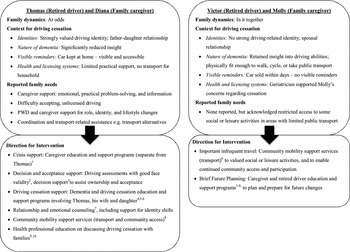
Our study reinforces the need for individualized solutions tailored to the specific dynamics, needs, and context of each family (Thompson et al., Reference Thompson, Spilsbury, Hall, Birks, Barnes and Adamson2007; Vernooij-Dassen et al., Reference Vernooij-Dassen, Joling, van Hout and Mittelman2010), and suggests a framework to facilitate identification of a unique set of interventions for each family, as illustrated in Figure 2. Figure 2 depicts examples of published interventions that may appropriately target the distinct needs of two family dyads interviewed in this study (Victor and Molly; Thomas and Diana), in supporting their family dynamics. Each would be applied differently, reflecting the different families’ needs. These illustrate how clinical approaches may be individualized based on each dyad's family dynamics, unique context for driving cessation, and reported needs. It should be noted that unlike Diana, Victor and Molly initially reported no identified needs – indicating some families’ need for support in ascertaining and conveying their needs.
Application of framework to support families during driving cessation. 1. Thompson et al., Reference Thompson, Spilsbury, Hall, Birks, Barnes and Adamson2007; 2. Wheatley et al., 2014; 3. Carmody et al., Reference Carmody, Potter, Lewis, Bhargava, Traynor and Iverson2014; 4. Gustafsson et al., Reference Gustafsson2011; 5. Dobbs et al., 2009; 6. Berg-Weger et al., Reference Berg–Weger, Meuser and Stowe2013; 7. Whitlatch et al., 2006; 8. Molnar et al., 2008; 9. Byszewski et al., Reference Byszewski2003; 10. Meuser et al., 2006.

To our knowledge, this is the first study to integrate the in-depth exploration of family dynamics during driving cessation of people with dementia with the multiple contextual factors influencing family dynamics. HP need to understand and consider family dynamics and contextual issues from the perspectives of people with dementia and their families, whilst flexibly developing individualized interventions that sensitively address families’ distinct needs. Consequently, families may be supported towards more positive dynamics with reduced interpersonal conflict and stress during management of driving cessation with people with dementia.
Strengths, limitations, and future directions
An important strength of this study lies in its integration of all three key stakeholder groups’ perspectives in exploring family dynamics and related needs during driving cessation in an in-depth way. Participants reflected on family experiences from different stages of the transition process, thus providing a range of experiences or insights from different points in the process. Additionally, a range of health professions involved in driving cessation was represented.
However, several study limitations exist. Highly distressed potential participants in the peak of resolving driving concerns might not have been able to participate and share their unique experiences. Within stressful life transitions, people who have adjusted and retrospectively reflect on their transition experience may have a changed perspective compared to when they were experiencing the events (Liddle et al., Reference Liddle, Turpin, Carlson and McKenna2008). Future research could therefore involve longitudinally following participants’ entire driving cessation journey where interviewers develop a trusting and ongoing relationship with participants. This could improve understanding of the crisis points, capture changes in family dynamics and needs over time, address identified immediate needs with relevant interventions, as well as increase participants’ openness and comfort in sharing their experiences.
Despite attempts to include people with dementia, relatively few participated, possibly due to the emotional nature of the issue and the possibility of the research team having to report behaviors at risk of causing imminent harm. This has been found by other researchers involving people with dementia (e.g. Carmody et al., Reference Carmody, Traynor and Marchetti2015). For ethical reasons, people with dementia were interviewed in the presence of a FC, which could have restricted their sharing of personal experiences. Future research could consider utilizing the person-centered process consent method described in Dewing (Reference Dewing2007) where people with dementia are given autonomy in their consent and assent to participate in a research study without family involvement. With reduced FC involvement during interviews, studies may gain more direct input from the retired drivers in understanding their experiences and needs relating to family dynamics.
Further research exploring the family dynamics and related needs for specific groups such as people with dementia and families living in rural and remote areas, or from culturally and linguistically diverse (i.e. non-English-speaking) backgrounds, would be useful for designing localized support programs and services. Since people with young onset dementia have different experiences and needs compared to older adults with dementia (Ducharme et al., Reference Ducharme, Kergoat, Antoine, Pasquier and Coulombe2013), a study into these needs and experiences is warranted.
Existing driving cessation research has focused primarily on understanding experiences of losing the driver role. Since the driver and passenger roles are associated with different responsibilities and identities, experiences of drivers transitioning to the passenger role and its subsequent impact on family dynamics may provide deeper insight into the driving cessation experience, and merit consideration.
Clinical implications
While existing work (Byszewski et al., Reference Byszewski2003; Carmody et al., Reference Carmody, Potter, Lewis, Bhargava, Traynor and Iverson2014; Carter et al., Reference Carter, Monaghan, O’Brien, Teodorczuk, Mosimann and Taylor2015) has provided an evidence based approach to supporting people in their decisions to cease driving, relatively little clinical guidance is available about families supporting this transition. This study would suggest that clinicians need to involve retired and retiring drivers with dementia and their families in discussions about their driving and driving cessation needs. Sufficient privacy will need to be provided during consultations so that all parties can express their perceptions and needs and receive support. Provision of information to support navigating the system, clear assessment of driving performance, future planning, community mobility support, and relationship support are all required from HP from the findings of the study. Earlier work indicated that different needs may exist at different times in the transition (Liddle et al., Reference Liddle, Bennett, Allen, Lie, Standen and Pachana2013), but the current study also strongly indicates the need for an approach by HP that is sensitive to the needs and dynamics of families experiencing this transition.
Conclusion
Interactions between people with dementia and their families regarding driving cessation are complex and dynamic, forming an integral part of what can be a challenging experience. The range of interactions experienced was organized into a continuum of family dynamics from more collaborative dynamics (in it together) to more open conflict (at odds). It is important for HP to consider each family's unique family dynamic and contextual factors influencing family dynamics when developing individualized interventions for people living with dementia and their families.
Conflict of interest declaration
This research was funded by a University of Queensland New Staff Grant. The funding body had no role in the design or conduct of the research project. No authors have any conflict of interests. Dr. Jacki Liddle is employed by the Asia-Pacific Centre for Neuromodulation (APCN) at the University of Queensland. APCN is in part funded by unrestricted research and education funding from Medtronic Inc and St Andrew's War Memorial Hospital. The funding bodies had no role in the design or conduct of the research project.
Description of authors’ roles
JL, NAP, and DCL completed study design, and application for and achievement of funding. JL, NAP, SB, SA, and BS were involved in data collection. JL, SB, PL, and AT completed data analysis, as well as writing and editing of this paper.
Acknowledgments
We would like to acknowledge and thank all participants for their involvement in the study. We also appreciate the contributions of the HP, seniors’ services, community organizations, and the Ageing Mind Initiative at the University of Queensland who promoted the study. The assistance of research staff member Rosemary Allen in this study's data collection is also acknowledged.
Appendix I: Interview Guide
Family members – key questions
-
1. Can you tell me what driving means to you?
-
2. Can you tell me what driving means to your family member?
-
3. Can you tell me how your family member came to stop driving?
-
4. Have there been any changes in your life or your family member's life since stopping driving? Do you expect any changes?
-
5. What, if anything, do you think might have helped?
-
6. What are your needs now?
-
7. Any advice or information you can share that might help other families facing driving issues?
Health professionals – key questions
-
1. What is your general role working with people with dementia about driving-related issues?
-
2. What is the typical experience (or range of experiences) that people with dementia and their families have with driving cessation?
-
3. In your opinion, are there unmet needs related to driving cessation for people with dementia? If so, what are they?
-
4. What would help people with dementia when they stop driving?
-
5. In your opinion, what would be the optimal way for people with dementia to stop driving?