Earthquakes pose a significant threat to human lives all over the world. On February 6, 2023, Turkey experienced 2 major earthquakes, the first with a magnitude of 7.7 and the second with a magnitude of 7.6, both centered in the province of Kahramanmaraş. The seismic events resulted in the loss of over 50 000 lives and inflicted substantial damage on several cities.1 Traumatic events such as natural disasters have been observed to elevate death anxiety among individuals.Reference Chung, Berger and Jones2 Typically, increased death anxiety is correlated with post-traumatic stress disorder.Reference Hoelterhoff and Chung3 Death anxiety is defined as fear and anxiety about death triggered by the thought of dying.Reference Chen, Liu and Li4, Reference Cheong, Ha and Tan5 Death anxiety plays a role in the development of several mental disorders.Reference Menzies, Sharpe and Dar-Nimrod6 Several studies have established a positive relationship between the accentuation of mortality concerns and heightened anxiety levels, as well as diminished psychological well-being.Reference Juhl and Routledge7, Reference Shakil, Ashraf and Muazzam8 Excessive death anxiety in individuals can give rise to complications such as pessimism,Reference Barnett, Anderson and Marsden9 hopelessness, loneliness,Reference Chow10 low perceived social support,Reference Adeeb, Saleem and Kynat11 and inability to fully enjoy life.Reference Yalom12 On the other hand, studies investigating death anxiety suggest that individuals who exhibit a positive outlook on life,Reference Azarian, Aghakhani and Ashuri13 perceive their existence as meaningful,Reference Chow10 enjoy a good quality of life,Reference Adeeb, Saleem and Kynat11 experience a sufficient level of happiness, and have high life satisfaction tend to have lower levels of death anxiety.Reference Sönmez-Benli and Yıldırım14
Life satisfaction refers to the degree of contentment resulting from an individual’s overall appraisal of his or her life.Reference Dağlı and Baysal15 Increased life satisfaction is associated with improved physical and mental well-being, and it plays a crucial role in effectively adapting to life’s challenges.Reference Gonzalez-Bernal, Rodríguez-Fernández and Santamaría-Peláez16 Myers and Diener (1995) define high life satisfaction as the presence of more positive evaluations regarding one’s life compared to negative evaluations.Reference Myers and Diener17 Furthermore, individuals who experience satisfaction with their lives are reported to exhibit enhanced resilience when confronted with the inevitability of death.
The catastrophic earthquake event, widely regarded as the disaster of the century, has resulted in substantial financial losses, increased death anxiety, diminished life satisfaction, and a range of other adverse psychosocial consequences among affected individuals. Given the aforementioned insights, this study aims to contribute to the development and implementation of health care services tailored to individuals affected by natural disasters by assessing their coping skills in the face of earthquakes, as well as their levels of death anxiety and life satisfaction. This study aims to determine the effect of death anxiety on the life satisfaction of individuals living in 11 provinces declared as earthquake zones in Turkey.
Method
Research Design
This study employs a descriptive and correlational research design. The study population consisted of approximately 2 768 777.49 individuals residing in these provinces.18 The sample size for the research was determined using the sampling method for a known population, with a 95% confidence interval.
Participants
The study population consisted of a total of 2 768 778.49 individuals residing in 11 provinces designated as earthquake-prone areas in Turkey. The sample size was determined to be 384 people by calculating the known universe sampling method. The study was completed with a total of 442 participants by reaching 15% more people than the sample size. The inclusion criteria specified that participants must reside in the earthquake zone and be 18 years of age or older. However, 7 participants were excluded from the study due to not meeting the sampling criteria, resulting in final data collected from 435 participants.
Data Collection
The study’s data collection period spanned from March 17, 2023 to April 4, 2023. Due to unfavorable conditions in the earthquake zone, face-to-face interviews were not feasible. Therefore, data collection tools were administered through Google Docs for this study. Email and various social media platforms such as Facebook, Instagram, and WhatsApp were utilized to distribute the online data collection forms to individuals who experienced the earthquake in the 11 provinces of Turkey. Participants who provided their consent were requested to complete the forms and share the data collection tool link with other earthquake survivors in their network. Hence, the research employed the “snowball sampling method,” a form of non-random sampling.
Instruments
Questionnaire on sociodemographic and some other characteristics
This form, which was prepared by the researchers in line with the literature, consists of a total of 24 items about sociodemographic characteristics and the earthquake.Reference Hoelterhoff and Chung3, Reference Shakil, Ashraf and Muazzam8, Reference Gonzalez-Bernal, Rodríguez-Fernández and Santamaría-Peláez16
Thorson Powell Revised Death Anxiety Scale (RDAS)
The scale developed by Thorson and PowellReference Thorson and Powell19 (1998) was adapted into Turkish by Karaca and Yıldız (2001).Reference Karaca and Yıldız20 The RDAS is a 5-point Likert-type scale (0 = strongly disagree, 4 = strongly agree) and consists of 25 items and 4 sub-scales. Seventeen items (1, 2, 3, 5, 6, 7, 8, 9, 12, 14, 15, 16, 18, 19, 20, 22, and 24) contain positive statements, while 8 items (4, 10, 11, 13, 17, 21, 23, and 25) contain negative statements. Negative items are reverse-scored. The total score ranges from 0 to 100. A high score indicates high death anxiety. The results can be categorized into 4 levels of death anxiety according to the range of scores: very low (0-25), mild (26-50), moderate (51-75), and very high (76-100). The Cronbach’s alpha value of the RDAS is 0.84.Reference Karaca and Yıldız20 In this study, Cronbach’s alpha was calculated to be 0.854.
Satisfaction with Life Scale (SWLS)
This scale is a measure of an individual’s level of satisfaction with his or her life. The scale was developed by Diener et al. (1985),Reference Diener, Emmons and Larsen21 and its Turkish validity and reliability were conducted by Dağlı and Baysal (2016).Reference Dağlı and Baysal15 The 5-point Likert-type scale consists of 5 items and is scored as 1 = strongly disagree, 2 = disagree, 3 = neutral, 4 = agree, and 5 = strongly agree. The total score is the sum of the item scores, and the mean item score is calculated by dividing the total score by 5. A low score indicates low life satisfaction and a high score indicates high life satisfaction. The Cronbach’s alpha value of this scale was reported to be 0.88.Reference Dağlı and Baysal15 In this study, the Cronbach’s alpha value was calculated as 0.857.
Data Analysis
The data were analyzed using SPSS for Windows (version 26.0, IBM Corp, Armonk, NY, USA). Number, percentage, mean, and standard deviation were used to evaluate the study data. Skewness and kurtosis coefficients were analyzed for normality assumptions of numerical variables, and the variables were found to be normally distributed as the coefficients were within the range of ± 1.5. Therefore, parametric statistical methods were used in the study. Differences between 2 independent groups were analyzed by independent samples t-test, and differences between more than 2 independent groups were analyzed by 1-way analysis of variance (ANOVA). In case of a difference as a result of ANOVA, the group causing the difference was determined by Tukey’s multiple comparison test. Relationships between 2 independent numerical variables were interpreted using Pearson’s correlation coefficient. Simple linear regression analysis was used to investigate the effect of one numerical variable on another numerical variable. P < 0.05 was accepted as the level of statistical significance.
Ethical Considerations
Approval No: 81829502.903/40, dated March 17, 2023 was obtained from the Ethics Committee for Non-Interventional Studies of Kafkas University, Faculty of Health Sciences. A form with detailed information about the purpose and method of the research was sent online to the individuals who agreed to participate in the research, and their consent was obtained. This study was conducted following the tenets of the Declaration of Helsinki. Voluntary participants were included in the study, and their identities were kept confidential.
Results
Sample Characteristics
Table 1 shows that 62.8% of the participants were female. Of the participants, 39.1% were in the 18-25 age group, 37.7% were in the 26-40 age group, 23.2% were 41 years or older, and the mean and standard deviation of age was 31.76 ± 10.96. Of the participants, 57% were single, 70.6% had a university degree, 54.7% were employed, and 49.2% had an income is lower than expenses. It was found that 28% of the participants were students, 24.4% were health professionals, 14.3% were academics/teachers, 11% were self-employed, 6.9% were civil servant, and 15.4% were in other occupational groups.
Distribution according to demographic characteristics

Responses to Statements Regarding the Experienced Earthquake
As shown in Table 2, 6.4% of the participants defined the earthquake as “a great destruction from God,” 28.5% as “a frightening situation,” 17% as a “disaster,” 14.5% as “apocalypse,” 13.3% as “natural disaster,” 6.7% as “pain, grief, trauma,” 7.8% as “loss and death,” and 5.7% as “helplessness.” Of these, 42.8% were in Hatay province at the time of the earthquake. Among them, 47.6% suffered financial losses due to the earthquake. Of the participants, 6.2% lost their first-degree relatives in the earthquake. Among them, 72.2% lost non–first-degree relatives in the earthquake. Of the participants, 3.4% were buried under debris in the earthquake. Of the participants, 13.6% had injuries due to the earthquake, and 3.4% lost an extremity due to the earthquake. Of those who lost an extremity, 86.7% lost a leg and 13.3% lost an arm. Post-earthquake physical health of 45.3% of the participants was medium according to their self-reports. The psychological health of 69.4% of the participants was poor after the earthquake. Among the participants, 32.9% did nothing at the time of the earthquake, 29% rushed out, and 29.7% formed a life triangle. The most common emotions experienced during the earthquake were afraid at 76.1%, panic at 59.8%, shock at 52.9%, and confusion at 52.2%. Initially, 65.5% of the participants were able to cope with the situation. Of those who were able to cope with the situation at the beginning, 28.8% were able to cope with “auto-suggestion” and 24.6% were able to cope with “family support.” Of these, 74.7% were currently able to cope with the event. Of those who were currently coping, 24.9% were coping with “shifting focus,” 24% with “auto-suggestion,” and 19.7% with “religious faith and prayer.” Of the participants, 52.6% accepted the event they experienced. Among those who could accept the event now, 26.6% said that the most important factor in this regard was “religious faith” and 24.5% said “helplessness.”
Distribution of responses to statements regarding the experienced earthquake

+ Participants were able to give more than one answer to this question.
Descriptive Statistics for RDAS and SWLS Scores
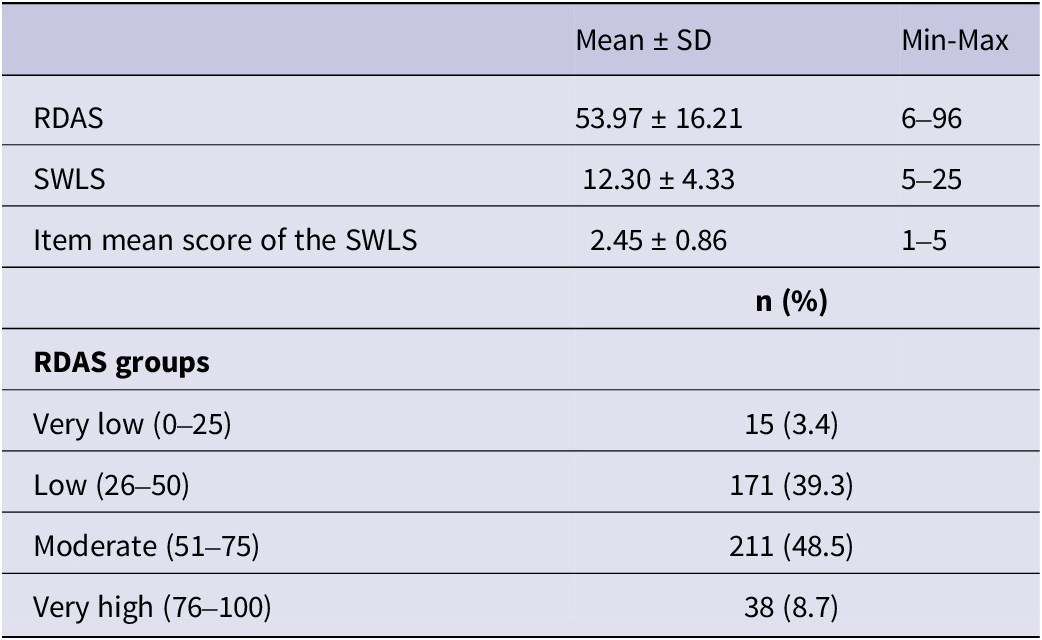
As shown in Table 3, the mean RDAS score of the participants was 53.97 ± 16.21. Their mean total SWLS score was 12.30 ± 4.33, and the mean item score was 2.45 ± 0.86. In addition, of the participants’ RDAS scores, 3.4% were very low, 39.3% were low, 48.5% were moderate, and 8.7% were very high.
Descriptive statistics for RDAS and SWLS scores

Scale Scores According to Statements About the Earthquake Experienced
As shown in Table 4, the statistical analysis revealed the relationship between the study participants’ RDAS and SWLS scores and their perception of the earthquake.
Investigation of differences in scale scores according to statements about the earthquake experienced

t: Independent samples t-test; F: One-way analysis of variance (ANOVA) Difference: Tukey.
* P < 0.05.
Relationship Between RDAS and SWLS Scores
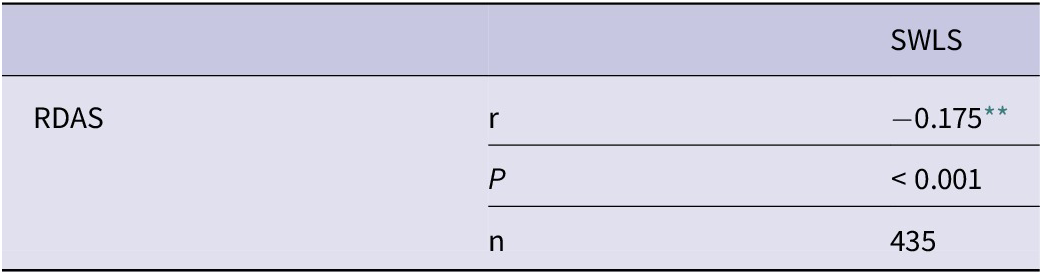
According to Table 5, the result of the correlation analysis showed that there was a statistically significant low-level negative relationship between RDAS scores and SWLS scores of the study participants (r = −0.175).
Analysis of the relationship between RDAS and SWLS scores

r: Pearson correlation coefficient.
** P < 0.01.
As shown in Table 6, the simple linear regression model established to investigate the effect of RDAS scores on SWLS scores is a statistically significant model (F = 13.760, P < 0.001).
Examination of the effect of RDAS scores on SWLS scores

β: Regression coefficient; DW: Durbin Watson.
* P < 0.05.
** P < 0.001
Discussion
In this section, the research findings are presented and analyzed in light of the existing literature. This study represents an original contribution to the field as it is the first of its kind to investigate the relationship between death anxiety and life satisfaction among individuals who have experienced an earthquake.
The results of this study revealed that nearly half of the individuals residing in the earthquake zone reported experiencing moderate levels of death anxiety, as indicated by the mean scores obtained on the RDAS scale (Table 3). Notably, participants who perceived the earthquake as a “natural disaster” demonstrated lower levels of death anxiety compared to those who perceived it as “a frightening situation,” “apocalypse,” and “loss and death.” Moreover, individuals who self-reported their psychological health as ”poor" following the earthquake exhibited significantly higher levels of death anxiety (Table 4). The existing literature indicates that various studies have investigated death anxiety using different measurement scales and samples.Reference Galehdar, Toulabi and Kamran22-Reference Tepe Medin, Hintistan and Ozoran24 After the Buffalo Creek Dam collapse, a natural disaster, Lifton and Olson (1999) interviewed 43 disaster survivors immediately after the event and found that death anxiety was high among these disaster survivors when the effects of the event were still new.Reference Erdur-Baker, Erdur-Baker and Doğan25 Since there were no other studies on earthquake survivors in the literature, the results of this study were compared with the results of some studies conducted on the COVID-19 pandemic, which was a sudden and unexpected event like a natural disaster. Çağlar and Kaçer (2021) compared 3 groups, including those hospitalized due to COVID-19, heart attack survivors, and healthy volunteers, and found that the death anxiety scores of patients hospitalized due to COVID-19 were higher than other groups.Reference Çağlar and Kaçer26 Several studies found high levels of death anxiety in participants who had COVID-19 during the period when the number of cases was rapidly increasing.Reference Ozer, Aksoy and Turan27, Reference Şahan and Yıldız28 Another study found that participants experienced mild death anxiety during the COVID-19 pandemic.Reference Lok, Aydın and Uzun29 In contrast, another study found a moderate level of death anxiety associated with COVID-19.Reference Ozgüç, Kaplan Serin and Tanriverdi30 In this study, the fact that participants who perceive earthquakes negatively have a heightened fear of death indicates that earthquakes adversely affect their mental health.
In addition, the first 3 expressions used by the participants to define the earthquake in the study (“a frightening situation,” “disaster,” “apocalypse”) showed that these perceptions explain their moderate level of death anxiety (Table 2). People generally experience anxiety in the face of unknown and unexpected events. This level of anxiety can vary from low to high depending on the severity of the situation. In this natural disaster, which has been called the disaster of the century, people have experienced many aftershocks. Therefore, they repeatedly experience fear of death. However, it was found that the participants did not indicate an effective coping method both at the beginning and now (Table 2). It is believed that by adding coping methods to the plans for health services to be provided to earthquake victims, the level of anxiety will be reduced to eliminate this recurrent anxiety.
In this study, the RDAS scores showed statistically significant differences according to the variables of the definition of the earthquake, evaluation of psychological health after the earthquake, methods of coping at the beginning, and acceptance of the event (Table 4). The participants in this study who defined the earthquake as “loss and death” reported that they felt psychologically bad after the earthquake, tried to cope with this situation by crying, and still did not accept the event. Unfortunately, such a traumatic event (earthquake, flood, epidemic, etc.), which occurred unexpectedly, was experienced not only by the individual but also by those around him/her. This traumatic situation can affect almost everyone differently. They may have different reactions. For this reason, we should provide appropriate care and support by taking into account what individuals say about the earthquake they have experienced. There are findings in the literature that the level of fear experienced during an earthquake has significant effects on post-earthquake mental health.Reference Livanou, Kasvikis and Basoglu31, Reference Salcıoglu, Basoglu and Livanou32 This may be due to the events experienced and emotional states felt during and after the earthquake.
In this study, the life satisfaction of earthquake survivors was found to be low according to the mean SWLS score (Table 3). Since this study is the first study on the life satisfaction of earthquake survivors, the results were compared with studies that used the same scale in different samples. In these studies, the life satisfaction of nurses was found to be low during COVID-19, which is a sudden and unexpected situation.Reference Lok, Aydın and Uzun29, Reference Karabag Aydın and Fidan33, Reference Teke, Özer and Bahçecioğlu Turan34 The mean score of life satisfaction in the study is similar to the literature. Different studies conducted during the COVID-19 pandemic found that participants had moderate life satisfaction.Reference Lok, Aydın and Uzun29, Reference Ozmen, Ozkan and Ozer35, Reference Zhang, Wang and Rauch36 A minority of participants reported poor physical health after the earthquake, and about two-thirds reported poor psychological health after the earthquake. However, the majority of the participants used the expressions “I was afraid,” “panicked,” and “shocked” to describe their feelings about the earthquake (Table 2). These findings support a low level of life satisfaction. A higher rate of negative evaluations compared to positive evaluations in a person’s life leads to a low level of life satisfaction.Reference Myers and Diener17 In light of all this information, it was concluded that individuals who experienced the earthquake, which caused significant changes in the participants’ lifestyles, would have low life satisfaction due to their psychologically negative self-evaluations.
In this study, SWLS scores showed statistically significant differences according to the variables of loss of first-degree relatives in the earthquake, evaluation of physical health after the earthquake, evaluation of psychological health after the earthquake, coping with the situation at the beginning, coping with the situation now, acceptance of the experienced event, and the most important factor in accepting the event (Table 5). Most of the individuals who participated in this study lost their first-degree relatives, had good physical health, and moderate psychological health, were able to cope with the situation at the beginning and now, accepted the event they experienced, and reported that the most important factor in this acceptance was their religious beliefs. Individuals may experience various emotional states intensely after an earthquake. However, these symptoms are expected to diminish over time.
In this study, life satisfaction is expected to decrease as death anxiety increases. The simple linear regression model showed that death anxiety affected life satisfaction, and the model explained 2.9% of the change in life satisfaction.
There are many studies in the literature supporting a negative relationship between death anxiety and life satisfaction in different samples.Reference Lok, Aydın and Uzun29, Reference Karabag Aydın and Fidan33, Reference Duong37–Reference Saeed and Bokharey42 During the COVID-19 pandemic, a negative relationship between anxiety and life satisfaction was found among participants in the Trzebiński et al. (2020) study.Reference Trzebiński, Cabański and Czarnecka40 Similarly, another study conducted during the COVID-19 pandemic found that mean life satisfaction explained 74.9% of the change in death anxiety. In addition, life satisfaction scores had a significant effect on death anxiety.Reference Lok, Aydın and Uzun29 In a study conducted by Arslan (2019) on college students, students with low death anxiety were found to have higher life satisfaction.Reference Arslan41 In their study, Saeed and Bokharey (2016) reported that death anxiety had a significant negative correlation with life satisfaction.Reference Saeed and Bokharey42 A study conducted among health care professionals during the COVID-19 pandemic found that life satisfaction and death anxiety were inversely correlated.Reference Tomaszek and Muchacka-Cymerman39 It can be thought that the earthquake resulting in the death of an individual or relative or causing injury negatively affected participants’ life satisfaction by leading them to experience death anxiety.
It is known that the religious belief of the people living in the earthquake zone in Turkey is Islam. It can be seen that the expressions of “auto-suggestion, family support, religious faith and prayer” were in the first 3 ranks as coping methods at the beginning to cope with the earthquake experienced by the participants, and the expressions of “shifting the focus, auto-suggestion, religious faith and prayer” were in the first 3 ranks as coping methods at the moment. It can be said that people mostly prefer “religious faith and prayer” as coping methods that do not change over time. In this sense, it can be assumed that faith comes to the fore when faced with events that cause death anxiety.
Limitations
The first limitation of this study was the fact that the participants consisted of only earthquake victims who volunteered to participate and that the snowball sampling method was used rather than random sampling method. In addition, the results of the study are valid only for the earthquake victims included in the study; therefore, they cannot be generalized to all people and the reliability of the data is limited to the accuracy of the answers given by the people who participated in the study.
Conclusion
The findings of this study indicate a negative association between death anxiety and life satisfaction. Consequently, health care professionals should offer increased psychological and communication support to individuals who have experienced significant disasters like earthquakes. Training programs should be implemented to equip individuals with strategies for coping with death anxiety. Furthermore, it is advisable to conduct follow-up interviews with individuals at a later time to identify any potential long-term symptoms resulting from the traumatic event. Training and psychological counseling interventions should be provided to address recurring death anxiety. The results of this study present an opportunity to identify the necessary support services for individuals following an earthquake.
Data availability statement
The data that support the findings of this study are available from the corresponding author, TS, upon reasonable request.
Acknowledgments
We would like to thank all the earthquake victims who participated and supported our study during this difficult process.
Author contribution
RTD concept, review, data searching, design, statistical extractions, analysis. AKA review, assisted in collecting the data. TS review, assisted in collecting the data, drafted the manuscript. ZÇ assisted in collecting the data. All authors provided critical review of the manuscript and approved the final draft for publication.
Funding statement
This research did not receive any specific grant from funding agencies in the public, commercial, or not-for-profit sectors.
Competing interests
The authors declare no conflict of interest.
Ethical standard
Approval No: 81829502.903/40, dated March 17, 2023 was obtained from the Ethics Committee for Non-Interventional Studies of Kafkas University, Faculty of Health Sciences. This study was conducted following the tenets of the Declaration of Helsinki.