Introduction
ENT presentations are prevalent in clinical practice. It is the third largest surgical specialty in the UK, with over 900 practising consultants.Reference Ferguson, Bacila and Swamy1,Reference Wilmot, Davis and Carrie2 ENT constitutes a significant portion of the workload in primary care, with ENT-related complaints accounting for 25 per cent of adult and 50 per cent of paediatric consultations.Reference Griffiths3,Reference Donnelly, Quraishi and McShane4 Despite this, ENT features little in medical school curricula and is estimated to comprise just 1 per cent of the UK undergraduate curriculum.Reference Davies and Elhassan5 The average duration of undergraduate ENT placement varies from 8 to 13.7 days, and a significant number of medical schools lack a mandatory ENT placement.Reference Ferguson, Bacila and Swamy1 As a result, most medical graduates are not confident managing even the most common ENT conditions.Reference Ferguson, Bacila and Swamy1 For these reasons, it is imperative that the limited time available for teaching undergraduate ENT is utilised efficiently.
In order to ensure effective use of teaching time, medical schools require evidence-based guidance regarding what should be included and prioritised in undergraduate specialty teaching. Until recently, no such guidance existed for ENT. This prohibited a standardised approach across UK medical schools.
In 2014, Lloyd published an evidence-based ENT undergraduate curriculum on the Student and Foundation Doctors in Otolaryngology UK website.Reference SFO6 This curriculum was developed using a Delphi study carried out to identify the key learning objectives for undergraduate training.Reference Lloyd, Tan, Taube and Doshi7 The Delphi process, an established method of curriculum development, uses a series of questionnaires to capture the collective opinion of a group of experts.Reference de Villiers, de Villiers and Kent8 Lloyd et al. asked a group of ENT consultants and specialist registrars, accident and emergency consultants and specialist registrars, general practitioners and paediatricians to rank 232 learning objectives using a Likert scale in two rounds of online questionnaires.Reference Lloyd, Tan, Taube and Doshi7 Outcomes determined to be less relevant were excluded and the remaining learning outcomes formed the syllabus of the ENT undergraduate curriculum. In order to further aid prioritisation of topics, outcomes with the highest scores were marked with an asterisk to indicate their particular importance.Reference Lloyd, Tan, Taube and Doshi7 For the first time, medical schools could access a structured national ENT syllabus to guide curriculum content and development. This curriculum will be referred to as the ‘ENT undergraduate curriculum’ from here on.
Aim
This study aimed to assess the extent that current UK medical school learning outcomes correlate with the syllabus of the ENT undergraduate curriculum.
Materials and methods
Design
Individual learning outcomes were identified from the ENT undergraduate curriculum. Learning outcomes were listed in a Microsoft Excel® spreadsheet to create a data collection proforma, allowing outcomes to be marked as either ‘met’ or ‘not met’ when compared to medical school curricula. Learning outcomes not explicitly related to ENT were excluded, such as ‘Build rapport with patients of different groups and their carers’. Broad outcomes such as this were felt to be achieved throughout the entirety of medical school and across a range of specialties.
Data collection
We identified 41 UK medical schools that award a primary medical qualification.9 New medical schools were excluded as they had not fully developed their curricula (n = 5). Where medical schools shared the same curriculum, only one was included (n = 2). The remaining 34 eligible medical schools were contacted by e-mail to seek approval to recruit medical students who could audit their undergraduate curriculum. Follow-up e-mails and telephone calls were made where required.
Two medical students were recruited from each approving medical school by distribution of an advertisement poster via undergraduate surgical societies. The students were asked to review all curriculum documents, study guides and handbooks that were related to ENT. This included any area of the curriculum where ENT learning outcomes may have been achieved, for example paediatrics and general practice. Curricula were reviewed during the 2018–2019 academic year. Students were asked to collect data independently, and then liaise with the other student in their pair to identify any discrepancies in their data. Where a discrepancy was found, the students were initially instructed to attempt to reach a consensus through discussion with one another. If uncertain or unable to reach a consensus, students were advised to contact the author (AWM) for guidance and provide all relevant learning materials supporting the learning outcome in question.
Ethical considerations
The Newcastle Joint Research Office was consulted and advised that there were no ethical considerations for this study.
Results
Curricula from 16 of the 34 UK medical schools (47 per cent) were reviewed. Reasons for not being included in the review were: refusal due to staff and student burden (n = 3); curriculum currently transitioning (n = 2); no response (n = 8); and an inability to recruit students (n = 5).
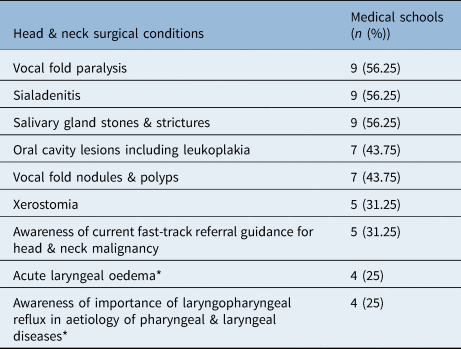
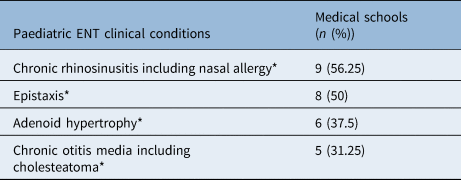
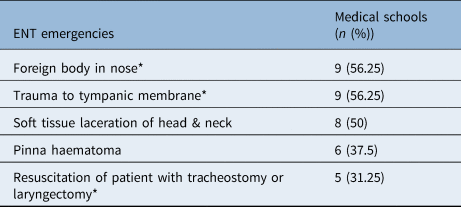
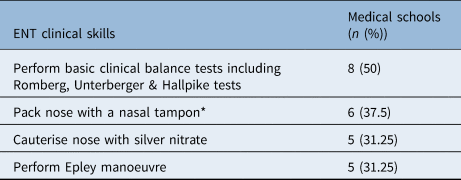
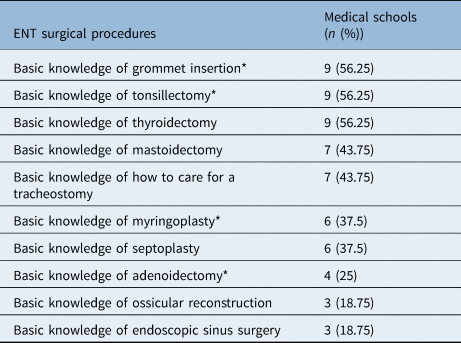
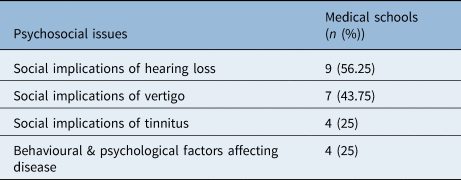
Learning outcomes that were met by less than 60 per cent of participating medical schools are shown in Tables 1–8. Topics that were identified as of particular importance in the ENT undergraduate curriculum are marked with an asterisk.
Learning objectives related to rhinological diseases

Learning objectives related to head and neck surgical conditions

*Indicates topics identified as of particular importance in the ENT undergraduate curriculum
Learning objectives related to paediatric ENT clinical conditions

*Indicates topics identified as of particular importance in the ENT undergraduate curriculum
Learning objectives related to ENT emergencies

*Indicates topics identified as of particular importance in the ENT undergraduate curriculum
Learning objectives related to ENT clinical skills

*Indicates topic identified as of particular importance in the ENT undergraduate curriculum
Learning objectives related to ENT surgical procedures

*Indicates topics identified as of particular importance in the ENT undergraduate curriculum
Learning objectives related to medications used in ENT

*Indicates topics identified as of particular importance in the ENT undergraduate curriculum
Learning objectives related to ENT-specific psychosocial issues

Discussion
The areas with the highest proportion of learning outcomes met were ENT anatomy and physiology, and adult otology. An area where a low proportion of outcomes was met was surgical procedures (Table 6). Grommets and tonsillectomy are amongst the most common surgical procedures performed in the UK.Reference Seymour10 General practitioners frequently refer patients for ENT procedures and are actively involved in their post-operative management. However, a survey of final year medical students at Newcastle University found that only one-third of aspiring general practitioners had seen a tonsillectomy or grommet insertion.Reference Doshi and Carrie11 Eight per cent of students surveyed had never heard of a septoplasty.Reference Doshi and Carrie11 This is reflective of a wider deficit in undergraduate surgical skills training, with only around one-quarter of medical schools teaching basic suturing.Reference Davis, Toll, Bates, Cole and Smith12 The migration of teaching surgical skills from undergraduate to post-graduate training may be a contributing factor to the declining interest in surgical careers amongst medical students.Reference Peel, Schlachta and Alkhamesi13
Only around one-third of medical schools provided teaching on the Epley manoeuvre. Benign paroxysmal positional vertigo has an estimated lifetime prevalence of 2.4 per cent and is thought to be the most common cause of vestibular vertigo. Evidence suggests that only a minority of patients receive effective treatment, despite the development of highly effective positioning manoeuvres.Reference von Brevern, Radtke, Lezius, Feldmann, Ziese and Lempert14
Only around one-third of medical schools taught students how to perform nasal packing or nasal cautery (Table 5). Epistaxis has a lifetime incidence of 60 per cent in the general population, and constitutes around one-third of emergency admissions to ENT.Reference Mehta, Stevens, Smith, Williams, Ellis and Hardman15,Reference Hall, Blanchford, Chatrath and Hopkins16 A recent large prospective observational study of epistaxis management in the UK showed that only 30 per cent of patients received management that complied with national guidance. The findings suggest a trend toward nasal packing as a first-line management strategy, without initially assessing for a bleeding point to perform nasal cautery. This illustrates that a lack of undergraduate teaching on basic ENT practical skills may be having a detrimental effect on patient outcomes and financial implications for the National Health Service (NHS).
A further area with a low proportion of outcomes met was medications used in ENT (Table 7). Only a minority of medical schools delivered teaching on topical ear drops. Patients with otitis externa are often inappropriately prescribed oral antibiotics in primary care, with an associated increase in disease persistence.Reference Pabla, Jindal and Latif17 Significant amount of antimicrobial prescriptions in primary care are for ENT-related problems. Dolk et al. reviewed primary care data in England from 2013 to 2015; one in five antibiotic prescriptions were for sore throat, upper respiratory tract infection or ear-related diagnoses.Reference Dolk, Pouwels, Smith, Robotham and Smieszek18 Further analysis of these data suggested that up to 23 per cent of antibiotic prescriptions were inappropriate, with sore throat, sinusitis or acute otitis media constituting over one-third of these prescriptions.Reference Smieszek, Pouwels, Dolk, Smith, Hopkins and Sharland19 Antibiotics were prescribed for 92 per cent of children with acute otitis media versus the ideal prescription rate of 17 per cent.Reference Pouwels, Dolk, Smith, Robotham and Smieszek20 This trend of antimicrobial prescribing in primary care exists despite the implementation of national guidelines.Reference Williams, Greene, Naik, Hughes, Butler and Hay21 Greater undergraduate education regarding the appropriate use of antimicrobials in common ENT conditions may help change this trend from an early stage of training.
Resuscitation of patients with laryngectomy and tracheostomy was taught by 31 per cent of medical schools (Table 4). In emergency situations, appreciation of the altered anatomy in laryngectomy and tracheostomy patients is crucial to ensure effective delivery of oxygen to the patient. Evidence suggests that a significant proportion of front-line emergency staff are unable to identify the correct route of oxygen administration in laryngectomy patients.Reference Darr, Dhanji and Doshi22 As a potential patient safety issue, this should be prioritised in undergraduate education, in concordance with its identification as a topic of importance in the ENT undergraduate curriculum.
Implications for practice
This poses the question: how do we address these deficiencies in ENT undergraduate education? Although prioritisation of topics is essential, the paucity of time allocated to ENT in medical school curricula remains a major barrier to achieving the standards of Lloyd's curriculum. First, we should consider whether teaching sessions utilise the allocated time efficiently. Integrating an examination skills session into an ENT undergraduate teaching programme is a simple yet effective intervention. A study of final year medical students at Newcastle University demonstrated that students found a 90-minute ENT examination skills session to be the most useful aspect of their 2-day ENT placement.Reference Mayer and Carrie23 These sessions provide the opportunity to teach key clinical skills, such as anterior rhinoscopy and basic epistaxis management.
Knowledge-based outcomes – for example, medications used in ENT – may be more amenable to an e-learning format. E-learning is an effective approach for teaching undergraduates otolaryngology, providing learners with control over the time, place and pace at which they learn.Reference Tarpada, Hsueh and Gibber24 These resources can be used to guide students’ learning during self-study toward areas not addressed during their placement. However, despite its effectiveness, only a minority of UK medical schools currently use e-learning.Reference Steven, Mires, Lloyd and McAleer25
Introductory courses to ENT have been shown to be an effective means of increasing junior doctors’ confidence in managing common ENT emergencies.Reference Gough, Biggs, Bird, Kane and Patel26,Reference Elloy and Sama27 Given that a desire for more undergraduate ENT experience is common amongst newly qualified doctors,Reference Powell, Cooles, Carrie and Paleri28 greater availability of such courses targeted at medical students approaching qualification may be popular for examination preparation and in preparation for clinical practice.
Comparison with literature
In 2017, Steven et al. examined ENT curricula documents from 19 UK medical schools.Reference Steven, Mires, Lloyd and McAleer25 Several similarities can be seen when these results are compared with our own. Both studies found that ENT-related psychosocial issues were covered less often. Furthermore, topics that were mentioned most frequently, for example epistaxis, and least frequently, for example pinna haematoma, broadly aligned. However, topics were taught by a relatively greater proportion of medical schools in our study. For example, 93.75 per cent of medical schools covered acute tonsillitis, in contrast to 58 per cent reported by Steven et al. There are several confounding variables to acknowledge: the included medical schools were not matched, and curricula may have been revised during the three-year period between the two studies. Nevertheless, as our study examined the entire medical school curriculum, this may represent ENT teaching from allied specialties such as paediatrics and general practice, and the disparity between the intended curriculum and the curriculum in action.
Implications for research
Outcomes marked of importance in the ENT undergraduate curriculum did not appear to be preferentially taught by medical schools. Insufficient time has passed for these recommendations to be widely implemented into medical school curricula. However, given the limited teaching time available, it would be advisable that any new ENT curriculum align with the recommendations of the ENT undergraduate curriculum. Seven medical schools were not included in our study because of an incomplete or transitioning curriculum. Once complete, an examination of these curricula may act as a barometer for change in ENT undergraduate education.
Limitations
Less than half of eligible medical schools agreed to participate in the study, meaning that conclusions drawn may not be generalisable across all UK medical schools. Furthermore, there is a risk of selection bias, where only those schools with more developed ENT curricula may have responded. We examined the syllabus in isolation, without gathering data on other aspects of the curriculum such as placement duration, teaching methods, assessment or feedback. Therefore, no appraisal of the quality or extent of teaching could be made.
• ENT is under-represented in undergraduate curricula
• Most medical graduates are not confident in managing common ENT conditions
• In 2014, the first evidence-based ENT undergraduate curriculum was published to guide UK medical schools
• Topics of importance identified in the ENT undergraduate curriculum are not preferentially taught by UK medical schools
• Only a minority of UK medical schools deliver teaching on ENT surgical procedures, nasal packing or cautery, ENT medications, laryngectomy or tracheostomy
The recruitment of two medical students at each university to independently collect data assured inter-observer reliability. However, one medical student withdrew from the study, leaving only one student at that participating medical school to collect data. Interpretation of whether a learning outcome was met is inherently open to bias. Furthermore, medical student pairs were not directly supervised by a doctor during data collection to ensure their interpretation of learning outcomes was appropriate. Discussion of discrepancies in data was not supervised to ensure this was an unbiased interaction.
Overall, these limitations reduce the internal validity of the findings. In other words, these sources of bias may confound the conclusions drawn from our results.
Conclusion
There is wide variability in the content of ENT undergraduate education between UK medical schools. A significant proportion of ENT teaching may be delivered in allied areas such as general practice and paediatrics. Important omissions in medical school curricula may have detrimental implications for patient outcomes in the NHS. Careful consideration of which topics are prioritised, as well as the teaching modalities utilised, is essential in a time-restricted curriculum. In addition to this, ENT learning opportunities for undergraduates outside of the medical school curriculum should be made widely available.
Competing interests
None declared