INTRODUCTION
Sleep disturbance (SD) is common in patients with advanced cancer. Advanced cancer patients experience SD 24–95% of the time (Koopman et al., Reference Koopman, Nouriani and Erickson2002; Berger et al., Reference Berger, Parker and Young-McCaughan2005; Lianqi & Ancoli-Israel, Reference Lianqi and Ancoli-Israel2008). This wide range in frequency reflects the use of different definitions of SD, different assessment tools, and varied methodologies. Sleep disturbance is experienced along the entire course of the illness (Berger et al., Reference Berger, Parker and Young-McCaughan2005; Palesh et al., Reference Palesh, Roscoe and Mustian2010; Mystakidou et al., Reference Mystakidou, Parpa and Tsilika2007), and it often intensifies during treatment (Palesh et al., Reference Palesh, Roscoe and Mustian2010), thus affecting a patient's quality of life.
Patients who experience SD can also experience significant distress due to a decline in cognitive function, an inability to engage in work or recreational activities, loss of hedonic capacity, lower quality of life, and adverse alterations to immune and neuroendocrine functions (Berger et al., Reference Berger, Parker and Young-McCaughan2005; Redwine et al., Reference Redwine, Hauger and Gillin2000; Davidson et al., Reference Davidson, MacLean and Brundage2002; Lamberg et al., Reference Lamberg2000). Even so, SD is frequently underdiagnosed and undertreated in clinical oncology practice (Berger et al., Reference Berger, Parker and Young-McCaughan2005; Ancoli-Israel, Reference Ancoli-Israel2009).
Few studies have assessed the severity of SD among patients receiving outpatient palliative care or identified factors and symptoms associated with the severity of SD. Apart from cancer-related symptoms (e.g., pain, fatigue, anxiety, and depression), other factors — such as cancer itself (Mystakidou et al., Reference Mystakidou, Parpa and Tsilika2007; Ancoli-Israel, Reference Ancoli-Israel2009; Sela et al., Reference Sela, Watanabe and Nekolaichuk2005; Mercadante et al., Reference Mercadante, Girelli and Casuccio2004; Parker et al., Reference Parker, Bliwise and Ribeiro2008; Mystakidou et al., Reference Mystakidou, Parpa and Tsilika2009; McMillan et al., Reference McMillan, Tofthagen and Morgan2008; Gibbins et al., Reference Gibbins, McCoubrie and Kendrick2009; Palesh et al., Reference Palesh, Collie and Batiuchok2007), female sex, family history of SD or anxiety, cancer treatment, medications that include alcohol, and hospitalization — have been associated with SD (Parker et al., Reference Parker, Bliwise and Ribeiro2008; Clark et al., Reference Clark, Cunningham and McMillan2004; Sharma et al., Reference Sharma, Hansen and O'Connor2011). In addition, as sleep correlates with other cancer-related symptoms that contribute to distress, strategies to characterize, assess, and mitigate sleep problems are important.
Although SD is common and distressing in patients with advanced cancer, there is limited literature on the frequency, intensity, and correlates of SD at the time of the initial outpatient palliative consultation. There are also no published studies to date investigating the response rate of sleep disturbance to outpatient palliative care consultation. In addition, although vast amounts of information are available about the positive impact of supportive care consultation on cancer-related symptoms, the complexity of SD may make it hard to control with only one visit and limited follow-up. Recent studies indicate that most patients have only one or two follow-up visits due to late referral and the logistics of receiving care in a comprehensive cancer center away from home (Dalal et al., Reference Dalal, Palla and Hui2011). Hence, it is vital to obtain prompt control of SD within a short period of time using supportive care. Information regarding SD at the initial consultation and determining the factors associated with improvement after the initial consultation would provide preliminary data for future prospective controlled trials.
The primary aim of our study was to determine the frequency, intensity, and correlates of SD as assessed with the Edmonton Symptom Assessment System (ESAS) sleep item at the time of initial consultation. The secondary aims were to determine the response rate between baseline and initial follow-up after an outpatient supportive care consultation and to identify the predictors of improvement in the ESAS sleep item score at the first follow-up visit.
PATIENTS AND METHODS
We retrospectively reviewed the electronic medical records of 1316 consecutive advanced cancer patients seen for initial consultation at the outpatient supportive care clinic (OPC) at The University of Texas MD Anderson Cancer Center from January 1, 2008 through February 20, 2010. Only patients who had completed an ESAS questionnaire at the initial visit and at any follow-up visits within 7–30 days of the initial visit were eligible for inclusion. Of the 1316 patients screened, a total of 442 met the eligibility criteria. The characteristics and symptoms of patients with and without follow-up were compared to determine if the study sample truly represented the OPC advanced cancer population.
Information regarding patient characteristics, frequency of sleep, and cancer-related symptoms were recorded using the validated ESAS scale, and changes in SD at the time of follow-up were analyzed.
Symptom Measurement
The severity of symptoms was determined by reviewing ESAS scores and other information in the patients' electronic records. The consultation notes completed by the palliative care team and medical orders (including pharmacological and nonpharmacological interventions) were also examined.
ESAS
The ESAS was designed to determine severity during the previous 24 hours of nine symptoms commonly experienced by cancer patients: pain, fatigue, nausea, depression, anxiety, drowsiness, dyspnea, anorexia, and feelings of diminished well-being. An optional “other symptom” (the tenth symptom on the ESAS tool) could also be reported by the patient. The ESAS questionnaire designed for prospective symptom severity data collection at our center uses patient-reported SD as a mandatory tenth symptom (Delgado-Guay et al., Reference Delgado-Guay, Yennurajalingam and Parsons2011; Bruera et al., Reference Bruera, Kuehn and Miller1991). The severity of each symptom is rated on a 10-point scale (0 = no symptom, 10 = worst possible severity). The ESAS is both valid and reliable in assessment of symptom intensity in cancer patients. The overall Cronbach's alpha coefficient for the ESAS instrument in this population was 0.79 (Bruera et al., Reference Bruera, Kuehn and Miller1991) and 0.75 (Carvajal et al., Reference Carvajal, Centeno and Watson2011). A symptom distress score (SDS) is defined as a composite score of the symptoms on the ESAS.
Screening of SD
To determine the frequency of SD, we used a cutoff score of 3/10 on the ESAS sleep item. This is based on a prior published validation study of the ESAS sleep item where it was compared to the Pittsburgh Sleep Quality Index (PSQI) as the gold standard. In our study, the cutoff score of ≥3 of 10 on the ESAS sleep item had a 0.74 sensitivity and 0.73 specificity for diagnosis of sleep disturbance according to the PSQI (score ≥5) (Delgado-Guay et al., Reference Delgado-Guay, Yennurajalingam and Parsons2011). In addition, the positive predictive value for an ESAS score ≥3 out of 10 was 0.94 (Delgado-Guay et al., Reference Delgado-Guay, Yennurajalingam and Parsons2011). The PSQI has been validated to measure the quality and patterns of sleep (Buysse et al., Reference Buysse, Reynolds and Monk1989). It differentiates “poor” from “good” sleep by measuring subjective sleep quality, sleep latency, sleep duration, habitual sleep efficiency, sleep disturbances, use of sleeping medication, and daytime dysfunction. A patient indicates how frequently each item was experienced on a scale from 0 to 3. The seven component scores are then summed to obtain a global sleep score that can range from 0 to 21. A score above 5 indicates poor sleep (Buysse et al., Reference Buysse, Reynolds and Monk1989). This self-report tool has internal consistency, as indicated by an overall reliability coefficient (Cronbach's α) of 0.83 (Buysse et al., Reference Buysse, Reynolds and Monk1989).
Outpatient Supportive Care Service
Care at The University of Texas MD Anderson Cancer Center's Supportive Care Center is provided by an interdisciplinary palliative care team led by board-certified palliative care specialists. Ten specialists work as a team and provide mutual coverage in cases of absence or illness, so that there are never clinic cancellations. This helps the team to maintain a homogeneous approach to assessment, management, and communication with patients and their families. The other team members include a registered nurse trained specifically in palliative care, a pharmacist, a nutritionist, a chaplain, a social worker, and a counselor. Other services such as wound management, speech therapy, occupational therapy, and physical therapy are consulted as needed. The care of all patients follows a standardized management plan (Elsayem & Bruera, Reference Elsayem and Bruera2008). Patients and their families are initially assessed by the registered nurse using tools such as the ESAS, the Memorial Delirium Assessment Scale [MDAS] (Breitbart et al., Reference Breitbart, Rosenfeld and Roth1997), and constipation and family support questionnaires. The findings are then discussed with a palliative care specialist, who then conducts an interview with the patient and family and performs a physical examination. The physician and nurse then ask appropriate members of the interdisciplinary team to participate based on the patient's and family's individual needs. The interventions and care provided by the interdisciplinary team follow palliative care guidelines established by the National Comprehensive Cancer Network and National Consensus Project for Quality Palliative Care and outlined elsewhere (NCP, 2009). These guidelines focus on: (a) assessing and managing cancer-related symptoms, including SD; (b) providing assistance to the patient's and caregivers' understanding of the disease and treatment goals; and (c) providing assistance to the patient and caregivers in coping with the life-threatening illness and in decision-making.
A standardized treatment plan is followed for the management of SD. Nonpharmacological measures are universal, including sleep hygiene (avoidance of daytime napping, not going to bed until drowsy, avoidance of psychostimulants such as caffeine in the afternoon/evening), exposure to natural light during the day, and exercise. Hypnotics are avoided; however, mirtazapine is usually prescribed if a patient has SD along with depression, and olanzapine is usually provided for severe emotional distress and anxiety concomitant with SD. Another commonly used medication is melatonin, especially if SD is associated with anorexia or fatigue.
Institutional Review Board Approval
We received institutional review board approval for this retrospective study, as well as waiver of informed consent.
Statistical Analysis
Descriptive statistics (e.g., means, standard deviations, medians, and ranges) were employed to summarize the continuous demographic and clinical characteristics as well as baseline, follow-up, and change in ESAS sleep item scores. Spearman correlation coefficients were used to determine the associations between baseline sleep score and cancer-related symptoms, including pain, as measured by the ESAS and age. Associations of race, gender and other categorical variables to ESAS score were tested using analysis of variance (ANOVA) and two-sample t tests. Patient characteristics and symptoms between patients with consult plus follow-up and patients with initial visit only were compared using t tests and Fisher's exact tests.
Definition of Response. Different studies have addressed the change in such subjective outcomes as quality of life and symptoms (Follwell et al., Reference Follwell, Burman and Le2009; Joly et al., Reference Joly, Vardy and Pintilie2007; Osoba et al., 1998) For symptom variables such as those included in the ESAS (Follwell et al., Reference Follwell, Burman and Le2009) and in most quality-of-life tools that include pain and sleep disturbance, an improvement of 1 point on a 0–10 scale is considered clinically significant (Follwell et al., Reference Follwell, Burman and Le2009; Joly et al., Reference Joly, Vardy and Pintilie2007; Osoba et al., Reference Osoba, Rodrigues and Myles1998). Therefore, we defined a response as a 1-point improvement in the ESAS sleep item score between baseline and initial follow-up after an outpatient supportive care consultation for SD (Follwell et al., Reference Follwell, Burman and Le2009; Joly et al., Reference Joly, Vardy and Pintilie2007; Osoba et al., Reference Osoba, Rodrigues and Myles1998).
Frequencies and proportions were employed to present the categorical demographic and clinical characteristics as well as response rate. The ANOVA was used to examine the effect of cancer type on baseline ESAS sleep scores. Two-sample t tests were utilized to identify pairwise differences in baseline ESAS sleep scores between various cancer types. An exact binomial confidence interval was calculated for response rate. The variables sex, race, age group, opioids, steroids, and anxiolytics, and each of the baseline ESAS items were employed in the univariate and multivariable logistic regression models to identify the predictors of response to outpatient supportive care consultation.
RESULTS
Patient Characteristics
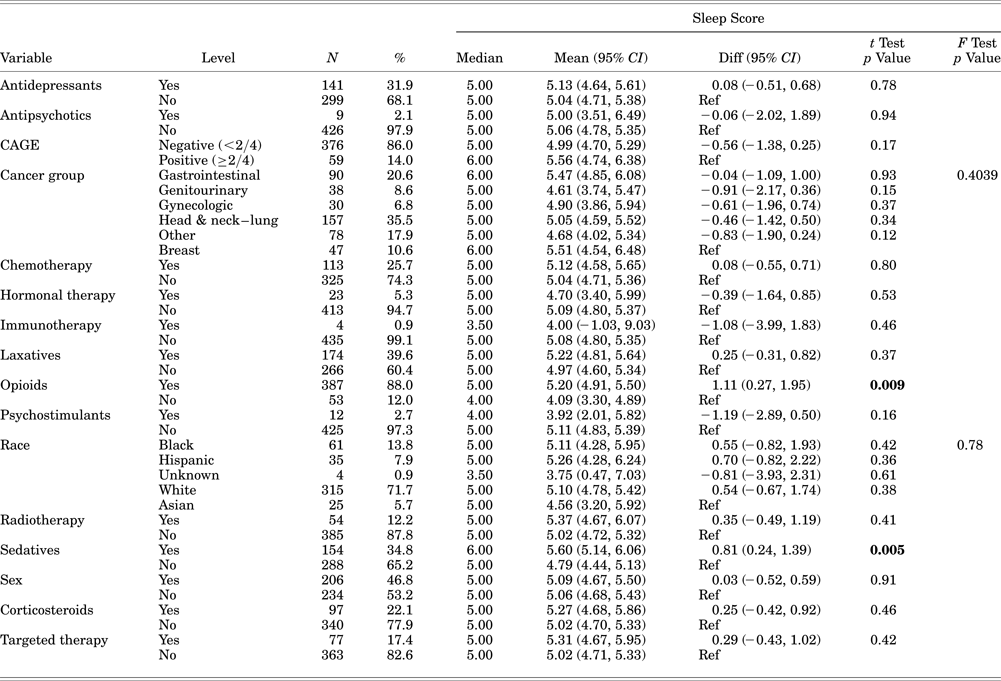
Patient characteristics are detailed in Table 1. The median age was 58 years; 53% were male. The baseline median ESAS sleep item score was 5 (25th and 75th quartiles, 2.25–8); the mean (± standard deviation) was 5.1 (± 3). The median time between visits was 15 days. Of the sample of 442 patients, 330 (75%) had scores indicating SD (≥3/10). The median ESAS sleep item score at follow-up was 4 (25th and 75th quartiles, 2–7); the mean (± standard deviation) was 4.5 (± 2.9).
Patient characteristics and risk of elevated baseline ESAS sleep item score for categorical variables

Abbreviations, ESAS: Edmonton Symptom Assessment Scale. CAGE: screening tool for alcoholism. Cut down. Annoyed. Guilty. Eye-opener.
Correlation Between Baseline SD and Baseline Characteristics
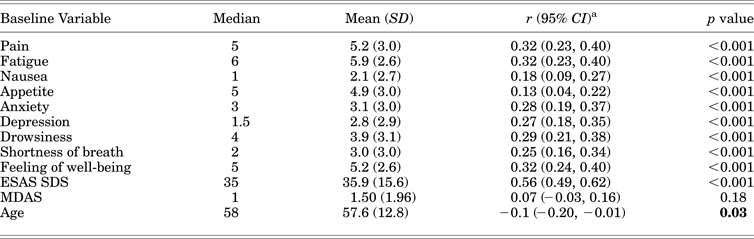
No univariate associations between baseline SD and demographic variables were found (Table 1). There were no univariate associations between baseline SD and medications at presentation except for sedative use (Table 1). The ANOVA detected no statistically significant differences (p = 0.40) in baseline SD among the six cancer types. Baseline SD significantly correlated with all ESAS symptoms; no correlation with the MDAS was found (Table 2).
Correlation of baseline ESAS sleep score with other continuous variables (N=442)
Abbreviations, ESAS: Edmonton Symptom Assessment Scale; MDAS: Memorial Delirium Assessment Scale; SDS = symptom distress score.
ar = Spearman correlation coefficient.
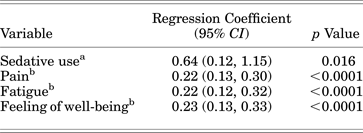
The multivariable regression model found intensity of baseline ESAS sleep item scores to be associated with baseline sedative use, baseline ESAS pain scores, baseline ESAS fatigue scores, baseline ESAS feeling of well-being scores, and sedative use (R 2 = 0.22) (Table 3).
Multivariable model predicting baseline ESAS sleep score (N = 442 R 2 = 0.22)
Abbreviations, ESAS: Edmonton Symptom Assessment Scale.
aComparison of 154 users (35%) to 288 nonusers (65%).
bBaseline.
Correlation Between Changes in SD with Change in Other ESAS Symptoms
There was a statistically significant correlation between SD and other ESAS symptoms: pain (r = 0.17, p = 0.002); fatigue (r = 0.23, p < 0.0001); nausea (r = 0.10, p = 0.03); depression (r = 0.18, p = 0.0001); anxiety (r = 0.17, p = 0.0002); appetite (r = 0.24, p < 0.0001); drowsiness (r = 0.12, p = 0.007); feeling of well-being (r = 0.25, p < 0.001); and shortness of breath (r = 0.24, p < 0.001).
Association Between Response to Outpatient Palliative Consultation For SD and Baseline Characteristics
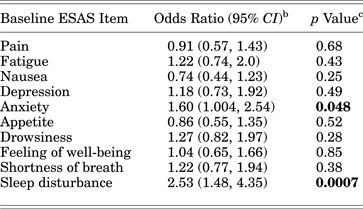
An SD response (≥1 of 10 decrease) on the ESAS sleep item was seen in 196 (59%; 95% CI, 53.9–64.6%) of the 330 patients with clinically significant baseline SD (≥3). Additionally, an SD response of ≥30% (≥2 of 10 decrease) on the ESAS sleep item was seen in 166 (50%). Higher baseline SD (odds ratio (OR) = 2.53; p = 0.0007) and anxiety scores (OR = 1.59; p = 0.048) were associated with a response in patients with moderate to high baseline SD (Table 4). Use of such medications as anxiolytics/hypnotics, steroids, and opioids as a part of the consultation was not associated with an SD response, nor was delirium.
Univariate analyses of baseline ESAS subscales as predictors of response of sleep disturbance to outpatient supportive care consultationa
a Sleep improvement is defined as a 1-point decrease from baseline on a ESAS sleep item score of 0–10. Analyses were based on the subset of patients with a baseline ESAS sleep score ≥3 (N=330).
bComparison of high-category (≥4) versus low-category (<4).
cWald chi-square test.
ESAS = Edmonton Symptom Assessment Scale. CI = confidence interval.
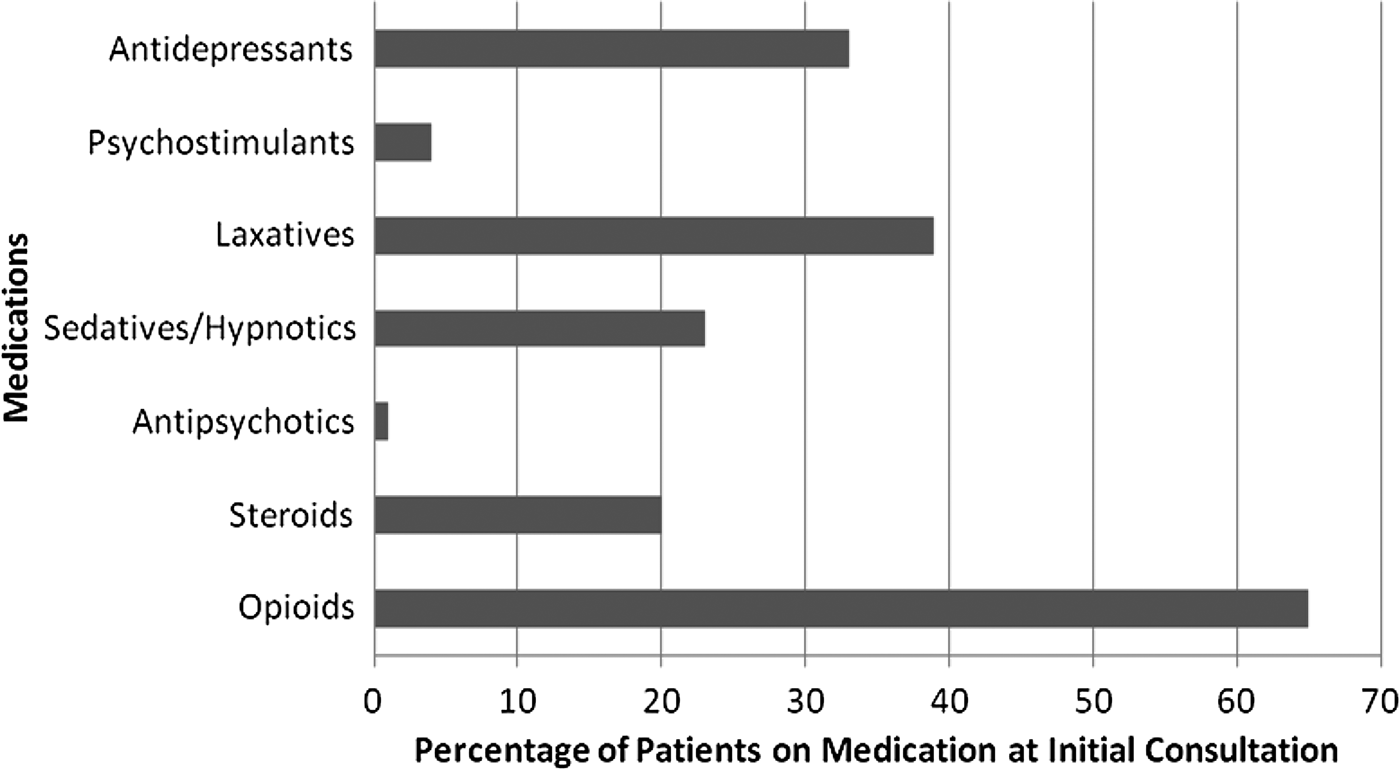
Medications by class at the initial consult and medication changes after the initial outpatient supportive care consultation are summarized in Figures 1 and 2, respectively.
Medications by class at time of initial outpatient supportive care consultation (N = 258).
Common pharmacological interventions by class after initial outpatient supportive care consultation (N = 440).
DISCUSSION
We found that 75% of the patients had clinically significant SD (ESAS sleep item score ≥3/10) at the initial visit. We also found that 59% of patients with clinically significant baseline SD had decreased SD severity following an outpatient supportive care consultation. The severity of SD and anxiety at initial visit predicted response at first follow-up.
Only a few studies have assessed the severity of SD among patients receiving supportive care or have identified associated factors and symptoms associated with severity. In a study by Sela et al. (Reference Sela, Watanabe and Nekolaichuk2005) at a multidisciplinary pain and symptom control clinic, high correlations were found between difficulty falling asleep and fatigue (r = 0.61), early awakening and fatigue (r = 0.59), and difficulty falling asleep and anxiety (r = 0.57). A study by Mystakidou et al. (2009) found posttraumatic experience and quality of life to be the strongest predictors of sleep quality. A prospective audit by Hugel et al. (2008) found pain to be the most common cause of SD. Urinary frequency and dyspnea were the next most common causes. A prospective study by Gibbins et al. (Reference Gibbins, McCoubrie and Kendrick2009) found that patients with SD had significantly higher anxiety and pain compared to those without. Mercadante et al. (Reference Mercadante, Girelli and Casuccio2004) found a significant association of less restoring sleep with fatigue and drowsiness in 123 advanced cancer patients. In a more recent study, we found that SD was associated with increased frequency of pain, depression, and anxiety and with a worse sense of well-being (Delgado-Guay et al., Reference Delgado-Guay, Yennurajalingam and Parsons2011). In the present study, the frequency of SD at time of initial consult was similar to that seen in studies mentioned above (Mystakidou et al., Reference Mystakidou, Parpa and Tsilika2007; Sela et al., Reference Sela, Watanabe and Nekolaichuk2005; Mercadante et al., Reference Mercadante, Girelli and Casuccio2004; Hugel et al., Reference Hugel, Ellershaw and Cook2004). Sleep disturbance was associated with sedative use, pain, fatigue, and feeling of well-being in our multivariate analysis, suggesting that patients with persistent symptoms such as fatigue, feelings of diminished well-being, and pain should undergo regular screening for SD. Unfortunately, our model only explains 22% of the variance in SD. The correlation of change in SD with change in other ESAS symptoms provides us with further information on the extent of improvement in SD and how it is linked to changes in other ESAS symptoms. More research is necessary to better characterize the contributing factors of SD in palliative care patients.
Though prior studies have been undertaken to determine the frequency and association of SD in patients with advanced cancer presenting to outpatient supportive care clinics (Sela et al., Reference Sela, Watanabe and Nekolaichuk2005; Mercadante et al., Reference Mercadante, Girelli and Casuccio2004; Parker et al., Reference Parker, Bliwise and Ribeiro2008, Sharma et al., Reference Sharma, Hansen and O'Connor2011; Delgado-Guay et al., Reference Delgado-Guay, Yennurajalingam and Parsons2011; Berger et al., Reference Berger, Kuhn and Farr2009), we believe that ours is the first to describe an SD response to initial supportive care consultation — that there is a moderate positive response to supportive care consultation. Our results suggest that a prospective study is needed to determine whether improvement in SD is due to specific interventions or simply a marker of improvement in other symptoms.
Interestingly, our study found no association between SD or its improvement and gender, race, or cancer type; treatment with radiotherapy, chemotherapy, immunotherapy, targeted therapy, or hormonal therapy; use of opioids, steroids, antipsychotics, or psychostimulants; alcoholism; or delirium. Prior studies have found significant association with many of these factors (Mercadante et al., Reference Mercadante, Girelli and Casuccio2004; Parker et al., Reference Parker, Bliwise and Ribeiro2008; Clark et al., Reference Clark, Cunningham and McMillan2004; Berger et al., Reference Berger, Kuhn and Farr2009). Our findings may result from the fact that our patients had a high overall symptom burden due to the advanced status of their cancers and so the above-listed variables had lesser significance. We recommend that a prospective study to determine the association of various risk factors in outpatient supportive care patients with SD as well as the impact of palliative consultation on SD improvement be conducted.
The importance of the present study is that it is the first to provide data regarding the impact of supportive care consultation on SD. The speed of improvement — 59% of patients with moderate to severe SD improved by first follow-up following an outpatient supportive care consultation — is important because cognitive-behavior therapy, a standard treatment for SD, requires more than a few sessions to be effective (Koopman et al., Reference Koopman, Nouriani and Erickson2002; Espie et al., Reference Espie, Fleming and Cassidy2008).
Our study also provides data concerning pharmacological interventions during the initial palliative consultation to improve such cancer-related symptoms as SD. These data will provide preliminary data for future prospective controlled studies to effectively manage SD.
This study does have several limitations, including its retrospective design, a reliance on a single-item measure of sleep disturbance, and a lack of a comparator group to evaluate for time-dependent changes.
The collected data concerning pharmacological intervention at the initial palliative consultation to improve cancer-related symptoms will provide preliminary data for future prospective controlled studies and will contribute to the effort to effectively manage SD.
CONCLUSION
The frequency and severity of self-reported SD in patients with advanced cancer seen in outpatient supportive care centers were high. Response to interdisciplinary supportive care for SD was low. The severity of SD and anxiety at the initial visit predicted response at the first follow-up visit. Further research is greatly needed.
ACKNOWLEDGMENTS
Sriram Yennurajalingam is supported in part by a grant from the American Cancer Society (RSG-11-170-01-PCSM). The authors sincerely acknowledge the contribution of Ray Chacko, B.B.A., Kenneth Tarleton, B.S.N., R.N., in data collection, and Bryan F. Tutt in scientific editing. A part of this study was presented at the 2011 American Society of Clinical Oncology annual meeting.