Introduction
A brain injury represents a sudden change and transition that affects not only body and brain, but all aspects of life (i.e., family, identity, wellbeing, job situation, etc.). Therefore, a process of recovering one's life must begin and, ideally, rehabilitation supports this general process. Correspondingly, a paradigmatic change in brain injury rehabilitation in the late 1980s recommended a change in focus from purely physical aspects to a broader picture including the psychosocial consequences of brain injury. Psychosocial functioning can be understood as mental wellbeing, having interpersonal and social relationships and self-mastery (WHO, 2001).
Even though it is well known that clients with an acquired brain injury (ABI) are at risk of mental health problems (e.g., Morton & Wehman, Reference Morton and Wehman1995; Teasdale & Engberg, Reference Teasdale and Engberg2004; Reference Teasdale and Engberg2005), less is known about what influences these problems, for instance, is there a connection between a client's physical and cognitive status and mental wellbeing? Or are psychosocial consequences a result of the ABI's impact on life transition?
The rehabilitation process following ABI is characterized by several transitions. A transition is defined as a passage from one life phase, condition or status to another (Schlossberg, Reference Schlossberg1984). Parkes (Reference Parkes1971) originally introduced transitions as a conceptual framework for research into managing chronic illnesses. Transitions occur when a major change requires an individual to restructure ways of perceiving the world and to develop new ways of living in it (Parkes, Reference Parkes1971). The transition framework gives attention to the post-acute phase of recovery and the changes that occur over time. Usually a transition is precipitated by a triggering event (e.g., an ABI). This trigger initiates a change in the way individuals understand themselves and their situations (Schlossberg, Waters, & Goodman, Reference Schlossberg, Waters and Goodman1995). According to Schlossberg et al. (Reference Schlossberg, Waters and Goodman1995), there are two universal properties of transitions: (a) transitions happen over time and (b) transitions include a change in nature (e.g., identity, role, relationships, behaviour, abilities, etc.).
An ABI produces an abrupt transition in life. Survivors of ABI often ask ‘Will I be normal?’, ‘Why did this happen to me?’ or ‘Is life worth living now?’ (Prigatano, Reference Prigatano1999). They are pondering whether or not they will be able to re-establish a sense of purpose or meaning in life and a (new) sense of self. If the first two questions can be answered in a positive manner, then the third question typically can be too (Prigatano, Reference Prigatano1999). If these questions cannot be positively addressed, depression and a decreased quality of life can occur, in some cases even leading to suicide (Morton & Wehman, Reference Morton and Wehman1995; Prigatano, Reference Prigatano1991; Teasdale & Engberg, Reference Teasdale and Engberg2004; Reference Teasdale and Engberg2005).
There are three key transitions in ABI rehabilitation to consider: (1) from hospital to inpatient rehabilitation, (2) from inpatient rehabilitation to home and (3) return to productivity. For younger clients, a fourth transition was identified: (4) from school to work (Rumble, Reference Rumble, Noggle, Dean and Barisa2013). Turner, Fleming, Ownsworth, & Cornwell (Reference Turner, Fleming, Ownsworth and Cornwell2008) conducted an extensive literature review to explore how individuals with ABI perceive the second transition from hospital (inpatient rehabilitation) to home. Based on this they developed the Acquired Brain Injury Transition Model. This model focuses on three key components of importance in the hospital-to-home transition: (1) Personal factors, which refers to the client's readiness for the upcoming transition (i.e., how is the client's psychological wellbeing and how can it be supported), (2) Family factors, which refers to the family's psychological wellbeing and their ability to provide post-discharge support and assistance and (3) Professional/service factors, which refers to the availability or access to support services, access to post-discharge rehabilitation therapy, coordination and communication between services (Turner et al., Reference Turner, Fleming, Ownsworth and Cornwell2008.). Turner and colleagues (Reference Turner, Fleming, Ownsworth and Cornwell2008) suggested that these three components interact dynamically and require equal attention in the transition phases.
Transitions is an emerging area of research in ABI (Turner, Fleming, Cornwell, Haines, & Ownsworth, Reference Turner, Fleming, Cornwell, Haines and Ownsworth2009; Turner, Fleming, Ownsworth, & Cornwell, Reference Turner, Fleming, Ownsworth and Cornwell2011) and a growing body of research has examined the subjective experience of individuals with ABI during the transition from hospital to home (e.g., Conneeley, Reference Conneeley2012; Gustafsson & Turpin, Reference Gustafsson and Turpin2012; Hall, Grohn, Nalder, Worrall, & Fleming, Reference Hall, Grohn, Nalder, Worrall and Fleming2012; Nalder et al., Reference Nalder, Fleming, Foster, Cornwell, Shields and Khan2012; Wolf, Brey, Baum, & Connor, Reference Wolf, Brey, Baum and Connor2012).
However, transitions also encompass a more existential dimension, such as identity reconstruction from an old to new ‘me’ and a change in social status over time. The concept of life transitions, that is, the impact of the brain injury on transitions across the lifespan is emerging as a field in brain injury literature but needs further attention. For example, Turner et al. (Reference Turner, Fleming, Ownsworth and Cornwell2011) identified important transition themes as ‘the new me’, and ‘adapting to life in the real world’. In a similar vein, Levack, Kayes and Fadyl's (Reference Levack, Kayes and Fadyl2010) study revealed themes like reconstruction, self-identity and reconstructing a place in the world. Also, Hoogerdijk, Runge and Haugboelle (Reference Hoogerdijk, Runge and Haugboelle2011) and Glintborg (Reference Glintborg2016) discussed the struggle to reconstruct identity after brain injury. In addition, Klinger (Reference Klinger2005) found that participants discovered ‘new selves’ through occupation.
In summary, it is well known that an ABI is associated with long-term psychosocial limitations (e.g., Morton & Wehman, Reference Morton and Wehman1995; Teasdale & Engberg, Reference Teasdale and Engberg2004; Reference Teasdale and Engberg2005). Psychosocial outcomes like quality of life and depression are often key outcome measures for brain injury research; however, there has been a limited focus on how life transitions unfold after the ABI and how this process affects and shapes the outcome (Nalder, Fleming, Cornwell, Shields, & Foster, Reference Nalder, Fleming, Cornwell, Shields and Foster2013).
Therefore, this study aimed to (1) investigate the status of clients with moderate or severe ABI two-year post discharge on the following outcomes variables: physical and cognitive function, depression, quality of life, civil and work status, (2) examine correlations between these outcomes and (3) explore through qualitative interviews the subjective experiences of individuals with ABI in order to increase our understanding of the clients’ perspectives on this outcome and its relation to life transitions in a two-year period. This knowledge may be a valuable resource for professionals facilitating the recovery journey after brain injury.
Method
A pragmatic mixed methods approach was used in order to combine the representativeness and generalizability of quantitative findings and the rich, contextual nature of qualitative findings (Greene & Caracelli, Reference Greene and Caracelli1997). The study was a triangulation mixed method design with an equal weight of quantitative and qualitative data. This type of design aims at obtaining different but complementary data on the same topic (Creswell & Clark, Reference Creswell and Clark2011).
Participants
In 2013, we recruited pre-retirement adults (18–66 years) from Aalborg Municipality who (a) had suffered a moderate or severe ABI (according to duration of Post-Traumatic Amnesia (PTA) and neuro-imaging results) and (b) been admitted to the Neuro-Rehabilitation Centre in the Northern Region of Denmark in 2011.
The Neuro-Rehabilitation Centre in Northern Denmark receives clients from the Northern Region of Denmark. There is room for 37 patients, 29 beds for patients with strokes and haemorrhage and 8 beds for patients with traumatic brain injuries and related disorders. Out of the 37 beds at the Centre, 15 are ‘5-day’ beds for individuals with less-severe ABI who are only at the hospital during weekdays, and go home at the weekend.
From a total pool of 137, the majority was excluded because of a higher age than 66 years old. Thus, 55 patients met the criteria. Of these, two had passed away and 16 declined, typically based on no wish for further contact with the treatment system. On this basis, 37 adults agreed to participate in the study.
Since the study involved human participants and person-sensitive data, the study was approved by the Danish Data Protection Agency (Datatilsynet). The project was also reported to the Regional Research Ethics Committees for the Region of Nordjylland who found it exempt from full review.
Standardized Measures
Three standardized measures were used: Major Depression Inventory (MDI), WHO-Quality of Life-bref (WHOQOL-bref) and Functional Independence Measure (FIM™), all of which were applied two years post-hospitalization.
In addition, clients’ FIM™ scores at discharge two years earlier were retrieved retrospectively from the neuro-rehabilitation centre's archives (Discharge FIM).
The first author collected all other data used in this paper. The MDI, WHOQOL-bref, ‘FIM at 2-year follow-up’ and the interview were administered in the participants’ own homes. Duration of the testing and interviewing was approximately two or three hours.
Major depression inventory
The MDI is a self-report instrument designed to screen for depression. MDI scores range from 0 to 50; scores above 20 indicate depression (Bech, Rasmussen, Olsen, Noerholm, & Abildgaard, Reference Bech, Rasmussen, Olsen, Noerholm and Abildgaard2001). The MDI differs from other self-report inventories, such as the Beck Depression Inventory (BDI), because it is able to generate an ICD-10 (WHO, 2006) or DSM-IV (APA, 2000) diagnosis of clinical depression in addition to an estimate of symptom severity. In this article, scale scores are converted into categories based on severity to aid interpretation: mild depression (20–24), moderate depression (25–29) or severe depression (30 or more) (Bech et al., Reference Bech, Licht, Stage, Abildgaard, Bech-Andersen, Søndergaard and Martiny2005). The MDI has shown good psychometric properties with a Cronbach's α = .82.
Quality of life
The WHOQOL-bref is a self-report instrument, which has four subscales: physical QOL, psychological QOL, social QOL and environmental QOL (WHO, 1996). Psychological Quality of Life includes bodily image and appearance, self-esteem, positive feelings, negative feelings, spirituality/religion and personal beliefs, thinking, learning, concentration and memory (WHO, 1998). Raw scores are transformed into a scale score from 0 to 100 (worst to best). Scores indicate: very dissatisfied (0–20), dissatisfied (21–40), neither/nor (41–60), satisfied (61–80) and very satisfied (81–100). In our study, all subscales had high internal consistency with all Cronbach's α > .81.
The functional independence measure (FIM™)
The FIM™ is a generic instrument consisting of 18 items. The scale can be divided into two subscales: a motor scale (13 items) and a cognitive scale (5 items). Each item is ranked on a seven-point scale with 7 meaning completely independent and 1 meaning completely dependent on physical assistance. Five or below indicates the need of help from another person (ranging from supervision to physical assistance). Thus, the total FIM™ score ranges from 18 to 126 (worst to best) (Keith, Granger, Hamilton, Sherwin, Reference Keith, Granger, Hamilton and Sherwin1987). The first author is a licensed FIM™ user. FIM™ is systematically employed when patients are hospitalized and discharged from the neuro-rehabilitation centre. Thus, experienced hospital staff members had conducted the ‘Discharge FIM’ in 2011, and the first author conducted the ‘FIM at 2-year follow-up’ in 2013. In our study, the FIM™ had high internal consistency (Cronbach's α = .84).
Marital status & return to work
As part of a background data questionnaire, every participant was asked standard questions about their pre- and post-employment status and about their pre- and post-hospitalization marital status (i.e., if they were in a relationship or single).
Interviews
All participants were interviewed two years post-hospitalization in their personal homes by the first author (see interview schedule in the appendix). The semi-structured interview followed an interview schedule including questions about their experiences during the rehabilitation process and life transitions (e.g., ‘how do you see yourself today compared to pre-injury’) Clients were asked specifically to elaborate on their transition experiences during all three transitions (from acute to subacute hospital, from hospital to home and to return to productivity). In addition, they were asked if there were certain situations or things that stood out across all transitions.
Some clients had aphasia, which meant that these clients were given more time to answer and given the opportunity to write or draw when the spoken word was hard to find. Except from lengthening the interview sessions, we did not find this to influence the data.
For participant validation, general themes were orally summarized at the end of the interview to ensure the meaning was correctly understood. The interviews were completed in Danish and were reported in the form of field notes. The raw field notes were later processed in order to be available for analysis. This means that they were converted into expanded write-ups. In addition to the verbatim responses from participants, the field notes also included the researcher's private abbreviations. A formal write-up adds back some of the missing content, since the raw field notes stimulate the researcher to remember (Miles, Huberman, & Saldana, Reference Miles, Huberman and Saldana2013). In this way, the raw hand-written field notes were made into an electronic document for analysis. The interviews were conducted in Danish, which means that quotes in this article are translated into English. All participants gave written-informed consent to participate in the study.
Data Analysis
The purpose of using a mixed methods design is to particularize and generalize findings from two different domains of inquiry. We concurrently collected the quantitative and qualitative data and concurrently interpreted both kinds of data in the analysis. Quantitative data were processed and analysed using the statistical software program IBM SPSS 22. Pearson's r was used to test for correlation on these variables: MDI, FIM™ and psychological QOL. A paired t-test was used to compare ‘Discharge FIM’ and ‘FIM at 2-year follow-up’. QOL scores were compared (independent t-test) with the general population means from a published study (Nørholm & Bech, Reference Nørholm and Bech2001). Depression was also compared to population norms by calculating the odds ratio. Last an independent t-test was used to test any effect of gender or diagnosis on depression and quality of life.
The interviews were coded and analysed using the software program NVivo 10. The analysis is based on Thematic Content Analysis (cf. Braun & Clarke, Reference Braun and Clarke2006). Field notes were carefully read in a process of line-by-line reading and open coding in accordance with Miles et al. (Reference Miles, Huberman and Saldana2013).
Themes emerged inductively based on codes with similar content and were organized into categories and subcategories to represent meaning. Consensus coding was done with research colleagues. Next, discussions and descriptions of themes were developed and finally a model based on main themes was constructed in order to understand and analyse the data further.
Data presented in this article are illustrated as verbatim quotes. Sometimes the term ‘condensed’ is used, which means that a verbatim quote made by one client is representative of several clients. Since the interviews with the informants were collected as field notes, the quoted statements are based on the authors’ understanding of what was said, in keeping with Miles et al. (Reference Miles, Huberman and Saldana2013). All names are changed to ensure anonymity.
Results
Demographics
There were 37 participants in this study (54% were women). Their median age was 55 (M = 53.7; SD = 10.7) years. The participants had suffered from strokes (n = 15), brain tumours (n = 3), intracerebral haemorrhages (n = 9), traumatic head injuries (n = 5), infections (n = 1) and diffuse axonal injuries (n = 4). Thus, the majority suffered from intracerebral haemorrhages and strokes (67%). The median duration of hospitalization at the rehabilitation centre was 23.4 (M = 50.14; SD = 34.7) days.
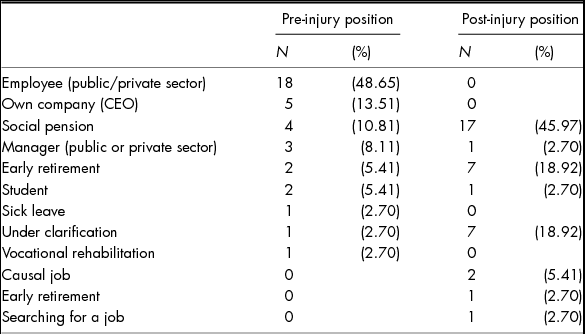
Participants’ pre-injury civil status had not changed two years post-hospitalization; 75% were in a relationship at both points in time. However, two clients reported being in imminent risk of a divorce. There was a major change in their work situation from pre- to post-injury (see Table 1). Sixty-five percent were in education or had full time work at the time of the injury. The rest were either on sick leave, seeking a job, in vocational rehabilitation or were on an official age-related retirement. Only 13.5% were on an early retirement or social pension before the injury whereas this was the case for 46% two years post-hospitalization. Only one person had returned to a paid job (same position as pre-injury) and one was a student (same position as pre-injury).
Work Situation Before and After the Injury (N = 37)

Bio-Psycho-Social Status Two Years Post-Hospitalization
Depression
The mean MDI-score was 15, which is below the threshold value of 20 for depression. Of all 37 participants, 35.1% (n = 13) showed signs of clinical depression (13.5% (n = 5) of mild, 18.9% (n = 7) of moderate and 2.7% (n = 1) of severe depression). The remaining 64.9% (n = 24) showed no signs of depression. No gender- or diagnosis-based differences were found.
For comparison, a recent Danish general population study on depression (N = 14,787) found that 2.3% of the population showed signs of depression as measured by MDI (Ellervik, Kvetny, Christensen, Vestergaard, & Bech, Reference Ellervik, Kvetny, Christensen, Vestergaard and Bech2014). Thus, the relative risk (RR; cf. Osborne, Reference Osborne2006) for depression was 14 times higher for ABI clients (in terms of odds ratios: odds were .02 in the general population and .33 in our sample, corresponding to an OR of 25).
Quality of life
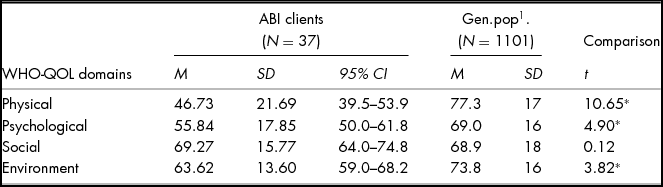
Mean scores for physical and psychological QOL were found to be lower than the social and environmental QOL (see Table 2). For instance, only 39% of patients were satisfied or very satisfied with their psychological QOL. No gender- or diagnosis-based differences were found.
Quality of Life for ABI Clients Versus General Population

1 Reproduced with permission from Nørholm & Bech (Reference Nørholm and Bech2001).
*Significant difference when compared to general population, p < .01.
When comparing the QOL mean scores for all four domains with the results found in a Danish validation study of the WHOQOL-bref on the general population (Nørholm & Bech, Reference Nørholm and Bech2001), we found that clients with ABI had a significantly lower physical, psychological and environmental quality of life (see Table 2).
FIM™
There was a strong positive correlation between the scores at discharge and two years post-hospitalization (r = .846, N = 36, p < .01, two-tailed). A conventional cut-off (> 108) for functional independence was adopted in a study by Hall, Mann, High, Kreutzer and Wood (Reference Hall, Mann, High, Kreutzer and Wood1996). In our study, 81% of clients already had a total FIM™ score of 108 or above at discharge. The majority of the participants (69%) had modified independence two years post-hospitalization. No gender- or diagnosis-based differences were found. Modified independence means that clients require use of a device or need supervision, but no physical assistance. A paired t-test showed no significant change in functional status, neither in total, motor or cognitive status two years post-hospitalization. That is, statistically the functional status at discharge remains the same two years later, which may be due to the aforementioned ceiling effect. Nineteen clients progressed, 16 clients decreased and two remained stable in their total functional status.
Correlations Between Depression, Psychological QOL and FIM™
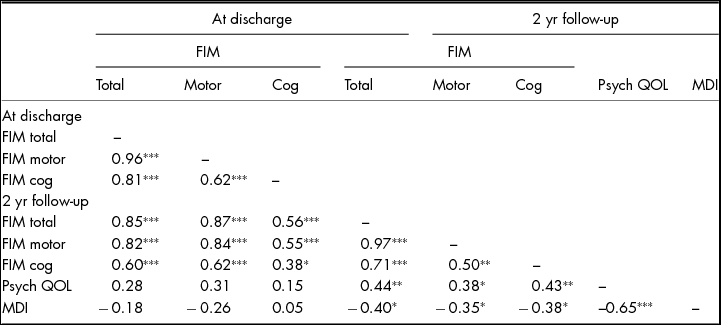
As seen in Table 3, we found significant correlations between ‘FIM at 2-year follow-up’ (total as well as cognitive and motor) and concurrent measures of depression and psychological QOL. This was not the case for ‘Discharge FIM’.
Pearsons r Correlations Between Functional Independence and Psychological Wellbeing (N = 37)

Note. FIM total = Functional Independence Measure total score; FIM motor = Functional Independence Measure Motor subscore; FIM cog = Functional Independence Measure Cognitive subscore; Psych QOL = Psychological Quality of Life; MDI = Major Depression Index.
*p < .05, ** p < .01, *** p < .001, two-tailed.
Exploring Life Transitions Seen from a Client Perspective
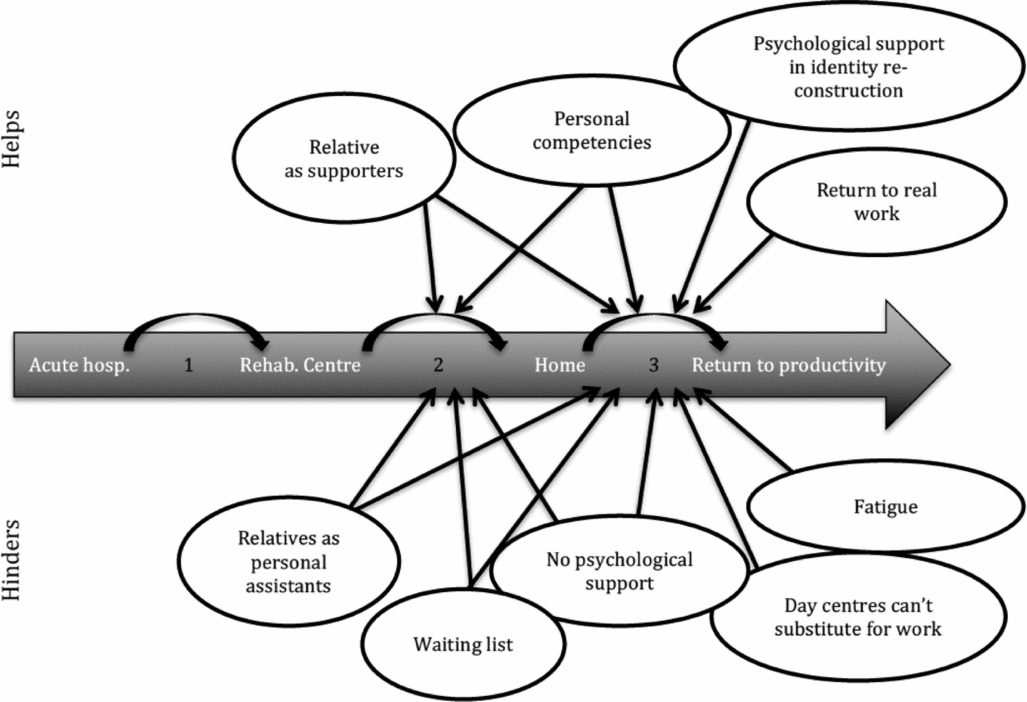
Our qualitative analysis found the following six themes of importance in transitions: (1) fatigue, (2) waiting lists, (3) personal competences (especially independence and drive), (4) relatives, (5) return to work and (6) psychological rehabilitation. Some of the themes have several layers and can be divided into subordinate themes. Furthermore, some of the themes influence both the second and third transition. We have drafted a model (see Figure 1) to illustrate the themes and how they influence rehabilitation outcome. Details are provided in the following.
Clients' experience about what helped and hindered transitions in neurorehabilitation

(1) Fatigue. Ten clients reported about fatigue (participant 1, 2, 3, 5, 14, 20, 22, 24, 25 and 26), especially as a barrier in the third transition (return to productivity), and therefore it was closely related to other predominant themes of importance during the third transition for instance waiting list (theme 2) and return to work (theme 5).
The following condensed statements were found in this subset of participants: ‘Many breaks due to fatigue’, ‘Less social contact due to fatigue’ and ‘Fatigue still takes up much of the time’.
The qualitative findings of this study suggest interconnectedness between fatigue, and other themes, for instance, relatives as personal assistants and return to work in the third transition. One of the informants, a middle-aged woman we shall call Laura, used a metaphor to explain this interconnectedness in the way she handled her fatigue: ‘At home we operate with a metaphor of biscuits. We wake up every morning with a number of biscuits – some activities provide more biscuits, while others eat them up’.
Laura was drained of energy because her newlywed husband has had to become her personal assistant in various daily activities due to her leg paralysis, for example, personal hygiene and using the toilet. She found it very humiliating, but the municipality would not grant her more assistance. She received 12 hours’ support per week.
(2) Waiting list. Another participant we shall call Martin talked about similar issues; for him, the struggle with the ‘job centre’ took much of his energy. He had a great desire to regain a productive life and to work part-time. The job centre was still looking into his case, and two years post-hospitalization, there was still no clarification on his work situation. Here, we have an example of a factor inhibiting positive transitions and outcomes: waiting times or waiting lists, an adverse effect within the paradigm of socialized medicine. Although we did not measure this variable, Martin indicated that waiting has negatively affected his QOL. Combining these statements with quantitative results, we see that although 13 of the 37 participants showed signs of depression when being tested, only three of the 10 informants reporting about fatigue showed signs of depression (two moderate and one severe), while seven clients showed no signs of depression (70%). It is noticeable that only two of the seven informants from the whole population showed signs of moderate depression (29%) and the only client showing signs of severe depression (10%) showed up in this subset of clients reporting on fatigue. Consequently, there seems to be no obvious relationship between fatigue and depression.
(3) Personal competences (independence and drive). As we have revealed already, themes intertwine and are closely related. Being highly driven and very independent was perceived across clients as something that would help a seamless second (from hospital to home) and third transition (return to productivity). A subset of 11 participants reported about this (participant 6, 9, 11, 12, 16, 24, 25, 30, 31, 33 and 37). The following condensed statements were found in this subset of participants: ‘I needed to prove to myself that I could do this’, ‘I'm very independent’, ‘I seek help myself’, ‘I found my own training and rehabilitation patterns (self-training)’ and ‘Having a strong will, being stubborn and having a strong drive towards independence’.
When combining the participants making these statements with respect to the level of depression and psychological QOL measures, we found that the depression level was low (no depression) for these participants except for two (moderate depression). The psychological QOL ratings were dissatisfied for five participants (45%), satisfied for five participants (45%), and very satisfied for one participant (9%).
In fact, a Mann–Whitney U test revealed that all of the participants who described themselves as being highly driven and independent had a significantly higher total ‘Discharge FIM’ compared to the rest of the sample (U = 50.50, z = −3.08, p < .05) and they did not have the need for technological helping devices. A younger woman we shall call Louise expressed this as ‘I was a newlywed and wanted to get back to my husband, and to be an attractive wife. It was embarrassing to be in a wheelchair’. Several other statements relate to the drive not only to regain physical functions, but also to be able to return to work. The goal of returning to work was for many ‘a carrot’, which gave them hope and provided them with the motivation to battle on during the second (from hospital to home) and third transition (return to productivity).
(4) Relatives. Even though having relatives involved in the rehabilitation process is of great importance, there was more to it than that. Reliance on care givers as personal assistants was found to yield complicated responses. These data revealed a range of perceptions experienced by the participant related to guilt, humiliation, gratitude, disempowerment, difficulty reconciling loss of independence or self-reliance and dismay about sacrifices made by the care giver.
(4a) Relatives as personal assistants. The following condensed statements were found in the subset of 10 participants reporting about relatives as personal assistants: ‘I feel guilty – it's humiliating that my husband is my personal assistant’, ‘It's only when my relatives are here that we train motor functions’, ‘My relatives help me and make the difference’ and ‘My spouse had to give up work (or take leave of absence) to assist me’ (participant 1, 3, 4, 5, 9, 10, 12, 17, 35 and 37).
Laura, mentioned earlier, was a newlywed when she went through her rehabilitation process. Her husband took a leave of absence to support and assist her (as she was paralysed and unable to walk independently). For this couple, it was a balance between him becoming her personal assistant on the one hand and still being her lover and husband on the other hand. She expressed it as ‘I feel guilty in relation to my husband. It's humiliating when he has to help me use the toilet or take a bath’. The service provided from the municipality was partly withdrawn when they realized that her husband was unemployed and able to help her with personal hygiene. Similarly, a woman we shall call Briany who was paralysed was not granted assistance from the municipality because her husband runs a company from home and was thus seen as always available to help her to the bathroom. Several other informants told similar stories to Laura and Briana and they all reported about this as a barrier for positive transitions.
Combining the statements from these two participants with quantitative measures, they both showed signs of moderate depression, whereas other participants reported similar experiences without showing signs of depression. Common to both participants was also a decrease in Total FIM™, for Laura from 83 at discharge to 76 at follow-up and for Briana from 121 to 98, leaving them more dependent on others.
(4b) Relative as supporters. Another component of being a relative is the tremendously important role they play in being a practical and an emotional support to the person with ABI. The participants experienced that having a relative close by and involved in the rehabilitation process was an important influencer of good transitions – especially the second transition (from hospital to home). Statements like ‘it's because of Peter that my quality of life is this high’ (Laura) indicated this.
Combining Laura's statement with her psychological QOL, we can see that she was dissatisfied. According to her statement, she might have felt even worse (i.e., very dissatisfied) without her husband. Participants who did not have family to support them, described a harder time receiving the needed services to navigate the different transitions. In relation to the former theme ‘relatives as personal assistants’, there seem to be a line between relatives as practical and emotional supporters and relatives that took on a more nursing role. The latter caused an imbalance in the relationship.
(5) Return to work. The following condensed statements were found in a subset of 15 participants reporting about return to work: ‘A big drive towards return to work’, ‘Work is like a carrot’, ‘At work I feel equal’, ‘A big loss not to be able to return to work’ and ‘It has to be a real job’ (participant 12, 14, 16, 17, 18, 19, 20, 21, 23, 24, 26, 31, 32, 33 and 34).
Clients reported that an important helper in the third transition (return to productivity) was that the employment has to be ‘a real job’. One of the clients we shall call him John, had a very telling quote about the day centre to which the municipality referred him: ‘You know these day care centres you attended as a child – it's like that. However, I am a grown up. Do you remember how it was like to be in a day care centre? I know they don't talk down to you. . .but yet they damn well do anyway.’
Seven of the informants talked about the day centre that they were referred to, called the Work and Rehabilitation Club. They described it as ‘not being a real job’ and they felt they were subjected to indignities. It was described as suffocating. The staffs were too ‘clingy’ and the clients did not feel empowered, nor supported in the third transition.
Combining these qualitative statements with our quantitative analysis we found a moderate but significant negative correlation between work situation two years post-hospitalization and psychological QOL (rpb = −.376, N = 37, p < .05).
Considering how many of our participants actually regained a job two years post-hospitalization, we saw that only one client from the sample (N = 37) was employed full-time at this point (3%), compared to 22 before injury (59%). Furthermore, only two had obtained a causal job, and one had regained the part-time job he had during his official retirement only with fewer hours per week. There was a tendency for those still waiting for clarification (four persons) and those who had received an early pension (four persons) to show greater signs of depression and/or a decrease in QOL. Furthermore, clients reported that it was of great importance to maintain their ‘wish’ and ‘hope’ about going back to work. One participant tried to return to work, and was supported in this, but ‘drew the conclusion himself’ that he would not be able to teach again. Others who had received an early pension felt that ‘others’ (the municipality) drew this conclusion for them and this worsened the third transition (return to productivity).
Returning to meaningful activities was strongly related to a positive third transition. However, very few returned to real jobs, and this lead to another life transition; from being employed to unemployed or retired which caused a loss of identity. This identity transition caused concerns about ‘who am I now’ and difficulties with reconstructing an alternative identity.
(6) Psychological rehabilitation. One of the most central themes turned out to be regarding psychological support and rehabilitation. The following condensed statements were found in a subset of 10 participants reporting about the need for psychological support during both the second and the third transition: ‘I had lost something – sorrow’, ‘Needed emotional support rather than practical and physical support’, ‘Needed emotional support to family members to survive this’ and ‘Getting a psychologist was worth its weight in gold’ (participant 5, 8, 16, 24, 31, 32, 33, 34, 35 and 37).
Several of the statements regarding psychological support were about dealing with the sudden transition from being well to disabled and the loss of identity that follows. Jim, a young man in his forties, described this by saying ‘before I was an athlete, I did a lot of yoga, but now I'm just someone who's sick’. He tried to take up yoga again during the third transition ‘I have tried a little but the identity as an athlete is gone, and that is the biggest loss. . . . I even started smoking’. Jim showed signs of mild depression and expressed dissatisfaction with his psychological quality of life. Several others referred to this new identity as being sick or even stupid. Some of the clients thought that having an ABI had the connotation in society of ‘being stupid’. In particular, people with aphasia had the feeling that others thought of them as being unintelligent because of their decreased communicative skills. However, clients expressed that professionals did not ask or talk to them about these things during the third transition (return to productivity).
At our interview, several clients declared that this was actually the first time anyone had asked about their emotional status. The interest of the service contributors related mostly to practical concerns such as activities of daily living (ADL), for example, how to cook, how to shower and to get assistive technologies installed in the house. For some clients, it felt like the service providers ‘took over the house’. The loss of identity was very seldom addressed in rehabilitation efforts. Two of the informants mentioned that they were offered anti-depressants to prevent depression (although it is possible that others were also offered them, only two addressed this specifically). A male participant as we shall call Doug rejected this offer: ‘I said no to antidepressants; I need to deal with my sorrow, because it is a sorrow. I have lost something’. Doug did not receive psychological support from service providers, but spent a lot of time dealing with his own grief in various ways. He also used his family. Only recently he said ‘I have begun to accept my brain injury’. For Doug it had been a long journey and the psychological issues related to transitions were the most demanding part of it. He still described himself as more emotional, for example, he cried more often, as was evident during this interview. However, he referred to it as part of the process. Five informants directly addressed the need for a psychologist. A male we shall call Brian addressed it as ‘I was offered an antidepressant; it was a psychologist I needed’. However, only one participant received psychological treatment during the third transition (return to productivity) and her statement ‘It was worth its own weight in gold!’ was very strong. She mentioned the identity loss and crisis on different levels – also in relation to her spouse and children. She described the second transition from the neuro-rehabilitation centre to home as especially difficult. ‘I was someone else – another role – let me get back’ [to the rehabilitation centre]. Even though her family supported her a lot and was there for her, she felt different and wished for psychological support during this transition.
In sum, there seem to be different factors affecting outcomes seen from a client perspective and, the same factor, for instance relatives, could be both a barrier and a promoter of a good transition.
Discussion and Conclusion
In this article, we investigated the status of 37 adults suffering from an ABI two years post-hospitalization. Results revealed that ABI clients especially suffer from psychological consequences two-year post-hospitalization. Of all clients, 35.1% showed signs of depression. When looking at the general population, only 2.3% show similar signs (Ellervik et al., Reference Ellervik, Kvetny, Christensen, Vestergaard and Bech2014). Furthermore, 61% of all clients had a reduced psychological quality of life. Again, when comparing this to the general population (Nørholm & Bech, Reference Nørholm and Bech2001), ABI clients had a significantly lower psychological QOL.
In addition, we found that clients’ ‘FIM at 2-years follow-up’ had a significant correlation with depression and psychological QOL although this was not the case for ‘Discharge FIM’. One interpretation is that at discharge, there is still hope for motor and cognitive development and thus little decline in mood and quality of life, but this hope fades with time, if progress stagnates. This suggestion is compatible with a system view, where function, mood and quality of life are mutually dependent and thus may all be influenced by issues such as how well transitions work. Moreover, people with aphasia had the feeling that others thought of them as being unintelligent because of their decreased communicative skills. This was also found in a British study on traumatic brain injury where clients experienced a decrease in social communication skills one-year post-hospitalization that was associated with decreases in community integration and quality of life (Dahlberg et al., Reference Dahlberg, Cusick, Hawley, Newman, Morey, Harrison-Felix and Whiteneck2007).
Fifteen statements about the importance of returning to work during the third transition are quite striking, and confirm previous research that work is a strong predictor of QOL (e.g., Dahlberg et al., Reference Dahlberg, Cusick, Hawley, Newman, Morey, Harrison-Felix and Whiteneck2007). Moreover, return to meaningful occupation may also support other life transitions which were identified (i.e., identity reconstruction). Thus, the transition to ‘the new me’, and ‘adapting to life in the real world’ was yet again found as important life transitions to support (Hoogerdijk et al., Reference Hoogerdijk, Runge and Haugboelle2011; Levack et al., Reference Levack, Kayes and Fadyl2010; Turner et al., Reference Turner, Fleming, Ownsworth and Cornwell2011).
A way to support some of these transitions better is through meaningful occupation or real work, which is in line with Klinger (Reference Klinger2005) that found participants discovered ‘new selves’ through occupation. However, as revealed in this study very few returned to work or even supported employment.
Our findings also resonate with previous studies of clients with ABI that have revealed that especially the psychosocial problems after ABI represent a challenge in rehabilitation (e.g., Morton & Wehman, Reference Morton and Wehman1995; Teasdale & Engberg, Reference Teasdale and Engberg2004; Reference Teasdale and Engberg2005). However, our study suggests a possible link between mental health problems and life transitions. Even though rehabilitation practice should be based on a dynamic and coherent approach (since the 1980s) and securing a holistic approach, addressing the effects of ABI on life transitions still seems to be a challenge. Like previous research (Turner et al., Reference Turner, Fleming, Ownsworth and Cornwell2008), our study indicated that psychological aspects of life transitions are important and we suggest that these need more attention in rehabilitation practice.
Therefore, the second part of this study investigated the clients’ ‘lived experiences’ during the rehabilitation process and during life transition and what might help these transitions. Analysis of interviews with clients revealed six themes/factors of importance in the second and third transition seen from a client perspective. These are fatigue, waiting lists, personal competences (especially independence and drive), relatives, work and psychological rehabilitation.
Our study indicates that the current approach to rehabilitation does not address the psychological issues related to life transitions sufficiently. According to the participants themselves, the need for psychological rehabilitation was of paramount interest, alongside an enhanced possibility of returning to real work as already mentioned and not activity centres. Prigatano (Reference Prigatano1991) advocated for the use of psychotherapy in brain injury rehabilitation by placing a more direct focus on the disordered mind and the wounded soul and the importance of helping people cope with this during transitions. According to Prigatano, failure to address the residual cognitive and personality problems causes psychosocial deterioration. This could lead to a second disability, alongside the cognitive and physical impairments caused by the brain injury, namely the stigma from both self and others, and the psychosocial consequences that follow (e.g., depression and decreased QOL) which were exhibited by some of the participants in this study. Psychological rehabilitation is not only needed for clients, but also for close relatives. Even though some relatives initially offer to be personal assistants and want to help in all possible ways, somewhere along the process this can develop into an ongoing burden and imbalance in the relationship, and have negative consequences for marital status as well as psychosocial consequences for the relatives. Therefore, rehabilitation services need to place a strong focus on relatives and their emotional wellbeing during transitions, since they play a tremendous role not only during the rehabilitation process, but also in life transitions after an ABI.
We found support for the assumption that developing rehabilitation based on a holistic approach – notably addressing psychosocial aspects in brain injury rehabilitation alongside more commonly used approaches of a physical and cognitive nature. Currently, the influences of personal factors on life after ABI seen from an ‘inside’ perspective (the person with ABI's subjective experience) are not strongly represented within the ABI literature, and is recommended for future research.
Limitations
Some limitations of this study need to be taken into account. One limitation regards the qualitative data being field notes. Field notes are researchers' written accounts of what they hear, see, experience, and think in the course of collecting and reflecting on their data. Thus, data are subject to the researcher's interpretation of the situation.
With regards to the quantitative data, the FIM™ instrument was originally developed as a tool to measure outcome in the acute and subacute phase of rehabilitation. Therefore, these were the historical data available for comparison. However, when used in longitudinal studies FIM™ may lack sensitivity, and a known disadvantage is the risk for a ceiling effect when you reach a certain level (approximately 108).
Clinical Implications
Taking clients’ and relatives’ accounts into consideration, we strongly recommend for clinical practice to support life transitions after an ABI. By identifying influences that are likely to enhance or impair good life transitions, our model could have practical impacts on the successful rehabilitation of people suffering from ABI and assist hospitals and the municipality providing these services. It might also assist administrators in making program-level decisions.
Supplementary Material
To view supplementary material for this article, please visit https://doi.org/10.1017/BrImp.2017.14.
Acknowledgements
We would like to thank Lisa Archibald for helpful feedback on earlier versions of this paper.
Financial Support
This article is affiliated with the REKO-project (Rehabilitation Mediated by Coordinated Interventions), funded by the Ministry of Health though a grant to Aalborg Municipality and Aalborg University, Denmark. Furthermore, the project was supported by the Inge Lehmann's scholarship.
Conflict of Interest
The authors of this article declare no conflict of interest.
Ethical Standards
The authors assert that all procedures contributing to this work comply with the ethical standards of the relevant national and institutional committees on human experimentation and with the Helsinki Declaration of 1975, as revised in 2008.
Disclaimer
FIM™ is owned by Uniform Data System for Medical Rehabilitation (UDSMR), USA. The use of the FIM™ instrument to collect data for this research study was authorized and conducted in accordance with the term of a special purpose license granted to Licensee by Uniform Data System for Medical Rehabilitation (a division of UB Foundation Activities, Inc., ‘UDSMR’). Licensee has not been trained by the UDSMR in use of the FIM™ instrument, and the patient data collected during the course of this research study has not been submitted to or preceded by UDSMR. No implication is intended that such data can or will be subjected to UDSMR's standard data processing procedures or that it is otherwise comparable with data processed by UDSMR.