


Background
Appropriate, specialised long-term follow-up is an important aspect of care for children with CHD, but there are often barriers to clinic attendance that can lead to missed visits. There are many social factors for missed visits that have been identified in adult and paediatric literature, including transportation barriers and limited income. Reference Zuckerman, Perrin, Hobrecker and Donelan1 There is also evidence that missed visits and longer lapses in care are associated with adverse outcomes in paediatric patients, including those with CHD. A large cohort review showed increased emergency department visits and subsequent inpatient admissions in paediatric neurology patients who missed specialty appointments. Reference Jarvis, Livingston, Childs and Fraser2 Teenage and young adult patients with CHD with lapses in care of two or more years are at increased risk of needing acute interventions at the time they re-present to care. Reference Rosamilia, Williams and Bair3
Our study examines patterns of missed cardiology visits among paediatric patients with CHD as well as trends in presentations to the emergency department in this cohort. This study focused on whether there are differences in these parameters between CHD patients in a rural, underserved, and resource-limited region compared to those in more urban or affluent areas. We hope to find social factors that may help identify patients at increased risk of missing appointments, and whether missed appointments may be related to more emergency department visits.
Methods
We conducted a single-centre chart review of CHD patients seen from 2012–2024. We did not include patients with simpler lesions such as bicuspid aortic valve or patent ductus arteriosus, instead focusing on patients with lesions that would require close follow up (at least yearly). We also categorised patients based on the complexity of their underlying anatomy into three groups: single ventricle, complex bi-ventricular, and simple bi-ventricular.
We recorded medical and social parameters and analysed trends in cardiology follow-up, emergency department visits, and admissions from the emergency department. We particularly focused on numbers of missed cardiology appointments, which included “no-shows” and same day cancellations. For emergency department visits, we excluded visits for trauma, as these were unlikely to be related to their underlying CHD.
The primary social exposure was the area deprivation index, a composite measure of neighbourhood disadvantage based on income, education, employment, and housing quality. Reference Kind and Buckingham4 We investigated whether missed cardiology appointments and acute emergency department visits differed across area deprivation index quartiles. We also looked to see if more missed cardiology appointments might be related to more emergency department visits and hospital admissions. In addition, we analysed other potentially confounding parameters, including insurance class, gender, and race.
Statistics
Descriptive statistics were used to summarise demographic characteristics, CHD classifications, appointment attendance, emergency department visits, and unplanned inpatient admissions (i.e., after presentation to the emergency department). Categorical variables were summarised using frequencies and percentages, while continuous variables were summarised using medians and interquartile ranges because several variables demonstrated non-normal distributions.
Area deprivation index was analysed using state scales and categorised into quartiles where the first quartile (Q1) represents the least deprived areas, and the fourth quartile (Q4) represents the most deprived areas.
Group differences were assessed using chi-square tests and the Cochran–Armitage test for trend across area deprivation index quartiles. Modified Poisson linear regression with robust confidence intervals was used to compare the relationship between missed clinic visits, emergency department visits and unplanned admissions. We used continuous variables and discrete cut-offs. For missed clinic visits, we used a cut-off of ≥2 missed visits, for emergency department visits, we used a cut-off of ≥5 emergency department visits, and for admissions, we used a cut-off of ≥2 admissions.
Results
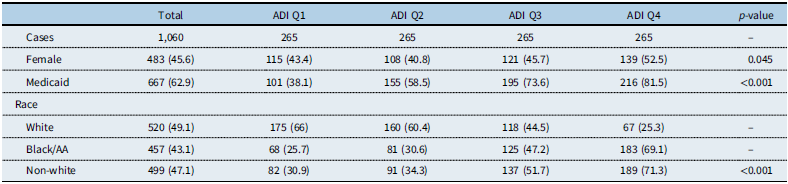
We identified 1,060 patients with a relevant CHD diagnosis seen before age 18 years with documented social parameters (specifically area deprivation index). The complexity of the underlying CHD was similar between quartiles. Our cohort was 43% African American and 49% White. The proportion of non-white patients increased with worsening area deprivation index (p < 0.001). Reference Rosamilia, Williams and Bair3 There were 667 (63%) patients with Medicaid, and this was also more common with worsening area deprivation index (p < 0.001) (Table 1).
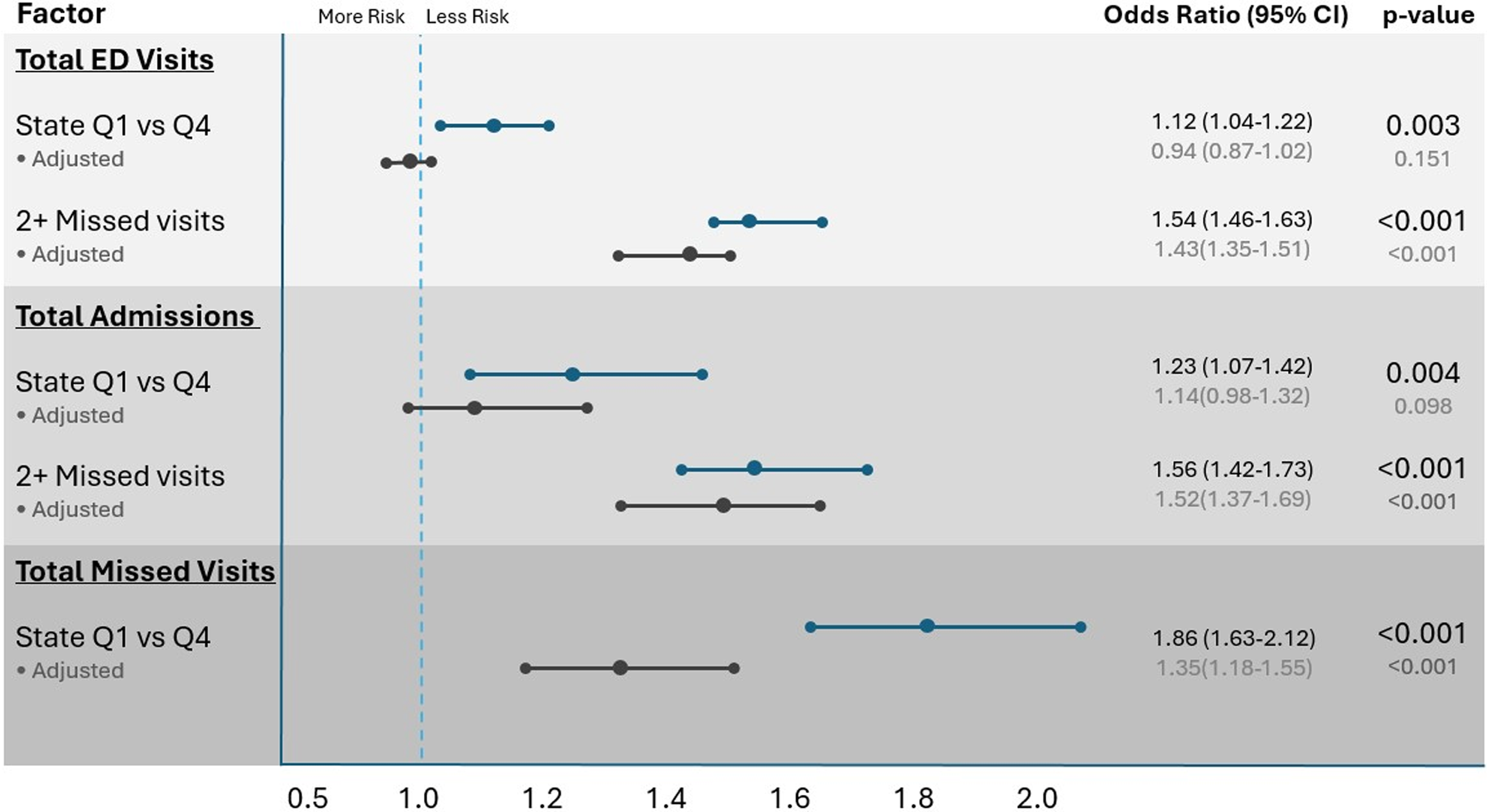
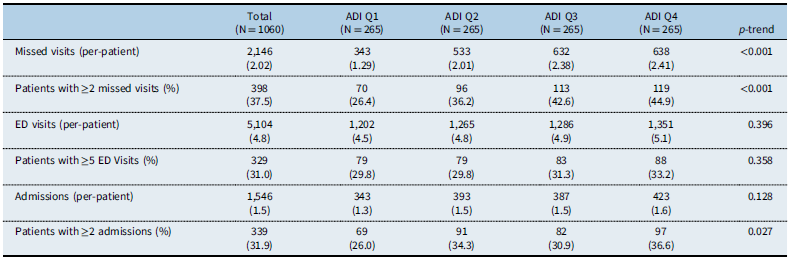
Overall, 46% of our population had ≥2 missed clinic visits, 31% of the cohort had ≥5 emergency department visits, and 32% of the cohort had ≥2 admissions. Patients from more socioeconomically deprived neighbourhoods were at progressively increased risk of missing two or more cardiology appointments, with a significant increasing trend across area deprivation index quartiles (p-trend = <0.001). The relative risk of patients in Q4 missing ≥2 visits was 2.27 (95% CI 1.58–3.27) compared to those in Q1. The overall number of missed visits showed a similar increasing trend across area deprivation index quartiles (p-trend < 0.001). These relationships remained significant when controlling for Black race and the complexity of CHD (Table 2 and Figure 1).
Odds ratios and 95% confidence intervals are shown for unadjusted and adjusted models, with the x-axis displayed on a logarithmic scale. There were 3 distinct outcomes, total emergency department (ED) visits, total unplanned admissions, and total missed cardiology visits. Reference groups for the predictors were state ADI quartile 1 (Q1) and <2 missed cardiology visits (for the ED and admission parameters). Adjusted models considered Black race, a common confounder in studies using ADI.

Figure 1. Long description
Forest plot showing differences in emergency department visits, inpatient admissions, and missed clinic visits between patients in different ADI quartiles. It also shows differences in ED visist and admissions between patients with 2 or more prior missed visits. There are significantly more missed visits among patients from more deprived areas, and patients with 2 or more missed visits have more ED visits and admissions, even when controlling for race.
Demographic and clinical characteristics of the CHD cohort overall, by state ADI quartile

Table 1. Long description
Demographic breakdown of a cohort of children with congenital heart disease including the total number of cases, % female, % on Medicaid, and the racial breakdown, particularly between white and African American patients. The table shows a significantly higher number of African American patients and patients on Medicaid in the most deprived group.
Demographic breakdown of a cohort of children with CHD. Report includes the incidence of each parameter in the entire cohort and then in each ADI quartile. Values are presented as n (%). ADI quartiles are based on state-level area deprivation index, with Q1 representing the least deprived areas and Q4 representing the most deprived areas. p values compare characteristics across state ADI quartiles only. p values are shown only for selected variables where group comparisons were performed.
ADI = area deprivation index.
Breakdown of missed cardiology appointments, emergency department visits, and unplanned admissions based on state ADI quartiles

Table 2. Long description
Breakdown of total missed visits, ED visits, and admissions. Additional breakdown of these visits for patients with total visits above specific cuttoffs. There were significantly more missed clinic visits, both total and when using a cuttoff, among patients from more deprived areas. There were more patients with >2 admissions from more deprived areas, but absolute nubmer of admissions and ED visits were not significantly different.
Breakdown of clinical encounters among a CHD cohort for cardiology clinic visits, ED visits, and unplanned admissions. For the total population and each ADI quartile, the total number of encounters are given, along with the per-person average. For discrete cut-offs (≥ # of encounters), the total number of patients meeting this cut-off are listed, as well as the percentage of the population that meets this cut-off.
ADI = area deprivation index; ED = emergency department.
When comparing numbers of emergency department visits across area deprivation index quartiles, there was no significant difference across quartiles overall, though there was an increase in total number of emergency department visits between the least deprived quartile (Q1) and the most deprived quartile (Q4), (RR 1.124 (CI 1.04–1.22, p 0.003). This relationship became insignificant when controlling for Black race. When considering patients with ≥5 emergency department visits, there was still no significant relationship with area deprivation index or when directly comparing Q1 and Q4 (Table 2 and Figure 1).
When comparing the total number of unplanned admissions across area deprivation index, there was no significant difference across quartiles, though when comparing patients with ≥2 unplanned admissions, there was a slight increasing trend across quartiles (p 0.027). There was a 23% increase in number of emergency department visits between Q1 and Q4, (RR 1.23 (CI 1.07–1.42, p 0.004). When adjusting for Black race, the differences between emergency department visits and admissions between the least and most deprived quartiles were no longer statistically significant (Table 2 and Figure 1).
Among patients with ≥2 missed cardiology visits, there was a significant difference in the risk of visits to the emergency department and subsequent admissions. Patients with ≥2 missed cardiology visits had 1.54 times as many emergency department visits (RR 1.54, CI 1.46–1.63, p < 0.001), though there was not a significant difference when applying the cut-off of ≥5 emergency department visits. Patients with more missed visits had 1.56 times as many unplanned admissions from the emergency department (RR 1.56 CI 1.42–1.73, p < 0.001) and were more likely to have ≥2 admissions overall. This remained significant when controlling for Black race (Table 2 and Figure 1).
Discussion
Our data suggest that children with CHD who come from more disadvantaged neighbourhoods are more likely to miss cardiology appointments, more likely to present to the emergency department, and more likely to be admitted after an emergency department visit. The difference is particularly noticeable when comparing the most disadvantaged areas to the least disadvantaged. While the difference in risk of emergency department visits and admissions between area deprivation index quartiles weakens when controlling for race, area deprivation index remains significant when predicting missed cardiology visits.
When looking at the effect of ≥2 missed cardiology visits on the number of emergency department visits and unplanned admissions, there is a significant difference in the risk for more acute visits. This relationship remains even when controlling for race. Our data suggest that patients from more deprived communities, based on their neighbourhood’s area deprivation index, have more missed cardiology appointments. Additionally, patients with more missed cardiology appointments have a greater number of emergency department visits and unplanned admissions.
The increased risk for missed clinic visits among patients with higher area deprivation index levels is likely multifactorial and based on many known social risk factors for adverse health outcomes and missed visits. Such barriers likely include transportation, childcare, finances, and free time away from work, but these factors can be difficult to identify during routine care. Reference Zuckerman, Perrin, Hobrecker and Donelan1 Both area deprivation index and the social vulnerability index (a measurement of community resilience) have been shown to be related to missed paediatric specialty visits in surgical, haematology, and neurodevelopment patients. 5–Reference Catanzarite, Bouck and Matthes8 area deprivation index is already integrated into major electronic health records and could serve as a screening variable to identify patients at higher risk for missed appointments and guide interventions to improve attendance. This would be particularly useful in paediatric cardiology practices that serve rural communities, since prior research has already shown an association between missed cardiology visits and greater distance from clinic. Reference Rosamilia, Williams and Bair3 Improving rates of clinic attendance can help reduce the financial and scheduling burden of missed visits on a practice.
Reducing missed visits could also help improve the care of congenital heart patients. Missed appointments can delay the recognition of early signs of clinical deterioration; they can lead to missed medications, delayed referrals, and missed opportunities for caregivers to understand their child’s health. These factors may be contributing to the increased number of visits to the emergency department seen in patients with ≥2 missed cardiology visits. It has already been shown that gaps in paediatric cardiology care of two or more years have been associated with emergency department visits. Reference Rosamilia, Williams and Bair3 The association between missed visits and emergency department presentation has also been noted in children seen in neurology clinics and among patients who did not have regular health check-ups in the preceding year, which suggests a similar pattern to our specialty cohort. Reference Jarvis, Livingston, Childs and Fraser2,Reference Holland, Varni, Pulcini, Simon and Harder9
When controlling for Black race, the lack of a significant relationship between emergency department visits and area deprivation index was not entirely surprising, as previous studies have shown that race often confounds area deprivation index associations. Since area deprivation index considers a community’s education, income, and housing quality, this relationship could simply reflect well-documented inequities between Black and non-Black communities. Area deprivation index may not be effective on its own for predicting a patient’s risk of increased emergency department visits, but it may contribute to the overall risk profile. Previous studies have looked at risk factors for visits to the emergency department and have shown that patients with public insurance and lower family educational attainment had more presentations to the emergency department for “low-resource-intensity” visits. These were considered visits that could have potentially been managed as an outpatient visit. Reference Gaffney, Michelson, Monuteaux, Porter and Hudgins10 In a meta-analysis of paediatric emergency department visits, Black race, family income, and deprivation (both individually or in a community) were all associated with higher emergency department utilisation in a mixed paediatric population. Reference Amjad, Tromburg and Adesunkanmi11
While our results are limited by coming from a single centre as part of a retrospective chart review, our large and diverse patient population allows us to better understand a cohort of some of the highest risk congenital heart patients. Many congenital heart centres serve patient populations already facing significant social barriers to their cardiac care, and missed cardiology visits can further exacerbate this problem. The relationship our data shows between community deprivation and missed cardiology appointments continues to drive home the importance of considering the social factors that often complicate a child’s medical care. The clinical relevance of missed visits was also evident in our data, which showed a relationship between missed visits and emergency department visits and unplanned admissions. Identifying patients with a higher risk for missing visits is a crucial step for eventually developing patient centred interventions to improve clinic attendance. Based on our findings, area deprivation index may be a powerful, accessible component to help identify patients in the greatest need.
Acknowledgements
Study data were collected and managed using REDCap electronic data capture tools hosted at the University of Mississippi Medical Center. REDCap (Research Electronic Data Capture) is a secure, web-based software platform designed to support data capture for research studies, providing (1) an intuitive interface for validated data capture; (2) audit trails for tracking data manipulation and export procedures; (3) automated export procedures for seamless data downloads to common statistical packages; and (4) procedures for data integration and interoperability with external sources.
Financial support
This research received no specific grant from any funding agency, commercial, or not-for-profit sectors.
Competing interests
None.

 Open access

