Introduction
Recently, the importance of goose meat, as an alternative protein source of animal origin, has become more obvious. Goose breeding is desirable as it requires less equipment and work and is profitable compared to the other poultry breeding (Dogan, Reference DOGAN1988). Geese can graze and be kept on pasture, without requiring modern housing systems. Certain diseases which are important in broiler production are not seen in geese (Demirulus, Reference DEMIRULUS2005).
Today, goose breeding is very common in various countries in Asia and Europe. Even though geese are raised in every region in Turkey, Kars has the second biggest goose population (96950) after the city of Ardahan (TUIK, 2010). Goose breeding is preferred as a small family farm activity in Kars because industrial development is low and family income depends mostly on agriculture and stockbreeding. The suitable climatic and geographic conditions, low production costs, contribution to social development, and requirements for meat and fat particularly in winter, are the other reasons why goose breeding is economically important and common in Kars.
Goose breeding is mostly done in small family farms in Turkey. There is limited information on the economics of goose breeding. Therefore, this survey was performed to reveal the economical advantages of the goose breeding in Kars.
Surveying goose breeding in Turkey
A survey was conducted on determining the general knowledge of the farmers and the economic realities of goose breeding, through communication with 64 persons via a questionnaire. Lack of accounting records led us to use a face to face survey method in the study. Elements of expense and income were determined firstly while calculating the results of economic activity of small family farms in 2010. Expenses included operation and production spending on such entities as feed, water, and labour.
Work expenditure was calculated as man working unit (MWU), with regard to the differences of the age and gender. To translate the family labour force into MWU, the minimum wage ($394) was multiplied by 0.5 for boys and girls of 7-14 years of age, 1 in men and 0.75 in women of 15-49 years of age, and 0.75 in men and 0.5 in women of ≥50 years of age (Karagolge, Reference KARAGOLGE2001). General management expenses, amortisations, veterinary costs, and housing expenses including heat and light were calculated according to the statements of the farmer. Total income was calculated from the sales of goose carcasses and feather after the slaughter. Profit was obtained by subtracting costs from income.
Percentage and mean values of the data were calculated using SPPS version 11.0 (The Statistical Package for the Social Sciences) package program. Student t-test was used to reveal significance of the differences between the groups, using confidence limits of P<0.05 (Duzgunes et al., Reference DUZGUNES, KESICI and GURBUZ1983).
Economic analysis of goose breeding
This survey revealed that the farmers raise 24.1 (min: 3; max: 70) geese yearly, four of which are kept for breeding (3 females and 1 male), and an average of 42.8 (min 13; max 82) eggs are produced, each goose laying 13.7 eggs on average. Female and male breeding stock are kept for 5.6 and 5.2 years, respectively. The age of peak egg production is 2.2 years. The hatchery efficiency is 65.9% (min: 9.68; max: 100). There was no statistical relationship between bird age and hatchery efficiency (P>0.05).
Goose breeding in Kars is done traditionally through natural hatching methods, using local and mix-breed species. It has been found that 13 (min: 10; max: 15) eggs are put in the nest of the broody goose. There was no statistical relationship between the number of eggs and hatchery efficiency (P>0.05). It was determined that 85.9% of the farmers separated the female broody geese from the males during the hatching period, and kept them either in a coop (75%) or in a house (25%). Moreover, 96.9% of the non-fertilized eggs were allocated for disposal. Farmers indicated that the first hatching begins in March, continues throughout August, and the mortality rate after hatchery is 8.7%. Mortality is typically due to cold weather, diseases, and predators including dogs and cats. 82.8% of the farmers mentioned that they keep the goslings in a house within a plastic or cardboard box containing bedding materials such as feather or straw for 7-10 days. During this period, 21.9% of the farmers put the female geese together with the goslings while 78.1% keep them in separate coops. 42.2% of the farmers reported that they usually add vitamin supplementation to the goslings feed. This is done for 21.9% of poults, and 12.5% of mature geese. Only 10.9% of the farmers use medication in case of any disease occurring, but this happens in only 50 % of mature geese flocks. The percentage of the farmers who just let the sick animal die is 39.1 while 10.9% practise culling out.
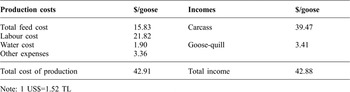
Farmers have indicated that they usually slaughter the animals in October-November, right after the first snow falls, acquiring an average of 3.49 kg carcass weight. They utilise every components of the animal, including internal fat and organs, heads, feet, and feathers. It was found that 56.2% of the farmers salt the carcasses and then store them a cold place or under refrigeration, 43.8% dry up the salted carcasses in the open air for 1-2 days, then store them. While 78% of the farmers use crystal salt on the carcasses, 22% use kitchen salt. Nearly 110 g salt is used for each of the carcasses and they are stored for 3 months. Data on expenses and income for a 26-week feeding period are displayed in Table 1.
Seasonal goose production costs and incomes in US$ (average 26-week growing period).

Note: 1 US$=1.52 TL
As can be seen from Table 1, expenses and income are nearly equal, indicating little or no profit. Since the workers are mostly women who demand no money for the work, which includes feeding and maintenance of the animals, raising geese is usually considered to be a profitable event as labour costs are disregarded. The second cost of importance was feed costs; whereby it costs $15.83 for a goose for the 26-week growing period, which is mostly due to the intensive barley feeding practised during the last month before slaughtering animals. Goose feather is used to make pillows and comforters by villagers, and a pillow can be made from the harvested feathers of ten geese. Income from goose manure was not counted since 95.3% of the farmers reported that they did not to utilise it. Likewise, management and repair costs of the buildings and amortization were disregarded because geese are mostly raised at open areas and slaughtered in the beginning of winter. However, farmers indicated that they use a small part of available sheds and shelters for large domesticated farm animals.
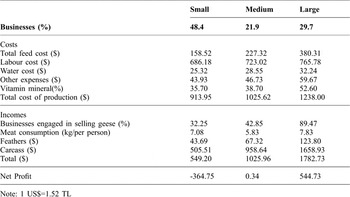
In the study, family businesses were divided into three groups, in terms of the number of poultry per flock; small being 1-19 (mean; 12.81) geese, medium being 20-29 (mean; 24.29) geese, and large flocks comprising ≥30 (mean; 42.53) geese. Data on the expenses-income state and profitability are shown in Table 2.
The average costs (US$) and incomes in family businesses.

Note: 1 US$=1.52 TL
As shown in Table 2, the medium and large size businesses gain most profits out of goose breeding. The lack of profitability of small size businesses is due to high labour costs. The survey revealed that 48.4% of the farmers consume the goose meat with their family members while 51.6% sell the goose meat, and consume the rest. Geese are sold either alive or as carcasses. This survey found that every female goose lays an average of 13.7 eggs in a season. This was similar to the findings of Tilki and Inal (Reference TILKI and INAL2004) who reported this number to be 13 in domestic geese in Isparta. This number was higher than that of the reports by Onk (Reference ONK2009) (12.66) and Ayakyay (Reference AYAKYAY2008) (11.97), which conducted surveys on the domestic geese in Kars. This may be due to the breed variations. This study determined that farmers held the female and male geese in reserve for an average of five years (min: 2; max: 10). Thus, in geese, sexual activity decreases at around ten years of age (Muglali, Reference MUGLALI2001). Shalev and Pasternak (Reference SHALEV and PASTERNAK1999) have suggested that female geese be disposed of at three years of age, rather than five to six, which affects business profitability positively since, with a 70% fertilization rate, more goslings per dam can be obtained in this period. The survey revealed that peak laying occurred at 2.2 years of age.
This survey reported the hatchery rate to average out at 65.9%. This is very close to the data (65.1%) of Ayakyay (Reference AYAKYAY2008) while higher than those of Onk (Reference ONK2009) (60.9%), Tilki and Inal (Reference TILKI and INAL2004) (54.7-57.1%), and Arslan and Saatcı (2003) (22.2%). The variation in these results is probably due to different incubation methods and hatchery characteristics. In our survey, it was found that farmers who usually own domestic and mix-breed geese use natural incubation methods, and put the remaining eggs under turkeys and hens for incubation. In the case of farmers preferring natural incubation, geese sometimes resume laying eggs for a second incubation period in a year. Since geese lay no eggs during the natural incubation period the number of eggs laid is lower, which economically not a preferred choice.
Special care is essential only during the first days of the gosling's life, since management of older geese is relatively easier, as compared to other poultry (Demirulus, Reference DEMIRULUS2005). Thus, 42.2% of the farmers have said that they use vitamin supplements, and 62.5% use some kinds of heating system for these young geese.
Because geese are hardy with respect to changes in environmental conditions, veterinary costs are usually very low (Muglali, Reference MUGLALI2001). Only 10.9% of the farmers indicated that they use treatments in the case of gosling diseases, while this level increases to 50% in mature geese, which are more valuable animals. Mortality rates are usually very low since fewer diseases are seen in geese. Mortality is minimal when there is no disease present and if a good management is applied (Muglali, Reference MUGLALI2001). In a goose farm, when an optimum care and feeding conditions are not applied, very high levels of mortality can be observed in each successive year (Gonul et al., Reference GONUL, YUCELYIGIT, AKSU and KAPUCU1995). While the published literature (Muglali, Reference MUGLALI2001) reports the mortality rate as 2% at slaughter, it was found to be 8.7% in our study. According to farmers, this high mortality rate is often due to the cold weather, diseases, or being killed by another animal.
Goose breeding in this area of Turkey is appealing due to its topographical and climatic conditions and economic circumstances, including lower housing costs as compared to those of the other large farm animals. It is conducted using traditional methods in Turkey and alternates with producing large farm animals (Celik, Reference CELIK2007). Energy levels of goose meat is good because of the high fat level in the meat. In cold weathers, people in this area usually derive their energy intake from goose meat and fat (Selcuk et al., Reference SELCUK, AKYURT and GELIYI1983). In this study, it was observed that goslings usually start hatching in spring, beginning in March, and being slaughtered in October-November, at the start of winter.
The survey determined the average weight of a single goose carcass to be 3.49 kg, which is higher than the findings of Kirmizibayrak (Reference KIRMIZIBAYRAK2002) (3.14 and 2.91 kg) and Onk (Reference ONK2009) (3.29 and 3.02 kg) while similar to those of Tilki et al. (Reference TILKI, SAATCI, KIRMIZIBAYRAK and AKSOY2004) (3.59 and 3.34 kg).
Goose poults are normally grazed on pasture at maturity, pre-slaughter (Selcuk et al., Reference SELCUK, AKYURT and GELIYI1983). Shalev and Pasternak (Reference SHALEV and PASTERNAK1999) suggested that feeding geese until eight weeks of age can have advantages, and grazing them on pasture after that may decrease the consumption of feed by 30%. In the Kars region, geese are usually raised in an open area, with extensive feeding and foraging. Instead of constructing any particular housing system, part of the housing systems for larger farm animals and chickens is used. On the other hand, the geese kept for breeding usually receive family leftovers in winter, which significantly lowers feeding cost.
Geese are raised for the family consumption at particular in winter time. The bird provides energy and essential animal proteins as well as an income for people in this region in winter time. Only larger businesses gain significant amount of profits out of goose breeding. This indicates that, in this area, goose breeding needs to be performed on a larger scale rather than as a small family business to gain commercial profit.
Conclusions
Upon meeting with people who deal with goose breeding in this region, it has been revealed that they generally do not have enough knowledge on how best to raise gees for profit, instead using traditional methods. This results in significant performance and profit losses. The results of the survey performed indicated that contemporary goose breeding facilities, including infrastructure, should be constructed to increase performance of goose breeding and to raise the level of profit, and that key personnel need technical training to achieve this.