Introduction
The blue petrel (Halobaena caerulea Gmelin) is an abundant seabird with a circumpolar distribution that mainly forages at high latitudes in the Southern Ocean (Marchant & Higgins Reference Marchant and Higgins1990). Some birds disperse north off the west coast of South America in winter, but elsewhere they seldom venture north of the Subtropical Front (Brown et al. Reference Brown, Norman and Eades1986, Ryan et al. Reference Ryan, Avery, Rose, Ross, Sinclair and Vernon1989). Almost the entire population of some 2.4 million pairs breeds from 47 to 56°S at five sub-Antarctic island groups and islands off the southern tip of South America (Dilley et al. Reference Dilley, Davies, Connan, Schramm and Ryan2017), with a small population recently discovered farther north on Gough Island (40°S, 10°W; Ryan et al. Reference Ryan, Dilley, Jones and Bond2015). Adults breed in early summer, returning to colonies from the end of August, laying eggs in late October and fledging chicks in late January–early February (Marchant & Higgins Reference Marchant and Higgins1990; although breeding occurs ~1 month later at Gough Island; Ryan et al. Reference Ryan, Dilley, Jones and Bond2015). Moult takes place immediately after breeding, with some birds dropping up to three inner primaries even before leaving their colonies (Marchant & Higgins Reference Marchant and Higgins1990). Wing moult is complete and rapid, with birds in fresh plumage returning to their colonies to reoccupy breeding burrows for a few days in April–June (Fugler et al. Reference Fugler, Hunter, Newton and Steele1987, Marchant & Higgins Reference Marchant and Higgins1990). Recently, leg-mounted activity loggers (wet-dry sensors) have shown that blue petrels exhibit a marked increase in the proportion of time spent sitting on the water during moult (Cherel et al. Reference Cherel, Quillfeldt, Delord and Weimerskirch2016). Using the duration of this period of decreased flight activity as a proxy for the moult period, Cherel et al. (Reference Cherel, Quillfeldt, Delord and Weimerskirch2016) inferred that blue petrel moult lasts ~10 weeks, which is shorter and thus probably more intense than that of ecologically similar prion Pachyptila species (Rohwer & Rohwer Reference Rohwer and Rohwer2013).
Tracking studies (Navarro et al. Reference Navarro, Cardador, Brown and Phillips2015, Cherel et al. Reference Cherel, Quillfeldt, Delord and Weimerskirch2016), the low δ13C values of blue petrel feathers (Cherel et al. Reference Cherel, Bocher, Trouvé and Weimerskirch2002, Reference Cherel, Phillips, Hobson and McGill2006, Phillips et al. Reference Phillips, Bearhop, McGill and Dawson2009) and the few records of moulting birds at sea (Bierman & Voous Reference Bierman and Voous1950, Wanless & Harris Reference Wanless and Harris1988) all indicate that moult occurs in Antarctic waters. Adults breeding at Kerguelen and South Georgia mainly moult at 55–65°S and between 20°W and 30°E (Cherel et al. Reference Cherel, Quillfeldt, Delord and Weimerskirch2016, R.A. Phillips, personal communication 2019) in a ‘hotspot’ shared with several other seabird species (Quillfeldt et al. Reference Quillfeldt, Cherel, Masello, Delord, McGill and Furness2015, Cherel et al. Reference Cherel, Quillfeldt, Delord and Weimerskirch2016). Given that the only other substantial populations in the Atlantic and Indian oceans breed at islands located between South Georgia and Kerguelen (i.e. the Prince Edward and Crozet islands), it is probable that virtually all birds from these ocean basins moult in Antarctic waters south of Africa. However, approximately half of the world's population of blue petrels breeds at the Diego Ramirez archipelago, south-west of Cape Horn (Lawton et al. Reference Lawton, Robertson, Kirkwood, Valencia, Schlatter and Smith2006). Nothing is known about the moulting location of birds from this colony, although Wanless & Harris (Reference Wanless and Harris1988) noted that most blue petrels seen in early February 1987 in the western Amundsen Sea (~67°S and 148–153°W) were in moult. We report very large concentrations of blue petrels moulting in the Amundsen Sea and adjacent Bellinghausen Sea, most of which probably come from Diego Ramirez, as this is the closest colony to this region. Photographs of birds in flight confirm the intense nature of moult, with birds replacing seven to eight primaries and most greater coverts at the same time. Given the increased flight costs while undergoing rapid wing moult (Hedenström & Sunada Reference Hedenström and Sunada1999) and the high energetic cost of moult in general (Lindström et al. Reference Lindström, Visser and Daan1993), blue petrels need a reliable food source during this short, intense moult period. We suggest that the nutrient-rich waters off West Antarctica are a key moult area for half of the world's blue petrels.
Study area and methods
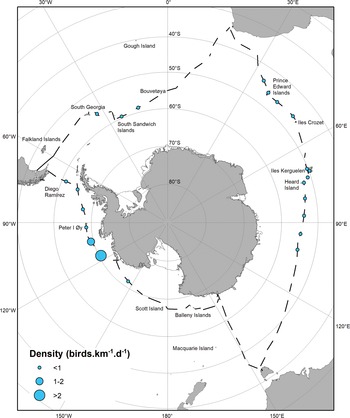
We counted seabirds from the Akademik Tryoshnikov during daylight steaming throughout the Antarctic Circumnavigation Expedition (ACE) from 21 December 2016 to 19 March 2017. The expedition travelled from Cape Town to Hobart via the sub-Antarctic islands (Prince Edward Islands, Iles Crozet, Iles Kerguelen and Heard Island), then at higher latitudes from Hobart to Punta Arenas via the Balleny Islands, Scott Island, Mount Siple, Peter 1 Øy and Diego Ramirez, and then from Punta Arenas to Cape Town via South Georgia, the South Sandwiches and Bouvetøya (Fig. 1). Standard 300 m-wide transect counts of seabirds were made on the side of the bow with best visibility following Tasker et al. (Reference Tasker, Jones, Dixon and Blake1984). Birds following the ship were excluded from counts. Despite using the ‘snapshot’ approach (~1 scan per min, depending on the ship's speed) to reduce the risk of over-counting birds moving faster than the ship (Tasker et al. 1984), we report birds counted per kilometre of transect per day as an index of abundance rather than absolute density estimates, because blue petrels often approach vessels (Griffiths Reference Griffiths1982), thus increasing the effective transect width to an unknown extent (cf. Ainley et al. Reference Ainley, Jacobs, Ribix and Gafney1998). However, area-based densities were estimated for birds sitting on the water because there is little risk of the ship influencing the distribution of birds in moulting flocks, which typically only fly when flushed by the ship's passage. These densities were extrapolated across the range over which we encountered moulting flocks to get a very rough idea of the numbers involved, assuming the band of birds was ~50–100 km wide. We also recorded the presence of pack ice (estimated % cover over the 10 min observation period), as well as the presence of icebergs in the general vicinity (within ~1 km of the transect). Sea temperature was recorded every minute from the ship's ferrybox (intake 5 m below the surface) and averaged per 10 min observation period.
Map of daily seabird transect counts during the Antarctic Circumnavigation Expedition (bold dashed line) and the average encounter rate with blue petrels (birds km−1 d−1).

Moult was scored from photographs of birds in flight. Birds with a mix of old and new primaries were easily distinguished, but birds completing primary moult (finishing growing P10) were difficult to differentiate from birds that had completed moult, and it was not easy to tell whether inner primaries had completed growing or not. Images were taken with a Canon 7D mark II SLR camera equipped with a Canon 500 mm f4 telephoto lens or Canon 5D mark IV with a 100–400 mm zoom lens. Moult intensity typically is reported as the number of primaries replaced at once (Rohwer & Rohwer Reference Rohwer and Rohwer2013) or the raggedness value, which is the sum of the difference between the moult score of each growing primary and a fully grown score of 5 (Haukioja Reference Haukioja1971, Bensch & Grahn Reference Bensch and Grahn1993). However, both of these measures ignore the large differences in primary length/mass across the wing, especially in species such as petrels that have long, pointed wings (Dawson Reference Dawson2005). Accordingly, moult intensity also was estimated as the proportion of total feather length and mass being grown at once. The lengths and masses of blue petrel remiges (primaries and secondaries) were measured from the wings of birds killed by brown skuas (Catharacta antarctica Lesson) on Marion Island. All primary and secondary feathers were collected, dried (40°C for 24 h), weighed (to the nearest 1 mg) and measured (flattened feather length).
Results
During the ACE, 30 338 seabirds from 89 species were counted on 15 452 km of transects totalling 635 h over 75 days. With 2645 birds, the blue petrel was the third most abundant species counted after short-tailed shearwater (Ardenna tenuirostris Temminck, n = 6835; Ryan et al. Reference Ryan, Le Bouard and Lee2017) and Salvin's prion (Pachyptila salvini Mathews, n = ~3350), with Antarctic prions (Pachyptila desolata Gmelin) and slender-billed prions (Pachyptila belcheri Mathews) also totalling > 2000 individuals. Despite their circumpolar range, blue petrels were patchily distributed along the ACE cruise track (Fig. 1). In the Indian Ocean sector (late December–mid-January), birds were seen around their breeding islands (Prince Edwards, Crozet and Kerguelen), extending east to 55°S, 105°E. In the Pacific Ocean sector (late January–February), they were seen from 72°S, 144°W to 62°S, 68°W off West Antarctica, and in the Atlantic Ocean sector (late February–March), a few birds were observed east of South Georgia and the South Sandwich Islands (Fig. 1).
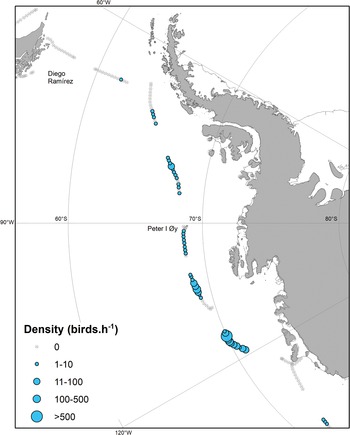
Most blue petrels were counted in the Pacific Ocean sector (96.5%), with only 3.4% in the Indian Ocean sector and 0.1% in the Atlantic Ocean sector. Off West Antarctica, 95.6% were seen from 13 to 16 February in the Amundsen and western Bellinghausen seas between 71°S, 119°W and 67°S, 78°W (Fig. 2). The average density per hour over these four days was 0.62 ± 2.21 birds km−2 (range 0–14.5 birds km−2, n = 47), with an average density per 10 min observation period of 3.8 ± 12.6 birds km−2 (range 0–88 birds km−2, n = 280) due to the many large flocks seen on 13 February at 70°S, 115°W and on 14 February at 69°S, 103°W. The mean density on these two days, when 91.5% of all blue petrels were counted, was 1.16 ± 3.03 birds km−2 averaged hourly (n = 24) and 7.0 ± 17.0 birds km−2 averaged per 10 min count (n = 144). Crude extrapolation of the density estimates from 78–119°W gives a range of 50 000 (hourly average density for a band 50 km wide) to 600 000 (10 min average density for a band 100 km wide) birds in this region. No blue petrels were seen north of 61.8°S as we approached the breeding colonies at Diego Ramirez and Cape Horn (Fig. 2).
Map of hourly blue petrel counts off West Antarctica from 9 to 18 February 2017.

Icebergs were regular throughout the area from 13 to 16 February (icebergs passed during 23% of 10 min count sections), but blue petrels avoided areas with pack ice (range 0–80% cover per 10 min observation period). Blue petrels were only observed in 1 out of 23 of the 10 min counts when pack ice was present (2 birds as we approached the pack off Peter 1 Øy) compared to 48% of counts without ice (n = 257, Fisher exact test P = 0.002). Sea temperature measurements over the four days ranged from -1.1 to 1.9°C, but blue petrels were only observed from -0.7 to 0.9°C, with the largest flocks occurring at -0.3°C.
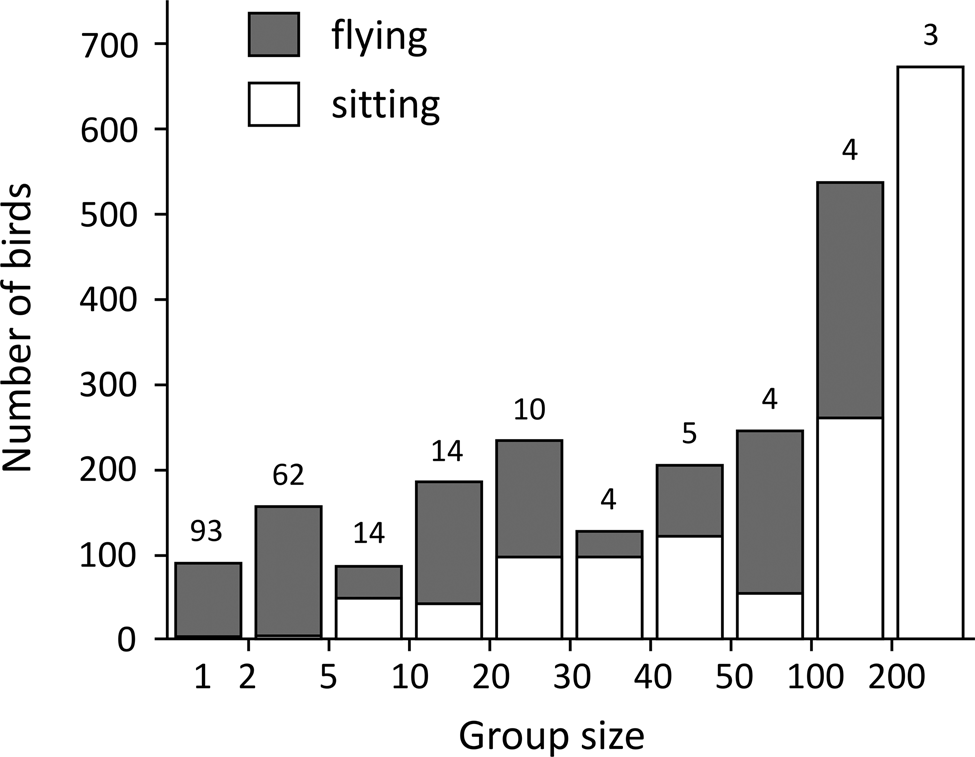
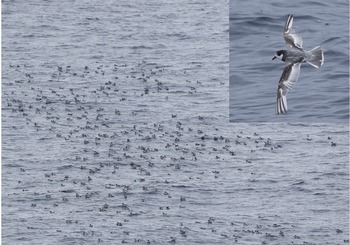
Most blue petrels off West Antarctica were encountered in large flocks of up to 300 individuals (Fig. 3). Overall, 55% of birds were sitting on the sea surface, but the proportion of sitting birds increased with group size (Fig. 3). Flocks on the water surface usually comprised only blue petrels, but they were occasionally joined by small numbers of Cape petrels (Daption capense L.; Fig. 4). Blue petrels often associate with prions at sea, but we only observed modest numbers of Antarctic prions and a few slender-billed prions in the eastern Bellinghausen Sea (15, 140 and 18 on 16–18 February, respectively, with 94% being Antarctic prions). Small numbers of blue petrels co-occurred with prions in nine of the 10 min count periods on 16–17 February, but there was no evidence of spatial co-occurrence on these days (χ2 = 0.26, df = 1, P = 0.69). Several small flocks of blue petrels (5–20 birds) were observed feeding, often in association with other birds (Cape and mottled petrels (Pterodroma inexpectata Forster) and southern fulmars (Fulmarus glacialoides Smith)) or cetaceans (orcas (Orcinus orca L.) and humpback whales (Megaptera novaeangliae Borowski)), but there was no sign of feeding by the large flocks of birds sitting on the water.
Numbers of blue petrels in flocks of different sizes off West Antarctica from 9 to 18 February 2017, showing the proportion of birds sitting on the water. Numbers above each column are the number of flocks in each size group; note the uneven group size intervals.

Part of a large flock of blue petrels, with one Cape petrel (top left), at 70°S, 103°W off West Antarctica on 14 February 2017. Inset shows a blue petrel in flight moulting six inner primaries on its left wing, seven on its right wing, the corresponding primary coverts and all secondary greater coverts (photographs: P.G. Ryan).

The first blue petrels moulting wing feathers were observed on 11 January at 55°S, 96°E, towards the eastern edge of the observed range in the Indian Ocean sector. Of 22 birds seen on 11–12 January, 14 were in moult, replacing inner or central primaries. Approximately half of the birds off West Antarctica were also undergoing wing moult on 13–16 February, particularly in the large flocks resting on the water surface. None of the three birds seen in the Atlantic Ocean sector (5–9 March) was moulting its flight feathers.
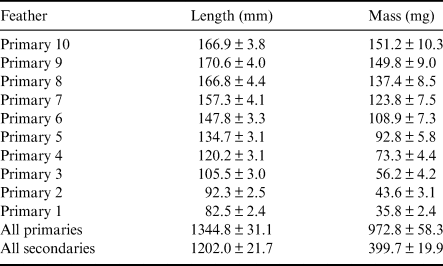
Moult was often intense, with seven to eight primaries and their primary coverts growing on each wing, plus all of the greater secondary coverts (Fig. 4). It was possible to score the primary moults of 36 birds in one flock of ~300 birds photographed as it flushed on 14 February off West Antarctica. Of these, 16 (44%) retained 1–4 old outer primaries, at least 6 (17%) were growing the outer primary and the remainder apparently had completed the primary moult (although it was probable that some were still growing P10). It was clear that birds with as few as two old outer primaries were still growing their innermost primaries (i.e. they were shorter than the adjacent secondaries), but birds with only one old outer primary may have completed growth of the inner three to four primaries. The raggedness value of birds retaining 1–4 old primaries was 14–18, with no pattern related to moult progression. Despite the marked reduction in wing area (Fig. 4), such birds were capable of sustained flight, sometimes flying alongside the ship's bow for several minutes. Replacing 7–8 inner primaries at once is a substantial proportion of the total length (62–75%) and mass (55–69%) of the primaries (Table I). Expressed as a proportion of all remiges, these birds are simultaneously replacing 33–40% of the length and 39–49% of the flight feather mass (Table I). Replacing the corresponding primary greater coverts and all secondary greater coverts at the same time further adds to moult intensity.
The average (± SD) length and mass of blue petrel primary (n = 13) and secondary (n = 3) feathers.

Discussion
The rate of feather growth only increases slightly with body mass and feather size (Rohwer et al. Reference Rohwer, Ricklefs, Rohwer and Copple2009, de le Hera et al. Reference De la Hera, Desante and Milá2012), which means that large birds take longer to replace their flight feathers, unless they increase the number of feathers replaced at once (i.e. increase the intensity of moult; Bridge Reference Bridge2006, Rohwer & Rohwer Reference Rohwer and Rohwer2013). A bird the size of a blue petrel typically grows its primaries at 4–6 mm per day (Rohwer & Rohwer Reference Rohwer and Rohwer2013). If each primary was moulted sequentially, it would take at least 6 months to replace only the primaries, yet blue petrels replace all of their wing feathers in ~10 weeks between the end of the breeding season in January–February and their brief return to their colonies in April–May (Fugler et al. Reference Fugler, Hunter, Newton and Steele1987, Cherel et al. Reference Cherel, Quillfeldt, Delord and Weimerskirch2016). They achieve this by having one of the most intense wing moults yet recorded (Bridge Reference Bridge2006).
Rohwer and Rohwer (Reference Rohwer and Rohwer2013) showed that moult intensity explains most of the variation in moult duration, with the average number of primaries grown at once varying from one to four among birds that retain the ability to fly while moulting. Some petrels grow four to six inner primaries at once (Bridge Reference Bridge2006), but blue petrels are exceptional in replacing up to eight primaries at once. Northern fulmars (Fulmarus glacialis L.) occasionally also have up to eight inner primaries growing at the same time, but such birds apparently lose the ability to fly (Warham Reference Warham1996). The primaries are replaced in a simple descending wave, creating a very large gap in the wing area, which has a greater impact on flight ability than several smaller gaps (Hedenström & Sunada Reference Hedenström and Sunada1999). It is impressive that blue petrels with only two to three outer primaries can still fly. Although hummingbirds also achieve this feat (Chai Reference Chai1997), some passerines that undergo very rapid moult become flightless (Haukioja Reference Haukioja1971). In addition to replacing up to eight primaries at once, blue petrels also moult all of the greater secondary coverts, which facilitates the simultaneous moult of large numbers of secondaries later in the moult cycle. The greater secondary coverts are unusually long in petrels and albatrosses, and thus once grown, they reduce the wing gaps created by moulting of the secondaries.
Moulting petrels partially compensate for large moult gaps in the primaries by increasing the spread of the remaining primaries (Bridge Reference Bridge2006) and perhaps also the tail feathers (Fig. 4). However, it is not surprising that moulting blue petrels spend considerably more time sitting on the water (44–66%) than post-moult birds (7–19%; Cherel et al. Reference Cherel, Quillfeldt, Delord and Weimerskirch2016). Reducing wing area typically results in a reduction in the amount of time birds spend in flight (e.g. Carrascal & Polo Reference Carrascal and Polo2006). The inverse relationship between moult duration and the amount of time moulting prions and blue petrels sit on the water presumably reflects differences in moult intensity between species (Cherel et al. Reference Cherel, Quillfeldt, Delord and Weimerskirch2016). Reduced flight ability during moult also increases the risk of predation (e.g. Lind Reference Lind2001). We saw a blue petrel being closely pursued by a south polar skua (Catharacta maccormicki Saunders) for several minutes off West Antarctica. The outcome of this chase was not observed, but it is possible that predation risk by skuas contributes to the flocking behaviour of moulting blue petrels.
It would be interesting to know whether blue petrels also moult their body plumage at the same time as they replace their flight feathers, because birds replacing body feathers experience higher thermal conductance due to reduced insulation (Murphy Reference Murphy and Carey1996). We might thus expect that body moult should not occur during wing moult, given the large amount of time moulting blue petrels spend sitting in cold water (~0°C). If body moult occurred gradually throughout winter, it would also spread the physiological cost of moult. However, very few blue petrels exhibit body moult in winter (Brown et al. Reference Brown, Norman and Eades1986), whereas birds collected in January have extensive body moult coinciding with primary and secondary moult (Bierman & Voous Reference Bierman and Voous1950). Stable isotope ratios are similar in primary and body feathers (Cherel et al. Reference Cherel, Quillfeldt, Delord and Weimerskirch2016), suggesting that both sets of feathers moult at the same time. By comparison, prions show greater variability in the isotope signatures of body feathers than primaries, indicating that body moult is more protracted than wing moult (Cherel et al. Reference Cherel, Quillfeldt, Delord and Weimerskirch2016).
Moult is energetically demanding not only due to the costs of feather production, but also due to the necessity to maintain the tissues necessary for feather production (Lindström et al. Reference Lindström, Visser and Daan1993, Murphy Reference Murphy and Carey1996). Just as breeding birds can be categorized along a continuum from income to capital breeders (Jonssön Reference Jonssön1997), the energy to support moult can derive from body stores (‘capital’ moulters) or from food ingested during moulting (‘income’ moulters). Penguins are an extreme example of the former strategy, as they fast ashore throughout most of their catastrophic moult, but many other birds also lose mass during moult, suggesting some contribution from stored energy reserves (e.g. Portugal et al. Reference Portugal, Green and Butler2007). Adult blue petrels moult immediately after breeding, however, so they have little opportunity to accumulate energy and key nutrients prior to moulting, suggesting that they rely substantially on food obtained during moult (i.e. they are probably income moulters). As a result, they probably depend on a reliable food source to fuel their very intense moult (Cherel et al. Reference Cherel, Quillfeldt, Delord and Weimerskirch2016). Blue petrels are thought to target krill and other macrozooplankton while moulting, when foraging occurs mostly at night (Cherel et al. Reference Cherel, Quillfeldt, Delord and Weimerskirch2016), although some foraging does occur during the day (Wanless & Harris Reference Wanless and Harris1988, this study).
Adult blue petrels from Kerguelen and South Georgia mainly moult between 55–65°S and 20°W–30°E (Cherel et al. Reference Cherel, Quillfeldt, Delord and Weimerskirch2016, R.A. Phillips, personal communication 2019), at the same time and place where slender-billed prions from the world's two largest colonies, Kerguelen and the Falklands, moult (Quillfeldt et al. Reference Quillfeldt, Cherel, Masello, Delord, McGill and Furness2015, Cherel et al. Reference Cherel, Quillfeldt, Delord and Weimerskirch2016). Large numbers of Kerguelen petrels (Aphrodroma brevirostris Lesson) also moult in this area in February (P.G. Ryan, personal observation). We encountered surprisingly few blue petrels in the Atlantic Ocean sector of the ACE in early March 2017 (Fig. 1), possibly because our track was north of their main moulting area. However, we did count some 1500 slender-billed prions (72% of all birds of this species seen during the ACE), 700 Antarctic prions (26%) and 150 Kerguelen petrels (63%) between 60°S, 25°W and 54°S, 03°E from 8 to 11 March, with all of the slender-billed prions on 9–10 March between 59°S, 15°W and 57°S, 04°W. Most of the slender-billed prions, some of the Antarctic prions and a few Kerguelen petrels were in moult (some just starting inner primaries and others nearly complete with just the outer tail still growing). All of these species presumably exploit a late summer abundance of zooplankton, principally Antarctic krill (Euphausia superba Dana), making this region a key foraging area for moulting seabirds (Cherel et al. Reference Cherel, Quillfeldt, Delord and Weimerskirch2016).
Our observations identify the seas off West Antarctica as a second moult hotspot for blue petrels. Previous seabird studies also have reported blue petrels in the Amundsen and Bellinghausen seas in February–March (Zink Reference Zink1981, Wanless & Harris Reference Wanless and Harris1988, Ainley et al. Reference Ainley, Jacobs, Ribix and Gafney1998, Ropert-Coudert et al. Reference Ropert-Coudert, Hindell, Phillips, Charrassin, Trudelle, Raymond, Broyer, Koubbi, Griffiths, Raymond, Udekem d'Acoz, d' and van de Putte2014, B. Raymond, personal communication 2019). It is difficult to estimate the numbers of petrels moulting in this region, because we do not know their latitudinal extent. The ACE cruise track was selected to be as short as possible without venturing into dense pack ice and thus mostly remained just north of the pack, where bird densities might be particularly high (e.g. Ainley et al. Reference Ainley, Jacobs, Ribix and Gafney1998, Ribic et al. Reference Ribic, Ainley, Ford, Fraser, Tynan and Woehler2011). However, we may have underestimated the western limit of the moult area, because we saw small numbers of birds on 9 February at 71–72°S and 142–144°W, before heading farther south to the Mount Siple area (Fig. 2). Wanless & Harris (Reference Wanless and Harris1988) observed large flocks as far west as 165°W in early February. However, even relatively conservative extrapolation over the area from 120 to 80°W suggests a population of 105–106 blue petrels off West Antarctica in late summer (see the Results section for details). These birds almost certainly breed at Diego Ramirez, the closest colony to this moult area, which has a population of ~1.35 million pairs (Lawton et al. Reference Lawton, Robertson, Kirkwood, Valencia, Schlatter and Smith2006), representing more than half the world's population (Dilley et al. Reference Dilley, Davies, Connan, Schramm and Ryan2017). Blue petrels breeding at the Prince Edward Islands and Iles Crozets have not been tracked, but these islands lie between Ile Kerguelen and South Georgia (Fig. 1), and given the fact that adults return to their colonies in April–May, adults almost certainly moult south of Africa, together with birds from South Georgia and Kerguelen.
During winter, blue petrels disperse widely across the Pacific Ocean (Szijj Reference Szijj1967, Navarro et al. Reference Navarro, Cardador, Brown and Phillips2015) and more broadly across the Southern Ocean (Marchant & Higgins Reference Marchant and Higgins1990, Cherel et al. Reference Cherel, Quillfeldt, Delord and Weimerskirch2016). By relying on a few relatively small areas in which to moult, blue petrels are potentially susceptible to local environmental change and subsequent food chain impacts. The marine ecosystems west of the Antarctic Peninsula are experiencing some of the fastest and most extreme impacts of climate change on Earth (Meredith & King Reference Meredith and King2005, Ducklow et al. Reference Ducklow, Baker, Martinson, Quetin, Ross and Smith2007), with changes in pack ice and krill abundance driving changes in seabird communities (Ainley et al. Reference Ainley, Russell, Jenouvrier, Woehler, Lyver, Fraser and Kooyman2010, Trivelpiece et al. Reference Trivelpiece, Hinke, Miller, Reiss, Trivelpiece and Watters2011). These changes may also have adverse consequences for the world's most important population of blue petrels, and trends in the breeding population on Diego Ramirez should be assessed.
Acknowledgements
We dedicate this paper to the memory of David Walton, chief scientist of the ACE cruise, who delighted in the diversity of Antarctic life. Richard Phillips, Ben Raymond and Yan Ropert-Coudert kindly provided additional information, and Giuseppe Suaria provided sea temperature data. The ACE was a research cruise of the Swiss Polar Institute, supported by funding from the ACE Foundation.
Author contributions
PGR wrote the paper, JRL prepared the maps and all authors conducted field observations and commented on the draft paper.