Introduction
The Beijing Normal University Accelerator Mass Spectrometry (BNUAMS) Laboratory, as an analytical and experimental unit affiliated with the State Key Laboratory of Earth Surface Processes and Disaster Risk Reduction, focuses on the global frontier research in geographical science and disaster risk science through applications of nuclear technology, such as quantification of earth surface erosion and source tracing of historical events from major natural disasters. By advancing AMS determination techniques and enhancing application research of rare radioisotopes in tracing and chronology, BNUAMS Laboratory is committed to supporting disaster risk prevention and artificial intelligence-assisted decision-making in Earth system science, environmental science and archaeology. In addition, the laboratory is also emphasizing technical supports to nuclear safety through collaboration with the Nuclear and Radiation Safety Centre, Ministry of Ecology and Environment of China.
The BNUAMS system features a unique configuration based on 1.0 MV Model 4110 MC+ TandetronTM accelerator mass spectrometer manufactured by High Voltage Engineering Europa B.V. (HVEE). The system is optimized for low background analyses of elements ranging from beryllium to the actinides. On-site installation, commissioning, and acceptance test of BNUAMS system were completed in October 2024. The achieved precisions and abundance sensitivities for conventional isotopes like 14C, 10Be, 26Al, 41Ca, 129I were on a par with those of similar AMS system worldwide. The abundance or mass sensitivities of actinide isotopes maybe demonstrated an optimum level of commercial AMS facilities (Zhao et al. Reference Zhao, Liu, Zhou, An, Liu, Wang, Liu, Liu, Fu, Klein, Mous, Scognamiglio, Wu, Xu, Zhao and Zhang2025).
Subsequently, trial experiments were conducted to establish standardized procedures for routine measurements of all supported AMS isotopes by the end of 2024. Multi-element AMS analytical services officially commenced in March 2025. During the first year of operation, more than 3,000 samples, including 1,800 radiocarbon graphite samples, were measured. The resulting data demonstrate the reliability, accuracy, and stability of the BNUAMS system over one year and confirm its capability for routine radiocarbon dating.
This paper provides a brief overview of the BNUAMS system, the experimental setup for radiocarbon determination, and the ongoing results obtained from routine radiocarbon dating operations.
Methods
AMS system description
The BNUAMS system is a fully configured multi-element AMS facility operating at a terminal voltage of 1.0 MV (Zhao et al. Reference Zhao, Liu, Zhou, An, Liu, Wang, Liu, Liu, Fu, Klein, Mous, Scognamiglio, Wu, Xu, Zhao and Zhang2025). It is the fifth 1 MV system delivered by HVEE and the 23rd 1 MV system of approximately 160 AMS facilities worldwide (Kutschera Reference Kutschera2023). Over nearly five decades of AMS development, the necessary terminal voltage of AMS has progressively decreased from 6 - 14 MV to sub-megavolt levels as a result of the evolution of AMS technology. For radiocarbon, a newly developed compact low-energy AMS (LEA) system operates at a reduced terminal voltage as low as 50 kV (Šapolaitė et al. Reference Šapolaitė, Kazakevičiūtė-Jakučiūnienė, Garbarienė and Ežerinskis2025). For other traditional isotopes, the terminal voltage of 300 kV has achieved high detection sensitivities comparable to 1.0 MV or higher (Fujita et al. Reference Fujita, Miyake, Matsubara, Saito-Kokubu, Klein, Scognamiglio, Mous, Columna, Shimada and Ishimaru2022; He et al. Reference He, Zhao, Bao, Li, Zhang, Hu, Su, Gong and You2022; Maxeiner et al. Reference Maxeiner, Synal, Christl, Suter, Müller and Vockenhuber2019). Nevertheless, the terminal voltage of 1.0 MV remains an optimal compromise for multi-element AMS system up to now, balancing analytical capability, instrument scale, and operational stability.
The layout of BNUAMS system is shown in Figure 1. The entire system is composed, as the majority of AMS systems, of six principal subsystems: ion source system, low-energy mass spectrometer system, TandetronTM accelerator and stripper system, high-energy mass spectrometer system, detection system, control and data analysis system. Since the fundamental architecture and performance of these subsystems has been explicated extensively in a large series of previous publications (Chamizo et al. Reference Chamizo, López-Gutiérrez, Ruiz-Gómez, Santos, García-León, Maden and Alfimov2008; Hong et al. Reference Hong, Park, Sung, Woo, Kim, Choi and Kim2010; Klein et al. Reference Klein, Mous, Liu, Zhao and Zhou2019; Klein et al. Reference Klein, Mous and Gottdang2006; Nadeau et al. Reference Nadeau, Vaernes, Svarva, Larsen, Gulliksen, Klein and Mous2015; Stan-Sion et al. Reference Stan-Sion, Enachescu, Ghita, Calinescu, Petre, Mosu and Klein2014; Zhang et al. Reference Zhang, Wang, Du, Yu, Song, Yang, Ma, Liu and Shen2025), only the specific features of BNUAMS system are highlighted in this paper.
The general layout of 1 MV BNUAMS.

Figure 1. Long description
A diagram of a 1 MV tandem accelerator mass spectrometer system. The system includes several key components arranged in a specific configuration. Starting from the left, there is an SO-110C ion source connected to a 54 degree electrostatic analyzer. The ions then move through a 120 degree magnet before entering a 1 MV tandem accelerator. After acceleration, the ions pass through a 105 degree magnet 1, followed by two offset Faraday cups for 12C and 13C. The ions are further directed through a 110 degree electrostatic analyzer and switched into two beam lines via a 120 degree magnet. One beam line feeds into Detector System 2 and the other passes through a 105 degree magnet to reach Detector System 1.
The ion source system is equipped with a conventional cesium sputtering negative ion source of the latest upgrade version of Model SO-110C and a carousel loading up to 200 targets simultaneously (Klein and Mous Reference Klein and Mous2017). The latest version is designed to fulfill stringent AMS performance requirements of low background and high output beam currents. It is more convenient to map sputter voltage and extraction voltage as sputter voltage tuning range is enlarged to 12 kV and extraction voltage can be set up to 40 kV.
The low-energy (LE) mass spectrometer system consists of a 54° spherical electrostatic analyzer and a 120° analyzing magnet with an electrostatic bouncing system, which outputs a sequence of variable “bouncing” voltages to sequentially inject different isotopes ions into the following tandem accelerator system. Compared with other HVEE 1 MV AMS systems, the LE electrostatic analyzer is an additional element dedicated to enhance energy resolution (Klein et al. Reference Klein, Mous, Liu, Zhao and Zhou2019). The LE analyzing magnet has a mass-energy product of 14 AMU×MeV supporting injection of ions mass up to 400 AMU at a typical beam energy of 35 keV extracted from ion source. The mass resolution exceeds 800 at 265 AMU (PbF2) which is advantageous for actinide isotopes analysis. The “bouncing” frequency can reach 100 Hz with a duty cycle of 1/100 enabling injection periods as short as 100 μs for stable isotopes.
The TandetronTM accelerator and stripper system is composed of a dynamitron type high voltage tandem accelerator with terminal voltage of 1 MV and a dual gas stripper channel fabricated with accelerator tubes at the terminal. The stripper system switches stripper gas between argon and helium via remote computer control. The stripper gas is recirculated using two turbo molecular pumps. A so-called “Q-Snout” lens at the accelerator entrance and a quadrupole triplet lens at the exit ensure efficient beam focusing to pass through accelerator and stripper channel.
The high-energy (HE) mass spectrometer system consists of two 105° analyzing magnets with an electrostatic bouncing system, a 110° electrostatic analyzer, a 120° analyzing magnet, and two sets of manually adjustable offset Faraday cups with integrated stabilizer slits for stable isotopes beam measurements. The nominal mass-energy product of the two 105° HE analyzing magnets is 100 AMU×MeV. The 110° HE electrostatic analyzer, with an energy/charge capacity of 1.5 MV, supports 2+ and 3+ charge states from 1- ion injection at 1.0 MV. The 120° HE analyzing magnet is dedicated to removing ions scattered in the 110° HE electrostatic analyzer, which can improve background levels for radiocarbon measurements. Its mass-energy product of 14 AMU×MeV allows transmission of 14C2+ at the ion energy of 3 MeV, or 14C3+ at 4 MeV. Stable isotopes are measured in Faraday cups located at the image point of the first 105° HE analyzing magnet. Two offset Faraday cups enable simultaneous measurement of two stable isotopes such as 12C and 13C. The Faraday cups are manually adjustable to adapt different elements including 9Be, 26Al, 40Ca, 127I, etc.
The detection system is used to measure rare isotopes, which comprises a gas ionization chamber and associated electronics devices and gas supply pipeline systems. Two independent sets of gas ionization chambers are located at the end of two beamlines respectively. One is downstream of 120° HE analyzing magnet for beryllium and radiocarbon measurement and the other is downstream of the second 115° HE analyzing magnet for heavier elements.
The control and data analysis system includes an industrial computer platform, a field bus control system, dedicated BNUAMS system control software, and AMS data analysis software. The architecture of control system employs PLC as controller and EtherCAT protocol as field bus. The signals from detection system are independently processed and displayed as two-dimensional spectra using MCA4 software. The computer control and AMS data analysis software, developed in python, provides GUI components for instrument operation and measurement data visualization.
Characteristic features of BNUAMS
BNUAMS is a configured multi-element 1 MV AMS system. To achieve optimal performance for radiocarbon and other nuclides measurements, it incorporates several special structural designs compared to most other 1 MV AMS systems. As detailed in the preceding subsystems, these characteristic features are summarized as follows:
-
1. Low-energy mass spectrometer: The injector magnet has been modified from 90° to 120°, increasing the mass resolution (M/ΔM) to 800 at 265 AMU.
-
2. Gas stripping system: The system has been upgraded to a dual stripper gas configuration, allowing for the switchable use of Ar and He as stripping gases.
-
3. High-energy mass spectrometer: This system features two analysis beamlines. In addition to the traditional 105° analyzing magnet beamline, a 120° deflection magnet has been added, dedicated specifically to the measurement of radiocarbon and other light nuclides.
-
4. Heavy nuclide analysis beamline: The beamline designed for heavy nuclide measurements utilizes two identical 105° analyzing magnets.
-
5. Bouncing capability: Both the analyzing magnets and the electrostatic analyzer in the high-energy mass spectrometer are equipped with a bouncing function.
-
6. High mass-energy product: The mass-energy product of the two analyzing magnets reaches 100 AMU×MeV, with a deflection radius of 1.2 m.
Results and discussion
Performance of on-site acceptance tests
On-site installation for BNUAMS was completed successfully in June 2024, followed by on-site commissioning and acceptance tests from July to October to ascertain desired precision and background levels for 14C, 3H, 10Be, 26Al, 41Ca, 129I, 239,240Pu, 236U. As this paper just focuses on radiocarbon performance, only the radiocarbon results are presented hereafter.
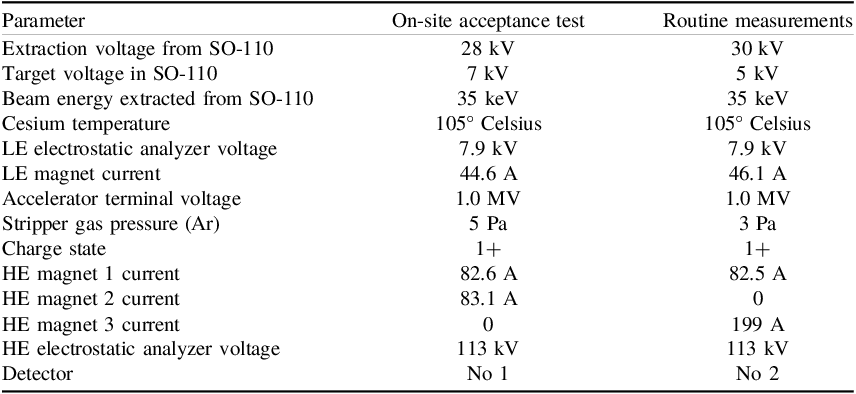
The radiocarbon sample materials employed for commissioning were NIST Standard NBS 4990C Oxalic Acid II (OXII) prepared by BNUAMS laboratory and the Xi’an AMS Center. In our experiments, the extraction energy was set to 35 keV which is the conventional value of extracted beam energy from this ion source (Klein et al. Reference Klein, Mous and Gottdang2006). The cesium reservoir temperature was maintained at 105° Celsius to emit approximately 80 μA of C- beam current from fresh samples. The maximum yield with charge state 2+ is obtained at 1 MV accelerator terminal voltage. Therefore, carbon ions in the 2+ charge state were picked up to stream through the first 105° HE analyzing magnet after accelerating and stripping. Argon is used as stripper gas and the pressure is set to 5.0 Pa. Under this setup, the maximum transmission efficiency of 53% was observed. The transmission efficiency is defined as the ratio of current measured in pre-accelerator Faraday cup to that in post-accelerator Faraday cup. Detailed parameters for radiocarbon measurement are listed in Table 1.
Selected parameters measured for radiocarbon.

Table 1. Long description
A table comparing parameters for on-site acceptance test and routine measurements. The table has 14 rows and 3 columns. The columns are labeled Parameter, On-site acceptance test, and Routine measurements. Row 1: Extraction voltage from SO-110, 28 kV, 30 kV. Row 2: Target voltage in SO-110, 7 kV, 5 kV. Row 3: Beam energy extracted from SO-110, 35 keV, 35 keV. Row 4: Cesium temperature, 105 Celsius, 105 Celsius. Row 5: LE electrostatic analyzer voltage, 7.9 kV, 7.9 kV. Row 6: LE magnet current, 44.6 A, 46.1 A. Row 7: Accelerator terminal voltage, 1.0 MV, 1.0 MV. Row 8: Stripper gas pressure (Ar), 5 Pa, 3 Pa. Row 9: Charge state, 1+, 1+. Row 10: HE magnet 1 current, 82.6 A, 82.5 A. Row 11: HE magnet 2 current, 83.1 A, 0. Row 12: HE magnet 3 current, 0, 199 A. Row 13: HE electrostatic analyzer voltage, 113 kV, 113 kV. Row 14: Detector, No 1, No 2.
In on-site acceptance test, radiocarbon sample material used for precision analysis was OXII prepared by the Xi’an AMS Center, and that for background level analysis was commercial graphite (Innochem LOT: KYIF1003) without processes of chemical pretreatment procedures, combustion and graphitization. Four OXII standard samples and 1 background sample were involved in the final test. All samples were pre-sputtered for 1–2 minutes to remove potential surface contamination and subsequently measured for 10 cycles, each cycle comprising 11 blocks of 10 s. Each OXII sample yielded over 250,000 14C total counts, corresponding to a statistical uncertainty below 0.20%. The measured weighted mean value of four OXII samples 14C/12C ratio was 1.4004 × 10⁻¹² with a relative standard deviation of 0.20%. The background level was below 7 × 10⁻¹⁷.
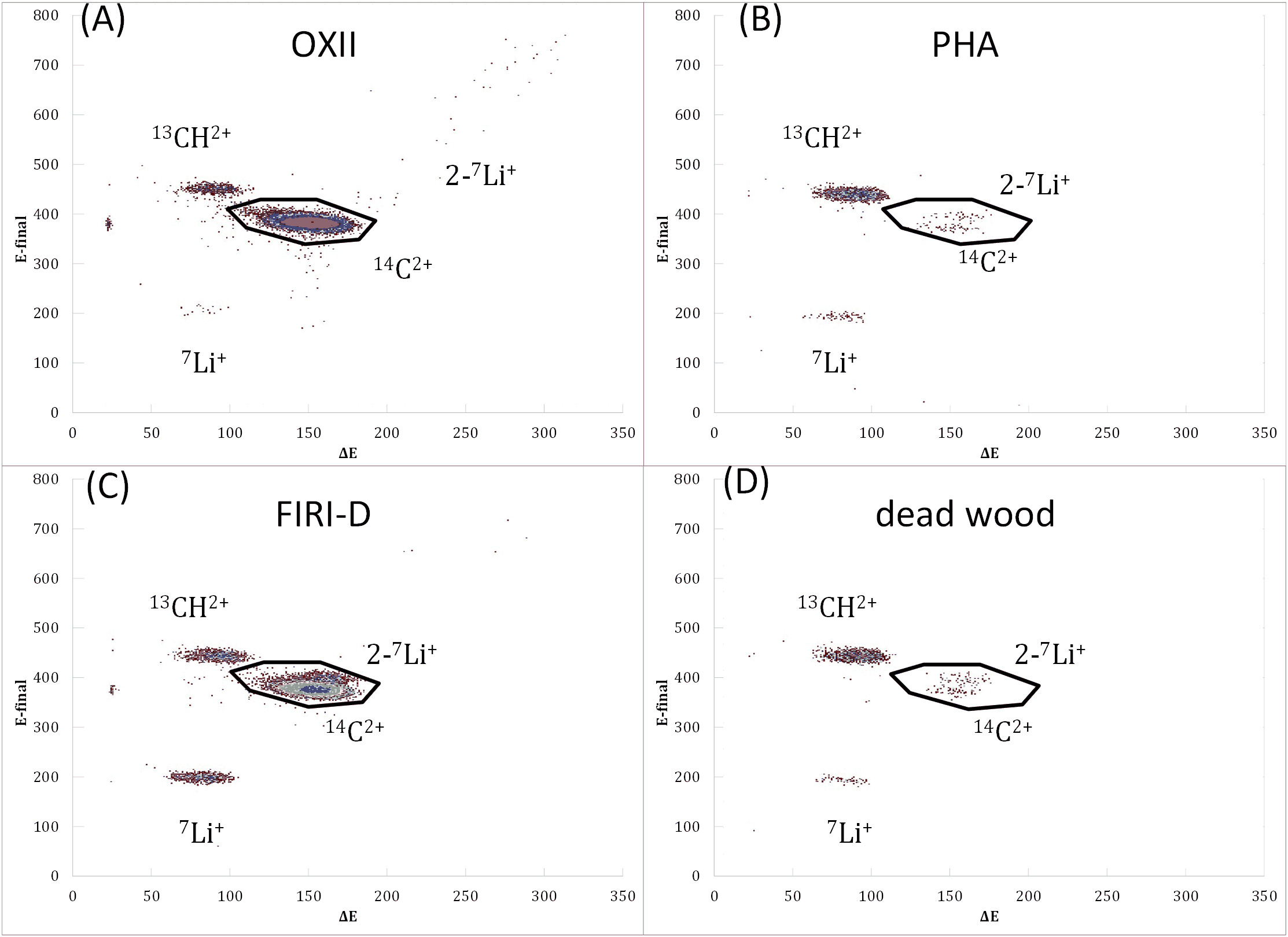
Interference from the molecular isobar 2-7Li+ is severe when 2+ ions 14C2+ is measured in some 1 MV AMS systems. It is due to the 2-7Li+ molecule having similar energy, mass, and charge with 14C2+ so that easily undistinguished by analyzing magnets, electrostatic analyzer and detector. These interferences are minimized through fine beam tuning as their trajectories differ slightly from that of 14C2+ and through detector energy discrimination capability. The typical spectra from a set of radiocarbon samples are shown in Figure 2.
Spectra of carbon samples contaminated with Li when using charge state of 2+. (A) OXII standard, (B) phthalic anhydride as process blank, (C) FIRI-D as secondary reference, (D) dead wood as process blank.

Figure 2. Long description
Panel A: Scatter plot labeled OXII standard. The x-axis is labeled ΔE and ranges from 0 to 350. The y-axis is labeled Efinal and ranges from 0 to 800. Key data points include 13CH2+, 2-7Li+, 14C2+, and 7Li+. Panel B: Scatter plot labeled PHA. The x-axis is labeled ΔE and ranges from 0 to 350. The y-axis is labeled Efinal and ranges from 0 to 800. Key data points include 13CH2+, 2-7Li+, 14C2+, and 7Li+. Panel C: Scatter plot labeled FIRI-D. The x-axis is labeled ΔE and ranges from 0 to 350. The y-axis is labeled Efinal and ranges from 0 to 800. Key data points include 13CH2+, 2-7Li+, 14C2+, and 7Li+. Panel D: Scatter plot labeled dead wood. The x-axis is labeled ΔE and ranges from 0 to 350. The y-axis is labeled Efinal and ranges from 0 to 800. Key data points include 13CH2+, 2-7Li+, 14C2+, and 7Li+.
Performance of routine measurements
On-site acceptance tests were carried out in some special situations, such as elaborate standard and background samples, perfectly tuned conditions, unpolluted ion source, shorter batch time and so on, which are not applicable to routine measurements. Therefore, routine measurement procedures were optimized over a two months period following the acceptance test. Routine measurements have been conducted for over a year, during which more than 1,800 radiocarbon samples have been analyzed.
The routine measurement procedural parameters for radiocarbon were refined through some systematic investigations after acceptance testing. The sputter voltage, also known as target voltage or cathode voltage, was reduced from 7 kV to 5 kV and the extraction voltage increased from 28 kV to 30 kV to maintain a constant beam extraction energy of 35 keV from ion source system. The cesium reservoir temperature was set to a lower value to reduce C beam to ∼40 μA as that of ∼60 μA used during OSAT did not readily support large batch measurements of multiple samples. Detailed parameters for radiocarbon measurement are listed in Table 1.
The number of graphite targets varies depending on the specific requirements of each research batch. Basically, each analytical batch includes at least 6 OXII standards, 2–3 process blanks, 4–6 secondary standards of known age, and several unknown samples. Measurement cycles of all samples are assessed to ensure more than 250,000 total 14C counts for all OXII standard samples. Each cycle lasts 10 minutes with 40 blocks of 15 s. The final radiocarbon results are calculated and presented according to the general principles (Stuiver and Polach Reference Stuiver and Polach1977). Only process blanks are subtracted, and no machine blank correction is applied because unprocessed commercial graphite samples were consistently determined older than 60 kyr BP.
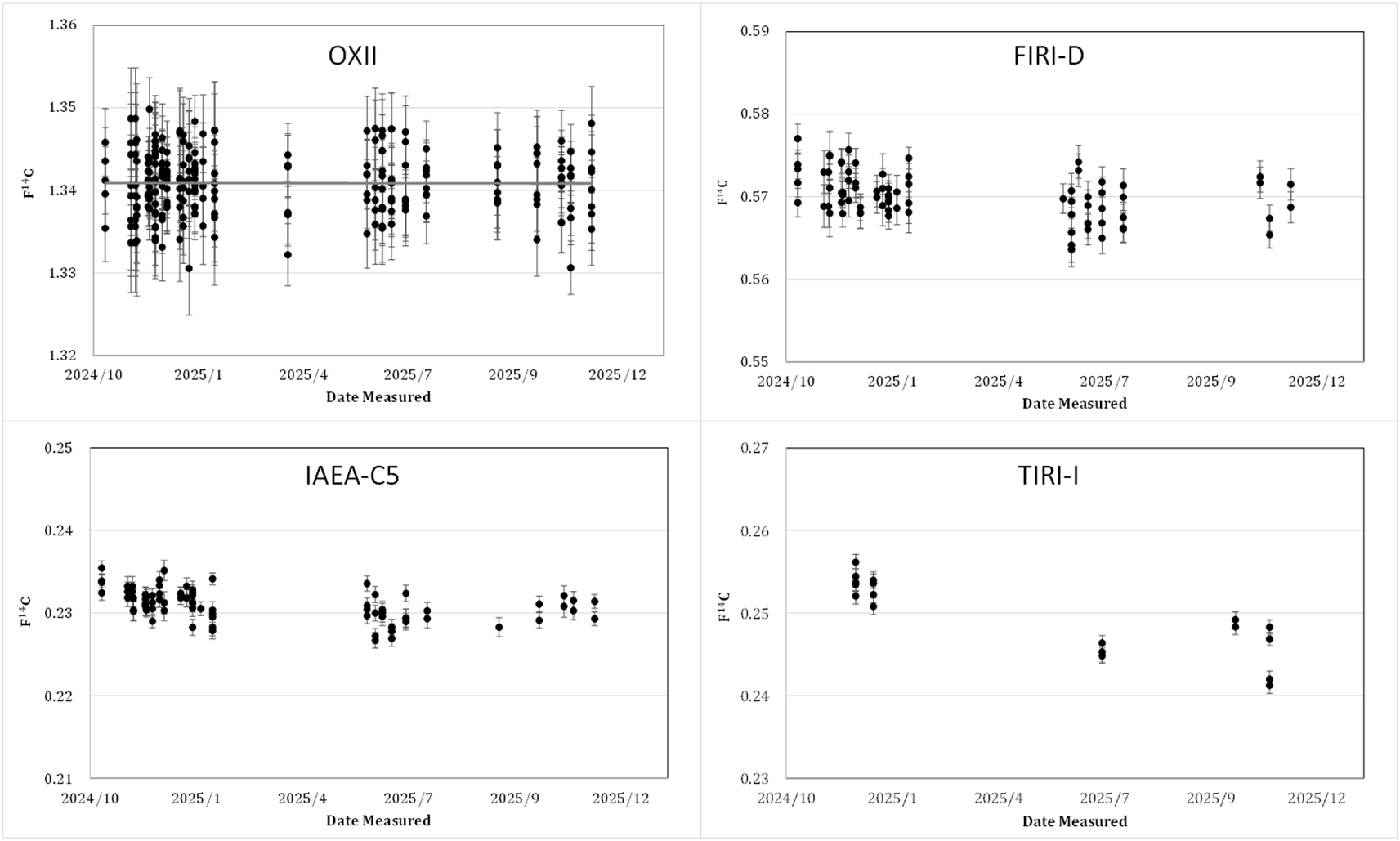
From October 2024 to December 2025, the weighted mean F14C value for OXII standard samples was 1.3408 ± 0.0038 (n = 239, Figure 3). Process blanks were performed for each individual batch of samples. The average F14C result for organic background sample, dead wood, was 0.0018 ± 0.0008 (n = 77, Figure 4), which were processed together with unknown samples during chemical pretreatment. A calcite as inorganic background was assessed to 0.0012 ± 0.0007 F14C (n = 24, Figure 4). Commercial graphite and phthalic anhydride were measured to assessed the machine background (∼60 kyr BP) and processed background (∼50 kyr BP) respectively. In this study, nearly all samples have a carbon content of ∼1 mg.
Results of routine measurements for radiocarbon standard samples OXII and the secondary reference standard samples FIRI-D, IAEA-C5 and TIRI-I.

Results of routine measurements for radiocarbon process background, dead wood for organic and calcite for inorganic samples.

The secondary reference standards are used for quality control and procedure assurance. FIRI-D (Belfast dendro-dated pine) (Scott Reference Scott2003) and IAEA-C5 (Two Creeks wood) are most used in BNUAMS radiocarbon measurements. The weighted mean F14C value of FIRI-D is 0.5702 ± 0.0028 (n = 79, Figure 3, radiocarbon age 4513 ± 39 yr BP), consistent with the consensus value 4508 ± 3 yr BP. IAEA-C5 F14C is 0.2310 ± 0.0018 (n = 82, Figure 3) consistent with the consensus value 0.2305 ± 0.0002. TIRI-I (Travertine) (Gulliksen and Scott Reference Gulliksen and Scott1995) reference used for inorganic procedure is 0.2496 ± 0.0043 F14C (n = 18, Figure 3, radiocarbon age 11149 ± 137 yr BP) consistent with the consensus value 11060 ± 17 yr BP. All results are calculated using background and standard (OXII) correction.
Conclusion
The BNUAMS system is a uniquely configured 1.0 MV multi-element AMS facility incorporating two independent detection lines in traditional architecture to ensure isotope abundance sensitivities for light and heavy AMS nuclides. On-site acceptance tests demonstrated measurement precision and background level on a par with that of other similar AMS system for conventional AMS nuclides including 14C. The radiocarbon routine measurements in 2025 after acceptance tests are presented. The achieved precision is 0.28% for OXII standards. The machine background level corresponds to ages older than 60 kyr BP and process background exceeds 50 kyr BP. For secondary reference standards FIRI-D and IAEA-C5, the weighted mean value agrees with the consensus values within 2σ. Those results confirm long-term analytical reliability and demonstrate the annual performance remaining competitive although inferior to that of acceptance tests.
Acknowledgments
This work was supported by the National Natural Science Foundation of China (grant no. 42030512). We would like to thank Xi’an AMS team and IHEG-CAGS AMS team for their assistance in AMS operation and sample preparation. We sincerely thank the reviewers for providing insightful and constructive comments on the manuscript.
Competing interests
The authors declare no competing interests.