I. INTRODUCTION
Nanoglasses (NGs) constitute a new subcategory of amorphous materials with a wide range of interesting properties including changes in their magnetic and mechanical behavior. Reference Ghafari, Hahn, Gleiter, Sakurai, Itou and Kamali1 While regular metallic glasses are obtained by freezing the liquid state in a quenching or rapid cooling process. NGs are created by inert gas condensation leading to small amorphous particulates that can be compressed and “sintered” into a bulk material. Reference Ghafari, Hahn, Gleiter, Sakurai, Itou and Kamali1–Reference Gleiter4 NGs can also be generated by severe plastic deformation of bulk metallic glasses (BMGs) Reference Wang, Cao, Jiang, Franz, Schroers, Valiev, Ivanisenko, Gleiter and Fecht5 and recently by magnetron sputtering using powder targets. Reference Chen, Takeuchi, Nakayama, Wu, Esashi, Inoue and Louzguine-Luzgin6 It was found experimentally that NGs exhibit a higher intermediate range order than BMGs. Reference Ghafari, Kohara, Hahn, Gleiter, Feng, Witte and Kamali3 Molecular dynamics (MD) simulations and experimental results for NG structures revealed that the interphase region between the particles contains a significantly larger fraction of excess free volume than the particles, Reference Fang, Vainio, Puff, Wurschum, Wang, Wang, Ghafari, Jiang, Sun, Hahn and Gleiter2,Reference Ritter, Sopu, Gleiter and Albe7,Reference Sopu, Albe, Ritter and Gleiter8 which is considered to be the main reason for the changed response of the material.
Typical BMGs usually fail catastrophically by shear banding once a critical stress is surpassed. Reference Schuh, Lund and Nieh9–Reference Schuh, Hufnagel and Ramamurty11 Once the so-called shear transition zones are activated, their avalanche-like propagation creates the shear bands. Reference Argon12 This rapid shear banding destroys the short-range order (SRO) of the BMGs during its progress. Reference Argon12 The absence of a mechanism to inhibit or slow the shear bands leads to lack of damage tolerance and limited plasticity, Reference Schuh, Hufnagel and Ramamurty11,Reference Suryanarayana13–Reference Calin, Eckert and Schultz15 thus severely limiting their applicability. In contrast, NGs were found to have a lower yield strength than typical BMGs, but exhibited plastic deformation while having a comparable fracture strength. Reference Fang, Vainio, Puff, Wurschum, Wang, Wang, Ghafari, Jiang, Sun, Hahn and Gleiter2 This unusual behavior was attributed to the intersection of multiple shear bands at the interface. Reference Fang, Vainio, Puff, Wurschum, Wang, Wang, Ghafari, Jiang, Sun, Hahn and Gleiter2
Although several approaches have been taken to enhance the plasticity in BMGs, Reference Hays, Kim and Johnson14–Reference Eckert, Das, Pauly, Duhamel, Kim, Yi and Wang16 the underlying understanding of how to stop the propagation of shear bands is still needed. However, due to the premature failure of BMGs (as opposed to NGs), the first shear band or set of parallel shear bands in an unconfined volume usually leads to catastrophic failure at room temperature thus limiting further studies of shear band interaction.
Shear bands can be considered to be either a sequence of shear transformation zones (STZ) being activated Reference Argon12 or a discrete burst after intense strains have been accumulated in a confined volume. Reference Schuh, Hufnagel and Ramamurty11 While the true mechanism is likely to be in between those two extremes, Reference Schuh, Hufnagel and Ramamurty11 both mechanism will lead to the creation of extra free volume and destruction of SRO. Reference Schuh, Hufnagel and Ramamurty11,Reference Argon12,Reference Chen, Ohkubo, Mukai and Hono17,Reference Shi and Falk18 Ritter et al. showed that the interphase region in the NGs exhibits the properties of a shear band Reference Ritter, Sopu, Gleiter and Albe7 and thus has a destroyed SRO. Reference Shi and Falk18–Reference Pampillo20 It was also found that annealing/relaxation of BMGs can recreate the SRO to some extent. Reference Ritter and Albe19,Reference Jiang and Atzmon21,Reference Koebrugge, Sietsma and van den Beukel22 For example, it was reported that in a Cu–Zr-system, a disturbed SRO can decrease the modulus of metallic glasses. Reference Shibutani, Wakeda, Ogata, Park, Chandra, Tsuzaki, Militzer and Ravindran23 Koebrugge et al. found that SRO increases the modulus and discovered that relaxed glasses will have higher moduli. Reference Koebrugge, Sietsma and van den Beukel22 Chen et al. measured an increase in the modulus for sputtered Au-NG. Reference Chen, Louzguine-Luzgin, Xie, Sharma, Perepezko, Esashi, Yavari and Inoue24
These results are important as the work presented in this paper basically encounters both phenomena, a constant and an increased modulus. It will be shown that signs of two distinct regions are in fact present in NGs and are contributing to the mechanical response. Since NGs contain large volume fractions of both the amorphous shearband-like interphase region and the amorphous particulates, Reference Ghafari, Hahn, Gleiter, Sakurai, Itou and Kamali1,Reference Sopu, Albe, Ritter and Gleiter8,Reference Fang, Vainio, Puff, Wurschum, Wang, Wang, Ghafari, Jiang, Sun, Hahn and Gleiter25 this leads to a two-phased material with two distinct glass transition temperatures. This two-phased microstructure could be used to introduce plasticity in amorphous materials.
II. EXPERIMENTAL DETAILS
Two nanoglass pellets of the nominal composition Fe28Sc72 and Fe90Sc10, respectively, as well as two melt-spun ribbon samples of Fe24Sc76 and Fe90Sc10, were investigated. The procedure for the sample preparation via inert gas condensation can be found elsewhere. Reference Ghafari, Hahn, Gleiter, Sakurai, Itou and Kamali1,Reference Ghafari, Kohara, Hahn, Gleiter, Feng, Witte and Kamali3,Reference Gleiter4,Reference Fang, Vainio, Puff, Wurschum, Wang, Wang, Ghafari, Jiang, Sun, Hahn and Gleiter25 To obtain compact samples for mechanical testing, all pellets were compressed at 5 GPa. Each pellet was used to obtain multiple samples for both indentation and thermal expansion coefficient measurements. The samples used for the nanoindentation experiments were polished to a mirror finish while the samples used for the thermal expansion measurements underwent both indentation and thermal expansion analysis.
Nanoindentation tests were performed using both a MTS XP Nanoindenter (Agilant, Phoenix, AZ) and Hysitron Triboindenter (Hysitron, Eden-Prairie, MN). Experiments in the MTS Indenter were performed using a depth-limited thin film method with continuous stiffness measurement (CSM) and a maximum displacement of 200 nm at a strain rate of 0.05 s−1. The experiments in the Triboindenter were performed under load control with a maximum load of 5000 N to achieve the same maximum displacement. Arrays of 25–49 indents were performed for each condition and sample with a minimum spacing of 4 µm between indents to avoid interference by previous indents.
Thermal expansion was measured for the Fe-rich samples only using a custom apparatus using a modified digital image correlation (DIC) code originally developed by Eberl et al. Reference Eberl, Gianola and Hemker26 The application of DIC allows for the strain to be measured in x and y. A total of 30 images were taken at temperature intervals of 20 °C. For each set of 10 images, an average strain value was determined resulting in three independent strain values for each temperature. Calibration of the set-up was performed by using an aluminum foil of technical purity. The thermal expansion measurements were found to be a good match of literature values. To minimize oxidation all experiments were performed in an inert gas environment.
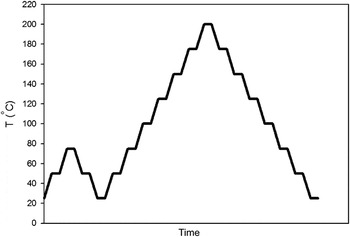
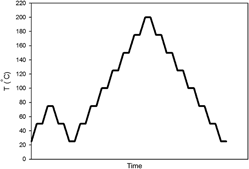
The temperature profile used for the NGs differs from the simple heating–cooling pattern used for Al and is shown in Fig. 1. It was comprised of two heating segments with an intermittent cooling segment. This was done to verify the reversibility of the thermal expansion and to study the thermal stability of the NGs. The sample was slowly heated to each target temperature, making sure that it did not surpass the target temperature at any time and was equilibrated for several minutes before the images to determine the strain were taken. The reference sample was subjected to the same heat treatment. The nanoglass samples were retested after undergoing one full cycle of thermal expansion measurements.
Temperature–time profile used to measure the thermal expansion behavior of the NG (note that the time increments vary in duration as the prime objective is to avoid exceeding the target temperature).

The chemical composition of both the source material and the final sample was measured using energy dispersive x-ray spectroscopy (EDX) in a JEOL JSM-7001 FE SEM (Jeol Ltd., Tokyo, Japan). X-ray diffraction analysis was performed using Rigaku diffractometer (Ultima IV, Rigaku, Japan) before and after the coefficient of thermal expansion (CTE) measurements to verify the amorphous character of the material.
III. RESULTS AND DISCUSSION
A. Thermal behavior
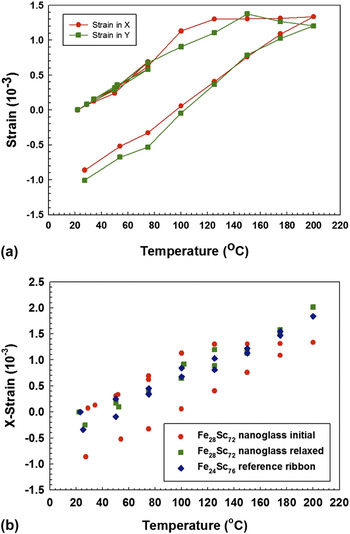
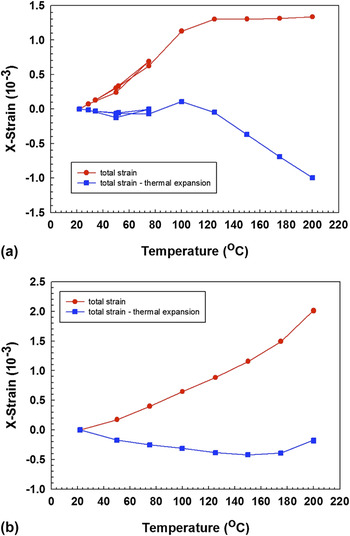
To access and verify that there is a two-phased structure created by the excess free volume in the NGs and that this second phase has properties similar to a shear band, a series of thermal measurements were conducted using both NGs and standard BMGs ribbons of the same composition. In Fig. 2(a), the strain–temperature diagrams for the NGs show that in the low T-regime (T < 100 °C) the material is expanding and the strain is fully recovered upon cooling in both the x- and y-direction. Neither the sample location (center versus edge of the pellet) nor the strain direction showed significant change in the response. Once the material is heated all the way to the maximum temperature of 200 °C, the strain stays constant and becomes negative upon cooling to room temperature (RT). For the ribbons, regular thermal expansion upon heating and contraction upon cooling with a net strain of approximately zero is observed [Fig. 2(b)]. After a second run on the NGs, their behavior was found to be similar to the reference ribbons [Fig. 2(b)]. Figures 3(a) and 3(b) show the total thermal strain (red lines with circles) and the difference between the total strain and the thermal strain originating from expansion. The thermal expansion strain was calculated based on the assumption that pure thermal expansion is fully reversible and that all other contributions to the total strain are caused by structural changes in the material. Following this approach, the thermal contraction data were used to extract the reversible thermal strain to be subtracted from the total strain. The result of this calculation is shown in Figs. 3(a) and 3(b) (blue line with squares). The change in free volume can be calculated assuming an isotropic behavior and taking the average of the x- and y-strain as z-strain, a volume strain V/V 0 of 10−8 can be computed for the NG.
(a) Strain plot for the NG in x- and y-direction as a function of temperature (b) comparison of strain for the BMG to the NG in its initial state and after one cycle of thermal expansion measurements.

Thermal strain in the x-direction for the Fe25Sc75 NG and the lost volume for the initial run (a) and after one round of thermal expansion measurements (b). The blue line with squares indicates the irreversible thermal strain contribution as obtained from thermal contraction subtracted from the total thermal strain.

Our results from the thermal expansion experiments show that the heat treatment involved does not crystallize the material (verified by XRD; data not shown here). However, there appears to be a significant release and redistribution of the excess free volume, ultimately causing the sample to shrink throughout the experiment. This behavior matches the thermal expansion measured in severely deformed BMGs. Reference Yavari, Moulec, Inoue, Nishiyama, Lupu, Matsubara, Botta, Vaughan, Di Michiel and Kvick27 Given that the excess free volume in the interphase region was found to be in excess of 15%, Reference Chen, Louzguine-Luzgin, Xie, Sharma, Perepezko, Esashi, Yavari and Inoue24,Reference Chen, Frank, Asao, Louzguine-Luzgin, Sharma, Wang, Xie, Ishikawa, Hatakeyama, Lin, Esashi, Yamamoto and Inoue28 it appears that this relaxation of the material possibly correlates with a redistribution of the excess free volume in the interphase region. The higher than usual excess free volume is formed by an inverse sintering process (where the porosity is absorbed into the material rather than material being diffused to fill the voids like in a regular sintering process encountered in crystalline solids). This mechanism is only available as the material is still in its liquid-like state and can absorb excess free volume at the price of a destroyed SRO in the interphase region. Surprisingly, this microstructure is quite stable and a change in excess free volume cannot be observed at temperatures below 100 °C, when a deviation from the previously observed linearity becomes obvious. Once the material is heated beyond this temperature, a homogenization of this metastable state occurs transforming it into a more stable BMG state. This could also be an indication that metallic glasses can actually exist in more than two states. Each state itself is metastable and has its own glass transition temperature. The results from the second run on the NG clearly show that, while the material is still amorphous, there is a good match in the thermal expansion and mechanical behavior of the former NG and the reference BMG. This would mean that our interphase region, which is structurally similar to a shear band, transforms into its more stable state. A similar observation was made on severely deformed BMGs by Yavari et al., who measured a loss of excess free volume in the deformed BMG sample and obtained the same values as for the initial BMG in a second run, Reference Yavari, Moulec, Inoue, Nishiyama, Lupu, Matsubara, Botta, Vaughan, Di Michiel and Kvick27 further highlighting that our hypothesis of the interphase region behaving similar to shear bands appears to be valid.
The main difference is that this interphase region, which can also be considered a second glassy phase is formed in the manufacturing process. As a consequence, it can be assumed that there are two ways to generate this second phase: (i) processing as for the NGs and (ii) through mechanical activation during deformation as for the BMGs. In regular BMG, shear bands do not relax without thermal activation and are thus thermodynamically metastable at RT.
As a consequence, a NG can be considered a two-phased amorphous material consisting of two distinct glasses that are structurally different but chemically similar. Classical processing techniques such as rapid quenching suggest that there is only one metastable state for each composition. While our results using low temperature processing techniques indicate that there are at least two phases that are metastable under certain conditions much like a crystalline material with two phases that are different in their crystal structure.
B. Mechanical behavior
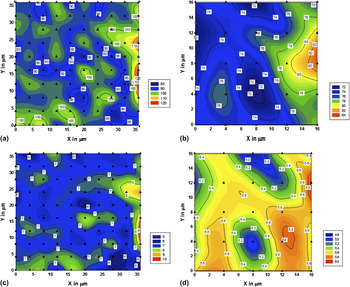
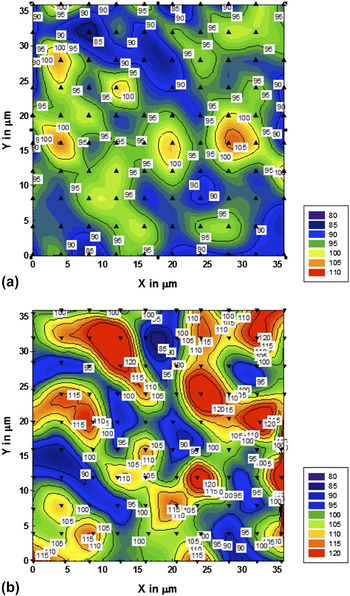
To further evaluate the effect of free volume, nanoindentation tests were performed on both NGs and ribbons as shown in Figs. 4–6. Reduced modulus and hardness maps were created for both the NG [Figs. 4(a) and 4(c)] and the BMG [Figs. 4(b)–4(d)]. The maps clearly show the variations of the mechanical properties as a function of location indicating that the microstructure is not less homogeneous in the NGs than in the ribbon. For the Sc-rich (Fe25Sc75) samples, an increase in hardness as well as modulus is found for the NGs as compared with the melt-spun ribbon samples [Figs. 4(a)–4(d)], while the Fe-rich NGs (Fe90Sc10) do not exhibit this difference (E r,NG = 130.1 ± 5.9 GPa, H NG = 7.0 ± 0.5 GPa, E r,BMG = 138.7 ± 6.7 GPa, and H BMG = 8.2 ± 0.7 GPa). Some of the NGs exhibit a significant increase in the modulus and hardness. There are two possible explanations for this increase. Albe et al. recently studied the deformation of NGs using MD simulations. Reference Ritter, Sopu, Gleiter and Albe7,Reference Sopu, Albe, Ritter and Gleiter8 Based on their analysis, the interphase region has a comparable structure to shear bands in regular BMGs. Reference Ritter, Sopu, Gleiter and Albe7,Reference Sopu, Albe, Ritter and Gleiter8 Even though the excess free volume determined in the simulation does not match the measured values, the concept of the interphase region being equivalent to a shear band seems plausible. Reference Ghafari, Kohara, Hahn, Gleiter, Feng, Witte and Kamali3,Reference Ritter, Sopu, Gleiter and Albe7,Reference Sopu, Albe, Ritter and Gleiter8,Reference Fang, Vainio, Puff, Wurschum, Wang, Wang, Ghafari, Jiang, Sun, Hahn and Gleiter25 This would also mean that the interface region would not only have more excess free volume than the bulk but also a disturbed SRO, which has been shown to decrease the modulus. Reference Koebrugge, Sietsma and van den Beukel22,Reference Shibutani, Wakeda, Ogata, Park, Chandra, Tsuzaki, Militzer and Ravindran23 The second option would be a contamination of the NG samples with oxygen in particular, as Sc has a high affinity for oxygen. Even though a similar increase has been observed in sputtered Au-NG, Reference Chen, Louzguine-Luzgin, Xie, Sharma, Perepezko, Esashi, Yavari and Inoue24 currently contamination with oxygen appears to be the more likely explanation for the increased RT modulus. A Fe28Sc72 NG sample tested in technical purity Ar (99.9%) showed a significant increase in modulus [Figs. 5(a) and 5(b)]. Since the increase is in the order of just 25%, SRO-effects during heating in the thermal expansion measurement as an explanation fall short. In particular, considering that while the oxygen contamination was still too low to be quantified by EDX, oxygen peaks were observed after CTE measurements in technical purity Ar (99.9%).
Modulus E r and hardness H maps for the Fe25Sc75 NG and BMG. Modulus (a) NG, (b) BMG and Hardness, (c) NG, and (d) BMG. Triangles indicate the location of the indents.

Modulus map for a Fe28Sc72 before (a) and after the thermal expansion measurement (b).

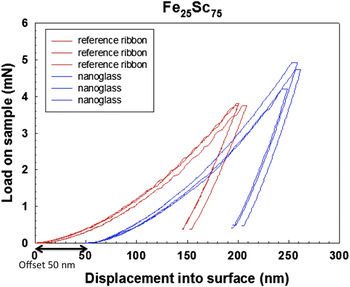
Representative load–displacement curves for the Fe25Sc75 NG and the BMG ribbon.

A more significant finding of the current study is the absence of pop-in events indicating shear localization in macroscopic shear bands. Even though the modulus and hardness data are inconclusive in respect to a clear difference between NGs and BMGs, the load–displacement curves for the reference ribbon and the nanoglass sample of the same composition clearly exhibit a different behavior (Fig. 6). While the melt-spun ribbon shows sharp displacement bursts usually attributed to shear localization and heterogeneous deformation by shear banding, it is evident that those pop-in events are missing or are below the displacement resolution of the NI system (Fig. 6). It appears that there is yet another change in the incipient plasticity which unlike the ones known so far seems to be not only temperature dependent but also microstructure dependent.
A shear band in a metallic glass is usually formed by the activation of STZ and the development of a coercive avalanche of these STZs until the shear band covers the distance from the surface to the point of the maximum shear stress underneath the indenter. Reference Packard, Franke, Homer and Schuh29,Reference Packard and Schuh30 The shear bands destroy the SRO in the metallic glasses. Reference Ritter, Sopu, Gleiter and Albe7,Reference Shi and Falk18,Reference Pampillo20,Reference Jiang and Atzmon21,Reference Shi and Falk31 In the NGs, there are already regions where the SRO is disturbed, namely the interphase region. Reference Ritter, Sopu, Gleiter and Albe7,Reference Sopu, Albe, Ritter and Gleiter8
As discussed in a review by Schuh et al., several studies have investigated primary and secondary shear banding in confined volumes, although these shear bands were either parallel or right on top of each other Reference Schuh, Hufnagel and Ramamurty11 but did not intersect. It is important to note that in confined loading conditions such as encountered in, for example, nanoindentation or uniaxial compression, multiple shear bands can be initiated in various directions without a complete failure of the sample. Reference Schuh, Hufnagel and Ramamurty11,Reference Suryanarayana13 Nonetheless, they will not intersect during their propagation. A study by Jiang et al. investigated the effect of prestraining BMGs and found an increase in plasticity and strength using indentation Reference Jiang and Atzmon21 due to the intersection of the shear bands.
Consequently, an avalanche of STZs approaching an area of disturbed SRO (interphase/secondary glass phase) will be stopped. There are two analogies that can be used to describe the phenomenon:
-
(i) The SRO can be considered to be the equivalent of a slip system in a crystal and the interphase region can be treated as a grain boundary (GB). Both the interphase region and the GB are disturbed areas. In conclusion, the motion of the respective carrier of plasticity (the shear band for the metallic glass and the dislocation for the crystal) will be inhibited.
-
(ii) Another possible and better analogy is that the shear band feeds of the SRO along the highest stress path destroying it in the process. To stop the propagation of this avalanche, the supply of undestroyed SRO in its path must be eliminated. The interphase potentially provides such an interruption of SRO.
Since the indentation is a mechanically irreversible process, the second analogy (case (ii)) appears to be more suitable. Consequentially, the plastic deformation required to accommodate the indent has to be homogeneously distributed throughout several small amorphous particles. In regular metallic glasses, the transition from highly localized/heterogeneous deformation to a more homogeneous deformation occurs at 0.8 T g. To our knowledge, this is the first experimental indication that shear bands can be inhibited by the interphase region in NGs and thus a homogeneous deformation behavior is obtainable in NGs at low temperatures. This opens a new avenue for metallic glasses and also their application in mechanical loading scenarios requiring some plasticity prior to failure.
IV. CONCLUSIONS
In this paper, we were able to show that through microstructural modifications bulk amorphous materials can be tuned to inhibit shear bands. This can mainly be attributed to the presence of a second phase with a disturbed SRO. As the structure is relaxed/heated above the glass transition temperature of the interphase, this interphase region is annihilated by a redistribution of the excess free volume. As a consequence, both the thermal as well as the mechanical behavior exhibit the behavior of a SRO-dominated BMG with regular fluctuations. To understand this transition and the inhibition of the macroscopic shear banding, better parameters such as the particle size, interphase region thickness, and strain rate need to be investigated further.
ACKNOWLEDGMENTS
We would like to thank Dr. Tao Feng (KIT) for preparing the nanoglass samples. The discussions with Dr. Chris Eberl (KIT) on the DIC and Prof. Andrea Hodge (USC) are gratefully acknowledged. We would also like to thank Dr. Ruth Schwaiger (KIT) for providing access to the MTS/Agilent nanoindenter.