1 Introduction
Two dynamical systems are said to be orbit equivalent if there exists a homeomorphism between the phase spaces that induces a one-to-one correspondence between their orbits. They are strong orbit equivalent if they are orbit equivalent and the cocycle maps (precisely defined in §2.4) are continuous everywhere except at most at one point. These definitions are weaker than topological conjugacy and define equivalence relations on the class of topological dynamical systems. In this article, as in many others in the field, we focus on minimal Cantor systems. This is because strong orbit equivalence essentially becomes topological conjugacy otherwise (see, for instance, [Reference Boyle and Tomiyama4, Reference Giordano, Putnam and Skau17]). Furthermore, in the case of minimal Cantor systems, we can use the machinery of Bratteli–Vershik representations to give a characterization of when two systems are strong orbit equivalent [Reference Giordano, Putnam and Skau17]. Several works have explored the dynamical invariants that are preserved under this equivalence. For instance, it is not hard to show that the set of invariant probability measures is preserved under orbit equivalence (and so, in particular, under strong orbit equivalence). See [Reference Herman, Putnam and Skau20] for further discussion. However, topological entropy does not impose any constraints on two systems being strongly orbit equivalent. In fact, within every strong orbit equivalence class, there exist systems with any non-negative numbers as their entropies (see [Reference Boyle and Handelman2, Reference Ormes24, Reference Sugisaki26, Reference Sugisaki27]). Talking about eigenvalues of dynamical systems under strong orbit equivalence, it was proved that the subgroup of rational continuous eigenvalues is an invariant; however, continuous or measurable eigenvalues may vary under strong orbit equivalence [Reference Cortez, Durand and Petite6, Reference Durand, Frank and Maass14, Reference Ormes24]. In the case of subshifts, the complexity functions in the context of this equivalence are also studied. For instance, for any given strong orbit equivalence class, there exists a subshift with arbitrarily low superlinear complexity [Reference Cecchi Bernales and Donoso5].
In this article, we explore the relationship of two other conjugacy invariants within the framework of strong orbit equivalence—automorphism groups and asymptotic components. The automorphism group of a dynamical system
 $(X,T)$
is the group, under composition, of all homeomorphisms on X that commute with the transformation T. They have been the subject of extensive study, especially in the context of subshifts of finite type and minimal subshifts. In the context of subshifts, the automorphism groups of a full shift [Reference Hedlund19] or subshifts of finite type [Reference Boyle, Lind and Rudolph3] are shown to be profoundly large, containing copies of finite groups, countably many copies of
 ${\mathbb Z}$
, free groups, among others. However, systems with low complexity exhibit a restricted automorphism group. In particular, systems with non-superlinear complexity have the automorphism group that is virtually
 ${\mathbb Z}$
[Reference Cyr and Kra8, Reference Donoso, Durand, Maass and Petite9]. We refer to [Reference Donoso, Durand, Maass and Petite10, Reference Salo25] and the references therein for more work in this direction. In this article, we explore, in particular, how small the automorphism group can be within a strong orbit equivalence class. It is worth mentioning that it is not always possible to find subshifts with non-superlinear complexity within a strong orbit equivalence class. This is because for a class containing a subshift of non-superlinear complexity, the dimension group (an invariant of strong orbit equivalence) is an abelian group of finite rational rank. Consequently, complexity arguments alone are insufficient for obtaining small automorphism groups. Instead, we employ the concept of asymptotic components, an essential tool for studying the automorphism groups of subshifts, and examine it in detail. Our main theorem (Theorem 1.2) concludes that we can construct subshifts with asymptotic components of any cardinality—finite, countable, or uncountable—within a strong orbit equivalence class. This result uses the combinatorial structure of the subshifts to a great extent. The method of studying automorphism groups by exploring their asymptotic components has been seen in some earlier works, especially for subshifts with low complexity [Reference Coven, Quas and Yassawi7–Reference Donoso, Durand, Maass and Petite9, Reference Donoso, Durand, Maass and Petite11]. Elements of the automorphism group induce permutations on the set of asymptotic components, and only the powers of T fix these permutations. Therefore, a system with fewer asymptotic components will have a smaller automorphism group. This fact, together with Theorem 1.2, allows us to construct a subshift whose automorphism group is isomorphic to
 ${\mathbb Z}$
within any strong orbit equivalence class. This system is immediately proven to have zero entropy using Theorem 1.1, which states that systems with positive entropy must have uncountably many asymptotic components. As a corollary to our main result, we also show that having a trivial automorphism group imposes no restrictions on its set of invariant measures (Corollary 4.16). We also construct subshifts with smaller automorphism groups and arbitrarily low superlinear complexity or arbitrarily large subexponential complexity. We prove similar results for strong orbit equivalence of Toeplitz subshifts. Note that Toeplitz subshifts satisfy the ‘equal path number property’, which is not preserved under the constructions described in §§4 and 5. Consequently, we cannot guarantee that applying the same construction will eventually yield a Toeplitz subshift. Therefore, we employ a different construction in this setup. Both constructions have their respective merits and demerits.
1.1 Main results
An asymptotic component is a collection of two or more points (modulo orbits) whose distance tends to 0 under the dynamics (forward or backward). The precise definition is deferred to §3. As a preliminary result, we have the following theorem on the topological entropy of a system having at most countably many asymptotic components.
Theorem 1.1. Let
 $(X,T)$
be a topological dynamical system with at most countably many asymptotic components. Then,
 $(X,T)$
has topological entropy zero.
We show that Theorem 1.1 is somehow optimal, in the sense that for any given subexponential function, there exists a minimal subshift whose complexity dominates that function along some subsequence, while possessing only a single asymptotic component (Theorem 4.19).
Now, we state our main result, which gives the existence of systems with finitely, countably infinite, or uncountably many asymptotic components within any strong orbit equivalence class of a minimal Cantor system.
Theorem 1.2. Let
 $(X,T)$
be a minimal Cantor system. There exist subshifts that are strong orbit equivalent to
 $(X,T)$
and have exactly k for any positive integer k, countably infinite, or uncountably many asymptotic components.
Theorem 1.2 is divided into three results, Theorems 4.15, 5.5, and Corollary 3.1. Here, the case of uncountably many asymptotic components is a consequence of Theorem 1.1.
As a corollary, we also obtain subshifts with a trivial automorphism group within a strong orbit equivalence class of minimal Cantor systems.
Corollary 1.3. Let
 $(X,T)$
be a minimal Cantor system. There exists a minimal subshift
 $(X',S)$
that is strong orbit equivalent to
 $(X,T)$
and such that
 $\mathrm {Aut}(X',S)$
is generated by S.
There are several other interesting corollaries of our main theorem, most of which are mentioned in §4. We also prove the following result for the strong orbit equivalence class of the Toeplitz subshift.
Theorem 1.4. Let
 $(X,T)$
be a Toeplitz subshift. Then there exist Toeplitz subshifts
 $(X',S)$
that are strong orbit equivalent to
 $(X,T)$
and have exactly k for any positive integer k, countably infinite, or uncountably many asymptotic components.
1.2 Organization of the paper
In §2, we provide a comprehensive overview of the necessary background and preliminaries. This includes an introduction to minimal Cantor systems, subshifts, Bratteli–Vershik systems, and strong orbit equivalence. Section 3 is devoted to the proof of Theorem 1.1. In §4, we focus on proving several auxiliary lemmas to provide the proof of Theorem 1.2 for the case of finitely many asymptotic components. Similar results for the case of countably many asymptotic components are obtained in §5. Finally, we look at the asymptotic components of systems within the strong orbit equivalence class of the Toeplitz subshift in §6.
2 Preliminaries
2.1 Minimal Cantor systems
We say that the pair
 $(X,T)$
is a topological dynamical system, or simply a system, if X is a compact metric space and
 $T\colon X\to X$
is a homeomorphism. A point
 $x\in X$
is said to be periodic if the orbit of x under T, defined by
 $\text {Orb}_T(x):=\{T^n(x)\mid n\in {\mathbb Z}\}$
, is finite. Otherwise, it is said to be aperiodic. A system
 $(X,T)$
is said to be aperiodic if every point in X is aperiodic and it is said to be minimal if for every
 $x\in X$
,
 $\text {Orb}_T(x)$
is dense in
 $X.$
A minimal Cantor system is a minimal system
 $(X,T)$
, where X is a Cantor space, that is, X is a non-empty totally disconnected compact metric space without isolated points.
Two dynamical systems
 $(X_1,T_1)$
and
 $(X_2,T_2)$
are said to be topologically conjugate if there exists a homeomorphism
 $\phi \colon X_1\to X_2$
such that
 $\phi \circ T_1=T_2\circ \phi $
. In such a case,
 $\phi $
is said to be the conjugacy map.
2.2 Symbolic dynamical systems
An alphabet
 ${\mathcal A}$
consists of a finite set of symbols. A word is a finite sequence (string) with symbols from
 ${\mathcal A}$
. The empty word is denoted by
 $\epsilon $
. If
 $w=w_1\cdots w_n$
is a word, then
 $|w|=n$
denotes the length of w. Let
 ${\mathcal A}^*$
denote the collection of all finite words with symbols from
 ${\mathcal A}$
, including the empty word. For two words
 $u=u_1\cdots u_s,w=w_1\cdots w_t\in {\mathcal A}^*$
, we define their concatenation as
 $uw:=u_1\cdots u_sw_1\cdots w_t$
. For two words
 $u,w$
, we say that u is a subword of w, denoted as
 $u\prec w$
, if there exist
 $t,v\in {\mathcal A}^*$
such that
 $w=tuv$
. When
 $t=\epsilon $
, we say that u is a prefix of w and when
 $v=\epsilon $
, we say that u is a suffix of w.
Let
 ${\mathcal A}^{{\mathbb Z}}$
denote the collection of all bi-infinite sequences with symbols from
 ${\mathcal A}$
. When
 ${\mathcal A}$
is given the discrete topology, the space
 ${\mathcal A}^{{\mathbb Z}}$
is a compact metric space with respect to the product topology. The metric on
 ${\mathcal A}^{\mathbb Z}$
is given as follows. For
 $x=(x_i)_{i\in {\mathbb Z}}, y=(y_i)_{i\in {\mathbb Z}}\in {\mathcal A}^{\mathbb Z}$
, such that
 $x\ne y$
,
 $\text {dist}(x,y)=2^{-n}$
, where
 $n=\min \{|j|:x_j\ne y_j\}$
and
 $\text {dist}(x,x)=0$
. For
 $x=(x_i)_{i\in {\mathbb Z}}\in {\mathcal A}^{\mathbb Z}$
, we denote it as
 $\cdots x_{-2}x_{-1}.x_0x_1x_2\cdots $
to specify the zeroth coordinate. For
 $x=(x_i)_{i\in {\mathbb Z}}\in {\mathcal A}^{{\mathbb Z}}$
and
 $i\le j$
, we denote
 $x_{[i,j]}=x_ix_{i+1}\cdots x_j$
,
 $x_{[i,j)}=x_ix_{i+1}\cdots x_{j-1}$
,
 $x_{(i,j]}=x_{i+1}x_{i+2}\cdots x_j$
,
 $x_{[i,\infty )}=x_ix_{i+1}\cdots $
, and
 $x_{(-\infty ,j]}=\cdots x_{j-1}x_j$
.
Define the left shift map
 $S:{\mathcal A}^{\mathbb Z}\to {\mathcal A}^{\mathbb Z}$
as
 $(S(x))_i=x_{i+1}$
, where
 $x=(x_i)_{i\in {\mathbb Z}}$
. A subshift
 $X\subseteq {\mathcal A}^{\mathbb Z}$
is a closed S-invariant subset, that is,
 $S(X)=X$
, with the induced topology. Clearly,
 $(X,S)$
is a topological dynamical system. When
 $(X,S)$
is infinite and minimal, X is a Cantor set. For a subshift, the underlying dynamics (map) is already understood to be the left shift map and hence we will only mention the map S whenever necessary, otherwise we just denote a subshift simply by X.
Let X be a subshift. A word
 $w\in {\mathcal A}^*$
is said to be allowed in X if w is a subword of a sequence in X, that is, there exists a sequence
 $x\in X$
and
 $i\le j$
such that
 $w=x_{[i,j]}$
. Let
 $\mathcal {L}_n(X)$
denote the collection of all allowed words of length n in X. We define
 $\mathcal {L}(X)=\bigcup _{n\ge 1}\mathcal {L}_n(X)$
to be the language of X. Recall that the topological entropy of a subshift X is given by
 $$ \begin{align*} h(X)=\lim_{n\to\infty}\frac{1}{n}\ln\#(\mathcal{L}_n(X)), \end{align*} $$
where
 $\#(.)$
denotes the cardinality of a set [Reference Lind and Marcus22]. For
 ${\mathbb N}_0={\mathbb N}\cup \{0\}$
, the function
 $p_X:{\mathbb N}_0\to {\mathbb N}_0$
defined as
 $p_X(n)=\#(\mathcal {L}_n(X))$
is called the complexity function of X.
For a word
 $w\in \mathcal {L}(X)$
and
 $n\in {\mathbb Z}$
, we denote
 $C_{w,n}$
to be the cylinder based at w and positioned at n. That is,
 $$ \begin{align*} C_{w,n}=\{x\in X\mid x_{[n,n+|w|-1]}=w\}. \end{align*} $$
Cylinders are clopen subsets of X and form a countable basis for the topology on X.
2.2.1
 $\mathcal {S}$
-adic subshifts

Let
 ${\mathcal A},{\mathcal B}$
be two finite alphabets and
 $\tau \colon {\mathcal A}^*\to {\mathcal B}^*$
be a morphism. We always assume that the morphism is non-erasing, that is,
 $\tau (a)$
is not the empty word for any
 $a\in {\mathcal A}$
. We say that
 $\tau $
is positive if for every
 $a\in {\mathcal A}$
, all symbols
 $b\in {\mathcal B}$
occur in
 $\tau (a)$
and it is left (or right respectively) proper if there exists
 $\ell \in {\mathcal B}$
(or
 $r\in {\mathcal B}$
respectively) such that
 $\tau (a)$
starts (or ends respectively) with
 $\ell $
(or r respectively) for all
 $a\in {\mathcal A}$
. A morphism
 $\tau $
is said to be proper if it is left proper and right proper. A morphism
 $\tau $
is a hat morphism if for any distinct
 $a,b\in {\mathcal A}$
, the symbols appearing in
 $\tau (a)$
and
 $\tau (b)$
are all distinct. For a given morphism
 $\tau $
, we define its incidence matrix A to be a non-negative integer matrix of size
 $|{\mathcal A}|\times |{\mathcal B}|$
such that for
 $a\in {\mathcal A}$
and
 $b\in {\mathcal B}$
, the entry
 $A_{a,b}$
is the number of occurrences of b in
 $\tau (a)$
. Clearly,
 $\tau $
is positive if and only if A is a positive integer matrix.
For a sequence
 $({\mathcal A}_n)_{n\ge 0}$
of finite alphabets, let
 $\boldsymbol {\tau }=(\tau _n:{\mathcal A}_{n+1}^*\to {\mathcal A}_n^*)_{n\ge 0}$
be a directive sequence of morphisms. For
 $N\ge 1$
and
 $0\le n<N$
, define
 $\tau _{[n,N)}=\tau _n\circ \cdots \circ \tau _{N-1}$
and
 $\tau _{[n,N]}=\tau _n\circ \cdots \circ \tau _{N}$
. We say that
 $\boldsymbol {\tau }$
is primitive if for every
 $n\ge 0$
, there exists
 $N>n$
such that
 $\tau _{[n,N)}$
is positive.
For
 $n\ge 0$
, we define the
 $\mathcal {S}$
-adic subshift generated by
 $\boldsymbol {\tau }$
at level n as
 $$ \begin{align*} X_{\boldsymbol{\tau}}^{(n)}:=\{x\in{\mathcal A}_n^{\mathbb Z}\mid \text{ for all }\ k\ge 0, \ x_{[-k,k]} \prec \tau_{[n,N)}(a) \text{ for some } N>n \text{ and } a\in {\mathcal A}_N\}. \end{align*} $$
We denote by
 $X_{\boldsymbol {\tau }}:=X_{\boldsymbol {\tau }}^{(0)}$
, the
 $\mathcal {S}$
-adic subshift generated by
 $\boldsymbol {\tau }$
. If
 $\boldsymbol {\tau }$
is primitive, then
 $X_{\boldsymbol {\tau }}^{(n)}$
is non-empty and minimal for all
 $n\ge 0$
.
2.2.2 Recognizability of morphisms
Let
 $\tau \colon {\mathcal A}^*\to {\mathcal B}^*$
be a morphism and
 $Y\subseteq {\mathcal A}^{\mathbb Z}$
be given. For
 $y=(y_i)_{i\in {\mathbb Z}}\in Y$
, define
 $\tau (y)=\cdots \tau (y_{-1}).\ \mathrm{Then}, \tau (y_0)\tau (y_1)\cdots \in {\mathcal B}^{\mathbb Z}$
by concatenation of words. For
 $x\in {\mathcal B}^{\mathbb Z}$
, if there exist
 $k\in {\mathbb Z}$
and
 $y\in Y$
such that
 $x=S^k(\tau (y))$
, then we say that
 $(k,y)$
is a
 $\tau $
-representation of x in Y. If
 $0\le k< |\tau (y_0)|$
, we say that
 $(k,y)$
is a centered
 $\tau $
-representation of x in Y. The morphism
 $\tau $
is recognizable in Y if every
 $x\in {\mathcal B}^{\mathbb Z}$
has at most one centered
 $\tau $
-representation in Y.
Let
 $\boldsymbol {\tau }=(\tau _n\colon {\mathcal A}_{n+1}^*\to {\mathcal A}_n^*)_{n\ge 0}$
be a directive sequence of morphisms. We say that
 $\boldsymbol {\tau }$
is recognizable if
 $\tau _n$
is recognizable in
 $X_{\boldsymbol {\tau }}^{(n+1)}$
for each
 $n\ge 0$
. When
 $\boldsymbol {\tau }$
is recognizable, for each
 $n\ge 0$
and
 $x\in X_{\boldsymbol {\tau }}$
, there exists a unique pair
 $(k,y)$
, where
 $y\in X_{\boldsymbol {\tau }}^{(n)}$
and
 $0\le k<|\tau _{[0,n)}(y_0)|$
such that
 $x=S^k(\tau _{[0,n)}(y)).$
In this case, we say that y is the
 $\tau _{[0,n)}$
- factorization of x.
We have the following lemma [Reference Donoso, Durand, Maass and Petite11, Lemma 3.6] that gives the local property of recognizability.
Lemma 2.1. Let
 $\boldsymbol {\tau }=(\tau _n)_{n\ge 0}$
be a directive sequence of morphisms. If
 $X_{\boldsymbol {\tau }}$
is recognizable, then for all
 $n\ge 0$
, there exists a positive integer R such that whenever
 $x,x'\in X_{\boldsymbol {\tau }}$
are such that
 $x_{[-R,R]}=x^{\prime }_{[-R,R]}$
, then
 $y_0=y^{\prime }_0$
, where
 $(y_i)_{i\in {\mathbb Z}},(y^{\prime }_i)_{i\in {\mathbb Z}}\in X_{\boldsymbol {\tau }}^{(n)}$
are the
 $\tau _{[0,n)}$
-factorizations of x and
 $x'$
, respectively.
2.2.3 Toeplitz subshifts
Toeplitz sequences were introduced in [Reference Jacobs and Keane21]. Let
 ${\mathcal A}$
be an alphabet and
 $x=(x_i)_{i\in {\mathbb Z}}$
be an infinite sequence with symbols from
 ${\mathcal A}$
. We say that x is Toeplitz if for all
 $n\in {\mathbb N}$
, there exists
 $p=p(n)\in {\mathbb N}$
such that
 $x_n=x_{n+kp}$
for all
 $k\in {\mathbb Z}$
. A subshift
 $X\subseteq {\mathcal A}^{\mathbb Z}$
is said to be Toeplitz if it is the orbit closure under the shift map of a Toeplitz sequence. That is,
 $X=\overline {\{S^kx\mid k\in {\mathbb Z}\}}$
for some Toeplitz sequence x. It is not difficult to see that a Toeplitz subshift is minimal. See [Reference Downarowicz13] for a comprehensive exposition about Toeplitz subshifts.
2.3 Bratteli–Vershik systems
In this section, we introduce Bratteli–Vershik systems and we state a fundamental result by Herman, Putnam, and Skau, which gives the conjugacy of a minimal Cantor system with a Bratteli–Vershik system. For more details, we refer to [Reference Durand and Perrin15].
2.3.1 Bratteli diagrams
A Bratteli diagram is an infinite directed graph
 $B=(V,E)$
with the following properties.
-
• Both V and E are partitioned into non-empty finite levels as
$V=\bigcup _{n\ge 0}V_n$
and
$E=\bigcup _{n\ge 1} E_n$
. -
•
$V_0=\{v_0\}$
and all edges in
$E_n$
, for
$n\ge 1$
, are from
$V_{n-1}$
to
$V_n$
.


For
 $n\ge 1$
, define
 $s:E_n\to V_{n-1}$
and
 $r:E_n\to V_n$
to be the source and the range maps of edges, respectively. For
 $n\ge 0$
, let
 $A_n$
denote the incidence matrix of B at level n, that is,
 $A_n$
is a non-negative integer matrix of size
 $|V_{n+1}|\times |V_n|$
such that
 $A_n(u,v)$
is the number of edges in
 $\{e\in E_{n+1}\mid s(e)=v \ \text {and } r(e)=u\}$
. A finite path in B is given by a finite sequence of edges
 $(e_1,e_2,\ldots ,e_k)$
such that
 $e_i\in E_{n+i}$
for some
 $n\ge 0$
, for all
 $1\le i\le k$
and
 $r(e_j)=s(e_{j+1})$
, for all
 $1\le j<k$
. For
 $0\le n<k$
, let
 $E_{n,k}$
denote the collection of all paths from
 $V_n$
to
 $V_k$
. Note that the number of paths from
 $v\in V_n$
to
 $u\in V_{k}$
is given by
 $(A_k\cdots A_n)_{u,v}$
.
For a strictly increasing subsequence
 $(n_k)_{k\ge 0}$
of integers with
 $n_0=0$
, we define the telescoping of
 $(V,E)$
with respect to
 $(n_k)_{k\ge 0}$
as the new Bratteli diagram
 $(V',E')$
, where
 $V^{\prime }_k=V_{n_k}$
and
 $E^{\prime }_k=E_{n_{k-1}+1,n_k}$
with
 $s((e_1,\ldots ,e_\ell ))=s(e_1)$
and
 $r((e_1,\ldots ,e_\ell ))=r(e_\ell )$
. A Bratteli diagram
 $(V,E)$
is said to be simple if there exists a telescoping
 $(V',E')$
of
 $(V,E)$
such that the corresponding incidence matrices
 $A^{\prime }_n$
are positive integer matrices at each level
 $n\ge 0$
.
2.3.2 Ordered Bratteli diagrams and Vershik map
An ordered Bratteli diagram is a Bratteli diagram
 $(V,E)$
together with a partial order
 $\le $
on E, where
 $e,e'\in E$
are comparable if and only if
 $r(e)=r(e')$
. This induces a partial order on finite paths on
 $(V,E)$
, called the reverse lexicographic ordering, which defines an order on any telescoping of
 $(V,E)$
.
We denote
 $$ \begin{align*} X_B=\{e_1e_2\cdots \mid e_i\in E_{i} \text{ and } r(e_i)=s(e_{i+1}) \text{ for } i\ge 1\}, \end{align*} $$
and
 $X_B^{\max }$
(
 $X_B^{\min }$
respectively) to be the collection of
 $x=(e_i)_{i\ge 1}$
, where
 $e_n$
is a maximal (minimal respectively) edge for all
 $n\ge 1$
. An ordered Bratteli diagram
 $B=(V,E,\le )$
is said to be properly ordered if it is simple and both
 $X_B^{\max }$
and
 $X_B^{\min }$
consist of exactly one point each, denoted
 $x_{\max }$
and
 $x_{\min }$
, respectively.
Given a properly ordered Bratteli diagram
 $B=(V,E,\le )$
, we define the Vershik map
 $T_B:X_B\to X_B$
to be
 $T_B(x_{\max })=x_{\min }$
and for
 $x\ne x_{\max }$
, the image of x is obtained as follows. Let
 $x=(e_i)_{i\ge 1}$
and k be the least integer such that
 $e_k$
is not a maximal edge. Let
 $e^{\prime }_k$
be the successor of
 $e_k$
with respect to
 $\le $
, where
 $r(e_k)=r(e^{\prime }_k)$
and
 $(e^{\prime }_1,\ldots ,e^{\prime }_{k-1})$
is the unique minimal path from
 $V_0$
to
 $V_k$
such that
 $r(e^{\prime }_{k-1})=s(e^{\prime }_k)$
. We define
 $$ \begin{align*} T_B(x)=e^{\prime}_1\cdots e^{\prime}_ke_{k+1}e_{k+2}\cdots. \end{align*} $$
Note that
 $X_B$
is a closed subspace of
 $\prod _{i\ge 1}E_i$
and hence a compact metric space (recall that
 $E_i$
terms are finite). When
 $B=(V,E,\le )$
is simple, we have that
 $X_B$
is a Cantor space. Moreover, when B is properly ordered,
 $(X_B,T_B)$
is a minimal system and we call it to be the Bratteli–Vershik system. A telescoping of Bratteli diagrams from
 $B=(V,E,\le )$
to
 $B'=(V',E',\le ')$
induces a conjugacy from
 $(X_B,T_B)$
to
 $(X_{B'},T_{B'}).$
Now, we state the result of Herman, Putnam, and Skau [Reference Herman, Putnam and Skau20] on the conjugacy between minimal Cantor systems and Bratteli–Vershik systems.
Theorem 2.2. Let
 $(X,T)$
be a minimal Cantor system. There exists a properly ordered Bratteli diagram
 $B=(V,E,\le )$
such that
 $(X_B,T_B)$
is topologically conjugate to
 $(X,T)$
.
2.4 Strong orbit equivalence
Let
 $(X_1,T_1)$
and
 $(X_2,T_2)$
be two topological dynamical systems. We say that
 $(X_1,T_1)$
is orbit equivalent to
 $(X_2,T_2)$
if there exists a homeomorphism
 $\phi :X_1\to X_2$
such that
 $\phi (\text {Orb}_{T_1}(x))=\text {Orb}_{T_2}(\phi (x))$
as sets for all
 $x\in X_1$
. Clearly,
 $(X_1,T_1)$
and
 $(X_2,T_2)$
are orbit equivalent if they are conjugate, in which case,
 $\phi $
can be taken as the conjugacy map. The orbit equivalence between
 $(X_1,T_1)$
and
 $(X_2,T_2)$
induces two maps
 $\alpha ,\beta :X_1\to {\mathbb Z}$
such that for each
 $x\in X_1$
,
 $$ \begin{align*} \phi\circ T_1(x)=T_2^{\alpha(x)}\circ \phi(x) \quad \text{and}\quad \phi\circ T_1^{\beta(x)}(x)=T_2\circ \phi(x). \end{align*} $$
We call
 $\alpha $
and
 $\beta $
to be the cocycle maps. Continuity of
 $\alpha $
or
 $\beta $
at all points implies that
 $(X_1,T_1)$
is either conjugate to
 $(X_2,T_2)$
or to its inverse (see, for instance, [Reference Boyle and Tomiyama4]). We say that
 $(X_1,T_1)$
and
 $(X_2,T_2)$
are strong orbit equivalent if they are orbit equivalent and the corresponding cocycles
 $\alpha $
and
 $\beta $
have at most one point of discontinuity.
Before stating the result that characterizes minimal Cantor systems that are strong orbit equivalent in terms of their associated Bratteli–Vershik representations, we give the following definition. Two Bratteli diagrams
 $(V_1,E_1)$
and
 $(V_2,E_2)$
have common intertwining if there exists a Bratteli diagram
 $(V,E)$
such that
 $(V_1,E_1)$
is a telescoping of
 $(V,E)$
to odd levels (that is, to the subsequence
 $(2k+1)_{k\ge 0}$
) and
 $(V_2,E_2)$
is a telescoping of
 $(V,E)$
to the even levels (that is, to the subsequence
 $(2k)_{k\ge 0}$
). Now, we state the following result from [Reference Giordano, Putnam and Skau17].
Proposition 2.3. Let
 $(X_1,T_1)$
and
 $(X_2,T_2)$
be two minimal Cantor systems with the associated properly ordered Bratteli diagrams
 $B_1=(V_1,E_1,\le _1)$
and
 $B_2=(V_2,E_2,\le _2)$
. Then,
 $(X_1,T_1)$
and
 $(X_2,T_2)$
are strong orbit equivalent if and only if
 $(V_1,E_1)$
and
 $(V_2,E_2)$
have a common intertwining. In particular, they are strong orbit equivalent if they have the same Bratteli diagram without ordering.
In [Reference Giordano, Putnam and Skau17], the above result is stated in terms of the dimension groups of the associated minimal Cantor systems, the notion of which is entirely omitted for the purpose of this paper. Interested readers are referred to [Reference Durand and Perrin15] and the references therein.
2.4.1 Morphisms read on an ordered Bratteli diagram
Let
 $B=(V,E,\le )$
be an ordered Bratteli diagram. We define a directive sequence
 $\boldsymbol {\tau }:=\boldsymbol {\tau }_B=(\tau _n)_{n\ge 0}$
of morphisms as follows.
For
 $n\ge 0$
and
 $u\in V_{n+1}$
, let
 $(e_1,\ldots ,e_k)$
be the ordered list of edges on
 $E_{n+1}$
with respect to the order
 $\le $
such that
 $\{e_1,\ldots ,e_k\}=r^{-1}(u)$
. For
 $n\ge 1$
, we define the morphism read on B at level n,
 $\tau _n:V_{n+1}^*\to V_n^*$
, as
 $\tau _n(u)=s(e_1)\cdots s(e_k)$
. For
 $n=0$
, we define
 $\tau _0:V_1^*\to E_1^*$
as
 $\tau _0(u)=e_1\cdots e_k$
.
Clearly, the incidence matrix
 $A_n$
of B on level n is the incidence matrix of the morphism
 $\tau _n$
for
 $n\ge 1$
. Moreover, for
 $u\in V_{n+1}$
, the length of
 $\tau _n(u)$
, denoted as
 $|\tau _n(u)|$
, is given by the uth row sum of
 $A_n$
. Let
 $X_{\boldsymbol {\tau }}$
denote the
 $\mathcal {S}$
-adic subshift associated with
 $\boldsymbol {\tau }$
. We now state the following result which gives conditions that guarantee the conjugacy between
 $(X_{\boldsymbol {\tau }},S)$
and
 $(X_B,T_B)$
. This is a reformulation of [Reference Donoso, Durand, Maass and Petite11, Proposition 4.5].
Proposition 2.4. Let
 $B=(V,E,\le )$
be an ordered Bratteli diagram and
 $\boldsymbol {\tau }=(\tau _n)_{n\ge 0}$
be the directive sequence of morphisms read on B. Suppose that
 $X_{\boldsymbol {\tau }}$
is minimal,
 $\tau _n$
is proper for
 $n\ge 1$
and each
 $\tau _n$
extends by concatenation to an injective map from
 $X_{\boldsymbol {\tau }}^{(n+1)}$
to
 $X_{\boldsymbol {\tau }}^{(n)}$
for
 $n\ge 0$
. Then,
 $(X_{\boldsymbol {\tau }},S)$
is conjugate to
 $(X_B,T_B).$
3 Asymptotic components and automorphism groups
In this section, we introduce the concept of asymptotic components and automorphism groups of topological dynamical systems. We describe the connection between these two notions. We also prove Theorem 1.1.
3.1 Asymptotic components and topological entropy
Let
 $(X,T)$
be a topological dynamical system. Let
 $\text {dist}$
denote the distance in X. Two points
 $x,y\in X$
are said to be left asymptotic with respect to T if
 $\lim _{n\to \infty }\text {dist}(T^{-n}x,T^{-n}y)=0$
. Similarly, we can define the notion of right asymptotic, but we do not consider that in this paper. For simplicity, we say that two points are asymptotic if they are left asymptotic. We denote
 $x\sim y$
if x and y are asymptotic. When
 $(X,S)$
is a subshift, note that whenever
 $x\sim y$
for distinct
 $x,y\in X$
, there exists
 $\ell \in {\mathbb Z}$
such that
 $x_{(-\infty ,\ell )}=y_{(-\infty ,\ell )}$
and
 $x_{\ell }\ne y_{\ell }$
. By the Morse–Hedlund theorem [Reference Morse and Hedlund23], in any infinite subshift, there exist non-trivial asymptotic pairs, that is, there exist distinct
 $x,y\in X$
such that
 $x\sim y$
. Clearly, if
 $x\sim y$
, then
 $S^nx\sim S^ny$
for all
 $n\in {\mathbb Z}$
. Consequently, an infinite minimal subshift has infinitely many non-trivial asymptotic pairs. Hence, we introduce a variant of this notion, called orbit asymptoticity.
For
 $x,y\in X$
, we say that
 $\text {Orb}_T(x)$
is asymptotic to
 $\text {Orb}_T(y)$
, denoted as
 $x\sim _{\text {Orb}}y$
, if there exist
 $x'\in \text {Orb}_T(x)$
and
 $y'\in \text {Orb}_T(y)$
that are asymptotic. This defines an equivalence relation on the collection of orbits of points on X under T. When an equivalence class is not reduced to a single element, we call it an asymptotic component.
We now have all the necessary materials to prove Theorem 1.1.
Proof of Theorem 1.1
Assume that the entropy of
 $(X,T)$
is positive and let
 $\mu $
be an ergodic Borel probability measure of X such that
 $h(\mu )>0$
. By hypothesis, X has at most countably many asymptotic components. Choose
 $x_1,x_2,\cdots \in X$
to be the representatives of points on distinct asymptotic components. Let
 $A_i'=\{y\in X \mid y\sim x_i\}$
and
 $A_{i}=\{y\in X\mid y\sim _{\text {Orb}} x_i \}$
be the asymptotic and orbit asymptotic sets associated with
 $x_i$
for
 $i\in {\mathbb N}$
. Note that
 $A_i=\bigcup _{n\in {\mathbb Z}} T^n A_i'$
. Also,
 $$ \begin{align*} A:=\{x\in X\mid x\sim y \text{ for some } y\ne x\}=\bigcup_{i\in {\mathbb N}} A_i\cup P, \end{align*} $$
where
 $P=\{x\in A \mid y\in \text {Orb}_T(x) \text { whenever } x\sim y\}$
. The elements in P consist of all elements in A whose orbit asymptotic class contains a single element and are not considered part of the asymptotic component. By [Reference Blanchard, Host and Ruette1, Propositions 1 and 3],
 $\mu (A)=1$
.
First, we prove that P has measure zero. If
 $P_n=\{x\in X\mid x\sim T^nx \}$
, then
 $P\subseteq \bigcup _{n\in {\mathbb Z}}P_n$
. Since
 $P_n$
is an invariant set and
 $\mu $
is an ergodic measure, either
 $\mu (P_n)=0$
for all
 $n\in {\mathbb Z}$
or there exists
 $n\in {\mathbb Z}$
, where
 $\mu (P_n)=1$
. In the former case, we have
 $\mu (P)=0$
and in the latter case, we let
 $R=\{x\in X\mid \lim _{i\to \infty }T^{n_i}x=x \text { for some subsequence } (n_i)_{i\ge 1}\}$
. By Poincaré recurrence theorem,
 $\mu (R)=1$
and hence
 $\mu (P_n\cap R)=1$
. This implies that
 $x=\lim _{i\to \infty }T^{n_i}x=\lim _{i\to \infty }T^{n_i+n}x=T^nx$
for almost every point in X. This contradicts
 $h(\mu )>0$
.
Hence, we have
 $\mu (\bigcup _{i\in {\mathbb N},n\in {\mathbb Z}}T^nA^{\prime }_i)=1$
and there exists
 $i\in {\mathbb N}$
such that
 $\mu (A_{i}')>0$
. Again by Poincaré recurrence theorem, there exists
 $n\geq 1$
such that
 $\mu (A_i'\cap T^{-n}A_i')>0$
. However, this is not possible as
 $A_i'\cap T^{-n}A_i'\subseteq P_n$
.
Using the above theorem together with the results from [Reference Sugisaki27], we state one part of our main result, Theorem 1.2.
Corollary 3.1. Let
 $(X,T)$
be a minimal Cantor system. There exists a minimal subshift
 $(X',S)$
that is strong orbit equivalent to
 $(X,T)$
and has uncountably many asymptotic components.
Proof. Let
 $(X,T)$
be a minimal Cantor system. By [Reference Sugisaki27, Theorem 1.1], there exists a minimal subshift
 $(X',S)$
with positive entropy that is strong orbit equivalent to
 $(X,T)$
. This subshift
 $(X',S)$
must have uncountably many asymptotic components by Theorem 1.1.
3.2 Automorphism groups of a dynamical system
An automorphism on
 $(X,T)$
is a homeomorphism
 $\phi \colon X\to X$
such that
 $\phi \circ T=T\circ \phi $
. Let
 $\text {Aut}(X,T)$
denote the group of automorphisms of
 $(X,T)$
under composition. Clearly,
 $T^n\in \text {Aut}(X,T)$
for all
 $n\in {\mathbb Z}$
. We say that
 $\text {Aut}(X,T)$
is trivial if it is generated by T.
Let
 $\phi \in \text {Aut}(X,T)$
. Whenever two points
 $x,y\in X$
are asymptotic with respect to T, it is easy to see that
 $\phi (x)$
and
 $\phi (y)$
are asymptotic with respect to T. Similarly,
 $\text {Orb}_T(\phi (x))$
is asymptotic to
 $\text {Orb}_T(\phi (y))$
whenever
 $\text {Orb}_T(x)$
is asymptotic to
 $\text {Orb}_T(y)$
. Hence,
 $\phi \in \text {Aut}(X,T)$
defines a permutation on the set of asymptotic components. Using [Reference Donoso, Durand, Maass and Petite9, Corollary 3.3], we can easily state the following result, which provides the connection between the number of asymptotic components and the automorphism group of a minimal subshift.
Proposition 3.2. If
 $(X,S)$
is a minimal subshift with finitely many asymptotic components, then
 $\mathrm {Aut}(X,S)$
virtually
 ${\mathbb Z}$
. Moreover, when
 $(X,S)$
has exactly one asymptotic component, then
 $\mathrm {Aut}(X,S)$
is trivial.
4 Subshifts with finitely many asymptotic components
Fix
 $k\ge 1$
. For a given minimal Cantor system
 $(X,T)$
, we construct a subshift that is strong orbit equivalent to
 $(X,T)$
and has exactly k asymptotic components. As a corollary, we also construct a subshift within the same strong orbit equivalence class having a trivial automorphism group.
4.1 A directive sequence of morphisms
We state the following properties for a directive sequence of morphisms to be satisfied so that the
 $\mathcal {S}$
-adic subshift generated by it has exactly k asymptotic components.
Definition 4.1. Let k be a positive integer and let
 $\boldsymbol {\tau }=(\tau _n:V^*_{n+1}\to V^*_n)_{n\ge 0}$
be a directive sequence of morphisms. We say that
 $\boldsymbol {\tau }$
satisfies Property (
 $P_k$
) if the following conditions are true;
 $\tau _0$
is a hat morphism, for
 $n\ge 1$
and
 $V_n=\{v_{1,n},\ldots ,v_{m_n,n}\}$
, we have:
-
(1)
$\tau _n$
is primitive and
$m_n>k$
; -
(2) for
$1\le i\le k+1$
,
$\tau _n(v_{i,n+1})$
has
$v_{1,n}^2v_{2,n}^2\cdots v_{i-1,n}^2v_{i,n}\cdots v_{k,n}v_{k+1,n}$
as a prefix; -
(3) for
$ i> k+1$
,
$\tau _n(v_{i,n+1})$
has
$v_{1,n}^iv_{2,n}$
as a prefix; and -
(4) for
$1\le i\le m_{n+1}$
,
$\tau _n(v_{i,n+1})$
has
$v_{m_n,n}$
as a suffix and
$\tau _n(v_{i,n+1})$
does not have
$v_{m_n,n}v_{1,n}$
as a subword.


Note that, to define Property (
 $P_k$
), the ordering of letters in
 $V_n$
terms is important (especially the first
 $k+1$
and the last letters). Hence, whenever we talk about Property (
 $P_k$
), we always mention that
 $V_n=\{v_{1,n},\ldots ,v_{m_n,n}\}$
with
 $v_{1,n},\ldots ,v_{k+1,n},v_{m_n,n}$
being the distinguished letters as in the definition. We state some properties of morphisms that satisfy (
 $P_k$
) for later use, which can be easily verified.
Remark 4.2. Consider a directive sequence of morphisms
 $\boldsymbol {\tau }=(\tau _n:V^*_{n+1}\to V^*_n)_{n\ge 0}$
, where
 $V_n=\{v_{1,n},\ldots ,v_{m_n,n}\}$
and with the incidence matrices given by
 $(A_n)_{n\ge 0}$
. Denote
 $(A_n)_{i,j}$
as the
 $(v_{i,n+1},v_{j,n})$
th entry of
 $A_n$
. For
 $\boldsymbol {\tau }$
to satisfy Property (
 $P_k$
), the necessary requirements are, for
 $n\ge 1$
:
-
(i)
$(A_n)_{i,j}>0$
for all
$1\le j\le m_n$
and
$1\le i\le m_{n+1}$
; -
(ii)
$(A_n)_{i,j}\ge 2$
for
$1\le j \le i-1$
and
$1\le i\le k+1$
; and -
(iii)
$(A_n)_{i,1}\ge i$
for
$i>k+1$
.


Remark 4.3. Consider a directive sequence of morphisms
 $\boldsymbol {\tau }=(\tau _n:V^*_{n+1}\to V^*_n)_{n\ge 0}$
that satisfies Property (
 $P_k$
), where
 $V_n=\{v_{1,n},\ldots ,v_{m_n,n}\}$
. Clearly,
 $\tau _n$
is injective on symbols, that is, for
 $u, u'\in V_{n+1}$
such that
 $u\ne u'$
, we have
 $\tau _n(u)\ne \tau _n(u')$
. In fact, more can be said than just that it is injective on symbols—no two distinct images can have the same prefixes of certain type. That is, there do not exist distinct elements
 $u,u'\in V_{n+1},$
such that both
 $\tau _n(u)$
and
 $\tau _n(u')$
share the same prefix
 $v_{1,n}^2\cdots v_{i-1,n}^2v_{i,n}\cdots v_{k+1,n}$
for some
 $1\le i\le k+1$
. Similarly, there do not exist distinct elements
 $u,u'\in V_{n+1},$
such that both
 $\tau _n(u)$
and
 $\tau _n(u')$
share the same prefix
 $v_{1,n}^iv_{2,n}$
for some
 $i>k+1$
. Hence, for
 $j>k$
, there do not exist distinct elements
 $u,u'\in V_{n+1},$
such that both
 $\tau _n(u)$
and
 $\tau _n(u')$
share the same prefix starting with
 $v_{1,n}$
and ending with
 $v_{j,n}$
.
4.2 Auxiliary lemmas
We have the following series of lemmas on the properties of the
 $\mathcal {S}$
-adic subshift
 $(X_{\boldsymbol {\tau }},S)$
, where
 $\boldsymbol {\tau }$
satisfies Property (
 $P_k$
).
We say that two words
 $u,v$
are prefix dependent if either u is a prefix of v or v is a prefix of u.
Lemma 4.4. Let
 $\boldsymbol {\tau }=(\tau _n:V^*_{n+1}\to V^*_n)_{n\ge 0}$
be a directive sequence of morphisms that satisfies Property (
 $P_k$
) with
 $V_{n}=\{v_{1,n},\ldots ,v_{m_n,n}\}$
for
 $n\ge 1$
. Then, for
 $n\ge 1$
and
 $1\le i\le k$
, the words
 $\tau _{[0,n)}(v_{i,n})$
and
 $\tau _{[0,n)}(v_{i+1,n})$
are not prefix dependent.
Proof. We prove this by induction on n. Clearly, the result holds for
 $n=1$
as
 $\tau _0$
is a hat morphism. Assume that the results hold true for
 $n-1$
. For
 $1\le i\le k$
, we have
 $$ \begin{align*} \tau_{[0,n)}(v_{i,n})&=w_{i,n}\tau_{[0,n-1)}(v_{i+1,n-1})u_{i,n} \quad \text{ and } \\ \tau_{[0,n)}(v_{i+1,n})&=w_{i,n}\tau_{[0,n-1)}(v_{i,n-1})u^{\prime}_{i,n}, \end{align*} $$
where
 $w_{i,n}=\tau _{[0,n-1)}(v_{1,n-1}^2\cdots v_{i-1,n-1}^2v_{i,n-1})$
. Clearly, if
 $\tau _{[0,n)}(v_{i,n})$
and
 $\tau _{[0,n)}(v_{i+1,n})$
are prefix dependent, then
 $\tau _{[0,n-1)}(v_{i,n-1})$
and
 $\tau _{[0,n-1)}(v_{i+1,n-1})$
are prefix dependent, which is a contradiction.
Definition 4.5. Let
 $\tau :{\mathcal A}^*\to {\mathcal B}^*$
be a morphism. For
 $x\in {\mathcal A}^{{\mathbb Z}}$
, we define the cutting point of
 $\tau (x)\in {\mathcal B}^{\mathbb Z}$
by
 $\tau $
to be the subset of integers defined (refer to Figure 1) as
 $$ \begin{align*} C_{\tau}(x):=\{-|\tau(x_{[-\ell,0)})|: \ell>0\}\cup\{0\}\cup \{|\tau(x_{[0,\ell)})|: \ell>0\}. \end{align*} $$
Cutting points of
 $\tau (x)$
:
 $C_{\tau }(x)=\{c_i\mid \ i\in {\mathbb Z}\}$
.

Note that when
 $\boldsymbol {\tau }=(\tau _n:V_{n+1}^*\to V_n^*)_{n\ge 0}$
satisfies Property (
 $P_k$
) with
 $V_n= \{v_{1,n},\ldots , v_{m_n,n}\}$
, the cutting points by
 $\tau _n$
are precisely where
 $v_{m_n,n}$
is followed by
 $v_{1,n}$
. This observation, together with the fact that
 $\tau _n$
terms are injective on symbols, it is easy to conclude that
 $X_{\boldsymbol {\tau }}$
is recognizable. This notion of cutting points will be useful whenever we talk about ‘desubstituting’ or factorizing the sequences using the recognizability of
 $X_{\boldsymbol {\tau }}$
.
Definition 4.6. Let X be a subshift on an alphabet
 ${\mathcal A}$
. Let
 $\mathcal {AP}:=\mathcal {AP}(X)=\{(x,y)\mid x\sim y \, \text { and }\, x\ne y\}$
be the collection of all non-trivial asymptotic pairs in X. We define a function
 $J:\mathcal {AP}\to ({\mathcal A},{\mathbb Z})$
, called a bifurcation function, as
 $J(x,y)=(v,\ell )$
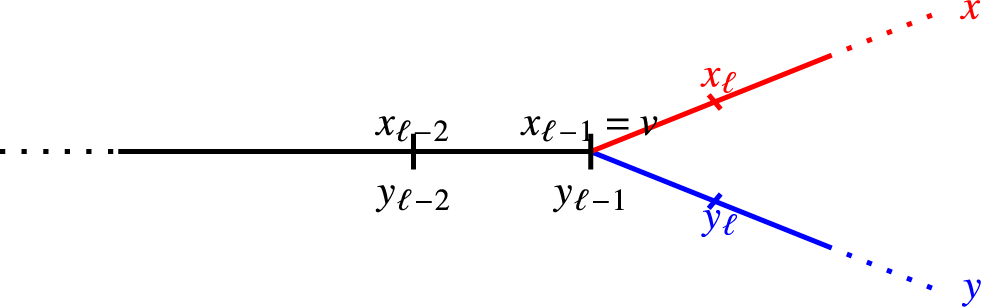
, where
 $x_{(-\infty ,\ell )}=y_{(-\infty ,\ell )},\ x_\ell \ne y_\ell $
and
 $x_{\ell -1}=y_{\ell -1}=v$
(refer to Figure 2). In this case, we say that v is a bifurcation signal (or simply, a signal) for x. That is, v is a signal for x if there exist
 $y\in X$
and
 $\ell \in {\mathbb Z}$
such that
 $(x,y)\in \mathcal {AP}$
and
 $J(x,y)=(v,\ell )$
.
Bifurcation point and the signal.

We remark that we use the notation
 $\mathcal {AP}$
without specifying the subshift, as this will be clear from the context.
Lemma 4.7. Let
 $\boldsymbol {\tau }=(\tau _n\colon V^*_{n+1}\to V^*_n)_{n\ge 0}$
be a directive sequence of morphisms that satisfies Property (
 $P_k$
), where
 $V_n=\{v_{1,n},\ldots ,v_{m_n,n}\}$
for
 $n\ge 1$
. Fix
 $n\ge 1$
. If
 $v_{i,n}\in V_n$
is a signal for
 $x^{(n)}\in X_{\boldsymbol {\tau }}^{n}$
, then
 $1\le i\le k$
.
Moreover, for
 $y^{(n)}\in X_{\boldsymbol {\tau }}^{(n)}$
with
 $(x^{(n)}, y^{(n)})\in \mathcal {AP}$
, and for
 $\ell \in {\mathbb Z}$
such that
 $J(x^{(n)}, y^{(n)})=(v_{i,n},\ell )$
, we have
 $\{x^{(n)}_\ell ,y^{(n)}_\ell \}=\{v_{i,n},v_{i+1,n}\}$
. That is, if
 $v_{i,n}$
is a signal, then at the bifurcation point, it is always followed by either
 $v_{i,n}$
or
 $v_{i+1,n}$
.
Proof. Let
 $x^{(n)}\in X_{\boldsymbol {\tau }}^{(n)}$
and
 $v_{i,n}\in V_n$
be a signal for
 $x^{(n)}$
. That is, there exist
 $y^{(n)}\in X_{\boldsymbol {\tau }}^{(n)}$
and
 $\ell \in {\mathbb Z}$
such that
 $x^{(n)}_{(-\infty ,\ell )}= y^{(n)}_{(-\infty ,\ell )},\ x^{(n)}_\ell \ne y^{(n)}_\ell $
and
 $x^{(n)}_{\ell -1}=v_{i,n}$
. Choose the maximum of
 $m<\ell -1$
, such that
 $x^{(n)}_{[m,m+1]}=v_{m_n,n}v_{1,n}$
. Hence, we have
 $$ \begin{align*} x^{(n)}_{[m,\ell)}=y^{(n)}_{[m,\ell)}=v_{m_n,n}v_{1,n}\cdots v_{i,n} \end{align*} $$
having no other occurrence of
 $v_{m_n,n}v_{1,n}$
as a subword, but
 $x^{(n)}_\ell \ne y^{(n)}_\ell $
.
Since the cutting points by
 $\tau _n$
are precisely where
 $v_{m_n,n}$
is followed by
 $v_{1,n}$
and since
 $X_{\boldsymbol {\tau }}$
is recognizable, there exist
 $u,u'\in V_{n+1}$
, where
 $\tau _n(u)$
and
 $\tau _n(u')$
have the same prefix starting with
 $v_{1,n}$
and ending with
 $v_{i,n}$
. Since
 $x^{(n)}_\ell \ne y^{(n)}_\ell $
, we have
 $u\ne u'$
. Hence, by Remark 4.3, we have
 $1\le i\le k$
.
For the second part of the proof, without loss of generality, let
 $x^{(n)}_\ell =v_{j,n}$
for
 $j\notin \{i,i+1\}$
. As before, choose the maximum of
 $m<\ell -1$
, such that
 $x^{(n)}_{[m,m+1]}=v_{m_n,n}v_{1,n}$
. Then,
 $x^{(n)}_{[m,\ell ]}=v_{m_n,n}v_{1,n}\cdots v_{k+1,n}\cdots v_{i,n}v_{j,n}$
. In particular, we have
 $$ \begin{align*} x^{(n)}_{[m,\ell)}=y^{(n)}_{[m,\ell)}=v_{m_n,n}v_{1,n}\cdots v_{k+1,n}\cdots v_{i,n} \end{align*} $$
having no other occurrence of
 $v_{m_n,n}v_{1,n}$
as a subword, but
 $x^{(n)}_\ell \ne y^{(n)}_\ell $
, which is a contradiction as before.
Lemma 4.8. Let
 $\boldsymbol {\tau }=(\tau _n)_{n\ge 0}$
be a directive sequence of morphisms that satisfies Property (
 $P_k$
) with
 $V_n=\{v_{1,n},\ldots ,v_{m_n,n}\}$
for
 $n\ge 1$
. Let
 $x,y\in X_{\boldsymbol {\tau }}$
be such that
 $x_{(-\infty ,0)}=y_{(-\infty ,0)}$
and
 $x_0\ne y_0$
. For a fixed
 $n\ge 1$
, choose
 $x^{(n)},y^{(n)}\in X_{\boldsymbol {\tau }}^{(n)}$
and
 $0\le r<|\tau _{[0,n)}(x^{(n)}_0)|,\ 0\le t<|\tau _{[0,n)}(y^{(n)}_0)|$
such that
 $x=S^r(\tau _{[0,n)}(x^{(n)}))$
and
 $y=S^t(\tau _{[0,n)}(y^{(n)}))$
. Then, the following hold.
-
(1)
$x^{(n)}\sim y^{(n)}$
. In particular,
$x^{(n)}_{(-\infty ,0)}=y^{(n)}_{(-\infty ,0)}$
and
$x^{(n)}_0\ne y^{(n)}_0$
. -
(2)
$r=t$
and
$x_{[-r,0)}=y_{[-r,0)}$
is the common prefix of
$\tau _{[0,n)}(v_{i,n})$
and
$\tau _{[0,n)}(v_{i+1,n})$
, where
$x^{(n)}_{-1}=y^{(n)}_{-1}=v_{i,n}$
for some
$1\le i\le k$
.


Proof. Clearly,
 $x^{(n)}\sim y^{(n)}$
using the local property of recognizability (Lemma 2.1) of
 $X_{\boldsymbol {\tau }}$
. Choose
 $\ell \le 0$
to be that
 $x^{(n)}_{(-\infty ,\ell )}=y^{(n)}_{(-\infty ,\ell )}$
and
 $x^{(n)}_\ell \ne y^{(n)}_\ell .$
By Lemma 4.7,
 $x^{(n)}_{\ell -1}=y^{(n)}_{\ell -1}=v_{i,n}$
for some
 $1\le i\le k$
and it is followed by either
 $v_{i,n}$
or
 $v_{i+1,n}$
. Without loss of generality, assume that
 $x^{(n)}_\ell =v_{i,n}$
and
 $y^{(n)}_\ell =v_{i+1,n}$
. Let
 $u=u_1\cdots u_{k_i}=\tau _{[0,n)}(v_{i,n})$
and
 $w=w_1\cdots w_{k_{i+1}}=\tau _{[0,n)}(v_{i+1,n})$
, where
 $k_j=|\tau _{[0,n)}(v_{j,n})|$
. By Lemma 4.4, u and w are not prefix dependent. Let
 $s\ge 1$
be the smallest number such that
 $u_s\ne w_s$
. Clearly, the bifurcation of x and y is at
 $x_0=u_s$
and
 $y_0=w_s$
. That is,
 $J(x,y)=(u_{s-1},0)$
if
 $s>1$
, and
 $J(x,y)=(u_{k_i},0)$
if
 $s=1$
. By the definition of recognizability, we can conclude that
 $\ell =0$
. Using this, the rest of the results are straightforward.
Lemma 4.9. Let
 $\boldsymbol {\tau }=(\tau _n\colon V^*_{n+1}\to V^*_n)_{n\ge 0}$
be a directive sequence of morphisms that satisfies Property (
 $P_k$
), where
 $V_n=\{v_{1,n},\ldots ,v_{m_n,n}\}$
for
 $n\ge 1$
. Fix
 $n\ge 1$
. Let
 $(x^{(n)}, y^{(n)})\in \mathcal {AP}(X_{\boldsymbol {\tau }}^{(n)})$
. Then, we have
 $J(x^{(n)},y^{(n)})=(v_{i,n},\ell )$
for some
 $\ell \in {\mathbb Z}$
and
 $1\le i\le k$
with
 $x^{(n)}_{[\ell -2i,\ell )}=v_{m_n,n}v_{1,n}^2\cdots v_{i-1,n}^2v_{i,n}$
. That is, if
 $v_{i,n}$
is a signal for a sequence in
 $X_{\boldsymbol {\tau }}^{(n)}$
, then at the bifurcation point, it is always preceded by
 $v_{m_n,n}v_{1,n}^2\cdots v_{i-1,n}^2$
.
Proof. Let
 $i>1$
and assume that
 $x^{(n)}_{[\ell -2i,\ell )}\ne v_{m_n,n}v_{1,n}^2\cdots v_{i-1,n}^2v_{i,n}$
. Then, as in Lemma 4.7, choose the maximum of
 $m<\ell -1$
, such that
 $x^{(n)}_{[m,m+1]}=v_{m_n,n}v_{1,n}$
. We have
 $$ \begin{align*} x^{(n)}_{[m,\ell)}=y^{(n)}_{[m,\ell)}=v_{m_n,n}v_{1,n}\cdots v_{k+1,n}\cdots v_{i,n} \end{align*} $$
having no other occurrence of
 $v_{m_n,n}v_{1,n}$
as a subword, but
 $x^{(n)}_\ell \ne y^{(n)}_\ell $
, which is a contradiction as before.
For
 $i=1$
, we want to prove that
 $x^{(n)}_{[\ell -2,\ell )}=v_{m_n,n}v_{1,n}$
. Assume this is not the case. We further divide it into two cases: (1)
 $v_{1,n}$
is preceded by
 $v_{m_n,n}v_{1,n}^t$
for some
 $t>0$
or (2) otherwise. Note that the second case is not possible, as argued for
 $i>1$
. However, for the first case, we will find no contradiction if we argue only as above since it is possible to find two distinct
 $u,u'\in V_{n+1}$
such that
 $\tau _n(u)$
and
 $\tau _n(u')$
have the same prefix
 $v_{1,n}^{t+1}$
. Let us assume that this is the case. That is,
 $x^{(n)}_{[\ell -t-2,\ell )}=y^{(n)}_{[\ell -t-2,\ell )}=v_{m_n,n}v_{1,n}^{t+1}$
for some
 $t> 0$
. By Lemma 4.7,
 $v_{1,n}^{t+1}$
is followed by
 $v_{1,n}$
or
 $v_{2,n}$
. Without loss of generality, let
 $\tau _n(u)$
have a prefix given by
 $v_{1,n}^{t+2}$
and let
 $\tau _n(u')$
have a prefix given by
 $v_{1,n}^{t+1}v_{2,n}$
. This implies that
 $u=v_{i,n+1}$
for some
 $i>k+1$
and
 $u'=v_{t+1,n+1}$
. Using Lemma 4.8 at level
 $n+1$
, there exists a signal
 $v_{i,n+1}$
for some
 $1\le i\le k$
that is followed by u and
 $u'$
. This is not possible by Lemma 4.7.
Lemma 4.10. Let
 $\boldsymbol {\tau }=(\tau _n\colon V^*_{n+1}\to V^*_n)_{n\ge 0}$
be a directive sequence of morphisms that satisfies Property (
 $P_k$
) with
 $V_n=\{v_{1,n},\ldots ,v_{m_n,n}\}$
for
 $n\ge 1$
. Then, each asymptotic component of
 $X_{\boldsymbol {\tau }}$
contains exactly two elements.
Proof. If this is not true, without loss of generality, there exist
 $x,y,z\in X_{\boldsymbol {\tau }}$
and
 $t\ge 0$
such that
 $x_{(-\infty ,0)}=y_{(-\infty ,0)}$
,
 $x_0\ne y_0$
,
 $x_{(-\infty ,t)}=z_{(-\infty ,t)}$
, and
 $x_t\ne z_t$
. First, we prove that
 $t=0$
is not possible. Otherwise, we have
 $y_0=z_0$
or
 $x_0,y_0,z_0$
to be all distinct. If
 $y_0=z_0$
, we can replace the tuple
 $(x,y,z)$
with
 $(z,x,y)$
and continue the analysis. For the case where
 $x_0,y_0,z_0$
are all distinct, we argue as follows. Let
 $x^{(n)},y^{(n)},z^{(n)}$
be the
 $\tau _{[0,n)}$
-factorization of
 $x,y,z$
, respectively in
 $X_{\boldsymbol {\tau }}^{(n)}$
. Then, by Lemmas 4.7 and 4.8,
 $x^{(n)}_{-1}=y^{(n)}_{-1}=z^{(n)}_{-1}=v_{i,n}$
for some
 $1\le i\le k$
. If
 $x_0,y_0,z_0$
are all distinct, then
 $x^{(n)}_0,y^{(n)}_0,z^{(n)}_0$
are all distinct. However,
 $v_{i,n}$
has to be followed by
 $v_{i,n}$
or
 $v_{i+1,n}$
and is therefore not possible.
To argue the case of
 $t>0,$
choose n large enough such that
 $\min \{|\tau _{[0,n)}(v)|: v\in V_n\}>t$
. By Lemma 4.8,
 $x^{(n)}_{-1}=y^{(n)}_{-1}$
and
 $x^{(n)}_0\ne y^{(n)}_0$
. This implies that
 $x^{(n)}_{-1}=v_{i,n}$
for some
 $1\le i\le k$
and is now preceded by
 $v_{m_n,n}v_{1,n}^2\cdots v_{i-1,n}^2$
by Lemma 4.9. Since
 $\min \{|\tau _{[0,n)}(v)| : v\in V_n\}>t$
,
 $x^{(n)}_0=z^{(n)}_0$
and
 $x^{(n)}_1\ne z^{(n)}_1$
. This implies that
 $x^{(n)}_0=v_{j,n}$
for some
 $1\le j\le k$
and is now preceded by
 $v_{m_n,n}v_{1,n}^2\cdots v_{i-1,n}^2v_{i,n}$
, which is a contradiction to Lemma 4.9.
4.3 Results
Now, we state and prove one of our main results giving a subshift of k asymptotic components. We also give some interesting corollaries of our result.
Theorem 4.11. Let
 $\boldsymbol {\tau }=(\tau _n\colon V^*_{n+1}\to V^*_n)_{n\ge 0}$
be a directive sequence of morphisms that satisfies Property (
 $P_k$
) with
 $V_n=\{v_{1,n},\ldots ,v_{m_n,n}\}$
for
 $n\ge 1$
. Then, there are exactly k asymptotic components in
 $X_{\boldsymbol {\tau }}$
.
Proof. First, we construct k many distinct non-trivial asymptotic pairs. For
 $i=1,\ldots ,k$
, we define two decreasing nested sequences
 $(C_{w_{i,n},\alpha _{i,n}})_{n\ge 1}$
and
 $(C_{u_{i,n},\alpha _{i,n}})_{n\ge 1}$
of cylinders on
 $X_{\boldsymbol {\tau }}$
, where
 $w_{i,n},u_{i,n}\in \mathcal {L}(X_{\boldsymbol {\tau }})$
and
 $\alpha _{i,n}<0$
are defined inductively. Let
 $\alpha _{i,1}=-|\tau _0(v_{1,1}^2\cdots v_{i-1,1}^2v_{i,1})|$
and for
 $n>1,$
 $$ \begin{align*}\alpha_{i,n}=-|\tau_{[0,n)}(v_{1,n}^2\cdots v_{i-1,n}^2v_{i,n})|+\alpha_{i,n-1}.\end{align*} $$
For
 $n\ge 1$
, define
 $$ \begin{align*} w_{i,n}= \begin{cases} \tau_{[0,n)}(v_{1,n}^2\cdots v_{i-1,n}^2v_{i,n}^2) &\text{ if } n \text{ is odd},\\ \tau_{[0,n)}(v_{1,n}^2\cdots v_{i-1,n}^2v_{i,n}v_{i+1,n})& \text{ if } n \text{ is even}, \end{cases} \end{align*} $$
 $$ \begin{align*} u_{i,n}= \begin{cases} \tau_{[0,n)}(v_{1,n}^2\cdots v_{i-1,n}^2v_{i,n}v_{i+1,n}) &\text{ if } n \text{ is odd},\\ \tau_{[0,n)}(v_{1,n}^2\cdots v_{i-1,n}^2v_{i,n}^2) & \text{ if } n \text{ is even}. \end{cases} \end{align*} $$
These cylinders are non-empty since
 $$ \begin{align*} \tau_{[0,n)}(v_{1,n}^2\cdots v_{i-1,n}^2v_{i,n}v_{i+1,n}),\tau_{[0,n)}(v_{1,n}^2\cdots v_{i-1,n}^2v_{i,n}^2)\in\mathcal{L}(X_{\boldsymbol{\tau}}). \end{align*} $$
Since
 $w_{i,n}\prec w_{i,n+1}$
for all
 $n\ge 1$
, it can be deduced that the cylinders are nested sequences whose diameters converge to zero. We let
 $\{x^i\}=\bigcap _{n\ge 1}C_{w_{i,n},\alpha _{i,n}}$
and
 $\{y^i\}=\bigcap _{n\ge 1}C_{u_{i,n},\alpha _{i,n}}$
. Clearly,
 $x^i\ne y^i$
and
 $x^i\sim y^i$
as
 $x^i_{(-\infty ,0)}=y^i_{(-\infty ,0)}$
and
 $x^i_0\ne y^i_0$
(we refer to Figures 3 and 4).
Construction of cylinders to get
 $x^i$
.

Construction of cylinders to get
 $y^i$
.

Note that
 $\boldsymbol {\tau }$
is a primitive morphism and hence,
 $X_{\boldsymbol {\tau }}$
is minimal. Also, since
 $(x^1,y^1)\in \mathcal {AP}(X_{\boldsymbol {\tau }})$
,
 $X_{\boldsymbol {\tau }}$
is not periodic. Hence, for each
 $1\le i\le k$
,
 $x^i$
and
 $y^i$
are not in the same orbit (because otherwise, both
 $x^i$
and
 $y^i$
would be periodic).
Now, we see that for
 $1\le i\ne j\le k,\ x^i$
and
 $x^j$
are not in the same orbit. Let
 $x=x^i,\ y=x^j$
. Without loss of generality, assume that
 $S^t(x)=y$
for some
 $t>0$
. We can choose
 $n>1$
large enough and even so that
 $\alpha _{i,n}+|w_{i,n}|>t$
. Let
 $(k_n,x^{(n)}),(\ell _n,y^{(n)})$
denote the centered
 $\tau _{[0,n)}$
- representation of x and y in
 $X_{\boldsymbol {\tau }}^{(n)}$
, respectively. Clearly,
 $x^{(n)}_0=v_{i+1,n}\ne v_{j+1,n}=y^{(n)}_0$
,
 $0\le k_n<|\tau _{[0,n)}(v_{i+1,n})|$
and
 $x=S^{k_n}(\tau _{[0,n)}(x^{(n)}))$
. This implies that
 $y=S^t(x)=S^{k_n+t}(\tau _{[0,n)}(x^{(n)}))$
. It is easy to see that
 $k_n=-\alpha _{i,n-1}$
and
 $|\tau _{[0,n)}(v_{i+1,n})|=|w_{i,n}|-\alpha _{i,n-1}+\alpha _{i,n}.$
Hence,
 $0\le k_n+t=|\tau _{[0,n)}(v_{i+1,n})|-|w_{i,n}|-\alpha _{i,n}+t<|\tau _{[0,n)}(v_{i+1,n})|$
. This means that
 $(k_n+t,x^{(n)})$
is a centered
 $\tau _{[0,n)}$
-representation of y in
 $X_{\boldsymbol {\tau }}^{(n)}$
, which contradicts its uniqueness. A similar argument also shows that for
 $i\ne j$
,
 $x^i$
and
 $y^j$
are not in the same orbit. Hence, the pairs
 $(x^1,y^1),\ldots ,(x^k,y^k)$
contribute to asymptotic components.
We claim that, for any given representative
 $(x,y)$
of an asymptotic component of
 $X_{\boldsymbol {\tau }}$
, we have
 $x\sim _{\text {Orb}}x^i$
for some
 $1\le i\le k$
. If not, without loss of generality, assume that
 $x_{(-\infty ,0)}=y_{(-\infty ,0)}$
and
 $x_0\ne y_0$
. Using the recognizability of
 $X_{\boldsymbol {\tau }}$
, choose
 $x^{(n)}, y^{(n)}$
,
 $0\le r(n)< |\tau _{[0,n)}(x^{(n)}_0)|$
, and
 $0\le t(n)< |\tau _{[0,n)}(y^{(n)}_0)|$
such that
 $x=S^{r(n)}(\tau _{[0,n)}(x^{(n)}))$
and
 $y=S^{t(n)}(\tau _{[0,n)}(y^{(n)}))$
. Clearly,
 $x^{(n)}_{-1}=v_{i,n}$
for some
 $1\le i\le k$
. Moreover, by Lemma 4.8,
 $r(n)=t(n)$
and
 $x_{[-r(n),0)}=y_{[-r(n),0)}$
is the common prefix of
 $\tau _{[0,n)}(v_{i,n})$
and
 $\tau _{[0,n)}(v_{i+1,n})$
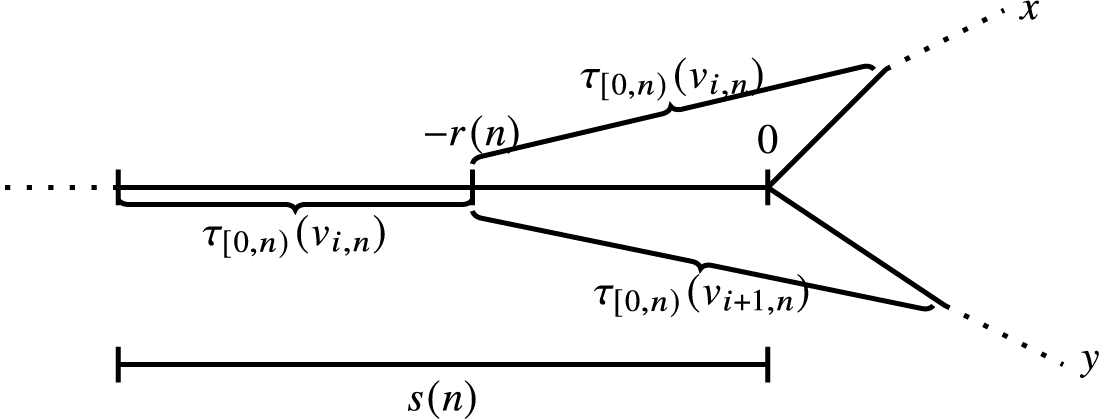
. This implies that
 $x_{[-s(n),0)}=x^i_{[-s(n),0)}$
, where
 $s(n)=r(n)+|\tau _{[0,n)}(v_{i,n})|$
(Figure 5). Since
 $s(n)\to \infty $
as
 $n\to \infty $
, we get x and
 $x^i$
are asymptotic.
Factorization of x and y at level n.

By Lemma 4.10, no two pairs
 $(x^i,y^i)$
and
 $(x^j,y^j)$
,
 $i\ne j$
, can be in the same asymptotic component. Hence, these are at least k distinct asymptotic components. By the previous claim, the subshift
 $X_{\boldsymbol {\tau }}$
has exactly k asymptotic components.
Corollary 4.12. Let
 $\boldsymbol {\tau }=(\tau _n)_{n\ge 0}$
be a directive sequence of morphisms that satisfies Property (
 $P_k$
) and let
 $X_{\boldsymbol {\tau }}$
be the associated
 $\mathcal {S}$
-adic subshift. Then,
 $(X_{\boldsymbol {\tau }},S)$
has zero entropy.
Proof. By Theorem 4.11, the
 $\mathcal {S}$
-adic subshift
 $X_{\boldsymbol {\tau }}$
has only finitely many asymptotic components. Hence, the result follows from Theorem 1.1.
To prove our main theorem, it is enough to construct an
 $\mathcal {S}$
-adic subshift associated with a directive sequence of morphisms that satisfies Property (
 $P_k$
) within a given strong orbit equivalence class. The following lemma allows us to construct such a subshift [Reference Cecchi Bernales and Donoso5, §4.1].
Lemma 4.13. Let
 $B=(V,E)$
be a simple Bratteli diagram. There exists a simple Bratteli diagram
 $B'=(V',E')$
with a sequence of incidence matrices
 $(A_n')_{n\in {\mathbb N}}$
such that for all
 $n\geq 1$
,
 $|V^{\prime }_n|>n$
, all the entries of
 $A^{\prime }_n$
are at least
 $|V_{n+1}'|$
, and
 $(X_B,T_B)$
and
 $(X_{B'},T_{B'})$
are strong orbit equivalent.
Proposition 4.14. Let
 $B=(V,E,\le )$
be a simple ordered Bratteli diagram. There exists a simple ordered Bratteli diagram
 $B'=(V',E',\le ')$
such that the Bratteli–Vershik systems
 $(X_B,T_B)$
and
 $(X_{B'},T_{B'})$
are strong orbit equivalent, and the directive sequence of morphisms read on
 $B'$
, given by
 $\boldsymbol {\tau }=(\tau _n)_{n\ge 0}$
, satisfies Property (
 $P_k$
). Moreover, the
 $\mathcal {S}$
-adic subshift
 $(X_{\boldsymbol {\tau }},S)$
is conjugate to
 $(X_{B'},T_{B'})$
.
Proof. By Lemma 4.13, and telescoping if necessary, we assume that for all
 $n\ge 1$
,
 $|V^{\prime }_n|>k$
and
 $(A_n')_{i,j}\ge |V^{\prime }_{n+1}|$
. We denote
 $V^{\prime }_n=\{v_{1,n},\ldots ,v_{m_n,n}\}$
. We can easily define an ordering
 $\le '$
on
 $(V',E')$
such that the directive sequence of morphisms
 $\boldsymbol {\tau }=(\tau _n)_{n\ge 0}$
read on
 $B'=(V',E',\le ')$
satisfies Property (
 $P_k$
).
To show that
 $(X_{\boldsymbol {\tau }},S)$
is conjugate to
 $(X_{B'},T_{B'})$
, by Proposition 2.4, it is enough to prove that
 $\tau _n$
is proper for
 $n\ge 1$
and that
 $\tau _n$
extends by concatenation to an injective map from
 $X_{\boldsymbol {\tau }}^{(n+1)}$
to
 $X_{\boldsymbol {\tau }}^{(n)}$
. Clearly,
 $\tau _n$
is proper.
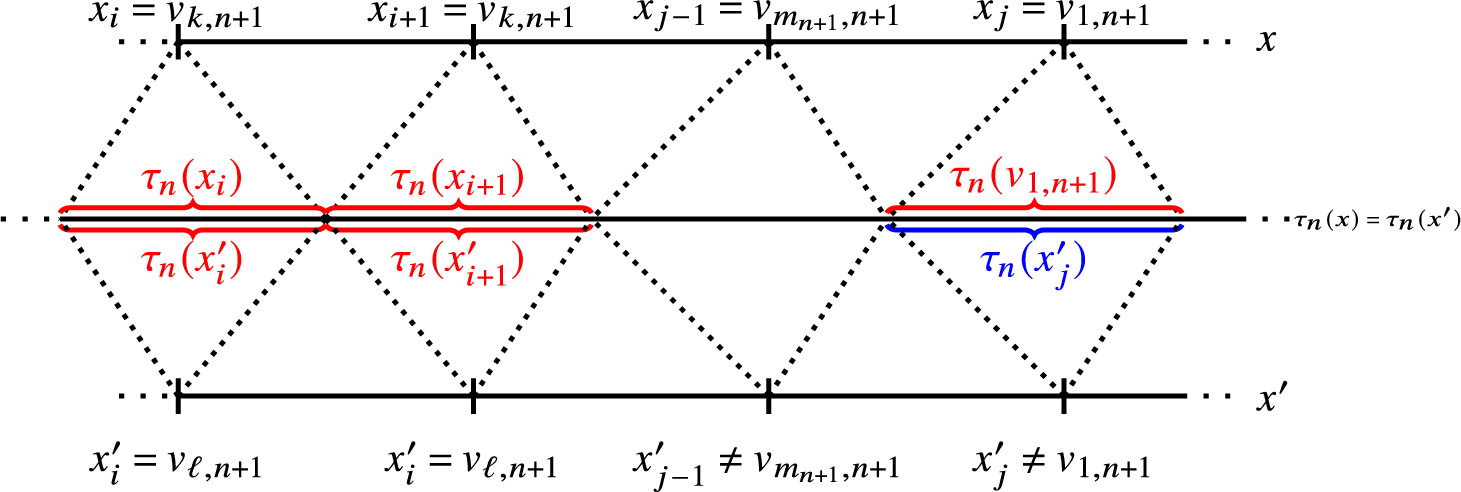
We fix two distinct sequences
 $x=(x_i)_{i\in {\mathbb Z}},x'=(x^{\prime }_i)_{i\in {\mathbb Z}}\in X_{\boldsymbol {\tau }}^{(n+1)}$
such that
 $\tau _n(x)=\tau _n(x')$
. The cutting points of
 $\tau _n(x)$
are wherever
 $v_{m_n,n}$
is followed by
 $v_{1,n}$
. Since the word
 $v_{m_n,n}v_{1,n}$
does not appear anywhere else except at the cutting points, the cutting points of
 $\tau _n(x)$
and
 $\tau _n(x')$
are the same. Hence,
 $\tau _n(x_i)=\tau _n(x^{\prime }_i)$
for all
 $i\in {\mathbb Z}$
. Since
 $\tau _n$
is injective on symbols, we have
 $x_i=x_i'$
for all
 $i\in {\mathbb Z}$
.
Theorem 4.15. For any given
 $k\ge 1$
and for any given minimal Cantor system
 $(X,T)$
, there exists a minimal subshift which has exactly k asymptotic components and that is strong orbit equivalent to
 $(X,T)$
.
Proof. Let
 $B=(V,E,\le )$
be the simple ordered Bratteli diagram with respect to which the associated Bratteli–Vershik system is conjugate to
 $(X,T)$
(Theorem 2.2).
By Proposition 4.14, construct an ordered Bratteli diagram
 $B'=(V,E',\le ')$
such that
 $(X_B,T_B)$
is strong orbit equivalent to
 $(X_{B'},T_{B'})$
and the directive sequence of morphisms read on
 $B'$
, given by
 $\boldsymbol {\tau }$
, satisfies Property (
 $P_k$
). By Theorem 4.11, the subshift
 $(X_{\boldsymbol {\tau }},S)$
has exactly k asymptotic components. Again, using Proposition 4.14,
 $(X_{B'},T_{B'})$
is conjugate to
 $(X_{\boldsymbol {\tau }},S)$
and hence,
 $(X,T)$
and
 $(X_{\boldsymbol {\tau }},S)$
are strong orbit equivalent.
By directly applying Proposition 3.2 to the
 $\mathcal {S}$
-adic subshift that satisfies Property
 $(P_1)$
, we have Corollary 1.3.
4.4 Invariant measures and automorphism groups
For a topological dynamical system
 $(X,T)$
, a Borel probability measure
 $(X,{\mathcal B},\mu )$
is said to be invariant if for any Borel subset
 $A\in {\mathcal B}$
, we have
 $\mu (T^{-1}(A))=\mu (A)$
. It is well known that the set of invariant probability measures, denoted as
 ${\mathcal M}(X,T)$
, endowed with the
 $\text {weak}^*$
topology, is a non-empty Choquet simplex. Recall that a compact, convex, metrizable subset K of a locally convex real vector space is said to be a Choquet simplex if for every
 $v\in K$
, there exists a unique probability measure
 $\mu $
on the set of extreme points of K, denoted by
 $\mathrm {ext}(K)$
, such that
 $\int _{\mathrm {ext}(K)} x\, d\mu (x)=v.$
We now discuss the possible invariant measures of systems with trivial automorphism groups.
Corollary 4.16. Let K be any Choquet simplex. Then, there exists a minimal subshift
 $(Y,S)$
with a trivial automorphism group such that its set of invariant measures,
 ${\mathcal M}(Y,S)$
, is affine homeomorphic to K.
Proof. By [Reference Downarowicz12, Theorem 5], there exists a minimal subshift
 $(X,S)$
such that
 ${\mathcal M}(X,S)$
is affine homeomorphic to K. Using Corollary 1.3, let
 $(Y,S)$
be the subshift that is strong orbit equivalent to
 $(X,S)$
with
 $\text {Aut}(Y,S)$
generated by S. Since the strong orbit equivalence preserves the set of invariant measures, up to the affine homeomorphism, we can conclude that
 ${\mathcal M}(Y,S)$
is affine homeomorphic to K.
For a topological dynamical system
 $(X,T)$
, a Borel probability measure
 $(X,{\mathcal B},\mu )$
is said to be a characteristic measure if for any Borel subset
 $A\in {\mathcal B}$
, we have
 $\mu (f^{-1}(A))=\mu (A)$
for all
 $f\in \text {Aut}(X,T)$
. The existence of a characteristic measure, in general, is still unknown. In the case of subshifts, by the Krylov–Bogolioubov theorem, the characteristic measures exist if the automorphism group is amenable. Also, characteristic measures exist for subshifts with zero entropy [Reference Frisch and Tamuz16]. In any case, we prove an analog of [Reference Downarowicz12, Theorem 5] in the case of characteristic measures.
Corollary 4.17. Let K be any Choquet simplex. Then, there exists a minimal subshift
 $(Y,S)$
such that its set of characteristic measures is affine homeomorphic to K.
Proof. By Corollary 4.16, there exists a minimal subshift
 $(Y,S)$
with a trivial automorphism group such that its set of invariant measures,
 ${\mathcal M}(Y,S)$
, is affine homeomorphic to K. The result holds for this subshift, since its set of all characteristic measures is given by
 ${\mathcal M}(Y,S)$
.
4.5 Complexity functions and automorphism groups
In this section, within a strong orbit equivalence class of a minimal Cantor system, we construct subshifts that have arbitrarily small superlinear complexity and trivial automorphism group. We also show that Theorem 1.1 is optimal. Specifically, we construct subshifts with arbitrarily large subexponential complexity that have a single asymptotic component (and consequently, have the trivial automorphism group).
Corollary 4.18. Let
 $(X,T)$
be a minimal Cantor system and
 $(p_n)_{n\ge 1}$
be a sequence of positive real numbers such that
 $\lim _{n\to \infty }{n}/{p_n}=0$
. There exists a minimal subshift
 $(Y,S)$
satisfying the following:
-
(1)
$(X,T)$
and
$(Y,S)$
are strong orbit equivalent; -
(2) the complexity of
$(Y,S)$
satisfies
$\lim _{n\to \infty } {p_Y(n)}/{p_n}=0;$
and -
(3)
$\mathrm {Aut}(Y,S)$
is generated by S.


Proof. Note that the directive sequence of morphisms that is constructed to satisfy [Reference Cecchi Bernales and Donoso5, Theorem 1.2(1) and (2)] satisfies Property
 $(P_1)$
.
In the following result, we show the existence of subshifts with sub-exponential complexity having trivial automorphism group.
Theorem 4.19. Let
 $(g_n)_{n\ge 1}$
be a sequence of positive real numbers such that
 $\lim _{n\to \infty }{\ln (g_n)}/{n}=0$
. Then, there exists a minimal subshift
 $(X,S)$
having exactly one asymptotic component (and thus having the trivial automorphism group) such that
 $\liminf _{n\to \infty }{g_n}/{p_X(n)}=0.$
Proof. We construct a Bratteli–Vershik system as follows. Let
 $|V_n|=n+2$
for all
 $n\ge 0$
. For
 $u\in V_{n+1}$
, let
 $L_n(u)$
denote the total number of edges from all the vertices in
 $V_n$
to u. In our construction, each
 $L_n(u)$
is the same (thus, our example is a Toeplitz subshift) and we denote it as
 $L_n$
. Let
 $L_0=3$
. Now, we define the rest of the levels inductively. Let
 $L_0,\ldots ,L_{n-1}$
be given. We choose
 $\alpha _{n}\in {\mathbb N}$
such that
 $(n+1)^{\alpha _{n}-1}\ge g_{\alpha _nL_{n-1}\cdots L_0}$
. It is possible to find such an
 $\alpha _n$
since
 $(g_n)_{n\ge 0}$
is sub-exponential.
We give an ordering on each level so that the directive sequence of morphisms read on it will satisfy Property
 $(P_1)$
. In particular, if
 $V_n=\{v_{1,n},\ldots ,v_{n+2,n}\},$
we have
 $\tau _n(v_{1,n+1})=v_{1,n}v_{2,n}wv_{n+2,n}$
, where w is a word of length
 $L_n-3$
that does not contain
 $v_{n+2,n}v_{1,n}$
as a subword. Since there are no other conditions on w, by choosing a large enough
 $L_n$
, we can ensure that w contains all possible words of length
 $\alpha _n$
with symbols from
 $V_n\setminus \{v_{1,n}\}$
, as subwords. There are
 $(n+1)^{\alpha _n}$
many words of length
 $\alpha _n$
with symbols from
 $V_n\setminus \{v_{1,n}\}$
. For each distinct word u of length
 $\alpha _n$
, since the morphism is injective on symbols,
 $\tau _{[0,n)}(u)$
is distinct and it is of length
 $\alpha _nL_{n-1}\cdots L_0$
. For
 $i>1$
, we can define
 $\tau _n(v_{i,n+1})=v_{1,n}^iv_{2,n}w'v_{n+2,n}$
, where
 $|w'|=L_n-3$
and
 $w'$
does not contain
 $v_{n+2,n}v_{1,n}$
as a subword.
Let X be the
 $\mathcal {S}$
-adic subshift generated by this directive sequence of morphisms. Clearly,
 $$ \begin{align*} p_X(\alpha_nL_{n-1}\cdots L_0)\ge (n+1)^{\alpha_n}\ge (n+1)g_{\alpha_nL_{n-1}\cdots L_0}. \end{align*} $$
Let
 $\tilde {L}(n)=\alpha _nL_{n-1}\cdots L_0$
. Then, we have
 ${g_{\tilde {L}_n}}/{p_X(\tilde {L}_n)}\le {1}/({n+1})$
. Hence,
 $\liminf _{n\to \infty } {g_n}/{p_X(n)}=0.$
5 Subshifts with countably infinite asymptotic components
Given a minimal Cantor system
 $(X,T)$
, we construct a subshift that is strong orbit equivalent to
 $(X,T)$
and that has countably infinite asymptotic components.
5.1 A directive sequence of morphisms
Given a simple Bratteli diagram, we define the following property of a directive sequence of morphisms. The
 $\mathcal {S}$
-adic subshift generated by this sequence will be shown to have countably many asymptotic components.
Definition 5.1. Let
 $\boldsymbol {\tau }=(\tau _n:V^*_{n+1}\to V^*_n)_{n\ge 0}$
be a directive sequence of morphisms. We say that
 $\boldsymbol {\tau }$
satisfies Property (
 $P_\infty $
) if the following conditions are true;
 $\tau _0$
is a hat morphism, for
 $n\ge 1$
and
 $V_n=\{v_{1,n},\ldots ,v_{m_n,n}\}$
, we have:
-
(1)
$\tau _n$
is primitive and
$m_n>n$
; -
(2) for
$1\le i\le n+1$
,
$v_{1,n}^2v_{2,n}^2\cdots v_{i-1,n}^2v_{i,n}\cdots v_{n,n}v_{n+1,n}$
is a prefix of
$\tau _n(v_{i,n+1})$
; -
(3) for
$ i> n+1$
,
$v_{1,n}^iv_{2,n}$
is a prefix of
$\tau _n(v_{i,n+1})$
; and -
(4) for
$ 1\le i\le m_{n+1}$
,
$v_{m_n,n}$
is a suffix of
$\tau _n(v_{i,n+1})$
and it does not have
$v_{m_n,n}v_{1,n}$
as a subword.


Similar to the last section, whenever we talk about Property (
 $P_\infty $
), we specify the ordering on
 $V_n$
as
 $V_n=\{v_{1,n},\ldots ,v_{m_n,n}\}$
, where
 $v_{1,n},\ldots ,v_{n+1,n}$
are the first
 $n+1$
distinguished letters. Also note that
 $\tau _n$
is injective on symbols.
Consider a minimal Cantor system
 $(X,T)$
. Let
 $(V,E)$
be the associated Bratteli diagram and
 $A_n$
be the associated incidence matrix at level n. Telescoping if necessary and using Lemma 4.13, assume that
 $|V_n|>n$
and
 $(A_n)_{i,j}\ge |V_{n+1}|$
for all
 $n\ge 1$
. We can define a new ordering
 $\le $
on
 $(V,E)$
, such that the directive sequences of morphisms
 $\boldsymbol {\tau }=(\tau _n)_{n\ge 0}$
read on
 $(V,E,\le )$
satisfies Property
 $(P_\infty )$
. Using Propositions 2.3 and 2.4, the
 $\mathcal {S}$
-adic subshift
 $X_{\boldsymbol {\tau }}$
is strong orbit equivalent to
 $(X,T)$
. We state this as a lemma below for convenience.
Lemma 5.2. Let
 $(X,T)$
be a minimal Cantor system. Then, there exists an ordered Bratteli diagram
 $B'=(V',E',\le ')$
such that
 $(X_{B'},T_{B'})$
is strong orbit equivalent to
 $(X,T)$
and the directive sequence of morphisms,
 $\boldsymbol {\tau }$
, read on
 $B'$
satisfies Property (
 $P_\infty $
). Moreover,
 $(X_{\boldsymbol {\tau }},S)$
and
 $(X_{B'},T_{B'})$
are conjugate.
Remark 5.3. Note that the conclusions of Lemmas 4.4, 4.7, and 4.8 hold true when
 $\boldsymbol {\tau }$
satisfies Property (
 $P_\infty $
). That is,
 $v_{i,n}$
is a signal for sequences in
 $X_{\boldsymbol {\tau }}^{(n)}$
if
 $1\le i\le n$
and at the bifurcation point, it is always followed by
 $v_{i,n}$
or
 $v_{i+1,n}$
. However, Lemma 4.9 holds true only for the signals
 $v_{i,n}$
, where
 $1<i\le n$
. That is, for
 $i>1$
, when
 $v_{i,n}$
is a signal, at the bifurcation point, it is only preceded by
 $v_{m_n,n}v_{1,n}^2\cdots v_{i-1,n}^2$
. A modification to Lemma 4.9 has to be stated when
 $v_{1,n}$
is a signal. In this case,
 $v_{1,n}$
is preceded either by
 $v_{m_n,n}$
or by
 $v_{m_n,n}v_{1,n}$
. The second case is possible because unlike in the case of Property (
 $P_k$
), the letter
 $v_{n+1,n+1}$
can be a signal for sequences in
 $X_{\boldsymbol {\tau }}^{(n+1)}$
and it is followed by
 $v_{n+1,n+1}$
or
 $v_{n+2,n+1}$
. Note that
 $v_{1,n}^2v_{2,n}$
is a prefix of
 $\tau _n(v_{n+1,n+1})$
and
 $v_{1,n}^{3}$
is a prefix of
 $\tau _n(v_{n+2,n+1})$
. In any case, Lemma 4.9 is only used to prove Lemma 4.10 and we shall see below that we still get the required result.
Lemma 5.4. Let
 $\boldsymbol {\tau }=(\tau _n:V_{n+1}^*\to V_n^*)_{n\ge 0}$
satisfy Property
 $(P_\infty )$
, where
 $V_n= \{v_{1,n},\ldots ,v_{m_n,n}\}$
. Let
 $x,y\in X_{\boldsymbol {\tau }}$
be such that
 $x_{(-\infty ,0)}=y_{(-\infty ,0)}$
, and
 $x_0\ne y_0$
and
 $x^{(n)},y^{(n)}$
be their
 $\tau _{[0,n)}$
-factorization, respectively, for
 $n\ge 1$
. Then, there exist
 $N\ge 1$
and
 $1\le i\le N$
such that
 $J(x^{(n)},y^{(n)})=(v_{i,n},0)$
for all
 $n\ge N$
.
Proof. Let
 $J(x^{(N)},y^{(N)})=(v_{i,N},0)$
for some
 $1<i\le N$
and
 $N\ge 1$
. Then,
 $x^{(N)}_{[-2i,-1]}=v_{m_N,N}v_{1,N}^2\cdots v_{i-1,N}^2v_{i,N}=y^{(N)}_{[-2i,-1]}$
and
 $\{x^{(N)}_0,y^{(N)}_0\}=\{v_{i,N},v_{i+1,N}\}$
. This implies that
 $$ \begin{align*}\{x^{(N+1)}_0,y^{(N+1)}_0\}=\{v_{i,N+1},v_{i+1,N+1}\}\end{align*} $$
and hence,
 $J(x^{(N+1)},y^{(N+1)})=(v_{i,N+1},0). $
Inductively,
 $J(x^{(n)},y^{(n)})=(v_{i,n},0)$
for all
 $n\ge N$
.
When
 $J(x^{(N)},y^{(N)})=(v_{1,N},0)$
for some
 $N\ge 1$
, we have
 $\{x^{(N)}_0,y^{(N)}_0\}=\{v_{1,N},v_{2,N}\}$
and two possible scenarios: either
 $x^{(N)}_{[-2,-1]}=v_{m_N,N}v_{1,N}=y^{(N)}_{[-2,-1]}$
or
 $x^{(N)}_{[-3,-1]}=v_{m_N,N}v^2_{1,N}=y^{(N)}_{[-3,-1]}$
. We first investigate the second scenario. In this case, by Remark 5.3, we have
 $J(x^{(N+1)},y^{(N+1)})=(v_{N+1,N+1},0)$
and hence,
 $J(x^{(n)},y^{(n)})=(v_{N+1,n},0)$
for all
 $n\ge N+1$
by the previous argument. Now, we focus on the first scenario. In this case, we have
 $J(x^{(N+1)},y^{(N+1)})=(v_{1,N+1},0)$
. Now, we can further divide this into two cases: either
 $x^{(n)}_{[-2,-1]}=v_{m_n,n}v_{1,n}=y^{(n)}_{[-2,-1]}$
for all
 $n>N$
, or
 $x^{(n_0)}_{[-3,-1]}=v_{m_{n_0},n_0}v^2_{1,n_0}=y^{(n_0)}_{[-3,-1]}$
for some
 $n_0>N$
. In the first case, we have
 $J(x^{(n)},y^{(n)})=(v_{1,n},0)$
for all
 $n\ge N$
and in the second case, we have
 $J(x^{(n)},y^{(n)})=(v_{n_0+1,n},0)$
for all
 $n>n_0$
.
5.2 Results
Theorem 5.5. For any given minimal Cantor system
 $(X,T)$
, there exists a minimal subshift which has countably infinite asymptotic components and that is strong orbit equivalent to
 $(X,T)$
.
Proof. By Lemma 5.2, it is enough to show that if
 $\boldsymbol {\tau }$
satisfies Property
 $(P_\infty )$
, then
 $X_{\boldsymbol {\tau }}$
has countably infinite asymptotic components. We construct countably infinite asymptotic pairs for
 $X_{\boldsymbol {\tau }}$
, say
 $\{(x^n,y^n)\mid n\ge 1\}$
. We then prove that these pairs contribute to asymptotic components, that no two asymptotic components are the same, and that these are the only possible ones.
For
 $i\in {\mathbb N}$
, we define two decreasing nested sequences
 $(C_{w_{i,n},\alpha _{i,n}})_{n\ge i}$
and
 $(C_{u_{i,n},\alpha _{i,n}})_{n\ge i}$
of cylinders on
 $X_{\boldsymbol {\tau }}$
, where
 $w_{i,n},u_{i,n}\in \mathcal {L}(X_{\boldsymbol {\tau }})$
and
 $\alpha _{i,n}<0$
are defined inductively. Let
 $\alpha _{i,i}=-|\tau _{[0,i)}(v_{1,i}^2\cdots v_{i-1,i}^2v_{i,i})|$
and for
 $n>i,$
 $$ \begin{align*}\alpha_{i,n}=-|\tau_{[0,n)}(v_{1,n}^2\cdots v_{i-1,n}^2v_{i,n})|+\alpha_{i,n-1}.\end{align*} $$
For
 $i\ge 1,n\ge 0$
, define
 $$ \begin{align*} w_{i,i+n}=\begin{cases} \tau_{[0,i+n)}(v_{1,i+n}^2\cdots v_{i-1,i+n}^2v_{i,i+n}^2) &\text{if } n \text{ is odd},\\ \tau_{[0,i+n)}(v_{1,i+n}^2\cdots v_{i-1,i+n}^2v_{i,i+n}v_{i+1,i+n}) &\text{if } n \text{ is even}, \end{cases} \end{align*} $$
 $$ \begin{align*} u_{i,i+n}=\begin{cases} \tau_{[0,i+n)}(v_{1,i+n}^2\cdots v_{i-1,i+n}^2v_{i,i+n}v_{i+1,i+n}) &\text{if } n \text{ is odd},\\ \tau_{[0,i+n)}(v_{1,i+n}^2\cdots v_{i-1,i+n}^2v_{i,i+n}^2) &\text{if } n \text{ is even}. \end{cases} \end{align*} $$
It is easy to check that
 $(C_{w_{i,n},\alpha _{i,n}})_{n\ge i}$
and
 $(C_{u_{i,n},\alpha _{i,n}})_{n\ge i}$
are decreasing nested sequences of cylinders, and we define
 $x^i=\bigcap _{n\ge i}C_{w_{i,n},\alpha _{i,n}}$
and
 $y^i=\bigcap _{n\ge i}C_{u_{i,n},\alpha _{i,n}}$
. We refer to Figures 6 and 7 to see the first two steps of the construction.
Construction of cylinders to get
 $x^i$
.

Construction of cylinders to get
 $y^i$
.

Note that
 $X_{\boldsymbol {\tau }}$
is recognizable and minimal. Hence, a similar analysis as in the proof of Theorem 4.15 using the
 $\tau _{[0,n)}$
-factorizations for
 $n>N$
, where N is as in Lemma 5.4, will confirm that
 $x^n$
and
 $y^n$
are not in the same orbit and for
 $n\ne m$
,
 $x^n$
and
 $x^m$
are not orbit asymptotic.
Now, we are left to show that if
 $(x,y)$
is a representative of an asymptotic component for
 $x,y\in X_{\boldsymbol {\tau }}$
, then
 $x\sim _{Orb} x^i$
for some
 $i\in {\mathbb N}$
. Without loss of generality, assume that
 $x_{(-\infty ,0)}=y_{(-\infty ,0)}$
and
 $x_0\ne y_0$
. Take
 $n\ge N$
, where N is as in Lemma 5.4. Let
 $x^{(n)},y^{(n)}\in X_{\boldsymbol {\tau }}^{(n)}$
be the
 $\tau _{[0,n)}$
-factorization of
 $x,y$
, respectively. Clearly,
 $x^{(n)}_{-1}=v_{i,n}$
for some
 $1\le i\le n$
. This implies that
 $x_{[-s(n),0)}=x^i_{[-s(n),0)}$
, where
 $s(n)=r(n)+|\tau _{[0,n)}(v_{i,n})|$
and
 $r(n)$
is the length of the common prefix of
 $\tau _{[0,n)}(v_{i,n})$
and
 $\tau _{[0,n)}(v_{i+1,n})$
. Since
 $s(n)\to \infty $
as
 $n\to \infty $
, we get x and
 $x^i$
to be asymptotic.
Corollary 5.6. Let
 $\boldsymbol {\tau }=(\tau _n)_{n\ge 0}$
be a directive sequence of morphisms that satisfies Property (
 $P_\infty $
) and let
 $X_{\boldsymbol {\tau }}$
be the associated
 $\mathcal {S}$
-adic subshift. Then,
 $(X_{\boldsymbol {\tau }},S)$
has zero entropy.


6 Asymptotic components within a strong orbit equivalence class of Toeplitz subshifts
In this section, we explore how our previous results can be realized within the context of Toeplitz subshifts. That is, we aim to find examples of Toeplitz subshifts with a prescribed number of asymptotic components within a strong orbit equivalence class. We show that this is possible, under the obvious restriction that the strong orbit equivalence class contains at least one Toeplitz subshift. We give similar proofs to the general case, but the methods are slightly different since they are tailored to handle the Toeplitz case.
A simple Bratteli diagram
 $(V,E)$
is said to have the equal path number property if for all
 $n\ge 0$
and
 $v,v'\in V_n,$
we have
 $\#(r^{-1}(v))=\#(r^{-1}(v'))$
, where
 $\#(.)$
denotes the cardinality of a set. This is the same as saying that the incidence matrices
 $(A_n)_{n\ge 0}$
have equal row sum property (that is, the sum of entries on the rows of
 $A_n$
are constant for each
 $n\ge 0$
). Clearly, when
 $(V,E)$
has the equal path number property, there are equal numbers of paths from
 $v_0$
to each vertex in
 $V_n$
for
 $n\ge 1$
. Note that the equal path number property is preserved under telescoping. We recall the following result from [Reference Gjerde and Johansen18, Theorem 8] for the sole purpose of this section.
Theorem 6.1. A minimal subshift is Toeplitz if and only if it has a Bratteli–Vershik system
 $(X_B,T_B)$
, where the Bratteli diagram
 $B=(V,E)$
satisfies the equal path number property.
By the above theorem, for a Toeplitz subshift, one may take a Bratteli diagram that satisfies the equal path number property. However, the construction of Bratteli diagram, as in Lemma 4.13 to obtain a directive sequence of morphisms that satisfies Property
 $(P_k)$
or Property
 $(P_\infty )$
, does not preserve the equal path number property. Hence, we have to do a different analysis to obtain a Toeplitz subshift with the required number of asymptotic components. We prove the construction of a subshift with exactly k asymptotic components. The case for countably many asymptotic components can be easily adapted.
Fix
 $k\ge 1$
. Let
 $(V,E)$
be a simple Bratteli diagram, where
 $V=V_0\cup V_1\cup \cdots , V_n=\{v_{1,n},\ldots ,v_{m_n,n}\}$
, and
 $E=E_1\cup E_2\cup \cdots $
. Let
 $A_n$
be its incidence matrix at level n and
 $(A_n)_{i,j}$
denote the
 $(v_{i,n+1},v_{j,n})$
th entry of
 $A_n$
. Telescoping if necessary, we assume that
 $(A_n)_{i,j}>3$
for all
 $n\ge 1, 1\le i\le m_{n+1}$
, and
 $1\le j\le m_n$
.
6.1 A directive sequence of morphisms
Given a simple Bratteli diagram, we define a partial ordering on it such that the directive sequence of morphisms read on it is given as follows. The
 $\mathcal {S}$
-adic subshift generated by this sequence will be shown to have k asymptotic components later in this section.
Definition 6.2. Let
 $(V,E)$
be a simple Bratteli diagram with other notation as mentioned earlier. We define an ordered Bratteli diagram
 $B'=(V,E,\le ')$
such that the directive sequence of morphisms read on
 $B'$
,
 $\boldsymbol {\tau }=(\tau _n)_{n\ge 0}$
, is as follows. For
 $n\ge 1$
,
 $\tau _n:V^*_{n+1}\to V^*_n$
is defined as
 $$ \begin{align*} \tau &_n(v_{i,n+1}) \\ & = \begin{cases} v_{1,n}^2\cdots v_{s-1,n}^2v_{s,n}\cdots v_{k+1,n}v_{1,n}^{\ell_{i,1}}\cdots v_{m_n,n}^{\ell_{i,m_n}}, & i\equiv s \text{ mod } k+1, 1\le s\le k+1,i\ne 1,\\[4pt] v_{1,n}^{3}v_{2,n}\cdots v_{k+1,n}v_{1,n}^{\ell_{1,1}}\cdots v_{m_n,n}^{\ell_{1,m_n}},& i=1, \end{cases} \end{align*} $$
where
 $V_n=\{v_{1,n},\ldots ,v_{m_n,n}\}$
for
 $i\ne 1$
,
 $\ell _{i,t}=(A_n)_{i,t}-2$
for
 $1\le t\le s-1$
,
 $\ell _{i,t}=(A_n)_{i,t}-1$
for
 $s\le t\le k+1$
, and
 $\ell _{i,t}=(A_n)_{i,t}$
for
 $k+2\le t\le m_n$
; and
 $\ell _{1,1}=(A_n)_{1,1}-3, \ell _{1,2}=(A_n)_{1,2}-1$
, and
 $\ell _{1,t}=(A_n)_{1,t}$
for
 $3\le t\le m_n$
. Note that
 $A_n$
is the incidence matrix of
 $\tau _n$
for all
 $n\ge 1$
. For
 $n=0,$
we define a hat morphism
 $\tau _0:V_1^*\to E_1^*$
as
 $\tau _0(v_{i,1})=e_{i,1}\cdots e_{i,k_i}$
, where
 $e_{i,j}$
is an edge from
 $v_{0}$
to
 $v_{i,1}$
,
 $k_i=(A_0)_{i,1}$
, and
 $V_0=\{v_0\}$
.
The morphisms defined in Definition 6.2 are well defined since
 $(A_n)_{i,j}>3$
for
 $n\ge 1$
and they are primitive. However, unlike morphisms that satisfy Property
 $(P_k)$
,
 $\tau _n$
need not be injective on symbols. In any case, we have the conjugacy between the associated Bratteli–Vershik system
 $(X_{B'},T_{B'})$
and the
 $\mathcal {S}$
-adic subshift
 $(X_{\boldsymbol {\tau }},S)$
(Proposition 6.4).
Remark 6.3. For
 $s\in \{1,2,\ldots ,k+1\},$
and
 $n\ge 1$
, denote
 $$ \begin{align*} D_{s,n}=\{v_{i,n}\mid 1<i\le m_{n},\ i\equiv s \text{ mod } k+1\} \quad\text{and}\quad D_{0,n}=\{v_{1,n}\}. \end{align*} $$
For
 $1\le i\le m_{n+1}$
, in
 $\tau _n(v_{i,n+1})$
, we always have that for
 $j\ne k+1$
, the letter
 $v_{j,n}$
is followed by either
 $v_{j,n}$
or
 $v_{j+1,n}$
; and
 $v_{k+1,n}$
is followed by either
 $v_{k+1,n},v_{k+2,n}$
, or
 $v_{1,n}$
. In any case, for any fixed
 $0\le s \le k+1$
, an element of
 $D_{s,n}$
is never followed by another distinct element of
 $D_{s,n}$
; the only possible exception is the element itself. In addition, elements in
 $V_n$
are never followed by two distinct elements belonging to the same
 $D_{s,n}$
for some s. These facts will be useful in proving the following results.
Proposition 6.4. Let
 $(V,E)$
be a simple Bratteli diagram and
 $B'=(V,E,\le ')$
be the ordered Bratteli diagram as in Definition 6.2. Then, the
 $\mathcal {S}$
-adic subshift
 $(X_{\boldsymbol {\tau }},S)$
is conjugate to the Bratteli–Vershik system
 $(X_{B'},T_{B'})$
.
Proof. As mentioned before, let
 $V_n=\{v_{1,n},\ldots ,v_{m_n,n}\}$
for
 $n\ge 1$
. By Proposition 2.4, it is enough to prove that
 $\tau _n$
is proper for
 $n\ge 1$
and that
 $\tau _n$
extends by concatenation to an injective map from
 $X_{\boldsymbol {\tau }}^{(n+1)}$
to
 $X_{\boldsymbol {\tau }}^{(n)}$
. Clearly,
 $\tau _n$
is proper.
In contrast, we fix two distinct sequences
 $x=(x_i)_{i\in {\mathbb Z}},x'=(x^{\prime }_i)_{i\in {\mathbb Z}}\in X_{\boldsymbol {\tau }}^{(n+1)}$
such that
 $\tau _n(x)=\tau _n(x')$
. For a morphism as in Definition 6.2, the cutting points of
 $\tau _n(x)$
occur precisely, where
 $v_{m_n,n}$
is followed by
 $v_{1,n}$
. Whenever
 $v_{m_n,n}$
is followed by
 $v_{1,n}$
in
 $\tau _n(x)$
, the same happens in
 $\tau _n(x')$
and vice versa. Hence,
 $\tau _n(x_\ell )=\tau _n(x^{\prime }_\ell )$
for all
 $\ell \in {\mathbb Z}$
. By the definition of
 $\tau _n$
, for each
 $\ell \in {\mathbb Z}$
, there exists
 $0\le s(\ell )\le k+1$
, such that
 $x_\ell ,x^{\prime }_\ell \in D_{s(\ell ),n+1}$
. By Remark 6.3,
 $s(\ell )=s(\ell +1)$
implies that
 $x_\ell =x_{\ell +1}$
and
 $x^{\prime }_\ell =x^{\prime }_{\ell +1}$
. Hence, the change in symbols happens both in x and
 $x'$
at the same time.
Choose
 $i\in \mathbb {Z}$
, where
 $x_i\ne x^{\prime }_i$
. Choose
 $m=\min _{j\ge i}\{x_jx_{j+1}=v_{m_{n+1},n+1}v_{1,n+1}$
or
 $x^{\prime }_jx^{\prime }_{j+1}=v_{m_{n+1},n+1}v_{1,n+1}\}$
. Without loss of generality, assume that
 $x_mx_{m+1}=v_{m_{n+1},n+1}v_{1,n+1}$
. Since
 $x_{m+1},x^{\prime }_{m+1}\in D_{0,n+1}$
, we have
 $x_{m+1}=x^{\prime }_{m+1}=v_{1,n+1}$
. Since the change of symbols in x and
 $x'$
happen at the same time, we have
 $x_m=x^{\prime }_m,\ldots ,x_i=x^{\prime }_i$
, which is a contradiction (Figure 8).
Image of x and
 $x'$
under
 $\tau _n$
, where
 $x\ne x'$
.

The following lemma is easily verifiable.
Lemma 6.5. Let
 $\boldsymbol {\tau }=(\tau _n)_{n\ge 0}$
be a directive sequence of morphisms associated with a simple Bratteli diagram
 $(V,E)$
as given in Definition 6.2. Then, for
 $n\ge 1$
, the words
 $\tau _{[0,n)}(v_{i,n})$
and
 $\tau _{[0,n)}(v_{i+1,n})$
are not prefix dependent, where
 $V_{n}=\{v_{1,n},\ldots ,v_{m_{n},n}\}$
.
Lemma 6.6. Let
 $\boldsymbol {\tau }=(\tau _n)_{n\ge 0}$
be a directive sequence of morphisms associated with a simple Bratteli diagram
 $(V,E)$
as in Definition 6.2 with
 $V_n=\{v_{1,n},\ldots ,v_{m_n,n}\}$
, and
 $X_{\boldsymbol {\tau }}^{(n)}$
be the associated
 $\mathcal {S}$
-adic subshift at level n. For
 $x^{(n)}\in X_{\boldsymbol {\tau }}^{(n)}$
, if
 $v_{i,n}\in V_n$
is a signal for
 $x^{(n)}$
, then
 $1\le i\le k$
. Moreover, for
 $y^{(n)}\in X_{\boldsymbol {\tau }}^{(n)}$
and
 $\ell \in {\mathbb Z}$
, where
 $J(x^{(n)},y^{(n)})=(v_{i,n},\ell )$
, we have
 $\{x^{(n)}_\ell ,y^{(n)}_\ell \}=\{v_{i,n},v_{i+1,n}\}$
.
Proof. If
 $v_{i,n}\in V_n$
is a signal for
 $x^{(n)}\in X_{\boldsymbol {\tau }}^{(n)}$
, then there exist
 $y^{(n)}$
and
 $\ell \in {\mathbb Z}$
such that
 $x^{(n)}_{(-\infty ,\ell )}=y^{(n)}_{(-\infty ,\ell )}$
,
 $x^{(n)}_{\ell -1}=v_{i,n}$
, and
 $x^{(n)}_{\ell }\ne y_{\ell }^{(n)}$
. Choose a maximum of
 $m<\ell $
such that
 $x^{(n)}_{[m,\ell )}=v_{m_n,n}v_{1,n}\cdots v_{m_n,n}v_{1,n}\cdots v_{i,n}$
. Since
 $X_{\boldsymbol {\tau }}$
is recognizable and the cutting points of
 $\tau _n$
are precisely where
 $v_{m_n,n}$
is followed by
 $v_{1,n}$
, we have u and
 $u'\ne u"\in V_{n+1}$
such that u is followed by
 $u'$
and
 $u"$
in
 $X^{(n+1)}_{\boldsymbol {\tau }}$
. In contrast, assume that
 $i>k$
. In that case,
 $u',u"\in D_{s,n+1}$
for some
 $0\le s\le k+1$
, which is not possible by Remark 6.3. Clearly, for
 $1\le i\le k$
,
 $v_{i,n}$
is followed by
 $v_{i,n}$
or
 $v_{i+1,n}$
.
Remark 6.7. By imitating the proof of Lemma 6.6, it is not difficult to see that Lemmas 4.8, 4.9, and 4.10 also hold in this setup. Hence, we can construct exactly k many asymptotic components, where the construction follows the proof of Theorem 4.15 (it is stated below as Proposition 6.8). The construction of the subshift using the directive sequence of morphisms as in Definition 6.2 is good enough to prove Theorem 4.15. However, note that the construction using Property
 $(P_k)$
or
 $(P_\infty )$
allows us to construct infinitely many subshifts with the desired property—something that would not be possible if we were only using Definition 6.2. Hence, both constructions are significant in their own right.
We state the following result, the proof of which is omitted.
Proposition 6.8. Let
 $\boldsymbol {\tau }=(\tau _n)_{n\ge 0}$
be a directive sequence of morphisms associated with a simple Bratteli diagram
 $(V,E)$
as in Definition 6.2 and let
 $X_{\boldsymbol {\tau }}$
be the associated
 $\mathcal {S}$
-adic subshift. Then,
 $X_{\boldsymbol {\tau }}$
admits exactly k asymptotic components.
6.2 Toeplitz subshifts of trivial automorphism group
Proof of Theorem 1.4
Let
 $B=(V,E,\le )$
be the simple ordered Bratteli diagram with respect to which the associated Bratteli–Vershik system is conjugate to
 $(X,T)$
. By Theorem 6.1, the Bratteli diagram
 $(V,E)$
has the equal path number property. Telescoping if necessary, we make sure that we can define the directive sequence of morphisms corresponding to
 $(V,E)$
as in Definition 6.2. Since the equal path number property is preserved under telescoping, the
 $\mathcal {S}$
-adic subshift associated with the directive sequence of morphisms as in Definition 6.2 is a Toeplitz subshift. Furthermore, it has exactly k asymptotic components.
We get the following corollary by taking
 $k=1$
.
Corollary 6.9. Let
 $(X,T)$
be a Toeplitz subshift. Then, there exists a Toeplitz subshift
 $(X',S)$
that is strong orbit equivalent to
 $(X,T)$
and that has the trivial automorphism group.
Remark 6.10. Since within a strong orbit equivalence class of a Toeplitz subshift, there is a Toeplitz subshift of positive entropy, by Theorem 1.1, we get a candidate for a Toeplitz subshift having uncountably many asymptotic components. It is also not difficult to construct a Toeplitz subshift of countably infinite asymptotic components. However, we refrain from providing a full description to prevent redundancy. We would like to just mention the following directive sequence of morphisms that works. For
 $n\ge 1$
, we define
 $\tau _n:V_{n+1}^*\to V_n^*$
as
 $$ \begin{align*} \tau&_n(v_{i,n+1}) \\ &= \begin{cases} v_{1,n}^2\cdots v_{s-1,n}^2v_{s,n}\cdots v_{n+1,n}v_{1,n}^{\ell_{i,1}}\cdots v_{m_n,n}^{\ell_{i,m_n}}, & i\equiv s \text{ mod } n+1, 1\le s\le n+1,i\ne 1,\\[4pt] v_{1,n}^{3}v_{2,n}\cdots v_{n+1,n}v_{1,n}^{\ell_{1,1}}\cdots v_{m_n,n}^{\ell_{1,m_n}},& i=1, \end{cases} \end{align*} $$
where
 $V_n=\{v_{1,n},\ldots ,v_{m_n,n}\}$
,
 $\tau _0$
is a hat morphism and
 $\ell _{i,j}$
terms are chosen accordingly so that the newly constructed subshift is strong orbit equivalent to the Toeplitz subshift with which we start.
Acknowledgements
Both authors were partially funded by Centro de Modelamiento Matemático (CMM) FB210005, BASAL funds for centers of excellence from ANID-Chile. The first author was partially funded by ANID/Fondecyt/3250410 and the second author was partially funded by ANID/Fondecyt/1241346.