1. Introduction
Population ethics is widely considered to be exceptional both in its importance and in its difficulty.Footnote 1 One source of difficulty is the conflict between certain enduring moral intuitions, on the one hand, and efforts to rationalize social preference over population alternatives, on the other (Blackorby et al. Reference Blackorby, Bossert and Donaldson1997; Arrhenius Reference Arrhenius2000). One important such intuition is the Asymmetry, originally named by McMahan (Reference McMahan1981): ‘the fact that a person’s life would be worse than no life at all (or “worth not living”) constitutes a strong moral reason for not bringing him into existence; the fact that a person’s life would be worth living provides no (or only a relatively weak) moral reason for bringing him into existence’ (p. 100). Other philosophers have investigated a stronger version of the Asymmetry, which omits ‘(or only a relatively weak)’ and insists on no reason.Footnote 2 This intuition is contradicted by a variety of social welfare functions in economics that register the addition of any person with a sufficiently good life as an improvement (Blackorby et al. Reference Blackorby, Bossert and Donaldson2005).
McMahan claims that the Asymmetry is ‘approved … by common sense’.Footnote 3 Because it has not been subjected to empirical study, it is not known how widespread belief in it would be. As Roberts (Reference Roberts2011b) summarizes, whether the Asymmetry is intuitive is important: ‘Of course, further efforts on behalf of the Asymmetry don’t make sense if we don’t indeed find the Asymmetry itself highly intuitive’ (p. 772). Beyond the value of documenting the extent of this intuition, a better empirical understanding of it could help clarify the enduring conflict between intuition and ‘moral mathematics’ in population ethics.
This paper reports two sets of questionnaire experiments in the spirit of Gaertner and Schokkaert (Reference Gaertner and Schokkaert2011) in which respondents were asked to assess the ethical relevance of various hypothetical facts, including about expected quality of life, to a decision about whether or not to conceive a child. The studies present two empirical conclusions. First, there is only very limited support for an absolute Asymmetry among experiment participants, both in within-participant and across-participant studies; instead, most participants report believing that bad expected quality of a potential baby’s life counts against procreation and that good expected quality of life counts in favour. Some results show support for a quantitative Asymmetry in which good quality of life counts normatively, but to a diminished degree relative to bad quality of life. To our knowledge this is the first paper to apply the tools of empirical social choice to study the Asymmetry of population ethics.
Second, the limited support for the Asymmetry that is observed behaves consistently with Greene’s (Reference Greene2014a) theory of dual-process moral reasoning: Asymmetry-rejecting responses are statistically associated with controlled cognitive processing, rather than automatic processing. Greene (Reference Greene2014b) argues that in situations of dual-process moral reasoning, we should normatively discount automatic process, relative to cognitively controlled process, if the issue is morally unfamiliar (in a technical sense described below in the discussion section). In population ethics more broadly, a range of choice-theoretic results have argued that the goodness (in addition to badness) of potential lives must matter for any procreative ethics or population-sensitive social welfare function that is rationalFootnote 4 and respects other minimal criteria (Broome Reference Broome2004; Blackorby et al. Reference Blackorby, Bossert and Donaldson2005). Although a prior literature has called for the abandonment of irrationalizable intuitions in population ethics, to our knowledge this is the first paper to ground such a suggestion in empirical evidence on judgement and decision-making.
1.1. The Asymmetry in population ethics
This paper operationalizes the Asymmetry as the joint claim that facts about a potential child’s expected quality of life being bad count as a normative reasonFootnote 5 against creating the child; however facts about a potential child’s expected quality of life being good do not count as a normative reason in favour of creating the child.
The Asymmetry is widely regarded to have intuitive appeal. Yet, McMahan (Reference McMahan1981) ultimately rejects the Asymmetry, in a review of an argument by Narveson (Reference Narveson1973). McMahan (Reference McMahan, Roberts and Wasserman2009) quotes this original formulation and reaffirms its appeal and its rejection, explaining: ‘My claim then was that although the Asymmetry is intuitively compelling, it is extraordinarily difficult to defend or justify. That will be my contention again now, 27 years later’ (p. 49). However, debate on the Asymmetry continues (McMahan Reference McMahan, Roberts and Wasserman2009; Roberts Reference Roberts2011a; Bradley Reference Bradley2013). Leading arguments in favour of the Asymmetry offer arguments against the principle of independence of irrelevant alternatives, at least in the case of procreative ethics (Roberts Reference Roberts2011a; Frick Reference Frick2014). Roberts (Reference Roberts2011b) suggests that many philosophers agree that attempts to justify the Asymmetry have failed. However, arguing against an impression that ‘it is time to move on’ from the Asymmetry, she suggests that the failure may not be of the Asymmetry but rather of existing accounts: ‘criticism [of such accounts] has not, in other words, moved us to say, “Oh, now I see why the Asymmetry is false”’ (p. 772). Perhaps an empirical understanding of moral judgements can help to so move us. If so, such an understanding may be of value to the larger project of adjudicating conflict between moral intuitions and rationalizable population ethics.
1.2. Dual-process moral psychology
Psychologist Joshua Greene (Reference Greene2014a) has articulated a ‘dual-process’ theory of moral reasoning, based on psychological experiments and other empirical studies. Greene argues that moral judgements and behaviours reflect an outcome of two distinct psychological and neural processes (which are sometimes in competition with one another): controlled, explicit, deliberative, slow, cognitive processes, on the one hand, and automatic, implicit, fast, emotional processes, on the other. This general dual-process categorization of mental processes is recognized throughout behavioural economics and the psychology of judgement and decision-making (i.e. far beyond moral psychology) and is sometimes described as ‘System 1’ and ‘System 2’ (Bargh and Chartrand Reference Bargh and Chartrand1999; Stanovich and West Reference Stanovich and West2000; Kahneman Reference Kahneman2011). The empirical contributions of Greene and his colleagues have been, first, to document such dual-process reasoning in moral judgement in particular and, second, to notice an empirical correlation between reasoning processes and the theoretical alignment of moral judgements:
Characteristically deontological judgements are preferentially supported by automatic emotional responses, while characteristically consequentialist judgements are preferentially supported by conscious reasoning and allied processes of cognitive control (Greene Reference Greene2014b: 699).
Assessing or replicating the full set of empirical evidence for this correlation is beyond the scope of this paper. Rather, we apply the empirical methods of Greene and co-authors to investigate whether dual-process moral reasoning is present as survey respondents consider questions which may invoke the Asymmetry. Most of this paper is devoted to reporting the details of this empirical investigation; the discussion in Section 4 considers possible normative implications.
1.3. Outline
This paper uses economists’ questionnaire-experimental method, recently reviewed in detail by Gaertner and Schokkaert (Reference Gaertner and Schokkaert2011), who summarize an active literature in empirical studies of social choice. They explain two principles of this method, both of which this paper adopts. First, participants are not monetarily incentivized for their choices, unlike in experimental economics studies of game theory: although the standard rationale for incentive payments is to predict behaviour, the purpose of empirical social choice is not to predict behaviour but to study normative choices. Second, rather than ask directly about abstract axioms, ‘respondents are confronted with specific stories that are related to real-world situations, and then are asked to give their opinion’ (p. 20).
Participants were recruited through Amazon Mechanical Turk (hereafter mTurk), an online labour marketplace for brief internet tasks at www.mturk.com. mTurk is widely used in decision-making experiments in psychology and in economics (Kuziemko et al. Reference Kuziemko, Norton, Saez and Stantcheva2015). Experimental methodologists have confirmed that classic findings from behavioural economics can be replicated using mTurk (Paolacci et al. Reference Paolacci, Chandler and Ipeirotis2010; Buhrmester et al. Reference Buhrmester, Kwang and Gosling2011). One advantage of mTurk over traditional lab-based experimentation on university undergraduate students is the ability to study a more diverse participant pool. The mTurk software was set to require participants to be in the USA and to prevent any participant from completing the survey more than once (including in separate sub-studies), which was verified by mTurk using IP addresses and in the data using anonymized mTurk user ID codes.
Section 2 reports Study 1a and Study 1b, which make within-respondent comparisons of the reported relevance of information about good and bad prospective quality of life. Section 3 reports Study 2 which makes across-respondent comparisons of respondents who were experimentally assigned to be told about different levels of prospective quality of life and were assigned to different treatment conditions that are known in the literature to influence cognitive reflection. Section 4 discusses these results with reference to Greene’s (Reference Greene2014b) theory of the normative significance of dual-process moral reasoning. Section 5 concludes.
2. Study 1: The Asymmetry, within respondents
2.1. Empirical method
2.1.1 Overview
Study 1 conducted an approximately five-minute survey experiment with participants recruited through mTurk in the autumn of 2014. The survey had three parts:
1. The main Asymmetry questions, about whether each of a series of hypothetical facts is ethically relevant for a couple’s procreation decision. As an experimental treatment, half of the participants are asked about the relevance of a life being good before being asked about the relevance of a life being bad; the order is reversed for the other half.
2. Demographic survey questions.
3. The Cognitive Reflection Test, a standard tool in the psychology and behavioural economics literature.
2.1.2 Survey question
The following was the text of the survey question presented to participants:
In this part of the survey, you will be asked about your views on a series of moral or ethical questions. The questions are all about a couple deciding whether or not to have another child. They already have two children, and their family is happy. The mother is not currently pregnant, so they are deciding whether or not to conceive a new baby. The couple sees reasons for and against conceiving another child, and has not yet decided what the right thing to do is.
The next survey questions are going to ask you about a series of possible facts, and whether you believe they ethically should matter for the couple’s decision. For each of the possible facts you will be asked whether you believe that fact should count as a moral or ethical reason in favour of or against having the child, or if you believe the fact would be irrelevant to whether the couple morally should have an additional child.
The purpose of the survey is to learn what you believe. Some of these possible facts would actually be something that potential parents would be unlikely to know; in these cases you should imagine that the couple nevertheless somehow knows the fact. To be clear, you are only asked whether the potential facts count morally for or against having the child; they do not have to settle the question or be the only thing that matters.
Morally, should the following facts influence whether the couple should have an additional child?
These were the seven facts, which were presented to the respondent in a random order:
The couple will soon receive a large inheritance from a distant relative which will make their family rich.
The new child would have an especially good and happy life, well worth living and full of very much joy and well-being.
The new child would have an especially bad and unhappy life, not worth living and full of very much pain and suffering.
The father has an inherited disease which means that he is likely to die 10 to 20 years from now, and is unlikely to live into old age.
Both members of the couple are busy doctors who would have to take time off of their life-saving work when the new baby is born.
The new child would be especially good at sports.
The parents and relatives of the couple hope they will have an additional child.
Each of the facts was followed by these three options, among which the respondent selected:
This fact should count as an ethical reasonFootnote 6 in favour of having an additional child; morally, this counts for having the child.
This fact should count as an ethical reason against having an additional child; morally, this counts for not having the child.
This fact is ethically irrelevant to whether or not to have an additional child.
2.1.3 Dependent variables
In analysing these data, we are interested in the fraction of respondents who report that the child having a good life is an ethical reason counting in favour of having a child and in the fraction who report that the child having a bad life is an ethical reason counting against. The other five facts were presented merely to aid the respondent in considering how to answer such an unusual survey question.Footnote 7
In the presentation of results, we contrast Asymmetry-supporting outcomes with outcomes that regard both a bad life and a good life as morally relevant. Sometimes we refer to such Asymmetry-rejecting outcomes as ‘utilitarian’. Here ‘utilitarian’ is used in Blackorby et al.’s (Reference Blackorby, Bossert and Donaldson2005) ‘generalized utilitarian’ sense, which includes many welfarist axiologies, including prioritarianism, versions of egalitarianism, variable-value axiologies, and more, alongside total and average utilitarianism (Greaves Reference Greaves2017).
Study 1a was conducted first and asked the exact question presented above. Study 1a forced a trichotomization of respondents’ answers (counts in favour, counts against, irrelevant). To permit more nuanced responses, Study 1b presented the same scenario, but required respondents to choose on a nine-position scale in response to the question:
Morally, should this fact influence whether the couple should have an additional child? Is the fact ethically a reason to have the child, or not to have the child, or does the fact not matter to the morality of the decision?
The first, third, fifth, seventh, and ninth positions on the scale were labelled:
ethically counts very strongly against having the child
should not have child: ethically counts against having the child
ethically irrelevant; does not matter morally to couple’s decision
should have child: ethically counts in favour of having the child
ethically counts very strongly in favour of having the child.
Because the question is more cumbersome, only the good life and bad life facts were asked about in Study 1b, again presented in a random order.
2.1.4 Cognitive Reflection Test
The Cognitive Reflection Test (CRT), developed by behavioural economist Frederick (Reference Frederick2005), is widely used in the experimental literature both to measure and to manipulate controlled, deliberative processing. The CRT is a tricky maths test of three questions, each of which has an intuitively appealing but incorrect answer. In addition to the many applications of the CRT throughout the behavioural economics literature, Paxton et al. (Reference Paxton, Ungar and Greene2012) employ it to show evidence of dual-process moral reasoning: participants with higher CRT scores are more likely to make characteristically utilitarian judgements in hypothetical moral dilemmas. Similarly, experimentally inducing participants to complete the CRT immediately before making moral decisions increases the probability of utilitarian-type judgements. In Studies 1a and 1b we use the CRT to measure differences across participants at the time; in Study 2, following the method of Paxton et al., we experimentally vary the timing of the CRT relative to survey questions in order to manipulate reflexive reasoning.
2.2. Choices only infrequently reflect the Asymmetry
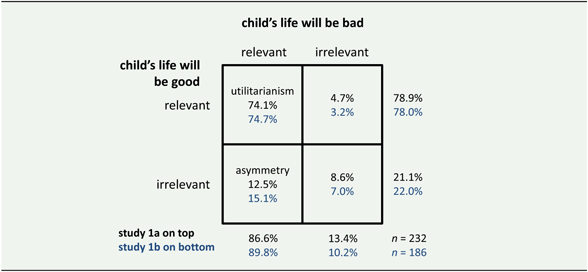
Table 1 presents the main results from Studies 1a and 1b. In Study 1b, the good and bad facts are each classified as ‘relevant’ if they are not rated at zero on the nine-point scale. Especially in light of the fact that no participant completed both surveys, the quantitative similarity of the distribution of participants into categories between Study 1a and 1b is striking. Among these respondents, there is wide support for the characteristically utilitarian position that both facts – that the prospective child’s life would be good and that it would be bad – are morally relevant to the couple’s decision. Nearly three-quarters of respondents report this view. In contrast, the Asymmetry is such a relatively uncommon answer as to be statistically indistinguishable from the position that both facts are irrelevant, good and bad; that is to say, in the sense of statistical significance, we cannot conclude from these data that the Asymmetry is more commonly held, on average in the population of respondents studied, than is the ‘neither is relevant’ position.
Studies 1a and 1b: Most respondents did not choose the Asymmetry

2.3. A quantitative Asymmetry?
In McMahan’s (Reference McMahan1981) statement of the Asymmetry – in which the expectation of a good life provides ‘no (or only a relatively weak) moral reason’ – the possibility is left open for a quantitative Asymmetry, where the goodness and badness of different lives are both normatively relevant, but perhaps goodness receives less weight.Footnote 8 Frick (Reference Frick2014) calls such a view ‘the Weak Normative Asymmetry’, although he does not directly discuss it beyond identifying its possibility. Like the absolute Asymmetry, it is not clear how a quantitative Asymmetry could be formulated in a rational social welfare function. A distinct but related quantitative Asymmetry view is advanced within economics by Dasgupta (Reference Dasgupta1998), who, while denying that his views imply that ‘creating a good life is not a good thing’, argues that ‘good lives may indeed be part of the intrinsic good, but ceteris paribus an improvement in the quality of life of an actual person is better still’ (p. 147). Some results of Study 1b suggest the possibility that some respondents would endorse such a quantitative Asymmetry.
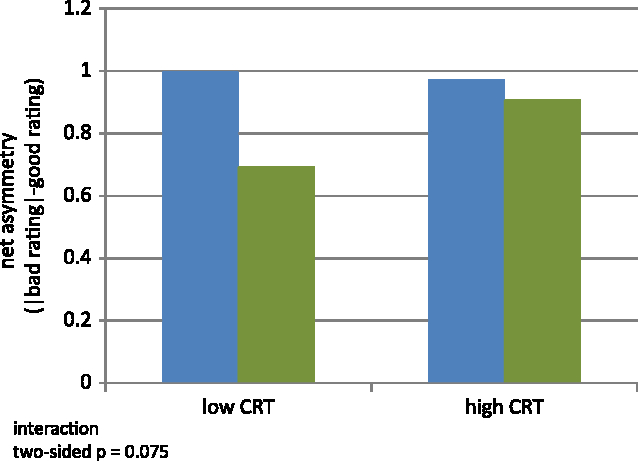
Study 1b allowed participants to rate the strength of the two facts as normative reasons on a nine-point scale around zero, as opposed to the forced trichotomization of Study 1a. Using this information, Figure 2 presents further detail on the results of Study 1b: the average net asymmetry computed for each respondent as
 $$-1\times \left({\rm{rating\ of\ bad\ life\ fact}}\right)_{\rm{i}}-\left({\rm{rating\ of\ good\ life\ fact}}\right)_{\rm{i}},$$
where the scale runs from −4 to 4. In a rejection of an absolute Asymmetry, we have already seen in Table 1 that 78% of participants in Study 1b reported that the good life fact counts as at least some degree of moral reason to have the child. In the further absence of any Asymmetry, a bad life fact and a good life fact of equal magnitude would be rated as equally important in opposite directions, so the average value of this difference would be zero.
2.4. Evidence consistent with dual-process moral reasoning
In Studies 1a and 1b, two features of the experimental design may speak to the possibility that participants applied dual-process reasoning: first, the order in which the good life and bad life facts were presented was randomly assigned as an experimental treatment, and second the CRT-measured differences across participants at the time of the survey.
We randomized the order of the two facts because we anticipated that many respondents’ automatic, intuitive response to the bad fact would be to say that it is relevant, while their automatic, intuitive response to the good fact would be to say that it is not. Thus, the random assignment of question order could be a random manipulation of cognitive reflection: participants who see the bad fact first are implicitly encouraged to compare the two cases before evaluating the relevance of the good fact.
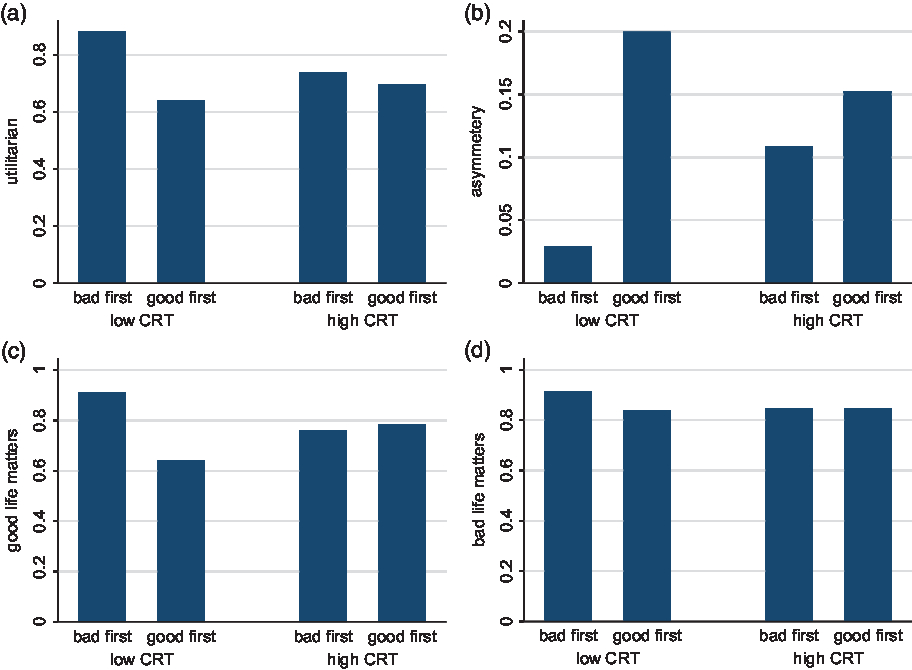
Figure 1 for Study 1a and Figure 2 for Study 1b present evidence that question order matters in the way that this reasoning predicts.Footnote 9 Respondents presented with the good fact first are more likely to show the Asymmetry than respondents presented with the bad fact first; respondents presented with the bad fact first are more likely to give the utilitarian pattern of answers than respondents presented with the good fact first.
Study 1a: Question order predicts judgement among participants with low cognitive reflection. (a) generalized utilitarianism; (b) Asymmetry; (c) good life matters; (d) bad life matters. CRT stands for Cognitive Reflection Test.

Study 1b: Net Asymmetry is associated with question order, cognitive reflection.

Furthermore, the effect of question order statistically interacts with individual differences in cognitive reflection scores: in both studies, the effect of question order is principally or only seen among participants with a below average CRT score.Footnote 10 Note the similarity between the matching Figures 1(b) and 2. Thus, participants who displayed low cognitive reflection in another part of the same survey were more influenced by a (presumably otherwise normatively irrelevant) randomized question order manipulation that had the statistical effect of switching some respondents from utilitarian-type answers to the Asymmetry. Collectively, the results of this section of the paper are consistent with an interpretation that some respondents may feel an intuitive attraction to the Asymmetry, but resolve it under cognitive reflection.
2.5. A difference between male and female respondents
Figure 3 presents an observed difference across respondents in Study 1a: averaging across experimental treatments, female participants are less likely to present the utilitarian pattern of answers and are more likely to present the Asymmetry, largely because they are less likely to report that the good fact matters.Footnote 11 This is related to another fact in the empirical social choice literature: in a study of social preferences between possible future aggregate populations that differ in their sizes and in their high levels of average well-being, Spears (Reference Spears2017) found that female participants were less likely than male participants to choose larger, less mean-rich populations (rather than smaller, more mean-rich populations).
Study 1a individual differences: female respondents were more likely to support the Asymmetry than males, on average. (a) generalized utilitarianism; (b) Asymmetry; (c) good life matters; (d) bad life matters.

This study was not originally designed to explain or to investigate why it might find a difference between male and female respondents. However, costs of childbearing before and during birth, and costs of child rearing after birth, fall disproportionately (and in many cases exclusively) on women. Plausibly, male respondents could, on average, simply underappreciate the full social costs of bearing and raising children. However, respondents were specifically asked not to weigh the benefits of a good life against other costs of procreation, but rather to simply consider in isolation whether each factor acts as a reason in favour; this instruction may not have been strictly followed, but a further experiment discussed in the appendix found no effect of a randomized treatment that made this instruction even more explicit.
Moreover, in many countries including the participants’, whether and how the state may regulate fertility is a contested topic of continuing political salience. This context may have influenced responses. The prompt only asked respondents what facts should matter ‘for the couple’s decision’ (not whether or how procreation should be a matter of public policy, or be anyone else’s decision) and, consistently with the focus of the Asymmetry on ‘reasons’, elaborated ‘you are only asked whether the potential facts count morally for or against having the child; they do not have to settle the question or be the only thing that matters’. In particular, the claim ‘the expectation of it having a very good life would be a reason for potential parents to count in favour of having a child’ would not remotely imply that the state should restrict abortion or that any woman should be prohibited from terminating a pregnancy. Further research could seek to clarify the implications of the politics and policy of abortion and fertility on social preferences over population, and more broadly could further investigate correlations in answers across population groups.
3. Study 2: The Asymmetry, across respondents
Study 2, conducted through mTurk in early 2015, builds further from Study 1 in four ways. First, Study 2 manipulated cognitive reflection, by manipulating the placement within the questionnaire of the CRT. Second, Study 2 randomly assigned a wide range of possible qualities of life (rather than only good and bad), in order to verify a continuous mapping from quality of life to normative implications for procreation. Verifying that an exceptionally good life provides affirmative reasons for procreation beyond what even a good life does is a strong test of the relevance of goodness.Footnote 12 Third, this wide range of possible qualities of life permits further investigation of the possibility of a quantitative (rather than absolute) Asymmetry, raised in Section 2.3. Finally, because each participant sees only one expected quality of life, comparisons are between-respondent; this is a robustness check of the within-respondent results of Study 1 and rules out any possible implications of question order for cognitive reflection, as discussed in Section 2.4.
3.1. Empirical method
Study 2 makes use of a standard survey question in the literature on subjective well-being, the Cantril life satisfaction ladder. The ladder question asks:
Please imagine a ladder with steps numbered from 0 at the bottom to 10 at the top. The top of the ladder represents the best possible life for you, and the bottom of the ladder represents the worst possible life for you. On which step of the ladder would you say you personally feel you stand at this time?
This question, commonly referred to as a measure of ‘life satisfaction’, has been thoroughly studied in the economics literature, such as by Deaton (Reference Deaton2013) and Fleurbaey (Reference Fleurbaey2009). The survey of Study 2 opened with this life satisfaction ladder question, followed by three more versions, intended to familiarize respondents with the scale:
On which step of the ladder would you say the average American probably stands?
On which step of the ladder would you say the average very poor person in a developing country probably stands?
On which step of the ladder would you say the average financially secure American with a fulfilling career and a healthy family probably stands?
After completing these four life satisfaction questions, respondents were presented with the three-question CRT and with an Asymmetry question, in a randomized order. This follows the methodology of Paxton et al. (Reference Paxton, Ungar and Greene2012). Thus, half of the respondents experienced
life satisfaction ladder → CRT → Asymmetry,
and half of the respondents experienced
life satisfaction ladder → Asymmetry → CRT.
In the question on the Asymmetry, participants first read introductory text that was identical to that in Study 1. Then they read:
Recall the ladder with steps numbered from 0 at the bottom to 10 at the top. The top of the ladder represents the best possible life (10), and the bottom of the ladder represents the worst possible life (0).
Imagine that the couple learned that if they have the additional child, it will certainly have a life of quality on the ladder.
Morally, should this fact influence whether the couple should have the additional child? [three options]:
This fact should count as an ethical reason in favour of having an additional child; morally, this counts for having the child.
This fact should count as an ethical reason against having an additional child; morally, this counts for not having the child.
This fact is ethically irrelevant to whether or not to have an additional child; this does not matter to the morality of their decision, although it might matter to the couple for reasons unrelated to morality.
The quality was randomly assigned across participants with equal probability on the integers 0–10.
3.2. Relevance throughout the range of life quality
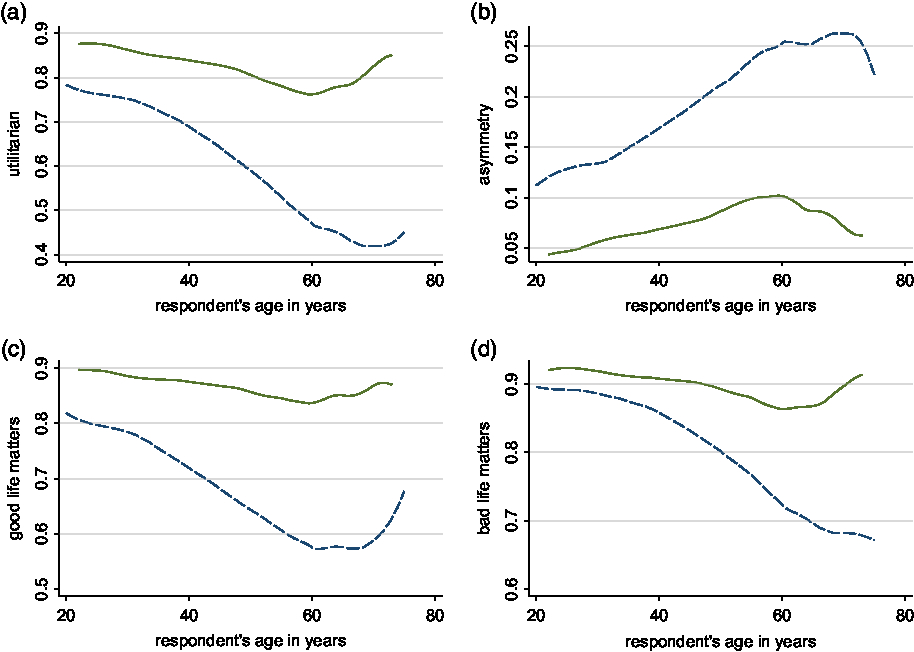
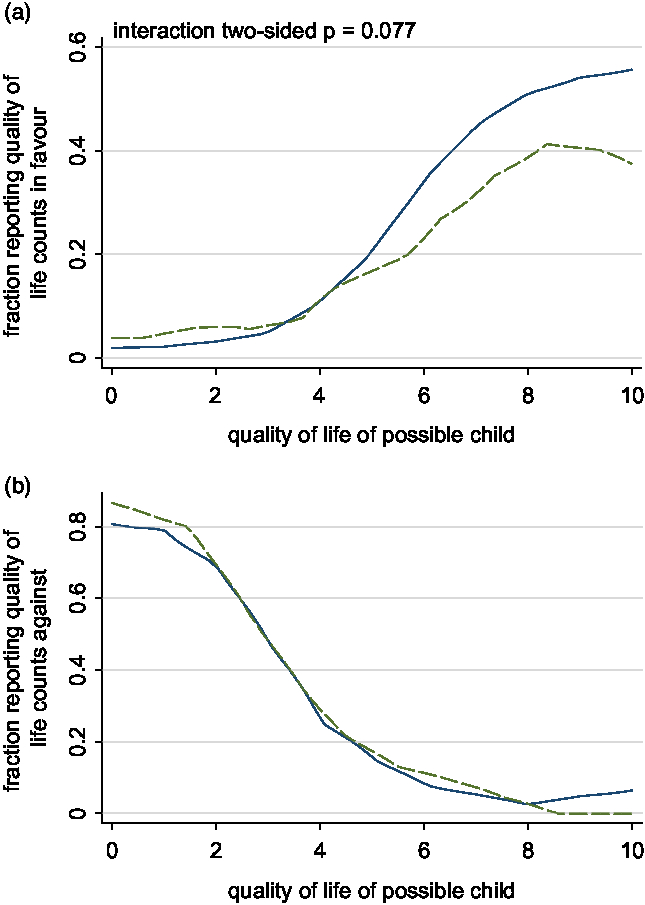
Figure 4 presents the results graphically; Table A4 in the supplementary statistical appendix (online) presents regression results with robustness checks.Footnote 13 In contrast with an absolute Asymmetry, the slope is both positive in panel (a) for counting in favour and negative in panel (b) for counting against. This is true throughout the relevant range, so that a life of quality 9 is more likely to count favourably than a life of quality 7.Footnote 14 Thus, according to these respondents, a life being great is more likely to count as a reason to procreate than is a life being good enough not to be bad.
Study 2: Relevance of quality of life under experimentally manipulated cognition. (a) fraction of respondents reporting quality of life counts ethically in favour of having child; (b) fraction of respondents reporting quality of life counts ethically against having child. Note: For further results, see Table A4 of the Statistical supplementary appendix (online). The P-value in panel (a) tests for the interaction between the child’s quality of life and the cognitive reflection treatment, in predicting judgements that the quality of life counts in favour of having the child.

These responses clearly disagree that the expectation of a good life is altogether normatively irrelevant. However, Section 2.3 suggested that a quantitative Asymmetry might be consistent with these results, whereby expected goodness counts, but counts to some degree less. The positive slope in panel (a) is less steeply positive, in absolute value, than the negative slope in panel (b) is negative. This difference is statistically significant (interaction t = 3.2, P < 0.01). Of course, respondents could bring essentially any scaling of cardinal levels of well-being into this ordinal scale (Decancq et al. Reference Decancq, Fleurbaey and Schokkaert2015), so this numerical interaction cannot be interpreted quantitatively literally nor taken as any definitive evidence of a quantitative Asymmetry. It could simply be the shape of a curved, rational, social welfare function; however, it could be consistent with a quantitative Asymmetry. What is clear, however, is that it is not consistent with respondents endorsing an absolute Asymmetry, in which a good quality of life offers no moral reason to create.
3.3. Evidence consistent with dual-process moral reasoning
By plotting averages separately by assigned cognitive reflection treatment, Figure 4 also presents evidence that is consistent with Asymmetric dual-process moral reasoning. In contrast with Study 1, here the cognitive reflection difference is randomly assigned, and therefore is more readily interpreted as a casual effect. In panel (a), for reasons in favour of having a child, there is an interaction between cognitive reflection and quality of life: the affirmative moral relevance of quality of life rises more steeply over good lives for participants who have been primed to employ cognitive reflection than for participants who have not.Footnote 15 In panel (b), for reasons against, there is no such interaction. This pattern is what would be predicted by an account of the Asymmetry in the dual-process sense of Greene.
4. Discussion: population intuition and cognitive reflection
The normative relevance of empirical evidence such as in this paper is currently an unsettled topic of debate; this section offers an interpretive discussion of the results.
Population ethics is an important case where intuition and reasoning famously collide. Several key moral intuitions – the Asymmetry, the Repugnant Conclusion, the Intuition of Neutrality – are named and treated with careful attention in the philosophical literature. The collision between intuition and deduction is so stark in population ethics in part because such intuitions appear opposed to a collection of strong results from a choice theoretic literature that is at home in the economics of social welfare functions (Blackorby et al. Reference Blackorby, Bossert and Donaldson1995, Reference Blackorby, Bossert and Donaldson2005; Arrhenius Reference Arrhenius2000; Rachels Reference Rachels, Tännsjö and Ryberg2004; Bradley Reference Bradley2013). Crucially, Broome (Reference Broome2004) demonstrates that attending to differences in the well-being of even very-well-off potential people is necessary for any social ordering of variable-size populations that is complete and transitive (the minimal requirements for a rational preference relation) and that respects Pareto improvements. Yet, some philosophers have been willing to abandon even these minimal goals for population ethics: see, for example, Singer (Reference Singer and Bayles1976) or Temkin (Reference Temkin2012).Footnote 16
An alternative response to the conflict would be to conclude, following Broome, that the technical results from the social choice literature are not mathematical flukes, but instead are informative. Unintuitive results, on this view, reflect the inevitable consequences of desiring to completely and transitively rank our actions (or society’s policies), given that one consequence of human actions is to change the set of people who are born. Adopting this view may require abandoning some intuitions. As Greaves (Reference Greaves2017) concludes: ‘One’s choice of population axiology appears to be a choice of which intuition one is least unwilling to give up’. This is an old dilemma (Singer Reference Singer2005). Axiomatic theorems tell us what our axioms amount to, but not whether to keep them. How are we to know which intuitions to abandon?
Greene (Reference Greene2014b) and other empirical researchers have documented characteristic patterns of dual-process moral psychology across multiple domains of ethical decision-making. As Rini (Reference Rini2013) and others have observed, one cannot reason immediately from empirical facts (of the sort that Greene and this paper have documented) to normative implications: one needs further careful reflection and an additional normative premise. As such a further normative principle, Greene suggests approaching an ethical question differently based on the extent to which it is unfamiliar*, rather than familiar*. Greene defines unfamiliar* situations as those in which automatic moral judgement would be unlikely to function well, because it has not been shaped by trial-and-error experience: ‘Let us define unfamiliar* problems as ones with which we have inadequate evolutionary, cultural, or personal experience’ (p. 714).
In particular, Greene recommends that we could safely and conveniently rely on low-cost, automatic moral judgements in familiar* cases, but should instead defer to deliberative, perhaps calculating, controlled cognitive reasoning in unfamiliar* cases. The motivation for this conclusion is that there is less likely to have been an informative experience or selective process that would tailor automatic processes to judge unfamiliar* problems well.Footnote 17 de Lazari-Radek and Singer (Reference de Lazari-Radek and Singer2012) make a similar suggestion, when they observe that the evolutionary processes that created humans and other animals have both selected consequences and non-selected byproducts.
Population ethics – and especially the present-day opportunity to make policy decisions that quantitatively importantly shape the size of the human population, or that influence the probability of human extinction – is decidedly unfamiliar*. If Greene’s principle is applicable here, then population ethics is a case in which we should favour deliberative, controlled reasoning over automatic intuition. And then, the recommendation would be clear: dual-process moral psychology in combination with a normative proposal such as Greene’s would offer a principled reason to abandon some such intuitions. Of course, even if this normative principle were widely accepted, it would still be the case that considerably more empirical evidence would be required before we could conclude that intuitive judgement behaviour about population ethics (or even just the Asymmetry) were fully documented and understood.
5. Conclusion
This paper can be read by two audiences. In the first, this paper is a straightforward exercise in the growing field within economics of empirical social choice (Gaertner and Schokkaert Reference Gaertner and Schokkaert2011). Such papers seek to inform the selection of models, axioms and social welfare functions in social choice theory by documenting those that are empirically observed to achieve support among study participants (Yaari and Bar-Hillel Reference Yaari and Bar-Hillel1984). In this case, one conclusion would be that these respondents did not demonstrate an absolute Asymmetry and, instead, many saw the expectation of good and even great lives as a reason counting in favour of creating a child. Versions of the Asymmetry differ in the philosophy literature, but a wide variety include a claim phrased similarly to the expectation of a good life being no moral reason to create someone (Holtug Reference Holtug2001; McMahan Reference McMahan, Roberts and Wasserman2009; Frick Reference Frick2014; Earl Reference Earl2017): this view is directly rejected by the choices of our average survey participant. That said, Roberts (Reference Roberts2011b) instead discusses the Asymmetry in terms of what is permissible, and McMahan (Reference McMahan1981) and Frick (Reference Frick2014) allow the possibility of a quantitative Asymmetry; these other versions of the Asymmetry are not spoken to as directly by these empirical results.
Of course, as in any empirical study of this kind, the results must be read in light of the limitation that we cannot be sure that experimental participants understood concepts in the same way that the literature does. The questionnaires use concepts such as ‘a life full of very much pain and suffering’ or simply ‘good and bad consequences’. It may be that participants’ ordinary-language reading of these terms is good enough to learn their views. But how these ideas should be understood is debated even by experts in the philosophical literature: some philosophers think that the average financially secure person living in a developed country today has a life that is only barely worth living, and some even think that privileged present-day human lives are not lives worth living (Tännsj Reference Tännsjö2002; Benatar Reference Benatar2017).
For philosophical audiences, this paper joins a debate between intuitions and formal derivations in population ethics. Advocacy exists in the population literature both for abandoning intuitions and for abandoning transitive rationality. Outside of population ethics, some reject the normative relevance of experimental evidence, while some have suggested that accumulating, domain-general empirical evidence of dual-process moral reasoning may offer a principled tool for abandoning some intuitions. For a reader who finds such a suggestion attractive, the evidence in this paper may indicate that it applies to population ethics – or, at least to the Asymmetry, which is investigated here.
Supplementary information
To view supplementary material for this article, please visit https://doi.org/10.1017/S0266267119000221
Acknowledgements
This research was supported by grant P2CHD042849, awarded to the Population Research Center at The University of Texas at Austin by the Eunice Kennedy Shriver National Institute of Child Health and Human Development. The content is solely the responsibility of the author and does not necessarily represent the official views of the National Institutes of Health. I also am grateful to the Princeton University Center for Health and Wellbeing which hosted me for the spring semester of 2016 while I wrote the first draft of this paper; for comments from seminar participants there; and especially for conversations with Mark Budolfson, Diane Coffey, Marc Fleurbaey and Melinda Roberts.
Dean Spears is an economic demographer. He is an Assistant Professor in the economics department and Population Research Center of the University of Texas at Austin, is a visiting economist at the Indian Statistical Institute – Delhi Centre, and is affiliated with IZA, IFFS, and the Princeton Climate Futures Initiative. He is a co-founder of r.i.c.e., a research and advocacy non-profit working for children’s health in India. He is the author of Where India Goes: Abandoned Toilets, Stunted Development, and the Costs of Caste with Diane Coffey and of Air: Pollution, Climate Change, and India’s Choice Between Policy and Pretence. URL: https://liberalarts.utexas.edu/prc/directory/faculty/spearsde