A large number of family caregivers are employed or working part-time in addition to their caregiving responsibilities. In the United States, approximately 7 out of 10 caregivers were employed at least some of the time when they provided care (National Alliance for Caregiving (NAC), 2009). Role responsibilities divided between caregiving and working frequently compete and conflict; employed caregivers are described as feeling “sandwiched” (Neal & Hammer, Reference Neal, Hammer, Neal and Hammer2007) and “caught in the middle” (Brody, Reference Brody1981) as they struggle with balancing and combining two responsibilities. Consequently, working caregivers are likely to make adjustments in their work and caregiving activities (Evandrou, Glaser, & Henz, Reference Evandrou, Glaser and Henz2002; Scharlach, Gustavson, & Dal Santo, Reference Scharlach, Gustavson and Dal Santo2007). According to the National Alliance for Caregiving (2009), 70 per cent of working caregivers in the United States made work-related adjustments in order to take on caregiving responsibilities.
In research on caregiving and labour force participation, many studies have examined the relationship independently, assuming a unidirectional relationship (Dentinger & Clarkberg, Reference Dentinger and Clarkberg2002; Pavalko & Henderson, Reference Pavalko and Henderson2006; Pohl, Collins, & Given, Reference Pohl, Collins and Given1998; Young & Grundy, Reference Young and Grundy2008). That is, they distinguished caregiving’s interfering with work from work’s interfering with caregiving, and addressed each model separately, with more attention directed to the impact of caregiving on work. In particular, most previous research used cross-sectional designs, and thus, the direction of the relationship between caregiving and labour force participation remains ambiguous. It is unclear whether caregivers leave the labour force due to care demands, or whether people not in the labour force may be more apt to become caregivers. Although a few studies have investigated the reciprocal association between caregiving and employment, the results have been inconsistent (Huang, Hammer, Neal, & Perrin, Reference Huang, Hammer, Neal and Perrin2004; Pavalko & Artis, Reference Pavalko and Artis1997).
Based on a life course perspective that highlights the role of personal and social contexts in life events and transitions (Kim & Moen, Reference Kim and Moen2002), we assume gender differences in caregiving and employment. Women undergo different employment and caregiving experiences than men due to gender differences in work trajectories, employment opportunities, and family responsibilities. Whereas previous studies on employment have given attention primarily to men, empirical findings on caregiving have focused on women. Empirical findings suggest that there are differences in the consequences of both caregiving and working by gender. On the one hand, caregiving significantly reduced working hours for both genders, but the magnitude of the caregiving effect has been found to be larger for women (Ettner, Reference Ettner1995, Reference Ettner1996). Also, caregiving appears to lower women’s chances of being employed but does not affect male caregivers’ employment (McLanahan & Monson, Reference McLanahan and Monson1990). Rather, male caregivers appear more likely to stay in the labour force (Dentinger & Clarkberg, Reference Dentinger and Clarkberg2002). On the other hand, full-time employment reportedly reduces caregiving hours for both genders (Boaz, Reference Boaz1996).
The goal of this study was to investigate the reciprocal association between caregiving and labour force participation by examining whether parental caregiving influences labour force participation and vice versa, and by exploring the differences between men and women through a longitudinal research design. Using a nationally representative sample of men and women, particular attention was given to two important issues that are not sufficiently addressed in previous literature: (a) the reciprocal association of parental care and labour force participation, and (b) gender differences in the relationship between caregiving and labour force participation.
Effects of Caregiving on Labour Force Participation
First, with respect to the consequences of caregiving, a large body of literature has documented that caregiving is negatively related to labour force participation. Several researchers have reported that many caregivers left the labour force or even retired or shifted from full-time to part-time employment as a result of providing care to parents (Pavalko & Henderson, Reference Pavalko and Henderson2006). Spiess and Schneider (Reference Spiess and Schneider2003) examined the relationship between changes in caregiving and working hours among women who participated in the labour force. Initiating caregiving was associated with reduced hours in paid work, while stopping care and reducing hours of care were not associated with a change in working hours.
Second, several studies have shown that caregiving has positive associations with employment. As family caregiving often causes a financial burden, caregivers may want to remain employed due to financial considerations or health insurance (Carmichael & Charles, Reference Carmichael and Charles2003; Dentinger & Clarkberg, Reference Dentinger and Clarkberg2002). In addition, some caregivers consider their workplace a respite from the demands of caregiving (Carmichael & Charles). From this perspective, employed caregivers consider their employment as a means of buffering the strain and stress of caregiving demands, and thus, caregivers may want to keep working (Pavalko & Woodbury, Reference Pavalko and Woodbury2000). Dentinger and Clarkberg showed that while male caregivers for parents/parents-in-law significantly delayed their retirement decision, there was no significant association between caregiving and retirement decision among female caregivers. The results suggested that men were more likely to feel a financial burden when they assumed caregiving responsibilities. Therefore, men remained in the labour force longer and postponed the transition to retirement to maintain the same level of income.
Lastly, there is also a body of studies that failed to find any significant associations between caregiving and employment or that showed mixed results (Pohl et al., Reference Pohl, Collins and Given1998; Wolf & Soldo, Reference Wolf and Soldo1994). Wolf and Soldo suggested that caring for an elderly parent was not associated with any reduction in labour force activity among married women. Pohl et al. demonstrated that women who were employed full-time prior to caregiving were less likely to make changes in their employment status over the first 18 months after caregiving initiation.
Effects of Labour Force Participation on Caregiving
Compared to the literature on the effects of caregiving on work, relatively fewer studies have examined how caregivers’ labour force participation affects the decision to take on caregiving responsibilities. Some research has suggested that employment limits the likelihood and amount of time that family members could provide care (Doty, Jackson, & Crown, Reference Doty, Jackson and Crown1998; Dwyer, Henretta, Coward, & Barton, Reference Dwyer, Henretta, Coward and Barton1992; Scharlach et al., Reference Scharlach, Gustavson and Dal Santo2007). Employed female primary caregivers provided significantly fewer hours of help to the disabled elderly care recipients than their non-working counterparts (Doty et al., Reference Doty, Jackson and Crown1998). However, women were equally likely to become caregivers regardless of their employment status, and employment was not significantly associated with discontinuing parental caregiving (Moen, Robison, & Fields, Reference Moen, Robison and Fields1994).
Although previous cross-sectional design studies have shown inconsistent results, two longitudinal studies have replicated the negative association between employment and caregiving (Mentzakis, McNamee, & Ryan, Reference Mentzakis, McNamee and Ryan2009; Young & Grundy, Reference Young and Grundy2008). Young and Grundy suggested an association between patterns of employment and propensity to caregiving. For example, men with the least employment experience were more likely to provide care than those with the most experience. Also, women with no work experience were more likely to provide caregiving than those with work experience. Mentzakis et al. (Reference Mentzakis, McNamee and Ryan2009) examined the determinants of informal care and found that employment competed with co-residential care, and thus, participation in the labour force negatively affected the decision to be a caregiver.
Reciprocal Relationships of Caregiving and Labour Force Participation
Although some studies have suggested the need to examine the reciprocal relationship between caregiving and labour force participation, only a few studies have dealt with the reciprocal nature (Berecki-Gisolf, Lucke, Hockey, & Dobson, Reference Berecki-Gisolf, Lucke, Hockey and Dobson2008; Boaz & Muller, Reference Boaz and Muller1992; Huang et al., Reference Huang, Hammer, Neal and Perrin2004; Pavalko & Artis, Reference Pavalko and Artis1997). Boaz and Muller were among the first researchers to suggest the potential for the simultaneity of both relationships. Their findings showed that full-time employment reduced the hours of caregiving and one additional hour of caregiving significantly reduced the probability of full-time employment.
However, the cross-sectional design of these studies prevents inferences about the direction of association between caregiving and labour force participation. Using a sample of dual-earner couples from longitudinal data, Huang et al. (Reference Huang, Hammer, Neal and Perrin2004) examined the relationships between work and family caregiving separately for wives and husbands. Their findings suggested a direct and reciprocal relationship between work and family care where each negatively impacted the other in both samples of wives and husbands, with higher family-to-work conflict at Wave 1 associated with higher work-to-family conflict at Wave 2 (and vice versa). Although the reciprocal relationships between work and family care were found for both husbands and wives, they were stronger for wives. Based on their findings, these researchers suggested taking potential gender differences into account in future studies.
In contrast, Pavalko and Artis (Reference Pavalko and Artis1997) examined the relationship between caregiving and employment using data over a three-year period and found that women’s employment status was not associated with taking on caregiving responsibility, whereas initiation of caregiving was related to reduced working hours and the increased likelihood of labour force withdrawal. Based on these findings, they suggested that for women the relationship between caregiving and employment was unidirectional; that is, caregiving has negative impacts on employment, but not vice versa. Another study investigated the order of occurrence between caregiving and employment in a sample of women using the longitudinal design (Berecki-Gisolf et al., Reference Berecki-Gisolf, Lucke, Hockey and Dobson2008). Their results showed that while hours of paid work were not significantly associated with starting caregiving, taking on a caregiver role was associated with reduced hours in the workplace. In summary, empirical evidence about the reciprocal relationships between caregiving and labour force participation appears somewhat equivocal, warranting further studies on this topic. Also, previous research has suggested gender differences in the consequence of parental care on employment, with women experiencing more negative effects than men caregivers.
Studies focusing on family caregivers’ labour force participation have implications for designing social policy and programs to support family caregivers. Empirical support is necessary to establish effective policy and practice, but existing research on caregiving responsibilities and employment is inconsistent. The current study contributes to clarifying equivocal findings regarding caregiving and employment through the use of nationally representative data and a longitudinal study design.
This study used a cross-lagged panel model to examine whether caregiving related to subsequent employment status, whether employment related to subsequent caregiving, and whether a reciprocal relationship existed between them across time. Also, we examined gender differences in the relationships between caregiving and working. First, we hypothesized that caregivers at earlier observation points are less likely than non-caregivers to be in the labour force at later observation points (hypothesis 1). Second, we hypothesized that those in the labour force at earlier observation points are less likely to assume caregiving roles at later observation points than those not in the labour force (hypothesis 2). Third, we hypothesized that women experience more negative consequences of employment and caregiving than men (hypothesis 3). To explore gender differences, the relationships between caregiving and labour force participation were examined separately for men and women.
Design and Methods
Data and Study Population
Data were drawn from the U.S. Health and Retirement Study (HRS), and the analyses were based on three waves of longitudinal data from 2006 to 2010 surveys. The HRS provides a wide variety of individual and household information including data on demographic characteristics, family characteristics, health status, inter/intra-family transfer in time and money, employment, income, and assets. The HRS data were collected from a large representative national probability sample of the non-institutionalized population aged 51 and older in the United States. Baseline interviews were completed in 1992 with approximately 12,654 (7,608 households) adults born between 1931 and 1941 and their spouses and partners irrespective of age eligibility. The overall response rate was 81.6 per cent for individuals and 82.1 per cent for households (Health and Retirement Study [HRS], 2011). Respondents were interviewed biannually, and age-eligible new sub-samples have been added every six years (Hauser & Willis, Reference Hauser, Willis and Waite2005).
The study sample consisted of adult children aged 51 or older at 2006 (Time 1) with at least one living parent or parent-in-law in order to define a population with a high likelihood of providing parental care. As a result, respondents aged less than 51 or those without living parents were excluded in this study. Our final analytical sample size was 3,534 with 2,093 women and 1,441 men.
Measures
Caregiving and labour force participation were the key variables of interest. Caregiving was defined as providing elderly parents help with activities of daily living (ADLs), that is, personal care activities such as self-feeding, toileting, bathing, grooming, and dressing (see Lawton & Brody, Reference Lawton and Brody1969) during the past 12 months. Labour force participation was defined as being in the labour force, including self-reported work for pay and self-reported unemployment but looking for work. Those who self-reported being retired or disabled were considered as being out of the labour force. Both variables were dichotomized (1 = yes, 0 = no) and measured at each of the three observation times.
Age, race, education, marital status, number of siblings, number of children, respondent’s health status, parents’ need for help, and household income were included as co-variates. Age was categorized into four levels (1 = 51–60 years old; 2 = 61–70 years old; 3 = 71–80 years old; 4 = 81 years or older). Race was recoded as (1) White and (0) African American and others. Education was measured as number of years of completed school (range: 0–17). Marital status was measured as (1) married, or (0) separated, divorced, widowed, and never married. Number of siblings (range: 0–16) and number of children (range: 0–15) were included as continuous co-variates. Household income included incomes obtained from all sources such as earnings, household capital, employer pension or annuity, Social Security or Supplemental Security Income, income from other government transfers, and incomes of all other household members (range: 0–$1,816,000). These co-variates were treated as time-invariant and their measures at Time 1 were used in the analysis. The respondents’ health status and parents’ need for help were used as time-varying co-variates and measured at each time of observation. Respondents’ self-rated health was measured as (1) good, very good, or excellent, and (0) fair or poor. Parents’ need for help was assessed based on respondents’ reports that their parents needed help with basic personal needs like dressing, eating, or bathing (1 = yes; 0 = no).
Data Analysis
We analysed data separately for men and women to examine gender difference and to avoid violation of statistical assumption about data independence. This approach has been adopted in previous studies (e.g., Huang et al., Reference Huang, Hammer, Neal and Perrin2004). The HRS data were obtained from all eligible persons in the household. In this study, 3,534 individuals came from 1,986 households. Whereas about 71 per cent of households had only one individual, the remaining 29 per cent of households had more than one member which accounted for about 43 per cent of the total sample. Thus, some subjects were nested within households, violating the assumption of independence of subjects with the result that the nested subjects might affect the research results (Raudenbush & Bryk, Reference Raudenbush and Bryk2002). We had large-enough sample sizes for separate analyses by gender that would increase power to detect significant associations.
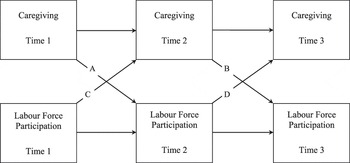
First, we conducted univariate and bivariate analyses to examine variable distributions and correlations. Second, we used structural equation modeling (SEM), specifically, a cross-lagged panel model, to examine the reciprocal relations between caregiving and labour force participation. The cross-lagged panel model was used with multiple dependent variables measured repeatedly over time, allowing for the examination of both directions between variables at multiple time points (Finkel, Reference Finkel1995; Menard, Reference Menard1991). SEM has been used in analyzing both continuous and categorical data (Bollen & Maydeu-Olivares, Reference Bollen and Maydeu-Olivares2007; Lee & Xu, Reference Lee and Xu2003). In SEM, categorical endogenous variables are analysed with a polyserial correlation matrix, using an estimation method that does not require normality or adjustment for violation of normality (e.g., weighted least squares or maximum likelihood robust). This study examined relationships between caregiving and labour force participation across three time periods over four years (see Figure 1). Measures were taken at three points in time, permitting comparisons of individual responses between three time intervals, thereby assessing the extent and direction of any changes that may have occurred over time.
Cross-lagged panel model of reciprocal relationship between caregiving and labour force participation
Note: For the simple presentation, co-variates (i.e., age, race, education, marital status, health status, number of siblings, number of children, parents’ need for personal care, and household income) were not included.

In order to test the study hypotheses, the model included the following hypothesized relationships: two cross-lagged structural paths (A and B) from caregiving at Time 1 to labour force participation at Time 2 and from caregiving at Time 2 to labour force participation at Time 3 (hypothesis 1), and two cross-lagged structural paths (C and D) from labour force participation at Time 1 to caregiving at Time 2 and labour force participation at Time 2 to caregiving at Time 3 (hypothesis 2). If the cross-lagged effects in both directions were significant, the standardized parameter estimates of both cross-lagged effects were compared to identify the reciprocal relationship between caregiving and labour force participation. In each model, caregiving and labour force participation at earlier times were adjusted for later observations after controlling for the co-variates. For example, caregiving in 2008 was predicted by employment in 2006 controlling for caregiving in 2006 and co-variates.
Typically, the chi-square statistic is calculated to evaluate the model fit. However, the chi-square test is sensitive to the sample size and is known to be biased (MacCallum, Widaman, Preacher, & Hong, Reference MacCallum, Widaman, Preacher and Hong2001). With a large sample size, the chi-square statistic is significant even though a difference might be negligible. To evaluate model fit with less sensitivity to sample size, several different fit indices, including the CFI (comparative fit index) and RMSEA (root mean square error of approximation) tests were used. A model with a CFI value of .95 or more and an RMSEA value of .06 or less was considered good fit. This study used the estimation method of weighted least squares mean and variance (WLSMV), which is the most popular method with categorical variables. No distribution assumption is required with WLSMV.
Results
Sample Characteristics and Descriptive Information
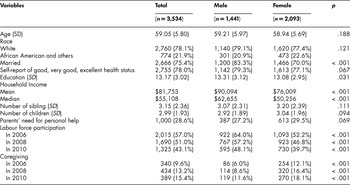
As shown in Table 1, the sample consisted of 3,534 adult children with an average age of 59.05 (SD = 5.80) at baseline. About 59 per cent of respondents were women, 78 per cent were White, 75 per cent were married, and 78 per cent self-reported their health status as good, very good, or excellent. They had an average of 13.17 years in schools (SD = 3.02) and a median annual household income of $55,108 (mean = $81,753). On average, they had 3.15 siblings (SD = 2.36) and 2.99 children (SD = 1.93), and more than 28 per cent of their parents needed personal help. The number of respondents who reported being in the labour force decreased over time from 57.0 per cent in 2006 to 43.1 per cent in 2010, whereas the number of respondents providing eldercare increased from 9.6 per cent in 2006 to 15.4 per cent in 2010. From bivariate analyses, we identified several significant gender differences in demographic characteristics in the total sample. Compared with women, men were more likely to be employed, married, with more years in school and greater household income. In contrast, women were more likely to provide caregiving to their parents and/or parents-in-law.
Demographic characteristics of sample

Reciprocal Relations of Caregiving and Labour Force Participation
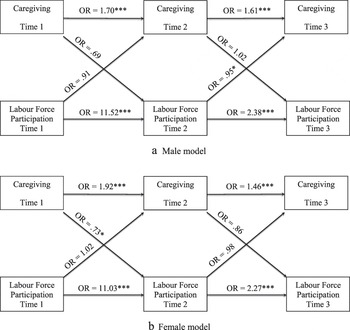
The model in the sample of men provided a good fit for the data: χ2 (97, n = 1,392) = 294.936, p < .001; CFI = .976; RMSEA = .038. Regarding the dynamics between caregiving and labour force participation, a reciprocal relationship was not found over the three waves. Figure 2 presents unstandardized odds ratios. Men in the labour force in 2008 were five per cent less likely to assume caregiving roles in 2010 (OR = .95, p = .028) than those out of the labour force, but the association was not significant between 2006 and 2008. Among men, providing care was not related to subsequent labour force participation at any time point.
Male and female models of reciprocal relationship between caregiving and labour force participation
Unstandardized odd ratios are reported. *p < .05, **p < .01,***p < .001.
Note: Co-variates of age, race, education, marital status, number of siblings, number of children, self-rated health, and parents’ need for personal care were included in the analysis but not shown in the figure.

In the sample of women, the model also provided a good fit: χ2 (97, n = 2,031) = 611.638, p < .001; CFI = .961; RMSEA = .051. Like the model for men, a reciprocal relationship was not found between caregiving and labour force participation over the three waves. As indicated in Figure 2, female caregivers in 2006 were 27 per cent less likely to be in the labour force in 2008 than non-caregivers (OR = .73, p = .018), but this association was not significant between 2008 and 2010. Labour force participation was not related to subsequent caregiving at any two consecutive observations. Caregiving and labour force participation demonstrated reversed relationships among men and women. Among men, those in the labour force were less likely to provide eldercare than those out of the labour force at later observation times. In contrast, women caregivers were less likely to be in the labour force than their non-caregiver counterparts at later observation times.
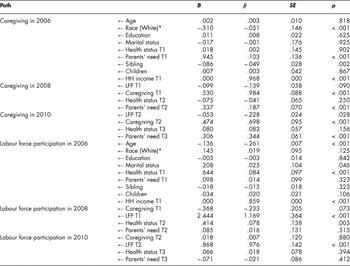
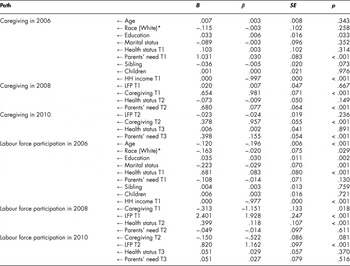
We controlled for the effects of demographic, health, and socioeconomic factors in the models. Table 2 presents unstandardized and standardized parameter estimates of the full model for the sample of men. Being White and having more siblings were negatively associated with caregiving in 2006. Household income was positively associated with caregiving in 2006. Parents’ need for help with ADLs at each time was positively associated with providing eldercare each year. With regard to labour force participation, being married and household income were positively associated with labour force participation in 2006. Health status in 2006 and 2008 were positively associated with labour force participation in 2006 and 2008. Age was negatively associated with labour force participation in 2006.
Parameter estimates of the full model (male)

Note: *Reference group is African American, Hispanic, Asian, and others.
T1 = Time 1; T2 = Time 2; T3 = Time 3; LFP = Labour force participation; HH = Household.
Model fit: χ2 (97, n = 1,392) = 294.936, p < .001; CFI = .976; RMSEA = .038.
Table 3 presents unstandardized and standardized parameter estimates of the full model for the sample of women. Education was positively associated with caregiving in 2006 and parents’ need for help at each time were positively associated with providing eldercare each year, whereas household income was negatively associated with providing care in 2006. Regarding labour force participation, age, being married, being White, and household income were negatively associated with labour force participation in 2006, whereas education was positively associated with labour force participation in 2006. Health status in 2006 and 2008 were positively associated with labour force participation in 2006 and 2008. Gender differences were also observed in the factors predicting caregiving and labour force participation. Household income predicted both caregiving and labour force participation positively for men, whereas it was negatively associated with both caregiving and labour force participation for women. In addition, being married was associated with labour force participation positively for men but negatively for women. Education positively predicted both caregiving and labour force participation only for the sample of women. Likewise, being White and having more siblings negatively predicted providing care only for the sample of men.
Parameter estimates of the full model (female)

Note: *Reference group is African American, Hispanic, Asian, and others.
T1 = Time 1; T2 = Time 2; T3 = Time 3; LFP = Labour force participation; HH = Household.
Model fit: χ2 (97, n = 2,031) = 611.638, p < .001; CFI = .961; RMSEA = .051.
Discussion
Although many studies have examined the relationship between caregiving and employment, few have investigated their reciprocal relationship and gender differences in the consequence of taking one role or the other. This study contributes to the literature by elucidating the equivocal relationships between caregiving and employment through the use of a national representative sample and the cross-lagged panel design. The methodological approach applied in this study allows for examining both directions of potential causality between caregiving and employment. The analysis provides estimates on the relative stability of the relationship over time (Menard, Reference Menard1991); thus, the pattern of co-variation may be established between the targeted outcomes. Findings provide support for the unidirectional relationship with reversed directions between two roles across genders; that is, caregiving has a negative effect on women’s labour force participation, whereas employment is negatively associated with caregiving in men.
The study extends our understanding of the relationship between eldercare and labour force participation in two ways. First, the consequences of caregiving and employment were examined in a longitudinal design to investigate the direction of reciprocity: whether caregivers left the labour force due to care demands, or whether commitment to the labour force prevented assuming a caregiver role. The results showed that there was no reciprocal relationship between caregiving and labour force participation; rather, a unidirectional relationship existed between the two, and this relationship demonstrated reversed directions between genders. The findings confirmed the negative impact of caregiving on employment among female caregivers. Consistent with previous studies (e.g., Berecki-Gisolf et al., Reference Berecki-Gisolf, Lucke, Hockey and Dobson2008; Lee & Tang, 2013; Pavalko & Artis, Reference Pavalko and Artis1997), women’s labour force participation was not associated with taking on care responsibility, whereas providing eldercare was related to labour force withdrawal. We found that women respondents providing care in 2006 were less likely to be in the labour force in 2008. Although this relationship was not validated in subsequent years (between caregiving in 2008 and labour force participation in 2010), the recession since 2008 might mitigate the effect of caregiving on employment during this period and obscure the relationships. On the other hand, women in the labour force were as likely as those out of the labour force to provide eldercare at any observation period, indicating that women assume care responsibilities regardless of their employment status.
Second, while most studies limit their analyses to a female sample, this study used both men and women to distinguish the consequences of caregiving and labour force participation by gender. The findings showed that male respondents who were in the labour force in 2008 were less likely to provide care in 2010, and providing parent care did not affect their participation in the labour force. Previous research helps explain the gender difference in this relationship. Women appear more likely than men to take on more intensive caregiving (Evandrou et al., Reference Evandrou, Glaser and Henz2002). Men are more likely to provide sporadic assistance or assistance with instrumental activities of daily living (IADLs), including financial management, transportation, shopping, and home maintenance, while women are more likely to provide assistance with ADLs and such hands-on tasks as personal care (i.e., bathing, dressing, and eating), medical treatment, and emotional support (Allen, Herst, Bruck, & Sutton, 2000; Levande, Herrick, & Sung, Reference Levande, Herrick and Sung2000; Neal, Ingersoll-Dayton, & Starrels, Reference Neal, Ingersoll-Dayton and Starrels1997). Thus, men’s caregiving requires less time to provide care, and male caregivers face fewer caregiving demands than female caregivers.
When providing care to their elderly parents, men may be able to stay in the labour force by reducing working hours instead of opting out of the labour market or balancing the two responsibilities of caregiving and working. Also, men who are employed might replace their own unavailability for caregiving with paid caregivers (Doty et al., Reference Doty, Jackson and Crown1998; Scharlach et al., Reference Scharlach, Gustavson and Dal Santo2007). Thus, we can see that for men employment reduces the likelihood of providing parental care, but caregiving does not affect labour force participation. In line with the life course perspective, our findings suggest that gender is a key factor in shaping the transitions between employment and caregiving. Men tend to remain in the labour force in the face of eldercare responsibilities, whereas women caregivers tend to lose paid work as well as its rewards, both intrinsically and extrinsically.
These empirical findings have four significant implications for policy and practice. First, the findings emphasize the importance of supporting the family caregiver, especially women. Despite women’s disengagement at work due to assuming caregiver roles, family caregiving is still not recognized seriously as a policy issue. In the long term, the substantial earnings loss for women caregivers raises a question about their retirement income because women caregivers accumulate fewer future Social Security benefits. Especially because women often already experience a break in employment due to childcare, they might be particularly vulnerable to problems accumulating wealth in later life. Therefore, efforts are needed to address poverty issues among women caregivers. For example, family caregiver credits through Social Security may improve their pension entitlements and add value to their caregiving work. Also, providing direct cash transfers or offering tax credits for purchasing long-term care insurance may compensate caregivers for their financial loss (Mellor, Reference Mellor and Meyer2000).
Second, paid family leave bills and supportive social services are important to assist family caregivers in the labour market and improve caregiving outcomes. The increased availability of publicly supported home care systems and caregiving leave have both increased flexibility in the workplace and increased the possibility of caregivers to remain in the labour force (Pavalko & Henderson, Reference Pavalko and Henderson2006). The Family and Medical Leave Act (FMLA), which was passed in 1993 in the United States, might be an option for some family caregivers to combine caregiving responsibilities and employment (Fredriksen-Goldsen & Scharlach, 2001). It allows workers to return to their jobs after a caregiving leave of up to 12 weeks during a 12-month period. However, it offers only unpaid leave except in California, where it is available only in larger companies with 50 or more employees. This Act needs be expanded to cover caregiving leave and support caregivers with respite care, counseling, and other supportive social services.
Third, the workplace is a primary arena for supporting working caregivers to manage care and work responsibilities (Neal & Hammer, Reference Neal, Hammer, Neal and Hammer2007). Workplace supports including flexible work schedules, paid leave, or supportive supervisors and co-workers positively influence family caregivers’ employment outcomes by reducing stress and role strain and helping them to meet their caregiving responsibilities (Kossek, Colquitt, & Noe, Reference Kossek, Colquitt and Noe2001). On the other hand, limited job flexibility and fewer workplace supports are likely to increase lateness for work and absenteeism, thus decreasing the productivity of employed caregivers (Scharlach, Reference Scharlach1994). Workplace supports have direct impacts on family caregivers’ labour force behaviours.
Finally, this study has practical implications for expanding eldercare programs to support caregivers as well as the long-term care of older adults. Services for older adults and their caregivers include referral resources in the community, on-site support groups for employed caregivers, and a variety of home- and community-based services. These interventions may allow caregivers to reconcile the responsibilities of caregiving and labour force participation.
Despite the strengths of the current study, there are several limitations that should be noted. First, several measurement issues need to be acknowledged. The study results may be biased because of the lack of objective measures of caregiving. Caregiving is defined as providing help with ADLs during the last 12 months in the survey, but depending on their personal perspective, respondents might not consider their behaviours to constitute caregiving. Therefore, measurement errors may have occurred due to respondent bias and non-response. Another measurement concern is the binary nature of the major study variables of caregiving and labour force participation, which provided little information about the amount or intensity of caregiving and type of labour force participation (full-time, part-time, and self-employed, etc.) involved. Second, separate models tested for women and men may have had limitations for examining gender differences. However, due to the limitations of nested data and insufficient data for analysis purposes, a direct comparison was impossible in the current study. Finally, our study examined a relatively short time period (four-year time span); consequently, our analyses did not test bidirectional associations at the within-person level. In order to examine the within-person level, we might need a longer time period than the time span used for the current study.
To overcome these limitations, the current study has a number of implications for further research in the field. Hypotheses in the current study were partially supported, and there is still a great deal to be learned about the reciprocal relationship between caregiving and labour force participation. It is imperative that the relationships among these variables be further examined in larger studies including more caregivers across various subgroups by race and financial status. Additional research is also needed to examine racial/ethnic differences and focus on the experience of African Americans, Asians, and Latinos who assume more care responsibilities and value more filial piety, as suggested in previous literature (Dilworth-Anderson, Williams, & Gibson, Reference Dilworth-Anderson, Williams and Gibson2002). Future research also needs to examine socioeconomic differences, specifically differences in financial status. Poor caregivers are more likely to take on heavy responsibilities and have the most difficulty meeting the expense of hiring caregivers for their parents and, thus, might leave the labour force to take on caregiving roles. Therefore, caregiving might have different impacts on labour force participation according to caregivers’ financial status.
In conclusion, the current study improves our understanding of the relationship between caregiving and labour force participation and clarifies previous equivocal findings by investigating the reciprocal association using both male and female samples. Our findings suggest that caregiving has a negative impact on women’s labour force participation, but employment status is not related to assuming the role of caregiver. Among men, labour force participation had a negative impact on caregiving, whereas taking caregiver roles did not affect their employment status. Findings from this study provide a greater understanding of gender differences in the relationship between caregiving and labour force participation. Pressures on families likely will rise in the near future as the number of older adults increases and as women’s labour force participation continues to grow. The results of this study will help us to prepare for an aging population and provide evidence and a rationale for providing support to family caregivers.