Over the last 40 years, there have been immense gains in our knowledge of how genes and environment contribute to psychopathology (Plomin, Reference Plomin1990; Rutter, Reference Rutter2004; Smoller, Reference Smoller2019). We have evolved from a time when genetic risk factors were considered to be of minimal or no importance for child development and psychopathology (e.g., Thapar & Rutter, Reference Thapar and Rutter2021) to an era where it is well-recognized not only that both genes and environment contribute in complex ways, but that their contributions are closely inter-related (Rutter, Reference Rutter2015; State & Thapar, Reference State and Thapar2015). We also have learnt that no single genetic (or environmental) risk factor on its own explains the development of psychopathology, and that there are many different biological and developmental routes that lead to the same outcome; equifinality is a concept that has long been familiar to those in developmental psychopathology (Cicchetti & Rogosch, Reference Cicchetti and Rogosch1996). We also know that the same genes or set of genetic risks, like environmental risks, can lead to very different characteristics, behaviors and outcomes. For example, the same genetic variants contribute risks for ADHD, ASD, Depression, Bipolar Disorder, and Schizophrenia (Lee et al., Reference Lee, Anttila, Won, Feng, Rosenthal, Zhu and Smoller2019). Pleiotropy refers to the multiple different effects of the same gene/genetic risks, and has been found to be extensive for human traits (Visscher & Yang, Reference Visscher and Yang2016). Whilst the discovery of extensive pleiotropy for psychopathology is relatively recent, the concept of multifinality again is well established in the field of developmental psychopathology (Cicchetti & Rogosch, Reference Cicchetti and Rogosch1996). In short, genetic discoveries have progressed, and genetic susceptibility does not seem to operate in ways that are fundamentally different from other types of risk and protective factors.
In this paper, we first outline how quantitative behavioral genetic research designs can be utilized to disentangle genetic and environmental contributions to psychopathology. Although most research in developmental psychopathology has used traditional quantitative behavioral genetic approaches, research designs also are now starting to incorporate molecular genetic approaches. We therefore briefly discuss newer molecular genetic approaches and their relevance to research in developmental psychology. As our focus is on conceptual issues, we refer readers elsewhere for detailed descriptions of the strengths and limitations of different genetic designs used to identify causal environmental factors (Davey Smith et al., Reference Davey Smith, Richmond and Pingault2022; Knopik et al., Reference Knopik, Neiderhiser, DeFries and Plomin2017; Smith et al., Reference Smith, Richmond and Pingault2021). Most of these designs have been used to identify likely causal environmental risk factors (Pingault et al., Reference Pingault, O’Reilly, Schoeler, Ploubidis, Rijsdijk and Dudbridge2018) but they can also be utilized in strengths-based research that seeks to identify protective factors and moderators that attenuate risk. Research on these topics is highly relevant for clinical practice and policymakers.
Research designs based on relatives: quantitative behavioral genetic research designs
Genetic studies of child psychopathology began with research designs that included relatives of varying degrees of familial and genetic relatedness (State & Thapar, Reference State and Thapar2015). These comprised family-, twin-, twin-extensions (e.g. children of twins), adoption, and IVF-based designs among others (Davey Smith et al., Reference Davey Smith, Richmond and Pingault2022; Liu & Neiderhiser, Reference Liu and Neiderhiser2017). Such studies highlighted that between-person variation in psychopathology is explained by both genetic and non-genetic contributions and include environmental, measurement error and stochastic effects.
Twin studies were used to generate heritability estimates for different forms of psychopathology. Heritability refers to the proportion of observed variation in a specific phenotype that is attributed to genetic variation. Misconceptions of heritability remain. For example, high heritability estimates do not mean an attribute is predetermined: high heritability is not equivalent to immutability. Moreover, heritability is population specific because environmental contexts can alter genetic expression, even for phenotypes that are typically viewed as highly heritable such as height and IQ (Sellers et al., Reference Sellers, Smith, Leve, Nixon, Cane, Cassell and Harold2019; Shanahan & Hofer, Reference Shanahan and Hofer2005; Turkheimer et al., Reference Turkheimer, Haley, Waldron, D’Onofrio and Gottesman2003). Last, it is also important to emphasize that heritability estimates are population based statistics, and refer to genetic contributions to variance within a population, rather than estimates of genetic influences for specific individuals. Whilst heritability estimates have their limitations (see Tenesa & Haley, Reference Tenesa and Haley2013 for a full explanation; see also Table 1), early studies using heritability estimates were nevertheless important for highlighting that genetic factors contribute to variation across different types of psychopathology. In general, twin studies suggested that genetic influences accounted for around 70–90% of total variance for neurodevelopmental disorders such as ASD and ADHD (Rutter, Reference Rutter2000; Thapar & Rutter, Reference Thapar and Rutter2021; Thapar, Reference Thapar2018) and for major mental illnesses such as schizophrenia and bipolar disorder (Sullivan et al., Reference Sullivan, Agrawal, Bulik, Andreassen, Borglum, Breen, Cichon, Edenberg, Faraone, Gelernter and Mathews2018; Sullivan & Geschwind, Reference Sullivan and Geschwind2019). Lower heritability estimates and larger environmental contributions were found for depression, anxiety, and antisocial behavior/conduct disorder (Burt, Reference Burt2009; Polderman et al., Reference Polderman, Benyamin, De Leeuw, Sullivan, Van Bochoven, Visscher and Posthuma2015).
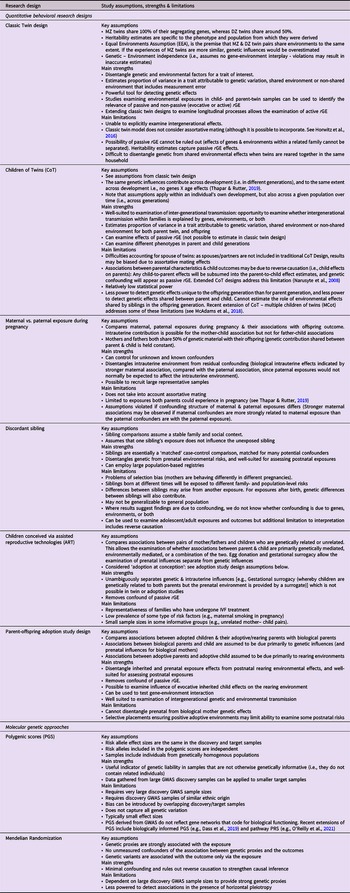
Summary of research designs

For further details regarding assumptions, strengths and limitations of quantitative behavioral research designs, see Thapar and Rice (Reference Thapar and Rice2020), Thapar and Rutter (Reference Thapar and Rutter2019), Rutter and Thapar (Reference Rutter, Thapar and Cicchetti2016), and Knopik et al. (Reference Knopik, Neiderhiser, DeFries and Plomin2017). See also Davey Smith et al. (Reference Davey Smith, Richmond and Pingault2022) and Smith et al. (Reference Smith, Richmond and Pingault2021).
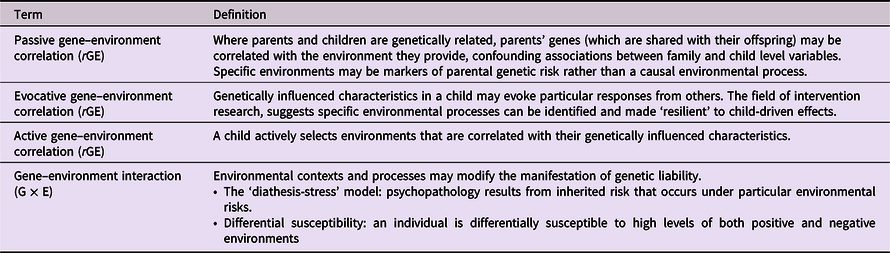
Although the initial relative-based research designs were used to examine the familial and genetic contributions to psychopathology, later these designs were employed to elucidate environmental processes. One consistent observation to emerge from these traditional relative-based designs was that many environmental factors (e.g. bullying, parenting, maltreatment) also appeared to be influenced by genetic factors, a phenomenon called gene-environment correlation (rGE: Knafo & Jaffee, Reference Knafo and Jaffee2013; Rutter, Reference Rutter2015; Scarr & McCartney, Reference Scarr and McCartney1983; see Table 2). Findings emphasized that genes and environment not only worked together but were interdependent (Broderick & Neiderhiser, Reference Broderick, Neiderhiser and Bornstein2019; Rutter, Reference Rutter2007a). The observation of rGE also highlighted the possibility that some of the associations between environmental factors and psychopathology could be accounted for by shared genes between the parent and child. These associations could have arisen because of so-called “genetic confounding” (Rutter, Reference Rutter2007b). Genetically informed designs thus became important for differentiating likely causal environmental processes involved in the development of psychopathology from genetic processes (Arseneault et al., Reference Arseneault, Milne, Taylor, Adams, Delgado, Caspi and Moffitt2008; Caspi et al., Reference Caspi, Moffitt, Morgan, Rutter, Taylor, Arseneault, Tully, Jacobs, Kim-Cohen and Polo-Tomas2004; Thapar & Rutter, Reference Thapar and Rutter2019).
Description of different types of gene-environment interplay
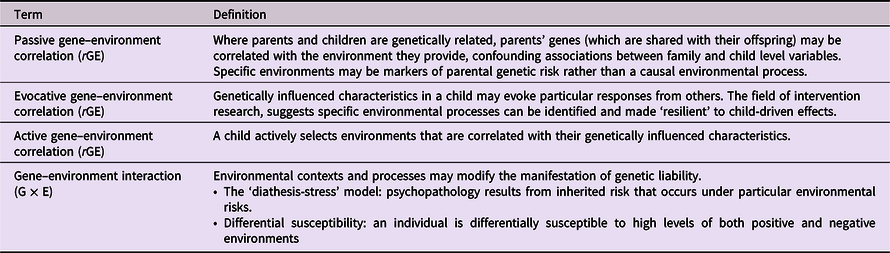
For more information regarding these processes see: Ge et al. (Reference Ge, Conger, Cadoret, Neiderhiser, Yates, Troughton and Stewart1996); Jaffee and Price (Reference Jaffee and Price2008); Jaffee and Price (Reference Jaffee and Price2012); Knafo and Jaffee (Reference Knafo and Jaffee2013); Knopik et al. (Reference Knopik, Neiderhiser, DeFries and Plomin2017); Luthar and Brown (Reference Luthar and Brown2007); Price and Jaffee (Reference Price and Jaffee2008); Reiss et al. (Reference Reiss, Leve and Neiderhiser2013); Scarr and McCartney (Reference Scarr and McCartney1983).
Unlike molecular genetic studies (see section “Molecular genetic approaches”) that directly measure genotype, research designs based on relatives utilize variation in genetic relatedness between family members to estimate heritable and environmental influences on phenotypes. Some designs are particularly suited to disentangling genetic and environmental contributions, such as parental genetic contributions from aspects of the rearing environment. For example adoption studies remove the confound of passive gene environment correlation (rGE) from estimates of rearing environment: see section on adoption study designs, and Table 2). Other designs, such as the assisted conception design, are suited to separating parental genetic contributions from prenatal environments for child outcomes (see Rice et al., Reference Rice, Langley, Woodford, Davey Smith and Thapar2018). Yet other study designs allow estimation of the impact of offspring genetically influenced characteristics on their environments (evocative or active rGE; e.g., twin study). As the rationale of genetically informative research designs have been outlined in detail elsewhere (e.g., Harold et al., Reference Harold, Leve and Sellers2017; Knopik et al., Reference Knopik, Neiderhiser, DeFries and Plomin2017; Liu & Neiderhiser, Reference Liu and Neiderhiser2017; Rutter & Thapar, Reference Rutter, Thapar and Cicchetti2016; Thapar & Rutter, Reference Thapar and Rutter2015, Reference Thapar and Rutter2019), we provide only a brief overview of quantitative behavioral genetic research designs that elucidate environmental processes that may inform tractable intervention and prevention sites (see Table 1 for a summary of research designs, and their assumptions and limitations).
One of the most commonly used designs based on relatives is the twin design. Twin designs take advantage of MZ twins sharing 100% of their segregating genes, and DZ twins sharing on average 50%. The twin design operates under the equal environments assumption (EEA) – that environments of MZ twins are no more similar than the environments of DZ twins. The EEA would be violated, for example, if parents of MZ twins treat their children the same way because they expect the children to be identical (rather than due to the actual behavior), while parents of DZ twins treat their children differently because they expect their children to be different since they are not genetically identical. If this assumption is violated, MZ twin correlations could be inflated and increase heritability estimates.
When phenotypic similarity between twins (concordance) depends on their genetic relatedness, then genetic contributions to the phenotype are inferred. However if phenotypic similarity does not vary across MZ and DZ twin pairs, then shared environmental factors are indicated (Harold et al., Reference Harold, Leve and Sellers2017; Knopik et al., Reference Knopik, Neiderhiser, DeFries and Plomin2017; Thapar & Rutter, Reference Thapar and Rutter2015). Twin designs can also estimate genetic and environmental contributions between multiple constructs by comparing cross-twin cross-trait correlations for two different measures across MZ and DZ twin pairs. For example, if the correlation between ADHD and depressive symptoms is approximately two times higher for MZ twins than DZ twins, then their covariance is due, at least in part, to shared genetic factors (Faraone & Larsson, Reference Faraone and Larsson2019). Shared and nonshared environmental contributions to covariance between constructs can also be estimated by examining differences in MZ and DZ twin correlations. The twin design has also been employed to examine associations between environmental exposures (e.g., parenting) and outcomes (e.g., conduct problems), decomposing covariance into genetic and environmental components (Broderick & Neiderhiser, Reference Broderick, Neiderhiser and Bornstein2019; J. B. Pingault et al., Reference Pingault, O’Reilly, Schoeler, Ploubidis, Rijsdijk and Dudbridge2018). For example, covariation between harsh discipline/corporal punishment and child antisocial behavior has been found to be partially accounted for by genetic factors (Jaffee et al., Reference Jaffee, Caspi, Moffitt, Polo-Tomas, Price and Taylor2004). Conversely, associations between maltreatment and child antisocial behavior have been found to be largely explained by family-wide or shared environmental factors (Jaffee et al., Reference Jaffee, Caspi, Moffitt, Polo-Tomas, Price and Taylor2004).
An extension of the classic twin design, Children of Twins (CoT) studies is better suited to examining cross-generational transmission. CoT studies take advantage of the fact that children of MZ and DZ twins are socially cousins, but children of MZ twins are as similar as half-siblings, sharing 25% of their segregating genes while children of DZ twins share 12.5% like any cousin pair. Children of MZ twins are therefore as genetically related to their parents as they are to their twin’s sibling (i.e., their uncle/aunt; see McAdams et al., Reference McAdams, Neiderhiser, Rijsdijk, Narusyte, Lichtenstein and Eley2014, Reference McAdams, Hannigan, Eilertsen, Gjerde, Ystrom and Rijsdijk2018; Sellers et al., Reference Sellers, Smith, Leve, Nixon, Cane, Cassell and Harold2019; Thapar & Rutter, Reference Thapar and Rutter2015). Thus, the CoT design provides the opportunity to examine whether intergenerational transmission within families is explained by genetic factors, environment factors, or both (see D’Onofrio et al., Reference D’Onofrio, Slutske, Turkheimer, Emery, Harden, Heath and Martin2007; Thapar & Rutter, Reference Thapar and Rutter2015). A limitation of the CoT design, however, is that is does not take into account the possibility that associations between parent and child characteristics may be due to reverse causation (i.e., child effects on parents). The Extended Children of twins (ECOT) addresses this limitation (Narusyte et al., Reference Narusyte, Neiderhiser, DʼOnofrio, Reiss, Spotts, Ganiban and Lichtenstein2008). Comparing the results from child- and parent-twin samples can also be useful in identifying the relevance of passive and non-passive rGE for phenotypes. Using this approach Neiderhiser and colleagues’ (Reference Neiderhiser, Reiss, Pedersen, Lichtenstein, Spotts, Hansson and Elthammer2004, Reference Neiderhiser, Reiss, Lichtenstein, Spotts and Ganiban2007) found evidence that different types of rGE may operate for different mothering constructs (e.g., passive rGE indicated for mother’s positivity and monitoring, and nonpassive rGE indicated for mother’s negativity: Neiderhiser et al., Reference Neiderhiser, Reiss, Pedersen, Lichtenstein, Spotts, Hansson and Elthammer2004). However, this approach can only be suggestive of the types of rGE correlation that are present. Other designs are needed before drawing robust conclusions.
Other research designs have been used to examine prenatal risk factors; for example, the comparison of maternal and paternal exposure during pregnancy and associations with offspring psychopathology has been used as a method to examine intrauterine effects, separate from genetic or household-level confounders (Thapar & Rutter, Reference Thapar and Rutter2015, Reference Thapar and Rutter2019). Associations are examined between maternal and paternal exposures during pregnancy and offspring outcomes. If an association between exposure and child outcome is causal (via intrauterine effects), a stronger association would be found for maternal exposure relative to paternal exposure, as only the mother provides the intrauterine environment. If associations are observed between paternal exposure and child outcomes, this increased risk is assumed to be due to (genetic and/or environmental) confounding. Limitations to this design include the fact that it is confined to exposures that both parents could experience in pregnancy (see Thapar & Rutter, Reference Thapar and Rutter2019). The discordant sibling design also is useful for disentangling genetic from prenatal environmental risks by examining the relationship between prenatal exposures and offspring outcomes where siblings have been differentially exposed (i.e., discordant for a specific exposure). Maternal genetic contribution is held constant (genetic factors are held constant at the level of mother-child genetic relationships: full siblings share 50% of their genes with their mother), but intrauterine environment can vary across pregnancy. For example, studies of siblings discordant for exposure to maternal smoking during pregnancy suggest that associations between maternal smoking during pregnancy and offspring ADHD may be due to early unmeasured confounding, rather than direct effects (Gustavson et al., Reference Gustavson, Ystrom, Stoltenberg, Susser, Surén, Magnus, Knudsen, Smith, Langley, Rutter and Aase2017; Obel et al., Reference Obel, Olsen, Henriksen, Rodriguez, Järvelin, Moilanen, Parner, Linnet, Taanila, Ebeling and Heiervang2011; Rice et al., Reference Rice, Langley, Woodford, Davey Smith and Thapar2018). Limitations of this research design include the fact that where associations are explained by confounding, it is not clear whether confounding is due to genes, shared environment, or both. There are also problems with selection bias as mothers are behaving differently in different pregnancies. For example, the samples include a group of mothers who are able to stop smoking during pregnancy but another group that has not. In addition, siblings born at different times will be exposed to different family- and population-level risks (see Thapar & Rutter, Reference Thapar and Rutter2019).
Children who have been conceived using assisted reproductive technologies (ART; Thapar et al., Reference Thapar, Harold, Rice, Ge, Boivin, Hay, van den Bree and Lewis2007) also provide an opportunity to examine associations between parents and children who differ in genetic relatedness to one or both of their rearing parents (“adoption at conception”; Harold et al., Reference Harold, Elam, Lewis, Rice and Thapar2012). This allows the examination of whether associations between parents and children are primarily genetically mediated, environmentally mediated, or a combination of the two. Egg donation and gestational surrogacy allow the examination of prenatal influences separate from genetic influences (see: Thapar et al., Reference Thapar, Rice, Hay, Boivin, Langley, van den Bree and Harold2009; Thapar & Rutter, Reference Thapar and Rutter2019). This research design is particularly informative for partitioning genetic and intrauterine influences, which is not possible in twin or adoption studies. ART designs have provided further evidence that smoking during pregnancy is not causally associated with child ADHD (Rice et al., Reference Rice, Langley, Woodford, Davey Smith and Thapar2018; Thapar & Rice, Reference Thapar and Rice2021; Thapar et al., Reference Thapar, Rice, Hay, Boivin, Langley, van den Bree and Harold2009).
Finally, the adoption study design provides an opportunity to disentangle heritable from postnatal effects on phenotypes, but this design cannot disentangle heritable and prenatal environmental effects on phenotypes (see Thapar & Rutter, Reference Thapar and Rutter2019; Thapar & Rutter, Reference Thapar and Rutter2015). It is an especially powerful design for identifying the contributions of the rearing environment on child outcomes. Where adopted children are placed with genetically unrelated adoptive parents at birth, associations between adopted children and their adoptive/rearing parents are attributed to environmental processes (unconfounded by shared genetic factors between parent and child, i.e., passive rGE; e.g., Leve et al., Reference Leve, Neiderhiser, Ganiban, Natsuaki, Shaw and Reiss2019; Rhea et al., Reference Rhea, Bricker, Wadsworth and Corley2013). Conversely, similarities between adopted children and their biological parents are attributed to shared genes (and, specific to birth mother: intrauterine influences). Evocative rGE can also be tested by examining associations between genetically influenced child characteristics and responses from others. Thus, the adoption design provides insights into how children’s genetically influenced behaviors can evoke specific behaviors in genetically unrelated rearing (adoptive) parents. For example, work using this design suggests that adoptive parents’ hostile parenting have an environmentally mediated impact on child behavioral problems. At the same time, children’s early impulsivity/activation (ADHD-like features) may elicit more hostile parenting (evocative rGE) (Sellers et al., Reference Sellers, Harold, Thapar, Neiderhiser, Ganiban, Reiss, Shaw and Leve2020) that in turn contributes to later ADHD symptoms (Harold et al., Reference Harold, Leve, Barrett, Elam, Neiderhiser, Natsuaki, Reiss and Thapar2013). The adoption design can also be employed to test for gene-environment interactions (G × E): testing whether environmental factors can modify the expression of genetically influenced risks or propensities (see Rutter, Reference Rutter2012). Adoption studies have shown, for example, that the effects of specific aspects of parenting on toddler behavior may vary as a function of genetic risk (as indicated by birth parent risk: Ganiban et al., Reference Ganiban, Liu, Zappaterra, An, Natsuaki, Neiderhiser, Reiss and Leve2021; Leve et al., Reference Leve, Harold, Ge, Neiderhiser, Shaw, Scaramella and Reiss2009).
Overall, research designs that include relatives who differ with regard to genetic relatedness addresses several core processes that are not discernable in non-genetically informed studies: (1) associations between environmental processes and child psychopathology may be partially explained by common genetic factors shared between parents and children rather than solely through environmental effects (passive rGE); (2) children may evoke specific responses from those in their environment due to their own genetic propensities (evocative rGE); and (3) inherited aspects of the child may interact with their environment such that the effects on child outcomes are not the same for all children (gene-environment interaction, G × E: see Table 2). Genetically informative designs such as adoption studies, twin and CoT studies, can also be used to examine selection effects due to genetic propensities (active rGE, see Rutter, Reference Rutter2007a). For example, evidence suggests that active rGE may, at least in part, explain selection of a deviant peer group (TenEyck & Barnes, Reference TenEyck and Barnes2015; Vitaro et al., Reference Vitaro, Beaver, Brendgen, Dickson, Dionne and Boivin2021), as well as prosocial leadership (see Knafo-Noam et al., Reference Knafo-Noam, Vertsberger and Israel2018). In designs that remove the confound of genetic contributions, findings provide a better understanding of malleable environmental factors that could be targeted to reduce adverse outcomes for children (see Harold & Sellers, Reference Harold and Sellers2018).
Molecular genetic approaches
In the 21st Century, we have witnessed the advent of a different and direct approach to investigating genetic contributions to psychopathology: large-scale molecular genetic studies of psychopathology that have led to an increasing number of genetic discoveries at the level of DNA variation. Here, scientists have sought to identify genetic contributions directly, rather than indirectly via an average measure of genetic sharing between different relatives (State & Thapar, Reference State and Thapar2015). These genome-wide association studies (GWAS) studies test for association between multiple genetic markers-DNA variation- and psychopathology, mainly with case-control designs but also testing for association with trait measures. Tens of thousands to millions of DNA variants (Verlouw et al., Reference Verlouw, Clemens, de Vries, Zolk, Verkerk, am Zehnhoff-Dinnesen, Medina-Gomez, Lanvers-Kaminsky, Rivadeneira, Langer and van Meurs2021) across every chromosome are tested. This results in a very large multiple testing burden, which is why GWAS need to be very large and include tens to hundreds of thousands of participants to identify genomic variants that withstand appropriate correction for this testing and that are genome-wide statistically significant. There are many different types of DNA variation, although most (99.9%) of our genomes do not show variation between different individuals. Gene discovery studies have examined DNA variation that is common (>1% frequency in the population; single nucleotide polymorphisms -SNPs) and rare genetic variants (<1% frequency). Rare genetic variants include deletions and duplications of DNA stretches (copy number variants; CNVs) and variation in DNA sequence within protein-coding regions of genes (exome sequencing studies) (see State & Thapar, Reference State and Thapar2015). More recent studies are moving to sequencing variation across non-coding regions too (whole genome sequencing). These studies have shown that multiple gene variants contribute to risk of psychopathology. Thousands of common gene variants of small effect size and rare gene variants of larger effect size (e.g., odds ratios of 3–50) (Singh et al., Reference Singh, Poterba, Curtis, Akil, Al Eissa, Barchas, Bass, Bigdeli, Breen, Bromet and Buckley2022) appear to be especially important for risk of neurodevelopmental disorders [e.g., intellectual disability (Vissers et al., Reference Vissers, Gilissen and Veltman2016); ASD (Thapar & Rutter, Reference Thapar and Rutter2021), ADHD (Thapar, Reference Thapar2018), Tourette’s syndrome (Huang et al., Reference Huang, Yu, Davis, Sul, Tsetsos, Ramensky, Zelaya, Ramos, Osiecki, Chen, McGrath, Illmann, Sandor, Barr, Grados, Singer, Nöthen, Hebebrand, King, Dion and Coppola2017) and schizophrenia (Rees et al., Reference Rees, O’Donovan and Owen2015; Singh et al., Reference Singh, Poterba, Curtis, Akil, Al Eissa, Barchas, Bass, Bigdeli, Breen, Bromet and Buckley2022; Trubetskoy et al., Reference Trubetskoy, Pardiñas, Qi, Panagiotaropoulou, Awasthi, Bigdeli, Bryois, Chen, Dennison, Hall and Lam2022)], although not exclusively to these conditions. However, these discoveries on which variants are associated with psychopathology do not in themselves tell us which genes and proteins are involved or explain the underlying biology or the mechanisms that lead to psychopathology. They represent only the first and distal step towards many more investigations. While the specifics of gene discovery and subsequent biological investigations may not interest most in the field of developmental psychopathology, some of these discoveries are currently being utilized to examine practice-relevant questions and processes relevant to psychopathology. We will discuss these newer molecular genetic approaches in brief and how they are relevant to research in developmental psychopathology.
Polygenic risk scores
Although the main objective of GWAS is to discover genetic variants for specific characteristics or traits including psychopathology, as with studies based on relatives, GWAS findings have also been used to test genetic as well as environmental contributions psychopathology. One approach has involved generating a composite measure of common gene variants known as polygenic scores (PGS). A “discovery” GWAS, which must be large, is used to identify nominally associated common gene variants (thousands of single nucleotide polymorphism: SNPs). The PGS are then calculated in an independent “target” sample by summing these “risk” or “protective” alleles and their effect sizes obtained from the discovery data set. These scores can be calculated for every individual in the independent genotyped “target” sample and their summed effects (PGS) provide a direct indicator of individual genetic propensity for the trait or disorder in question (Bogdan et al., Reference Bogdan, Baranger and Agrawal2018; Murray et al., Reference Murray, Lin, Austin, McGrath, Hickie and Wray2021). PGS can be generated from a “discovery” GWAS that can include measures of any trait or categorically defined characteristic (e.g. height, blood pressure, neuroticism, diabetes, depression, reported maltreatment). PGS have been generated for multiple physical health conditions, different types of psychopathology, traits such as height, and environmental measures among many other measured characteristics. As PGS are a sum of common variants (alleles; single nucleotide polymorphisms-SNPs) that are nominally associated with the characteristic in question, they include alleles that are not genome-wide significant or causal. PGS are being used increasingly in the field of developmental psychopathology because they provide a useful indicator of genetic propensity/liability in populations and samples that are not otherwise genetically informative (i.e., they do not contain related individuals).
As is true for other research designs (see Table 1), the use of PGS does have limitations. First, they provide a weak indicator of genetic predisposition/liability and explain only a small proportion of variance in psychopathology (e.g. 4% variance of ADHD, 11% in schizophrenia) and only a fraction of twin heritability. Although they become more powerful when GWAS are larger, they are still weak predictors on their own currently and do not capture all relevant genetic variation for any given phenotype. Second, as we might expect from relative-based study findings, PGS do not show specificity because of extensive pleiotropy for different mental health conditions. For example, schizophrenia PGS not only predict schizophrenia but also are associated with depression, anxiety and bipolar disorder. This pattern of findings likely reflects the well-reported genetic overlap between different psychopathologies. New methods are being developed to differentiate shared and specific genetic variance across multiple psychopathologies (e.g., genomic structural equation modeling: Grotzinger et al., Reference Grotzinger, Rhemtulla, de Vlaming, Ritchie, Mallard, Hill, Ip, Marioni, McIntosh, Deary and Koellinger2019; Peyre et al., Reference Peyre, Schoeler, Liu, Williams, Hoertel, Havdahl and Pingault2021). To some extent, this pattern may also reflect symptom overlap between current diagnostic categories. Third, PGS do not replicate well in samples that differ from the original discovery sample. The biggest source of difference here is ancestry. It is a serious concern in the field of genetics that nearly all the largest GWAS have been generated using people of European ancestry. PGS derived from these GWAS do not consistently generalize to people of other ancestries. This has led to calls for many more genetic studies of ethnically diverse populations. Without use of more diverse samples, the likely future beneficial impacts of genetic discoveries on healthcare, will lead to further social and healthcare inequities. Nevertheless, provided these limitations are understood, PGS can provide a useful indicator of genetic susceptibility. In addition, there is growing interest as to whether and when to combine PGS with family history and social/environmental measures to inform practice. For example, by combining these sources of data, practitioners could be helped in selecting the most appropriate intervention for individual children and families (Murray et al., Reference Murray, Lin, Austin, McGrath, Hickie and Wray2021). Multiple recent research studies also have shown that many social environmental measures are associated with PGS for psychopathology, in keeping with findings of gene-environment correlation from previous relative-based studies. For example, maltreatment and bullying victimization have been found to be associated with ADHD and depression PGS (Schoeler et al., Reference Schoeler, Choi, Dudbridge, Baldwin, Duncan, Cecil, Viding, McCrory and Pingault2019; Warrier et al., Reference Warrier, Kwong, Luo, Dalvie, Croft, Sallis, Baldwin, Munafò, Nievergelt, Grant and Burgess2021). If parents have also been genotyped it is possible to test associations with parent PGS, allowing for the fact that parent-child PGS are correlated (i.e., controlling for passive rGE). Relatedly, one study observed that a number of prenatal environmental exposures (e.g., maternal smoking in pregnancy) were associated with maternal ADHD PGS (Leppert et al., Reference Leppert, Havdahl, Riglin, Jones, Zheng, Smith, Tilling, Thapar, Reichborn-Kjennerud and Stergiakouli2019).
A separate question is whether PGS be used to test gene-environment interaction. The previous approach commonly used for identifying candidate genes (i.e., picking DNA variants in genes thought to be involved) has been shown to be flawed. False positives are easily generated. As already mentioned, with millions of DNA variants, sample sizes need to be enormous to identify genome-wide significant variants - the chances of a false positive are too high otherwise (Thompson, Reference Thompson1991; Zammit et al., Reference Zammit, Owen and Lewis2010). While testing candidate gene variant × environment was popular, because of non-replications such findings are now regarded with suspicion. A more recent approach is using PGS to test G × E. Whilst PGS are more robust than candidate gene variants, challenges remain. First, we have to take account of rGE before testing interactions as G × E effects can be observed in error if rGE is present but not taken into account (Rutter et al., Reference Rutter, Moffitt and Caspi2006). Second, there are no biologically plausible reasons for testing PGS × environment interactions because they are a sum of different genetic variants for multifactorial, complex phenotypes (Murray et al., Reference Murray, Lin, Austin, McGrath, Hickie and Wray2021; Zammit et al., Reference Zammit, Owen and Lewis2010): PGS are derived from genome wide inquiry, taking a composite score of genes based on the extent to which genes are correlated with a specific phenotype (Zhang & Belsky, Reference Zhang and Belsky2022). Third, multiple testing increases the potential for false positives when investigating a large number of environmental factors. Also, environmental exposures need to be assessed using high-quality measures and at developmentally appropriate times. Whilst G × E is intuitively attractive and found to be important for plants and animals raised in experimental conditions, even for physical health conditions where E and G are much better documented than for psychopathology, identifying G × E remains fraught with challenges. Whilst new methods are being developed to explore G × E using genomic data (e.g., Genome-wide by environment interaction studies, GWEIS; see Aschard et al., Reference Aschard, Lutz, Maus, Duell, Fingerlin, Chatterjee, Kraft and Van Steen2012), such an approach has a number of limitations: existing GWEIS may have reduced power to detect such effects as most large genotyped samples have limited environmental measures (Uher & Zwicker, Reference Uher and Zwicker2017). Furthermore, they take a SNP-by-SNP approach to G × E (Assary et al., Reference Assary, Vincent, Keers and Pluess2018; Uher & Zwicker, Reference Uher and Zwicker2017). Finally, psychopathology is influenced by multiple risk (and protective) factors each of which has probabilistic effects where genetic variants have distal influences on outcomes. Thus, caution is warranted. Nevertheless, it will be interesting to see if it becomes possible to test biologically plausible interactions as the field moves forward.
“Genetic nurture” and Mendelian randomization
To identify environmental contributions using genomic data, two designs have emerged as potentially relevant to the field of developmental psychopathology: a mother-father-child trio design to examine nurture using genomic data (“genetic nurture”) and Mendelian Randomization. The parent-child trio design assesses the effects of parents’ non-transmitted (and as transmitted) alleles on their offspring to differentiate direct (inherited) and indirect (phenotypically mediated) parental impacts. As non-transmitted genetic variants are free from genetic confounding that arises from genetic variants shared between parents and offspring (akin to removing confound of passive rGE: Wang et al., Reference Wang, Baldwin, Schoeler, Cheesman, Barkhuizen, Dudbridge, Bann, Morris and Pingault2021), non-transmitted alleles are assumed to be mediated by the parent’s phenotype (“genetic nurture”) and thus index environmental contributions (Kong et al., Reference Kong, Thorleifsson, Frigge, Vilhjalmsson, Young, Thorgeirsson, Benonisdottir, Oddsson, Halldorsson, Masson, Gudbjartsson, Helgason, Bjornsdottir, Thorsteinsdottir and Stefansson2018). Using PGS, this approach has provided evidence that the intergenerational transmission of educational attainment includes both inherited and environmental components (Kong et al., Reference Kong, Thorleifsson, Frigge, Vilhjalmsson, Young, Thorgeirsson, Benonisdottir, Oddsson, Halldorsson, Masson, Gudbjartsson, Helgason, Bjornsdottir, Thorsteinsdottir and Stefansson2018; Wang et al., Reference Wang, Baldwin, Schoeler, Cheesman, Barkhuizen, Dudbridge, Bann, Morris and Pingault2021). Such designs have yet to be widely utilized in psychopathology research, although recent work has provided evidence that ADHD cross-generational transmission is mainly attributable to inherited alleles rather than genetic nurture (Martin et al., Reference Martin, Wray, Agha, Lewis, Anney, O’Donovan and Langley2022; Pingault et al., Reference Pingault, Barkhuizen, Wang, Hannigan, Eilertsen, Andreassen, Ask, Tesli, Askeland, Smith, Davies, Reichborn-Kjennerud, Ystrom and Havdahl2021; de Zeeuw et al., Reference de Zeeuw, Hottenga, Ouwens, Dolan, Ehli, Davies and van Bergen2020).
Mendelian randomization (MR) is a different method that utilizes genetic variants as instrumental variables - proxies for an exposure (e.g., measured trait or environmental exposure). MR tests whether an exposure causes an outcome (vertical pleiotropy), accounting for pleiotropic effects (e.g., the same genetic factors influencing both the exposure and the outcome; horizontal pleiotropy) (Hemani et al., Reference Hemani, Bowden and Davey Smith2018). Based on certain assumptions, MR is analogous to a randomized controlled trial (RCT) in that genetic variants (SNPs, single nucleotide variants) are randomly assigned at conception and thus differ regarding the exposure they are selected as being associated with, but not with confounders, and are therefore comparable to groups within an RCT. One common type of MR method is a two-sample MR that utilizes summary SNP-exposure and SNP-outcome data from different GWAS (Hemani et al., Reference Hemani, Bowden and Davey Smith2018). MR has been invaluable in some areas of medicine but is challenging to apply to psychopathology because high polygenicity, and overlapping biology place limitations on identifying strong instruments (Martin et al., Reference Martin, Daly, Robinson, Hyman and Neale2019). Also, many of the key assumptions are easily violated (e.g., due to rGE). Thus, findings using MR methods should be interpreted with caution unless they converge across many different study designs.
Several studies have now used MR to investigate potentially causal effects of environmental factors on mental health (Pingault et al., Reference Pingault, Cecil, Murray, Munafò and Viding2017). For example, one MR study found genetic liability to years of education and body mass index to be associated with a decreased and increased likelihood of depression respectively and did not find strong evidence of a causal association for coronary artery disease (Wray et al., Reference Wray, Ripke, Mattheisen, Trzaskowski, Byrne, Abdellaoui, Adams, Agerbo, Air, Andlauer and Bacanu2018). MR studies have also added to evidence supporting (active) rGE, such as work suggesting genetic liability to schizophrenia may have a causal effect on living in more densely populated areas (Colodro-Conde et al., Reference Colodro-Conde, Couvy-Duchesne, Whitfield, Streit, Gordon, Kemper, Yengo, Zheng, Trzaskowski, De Zeeuw and Nivard2018). Finally, MR has been utilized to examine causal relationships between different psychopathologies, for example, suggesting that ADHD may have a causal impact on depression (Riglin et al., Reference Riglin, Leppert, Dardani, Thapar, Rice, O’donovan, Smith, Stergiakouli, Tilling and Thapar2021). Limitations of MR include that the use of samples of unrelated individuals can result in biased results because of uncontrolled confounding from familial effects. Samples of related individuals such as siblings or parent-offspring trios can be used to control for such effects (Brumpton et al., Reference Brumpton, Sanderson, Heilbron, Hartwig, Harrison, Vie, Cho, Howe, Hughes, Boomsma and Havdahl2020; Smith & Hemani, Reference Smith and Hemani2014).
Applying strength-based approaches to genetically informative designs
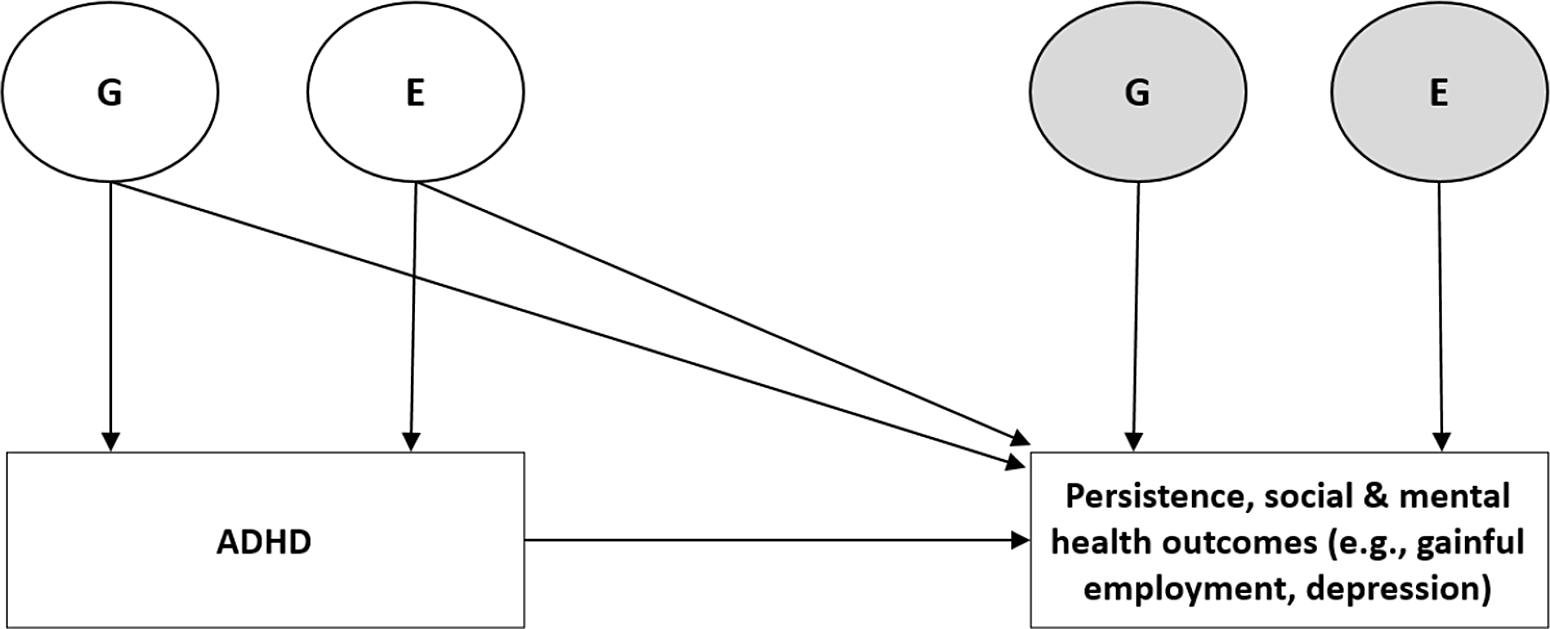
Both relative-based and molecular genetic research designs have highlighted the complex interplay between genetics and environmental exposure and the challenges of disentangling these, especially using traditional observational data. Genetic designs were originally used to examine the contribution of genetic and environmental influences to the origins of psychopathology. However, different social and genetic factors may contribute to the developmental course, accompanying comorbidities and outcomes of psychopathology compared to those that contribute to its origins (e.g., Pingault et al., Reference Pingault, Viding, Galéra, Greven, Zheng, Plomin and Rijsdijk2015) (Figure 1). While genetic designs have traditionally been used to focus on risk factors that contribute to the origins of psychopathology, for those seeing children and young people with psychopathology, the key question is: can we help optimize outcomes by modifying family and social contexts? If so, what aspects should we focus on?
Genetic and environmental influences on the origins and development of later psychopathology and outcomes.

Considering neurodevelopmental difficulties as an example, whilst psychopathologies such as ADHD, ASD and schizophrenia appear to be highly heritable, their developmental course and outcomes (e.g. mental wellbeing, physical health, anxiety and depression, gainful employment) may be influenced by different genes and environmental factors as well as moderated or shaped by social and family environments (Figure 1). Indeed, those with neurodevelopmental disorders such as ADHD are at heightened risk of later mental health problems including depression (Jaffee et al., Reference Jaffee, Moffitt, Caspi, Fombonne, Poulton and Martin2002, Rice et al., Reference Rice, Riglin, Thapar, Heron, Anney, O’Donovan and Thapar2019). Such comorbid mental health problems further impair functioning in those with a neurodevelopmental condition, yet currently there is very little evidence to guide families, practitioners and educators as to whether modifying family, educational and social environments could help protect against the development of common mental health problems (e.g., depression, anxiety) in this high-risk group.
Most previous genetically informative research has primarily focused on a deficit-based approach, being employed to identify likely causal environmental risks. For example, ADHD/ADHD genetic liability is known to elicit more hostile family relationships, and parents of children with ADHD or ASD are more likely to experience parenting stress, marital stress, and separation (Ben-Naim et al., Reference Ben-Naim, Gill, Laslo-Roth and Einav2019; Kousgaard et al., Reference Kousgaard, Boldsen, Mohr-Jensen and Lauritsen2018). Previous genetically informative studies have shown evocative effects from birth parent characteristics (birth-mother ADHD) through offspring early impulsivity and activation on maternal and paternal hostile behaviors (Harold et al., Reference Harold, Leve, Barrett, Elam, Neiderhiser, Natsuaki, Reiss and Thapar2013; Sellers et al, Reference Sellers, Harold, Thapar, Neiderhiser, Ganiban, Reiss, Shaw and Leve2020), which in turn was associated with developmental course of ADHD, as well as conduct problems (Sellers et al., Reference Sellers, Harold, Thapar, Neiderhiser, Ganiban, Reiss, Shaw and Leve2020). Whilst a deficit model can help with addressing questions about need, deficit models do not necessarily tell us about what interventions would work (see Sellers et al., Reference Sellers, Smith, Leve, Nixon, Cane, Cassell and Harold2019), and strength-based approaches also need to be considered.
Strength-based approaches consider positive assets, behaviors, or strengths within the individual, family and/or community that may support positive outcomes, and is linked to the concept of resilience, which is a developmentally dynamic perspective whereby specific environments/characteristics can reduce background risk. A strengths-based approach aligns more closely to preventive interventions which focus on enhancing positive rearing environments to prevent or mitigate negative child outcomes. As such, applying strength-based approaches to genetically informative study designs could help provide insights into positive environments that may mitigate risk, with findings of particular importance and relevance for clinical practice and policy. Whilst it is possible to incorporate and consider processes that emphasize strengths, there is currently limited examination of the role of positive aspects of family processes (and broader environmental factors) for developmental outcomes including mental health and related aspects of functioning.
Whilst the study of protective/promotive processes for children with neurodevelopmental difficulties is in its infancy, there is some evidence for the role of specific social- and family-level systems (Dvorsky & Langberg, Reference Dvorsky and Langberg2016). For example, social support and acceptance has been found to buffer against negative outcomes including poor academic attainment and co-occurring depression symptoms among children with ADHD (Dvorsky & Langberg, Reference Dvorsky and Langberg2016). Positive parenting may also promote more positive outcomes (Dvorsky & Langberg, Reference Dvorsky and Langberg2016). However, few studies have examined the complex interplay between biological and environmental processes when examining strengths-based processes. There is a need for future research to consider strengths-based approaches using behavioral genetic research designs, to disentangle genetic and environmental processes to support intervention and prevention science efforts.
Genetically informative designs, such as the adoption design, provide an especially powerful design for testing environmental mediators and moderators of children’s early behaviors and outcomes because adoptive parents are genetically unrelated to their offspring. It therefore becomes possible to test environmental mechanisms independent of parents’ genotype. A small number of studies have utilized genetically informative designs to examine the role of positive rearing environments. For example, CoT studies suggest that parent-child relationship quality is associated with positive self-worth and fewer internalizing problems (see Jami et al., Reference Jami, Hammerschlag, Bartels and Middeldorp2021). Using a longitudinal adoption-at-birth design, positive parenting (e.g., positive parent-child relationships, warmth parenting, and positive reinforcement) has also been associated with fewer externalizing problems (see Jami et al., Reference Jami, Hammerschlag, Bartels and Middeldorp2021). This suggests that positive rearing environments may provide important targets for intervention and prevention.
Genetically informative designs have also been used to examine whether positive rearing environments may modify risk. Using a home-reared and adopted away co-sibling design of individuals at high risk for major depression, a study found that those reared in adoptive homes (selected for high-quality rearing environments) had significantly reduced risk for major depression compared to individuals raised in their home environment (Kendler et al., Reference Kendler, Ohlsson, Sundquist and Sundquist2020). This protective effect was no longer evident if an adoptive parent had major depressive disorder. This suggests that positive rearing environments can mitigate risk for major depression.
Using a longitudinal adoption-at-birth design, evidence suggests that structured guidance provided a buffering effect on toddler behavior problems in those at high genetic risk, but did not help those at low genetic risk. Conversely, positive reinforcement benefited children regardless of genetic risk (Leve et al., Reference Leve, Harold, Ge, Neiderhiser, Shaw, Scaramella and Reiss2009). This specificity could help to inform interventions. Other genetically informative designs have examined the role of parenting as a moderator of genetic risk. For example, a twin study suggested that other aspects of parenting (parental warmth/rewarding parenting) may moderate the relationship between genetic risk and the developmental of callous/unemotional traits (Henry et al., Reference Henry, Dionne, Viding, Vitaro, Brendgen, Tremblay and Boivin2018). This suggests that warm and rewarding parents may mitigate risk.
Parent-offspring designs (including adopted and biological children) suggested that warmth in the mother-child relationship moderated the association between harsh parenting and child externalizing problems, such that the association between harsh parenting and child externalizing problems was stronger in the context of low maternal warmth, and weaker in the context of high maternal warmth. This pattern of association was observed whether or not the mother and child were genetically related, this ruling out passive rGE. This suggests that maternal warmth may modify risk of externalizing problems in children exposed to harsh parenting (Deater-Deckard et al., Reference Deater-Deckard, Ivy and Petrill2006).
Most genetically sensitive study designs have been used to identify likely causal environmental risk factors, and impacts of risks on child outcomes, making it more challenging to translate such findings in prevention and intervention contexts (Sellers et al., Reference Sellers, Smith, Leve, Nixon, Cane, Cassell and Harold2019). However, genetically informative designs can be used to examine protective factors that could help improve child psychopathology outcomes, by addressing processes that are not discernable in non-genetically informed studies: for example, considering rGE processes, and G × E. Genetically informative research designs can be utilized in strengths-based research to investigate how positive environments can mitigate risk (or promote child strengths), thus provide a better understanding of modifiable environmental factors that could inform recommendations for prevention and intervention targets, as well as address research gaps to help inform practice and policy, and ultimately reduce adverse outcomes for children. Positive measures of family life (e.g., supportive interparental and parent-child relationships) as well as across other contexts (e.g. schools) therefore need to be examined in genetically informative designs in the future to understand potentially environmental contributions to the developmental course of different mental health and functional outcomes.
Conclusion
The modern researcher is faced with a growing range of genetically informative designs available to address important questions in the field of developmental psychopathology. Many of these designs whilst first developed to identify genetic contributions, provide powerful approaches for examining environmental factors that contribute to psychopathology. There are many excellent examples of how quantitative behavioral genetics approaches have been used to test and identify prenatal, family, and social factors that contribute to the risk of psychopathology, independent of genotype. However, most of this research has focused on the origins of psychopathology, not necessarily on developmental course and outcomes. Moreover, as the predominant focus has been on a deficit approach, interventions, clinical practice, and policy that focus on supporting positive rearing environments often lack good quality evidence (Leve et al., Reference Leve, Harold, Ge, Neiderhiser and Patterson2010). It is crucial to align research to intervention and prevention science efforts more closely by considering strength-based environments, and how these positive environments can mitigate risk (or promote child strengths) (Sellers et al., Reference Sellers, Smith, Leve, Nixon, Cane, Cassell and Harold2019). Although there is a wide array of different genetic designs, each has different strengths and limitations (Davey Smith et al., Reference Davey Smith, Richmond and Pingault2022) and these are not always appreciated. Going forward, it will be important to select the design that is most appropriate for the question and to seek replication and convergence of findings across different study designs. Robust evidence that offers complement and replication across study designs is crucial for interventions and policies to be effective.
Acknowledgements
Sellers and Harold were supported by Economic and Social Research Council project grant awards (ES/N003098/1 and ES/L014718/1 respectively) and by the Andrew & Virginia Rudd Family Foundation. Riglin is supported by the Wolfson Foundation.
Funding statement
This work was supported by Economic and Social Research Council grant awards (RS ES/N003098/1; GTH ES/L014718/1), by the Andrew and Virginia Rudd Family Foundation (RS, GTH), and by the Wolfson Foundation (LR).
Conflicts of interest
None.