INTRODUCTION
Porcellanidae (Haworth, 1825) is a family belonging to the infraorder Anomura (Maclay, 1838) which comprises crustaceans similar to the ‘true’ crabs from infraorder Brachyura Linnaeus (Coelho-Santos & Coelho, Reference Coelho-Santos and Coelho1994). Currently, this family is typified around the world in 30 genera, among which seven (and 23 species) were registered inhabiting the Brazilian sea coast (Melo, Reference Melo1999).
Porcelain crabs are species that live in coastal and subtidal zones, commonly found in shallow waters inside fractures and underneath rocks in the tide line (Oliveira et al., Reference Oliveira, Masunari and Sicuro1995). Most of the species of porcelain crabs are free-living, although some of them have commensal habits, usually associating with other organisms (Rodríguez et al., Reference Rodríguez, Hernandéz and Felder2005) like sea anemones, molluscs, starfish and sea cucumbers (Lopéz-Victoria et al., Reference López-Victoria, Barrios, Kraus and Osorio2004).
Porcellana sayana is a porcelain crab well documented in the literature on commensal associations with other organisms. The reported associations include those with species of hermit crabs, such as: Dardanus venosus (H. Milne Edwards, 1848); Paguristes grayi (Benedict, 1901) (Telford & Daxboeck, Reference Telford and Daxboeck1978); Dardanus fucosus (Biffar & Provenzano, 1972) (Gore & Abele, Reference Gore and Abele1976; Werding, Reference Werding1977); Paguristes tortugae (Schmitt, 1933) (Werding, Reference Werding1977); and Petrochirus diogenes (Linnaeus, 1758) (Telford & Daxboeck, Reference Telford and Daxboeck1978; Gore, Reference Gore1982). There are also rare records of associations with other taxa, which include the Holothuroidea Astichopus multifidus (Sluter, 1910) (Werding, Reference Werding1977) and the sea turtle Caretta caretta (Linnaeus, 1758) (Frick et al., Reference Frick, Williams and Veljacic2002).
To date, there is only one association record of P. sayana with species from the infraorder Brachyura, the Majoidea Stenocionops furcata (Olivier, 1791) collected in Santa Marta, Colombia (Werding, Reference Werding1977). Recordings of symbiosis of P. sayana on the Brazilian coast were reported by Meireles & Mantellato (Reference Meireles and Mantellato2008), of which, with the hermit crab Dardanus insignis (Saussure, 1858), and by Baeza et al. (Reference Baeza, Forlan, Almeida, Barros-Alves, Alves and Fransozo2013) with the species Dardanus insignis, Petrochirus diogenes and another species of hermit crab not identified by the authors during trawl surveys on the south-east coast. Therefore, the aim of this study was to report for the first time the association between the porcelain crab P. sayana and the Majoidea crab Stratiolibinia bellicosa. Moreover, this is the first record of symbiotic association of P. sayana with Brachyura on the Brazilian coast, and the second record of such association in the specialized literature as a whole.
MATERIALS AND METHODS
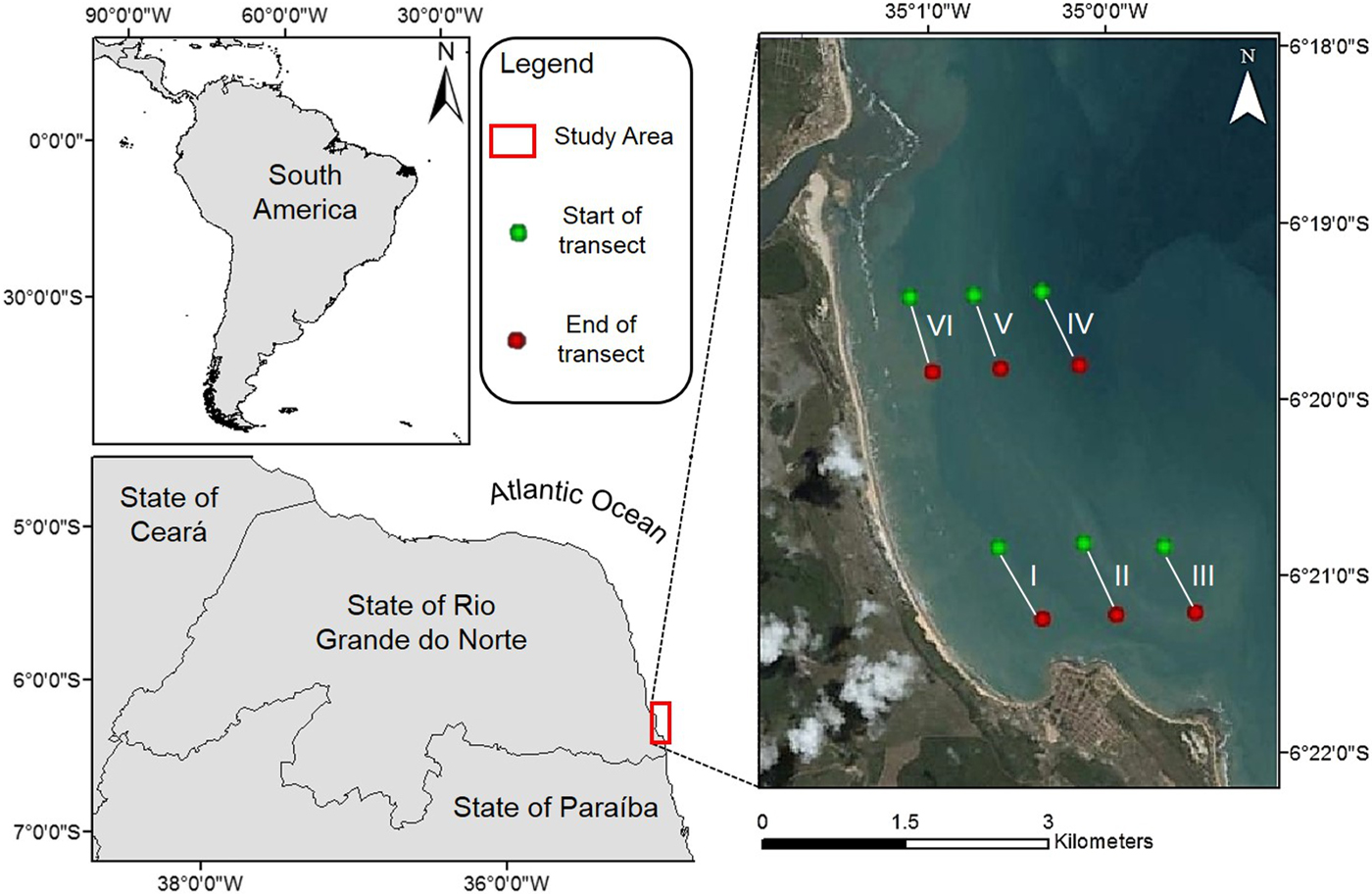
Monthly campaigns for benthic biodiversity research were performed on Baía Formosa, Rio Grande do Norte, north-eastern Brazil, from February 2013 to January 2014. In each of the campaigns, hauls were performed at six georeferenced locations (Figure 1) with an artisan fishing boat. The capture effort (haul), at each point, was that of 20 minutes at a speed of 1.08 knots, with fishing net with knitting of 4 mm between the knots. Besides, at the beginning and at the end of each sample point, depths were measured by a Humminbird 141c echobathymeter (Humminbird®) and the values of temperature and salinity of the sea bottom by a YSI Professional Plus (YSI®) multiparameter.
Local catch of porcellanid Porcellana sayana in association with Stratiolibinia bellicosa: featured transects (I–VI) sampled monthly.

During the campaign in September 2013, two porcelain crab (Porcellana sayana) specimens associated with the Stratiolibinia bellicosa species were captured. Porcelain crabs were also found circulating freely in the net treads during the study. According to Baeza et al. (Reference Baeza, Forlan, Almeida, Barros-Alves, Alves and Fransozo2013) it is likely that these roaming individuals have abandoned their hosts during the haul. Following the capture, the associated organisms were put in a plastic container with seawater. The container was carefully carried to the laboratory and then photographed and recorded on video. After that, the gathered specimens (the host and the symbionts) were put into individualized plastic bottles, which were labelled and stored in a freezer at –20°C for later laboratory procedure.
The porcelain crabs P. sayana were identified in accordance with the criteria in Melo (Reference Melo1999). The sexing was made based on the presence of male gonophores (located in the thigh of the fifth pair of appendages) and pleopods modified into gonopods for males, and the absence of male gonophores and presence of long and setose pleopods for females (Baeza & Asorey, Reference Baeza and Asorey2012). The procedures for sexing were performed with the aid of a stereomicroscope. The crab S. bellicosa was identified according to the criteria of Melo (Reference Melo1996) and Tavares & Santana (Reference Tavares and Santana2011). The sexing was performed by counting the number of pairs of pleopods: 2 for males and 4 for females. After the identification and sexing, the specimens were put into a 70% alcohol recipient and stored in the carcinological collection of the Grupo de Estudos em Ecologia e Fisiologia de Animais Aquáticos (GEEFAA) of the Federal University of Rio Grande do Norte (Universidade Federal do Rio Grande do Norte—UFRN), under the voucher numbers GEEFAA/UFRN-086 for S. bellicosa, and GEEFAA/UFRN-087 for P. sayana. In addition, the animals were measured for carapace width (CW) and weighed on a Western® digital caliper, with precision of 0.01 mm, and on a precision weighing balance of 0.01 g of accuracy, respectively.
RESULTS
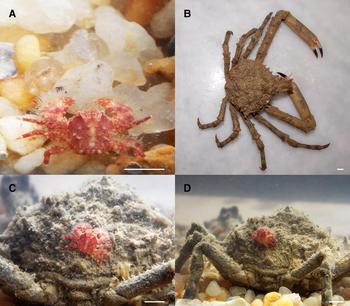
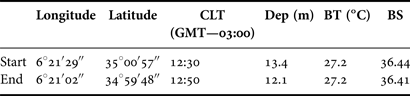
The specimens of Porcellana sayana (Figure 2A) interacting with Stratiolibinia bellicosa (Figure 2B) were captured at the sample point III (Figure 1), with average depth of 12.75 m. In this sample point, bottom temperature values of 27.2°C were recorded both at the beginning and at the end, while for bottom salinity, the values ranged from 36.44°C (beginning) and 36.41°C (end of the sample point) (Table 1).
(A) Porcellana sayana, dorsal view; (B) Stratiolibinia bellicosa, dorsal view; (C, D) symbiotic association between P. sayana and S. belicosa. Scale bars = 4 mm.

Abiotic factors at the beginning and at the end of the sample point where the Porcellana sayana was captured in association with Stratiolibinia bellicosa. CLT, current local time; Dep, depth; BT, bottom temperature; BS, bottom salinity.

Two female P. sayana were associated with the dorsal region of the carapace of a male S. bellicosa (Figure 2C, D; Supplementary Video Material), which performed opening movements and elevation of the third pair of maxillipeds for water circulation in the frontal region of this carapace. Occasionally, the specimens were moving through the host's body, mainly in the regions of the pereopods and on the posterior-ventral angle of the carapace.
The male S. bellicosa presented CW 46.6 mm and weighed 63.79 g. The two female P. sayana had CW of 3.6 and 4.8 mm and weighed 0.04 and 0.08 g, respectively.
DISCUSSION
Symbiotic relationships can be characterized as costs and benefits shared by both the partners. This balance of cost and benefit, according to the literature, is of crucial importance for life history of the organisms; for example, because of the impact in its reproductive strategies, feeding and social behaviour (Baeza & Thiel, Reference Baeza and Thiel2000; Baeza, Reference Baeza2007; Baeza et al., Reference Baeza, Forlan, Almeida, Barros-Alves, Alves and Fransozo2013).
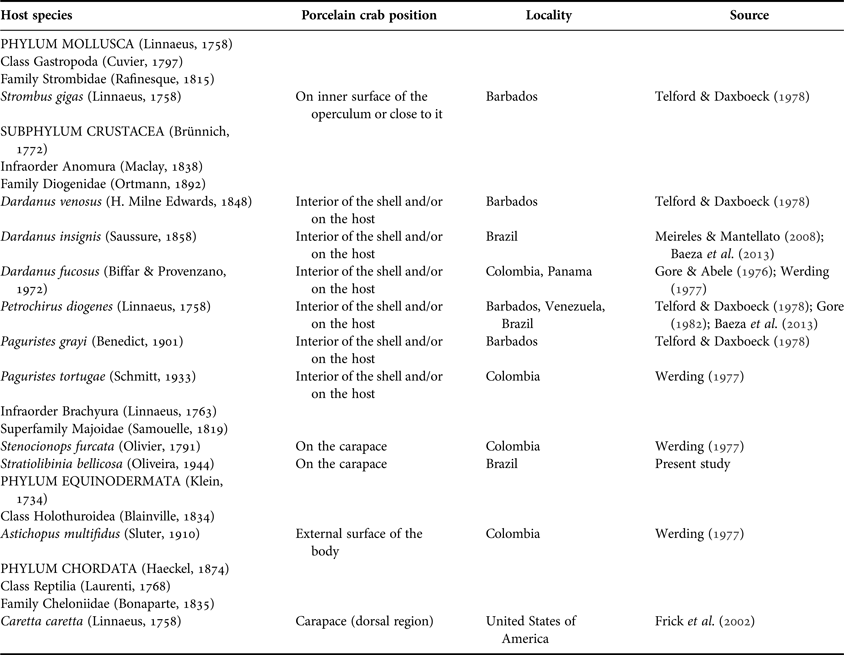
In some cases of symbiosis, the case of Porcellana sayana for instance, organisms adopt other living organisms or parts of living organisms (sessile or vagile) as shelter (Table 2).
Porcellana sayana: host species diversity of the porcelain crab, its position in the host and the study locality. Table modified from Baeza et al. (Reference Baeza, Forlan, Almeida, Barros-Alves, Alves and Fransozo2013).

These refuges are important resorts for vertebrate and invertebrate organisms in aquatic and terrestrial environments (Ocampo et al., Reference Ocampo, Nuñez, Cledón and Baeza2012). Protection against predators and against stressful abiotic conditions, direct (or indirect) source of food and access to sexual partners were listed by the same authors as positive outcomes in obtaining a shelter (see Ocampo et al., Reference Ocampo, Nuñez, Cledón and Baeza2012 for literature revision).
In this study, we have considered the association with the host Stratiolibinia bellicosa beneficial in two points for the symbiont P. sayana: (1) S. bellicosa as a vagile organism can provide a greater possibility of direct (or indirect) source of food; and (2) S. bellicosa can give protection against predators.
Porcelain crabs are primarily filter feeder animals (Veloso, Reference Veloso, Buckup and Bond-Buckup1999) that modify their behaviour in search of optimal conditions of water currents (Achituv & Pedrotti, Reference Achituv and Pedrotti1999). According to the observations made in this study, the specimens of P. sayana were always in movement, switching their position between the S. bellicosa specimen's dorsal region, posterior-ventral region and pereopods. By changing their position, the third pair of maxillipeds was rebounded and the specimens executed movements towards the oral region, possibly generating a water flow for filtering (Figure 2C, D; Supplementary Video Material). Furthermore, when disturbed in some way, specimens of P. sayana quickly moved to the ventral region of S. bellicosa.
Porcellana sayana has several records of association with hermit crabs, of which the shell's interior is the most preferred region, once this position was featured in every case found in the literature (Table 2). Thus, as the shells used by hermit crabs provide protection to the hosts, we believe that the S. bellicosa ornate shell can provide protection against predators as well. This proposition is reinforced by the fact that, in the survey conducted in the present study campaigns, the average number of hermit crabs went from 0 to 2 monthly. In the absence of hermits in the habitat of P. sayana, the spiked carapace of S. bellicosa could have been an advantageous option for protection.
Symbiotic crabs belonging to the Porcellanidae family are constantly used as models for studies on the usage of the host (Baeza & Thiel, Reference Baeza and Thiel2000; Baeza & Stotz, Reference Baeza and Stotz2003; Meireles & Mantellato, Reference Meireles and Mantellato2008) and evolution of behavioural traits (Baeza, Reference Baeza2007; Baeza & Asorey, Reference Baeza and Asorey2012). Therefore, the record of a symbiotic association with a new host species may provide information for future behavioural studies and population assessment of the symbionts and the hosts.
ACKNOWLEDGEMENTS
The authors thank the following institutions for scholarships: CAPES/Brazil to Carlos E.R.D. Alencar and Paulo V.N. Araújo; and CNPq/Brazil to Sávio A.S.N. Moraes. Financial support for the study was provided by the grant CNPq/MPA 407046/2012-7, the laboratory Grupo de Estudos em Ecologia e Fisiologia de Animais Aquáticos/GEEFAA gave field and laboratory assistance, and the fishermen Jonas ‘Baé’, Felipe and Severino provided field assistance. The authors also thank J.A. Baeza and an anonymous referee for their helpful comments on this work. All samplings were made according to the State and Federal laws of Brazil (SISBIO/ICMBIO 28314-1). The authors declare no conflict of interest.
Supplementary materials and methods
The supplementary material referred to in this article can be found online at journals.cambridge.org/mbdcup.
Video. Record of the association between Porcellana sayana with the Majoidea crab Stratiolibinia bellicosa.