Introduction
The image we have of our own body (and of the body of others) is influenced by intrinsic factors (age, sex, weight, ethnicity, personality, etc.) as well as by extrinsic ones (cultural norms, family, peers, both traditional and new media exposure, etc.). Body image is a complex and dynamic concept that includes beliefs about appearance, feelings about body size and shape and perception of the body (Cash & Pruzinsky, Reference Cash and Pruzinsky2004). Roy and Payette (Reference Roy and Payette2012) considered body image as ‘a physiological entity but also as a psychosocial construct, formed by four dimensions that combine in multiple ways: attitudinal/emotional, perceptual, behavioural and cognitive’.
In contemporary societies, body image concerns have increased remarkably due to their relationship with both eating (i.e. anorexia and bulimia) and weight disorders (i.e. obesity), anxiety and depression. There is a profuse literature on body image, mostly focused on adolescence (e.g. Cohelo et al., Reference Cohelo, Fonseca, Pinto and Mourao-Carvalhal2016; Solomon-Krakus et al., Reference Solomon-Krakus, Sabiston, Brunet, Castonguay, Maximova and Henderson2017) – a period of remarkable biological and psychological changes and social vulnerability. However, interest in and concern about body image are not exclusive to youth, and extend throughout adulthood (Baker & Gringart, Reference Baker and Gringart2009; Mellor et al., Reference Mellor, Fuller-Tyszkiewicz, McCabe and Ricciardelli2010). Some studies show that many adults and older people are very concerned about their body image (see Rocha & Terra, Reference Rocha and Terra2013), especially women (Sabik, Reference Sabik2015, Reference Sabik2017; Smith Kilpela et al., Reference Smith Kilpela, Becker, Wesley and Stewart2015). Adulthood is considered a fairly stable period in psychosocial terms, although there are many physical and mental changes related to ageing as age advances. At the physiological level, changes occur in the amount and distribution of body fat, which modify body morphology and weight status; this can be troubling, especially for women after menopause. According to Chrisler and Ghiz (Reference Chrisler and Ghiz1993) ‘body changes linked to menopause can change the way a woman thinks and feels about her body’. In men, biological changes are more progressive and body image seems less affected than in women, although there is no consensus on the matter (see Tiggemann, Reference Tiggemann2004; Davison & McCabe, Reference Davison and McCabe2005; Peat et al., Reference Peat, Peyerl and Muehlenkamp2008).
Through the use of validated silhouettes and other methodologies (measuring scales, questionnaires, etc.), many authors have studied body image, including Ideal Body Image (IBI), across various age groups, especially in children and adolescents (Voelker et al., Reference Voelker, Reel and Greenleaf2015; Neves et al., Reference Neves, Cipriani, Meireles, da Rocha Morgado and Ferreira2017) but also in young, middle-age and older adults (e.g. Rand & Wright, Reference Rand and Wright2000; Bibiloni et al., Reference Bibiloni, Coll, Pich, Pons and Tur2017; Ibáñez-Zamacona et al., Reference Ibáñez-Zamacona, Poveda and Rebato2020; Stagi et al., Reference Stagi, Ibáñez-Zamacona, Jelenkovic, Marini and Rebato2021). Ideal Body Image for the Opposite Sex (IBIOS) preferences have also been studied, although there is less literature on this subject (e.g. Fallon & Rozin, Reference Fallon and Rozin1985; Gleaves et al., Reference Gleaves, Cepeda-Benito, Williams, Cororve, Fernández M del and Vila2000; Jones et al., Reference Jones, Fries and Danish2007; Maruf et al., Reference Maruf, Akinpelu and Nwankwo2012). Regarding ideal body image (IBI), girls and women from Western countries generally desire smaller bodies for themselves than boys and men, who prefer larger/mesomorphic ones (Tiggemann, Reference Tiggemann2004; Thompson & Cafri, Reference Thompson and Cafri2007; Blashill & Wilhelm, Reference Blashill and Wilhelm2014). Discrepancies between perceived and ideal body image can lead to body image dissatisfaction and low self-esteem in both sexes. In relation to this, it is important to point out that ‘…evaluations individuals make of their bodies are related to the evaluations that they expect others may make’ (Davison & McCabe, Reference Davison and McCabe2005), which raises the question of what is the ideal body image that each sex has of the opposite sex. In this context, Jones et al. (Reference Jones, Fries and Danish2007), in a study of ethnically diverse rural adolescents, showed that both African-American and Caucasian men selected larger female figures as ideal than the female figures selected by women; while women reported ideal male figure ratings similar to those reported by males for themselves. However, Gleaves et al. (Reference Gleaves, Cepeda-Benito, Williams, Cororve, Fernández M del and Vila2000) found that American and Spanish women preferred larger bodies as IBIOS than the bodies that men thought women would choose; this tendency is the opposite of that observed by Fallon and Rozin (Reference Fallon and Rozin1985). The two above-mentioned studies pointed out that the differences between women and men with respect to IBIOS were associated with ethnicity and socioeconomic level – that is, the choice was culturally based.
Body weight is associated with health status, physical activity, body image and self-evaluation (Olmsted & McFarlane, Reference Olmsted and McFarlane2004), and their impact on body image is especially relevant in overweight and obese people (Schwartz & Brownell, Reference Schwartz and Ban Brownell2004), whose image differs from the cultural ideals in many societies. For example, Sarwer et al. (Reference Sarwer, Thompson and Cash2005) observed that middle-aged women with overweight or obesity showed great concern because their body image was not ideal for Western populations. In addition to physical problems stemming from weight status, this concern linked to the ‘perceived body image’ can influence interpersonal relationships and quality of life. However, it is not uncommon to observe a certain degree of dissatisfaction with body size among individuals of normal weight, especially among young women (Rodin et al., Reference Rodin, Silberstein, Striegel-Moore and Sonderegger1984), but also in men; this is considered a ‘cultural stereotype’ in both sexes (Tantleff-Dunn et al., Reference Tantleff-Dunn, Barnes and Larose2011). Body image studies should consider weight status due to its implication on body image disturbances (Stagi et al., Reference Stagi, Ibáñez-Zamacona, Jelenkovic, Marini and Rebato2021). The aim of the present study was to increase knowledge in this field using data from the Basque Country area of Spain. It was hypothesized that BMI in adults (a measure of nutritional status) influences their IBIOS selection. The study objectives were: i) to assess the differences in IBIOS preferences between the sexes and age groups (<45 years and ≥45 years), ii) to examine men’s and women’s same-sex body image preferences and iii) to analyse the possible association between IBIOS and nutritional status, as measured by BMI.
Methods
Sample
The study sample comprise 227 women and 178 men resident in the Basque Country of Spain aged between 18 and 70 years. Data were collected during 2010–2013. Their nutritional status ranged from normal weight to morbid obesity (see Ibáñez-Zamacona et al., Reference Ibáñez-Zamacona, Poveda and Rebato2020, for a more exhaustive description of the sample).
Anthropometry
Anthropometric measurements (height in cm, and body weight in kg) were taken using standard anthropometric techniques (Lohman et al., Reference Lohman, Roche and Martorell1988) by the same investigator (MEI-Z) in order to avoid inter-observer variability. Nutritional status was estimated using BMI, calculated as weight in kilograms divided by the square of height in metres (kg/m2). WHO cut-off points were used: underweight: BMI<18.5 kg/m2; normal weight: BMI=18.5–24.9 kg/m2; overweight: BMI=25.0–29.9 kg/m2; obesity: BMI≥30.0–39.9 kg/m2 (WHO, 2000).
Body image
The most attractive body image for the opposite sex (IBIOS) was assessed using the figural scale developed by Stunkard et al. (Reference Stunkard, Sørensen and Schulsinger1983). This validated scale consists of nine silhouettes for each sex that range from very thin bodies (silhouette 1) to very large ones (silhouette 9), representing increments in the weight percentage. The correspondence between these silhouettes, BMI and weight was established by Bulik et al. (Reference Bulik, Wade, Heath, Martin, Stunkard and Eaves2001) in a large Caucasian population sample. This instrument allows the measurement of body image in a reliable and simple way and is effective in classifying individuals as average/underweight, overweight or obese in populations of different ethnicity, socioeconomic status, sex and age (see Maupin & Hruschka, Reference Maupin and Hruschka2014; López Sánchez et al., Reference López Sánchez, Diaz Suarez and Smith2018).
An individual’s IBIOS was obtained by asking them to identify the figure that best represents their body image preference (ideal body image or IBI) for the opposite sex. Women’s and men’s body image preferences for the same sex (woman’s ideal body image [W-IBI] or man’s ideal body image [M-IBI]) were also analysed.
Data analysis
The sample was divided in four groups by sex and age (<45 years, young adulthood; ≥45 years, middle-aged/old adulthood). The cut-off point of 45 years was based on the onset of menopause in women in developed countries (the median age of natural menopause in Spain was estimated around 51.7 years, see Reynolds & Makhlouf Obermeyer, Reference Reynolds and Makhlouf Obermeyer2005), and when it occurs between 45 and 55 years of age it is considered natural and a normal part of ageing.
Sex and age differences in IBIOS were tested using a non-parametric Mann-Whitney U test for ordinal data. In addition, using the ideal body image (IBI) previously studied in Ibáñez-Zamacona et al. (Reference Ibáñez-Zamacona, Poveda and Rebato2020), comparisons between women’s and men’s preferences for both woman’s and man’s images (W-IBI and M-IBI, respectively) were made using the same test. The associations between IBIOS and BMI were tested using Spearman’s correlation analysis. Silhouettes with frequencies under 10% were excluded from the association analyses because of their low representation. All analyses were performed in SPSS 23.0. Statistical significance was considered at p<0.05.
Results
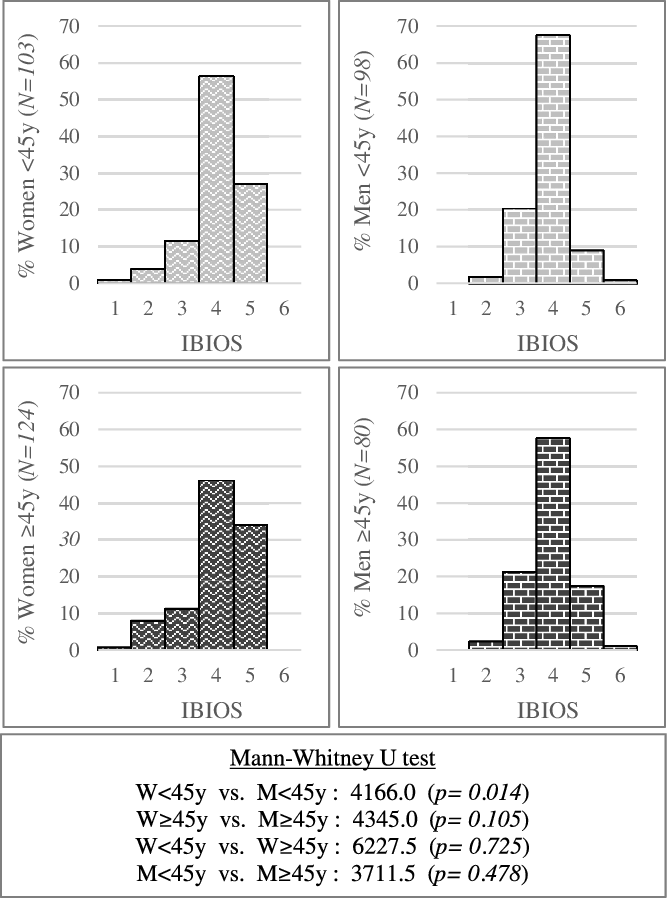
As shown in Figure 1, nearly half of the sample in each sex and age group considered silhouette number 4 to be the most attractive or ideal for the opposite sex (women: 56.3% in the group under 45 years, and 46% in the older age group; men: 67.4% and 57.5% in the younger and older groups, respectively). Differences by age were not significant. The next silhouette more frequently chosen as IBIOS by women was silhouette number 5, and by men it was number 3. No woman chose larger silhouettes than number 5 as the most attractive for men, and no man chose silhouettes higher than number 6 for women. Significant differences in IBIOS were detected by sex in young adults (p=0.014), but not in middle-aged or old adults.
Percentage of women and men who chose each silhouette as IBIOS in each age group, and results of Mann–Whitney U test.

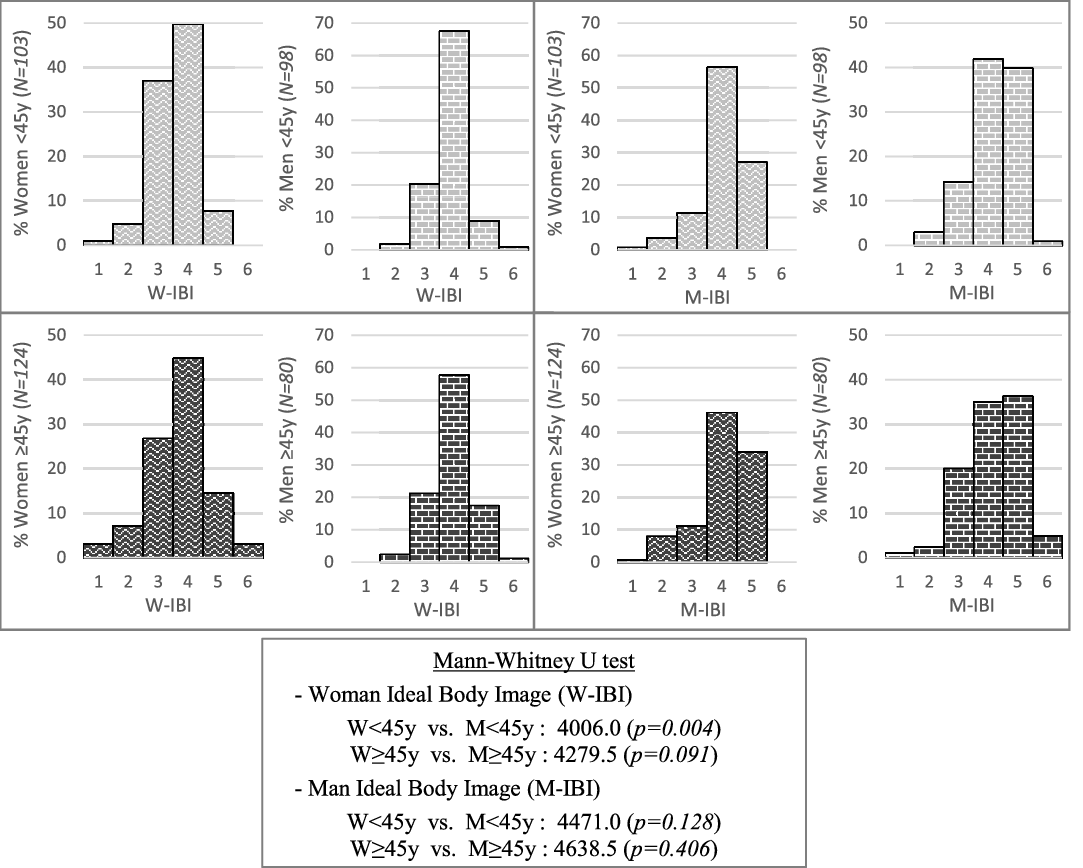
The comparisons of women’s and men’s preferences for same-sex body image (woman’s ideal body image [W-IBI] or man ideal body image [M-IBI]) only showed differences for W-IBI in the younger group (p=0.004) (Figure 2). Women chose smaller silhouettes as ideal figures for a woman’s body than men did.
Percentage of women and men who chose each silhouette as W-IBI and as M-IBI in each age group, and results of Mann–Whitney U test.

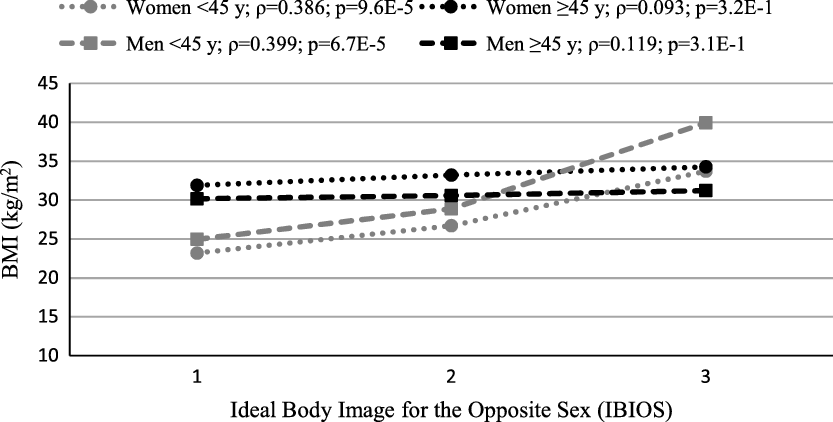
Nutritional status (BMI) and IBIOS were found to be significantly associated in women and men under 45 years of age (p=9.6E-5 and p=6.7E-5, respectively) but no significant associations were found in the older age group; older participants chose IBIOS regardless of their own BMI (Figure 3).
Mean BMI in each silhouette chosen as the ideal body image for the opposite sex in the four analysed groups (women <45 years, men <45 years, women ≥45 years and men ≥45 years). Results of Spearman’s correlation analysis between BMI and IBIOS are showed (ρ: Spearman’s rho).

Discussion
The choices of ‘others’ about our body are relevant not only at young ages, but also in adulthood; they can cause dissatisfaction and a loss of self-esteem, and lead to physical and psychological alterations and social isolation, even at older ages (Baker & Gringart, Reference Baker and Gringart2009; Slevec & Tiggemann, Reference Slevec and Tiggemann2011). The present research considered preferences for Ideal Body Image for the Opposite Sex (IBIOS) reported by a sample of adult women and men living in the Basque Country in Spain and their relationship with weight/nutritional status (BMI). In addition, it considered same-sex ideal body image preferences for women and men (W-IBI and M-IBI).
The morphological changes that occur during ageing, together with the modification of roles and social position that takes place during this process, could lead to the conclusion that adults of different ages have different perceptions and preferences about the opposite sex and, consequently, will choose different images as IBIOS. However, in this study sample, IBIOS was essentially the same in young and in older adults. Western cultures value the ideal of feminine thinness, but also that of youth, putting both on the same level (Smith Kilpela et al., Reference Smith Kilpela, Becker, Wesley and Stewart2015). Thus, it is possible that a similar IBIOS was chosen regardless of age. On the other hand, IBIOS showed a different tendency according to sex: women preferred slightly larger body sizes for men than what men preferred for women. Women in both age groups preferred silhouettes 4 and 5 as the ideal body image for a man. According to Bulick et al. (Reference Bulik, Wade, Heath, Martin, Stunkard and Eaves2001), silhouette 4 is in the upper range of normal weight (approx. BMI=23.3 kg/m2, younger group; approx. BMI=23.9 kg/m2, older group), and silhouette 5 is in the lower range of overweight (approx. BMI=25.5 kg/m2, younger group; approx. BMI=25.7 kg/m2, older group). These observations could point to a preference for ‘muscular bodies’ rather than an increase in body fat; however, although the silhouettes used are related to a progressive increase in weight and BMI, they do not allow us to distinguish between fat and lean mass from the total weight. Notwithstanding, a recent study by Stagi et al. (Reference Stagi, Ibáñez-Zamacona, Jelenkovic, Marini and Rebato2021) in a sample of young, middle-aged and elderly adults, using specific bioelectrical impedance vector analysis (BIVAsp) and Williamson silhouettes (Williamson et al., 2020), has shown that the silhouettes used to assess current body size perception are strongly related to body fat, so the interpretation of body preferences (i.e. a larger size in the sense of muscularity or fatness, or even both) remains unresolved.
The ideal body images that men prefer for a woman are mostly silhouettes 4 and 3 in both age groups, corresponding to a normal weight (for silhouette 3: approx. BMI=20.5 kg/m2, younger group; approx. BMI=21.2 kg/m2, older group; for silhouette 4: approx. BMI=22.6 kg/m2, younger group; approx. BMI=23.2 kg/m2, older group). This tendency exists in both age groups, although it was statistically significant only in participants under 45 years, possibly due to a relaxation of social pressure at older ages (Tunaley et al., Reference Tunaley, Walsh and Nicolson1999). Even though the ages and ethnicity were not strictly comparable, the present results were quite similar to those of Maruf et al. (Reference Maruf, Akinpelu and Nwankwo2012) in Nigerian women and men, where the majority of individuals considered normal weight as ideal for the opposite sex. In agreement with the study of Laus et al. (Reference Laus, Braga Costa and Sousa Almeida2015) in Brazilian women and men over 18 years, in the present sample the most chosen silhouettes as IBIOS by women were also the most chosen silhouettes as IBI by men and vice versa (results regarding IBI shown in Ibáñez-Zamacona et al., Reference Ibáñez-Zamacona, Poveda and Rebato2020). This means that both women and men prefer smaller body images for a woman’s body and relatively larger body images for a man’s body. This pattern is common in many populations (Barrett & Huffman, Reference Barrett and Huffman2011; Zaccagni et al., Reference Zaccagni, Masotti, Donati, Mazzoni and Gualdi-Russo2014), according to the socially prescribed appearance of each sex (see Calogero & Thompsom, Reference Calogero, Thompson, Chrisler and McCreary2010) and linked in part to socio-cultural pressure, such as social networks (Anixiadis et al., Reference Anixiadis, Wertheim, Rodgers and Caruana2019) and TV (Jucker et al., Reference Jucker, Thornborrow, Beierholm, Burt, Barton and Evans2017). Thinness is usually linked to the ideal of beauty in women (Levine & Piran, Reference Levine and Piran2004) whereas in men larger images are linked to the ideal of musculature (Pope et al., Reference Pope, Gruber, Mangweth, Bureau, de Col, Jouvent and Hudson2000; Blashill & Wilhelm, Reference Blashill and Wilhelm2014). However, significant sex differences were observed for W-IBI in the younger group, and women chose as ideal smaller silhouettes for female bodies than men did.
According to the ‘theory of social comparison’, individuals compare their opinions with those of other individuals (Festinger, Reference Festinger1954). In this framework, what a person believes the opposite sex would choose as the most attractive body influences their choice of ideal self-image, especially in the reproductive ages (in this sample, individuals under the age of 45), when individuals start to seriously consider their possible partners. In fact, as stated by Little and Perrett (Reference Little and Perrett2002), many of our current preferences for a particular appearance may reflect evolutionary adaptations related to mate choice. Some authors have pointed out that women think men are attracted to smaller, thinner women, which does not generally coincide with male preferences (Bergstrom et al., Reference Bergstrom, Neighbors and Lewis2004; Grossbard et al., Reference Grossbard, Neighbors and Larimer2011). This ‘misperception’ in the preferences of the opposite sex could support the present results in the younger group for W-IBI. However, in this age group, there was not a sexual difference for M-IBI, but a tendency towards bigger bodies preferred by men can be appreciated. According to Hildebrandt and Walker (Reference Hildebrandt and Walker2006), men accurately identified the men’s body image most attractive to women but they also found that men preferred a leaner and more muscular body than what they believed women did. Although Stagi et al. (2001) showed a positive association between silhouettes and fat mass, the inadequacy of silhouettes to distinguish between fat and lean mass (Coelho et al., Reference Coelho, Giatti, Molina, Nunes and Barreto2015) could have influenced the study results. Besides, in the middle-aged/old adults group there was a large concordance between what each sex considered W-IBI, and what they considered M-IBI. Some authors have found that the misperception in relation to what the other sex consider attractive is greater in young individuals (<30 years) than in older ones (Demarest & Allen, Reference Demarest and Allen2000), which may explain the present results.
Obesity is a global nutrition problem in developed countries, whose citizens live in contradiction between the desire to be thin and the growing ‘fattening’ of populations, often immersed in ‘obesogenic environments’ (Swinburn et al., Reference Swinburn, Egger and Raza1999). This situation can cause multiple problems related to body image such as body dissatisfaction and eating problems. Understanding the relationship between body image (body size perceptions and preferences) and weight status could improve both obesity prevention programmes and body image satisfaction. The participants in the present study shared the same origin and socioeconomic level and, in a general way, were equally exposed to the extrinsic factors that usually influence ideal body image (media, fashion…). However, some studied groups did not share IBIOS preferences. As initially hypothesized, in the younger groups (<45 years) there was a positive relation between BMI and choice of IBIOS. Thus, women and men with higher BMIs chose as IBIOS silhouettes indicative of a larger size, while participants with lower BMIs chose silhouettes representing smaller body sizes. Although the methodology used was not the same as in the present research, Maruf et al. (Reference Maruf, Akinpelu and Nwankwo2012) observed different IBIOS preferences in relation to weight in a sample of Nigerian women and men aged 21–29 years.
In conclusion, age can be considered an important factor in IBIOS preferences and in the association between this variable and nutritional status (BMI). In women and men of all ages, the silhouettes chosen as IBIOS were located within the normal weight range, although some sexual differences were relevant in younger individuals, where women chose relatively larger silhouettes for men and men preferred smaller silhouettes for women. In addition, only in younger individuals did women and men had different preferences for a woman’s body. It is also in this age group that there were significant and positive associations between IBIOS and weight status (BMI). Participants with a lower BMI chose smaller silhouettes, while those who were overweight or obese selected larger silhouettes. Older people chose IBIOS regardless of their own BMI.
This exploratory study had some limitations and strengths. First, the sample size may have influenced the power of the statistical analyses, but the sample was highly homogeneous in terms of origin and social status. Second, the results were specific for this sample, although they were fairly consistent with observations made in other populations. An important strength of the research was the inclusion of middle and older adults of both sexes, which are usually under-represented in studies of IBIOS, as well as the good representation of participants of different weight status (BMI), especially obesity.
Funding
This work was supported by the Spanish Ministry of Science and Innovation (MICINN) under grant number GCL2010-15511, and by pre-doctoral grant number PIF09049 from the University of the Basque Country. The last author is member of the UPV/EHU-Basque System Research Group IT1380-19.
Conflicts of Interest
The authors have no conflicts of interest to declare.
Ethical Approval
The authors assert that all procedures contributing to this work comply with the ethical standards of the relevant national and institutional committees on human experimentation and with the Helsinki Declaration of 1975, as revised in 2008. Written informed consent was obtained from all participants, and the study protocols were approved by the Ethics Committee for Human Research of the University of the Basque Country (UPV/EHU).