Introduction
In the long search for biological underpinnings and interventions in schizophrenia, one largely forgotten avenue is that of haemodialysis. In 1960, when the technique of dialysis was still in its infancy, Feer, Thoelen, Massini, and Staub trialled haemodialysis with concurrent blood transfusion in acute catatonia, with marked improvement in three out of five cases (Feer, Thoelen, Massini, & Staub, Reference Feer, Thoelen, Massini and Staub1960). The concept resurfaced again in the 1970s, with the publication of a very influential case series by Wagemaker and Cade (Reference Wagemaker and Cade1977) reporting a near curative effect of haemodialysis in five out of six cases of chronic schizophrenia. It was theorised that at least some cases of schizophrenia arose due to some ‘circulating factor’ which was removed by dialysis but not by healthy kidneys, with β endorphin suggested (but also promptly refuted) as one possible candidate (Ross, Berger, & Goldstein, Reference Ross, Berger and Goldstein1979). A 1980 review of uncontrolled case series was more circumspect in its findings that 43 out of 92 patients with schizophrenia (and normal renal function) receiving dialysis showed improvement (Fogelson, Marder, & van Putten, Reference Fogelson, Marder and van Putten1980; Splendiani et al., Reference Splendiani, Bruno, Marinangeli, Cupillari, Cirelli and Tancredi1983).
These early cases led to significant interest in the medical community, prompting multiple larger studies and publications and correspondence in leading journals. By the mid-1980s, it was concluded that dialysis was in fact unlikely to be effective in schizophrenia and interest died away. The current study asks whether anything useful can be gleaned from these past studies of relevance to current theories of the pathogenesis of schizophrenia.
Schizophrenia and immune dysfunction
Immune dysfunction in schizophrenia has been posited for decades, based on the link between maternal infection during gestation and increased risk of schizophrenia in offspring (Khandaker, Zimbron, Lewis, & Jones, Reference Khandaker, Zimbron, Lewis and Jones2013) and some epidemiological links between schizophrenia and a range of autoimmune diseases (Cullen et al., Reference Cullen, Holmes, Pollak, Blackman, Joyce, Kempton and Mondelli2019; Smyth & Lawrie, Reference Smyth and Lawrie2013; Wang, Chen, Chiang, Hsu, & Shen, Reference Wang, Chen, Chiang, Hsu and Shen2018). Recently, immune dysfunction in schizophrenia has again become of increasing pathophysiological interest and led to a number of treatment trials in view of three main lines of evidence (Deakin et al., Reference Deakin, Suckling, Barnes, Bryne, Chaudhry, Dazzan and Dunn2018). Firstly, the presence of neuronal cell surface-targeted IgG autoantibodies in people presenting with psychiatric symptoms in the context of encephalitis, providing a clear mechanism by which the immune system can trigger psychosis (Al-Diwani, Pollak, Irani, & Lennox, Reference Al-Diwani, Pollak, Irani and Lennox2017). Secondly, the finding that the top genome-wide association hit for schizophrenia is common variants influencing the levels of a component of the innate immune system: complement C4A (Sekar et al., Reference Sekar, Bialas, de Rivera, Davis, Hammond, Kamitaki and McCarroll2016). Thirdly, the replicable disturbance of cytokine levels in psychosis, including in anti-psychotic naïve people: a recent meta-analysis identified consistent elevations in interleukin-6, interleukin-17 and interferon-γ (Pillinger et al., Reference Pillinger, Osimo, Brugger, Mondelli, McCutcheon and Howes2018).
Haemodialysis and plasmapheresis as treatments for immune dysfunction
Might dialysis or plasmapheresis be able to modify any of the immune pathways currently theorised to contribute to schizophrenia? In the case of plasmapheresis, this is certainly the case. Plasmapheresis removes plasma and the large molecules such as immunoglobulins contained within it and is used successfully as a treatment for autoimmune encephalitis and many other antibody-mediated disorders (Reeves & Winters, Reference Reeves and Winters2013; Titulaer et al., Reference Titulaer, McCracken, Gabilondo, Armangué, Glaser, Iizuka and Dalmau2013).
In the case of haemodialysis, the relevance is not so immediately obvious. Haemodialysis is an effective method of clearing small (<1 kDa), water-soluble solutes from the blood; but one expects that these solutes would be cleared anyway by the kidneys in patients without end-stage renal failure. However, dialysis treatments would have exerted immunomodulatory effects through other mechanisms. Even using the low-flux, standard molecular weight cut-off dialysers of the early 1980s, there will have been some clearance of the so-called ‘middle molecules’, many of which have potentially immunomodulatory functions [e.g. C4A 9 kDa (Gorski, Hugli, & Müller-Eberhard, Reference Gorski, Hugli and Müller-Eberhard1979), interferon-γ 16–25 kDa (Kelker et al., Reference Kelker, Le, Rubin, Yip, Nagler and Vilcek1984), interleukin-6 26 kDa (Poupart et al., Reference Poupart, Vandenabeele, Cayphas, Van Snick, Haegeman, Kruys and Content1987), interleukin-17 35 kDa (Kolls & Lindén, Reference Kolls and Lindén2004), IgG 150 kDa (Roberts-Thomson & Shepherd, Reference Roberts-Thomson and Shepherd1990)]. The studies included in our review used unmodified cellulosic (cuprophane) dialysis membranes. These are relatively bio-incompatible and even induce a pro-inflammatory, complement-dependent response (Poppelaars et al., Reference Poppelaars, Faria, Gaya da Costa, Franssen, van Son, Berger and Seelen2018). Complement activation recruits and activates leucocytes which then release cytokines including interleukin-6 and interferon-γ (Kelker et al., Reference Kelker, Le, Rubin, Yip, Nagler and Vilcek1984). Therefore, if immune dysfunction does play an important role in the pathogenesis of schizophrenia, then it is plausible that dialysis treatment may have an effect on disease outcome. However, it might be difficult to predict a priori whether dialysis would be expected to improve or exacerbate psychiatric symptoms – particularly when one factor in the psychological stressors is associated with dialysis therapy.
This study thus systematically reviewed, for the first time as far as we are aware, the available literature regarding high-quality trials of plasmapheresis and haemodialysis in schizophrenia by identifying randomised controlled trials (RCTs) which used a sham intervention and were double-blinded. We aimed to establish whether these treatments improve or exacerbate psychotic symptoms, and relate these findings to current theories of immune dysfunction in schizophrenia.
Methods
Search strategy and selection criteria
We searched MEDLINE (Ovid interface, Ovid MEDLINE® in-process and other non-indexed citations and Ovid MEDLINE® 1946 onwards), EMBASE (Ovid interface, 1980 onwards), Cochrane Library (Wiley online platform) and PsycINFO (Ovid interface 1806 to current) for relevant articles indexed as of 10 September 2018. The following search terms were used [‘Schizophrenia’ AND (‘Dialysis’ OR ‘Renal Dialysis’ OR ‘blood component removal’)] and their synonyms, as described in online Appendix 1, Supplementary Information. Studies cited by included full texts as of relevance were also screened.
Titles and abstracts yielded by the search were screened by EC with a random sample of 10% screened by KM, which gave 95% agreement, with full texts retrieved in cases of uncertainty. Full texts were screened by EC. Included studies were those which investigated the use of dialysis or plasmapheresis in patients with schizophrenia (diagnosed by any criteria, of any age, sex or race), described themselves as randomised and double-blinded with a sham control intervention and had outcome scales. Studies not published in English were excluded.
Data were extracted independently by EC and KM. Data extracted from each study were: first author, year of publication, country of study, trial design, duration of study, intervention used, comparator used, patient characteristics (age, sex and duration of illness), drop-out rates, medication use, blinding measures, outcome measures, results and adverse outcomes. We also assessed the quality of studies using the Cochrane risk of bias criteria, commonly used when assessing clinical trials (see online Appendix 3, Supplementary Information for the PRISMA checklist for this review).
Results
Study characteristics
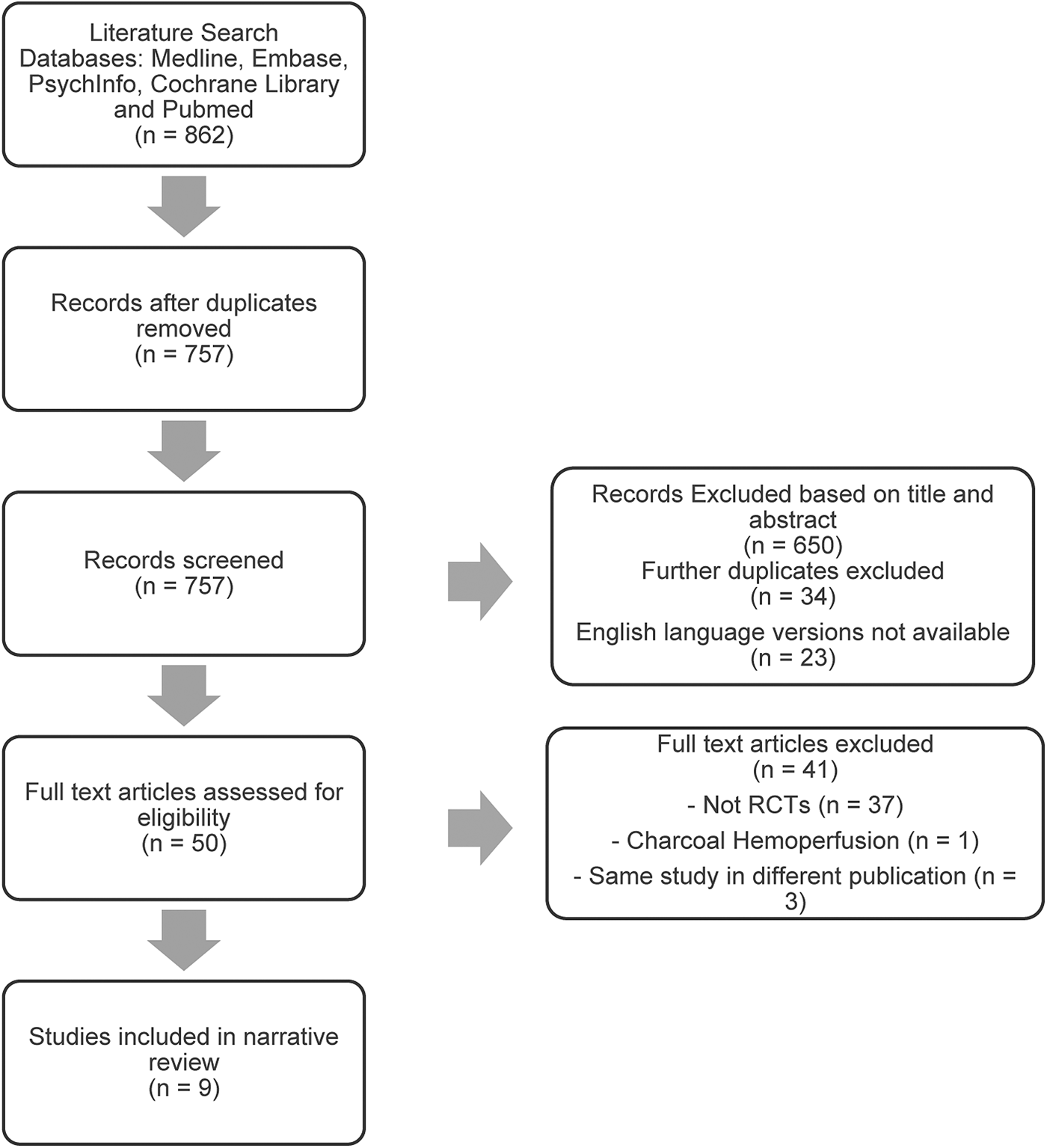
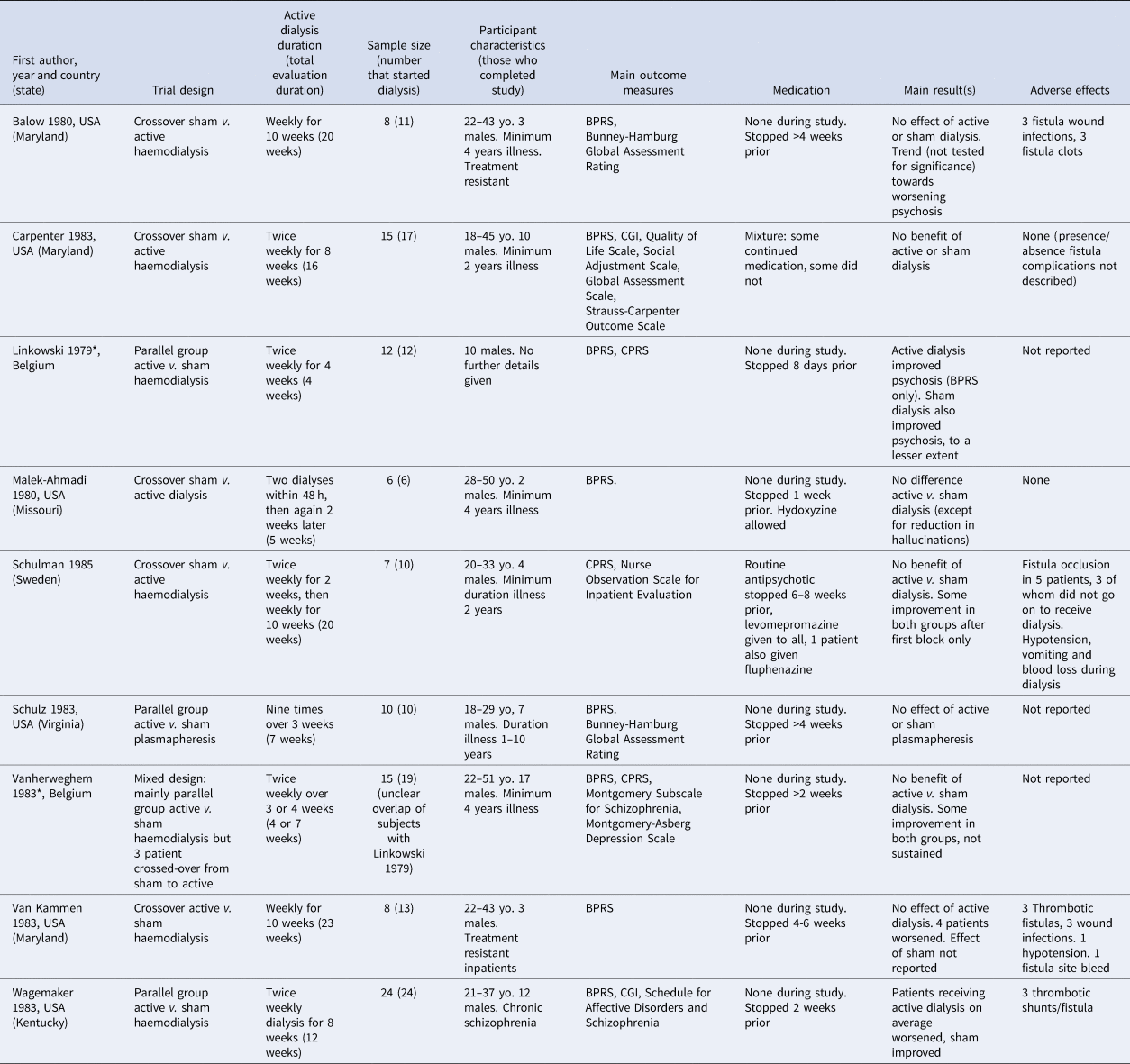
We assessed 862 citations, of which nine trials were identified for inclusion in this review (Fig. 1). Key aspects of the studies are given in Table 1, further details are provided in online Appendix 2, Supplementary Information.
Study selection.

Study characteristics with key patient data

BPRS, Brief Psychiatric Rating Scale; CPRS, Comprehensive Psychopathological Rating Scale; CGI, Clinical Global Impression Scale.
Three of the included studies had published in two separate journals; these will be referenced by the publication with the most detail regarding their trial (Carpenter et al., Reference Carpenter, Sadler, Light, Hanlon, Kurland, Penna and Bartko1983b; Carpenter, Sadler, Light, Hanlon, & Kurland, Reference Carpenter, Sadler, Light, Hanlon and Kurland1983a; Schulman, Reference Schulman1985; Schulman et al., Reference Schulman, Salum, Wahlund, Wetterberg, Asaba, Bergström and Örsten1983; Wagemaker, Rogers, & Cade, Reference Wagemaker, Rogers and Cade1983, Reference Wagemaker, Rogers and Cade1984). Eight of the studies compared active haemodialysis to sham haemodialysis (Balow, Schulz, van Kammen, & Bunney, Reference Balow, Schulz, van Kammen and Bunney1980; Carpenter et al., Reference Carpenter, Sadler, Light, Hanlon, Kurland, Penna and Bartko1983b; Linkowski, Vanherweghem, Jadot, & Mendlewicz, Reference Linkowski, Vanherweghem, Jadot and Mendlewicz1979; Malek-Ahmadi, Sorkin, Callen, Davis, & Davis, Reference Malek-Ahmadi, Sorkin, Callen, Davis and Davis1980; Schulman, Reference Schulman1985; van Kammen et al., Reference van Kammen, Schulz, Balow, Zahn, Mundinger, Flye and Bunney1983; Vanherweghem, Linkowski, & Mendlewicz, Reference Vanherweghem, Linkowski and Mendlewicz1983; Wagemaker et al., Reference Wagemaker, Rogers and Cade1983), the remaining study compared active plasmapheresis to sham plasmapheresis (Schulz et al., Reference Schulz, van Kammen, Waters, Klein, Balow and Bunney1983). The duration of active haemodialysis treatment ranged from 4 weeks (Linkowski et al., Reference Linkowski, Vanherweghem, Jadot and Mendlewicz1979; Vanherweghem et al., Reference Vanherweghem, Linkowski and Mendlewicz1983) to 12 weeks (Schulman, Reference Schulman1985), given once or twice weekly. Plasmapheresis was given nine times within a 3-week period (Schulz et al., Reference Schulz, van Kammen, Waters, Klein, Balow and Bunney1983).
The studies recruited at least 122 participants who either started preparation of vascular access or started treatment, of whom only 105 completed the intervention, primarily due to fistula complications (cf. Adverse events, below). The drop-out rate was at least 14% (17/122 recruited patients) [three studies did not report drop-outs (Linkowski et al., Reference Linkowski, Vanherweghem, Jadot and Mendlewicz1979; Malek-Ahmadi et al., Reference Malek-Ahmadi, Sorkin, Callen, Davis and Davis1980; Schulz et al., Reference Schulz, van Kammen, Waters, Klein, Balow and Bunney1983)]. The participants were aged between 18 and 51 years; 55% were male. Participants were selected from outpatient and inpatient populations, with four out of 10 studies admitting patients for the duration of the trial. Participants had all been unwell for at least 1 year (where reported) and typically had treatment-resistant schizophrenia symptoms.
Different techniques were employed for sham haemodialysis. In six of the studies, tubing was used to bypass the dialysis membrane, or no dialysate was circulated (Balow et al., Reference Balow, Schulz, van Kammen and Bunney1980; Carpenter et al., Reference Carpenter, Sadler, Light, Hanlon, Kurland, Penna and Bartko1983b; Malek-Ahmadi et al., Reference Malek-Ahmadi, Sorkin, Callen, Davis and Davis1980; Schulman, Reference Schulman1985; van Kammen et al., Reference van Kammen, Schulz, Balow, Zahn, Mundinger, Flye and Bunney1983; Vanherweghem et al., Reference Vanherweghem, Linkowski and Mendlewicz1983); two studies did not report the technique used (Linkowski et al., Reference Linkowski, Vanherweghem, Jadot and Mendlewicz1979; Wagemaker et al., Reference Wagemaker, Rogers and Cade1983). Sham plasmapheresis was achieved by running the participant's blood through a cell separator but returning all the blood components back to the participant (Schulz et al., Reference Schulz, van Kammen, Waters, Klein, Balow and Bunney1983).
The majority of studies (five) were cross-over in design with three studies having participants complete a course of active or sham dialysis followed by the alternative (Balow et al., Reference Balow, Schulz, van Kammen and Bunney1980; Carpenter et al., Reference Carpenter, Sadler, Light, Hanlon, Kurland, Penna and Bartko1983b; Malek-Ahmadi et al., Reference Malek-Ahmadi, Sorkin, Callen, Davis and Davis1980; Schulman, Reference Schulman1985; van Kammen et al., Reference van Kammen, Schulz, Balow, Zahn, Mundinger, Flye and Bunney1983). However, two studies opted to insert a 10-week block of active dialysis at random within 20 weeks of intervention (Balow et al., Reference Balow, Schulz, van Kammen and Bunney1980; van Kammen et al., Reference van Kammen, Schulz, Balow, Zahn, Mundinger, Flye and Bunney1983), meaning some patients had sham dialysis both before and after active dialysis, complicating interpretation. One study was of mixed design (parallel groups followed by some participants crossing-over) (Vanherweghem et al., Reference Vanherweghem, Linkowski and Mendlewicz1983) and three were parallel group design (Linkowski et al., Reference Linkowski, Vanherweghem, Jadot and Mendlewicz1979; Vanherweghem et al., Reference Vanherweghem, Linkowski and Mendlewicz1983; Wagemaker et al., Reference Wagemaker, Rogers and Cade1983).
Study findings
The study designs, participants, interventions and outcome measures were markedly varied; therefore, we provide a narrative review rather than a meta-analysis. The studies reported a range of outcomes relating to global clinical state, mental state, functional outcome, quality of life and adverse effects/events. The most popular scale was the Brief Psychiatric Rating Scale (BPRS), which is widely used to measure the severity of psychopathology on a 24-point scale, including items such as depression, hallucinations, unusual thought content and self-neglect (Kopelowicz, Ventura, Liberman, & Mintz, Reference Kopelowicz, Ventura, Liberman and Mintz2007). Frequency of assessment varied markedly. Most studies applied a statistical test to outcomes but did not report details of testing.
Only two studies identified a difference between sham or active dialysis on their primary outcome measure and the direction of effect conflicted. A significantly greater improvement was seen with active dialysis as assessed via the BPRS (but not the other rating scale applied) by Linkowski et al. (Reference Linkowski, Vanherweghem, Jadot and Mendlewicz1979). However, these subjects appear to have later been included in the results of a separate larger trial at the same institution which did not find a significant effect of active dialysis (Vanherweghem et al., Reference Vanherweghem, Linkowski and Mendlewicz1983). In contrast, a study at a different institution reported a significant worsening in patients receiving active v. sham dialysis (Wagemaker et al., Reference Wagemaker, Rogers and Cade1983). Several studies commented on the likely presence of placebo effects, noting substantial initial improvements which were not sustained (Balow et al., Reference Balow, Schulz, van Kammen and Bunney1980; Schulman, Reference Schulman1985; Vanherweghem et al., Reference Vanherweghem, Linkowski and Mendlewicz1983; Wagemaker et al., Reference Wagemaker, Rogers and Cade1983) and improvement in both sham and active groups (Linkowski et al., Reference Linkowski, Vanherweghem, Jadot and Mendlewicz1979). One author commented ‘The most dramatic episode in our study related to the first patient who stood up after dialysis and declared himself cured. He, indeed, had remarkable improvement for about a week, but he subsequently degenerated into an even more psychotic state. He had been on a sham procedure’ (Balow et al., Reference Balow, Schulz, van Kammen and Bunney1980, p. 206). The study which identified an overall worsening of symptoms on dialysis noted that nonetheless several patients and families opted to continue to finance dialysis independently after the end of the study (Wagemaker et al., Reference Wagemaker, Rogers and Cade1983). This may in part have related to individual variations in treatment response, with some patients on active dialysis showing benefit in studies that reported individual-level data (Malek-Ahmadi et al., Reference Malek-Ahmadi, Sorkin, Callen, Davis and Davis1980; Schulman, Reference Schulman1985; Vanherweghem et al., Reference Vanherweghem, Linkowski and Mendlewicz1983; Wagemaker et al., Reference Wagemaker, Rogers and Cade1983). However, as positive responses in individuals were also seen in response to sham dialysis, it is unclear whether ‘responders’ were showing larger placebo effects or treatment effects.
The only double-blind study of plasmapheresis in 10 patients with schizophrenia failed to observe a significant decrease in psychosis at the group level or in individual patients (Schulz et al., Reference Schulz, van Kammen, Waters, Klein, Balow and Bunney1983).
Adverse events
Adverse events related to dialysis occurred in 19 of the 81 patients (23%) in the seven studies where the presence or absence of adverse events was reported. Complications of gaining vascular access by creating arteriovenous fistulas occurred in four studies (Balow et al., Reference Balow, Schulz, van Kammen and Bunney1980; Schulman, Reference Schulman1985; van Kammen et al., Reference van Kammen, Schulz, Balow, Zahn, Mundinger, Flye and Bunney1983; Wagemaker et al., Reference Wagemaker, Rogers and Cade1983) including fistula wound infections (all successfully treated with antibiotics) and clotting of the fistula, which resulted in participants dropping out of the trials. Only two studies reported side effects of the dialysis itself (Schulman, Reference Schulman1985; van Kammen et al., Reference van Kammen, Schulz, Balow, Zahn, Mundinger, Flye and Bunney1983), which included hypotensive episodes, blood loss, nausea and vomiting and perforation of veins. The only study in outpatients reported that nine out of 17 of their participants were hospitalised during the treatment phase or follow-up of their trial due to worsening of their psychotic symptoms (Carpenter et al., Reference Carpenter, Sadler, Light, Hanlon, Kurland, Penna and Bartko1983b).
Quality assessment
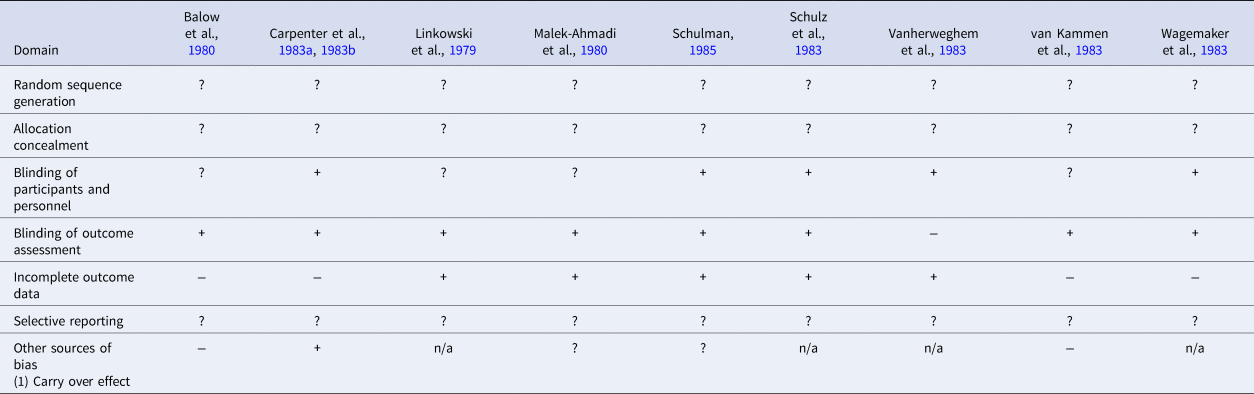
Trials were assessed using the Cochrane risk of bias tool (Higgins & Green, Reference Higgins and Green2011). Overall, the trials were assessed as at unclear or high risk of bias (Table 2). All nine of the included trials reported some form of randomisation; however, none of the studies described how randomisation was achieved or included any description of allocation concealment. The studies varied in including whether participants and the personnel were blinded and how they were blinded, with only five including adequate descriptions of blinding. All nine of the trials reported blinding of the outcome evaluators, although in one study, participants and personnel became unblinded midway through (Vanherweghem et al., Reference Vanherweghem, Linkowski and Mendlewicz1983). Four studies were rated as high risk for incomplete outcome data, due to patients dropping out but not being analysed in the end data. All nine studies had no available protocol, but all expected outcomes were reported as in the methods as planned.
Cochrane risk of bias table

+ low risk; − high risk;unclear risk.
The major source of bias which would have the potential to result in false-negative findings was the way medication was managed. All but one study stopped patients' routine antipsychotic medication 1–8 weeks prior to the study commencing. Two studies commenced patients on alternative antipsychotic medication (Malek-Ahmadi et al., Reference Malek-Ahmadi, Sorkin, Callen, Davis and Davis1980; Schulman, Reference Schulman1985) and one study allowed some to continue their routine medication and some to stop (Carpenter et al., Reference Carpenter, Sadler, Light, Hanlon, Kurland, Penna and Bartko1983b). The rationale for this was not given. Potentially, it could have been to reduce between-patient variation in how dialysis affected antipsychotic levels, although the majority of antipsychotics are not dialysed. However, the predicted consequence of medication discontinuation is that this would precipitate relapse, with the likelihood of relapse increasing over time (Leucht et al., Reference Leucht, Tardy, Komossa, Heres, Kissling, Salanti and Davis2012). The time window over which this would occur would depend on the half-life of the withdrawn medication but could reasonably be expected within the study duration of 2–23 weeks. Accordingly, the studies reporting worsening of psychosis in some patients all lasted longer than 8 weeks.
An additional source of bias in the five cross-over studies is the potential for carry-over effects for those participants who received active dialysis before sham dialysis, where dialysis to have had a non-neutral effect. Further, given that medication was discontinued or changed prior to intervention commencing in four of the cross-over studies, it would be anticipated that the treatment given later would be associated with worse outcomes. Only one study analysed the effects of order of interventions and of the interaction of treatment with order, finding no effect for the majority of measures (Carpenter et al., Reference Carpenter, Sadler, Light, Hanlon, Kurland, Penna and Bartko1983b).
Discussion
The main finding of this review is that haemodialysis and plasmapheresis have no effect on symptoms of schizophrenia, but the high bias risk of the studies makes this conclusion uncertain. Six studies of haemodialysis found no effect, one study found improvement (Linkowski et al., Reference Linkowski, Vanherweghem, Jadot and Mendlewicz1979) and one study found worsening (Wagemaker et al., Reference Wagemaker, Rogers and Cade1983). The single study of plasmapheresis found no effect (Schulz et al., Reference Schulz, van Kammen, Waters, Klein, Balow and Bunney1983).
Risk of bias
The studies were all at risk of bias in multiple ways which could both increase and decrease the likelihood of finding a treatment effect. The small sample sizes could be associated with a risk of bias in either direction. The likelihood of identifying a treatment effect was increased by the lack of description of randomisation process or allocation concealment, not using intention-to-treat analyses, the potential for selective reporting and the inadequate reporting of statistical testing.
The major source of bias which would have the potential to result in false-negative findings was the discontinuation or changing of routine antipsychotic medication prior to trials commencing, associated with an increasing risk of relapse over time (Leucht et al., Reference Leucht, Tardy, Komossa, Heres, Kissling, Salanti and Davis2012). Another possible reason that a treatment effect may have been obscured is that dialysis may not have been given frequently enough, or of sufficient quality. Similarly, plasmapheresis for autoimmune encephalitis is recommended on alternate days for 5–7 cycles (Shin et al., Reference Shin, Lee, Park, Jung, Jung, Lee and Chu2018). The overall frequency of administration in the study included here was a little less than this (nine times over 3 weeks) and the pattern of administration was unclear (Schulz et al., Reference Schulz, van Kammen, Waters, Klein, Balow and Bunney1983). A further methodological issue which could have obscured a treatment benefit was the cross-over nature of five of the dialysis studies, meaning that any positive effect of dialysis could have been carried over into some sham periods. However, if this were the case, then a trend of improvement over time in both groups would be expected, which was not seen.
Our systematic review was limited by its exclusion of studies not published in English and by not searching for data available outside peer-reviewed journals. Negative trials may also have gone unreported.
Relevance to immune dysfunction in schizophrenia
The lack of effect of plasmapheresis in the 10 patients studied in the one RCT identified for this intervention (Schulz et al., Reference Schulz, van Kammen, Waters, Klein, Balow and Bunney1983) argues against auto-antibodies or cytokines playing an important role in schizophrenia. However, this conclusion is weak given the small sample size and withdrawal of routine antipsychotic medication in this trial. Given the high relevance of plasmapheresis to current theories of immune dysfunction in schizophrenia, we reviewed our search results for any evidence from non-RCT trials of plasmapheresis, but none were identified.
The lack of effect of dialysis (positive or negative) suggests that small molecular weight molecules or solutes which are not regenerated between dialysis sessions are unlikely to be important in the pathogenesis of schizophrenia. The proportion of larger molecules (such as complement components and cytokines which may be relevant to schizophrenia) which were removed by these early dialyses is difficult to estimate but likely to be incomplete, meaning the lack of benefit of dialysis is not good evidence against these molecules being relevant to schizophrenia. The lack of a clear negative effect of dialysis suggests that its probable pro-inflammatory effect did not influence the symptoms of psychosis. However, one plausible route through which dialysis could exacerbate psychosis is through the psychological stressors that accompany dialysis treatment and the creation of vascular access. This was not assessed in the studies reviewed here as these stressors would have also been present in the sham control groups.
Patients were not selected or stratified in any way based on immune parameters and it remains possible that subgroups of patients with schizophrenia could be helped by either haemodialysis or plasmapheresis. Although some trials noted marked individual variation in response, it is unclear whether this reflected variation in placebo or treatment effects. No parameters were measured or suggested which could explain why some participants responded and others did not.
Conclusion and future directions
This systematic review concludes that the early positive findings of benefit from haemodialysis in schizophrenia were most likely driven by a placebo effect, potentially magnified by the invasive nature of extra-corporeal circulation and the intensive nursing and medical input required. There may also have been a publication bias in favour of positive results. The initial uncontrolled studies exposed more than 100 patients with a disabling psychiatric condition to changes in their antipsychotic medication and the risks of developing arteriovenous fistulas and other adverse events. Caution should therefore be applied in trialling similar interventions in future. However, it remains possible that plasmapheresis – or more selective extra-corporeal therapies such as immunoadsorption – may yet prove of benefit in subgroups of patients with psychosis where an auto-antibody or cytokine pathogenesis is suspected. In any future studies, continuation of antipsychotic medication and use of parallel group rather than cross-over designs would help to minimise the risk of missing a treatment effect.
Supplementary material
The supplementary material for this article can be found at https://doi.org/10.1017/S0033291720001324.
Acknowledgements
We thank Donna Watson, Academic Support Librarian, for advice on search strategy and obtaining full texts.
Financial support
This work was partially funded by a Postdoctoral Clinical Lectureship awarded to KM by NHS Education for Scotland and the Chief Scientist Office (Ref: PCL/17/01). RWH is supported by a Fellowship from the Wellcome Trust (209562/Z/17/Z).
Conflict of interest
None.