Introduction
The timing and origins of domesticated plant species is one of the most debated topics in Lithuanian prehistory, as processes of domestication had a great economic and social influence on society, shaping the landscape we live in today. Discussions about early crop cultivation have, however, been based on secondary evidence, such as the presence of Cerealia-type pollen (Stančikaitė et al., Reference Stančikaitė, Kabailienė, Ostrauskas and Guobytė2002; Girininkas, Reference Girininkas2009: 219; Stančikaitė, Reference Stančikaitė and Merkevičius2013), agricultural tools (Rimantienė, Reference Rimantienė1992b), and stable isotope analysis of human and animal bone collagen (Antanaitis-Jacobs et al., Reference Antanaitis-Jacobs, Richards, Daugnora, Jankauskas and Ogrinc2009). Clearly, the most definite evidence of an agricultural presence lies in the discovery of macroremains of domestic cereals and their direct dating. In the absence of such evidence, we cannot pinpoint the exact chronology of the presence of agricultural activities and validate other proxies.
The word ‘agriculture’ can be understood as representing the management of both domestic animals and crops, which did not necessarily come as a package. Therefore, we use the word ‘agriculture’ in this article to refer to plant cultivation alone, reviewing only the issues linked to domesticated plants species. Furthermore, we analyse—by revisiting the sources that had previously been put forward as indicators of agriculture—why we think that the evidence for crop cultivation during the Neolithic, i.e. 5500/5300–1800 cal bc (Antanaitis-Jacobs & Girininkas, Reference Antanaitis-Jacobs and Girininkas2002), is currently not substantial enough to confidently recognize crop cultivation in Lithuania. Finally, we present the AMS dating of a cereal grain from the settlement of Kvietiniai, which currently is possibly the earliest dated cereal for the whole eastern Baltic region (i.e. Lithuania, Latvia, Estonia, and Finland).
A Review of Agricultural Evidence from Lithuania
The most direct evidence of agriculture is the presence of domesticated crops as macrobotanical remains of cereal caryopses and chaff. The presence of cereal grains alone, without radiocarbon dates derived from them, is not enough to be confident about past human activities. Previous studies have shown that macroremains of grains can move through stratified deposits due to bioturbation or solifluction and therefore can intrude from the upper layers of a stratified site (e.g. Motuzaite Matuzeviciute et al., Reference Motuzaite Matuzeviciute, Staff, Hunt, Liu and Jones2013). Furthermore, archaeological deposits containing macrobotanical remains might be affected by various anthropogenic factors, such as tilling, digging, etc. Such actions may have occurred in both prehistoric and recent times. Hence direct dating of macrobotanical remains is an obligatory step for the attribution of cereal grains to a particular period, especially when discussing the earliest stages of agriculture in a region. In previous studies, most authors discussing the earliest agriculture in eastern Baltic countries referred to the first occurrence of Cerealia-type pollen in palynological cores as an indicator of agriculture in the region from the fifth or even sixth millennium bc onwards (e.g. Poska & Saarse, Reference Poska and Saarse2006; Girininkas, Reference Girininkas2009: 219; Alenius et al., Reference Alenius, Mokkonen and Lahelma2013; Nordqvist & Herva, Reference Nordqvist and Herva2013; Herva et al., Reference Herva, Mokkonen and Nordqvist2017). But macrobotanical remains of domesticated plants during this period are very scarce and none were radiocarbon dated.
Pollen and tools associated with agriculture
Pollen data are a valuable source of information for reconstructing the palaeoenvironmental histories and climatic oscillations in the surroundings of an area under study. Pollen records are normally extracted from natural deposits, such as bogs and oxbow lake sediments that are less prone to anthropological post-depositional disturbance, and the peaks of Cerealia-type pollen in the pollen cores normally mark the beginning of crop cultivation in the vicinity of pollen core samples. For many reasons, however, the pollen record should not be taken as a single proxy for identifying the beginnings of agriculture in a region. First, because the current methodology does not allow us to date cereal pollen directly. Second, Cerealia-type pollen does not always mean cereal pollen, as it is only a classification which also includes several wild grasses and other plants similar to domesticated grasses in terms of pollen shape and size, such as Avena brevis, Ammophila arenaria, Leymus arenarius, etc. (Behre, Reference Behre2007; Lahtinen & Rowley-Conwy, Reference Lahtinen and Rowley-Conwy2013). Furthermore, de Klerk et al. (Reference de Klerk, Couwenberg and Joosten2015) have argued that coring with more ‘primitive’ devices might result in the downward mechanical movement of parts of sediment, causing the samples to become disturbed. This may have been the case for the pollen data in the eastern Baltic, where coring was usually performed with Russian corers. As has been previously argued in the case of the early Secale cereale pollen in the eastern Baltic (Grikpėdis & Motuzaite Matuzeviciute, Reference Grikpėdis and Motuzaite Matuzeviciute2016), the same situation could apply to other early pollen data from Lithuania.
Unfortunately, the identification of the beginnings of cereal cultivation in Lithuania was previously mainly based on pollen data (e.g. Girininkas, Reference Girininkas2009: 219). Palynological studies in Lithuania show the earliest presence of solitary Cerealia-type pollen grains since the fifth millennium cal bc, but this evidence remains very sparse until the Bronze Age (Stančikaitė et al., Reference Stančikaitė, Kabailienė, Ostrauskas and Guobytė2002, Reference Stančikaitė, Baltrūnas, Šinkūnas, Kisielienė and Ostrauskas2006; Juodagalvis & Balakauskas, Reference Juodagalvis and Balakauskas2012; Stančikaitė, Reference Stančikaitė and Merkevičius2013).
A similar situation can be observed in Finland, where early pollen of cultivated plants is recorded from the sixth millennium bc (Alenius et al., Reference Alenius, Mokkonen and Lahelma2013). The earliest cereal pollen in Finland, a single grain of Fagopyrum esculentum, led to speculation that the appearance of agriculture in north-eastern Europe was associated with cultural influences from East Asia rather than the Near East (Alenius et al., Reference Alenius, Mokkonen and Lahelma2013). However, a recent review of Fagopyrum esculentum pollen in Europe has placed the origins of this eastern Asian crop in a much later period (de Klerk et al., Reference de Klerk, Couwenberg and Joosten2015). Moreover, a recent study by Lahtinen and Rowley-Conwy (Reference Lahtinen and Rowley-Conwy2013) has re-evaluated early pollen records in Finland and rejected them as an indicator of agriculture. The earliest Cerealia-type pollen data from Estonia, dating to 5600 cal bc, were also rejected as indicating early agriculture (Behre, Reference Behre2007). In fact, all Cerealia-type pollen data from central and northern Europe predating reliably dated macrobotanical finds of cereal grains have been questioned (Behre, Reference Behre2007). Therefore, early Cerealia-type pollen data from Lithuania should also be examined critically as evidence of early agriculture.
Together with pollen data, the presence of various tools (e.g. wooden digging sticks, hoes, etc.) has been presented as indicating the earliest occurrence of agriculture on Lithuanian Neolithic sites (Rimantienė, Reference Rimantienė1992b, Reference Rimantienė1996: 279). But Kriiska (Reference Kriiska, Dolukhanov, Sarson and Shukurov2009), as well as Piličiauskas et al. (Reference Piličiauskas, Kisielienė and Piličiauskienė2016), have argued that these tools may have been intended for gathering wild resources instead, or as tools for earth-moving works not necessarily associated with tilling for crops. Furthermore, tools that are definitely related to agriculture are present in Lithuania and in other countries of the eastern Baltic region only from the Bronze Age onwards; such tools are represented by flint sickle blades, stone hoes, stone mortars, and pestles (Kriiska, Reference Kriiska, Dolukhanov, Sarson and Shukurov2009; Piličiauskas et al., Reference Piličiauskas, Kisielienė and Piličiauskienė2016). Similarly, the earliest fossil field remains in the eastern Baltic are known only from the Bronze Age (Kriiska, Reference Kriiska, Dolukhanov, Sarson and Shukurov2009).
Macroremains
Macroremains of cultivated plants have previously been reported from two Lithuanian Neolithic sites, Šventoji and Šarnelė (Rimantienė, Reference Rimantienė1992a, Reference Rimantienė1992b, Reference Rimantienė1992c; Butrimas, Reference Butrimas1996), and have been quoted extensively by other authors (e.g. Poska & Saarse, Reference Poska and Saarse2006; Girininkas, Reference Girininkas2009: 222; Kriiska, Reference Kriiska, Dolukhanov, Sarson and Shukurov2009). Šventoji is one of the most extensively excavated and referenced Neolithic site complexes, situated along the swampy coast of the Litorina Sea terrace in north-western Lithuania. A total of around sixty archaeological sites dating from the Late Mesolithic to the Late Bronze Age were discovered along the river banks, littoral zones, and coastlines of former lagoons (Piličiauskas, Reference Piličiauskas2016). In the publications of Rimantienė (Reference Rimantienė1992a), macrobotanical remains of domesticated cereal were presented from the Šventoji sites and dated to the late fourth–third millennia bc. Among the cereals, seeds of Triticum dicoccum, Setaria italica, Cannabis ruderalis, Cannabis sativa, and Cannabis indica were mentioned. The criteria used for identifying these macrobotanical remains are unknown, but they were identified by the biologist E. Šimkūnaitė who was not specialized in analysing archaeological material. It should be mentioned that, unlike the Triticum species, Cannabis and Setaria italica, together with Panicum miliaceum plants, were domesticated in north-eastern Asia rather than south-western Asia. It is generally accepted that millets in particular reached Europe not earlier than the Bronze Age (Boivin et al., Reference Boivin, Fuller and Crowther2012; Motuzaite Matuzeviciute et al., Reference Motuzaite Matuzeviciute, Staff, Hunt, Liu and Jones2013), while Cannabis only arrived during the Iron Age (e.g. Merlin, Reference Merlin2003; Clarke & Merlin, Reference Clarke and Merlin2015, Reference Clarke and Merlin2016). The earliest evidence of millet in Lithuania, represented by the Panicum miliaceum species, was found on Late Bronze Age sites, such as Turlojiškė or the lakeshore-dwelling site of Luokesa 1 (Antanaitis-Jacobs et al., Reference Antanaitis-Jacobs, Kisielienė and Stančikaitė2004; Pollmann, Reference Pollmann2014).
Recent studies, which attempted to re-analyse the Triticum dicoccum seed that was found in Šventoji in Rimantienė’s excavations, resulted in the new identification of these cereal species to rye instead of wheat (Piličiauskas et al., Reference Piličiauskas, Kisielienė and Piličiauskienė2016). Direct dating of the rye grain from the Šventoji site attributed it to the twentieth century ad (Piličiauskas et al., Reference Piličiauskas, Kisielienė and Piličiauskienė2016). It is not surprising that rye from Šventoji did not belong to the Neolithic period, as cultivation of rye in Lithuania and in the rest of Europe did not take off until Roman times (Behre, Reference Behre1992; Grikpėdis & Motuzaite Matuzeviciute, Reference Grikpėdis and Motuzaite Matuzeviciute2016).
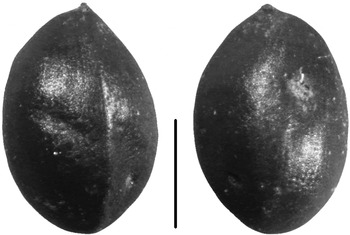
While preparing this article, we re-analysed the macrobotanical remains from the Šventoji 6 site stored at the National Museum of Lithuania in glass tubes. It is important to mention that the Šventoji seed remains were preserved in waterlogged conditions, but not charred; therefore, the starchy parts of the caryopses had vanished, leaving only the palaea and lemma parts of the plants that used to surround the actual grain. The plant remains included grains attributed by Rimantienė (Reference Rimantienė1992a) to hemp/cannabis and foxtail millet. Our analysis revealed that the seeds referred to as Cannabis in Rimantienė’s publications actually belong to a yellow water-lily (Nuphar lutea) plant (Figure 1). In addition, Cannabis sativa was also mentioned in a publication of research at the Šarnelė Neolithic settlement (Butrimas, Reference Butrimas1996); it was perhaps also mistakenly identified and belongs to water-lily instead, as the same person identified this seed.
Nuphar lutea seed from Šventoji 6, previously identified as Cannabis sativa (3092–2916 cal bc); scale bar:1 mm.

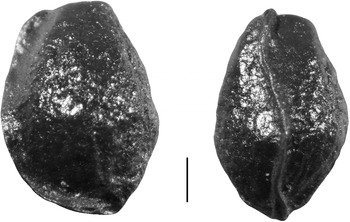
After analysing the two grains from Šventoji 6 attributed by Rimantienė (Reference Rimantienė1992a) to foxtail millet (Setaria italica), we cannot confirm the presence of this species either. The two grains stored in the museum were missing the caryopsis and only the lemma and palaea were present (Figure 2). Since the key identification criteria for all millets are the caryopsis and scutellum dimensions and shapes, the identification of millet from just lemma and palaea to species is very difficult (Motuzaite Matuzeviciute et al., Reference Motuzaite Matuzeviciute, Hunt and Jones2012). Therefore, it is very difficult to say from previously waterlogged but currently dried seeds stored in the museum whether the seeds from Šventoji belong to millet. The only feature we can clearly see is that the seed remains from Šventoji are much smaller (more than twice) than the seeds of Setaria italica from modern reference collections; they could therefore belong to Setaria viridis, a plant that is a native wild species of millet across Eurasia (Zohary et al., Reference Zohary, Hopf and Weiss2012).
Setaria viridis seed from Šventoji 6, previously identified as Setaria italica; scale bar: 1 mm.

Finally, after reviewing the macrobotanical data from Šventoji, which suggest that there is no evidence to support the claims of the presence of agriculture at the Šventoji sites during the Neolithic, we radiocarbon dated the Nuphar lutea seed (Figure 1), previously identified as Cannabis sativa, to obtain a clear date for that seed. The date of the Nuphar lutea from Šventoji 6 is as follows: 4387 ± 32 bp [UBA-30601], which is 3092–2916 cal bc (calibrated 14C age at ± 95.4% probability, i.e. ± 2σ probability in OxCal version 4.3).
Remains of wild food plants, such as hazelnuts (Coryllus avellana) and water chestnuts (Trapa natans), or even carbonized acorns (Quercus) and apples (Malus), are species represented in Neolithic sites analysed in Lithuania to date (Antanaitis et al., Reference Antanaitis, Riehl, Kisielienė and Kelertas2000). The earliest remains of domesticated plants date to the Late Bronze Age (908–485 cal bc) sites of Turlojiškė, where broomcorn millet was identified (Antanaitis et al., Reference Antanaitis, Riehl, Kisielienė and Kelertas2000), and from the lake dwelling site of Luokesa, where large quantities of domestic plant species were identified, including Panicum miliaceum, Triticum dicoccum, T. spelta, Hordeum vulgare, Pisum sativum, and Camelina sativa (Pollmann, Reference Pollmann2014).
A Review of Macrobotanical Remains from Other Eastern Baltic Countries
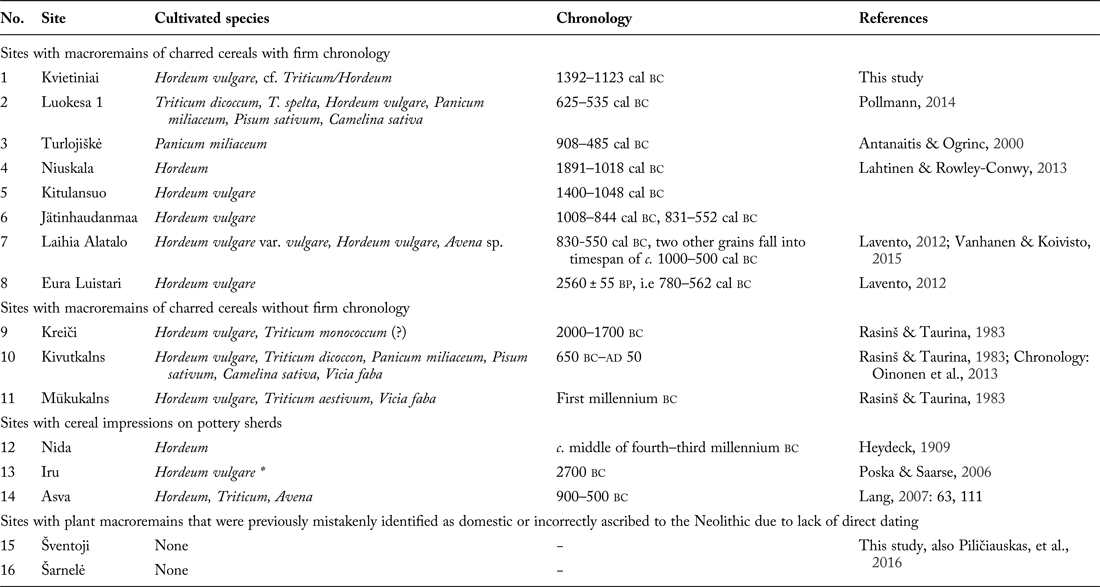
In other eastern Baltic countries, the situation is quite similar to that in Lithuania (Table 1). In Latvia, the earliest cereal macrofossils come from the Kreiči settlement dated to c. 2000–1700 bc, where single grains of Hordeum vulgare and possibly Triticum monococcum were recovered (Rasinš & Taurina, Reference Rasiņš and Tauriņa1983). These grains were unfortunately not AMS-dated and are currently lost, and therefore unavailable for direct dating (Mārcis Kalniņš, pers. comm. 1 December 2016). Macroremains of cultivated plants appear on Latvian sites from the first millennium bc; at Kivutkalns, for example, a few grains of Hordeum vulgare, Triticum dicoccum, Panicum miliaceum, Pisum sativum, and Camelina sativa were recovered together with other possible food plants, while at Mūkukalns a few grains of Hordeum vulgare, Triticum aestivum, and Vicia faba were present (Rasinš & Taurina, Reference Rasiņš and Tauriņa1983).
Eastern Baltic Neolithic and Bronze Age sites mentioned in the text. The location of the sites is indicated in Figure 3.

* The pottery sherd included a charred barley grain embedded in its surface and the imprint of another grain.
In Estonia, the earliest find associated with domesticated cereals comes from the settlement of Iru, where a sherd of Corded Ware was discovered with a barley grain embedded in its surface together with an impression of another grain (Kriiska, Reference Kriiska, Dolukhanov, Sarson and Shukurov2009). The Iru site was dated to c. 2700 bc (Poska & Saarse, Reference Poska and Saarse2006), but the sherd with a barley impression could be an import from elsewhere. Further data on early cereal cultivation in Estonia are only available for the Late Bronze Age, where impressions of grain, mainly barley, were discovered at the Asva settlement dated to c. 900–500 cal bc (Lang, Reference Lang2007: 63, 111). We should also mention that in Lithuania a Hordeum impression was recorded on a sherd of pottery from the Nida settlement, dated to around the middle of the fourth to the third millennium bc (Heydeck, Reference Heydeck1909; Rimantienė, Reference Rimantienė1989); but, as already indicated by Piličiauskas et al. (Reference Piličiauskas, Kisielienė and Piličiauskienė2016), this is not an indicator that people were growing crops at Nida.
In Finland, the earliest macrofossil finds of cereal are grains of Hordeum sp. recovered from the Niuskala settlement; one grain was radiocarbon dated to a very wide chronological range of 1891–1018 cal bc (Vuorela & Lempiäinen, Reference Vuorela and Lempiäinen1988). Therefore, Lahtinen and Rowley-Conwy (Reference Lahtinen and Rowley-Conwy2013) have argued that the chronology of this site should be reviewed. Nevertheless, other barley grains in Finland are of a similar age, such as those from Jätinhaudanmaa, Kitulansuo, and Eura Luistari (Table 1). The grains of barley and oat from the Laihia Alatola site were AMS-dated to the Late Bronze Age (Table 1). These are the only charred cereal finds from Bronze Age Finland. The evidence for cultivated crops increases during the pre-Roman Iron Age (c. 500 bc) (Vanhanen & Koivisto, Reference Vanhanen and Koivisto2015), and in the first millennium ad it is quite abundant in many archaeobotanically investigated sites (Onnela et al., Reference Onnela, Lempiäinen and Luoto1996; Aalto, Reference Aalto, Kirpichnikov, Ryabinin and Saksa1997).
New Macrobotanical Data for the Earliest Crops in Lithuania
In 2015, during a pipeline construction project, a rescue excavation was undertaken at the burial mounds and ancient settlement of Kvietiniai in western Lithuania (Figure 3). Although the Kvietiniai burial mounds were known since the 1930s, the first archaeological survey was conducted only in 2013 in connection with the pipeline construction project. In 2014, during the field evaluation of the site, intact and disturbed cremation burials were revealed together with the last human occupation horizon (Kontrimas, Reference Kontrimas2015). In 2015, Rokas Vengalis conducted an excavation of the area threatened by the pipeline: a total surface of 1958 m2 was uncovered. Another ten cremated burials were found, whose position suggests that they may have belonged to three burial mounds. The burials were preliminarily dated to the second half of the first millennium bc. The undisturbed cultural layers of two settlements with abundant artefacts were also recorded. The first settlement is dated to the Neolithic and related to the Corded Ware culture, while the second was dated to the Neolithic–Early Bronze Age. Isolated Late Mesolithic and Late Bronze Age finds were also recovered from the settlement (Vengalis et al., Reference Vengalis, Juškaitis, Pilkauskas and Kozakaitė2016).
Location of the Neolithic and Bronze Age sites mentioned in the text; a: sites with macroremains of charred cereal with firm chronology; b: sites with macroremains of charred cereal without firm chronology; c: sites with cereal impressions on pottery sherds; d: sites with plant macroremains that were previously mistakenly identified as domestic or incorrectly ascribed to the Neolithic due to lack of direct dating. The names of the numbered sites are indicated in Table 1.

Macrobotanical analysis
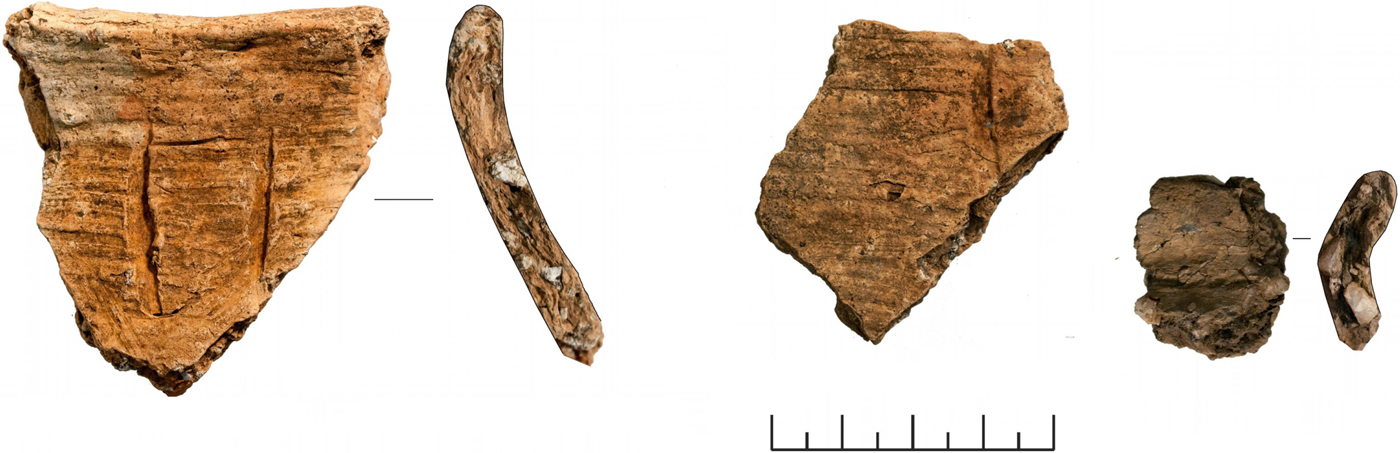
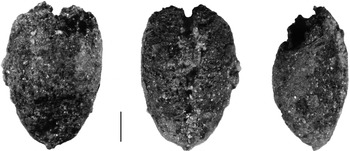
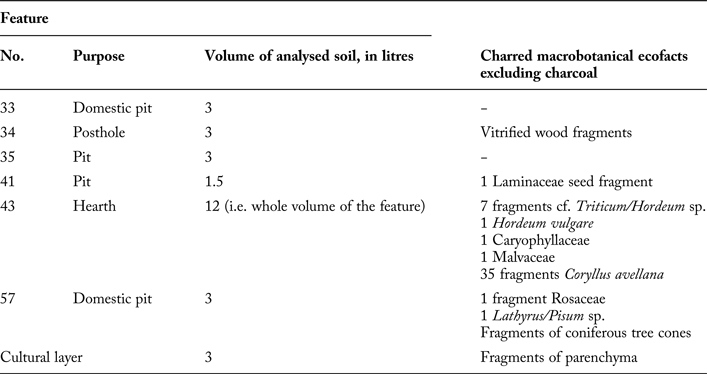
The archaeobotanical analysis of the Kvietiniai site has revealed the presence of domesticated cereals. They were found only in one context out of seven analysed (total volume 28.5 l). The context with the cereal remains is attributed to a hearth (Table 2), from which 12.5 l of sediment were floated using a sieve with a 0.3 mm mesh. The hearth contained pottery sherds with brushed and smooth surfaces and one sherd decorated with corded ornamentation (Figure 4), as well as one flint flake. Some animal bone fragments were found but not identified to species because they were too fragmented (Vengalis et al., Reference Vengalis, Juškaitis, Pilkauskas and Kozakaitė2016). The archaeobotanical analysis identified cereal fragments (eight in total), one of barley (Hordeum vulgare) (Figure 5), which was radiocarbon dated to 3009 ± 39 bp [UBA-30600], that is 1392–1123 cal bc using the IntCal013 calibration curve (Reimer et al., Reference Reimer, Bard, Bayliss, Beck, Blackwell, Ramsey, Buck, Cheng, Edwards, Friedrich, Grootes, Guilderson, Haflidason, Hajdas, Hatté, Heaton, Hoffmann, Hogg, Hughen, Kaiser, Kromer, Manning, Niu, Reimer, Richards, Scott, Southon, Staff, Turney and van der Plicht2013), at ± 95.4% probability, i.e. ± 2σ probability (OxCal 4.3). Currently this date represents the earliest directly dated domesticated cereal found on Lithuanian territory. The other cereal parts recovered in the hearth at Kvietiniai are too fragmented to identify them to species level with confidence; we therefore attributed them to genus, as cf. Triticum/Hordeum. In the same context as the cereal grains, only two poorly preserved wild plant seeds of the Caryophyllaceae and Malvaceae families were recovered. Together with the cereal remains, a relatively large quantity of hazelnut shells was recovered (thirty-five larger fragments in total), showing that people were exploiting wild foods for subsistence. The dominance of wild food remains, like nuts and berry fragments in the cooking area, absence of cereal chaff, ruderal plants, and weeds, and just a few cereal grains, could lead to speculation that people at Kvietiniai were supplementing wild foods with some domesticated crops but not the other way round. It is also not clear whether the crops were grown at the site or had been acquired from other agricultural communities elsewhere. The currently available data is insufficient to answer this question, but future strontium isotope analysis of Kvietiniai grain may shed some light on this question. So far, the evidence from Kvietiniai suggests that agriculture here was not fully established and was merely a food source supplementing the wild plant foods.
Brushed pottery and Corded Ware sherds from the hearth at the Kvietiniai settlement (feature 43) found together with charred cereal grains. Photograph by R. Vengalis (from Vengalis et al., Reference Vengalis, Juškaitis, Pilkauskas and Kozakaitė2016, with permission).

Charred barley grain from the Kvietiniai settlement radiocarbon dated to 1392–1123 cal bc; scale bar: 1 mm.

Results of the macrobotanical analysis from the Kvietiniai settlement.

It is important to mention that archaeobotanical research at Kvietiniai also targeted a few more contexts, such as a posthole, two domestic pits with a few sherds of pottery, a few pits of unknown use, and the cultural layer (Table 2). Only vitrified wood fragments were found in the samples taken from the posthole, showing burning at a high temperature. As for the pits, they contained some burnt parenchyma fragments, remains of coniferous tree cones, one seed of the Lamiaceae family, one seed of the Rosaceae family, and one seed of the Lathyrus/Pisum genus. The sample, however, is too fragmented to say whether this seed represents a domestic or wild pea species.
Discussion
After re-evaluating the evidence for agriculture in the Neolithic in Lithuania, we conclude that at this stage of knowledge there is no substantial evidence to support the notion that cereals were cultivated in Lithuania at this time. We do not claim that this situation will not change, but currently our earliest date of a grain of barley, apparently in a context containing brushed and corded pottery, only appears in the second half of the second millennium bc.
The data from Lithuania are in line with the situation observed in other eastern Baltic countries. Judging by the earliest macrobotanical remains of domesticated plants, it becomes clear that our barley grain from Kvietiniai is currently among the earliest definitely documented crops in the region (Table 1). The macrobotanical evidence also corresponds to the results of isotopic analysis, which showed that the Late Neolithic diet mainly consisted of animal protein, either meat or milk; only during the Late Bronze Age is a clear consumption of C4 plant protein attested, that macrobotanical research has shown to be millet crops (Antanaitis & Ogrinc, Reference Antanaitis and Ogrinc2000; Antanaitis-Jacobs et al., Reference Antanaitis-Jacobs, Richards, Daugnora, Jankauskas and Ogrinc2009). While talking of stable isotope analysis from Lithuania, it is important to point out that currently isotopic analysis of humans has been conducted on only twenty-eight individuals from the Stone and Bronze Ages (Antanaitis & Ogrinc, Reference Antanaitis and Ogrinc2000; Antanaitis-Jacobs et al., Reference Antanaitis-Jacobs, Richards, Daugnora, Jankauskas and Ogrinc2009; Piličiauskas, Reference Piličiauskas2016; Piličiauskas et al., Reference Piličiauskas, Jankauskas, Piličiauskienė and Dupras2017), which is a small sample to make any statistically significant interpretations on dietary change across space and time.
Features of late crop introduction are also seen in neighbouring north-eastern Poland. According to Nowak (Reference Nowak2007, Reference Nowak2013), the populations of north-eastern Poland remained hunters and gatherers until the end of the third millennium bc, and possibly even longer. The Neolithization of northern Poland is associated with such archaeological cultures as the Globular Amphora culture (GAC hereafter), the Corded Ware culture (CWC hereafter) and possibly the Trzciniec culture (Nowak, Reference Nowak2013).
Despite the lack of obvious markers of Neolithic agriculture, various researchers have expressed different views about early agriculture in Lithuania. The appearance of the GAC and CWC horizon in western Lithuania was seen by Rimantienė (Reference Rimantienė1992a) as the determinant factor for the start of agriculture. Conversely, Marek Zvelebil (Reference Zvelebil2001) proposed a period of Neolithization lasting 3000 years in the eastern Baltic, which started long before the arrival of GAC and CWC in the region. Some other researchers support the former model, concluding that the Neolithization of Lithuania began shortly after the introduction of pottery, from about the fifth millennium bc, and was completed around the third millennium bc (Girininkas & Daugnora, Reference Girininkas and Daugnora2015). However, as noted by Piličiauskas et al. (Reference Piličiauskas, Kisielienė and Piličiauskienė2016), the data used to support an early Neolithization in Lithuania come from multi-layered sites with a strong palimpsest effect; furthermore, recent AMS dating of supposedly Neolithic domestic animal bones has disproved such a chronological attribution. Moreover, given that the earliest macroremains of domestic plants date to the Bronze Age, it seems that agriculture was introduced much later than previously assumed. It therefore appears that in Lithuania the Pottery Mesolithic is followed by the Bronze Age.
The evidence for the earliest domestic animals in the eastern Baltic region is also not straightforward. Only two CWC beakers in a residue analysis of pottery from the Nida site, located on a thin sandy spit between the Baltic Sea and the Curonian lagoon, have been shown to contain ruminant dairy fat residue dated to c. 2700-2400 cal bc (Heron et al., Reference Heron, Craig, Luquin, Steele, Thompson and Piličiauskas2015). Despite the absence of directly dated domesticated animals at Nida and the fact that the earliest directly dated bones of domesticated animals in Lithuania only date to around the mid-second millennium bc (Piličiauskas et al., Reference Piličiauskas, Kisielienė and Piličiauskienė2016), Piličiauskas (Reference Piličiauskas2016) suggests that animal husbandry in Lithuania started around 2500 cal bc. It is likely, however, that the few pots from Nida, together with the CWC beaker-type pottery with remains of ruminant dairy fats from southern Finland dated to c. 2500 cal bc (Cramp et al., Reference Cramp, Evershed, Lavento, Halinen, Mannermaa, Oinonen, Kettunen, Perola, Onkamo and Heyd2014), were traded with dairy products (like butter) from the farming communities in the south.
Although the current data suggest that agriculture was introduced in the eastern Baltic much later than previously assumed, in the millennia following the appearance of pottery there were considerable changes in economy and subsistence strategies among local hunter-gatherer populations. Recent lipid residue analysis of early pottery from Estonia (Oras et al., Reference Oras, Lucquin, Lougas, Torv, Kriiska and Craig.2017) showed that the introduction of pottery in the late sixth and fifth millennia bc made a more efficient seasonal exploitation of aquatic resources possible, which promoted increased sedentism and population growth. A similar situation was observed in southern Finland (Cramp et al., Reference Cramp, Evershed, Lavento, Halinen, Mannermaa, Oinonen, Kettunen, Perola, Onkamo and Heyd2014), where the use of pottery allowed fishing communities of the fourth millennium bc to adopt a sedentary lifestyle. It has been suggested that the use of pottery enabled the eastern Baltic fishers to store seasonally abundant food resources and to live a sedentary life, which in turn resulted in the delayed expansion of farming in this region (Oras et al., Reference Oras, Lucquin, Lougas, Torv, Kriiska and Craig.2017).
Warm and wet conditions in the Atlantic period led to rising lake levels in Lithuania (Stančikaitė, Reference Stančikaitė2004). This was a favourable environment for the sedentary fishing populations of the fifth-fourth millennium bc. During the fourth millennium bc, cereal cultivation spread over northern Poland (except its eastern part) and southern Scandinavia with the Funnel Beaker culture (TRB) (Price, Reference Price and Price2000; Zvelebil, Reference Zvelebil2006; Nowak, Reference Nowak2013). According to Zvelebil (Reference Zvelebil2006), the Baltic Sea basin was a region of contact and exchange in the period 6000–2000 bc; we can therefore suppose that in the fourth–third millennium bc the inhabitants of the eastern Baltic already knew about farming and domestic products. Some early domestic animal products found in the eastern Baltic, such as a chisel made from the bone of a domesticated goat or sheep from the Neolithic burial of Zvejnieki (dated to 3089–2676 cal bc) (Jones et al., Reference Jones, Zarina, Moiseyev, Lightfoot, Nigst, Manica, Pinhasi and Bradley2017), or the ruminant dairy fats found in CWC beakers in Lithuania (Heron et al., Reference Heron, Craig, Luquin, Steele, Thompson and Piličiauskas2015) and Finland (Cramp et al., Reference Cramp, Evershed, Lavento, Halinen, Mannermaa, Oinonen, Kettunen, Perola, Onkamo and Heyd2014), may have been the result of exchange with distant agricultural communities. However, although eastern Baltic communities already knew about farming, they did not see it as offering advantages over fishing, hunting, and gathering in the rich eastern Baltic environments. In the early Subboreal period (starting around 5000 bp), the level of the lakes began to fall, leading to the creation of bogs (Stančikaitė, Reference Stančikaitė2004). At the onset of the Bronze Age, the level of the lakes dropped significantly and did not rise for over a thousand years (Stančikaitė, Reference Stančikaitė2004; Stančikaitė et al., Reference Stančikaitė, Baltrūnas, Šinkūnas, Kisielienė and Ostrauskas2006). Dry conditions that peaked at the end of the Bronze Age allowed lakes to shrink and opened some fertile coastlines to cereal cultivation, saving people from spending much energy in forest clearance. In such circumstances, classic agricultural sites were established, such as Luokesa 1 (Motuzaite Matuzeviciute, Reference Motuzaite Matuzeviciute2007). It was climatic factors that led to changes in the economy, as agriculture was mastered and gradually became the most important subsistence practice.
The debate about the early introduction of crops to the eastern Baltic is far from over, as fast-developing scientific methodologies and routine flotation of archaeological deposits come into play in the region. However, in the current stage of knowledge, we do not have a ‘Neolithic’ period, in the sense of a period of food production, in the eastern Baltic, but rather a Pottery Mesolithic lasting up to the Bronze Age.
Conclusions
After reviewing the evidence for crop cultivation from the Neolithic period (5500/5300–1800 cal bc) in Lithuania, it seems that currently there is no substantial evidence to suggest domestic plant cultivation at that time. Macroremains that were previously associated with Neolithic farming in western Lithuania have turned out to be either mistakenly identified as domestic or incorrectly ascribed to the Neolithic, while pollen predating carbonized remains of cultivated plants cannot be a sole firm indicator of the early stages of agriculture and should be used only in a multi-proxy study.
Currently, the barley grain from Kvietiniai dated to the second half of the second millennium bc possibly constitutes the earliest evidence for crops in the eastern Baltic region. The data obtained so far indicate that people at Kvietiniai were supplementing wild foods with some domesticated crops but not the other way round. Our review also reveals a similar situation for the domesticated animal evidence.
It therefore seems that crop cultivation appears in Lithuania only in the middle of the Bronze Age. Systematic collecting of samples for macrobotanical analysis in Lithuania has just started, and future research may push the appearance of crop cultivation in the eastern Baltic back to earlier periods.
Acknowledgements
This work was supported by the European Research Council under Grant 249642 (FOGLIP) project (M.K. Jones as PI). We would like to thank Rokas Vengalis for collecting sediment samples for macrobotanical analysis and the staff of the Archaeology Department of the National Museum of Lithuania, especially Dalia Ostrauskienė and Gediminas Petrauskas, for helping to find botanical material from earlier excavations. We are also grateful to the anonymous reviewers whose comments have contributed to improving this article and to Mārcis Kalniņš for personal communication.