Are poor single mothers more likely to stay in or move to states with higher welfare benefits? This question has important implications on at least two levels. As a policy matter, the answer will enlighten us about the effects of welfare on society and will assist efforts to understand whether states systematically lower benefits in order to avoid becoming “welfare-magnets” (Peterson and Rom 1989; Rom, Peterson, and Scheve 1998; Volden 2002). This answer will also help us anticipate how welfare policies may evolve in other areas of the world where it is—or is becoming—as easy to move across jurisdictional boundaries as in the United States.
As a theoretical matter, understanding the relationship between welfare and migration can help us better understand how the increasing mobility of people, firms, and capital affects governmental capacities to provide welfare and other redistributive benefits. If generous government benefits prompt people who receive them to flow in and the people who pay for them to flow out, the benefits will become increasingly difficult to sustain. This is true not only for a federal system such as the United States, but also for the international system in which political, social, and economic barriers to migration have fallen dramatically in recent years. Finding that welfare-induced migration occurs in the United States would enhance concern about governmental capacity for social services; finding no such behavior, on the other hand, would make us less inclined to believe that migration constrains governments in other, less likely contexts.
Lately, most scholars researching the question have found very little or no support for the idea that welfare affects migration in the United States (Allard and Danziger 2000; Levine and Zimmerman 1999; Schram, Nitz, and Krueger 1998; Schram and Soss 1999). They conclude that the evidence is “at best mildly in favor” of the idea that welfare affects migration (Brueckner 2000, 519) or, more typically, that welfare-induced migration is a “myth” (Allard and Danziger 2000; Schram and Soss 1999, 83). However, we should be cautious about accepting this emerging conventional wisdom. In a variety of ways, these studies fail to account for the complexities of migration and consequently run the risk of either obscuring the effect of welfare or, even worse, conflating the effect of welfare with the effects of other unmeasured factors. As I show below, this is precisely what has happened, the case in point being the link between welfare benefits granted through the Aid to Families with Dependent Children (AFDC) program in the late 1980s and the residential choices of poor single mothers, the program's primary constituency.
THREE HOLES IN THE EXISTING LITERATURE
Assessing whether welfare affects migration is no simple task, as attested by a vast, highly contested literature (for a review, see Brueckner 2000). To do this convincingly, researchers must account for all the factors other than welfare that affect people's decisions to move. Researchers have made progress in this respect, but problems persist. Three issues undermine the recent wave of research that downplays or dismisses the effect of welfare on migration.
First, many studies risk distorting the effect of welfare by inadequately accounting for state attributes that affect migration. These studies typically consist of statistical analyses of either aggregated migration flows or individual migration choices. They control for state-level influences on residential choice through variables measuring such attributes as state economic performance and differences in state climates (e.g., Allard and Danziger 2000; Frey et al. 1996; Schram, Nitz, and Krueger 1998).
This seemingly straightforward enterprise is actually remarkably difficult. Consider, for example, the variables Schram, Nitz, and Krueger use to characterize nonwelfare components of state attractiveness. Florida—the quintessential high–population growth state—averaged 5.5% unemployment from 1985 to 1990; its median income averaged $34,931 in nominal terms and $29,090 in state cost-of-living adjusted terms. Many states that were less attractive to potential in-migrants looked similar or better in these terms: Rhode Island averaged 3.9% unemployment and $38,492 in nominal median income. South Dakota averaged 4.4% unemployment and $30,460 in cost-adjusted median income. Of course, one could add variables (e.g., “average temperature,” “murder rate”) and all manner of nonlinearities and interactions (e.g., “temperature squared,” “temperature × income”). Nonetheless, one cannot help but suspect that significant aspects of state attractiveness resist measurement.
The danger is that studies with inadequate state-level controls will conflate the effect of welfare on migration with other factors. Recent demographic trends make this a particular concern. Americans tend to move from northern (“rust belt”) states with relatively high welfare benefits to southern (“sun belt”) states with relatively low welfare benefits. Failing to account for the complicated mixture of economic and social factors behind such moves results in analyses in which the states where welfare is high are also the states where the unmeasured attractiveness of living is low, and vice versa. The statistical result is that unmeasured disincentives to migrate to a state get lumped in with the observed (and correlated) welfare measures, leading to estimates in which the effect of welfare appears to be small or inconsequential, even if it is not.
Second, existing research fails to account adequately for individual-level factors that influence migration. Many individuals want to move “home” to the state in which they were born because, that is, where they are more likely to have family and to know the neighborhoods, schools, and industries. Moving home may have a particularly powerful appeal for single mothers, who often depend on the housing, childcare, financial assistance, and psychological support of parents, siblings, and friends (Allard and Danziger 2000, 358; Schram, Nitz, and Krueger 1998; Vartanian et al. 1999). In what follows, I refer to the attractions of home as “family ties”; some scholars refer to them as “social capital.”
The data described below bear out these expectations. Home is not just another variable; it is a fundamental influence on migration. Fully one-third of all interstate moves by poor single mothers were to the individuals' birth states. For many states, the proportion of in-migrants who were born there is extremely high: 54% of poor single mothers moving into Alabama from out of state had been born in Alabama. The comparable numbers were 57% for Louisiana, 58% for Mississippi, and 51% for West Virginia. (At the other extreme, only 12% of poor single mothers moving into Florida or Nevada were returning to their state of birth.)
Failure to account for the special attractiveness of birth states can lead researchers to understate or even reverse the true effect of welfare on migration. The reason is that single mothers were born disproportionately in poor, low-benefit states. If we fail to control for the attraction of home states for these women, we may mistake their fairly common moves home with a complete disregard for the low welfare benefits in their states of birth.
The omission of race in many studies raises similar concerns. Individuals are more likely to move to states with larger numbers of racially similar people (Frey et al. 1996). In the data discussed below, there are about 60,000 poor white single mothers and about 40,000 poor black single mothers. Of the whites, 510 lived in North Dakota, South Dakota, or Vermont; two of the black single mothers lived in those states. If race-specific attraction to states correlates with welfare (as is likely if, for example, African Americans are relatively more attracted to low-benefit southern states that have relatively large African American populations), failure to account for such variables may introduce yet another source of omitted variable bias that can distort the estimated effects of welfare on migration.
Third, many studies aggregate away important state-level differences. Levine and Zimmerman estimate a model in which the dependent variable is whether an individual moved out of state. By ignoring whether the person left for a high-benefit state such as California or a low-benefit state such as Louisiana, this approach limits the ability of the method to ascertain the role of welfare. Meyer (2000) estimates a model in which migration across regions is the dependent variable, thereby treating states as identical within regions. Depending on the specification, Meyer assumes that there are two or nine regions in the entire United States, implying, for example, that Maryland is identical to West Virginia and that New Hampshire is identical to New York. This assumption of intraregional homogeneity creates a chronic error in variables problem that likely will obscure relationships between variables such as welfare and migration.
Each of these problems potentially obscures or distorts the estimated effect of welfare on migration. Every recent study that dismisses welfare effects suffers from more than one of these problems, meaning that the true effect of welfare is buried under multiple layers of specification error. To get a better sense of the true relationship between welfare and migration, I develop an analytical approach that directly addresses each of these issues.
A MORE COMPREHENSIVE APPROACH
At the heart of the analysis is a random utility model of individual-level migration choices. The model characterizes the utility for every individual of living in every single state. Specifically, the utility of living in state s for person i currently in state j consists of a deterministic component vijs and a stochastic component εijs:
I estimate the model with a conditional logit setup (Greene 2000, 858). In the model, each individual selects the state that offers the highest utility. Assuming that the random shocks are independently and identically distributed Extreme Value Type I random variables, the probability that person i living in state j chooses state s is
where K is the total number of states to which an individual can move. The computationally convenient form makes estimation conceptually straightforward (even as it is practically difficult, given that a very large number of individuals are choosing among a large number of discrete choices).1
The model automatically satisfies the “independence of irrelevant alternatives” (IIA) condition. This condition implies that the ratio of probabilities of choosing one option to another is the same, whether or not a third option is included in the choice set. In an appendix available upon request, I discuss alternative estimation strategies and present results that indicate that the results are very similar in models that do not satisfy the IIA condition.
By explicitly modeling
all the state choices, I reduce the possibility that errors in variables obscure the effect of welfare on migration.
I control for state attributes by using state-level fixed effects, i.e., by using state-level dummy variables to control for all state attributes that are the same for all individuals in the analysis. For example, these variables control for state unemployment and state climate because for any given state, the values of these variables will be the same when modeling the probability that any individual will move to the state.2
To see this, first suppose that the utility of a state depends only on a single variable (say “unemployment rate”) and that the coefficient on this variable is negative one. For every individual, the utility of living in any given state would be negative one times the unemployment rate for the state. A state-level fixed effect completely captures this amount. If we add another state-level variable with a coefficient of two, say, the utility for all individuals of living in the state would be negative one times the unemployment rate plus two times the value of the new variable. Again, a state-level fixed effect would capture the utility value of a state. This reasoning directly extends to any number of state-level variables.
(A variable not encompassed by fixed effects varies for a given state across individuals; for example, only some people were born in New York, meaning that when modeling the utility of New York, the state-of-birth variable would be one for some individuals and zero for others.) The real advantage of fixed effects comes from their ability to subsume unmeasured variables and unspecified interactions. That is, fixed effects control for any attribute of a state—measurable or not—that affects all individuals in the same way. Thus the fixed-effect approach controls for state-level factors at least as well as—and usually better than—any approach relying on state-level covariates.
When using fixed effects, one must make special efforts to distinguish the effect of welfare on migration— if any exists—from the more general attractiveness of states measured by fixed effects. If the sample includes only poor single mothers who are all eligible for Aid to Families with Dependent Children (“AFDC”), then the welfare generosity of each state will be the same for all individuals in the sample (in the same manner that state unemployment and state climate were above). The state fixed effect will “soak up” the welfare effect and leave it statistically unidentified. I avoid this problem by using a quasi-experimental research design, sometimes referred to as a comparison group method (Levine and Zimmerman 1999; Meyer 2000). This design requires that I include in the sample a “control group” that is not eligible for welfare but otherwise resembles the “treatment group” of poor single mothers. General state attributes (captured by state fixed effects) influence individuals in the control and treatment groups; welfare, however, influences only individuals in the treatment group. Given the inclusion of the control group, the welfare variable is no longer a constant for all individuals for any given state (that is, welfare benefits are zero for individuals in the control group and the measured value for individuals in the treatment group). The welfare variable now is statistically identified; it allows us to see whether differences in welfare benefits explain any differences in behavior by the treatment and control groups.
I also control for, among other factors, the gravitational pull of birth states and potential differences in the attraction whites and African Americans have toward states. Including these variables not only serves important statistical control purposes, but also humanizes the analysis by moving beyond the caricature of welfare recipients as solely motivated by financial gain (see the excellent discussion on this point in Schram, Nitz, and Krueger 1998).
DATA
Individual-level data are from the Census Bureau's Public Use Microdata Series (PUMS) 1990 5% sample as accessed via Integrated PUMS (IPUMS) (Ruggles et al. 1997). This data set provides individual information on age, marital status, number and ages of children, income, race, education, birth state, and state of residence in 1985 and 1990. I work with the 1990 data for two reasons. First, most studies of welfare migration assess AFDC in the late 1980s or early 1990s. I use data from that period in order to ensure that it is the methods—and not changes in reality—behind any new results. Second, the highly variable welfare environment from 1996 to 2000 makes it hard to draw inferences about migration based on average levels of benefits over that time period. In contrast, AFDC was quite stable from 1985 to 1990.
The welfare population consists of 110,243 single mothers between 25 and 53 with children between 4 and 18 who had an income less than 125% of the poverty level.3
The earlier literature sometimes focuses on individuals who actually receive welfare. Meyer (2000, 5) details how doing so biases the results in favor of the welfare migration hypothesis. For example, some of the people who would not receive welfare in a low-benefit state could move to a higher-benefit state and receive welfare simply because eligibility is easier in the higher-benefit state. This dynamic will exaggerate the flow of welfare recipients into high-benefit states and nonrecipients out of low-benefit states. This paper follows Meyer's recommendation (8) of using an “at-risk group (single mothers or, better yet, low-educated single mothers).” He also notes that “a substantial fraction of any at-risk group may not be likely welfare recipients, and thus effects on the overall group are likely to be watered down estimates of the effects on likely participants.” Given the findings of this paper, it is reassuring that the welfare population is identified in a manner that biases against the welfare migration rather than in favor of it. Following the convention of this literature, I include only individuals who started and ended up in the continental United States; including Alaska and Hawaii produces essentially the same results. The limits on children's ages limit the sample to only those women who had children during the entire period from 1985 to 1990; earlier versions of this paper allowed for younger children and had similar results. The poverty level varies based on number of children in the family and other factors; the average poverty threshold in 1989 was $12,674 (IPUMS codebook [Ruggles et al. 1997], 225).
Of these, 8.9% moved across state lines between 1985 and 1990. The nonwelfare control groups reasonably match the welfare population in all respects except for eligibility for welfare. Following Meyer (
2000) and Levine and Zimmerman (
1999), I use three different control groups. The first consists of 69,270 childless single women between 25 and 53 years of age who had less than three times the poverty income and no college degree.
4 For all control groups I exclude individuals who have served in the military in the last five years, as their mobility may be very different from that of civilians. Also, I exclude disabled individuals from the control groups, as they may be more eligible for, or more interested in, welfare than others in the group.
The second control group consists of 96,684 childless single males who had less than three times the poverty income and no college degree. The third control group consists of 122,681 married women with children with household incomes greater than three times the poverty level and below the lesser of five times the poverty level or $50,000. No group perfectly matches the welfare population, but all match in some way the skill profiles and economic circumstances of poor single mothers. Using multiple specifications should increase confidence in the robustness of the results.
The focal variable is welfare benefits measured as the sum of maximum AFDC benefits for a family of four and Food Stamps for each state.5
This is the standard measure of welfare generosity in the literature. Other aspects of welfare generosity such as eligibility standards are correlated, but distinct. See Bailey and Rom 2004 for further discussion of the multiple dimensions of welfare generosity. Estimating the model using a measure of spending per poor person—a measure that taps eligibility as well—produces similar results.
The Food Stamp data are from the U.S. House Committee on Ways and Means (various years). I restrict the welfare effect to be zero for the control group by multiplying welfare benefits times a dummy variable indicating whether an individual is in the welfare population. This creates within-state individual-level variation in the welfare variable and allows it to be included in a model with state-level fixed effects. This is the critical variable for the welfare migration hypothesis.
State wage data are the average retail wages for food stores from the Census Bureau (2000); data from this sector of the economy reflect the earnings potential of low-skill women (Berry, Fording, and Hanson 2003). State unemployment data are from the Bureau of Labor Statistics (2001). All state-level variables are averaged across 1985–90. I adjust for cost-of-living differences using Meyer's (2000, 14) state price index (which focuses on variation in housing costs) and the national consumer price index.
I control for moving costs with several variables. I measure the “fixed cost” of moving across state lines with a dummy variable called move that takes on a value of one if j≠s. I measure the “variable cost” of moving, which depends on the distance of the move, with a variable called distance, which is the log of distance between state s and state j. Interaction terms allow for the possibility that the effect of moving costs differs between the welfare and the nonwelfare populations.
I also control for the possibility that the welfare and nonwelfare populations respond differently to state characteristics. For example, individuals in the welfare population may care less about wages and unemployment if they are expecting to rely on government or family assistance. Therefore I include interactions of state-level wage and unemployment variables with an individual-specific indicator variable for individuals in the welfare population. Although the general effects of wages and unemployment are not identified (because they are soaked up by the fixed effects), I can estimate the differential effect of these variables on the control and treatment populations with these interaction terms.
RESULTS
The analysis proceeds in two steps. First, I replicate and extend the analysis by Schram, Nitz, and Krueger (1998) to make two points: (1) that models with no or few nonwelfare controls show no welfare effects and (2) that better accounting for state-level and nonwelfare determinants of migration produces initial evidence of a welfare effect. I then present results for the more flexible and powerful random utility model of migration.
Revisiting Schram, Nitz, and Krueger
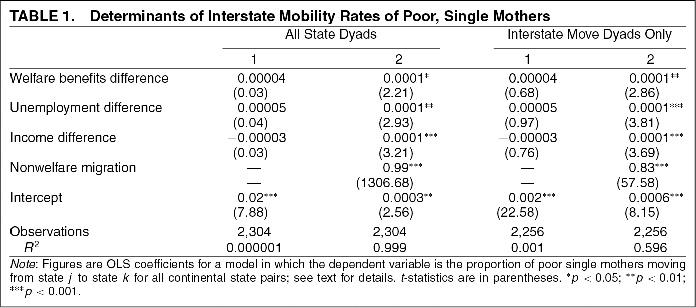
Schram, Nitz, and Krueger (1998) model migration patterns of poor single mothers as a function of welfare, income, and employment differentials. (Allard and Danziger (2000, 361) provide, among other analyses, a similar analysis with no controls.) In two of four specifications, Schram, Nitz, and Krueger find a significant negative relationship between welfare benefits and migration. This odd result suggest either that high welfare benefits repel poor single mothers (which seems unlikely and would constitute a major paradigm shift if true) or that nonwelfare factors correlated with welfare benefits have been omitted and are causing a spurious negative relationship.
To investigate whether omitted variable bias is the problem, Table 1 revisits Schram, Nitz, and Krueger's model. The dependent variable is Census Bureau data on the proportion of poor, single women with children moving from one state to another between 1985 and 1990 for all state pairs. The independent variables measure welfare, unemployment, and income differences. Column 1 reports results for a sparse specification as in Schram, Nitz, and Krueger. The results echo theirs: no variable is significant and the R2 is hardly measurable. Column 2 reports results when I add control for non–welfare state attractiveness with a variable measuring the proportion of poor, non-college-educated single women without children who moved from state j to state k. The same economic, social, and cultural attributes of states affect these women and the welfare population with one important exception: the women without children were not eligible for AFDC. Their migration patterns therefore embody (and control for) the nonwelfare attractiveness of states.
Including better controls dramatically changes the results. Most importantly for our purposes, the welfare variable is now positive and significant, as predicted by the welfare migration hypothesis. One discordant note is the extremely high R2. This occurs because the both the dependent variable and the nonwelfare migration variable are close to one for the 48 own-state pairs and close to zero for the 2,256 other pairs. Therefore the next two columns look only at interstate move dyads by excluding own-state pairs. Again, the sparsely specified model performs abysmally and the model with improved controls performs much better. Here again, welfare benefits are positively and significantly associated with migration.
Other individual-level variables measure systematic determinants of individual-specific attraction to or repulsion from certain states. An excellent proxy for family ties and social capital is the birth state of an individual. The variable birth state is one if person i was born in state s and zero otherwise. Simply put, this variable controls for the possibility that—all else equal—a person born in Mississippi derives greater utility from living in Mississippi than someone born in Vermont. I also interact this variable with an indicator for individuals in the welfare population in case birth state effects differ for the welfare and nonwelfare populations.
Conditional Logit Results
Tables 2 through 4 present the results for the more compelling tests based on the individual-level model of state choice. I estimate but do not report state fixed effects for all specifications.
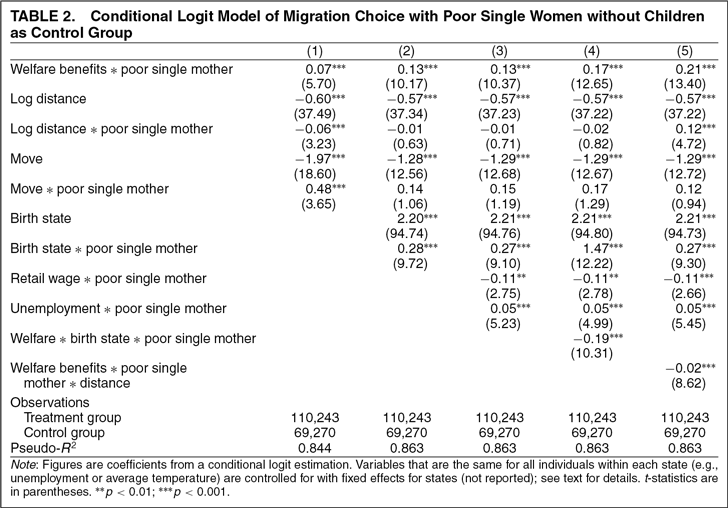
Table 2 indicates that welfare benefits exert a positive and highly significant effect on migration. The first specification includes only the distance, move, and welfare variables. The second specification adds birth state variables. I proceed in this fashion in order to highlight how omitting birth state effects attenuates the estimated effect of welfare on migration. Note that including the birth state variables causes the coefficient on welfare benefits to almost double. The welfare benefits variable is significant—and hardly changed—in the third specification, which adds wage and unemployment interactions for the welfare population. In the last two specifications, I assess whether welfare benefit levels interact with birth state and distance. The results indicate that both interactions matter, but that neither substantially changes the results. Column 4 reports the results when birth state and benefits variables are allowed to interact. The coefficient on welfare is higher than in the other specifications for non-birth states, while the coefficient on welfare for birth states (the sum of the main effect and the interaction) is essentially zero. This result implies that welfare and family effects are substitutes, not complements. Column 5 reports the results when distance and benefits interact. This tests whether the magnetic effect of welfare diminishes across space. The results indicate that this is indeed the case, as the interaction is significant.
The other noteworthy result in Table 2 is the overwhelming statistical significance of the birth state variables, which consistently has a t-statistic over 90. The interaction with the indicator variable for poor single mothers is also significant, indicating a stronger birth-state attraction for poor single mothers relative to the control group of women without children. Even taking into account the massive sample size, there can be no doubt that birth state attractiveness matters.
The control variables perform as expected. The distance variable is negative and significant, implying that the farther away a state is, the less likely an individual is to move there; the effect is the same for both the treatment and the control groups in columns 2 through 4. The move variables indicate a clear fixed cost to moving across state borders that is the same for control and treatment populations. Wages are less magnetic and unemployment is less repelling to individuals in the welfare population. Given the availability of government support for these individuals, it is not surprising that market factors play less of a role in migration for them.
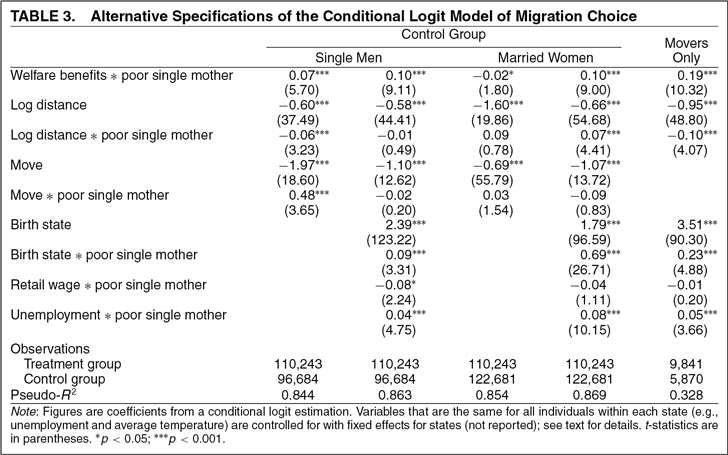
Table 3 explores the robustness of the results by presenting results for alternative specifications of the model. In columns 2 and 3, the control group is single men without children; in columns 4 and 5, it is middle-income married women with children. These specifications lead to rejection of the null hypothesis that welfare benefits exert no effect as long as birth state is taken into account. That is, in the specifications that include birth state and other controls (the third and fifth columns), welfare benefits are positive and statistically significant. In the specifications that do not include birth state, the coefficient on welfare benefits is 30% smaller (when single men are the control group) or negative and borderline statistically significant (when married women are the control group). This again indicates that failure to account for family ties in birth states can attenuate or even reverse estimated welfare effects.
Again, the null hypothesis of no birth state effects is overwhelmingly rejected. Birth states exert a stronger attraction on poor single mothers, especially when the control group is middle-income married mothers. It appears that the family and employment concerns of married women's husbands reduce the relative likelihood that these women will move to their birth states.
The results also indicate that wages exert a smaller effect on the welfare population than on the single male control group. There does not appear to be a difference in the effect of wages relative to married women, suggesting that married women with higher incomes and, in many cases, working husbands do not experience much of a wage effect. Unemployment repels poor single mothers less than either control group, again consistent with the idea that the welfare population is more likely to have nonmarket means of support.
The final column in Table 3 presents results for a conditional logit model estimated on a sample confined to those who did not reside in the same state in 1985 and 1990. Limiting the sample in this fashion addresses two concerns. First, it is possible that people make different calculations when deciding whether to move than when deciding where to move once they have decided to make an interstate move. Second, it is possible that cultural or behavioral differences across states may lead some states to have both high welfare benefits and, say, high rates of out-of-wedlock births. This could mean that states with high benefits may have a higher proportion of single mothers relative to the control group than other states even if welfare did not promote or deter migration. I exclude the move variables from the analysis because they are not identified for a sample in which everyone moved. Despite the massive reduction in the sample size, the last column in Table 3 indicates that welfare and birth state variables remain highly significant.
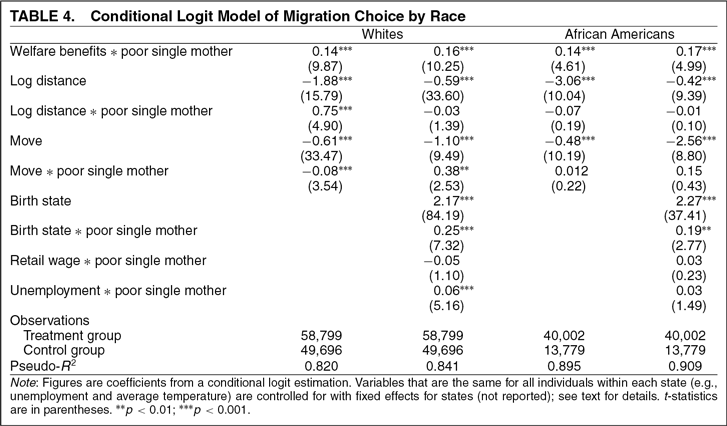
Table 4 includes race in the analysis by providing separate results for whites and African Americans. This controls for the possibility that state attractiveness varies by race and tests whether the marginal effects of welfare and other factors vary by race. The results indicate that race matters in some ways but not in others. Although state-level attractiveness varies across races, the marginal effects of the welfare, birth state, and other variables are similar for both races. The welfare variable is positive and significant even without the birth state variable for both races. What is happening here is that exclusion of both birth state and racial factors severely attenuates the estimated effect of welfare on migration. Including one or both of these factors makes the effect more clearly visible. When both are accounted for (as in the second column for each race), the effect of welfare is most clearly apparent.
The results indicate the existence of both birth state and welfare effects. But how large are these effects? To illustrate the magnitude of the birth state effect, I use specification (3) from Table 2 to simulate the probability that an individual moves from state j to state k when state k is or is not the individual's birth state. To conserve space, I discuss a representative example rather than provide a comprehensive tally of the simulations.
Consider a poor single mother living in Illinois in 1985. If she was born outside the continental United States, the model predicts that she would have a 93.7% probability of living in Illinois in 1990, a 0.11% probability of living in Alabama in 1990, and a 0.37% probability of living in Florida in 1990. If she had been born in Illinois, however, her probability of staying in Illinois through 1990 would rise to 99.4%; if she had been born in Alabama, her predicted probability of moving from Illinois to Alabama by 1990 would be 1.3%. If she had been born in Florida, her predicted probability of moving from Illinois to Florida by 1990 would be 4.3%. In general, women would be about 10 times more likely to move to a given state if they had been born there than if they had been born outside of the continental United States.
Birth state effects on migration not only are large in an absolute sense, but also are large relative to the effect of welfare on migration. In order to produce a change in the probability of living in Alabama similar to that produced by changing a 1985 Illinois resident's birth state from the noncontinental United States to Alabama, Alabama would have to increase its average welfare spending by the implausibly large amount of $18,000 in 1983 adjusted dollars (its actual average spending from 1985 to 1990 in 1983 housing cost–adjusted dollars was about $4,500).
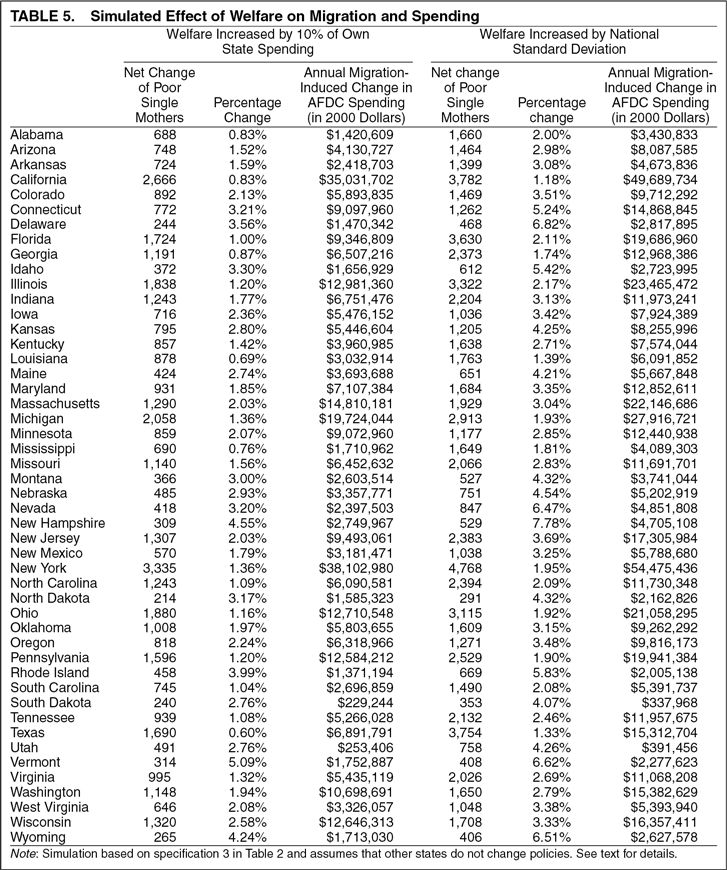
That birth state effects are so large does not mean that the welfare effects are negligible. Table 5 uses the results from Table 4 to simulate the effects on migration and spending of changes in welfare benefits. For each state, I calculate the welfare population by computing the predicted probability individuals from all states move to (or remain in) that state. For each state, I then increase its welfare benefits (holding all other states constant) and calculate the net change in expected population. I look at two levels of increases. A 10% increase represents the average legislated increase in welfare benefits during the time period covered. The national standard deviation ($1,086 per year in real, state-adjusted 1982–84 dollars) represents a more meaningful change. Under AFDC such large changes were rare, but Temporary Assistance for Needy Families (“TANF”) TANF has produced very substantial changes across states (although the changes are harder to quantify in terms of benefit levels as the changes include changes in eligibility, sanctions, and other nonbenefit aspects of aid).
Columns 2 and 3 in Table 5 simulate the effect on migration of an ordinary increase in benefits. Because the simulated increase is in percentage terms, the simulated effects are lower for low spending states. The effects are modest but nontrivial. Alabama (which had a low level of benefits, meaning that a 10% increase would be absolutely small) would see a net inflow of 688 families headed by poor single mothers; Wisconsin (which had more generous benefits, meaning that a 10% increase would be absolutely large) would see an increase of 1,320 poor single mothers.
The columns on the right simulate what would happen if a state increased its benefits by one standard deviation of all states while all other states maintained their benefit levels. The results are, not surprisingly, larger. For example, if Alabama increased its benefits by this amount, it would have 1,878 more poor single mothers. If Wisconsin increased its benefits by this amount, it would have 2,039 more poor single mothers. Because TANF has supplanted AFDC, these data are not to be taken as predictive; rather, they characterize the magnitude of the effect of more substantial changes in welfare policy in terms of a well-studied program.
Table 5 also provides an estimate of the annual amount spent on AFDC for the net in-migrants, calculated as follows. First, I estimated the eligibility percentage for each state as the actual (unsimulated) number of households receiving welfare divided by the actual number of low-income single mothers.6
To produce conservative cost simulations, I set the eligibility proportion at one for states that have more households receiving welfare than low-income single mothers.
Second, I multiplied the expenditures per welfare household (from the
Social Security Bulletin Annual Statistical Supplement for 1990 [Social Security Administration, various years]) times the net change in poor single mothers times the average eligibility of such individuals. This amount is the approximate cost per year realized after changing policy and having five years' worth of migration (since the estimated migration effects are based on data spanning five years).
These financial simulations understate actual costs in several respects. First, costs would continue indefinitely, accruing every year. Second, the costs would rise as in-migration continued over time. Third, the amount does not include other expenses associated with the in-migration of poor single mothers. These expenses may be large. For example, in 1990, almost four times as much was spent on Medicaid as on AFDC. Other social services and education also involve substantial sums. Fourth, benefit increases would also have direct costs due to increased spending on in-state residents, some of whom might be more likely to seek welfare benefits if benefits were increased.
Even for these narrowly defined costs, Table 5 indicates a nontrivial financial effect of welfare migration. For example, five years after increasing benefits by one standard deviation, Alabama would be predicted to spend $3.8 million more per year on the net in-migration alone. Even increasing benefits by 10% would cost Alabama $1.1 million a year on the in-migrants. Cutting costs by these amounts would yield commensurate savings. Although these estimates are modest relative to overall state budgets, they demonstrate how welfare-induced migration can make raising benefits more problematic and cutting benefits more tempting for many states.
CONCLUSION
The analysis presented here is built on three premises. First, we should be wary of existing research that is based on inadequately specified models. Second, state-level fixed effects, combined with a quasi-experimental research design, can effectively control for state attributes that affect migration. Third, a discrete-choice conditional logit model can effectively control for important individual determinants of migration such as family and race.
The results validate prior indications that family ties fundamentally influence residential choice. In all specifications, birth state effects are huge. These effects dwarf welfare effects, supporting Schram, Nitz, and Krueger's (1998, 228) rejection of narratives in which poor single mothers narrow-mindedly and illegitimately—if economically rationally—flock to states with higher benefits. These results imply that poor single mothers are as likely—or even more likely—to move home as everyone else. But more importantly for the vast literature on welfare and migration, the results also indicate that welfare benefits exert a nontrivial effect on state residential choice. This finding stands in contrast to much previous work.
The results do not imply that welfare-induced migration will fundamentally remake the demographic profile of the country. However, the welfare migration hypothesis does not require welfare to exert a dominant effect, only a real effect. And here, the results provide strong, robust indications that the effect is real. For example, simulations indicate that if California increased its benefits by a standard deviation, it would have a net inflow of about 4,289 households headed by poor single mothers after five years. These additional households would add approximately $56 million per year indefinitely to AFDC costs, to say nothing of additional costs associated with Medicaid, housing, and other services. Such effects are modest relative to state populations and budgets; whether they are modest with regard to the politics of state policymaking is an open question.
The results have important policy implications. They do not provide guidance whether redistributive social spending is desirable or effective; instead, the results imply that migration may discourage states from providing high welfare benefits because such generosity attracts and retains potential welfare recipients. Therefore, if redistributive social spending is desirable, then policymakers need to create institutional structures that can support it. They could do this, for example, with federal matching programs designed to offset for states the costs associated with welfare-induced migration (see Gramlich 1985 and Inman and Rubinfeld 1997, 58). The recent move toward funding welfare with block grants, on the other hand, may increase incentives for politicians to cut funding and may further undermine the ability of states to formulate social policies independently.
The results also have implications for broader debates about governmental capacities for redistributive social spending. Migration effects can be real but, nonetheless, obscured by the complexity of modeling reality. This implies that scholars should continue to cast a critical eye on empirical results in related areas such as tax and regulation related migration. Substantively, the findings validate the idea that mobility constrains governmental activities in at least one important context. To say that such constraints exist, however, is not to say that they are necessarily problematic. After all, these constraints could constitute either an undue hindrance on democratic autonomy or a useful discipline against excessive redistribution. Therefore, scholars should also continue the arduous task of normatively and theoretically investigating the proper role of government and the institutional mechanisms for enabling government to play that role in an increasingly integrated—and mobile—world.
I appreciate helpful comments from Scott Allard, Arik Levinson, Bob Lieber, Forrest Maltzman, Dan Nexon, Mark Rom, George Shambaugh, Joe Soss, Michele Swers, and anonymous reviewers. I also wish to thank Craig Volden for sharing data. In addition, I gratefully acknowledge the support of the Hoover Institution National Fellowship Program, Stanford University.






Comments
No Comments have been published for this article.