Introduction
Predispersal seed predation is one of the main causes of seed mortality in plant populations (Janzen, Reference Janzen1969, Reference Janzen1970, Reference Janzen1971a; Zhang et al., Reference Zhang, Drummond, Leibman and Hartke1997; Andersen, Reference Andersen1998; Ramírez and Traveset, Reference Ramírez and Traveset2010), increasing seed limitation and contributing to decrease plant recruitment (Louda, Reference Louda1982; Kolb et al., Reference Kolb, Ehrlén and Eriksson2007). Crop size (the number of seeds produced by an individual plant) and intra- and interpopulational variations may explain some changes in predispersal seed predation (Janzen, Reference Janzen1971a; Traveset, Reference Traveset1995; Crawley, Reference Crawley and Fenner2000; Xiao et al., Reference Xiao, Zhang and Wang2015; Christianini, Reference Christianini2017).
Predispersal seed predation is mainly performed by specialized invertebrates (Janzen, Reference Janzen1969, Reference Janzen1971a; Kolb et al., Reference Kolb, Ehrlén and Eriksson2007; Gripenberg, Reference Gripenberg2018). Many insects from Coleoptera, Hymenoptera, Diptera, Lepidoptera and Thysanoptera lay their eggs and grow their larvae inside developing fruits and seeds, preying on seeds before dispersal (Janzen, Reference Janzen1969, Reference Janzen1970; Janzen, Reference Janzen1971b; Zhang et al., Reference Zhang, Drummond, Leibman and Hartke1997; Crawley, Reference Crawley and Fenner2000; Barford et al., Reference Barford, Hagen and Borchsenius2011). These insects destroy seeds and make fruits less attractive to dispersers (Rathcke and Lacey, Reference Rathcke and Lacey1985), which may limit seed dispersal, plant recruitment and affect the ecological and evolutionary dynamics of their host plants (Kolb et al., Reference Kolb, Ehrlén and Eriksson2007). The interest in predispersal seed predation has not matched the significant attention devoted to post-dispersal seed predation over the last few decades, although both are important for the maintenance of tropical plant diversity (Janzen, Reference Janzen1970; Gripenberg, Reference Gripenberg2018).
Since seeds are critical resources to complete a predator's life cycle, a high number of seeds may allow greater opportunities for oviposition by insects. Therefore, seed predators may exert greater predation pressures where seeds are found in higher densities (density-dependence hypothesis; Janzen, Reference Janzen1969, Reference Janzen1970). On the other hand, a high seed crop size may maximize the probability of satiating local seed predators if many seeds are produced at irregular intervals or are available for only a short period of time (satiation hypothesis; Kelly and Sork, Reference Kelly and Sork2002; Kon et al., Reference Kon, Noda, Terazawa, Koyama and Yasaka2005). In this case, a large seed crop may increase the likelihood of an individual seed reaching maturity even under intense activity of the seed predators (Hubbell, Reference Hubbell1980).
Palms (Arecaceae) are present in all tropical and subtropical regions of the world. Most palms and their interactions with insects remain poorly known in tropical ecosystems around the world (Henderson et al., Reference Henderson, Galeano and Bernal1995; Prance et al., Reference Prance, Beentje, Dransfield and Johns2000; Henderson, Reference Henderson2002). Palms are important components (in terms of richness and abundance: Oliveira-Filho et al., Reference Oliveira-Filho, Shepherd, Martins and Stubblebine1989; Lenza et al., Reference Lenza, Pinto, Pinto, Maracahipes and Bruziguessi2011) of the Brazilian savanna flora, Cerrado. However, less than 50% of flowers of some palm species turn into viable seed due to predispersal seed predation among other reasons (De Steven et al., Reference De Steven, Windsor, Putz and De Léon1987; Henderson, Reference Henderson2002). Therefore, in this study, we examined the effect of seed crop size variation on seed predation. We expected that higher fruit set would lead to greater predispersal seed predation in a tropical palm species.
Materials and methods
Study species
We studied predispersal predation in seeds of Syagrus flexuosa (Mart.) Becc., an endemic palm species widely distributed in the Brazilian savanna. The genus Syagrus is mostly found in South America, primarily in Brazil (Henderson et al., Reference Henderson, Galeano and Bernal1995; Noblick, Reference Noblick2017), and species have been considered fundamental in seasonal ecosystems by offering abundant resources to frugivores in periods of food scarcity (Giombini et al., Reference Giombini, Bravo and Martínez2009). This palm flowers between November and April and fruits mainly from July to October (Martins and Filgueiras, Reference Martins, Filgueiras and Cavalcanti2006). The plant reaches 1–5 m high and it usually has 7–15 green leaves (40–80 pinnate: Noblick, Reference Noblick2017). Flowers are hermaphroditic in 6–12 racemes, with ovoid 4 cm fruits carrying one seed (Mamede, Reference Mamede2008). There are no studies regarding the reproductive biology of S. flexuosa, but the congeneric S. coronata has been described as self-compatible, with high occurrence of cross-pollination done by bees and beetles (Rocha, Reference Rocha2009).
This study was carried out in three tropical woodland savanna (Cerrado) sites in Brazil: Estação Ecológica de Águas Emendadas (ESECAE, sampled in 2003), Estação Experimental Fazenda Água Limpa (FAL) and Parque Estadual da Serra de Caldas Novas (PESCAN), both sampled in 2012. Study sites are located within conservation areas (distant from each other by at least 45 km) in Central-Western Brazil (Table 1), under Köppen's Aw climate with well-marked rainy (October–March) and dry seasons (April–September) (Nimer, Reference Nimer1989).
Main characteristics of the studied sites in the Cerrado from Central Brazil where predispersal seed predation of Syagrus flexuosa was evaluated: Estação Ecológica de Águas Emendadas (ESECAE), Estação Experimental Fazenda Água Limpa (FAL) and Parque Estadual da Serra de Caldas Novas (PESCAN). Dash means lack of information

Sampling and recording of the predation level
From 7 to 30 palms presenting fruits were sampled ad libitum per site (Table 2). In total, 46 palms were sampled (Table 2). Due to logistical reasons, we were unable to survey all sites and plants across the 2 years. All infructescences produced by a palm sampled in each site were collected to record the predispersal seed predation. Infructescences with fruits reaching maturity were recognized through the size and/or colour of fruits. After harvest, each infrutescence was placed in a plastic bag and labelled (site, individual). To evaluate predispersal seed predation, we counted the total number of seeds preyed on per infructescence and per palm individual. We first searched for external signs of predation on seeds (such as holes). To avoid underestimation of insect predation (Andersen, Reference Andersen1998), we also opened all seeds using a scissor in order to verify the presence or not of a larva (an unidentified Curculionidae, Coleoptera). Curculionidae larvae commonly feed on seed endosperm and embryo, complete their life cycle inside seeds and drill an exit hole during fruit ripeness and seed dispersal (Zhang et al., Reference Zhang, Drummond, Leibman and Hartke1997; Crawley, Reference Crawley and Fenner2000).
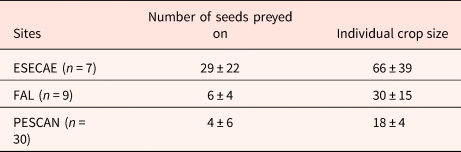
Average number ± SD of damaged seeds and of individual crop size for Syagrus flexuosa at three sites in Central Brazil (n = total individuals sampled): Estação Ecológica de Águas Emendadas (ESECAE), Estação Experimental Fazenda Água Limpa (FAL) and Parque Estadual da Serra de Caldas Novas (PESCAN)

Data analysis
We applied a Generalized Linear Mixed Model to test for the effects of seed crop on seed predation, using crop size per plant as a fixed predictor variable, palm identification nested within the site as a random factor to control for the spatial distribution of individual palms, pseudo-replication within sites and variation in the number of palms sampled per site. The number of seeds preyed on per palm was the response variable. The model used a Poisson family of error distribution and log-link function. Statistical analysis was done in R (R Core Team, 2013). We used the glmer function to fit the model by maximum likelihood (Laplace approximation) using the lme4 package in R. The full model was compared with a null model containing only an intercept and random effects with analysis of variance. The full model had a better fit to variance in data than expected by random factors only (Χ2 = 11.17; d.f. = 1; P = 0.008). We tested the overdispersion of the full model with an overdispersion detection function suggested by Thomas et al. (Reference Thomas, Lello, Medeiros, Pollar, Robinson, Seward, Smith, Vafidis and Vaughan2017).
Results
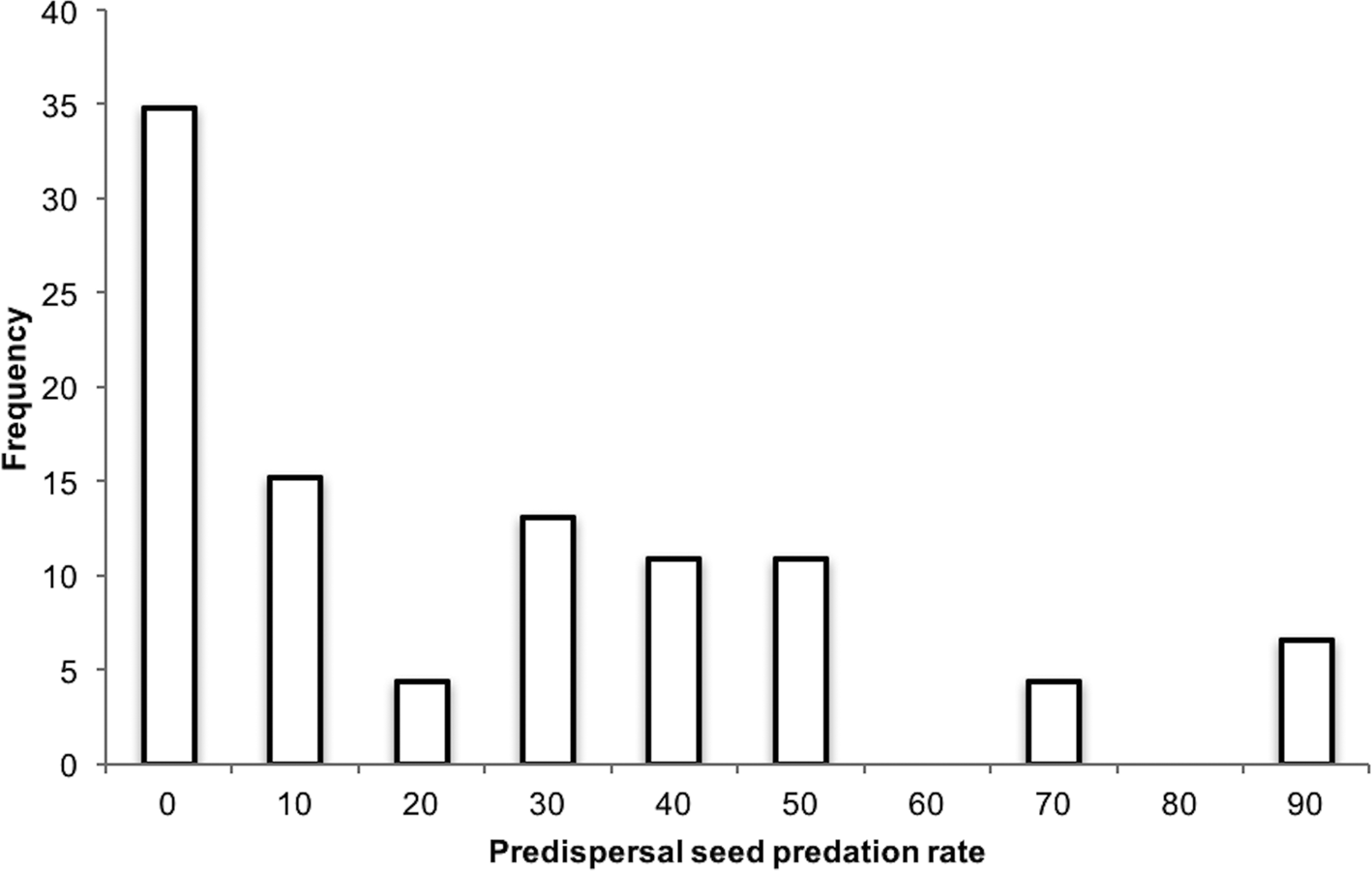
Predispersal seed predation in S. flexuosa ranged from 0 to 95% of seeds of individual palms and 35% of all the individuals were not affected by seed predation (Fig. 1). About 24 ± 27% (mean ± SD) of the palm seed crop was lost to predispersal seed predators (although there was a large coefficient of variation of seed loss: 89.1%). We also noticed a great variance in seed crop and loss among sites, with ESECEAE having more predated seeds than the other two areas (Table 2).
Distribution of predispersal seed predation rates (predated seeds per total seeds) in Syagrus flexuosa individuals. Data are pooled for all individuals in three savanna sites in Central Brazil (N = 46).

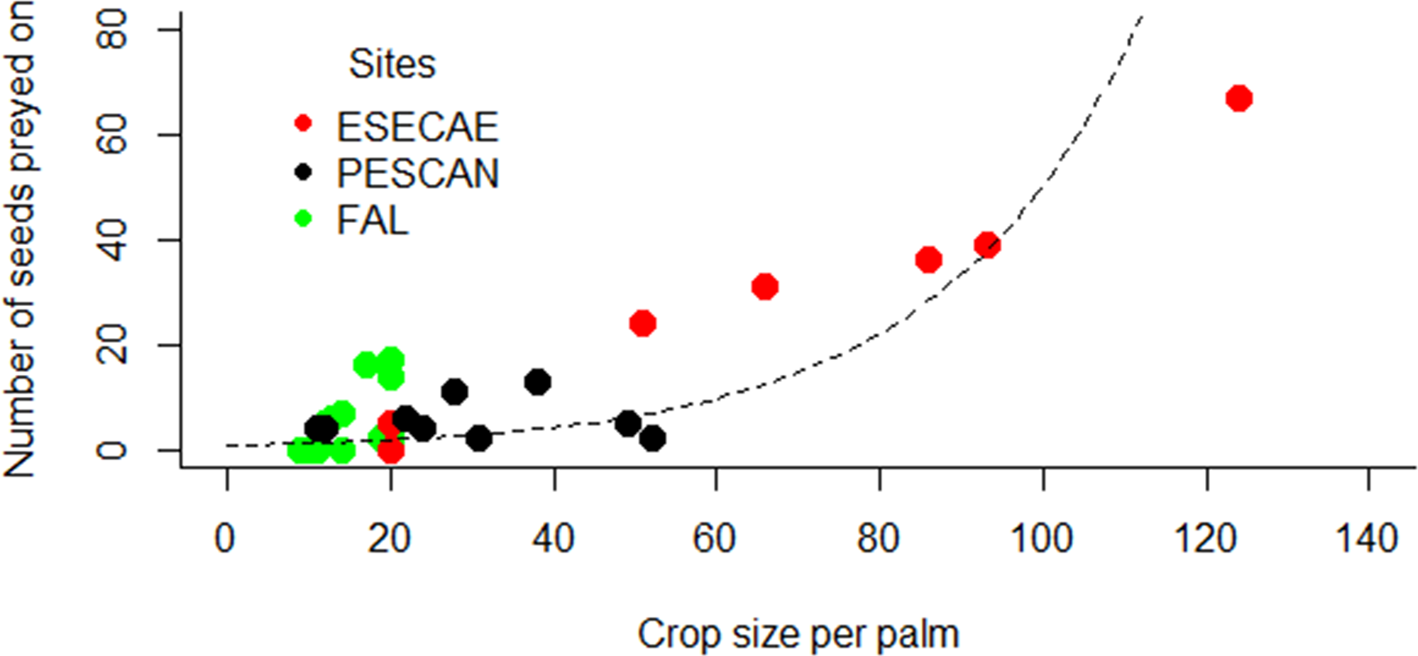
Additionally, there was a positive effect of crop size on the number of seeds preyed on per palm (untransformed estimate ± SE: 0.041 ± 0.009; z-value = 4.515; P < 0.001; Fig. 2; Model intercept did not differ from zero −0.186 ± 0.387; z-value = −0.480; P = 0.631). Since we detected some under dispersion (ratio = 0.254) in our model, the exact value of fixed factor estimates should be interpreted with caution.
Predispersal seed predation in response to variation in the number of seeds produced per palm of Syagrus flexuosa (N = 46). Data are pooled for all individuals in three savanna sites in Central Brazil. Not all points can be seen due to overlap. See the text for details of model fit.

Discussion
We observed predispersal seed predation in all sites sampled and a high variation in the number of seeds preyed on per individual of S. flexuosa. Although seed losses of the palm species reached a mean of 24% per individual and may suggest a low predation pressure compared with other palms (70% of seed loss), such as S. romanzoffiana growing in forest and woodland savanna (Brancalion et al., Reference Brancalion, Novembre and Rodrigues2011) and for Acrocomia aculeata in savanna (Pereira et al., Reference Pereira, Fonseca, Mota, Fernandes, Fagundes, Reis-Júnior and Faria2014), there was a large variation among studied individuals. In addition, crop size per palm was a very important driver of the number of seeds lost to predispersal seed predators.
Flower and fruit production in tropical environments are influenced by a multitude of abiotic and biotic factors (Janzen, Reference Janzen1967; Frankie et al., Reference Frankie, Baker and Opler1974; Mendoza et al., Reference Mendoza, Peres and Morellato2017). Several plants from Cerrado show large variations in seed crop among years (Pilon et al., Reference Pilon, Udulutsch and Durigan2015) and S. fleuxosa is not an exception. For instance, an average of 87 fruits was produced per palm in 1998 (data not shown) when compared with 30 fruits in 2012 in FAL. This may yield larger seed crops in less predictable time intervals, decreasing the chances to sustain large densities of specialized seed predators and increasing the chances of predator satiation in years of large crops (Kon et al., Reference Kon, Noda, Terazawa, Koyama and Yasaka2005; Kolb et al., Reference Kolb, Ehrlén and Eriksson2007). Despite this, flowering and fruiting of S. flexuosa is aseasonal within years in study sites (Bruno et al., Reference Bruno, Massi, Vidal and Hay2019). Therefore, insect seed predators may find opportunities for oviposition on seeds of S. flexuosa throughout the year. It is possible that female beetles select the most vigorous plants available for oviposition, based on seed crop size, to enhance offspring fitness (Heisswolf et al., Reference Heisswolf, Obermaier and Poethke2005). This may explain the increased likelihood of insect seed predation with increases in crop size per palm. Masting flowering/fruiting, on the other hand, could result in predator satiation and in a smaller proportion of seed predation (Kon et al., Reference Kon, Noda, Terazawa, Koyama and Yasaka2005; Kolb et al., Reference Kolb, Ehrlén and Eriksson2007). However, we found no evidence of satiation with increasing crop sizes of S. flexuosa. Alternatively, it is possible that less productive plants provide less attractive displays for ovipositing beetles, or that these plants selectively abort infested seeds in early development stages. Future studies could explore this issue further.
This study has shown that predispersal seed predation by Curculionideae larvae is related to the fruit production of S. flexuosa in a density-dependent way. The intensity of the seed predation varied more than 15 times among palms considering all sites, corroborating other studies with plants from the tropical savanna (Custódio et al., Reference Custódio, Carmo-Oliveira, Mendes-Rodrigues and Oliveira2014), including palms (Grenha et al., Reference Grenha, Macedo and Monteiro2008), and increased with the number of fruits produced, indicating that the seed predator's preference for many-flowered individuals may have the potential to affect the selection of plant traits and the overall intensity of seed predation (Kolb et al., Reference Kolb, Ehrlén and Eriksson2007).
Acknowledgements
We gratefully acknowledge the financial support provided to the authors by the Coordination of Improvement of Personnel in Higher Education, Brazil (CAPES) and by the National Council of Science and Technology, Brazil (CNPq). We also would like to thank ESECAE, FAL and PESCAN for permission to conduct research.