INTRODUCTION
In the cotton-growing areas of West and Central African savannas, pyrethroid insecticides have been extensively used since the early 1980s to control frugivorous bollworms such as Helicoverpa armigera, Diparopsis watersi, Earias insulana and E. biplaga. The most harmful species, H. armigera, can infest farmers' fields from the squaring and blooming stages (45–90 days after seedling emerge, DAS), i.e. from mid July to late August, depending on sowing date, but a consistent and predictable infestation peak occurs during fruiting, from early September to early October (90–120 DAS). A pest management programme, designed 30 years ago, provided small-scale West Africa cotton growers with a simple and cheap method of pest control (Ochou et al., Reference Ochou, Martin and Hala-N'Klo1998; Vaissayre et al., Reference Vaissayre, Sement and Trijau1984). Six calendar-based applications, usually including pyrethroids, were made 14 days apart through the growing season, from squaring (about 45 DAS) to opening of first mature bolls (about 120 DAS). However, when severe outbreaks due to pyrethroid resistance in H. armigera were recorded in most cotton-producing countries of West Africa in 1998 (Martin et al., Reference Martin, Ochou, Hala-N'Klo, Vassal and Vaissayre2000; Reference Martin, Chandre, Ochou, Vaissayre and Fournier2002), early-season pyrethroid applications were replaced by endosulfan, as a window strategy aimed at temporarily reducing selection of resistance genes (Forrester et al., Reference Forrester, Cahill, Bird and Layland1993; Irving, Reference Irving1999; Martin et al., Reference Martin, Ochou, Vaissayre and Fournier2003). Such a strategy proved successful in controlling H. armigera infestations on cotton and in preventing further resistance-based failures in West Africa (Martin et al., Reference Martin, Ochou, Djihinto, Traore, Togola, Vassal, Vaissayre and Fournier2005).
While pyrethroid resistance in H. armigera had not been detected in Cameroon, similar procedures were recommended for preventive purposes in the central cotton growing area, and then extended to the entire cotton-growing area following first warnings of pyrethroid resistance in some H. armigera field populations (Brévault et al., Reference Brévault, Asfom, Beyo, Nibouche and Vaissayre2002). However, insecticide failures were recorded in cotton fields in 2004 (Brévault and Achaleke, Reference Brévault and Achaleke2005; Brévault et al., Reference Brévault, Achaleke, Sougnabé and Vaissayre2008). Why did the window strategy not successfully prevent the occurrence of pyrethroid resistance in Cameroon? A possible hypothesis is that endosulfan sprays before mid-August were not appropriately timed since large refuge hosts, such as maize and indigenous weeds supported most populations of H. armigera at this time. In contrast, late pyrethroid applications on cotton from mid-August to mid-October exerted a high selection pressure since cotton had become the major or exclusive host plant (Brévault et al., Reference Brévault, Achaleke, Sougnabé and Vaissayre2008; Achaleke and Brévault, unpublished data). Accordingly, the use of pyrethroid alternatives to control H. armigera when cotton is the main host plant in the agricultural landscape is strategic (i) to slow down the evolution of pyrethroid resistance when applied at the regional scale and (ii) to overcome control failures at the field scale due to pyrethroid resistance (Martin et al., Reference Martin, Ochou, Djihinto, Traore, Togola, Vassal, Vaissayre and Fournier2005). Despite efforts to register new insecticides, few detailed studies have evaluated the efficacy of pyrethroid alternatives against the bollworm complex in Africa (Ochou and Martin, Reference Ochou and Martin2003). New compounds are more expensive than conventional pyrethroids, while the cheaper alternative endosulfan has been banned in several countries, including Cameroon. Furthermore, low prices of cotton have delayed the implementation of new chemistry since farmers tend to reduce overall cost inputs (Vaissayre et al., Reference Vaissayre, Ochou, Hema and Togola2006).
The objective of this study was to measure the effect of non-pyrethroid insecticides on bollworms damage and cotton yield (i) in multi-years on-station controlled experiments (2002–2006) presenting different patterns of bollworm species and resistance status, and (ii) in farmers' fields according to the planting date (2004) and location (2005). Promising chemistry would be integrated into updated control programmes in a way that delays the evolution of H. armigera resistance to pyrethroids and increase productivity of cotton in Cameroon.
MATERIALS AND METHODS
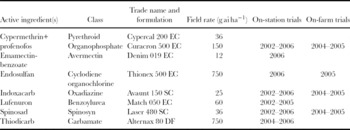
The efficacy of six insecticides (emamectin-benzoate, endosulfan, indoxacarb, lufenuron, spinosad and thiodicarb) was compared in on-station and on-farm trials to that of the conventional cypermethrin-profenofos mixture (cp) in controlling cotton bollworms at the early infestation peak of H. armigera. Trade names, active ingredients, application rates, and year of test of the insecticides used are listed in Table 1.
Active ingredients and recommended field rate of insecticides tested in on-farm and on-station experiments (2002–2006).

EC: emulsifiable concentrate. SC: suspension concentrate. DF: dry flow. ai: active ingredient.
On-station trials
The on-station trials were conducted during the growing seasons from 2002 to 2006 at the IRAD (Institute of Agricultural Research for Development) Research station at Garoua (9°23′N, 13°45′E), and were Fisher's block designs with six replicates. The variety IRMA A1239 (IRAD, Cameroon) was grown in single rows separated by 80 cm with 40 cm between plants, using standard agronomic practices. Plot size was 180 m2 (12 rows, 15 m long).
Treatments were applied to the six central rows of plots in the equivalent of 100 l of water ha−1 using a knapsack sprayer (T16, Berthoud, France), soon after detection of early-instar larvae of H. armigera and bored squares. Sampling was based on weekly observations of 50 randomly selected plants in control plots, from the first week of September, the period when H. armigera infestations are expected. Accordingly, the first treatments sprays occurred on position 4 or 5 in the conventional calendar-based programme (CbP) (Figure 1). This ‘action threshold’ was chosen as it is simple enough to enable adoption by farmers. Treatments were repeated seven days later in 2002–2004 (additional application in the CbP), and 14 days later in 2005–2006 (application 5 or 6 in the CbP). All trials included an untreated control and a conventional cp treatment. With the exception of tests conducted in this window, all plots were subjected to uniform spraying as stipulated in the CbP (Figure 1).
Calendar-based programme (CbP) recommended for cotton pest management in Cameroon (SODECOTON, 2004). Six applications are made at biweekly interval from squaring (about day 45 post seedling) to opening of first mature bolls (about day 120 post seedling). The application of endosulfan is recommended until mid-August, followed by a mixture of pyrethroid (usually cypermethrin at 36 g ha−1) and organophosphate (usually profenofos at 150 g ha−1). In both on-station and on-farm trials, first application of treatments took place in position 4 or 5.

On-farm trials
On-farm trials were conducted in 2004 in the neighbouring villages of Bocklé and Djalingo, near Garoua. In 2005, on-farm trials were carried out in the villages of Guider, Gaschiga, Bibémi and Ngong, all of them positioned along a N–S axis of about 150 km across the cotton growing area. The variety IRMA A1239 was grown by farmers in single rows separated by 80 cm with 40 cm between plants, using standard agronomic practices. A pairwise design with eight replications was implemented in each village. Each pair comprised the CbP and the spraying programme being evaluated. Plot size was 1250 m2.
Treatments were applied uniformly on the entire plots in the equivalent of 10 l of water ha−1 with an Ulva+ manual sprayer (Micron Sprayers Ltd., UK), in accordance with farmers' practices. As in on-station trials, and depending on the planting date, first application of treatments (cp, endosulfan, indoxacarb or spinosad) took place at application 4 or 5 in the CbP. In 2004, plots were sprayed with the same insecticide seven days later, while CbP plots were left unsprayed. In 2005, plots were sprayed with the same insecticide 14 days later (application 5 or 6 in the CbP). As in on-station trails, all plots were subjected to uniform spraying outside the test window, according to the CbP.
Sampling
In on-station trials, abscised squares and bolls were collected from the ground between rows five and six of each plot, three times a week, from two days after the first application of test insecticide, to 7–14 days after the second application. Abscised squares and bolls exhibiting damage and bollworms species composition in these organs were recorded. The four central rows (10 m long) of each plot were harvested for yield assessments. In order to illustrate the intensity of damage among and throughout cropping seasons, additional data from unsprayed plots of neighbouring insecticide trials conducted on Garoua Research station were compiled. In farmers' fields, yield was estimated by the number of open bolls and the corresponding weight of seed-cotton collected from four rows of 10 m long within plots.
Statistical analyses
Data from on-station trials were analysed using analyses of variance (ANOVA), with SAS GENMOD for binomial and negative binomial distributions and SAS GLM for Gaussian distributions (SAS Institute, 1989). Insecticide efficacy to protect squares and bolls from bollworms damage was calculated using the formula from Henderson and Tilton (Reference Henderson and Tilton1955). To compare treatments with the related CbP in on-farm trials, a pairwise Student t-test was used (Fahmy, Reference Fahmy2006).
RESULTS
Bollworm damage
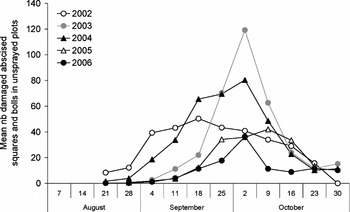
Data on damage in unsprayed plots of neighbouring on-station experiments showed that annual bollworm infestation peaked from mid-September to mid-October, except in 2002 when the peak occurred earlier and lasted longer (Figure 2). On the other hand, consistent decrease in bollworm damage was observed from 2003 to 2006.
Abundance of damaged squares and bolls resulting from bollworm attacks in unsprayed plots of neighbouring on-station trials at the IRAD Research station (2002–2006). Abscised squares and bolls were collected from between rows five and six of each plot (10 m long), three times a week, from squaring to boll opening.

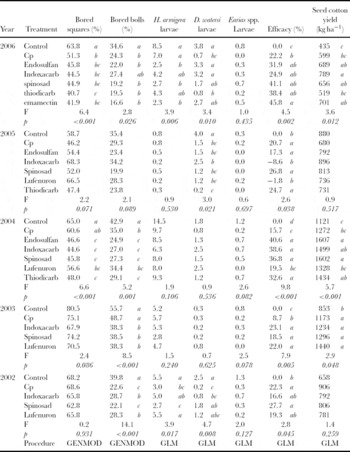
In 2002, insecticide applications had no effect on the proportion of damaged squares, but significantly reduced the proportion of damaged bolls (Table 2). Spinosad and cp showed the highest efficacy in protecting reproductive organs, while indoxacarb and lufenuron did not significantly reduce damage. Bollworms collected in abscised reproductive organs from control plots were predominantly H. armigera (58.9%), and D. watersi (26.8%). Earias spp. larvae were relatively rare throughout the five-year survey. Spinosad and cp controlled H. armigera equally well, while cp was better than spinosad for D. watersi.
Analysis of bollworm damage to reproductive organs and seed cotton yield of on-station trials during 2002–2006 cropping seasons.

Values of the same column within same year experiment followed by different letters are significantly different (ANOVA and Duncan test, p < 0.05). Efficacy (%) = 100 – ((% damaged squares + bolls in test plot × number of abscised squares + bolls in control)/ number of squares+bolls in control) = % saved squares + bolls.
In 2003, target applications of indoxacarb, lufenuron and spinosad, significantly reduced bollworm damage in abscised bolls compared to cp and control, but with no effect on the damage proportion of abscised squares (Table 2). These three pyrethroid alternatives also demonstrated better overall efficacy than cp in protecting bolls and squares. Bollworms collected in abscised reproductive organs from control plots were predominantly H. armigera (81.6%).
In 2004, the proportion of abscised squares and bolls with bollworm damage symptoms was significantly lower in plots sprayed with endosulfan, indoxacarb, spinosad or thiodicarb than in control or cp treated plots (Table 2). With exception of lufenuron, the pyrethroid alternatives showed better efficacy than the recommended cp in protecting squares and bolls. Bollworms collected in abscised bolls and squares from control plots were again represented mainly by H. armigera (82.9%).
Experiments conducted in 2005 showed an unusual pattern of bollworm infestation, with D. watersi as the dominant species (77.4%) (Table 2). Insecticide applications had no significant effect on the proportion of damaged abscised bolls and squares. With this change in pest composition, indoxacarb and lufenuron presented low efficacy, and endosulfan, spinosad and thiodicarb were equivalent to cp.
In 2006, collected bollworms were mainly H. armigera (64.6%) and D. watersi (29.1%) (Table 2). Insecticide applications generally reduced the proportion of both abscised and damaged squares and bolls. A new pyrethroid alternative, emamectin-benzoate, demonstrated higher efficacy than cp, while other pyrethroid alternatives did not significantly reduce damage, compared to cp. However, the number of H. armigera larvae collected was lower in plots sprayed with endosulfan, spinosad and emamectin than in plots sprayed with cp. The number of D. watersi larvae was lower in plots sprayed with cp than in plots sprayed with endosulfan or indoxacarb.
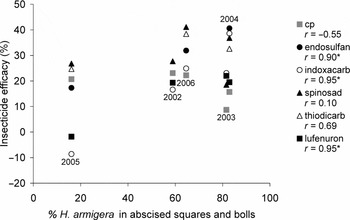
Over the five years of trials, efficacy of indoxacarb, endosulfan and lufenuron significantly increased with the proportion of H. armigera infesting squares and bolls whereas the efficacy of cp decreased (Figure 3). Spinosad and thiodicarb showed good efficacy regardless of the pattern of bollworm infestation.
Relationship between the relative abundance of H. armigera collected from damaged abscised squares and bolls and insecticide efficacy. r: Pearson coefficient (*p < 0.05).

Cotton yield
In on-station trials, target applications of non-pyrethroid insecticides significantly improved seed cotton yield in 2003, 2004, and 2006 (Table 2). These growing seasons were collectively marked by the dominance of H. armigera among bollworms. In 2004 and 2006, the cotton yield from cp treated plots was not different from the cotton yield of control plots (Table 2). In 2003, applications of lufenuron, spinosad and indoxacarb gave a cotton yield equivalent to that of cp but higher than the control plots. In 2004, endosulfan and spinosad gave a better cotton yield than cp, lufenuron and the control, while thiodicarb and indoxacarb gave moderate yield only. In 2006, indoxacarb produced a better yield than cp, thiodicarb and control while spinosad, endosulfan and emamectin gave a moderate yield (Table 2).
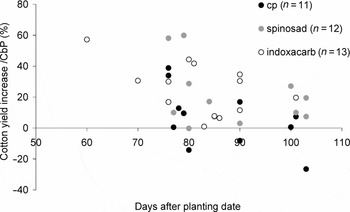
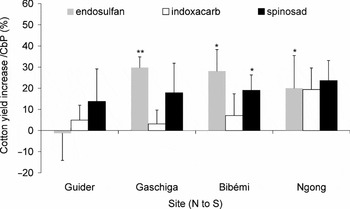
In the 2004 on-farm trial, plots sprayed with indoxacarb or spinosad recorded significant yield gains compared to CbP (t = 7.0, p < 0.001 and t = 4.1, p = 0.002), as opposed to cp (t = 1.0, p = 0.926). In addition, it was observed that the positive effect on yield of non-pyrethroid applications tended to increase as the application took place early in the crop cycle (Figure 4). In other words, the impact of insecticide application was higher in late sown fields. In 2005, pyrethroid alternatives recorded significant cotton yield gains relative to CbP at three of four experimental sites. Endosulfan provided a mean significant yield gain in Bibémi, Gaschiga and Ngong, and so did spinosad in Bibémi (Figure 5).
Cotton yield increase resulting from two 7-d apart applications of insecticides compared to CbP, according to the number of days after planting. Data from the villages of Djalingo and Bocklé were pooled. n: number of paired plots with exploitable data.

Cotton yield increase (±s.e.) resulting from two 14-d apart applications of non-pyrethroid insecticides compared to CbP, according to the site of the experiment. (*p < 0.05; **p < 0.01).

DISCUSSION AND CONCLUSION
In field experiments, it is difficult to group data of different cropping seasons due to variation in bollworm species composition, density and susceptibility to insecticides, as observed in 2002 with relatively pyrethroid-susceptible populations of H. armigera, and in 2005 with a high proportion of D. watersi. Interestingly, the cp mix was as effective as pyrethroid alternatives during these two cropping seasons, and the reason was in-part due to the low frequency of pyrethroid- resistant H. armigera in 2002 relative to other years and the susceptibility of D. watersi to pyrethroids (Brévault et al., Reference Brévault, Achaleke, Sougnabé and Vaissayre2008; Brévault et al., unpublished data). Furthermore, the method used to estimate species abundance in the bollworm complex probably overestimated the proportion of D. watersi because of its relatively sedentary behaviour and feeding habits, compared to the highly mobile and voracious H. armigera larvae (Nibouche et al., Reference Nibouche, Gozé, Beyo, Babin and Brévault2007).
From 2003 to 2006, damage steadily decreased in untreated plots around on-station trials, although H. armigera resistance frequency was increasing across populations (Brévault et al., Reference Brévault, Achaleke, Sougnabé and Vaissayre2008). Except in 2003, when the peak of infestation was high and mainly represented by H. armigera, the recommended cp mix protected to some extent bolls and squares from bollworm damage, relative to unsprayed plots. However, pyrethroid alternatives showed better efficacy than cp in 2003, 2004 and 2006. Unlike spinosad and thiodicarb which were good alternatives irrespective of bollworm species, endosulfan, indoxacarb, and to a lesser extent lufenuron, were only effective when the bollworm species was predominantly H. armigera. Tested in 2006, emamectin-benzoate (Ishaaya et al., Reference Ishaaya, Kontsedalov and Horowitz2002) showed promising efficacy to protect reproductive organs against bollworms.
In Pakistan, where H. armigera developed strong resistance to most classes of insecticides (Ahmad et al., Reference Ahmad, Arif and Ahmad1997), thiodicarb, spinosad and emamectin-benzoate were found to confer good control of cotton bollworms (Aslam et al., Reference Aslam, Razaq, Rana and Faheem2004). Similarly, pyrethroid- resistant field populations remained susceptible to spinosad, indoxacarb and emamectin-benzoate in laboratory bioassays (Ahmad, Reference Ahmad, Arif and Ahmad2003). In Australia, where populations of H. armigera have developed resistance to several insecticide groups, including synthetic pyrethroids (Forrester et al. Reference Forrester, Cahill, Bird and Layland1993; Gunning et al. 1996), alternatives such as indoxacarb, spinosad and emamectin-benzoate provided control, equal to or better than standard treatments with methomyl (Kay, Reference Kay2007). Conversely, in a field trial comparing new insecticides against Heliothis virescens and Helicoverpa zea, Johnson et al. (Reference Johnson, Lorenz, Hopkins and Page2000) reported that spinosad and indoxacarb conferred better protection than emamectin-benzoate. Brickle et al. (Reference Brickle, Turnipseed and Sullivan2001) showed that spinosad, thiodicarb and indoxacarb were more efficient than emamectin-benzoate in controlling H. zea in conventional non-irrigated cotton.
Yield results from on-farm experiments confirmed the suitability of pyrethroid alternatives such as spinosad and indoxacarb for controlling pyrethroid-resistant H. armigera, particularly in late sown fields, which were more prone to bollworm attacks during the late season. In field tests including various insecticides, Rashid et al. (Reference Rashid, Saeed, Akhtar, Siddiqi and Arshad2003) found that spinosad and indoxacarb controlled H. armigera on chickpea effectively, leading to increased seed yield. Endosulfan was found to be the least effective insecticide. In assessing the efficacy of new insecticides in managing Helicoverpa spp. on grain crops in Australia, Murray et al. (Reference Murray, Lloyd and Hopkinson2005) concluded that indoxacarb and spinosad were consistently equivalent or superior to other tested products (thiodicarb, 375 g ha−1) and provided residual protection for up to 14 days.
Economically, chemical pest control with pyrethroids still has a place in cotton integrated pest managment. However, the threat of resistance should be carefully managed by using alternative chemistries with no cross-resistance. Care is needed to decide on when and what insecticide to spray, depending on bollworm density and species, in the framework of threshold-based applications (Duffield and Jordan, Reference Duffield and Jordan2000). In Cameroon, calendar-based practice resulted in moderate insecticide use on cotton with only five to six applications per growing season, but did not match the diversity of farmers' objectives and constraints. In addition, spraying when pest pressure is low is economically unfavourable and harms non-target species, which are natural enemies of the pest species (Vaissayre et al., Reference Vaissayre, Ochou, Hema and Togola2006). Despite its efficacy, thiodicarb was less suitable because of its high toxicity and broad-activity spectrum. More selective insecticides such as spinosad and emamectin-benzoate should be recommended for control of H. armigera and D. watersi infestations, while indoxacarb should be restricted to control of H. armigera. Although promising new chemistries are still two to four-fold more expensive than commercial formulations used in the CbP, they offer significant selective control of cotton bollworms and likely cost effectiveness. Provided that training on optimal use is available, these chemistries should be integrated in pest management programmes, to soundly manage resistance to pyrethroids and to improve revenue of small-scale farmers in Cameroon and sub-Saharan Africa.
Acknowledgements
We express our sincere gratitude to the Cameroon Cotton Development Industry (SODECOTON) and to ARDESAC Project for providing financial and technical assistance. We are grateful to Mrs Christa Ellers-Kirk and the anonymous reviewers for comments and helpful suggestions.