Introduction
Since Schucknecht first described the use of intratympanic aminoglycosides to treat Ménière's disease in 1957,Reference Schuknecht 1 a variety of intratympanic gentamicin regimes have been described.Reference Chia, Gamst, Anderson and Harris 2 Gentamicin-induced vestibular ablation was first introduced to the UK in 1991, and its popularity in treating Ménière's disease that is refractory to medical treatment has grown, with 63 per cent of ENT surgeons using gentamicin or advocating its use.Reference Smith, Sankar and Pfleiderer 3 The majority of published intratympanic gentamicin case series report short-term, two-year patient outcomes.Reference Chia, Gamst, Anderson and Harris 2 , Reference Nedzelski, Schessel, Bryce and Pfleiderer 4 Few long-term series have been published and only one paper details patient outcomes following a minimum of five years' post-gentamicin therapy.Reference Bodmer, Morong, Stewart, Alexander, Chen and Nedzelski 5
In 1998, Pfleiderer published 2-year follow-up results for a series of 16 patients treated with a fixed-dose intratympanic gentamicin regime for unilateral Ménière's disease that was refractory to medical treatment.Reference Pfleiderer 6 These patients were subsequently followed up after a minimum of 15 years and are the subject of this report. The findings demonstrated that gentamicin treatment effectively controlled vertigo in unilateral Ménière's disease both in the short and long term.
Materials and methods
Sixteen patients with disabling unilateral Ménière's disease completed a minimum two-year follow up after receiving intratympanic gentamicin therapy between November 1991 and February 1995. This series consisted of 9 men and 7 women with a mean age of 53 years (ranging from 28–75 years), whose symptoms ranged from 1 to 12 years (a mean of 4.6 years). Patients were diagnosed based on clinical criteria recommended by the 1972 Committee on Hearing and Equilibrium.Reference Alford 7
The inclusion criteria were patients with unilateral Ménière's disease, with normal caloric response in the contralateral ear, who failed to respond to prolonged medical therapy, with or without conservative surgical intervention. The exclusion criteria were: bilateral disease, unilateral Ménière's disease in the only hearing ear, retrocochlear lesion as seen on magnetic resonance imaging and those failing to attend a minimum two-year follow up.
Prior to treatment, all patients underwent bone conduction audiometry and bithermal caloric testing. Gentamicin was administered into the middle-ear cleft of the affected ear via a Pfleiderer tube, which is an indwelling catheter that has previously been inserted through the tympanic membrane under general anaesthetic. The gentamicin solution was prepared by pharmacy from a stock solution of gentamicin 40 mg/ml buffered with 8.4 per cent bicarbonate to a pH of 6.4, with a final concentration of 26 mg/ml. In all patients, 12 × 1 ml doses of gentamicin were administered at equal intervals 3 times daily for 4 days. Any residual gentamicin in the tube or middle ear was aspirated and discarded immediately prior to each fresh dose. Allowing for the Pfleiderer tube capacity (0.35 ml), each instillation delivered 0.65 ml (equivalent to 17.35 mg) of fresh gentamicin to the middle ear. Following each dose, the patient was instructed to lie supine with their head turned 45 degrees away from the treated side, to encourage pooling about the round window.Reference Pfleiderer 6
In September 2010, the case notes of all 16 patients in Pfleiderer's published seriesReference Pfleiderer 6 were reviewed. Information regarding subsequent gentamicin therapy for recurrent ipsilateral Ménière's disease, or the development and treatment of contralateral Ménière's disease, was sought and recorded. Following the exclusion of deceased patients and those who had developed contralateral Ménière's disease, a telephone follow up of the remaining patients was carried out. All contactable patients were questioned regarding: the duration and frequency of any post-treatment vertigo attacks; any contralateral ear symptoms of tinnitus, aural fullness or fluctuating hearing loss; and any complaints of disequilibrium or imbalance and the effect on function and activities. Any useful volunteered feedback was also recorded.
Results
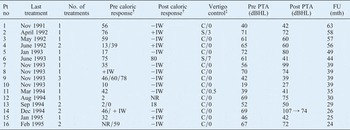
The 2-year objective audiovestibular outcomes for all 16 patients treated with intratympanic gentamicin, as documented by Pfleiderer in 1998, is duplicated in Table I.Reference Pfleiderer 6
Patient data at two years’ follow up*

* Results of intratympanic gentamicin treatment in patients with a minimum two-year follow up. †Data entries represent excitability difference percentages and/or ice water responses. ‡Data entries represent category of vertigo control post gentamicin treatment (C = complete control, S = substantial control; number values refer to number of Menieres vertigo attacks post treatment). Pt no = patient number; pre = pre-treatment; post = post-treatment; PTA pure tone average; FU = follow up; mth = months; −IW = no response to ice water stimulus; C = complete; +IW = a response to ice water stimulus; S = substantial; NR = no record. Adapted with permission. (Ref Reference Pfleiderer6)
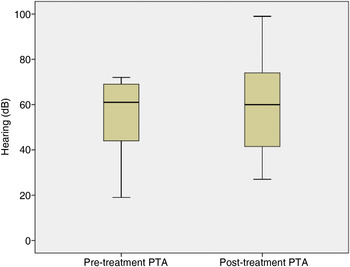
To summarise these outcomes, 14 of the 16 patients (87 per cent) experienced complete vertigo control, with the remaining 2 patients experiencing substantial control of vertigo following gentamicin treatment. Eleven patients required only one course of treatment to achieve control, four patients required two treatment courses and one patient required a three-course treatment regime. Post-treatment, all but 2 patients (6 and 13) achieved significant, measurable reduction in caloric function on the treated side. In 10 patients (62.5 per cent), treatment produced complete chemical labyrinthectomy, and there was no post-treatment caloric response to an ice water stimulus. Collectively, gentamicin treatment had little adverse impact on hearing. Hearing was unchanged in 13 patients, and in 1 patient hearing improved. Although 2 patients (7 and 14) suffered significant hearing loss in the treated ear, restoration of hearing thresholds to pre-treatment levels was achieved in 1 of these patients (patient 14) within the initial 2-year follow up. Thus, only one patient (patient 7) was left with profound sensorineural hearing loss in the treated ear two years following treatment.Reference Pfleiderer 6 A graphical representation of hearing thresholds pre- and post-gentamicin treatment is displayed in Figure 1.
Box and whisker plot showing the spread of hearing in the affected ear for all 16 patients before and after intratympanic gentamicin treatment. PTA = pure tone average (of 0.5, 1, 2 and 4 kHz)

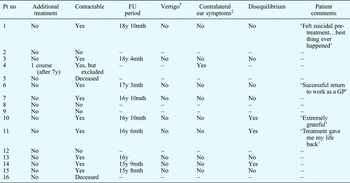
The results of the telephone follow up are summarised in Table II. Two patients (5 and 16) were asymptomatic at their last documented clinic follow up, but had died before this study was conducted. One patient (patient 4) developed Ménière's disease in the contralateral ear and underwent additional fixed-dose intratympanic gentamicin treatment seven years after the previous treatment (for the other ear) and was excluded. A further four patients (2, 8, 9 and 12) were not contactable, despite a minimum of three attempts. This left a total of nine patients.
Patient data at long-term follow up*

* Results of intratympanic gentamicin treatment in patients with a minimum follow up of 15 years and 8 months. †Any incidence of vertigo after the two-year follow up. ‡Contralateral ear symptoms included fluctuating hearing loss, aural fullness and tinnitus. Pt no = patient number; FU = follow up; y = years; mth = months
The nine eligible patients were contacted and interviewed by telephone. Follow up ranged from 15 years and 8 months, to 18 years and 10 months (a mean of 17 years and 3 months). When questioned, all nine patients had been completely free of Ménière's vertigo attacks between the time of their two-year post-treatment follow up and the time of the telephone consultation. One of these patients (patient 6) only achieved substantial control of vertigo during the immediate two-year post-treatment follow-up period (Table I), but had since enjoyed complete control of vertigo. The remaining eight patients all achieved complete vertigo control during the initial two-year follow-up period after intratympanic gentamicin treatment and continued to enjoy an absence of vertigo. All patients continued to suffer hearing loss and tinnitus in the affected ear, to which they have adjusted without problem; however, none had developed any associated symptoms of Ménière's disease in the contralateral ear. Only three of the nine patients suffered disequilibrium (patients 10, 11 and 14), but symptoms were minor with no impact on lifestyle. All patients treated for unilateral Ménière's disease with intratympanic gentamicin were delighted with their long-term symptom control; some of their comments have been included in Table II.
Discussion
The short-term benefit of intratympanic gentamicin treatment for unilateral Ménière's disease is clear, with a plethora of publications reporting the effective control of vertigo two years following completion of treatment.Reference Chia, Gamst, Anderson and Harris 2 , Reference Nedzelski, Schessel, Bryce and Pfleiderer 4 , Reference Pfleiderer 6 , Reference Cohen-Kerem, Kisilevsky, Einarson, Kozer, Koren and Rutka 8 However, there are few published reports regarding the long-term benefit and outcome of intratympanic gentamicin treatment.Reference Bodmer, Morong, Stewart, Alexander, Chen and Nedzelski 5 , Reference Beck 9
Nedzelski et al. (1992) were the first to publish a case series of patients with unilateral Ménière's disease treated with a 4-day fixed-dose protocol. The authors report 90 per cent complete vertigo control at the two-year follow up.Reference Nedzelski, Schessel, Bryce and Pfleiderer 4 The same 4-day fixed-dose protocol was used to treat the 16 patients with disabling unilateral Ménière's disease that provide the basis of this long-term follow-up report. Unsurprisingly, the results of this case series is comparable, with 87 per cent experiencing complete vertigo control after 24 months.Reference Pfleiderer 6 Complete vertigo control with this regime is more successful than other fixed-dose regimes examined in meta-analyses, which report overall success rates of between 68.7 per cent and 76.1 per cent.Reference Chia, Gamst, Anderson and Harris 2 , Reference Cohen-Kerem, Kisilevsky, Einarson, Kozer, Koren and Rutka 8
In studies reporting short-term two-year follow up for intratympanic gentamicin treatment, the majority of patients achieve complete vertigo control, and there is a clear correlation between successful vestibular ablation (absent caloric response to an ice water stimulus) and complete control of vertigo.Reference Chia, Gamst, Anderson and Harris 2 , Reference Nedzelski, Schessel, Bryce and Pfleiderer 4 , Reference Pfleiderer 6 An absent ice water response has been shown to be statistically predictive of adequate vertigo control and significantly reduces the need for further gentamicin treatment.Reference Hone, Nedzelski and Chen 10 It is assumed that caloric excitability of the horizontal semicircular canal cupula is representative of aggregate ipsilateral vestibular function, however, this may not be the case. Bodmer et al. (2007) published a minimum five-year follow-up study of patients who had received fixed-dose intratympanic gentamicin treatment. Of the 14 patients who described recurrent vertigo, 12 had an absent ice water caloric response post-treatment. Assuming that recurrent symptoms were not attributable to the development of bilateral Ménière's disease or problematic vestibulopathy, it is possible that an absent ice water caloric response is not indicative of complete vestibular ablation and that residual ipsilateral vestibular function may be responsible for recurrent symptoms.Reference Bodmer, Morong, Stewart, Alexander, Chen and Nedzelski 5
The currently reported series of patients with disabling unilateral Ménière's disease treated with intratympanic gentamicin is the longest follow-up case series to date for a 4-day fixed-dose regime. We have shown that all 9 contactable patients who met the inclusion criteria continued to be free of Ménière's vertigo attacks following a minimum follow-up period of 15 years and 8 months after gentamicin treatment. An absent ice water caloric response was achieved in six of these nine patients (Table I). In our view, this chemical labyrinthectomy, as determined by ablation of horizontal semicircular canal ampullary hair cell activity, should be the desired end point of treatment in order to guarantee long-term vertigo control.
Ménière's disease is characterised by periods of relapse interspersed by relatively asymptomatic periods that can vary in length according to the disease severity. One criticism of short-term follow-up studies is that reported successful outcomes may in fact be due to natural periods of remission rather than successful gentamicin-induced vestibular ablation. The series reported here, which followed a cohort of treated patients for a minimum of 15 years and 8 months, shows that successful control of Ménière's vertigo was attributable to gentamicin treatment rather than a prolonged period of natural remission. In addition, we have demonstrated that treatment success at two years appears to be a good predictor of long-term outcome, as there were no late failures of treatment. The development of bilateral Ménière's disease in one patient, which occurred seven years after the initial treatment, highlights the importance of considering and investigating contralateral disease, as this could easily be mistaken for late treatment failure.
A published national survey has highlighted the growing popularity of intratympanic gentamicin treatment for Ménière's disease, which showed that this treatment was favoured by 63 per cent of UK ENT surgeons.Reference Smith, Sankar and Pfleiderer 3 Intratympanic gentamicin regimes which fully ablate vestibular function on caloric testing achieve higher rates of complete vertigo control, but have a higher incidence of treatment-induced hearing loss.Reference Chia, Gamst, Anderson and Harris 2 Although only 1 out of 16 patients in our series suffered long-term profound sensorineural hearing loss (6 per cent), a low-dose, short course (9 doses over 3 days) has since been introduced to reduce the possibility of cochlear toxicity.
-
• Short-term vertigo control benefits of intratympanic gentamicin treatment for unilateral Ménière's disease are well known
-
• Few publications report long-term vertigo control outcomes following treatment
-
• Pfleiderer (1998) demonstrated vertigo control at two years' follow up in 16 patients treated with intratympanic gentamicinReference Pfleiderer 6
-
• This study reports a long-term follow up (over 15 years) with these patients; all maintained vertigo control
-
• The treatment successfully controlled severe unilateral Ménière's disease in the short and long term
There are criticisms and limitations of this report. Patients were telephoned without prior warning and voluntarily answered questions regarding their symptom control. It is possible that they had insufficient time to fully consider their symptoms following a prolonged period since treatment, or they may have under-reported any subsequent symptoms given the direct style of telephone consultation. Only one patient from the original series developed symptoms of bilateral Ménière's disease, which is lower than expected given the length of follow up. This could in part be explained by the low numbers in the series; it is possible that some patients who were not contactable and were therefore excluded from long-term follow up did develop bilateral disease. Finally, although pure tone averages in the affected ear are detailed in Table II for the two-year follow up after intratympanic gentamicin treatment, no subsequent audiological assessment was conducted as part of this long-term follow-up report.
Conclusion
We have demonstrated that intratympanic gentamicin treatment can reliably provide successful long-term control of troublesome unilateral Ménière's disease. Given its ease of administration and low complication rate, we recommend gentamicin as the treatment of choice in order to provide a long-term solution for patients whose quality of life is affected by symptomatic unilateral Ménière's disease and whose condition is refractory to medical treatment.