In the twentieth century, Jingju (‘Beijing opera’) had by far the most influence on perceptions of Chinese theatre in the West. Although by no means the first or only form of traditional Chinese theatre to take root outside mainland China, the international tours of China's most celebrated Jingju actor, Mei Lanfang (1894–1961), to the USA in 1930 and Russia in 1934, served to create a mass of critical work in Western languages that directed attention specifically towards Jingju.Footnote 1 Although attempts were made to classify Jingju as a ‘national Chinese art’ – a uniquely Chinese form in response to Westernization – within China's borders,Footnote 2 the tendency to send Jingju troupes to perform in the West has reinforced this view globally. In consequence, Jingju has functioned as shorthand for the more than three hundred forms of traditional Chinese theatre.Footnote 3
Despite attempts to homogenize the term, ‘Jingju’ itself lacks cogency. Rather than being a standardized form, since its official inception in the mid-nineteenth century, Jingju has been constantly reformed and altered. Although the Chinese state has overtly interfered with theatre practice since 1949,Footnote 4 defining Jingju as a singular set of practices has always been problematic due to the number of different schools (pai) of performance. These schools – the legacy of the artistic achievements and innovations of individual actors which currently number over eighty-fiveFootnote 5 – evidence how Jingju has existed as a multiple form since at least the early twentieth century.
Bearing this complexity in mind, this article seeks to examine how Jingju theatre practice is altered when it is performed by non-mainland Chinese organizations, specifically those that are situated in or are connected to ‘British-Chinese’ diasporas. In addition to Jingju as a heterogeneous art form, this task is further complicated by the fact that the British-Chinese community in Britain is similarly multiple and fragmentary. As Gregor Benton and Edmund Terence Gomez have observed in their important historical study of the Chinese in Britain, there is
an absence of community among the Chinese in Britain of the sort bonded by ethnic identity. In so far as an ascriptive community exists, it is divided by class, language, place of origin, period of arrival, and reason for coming, as well as by physical segregation within Britain. Not all Chinese come from China, Hong Kong, or Taiwan. They lack common genealogies or symbols, boundary markers of an ethnic community with shared identities. They lack the bonds of a common religion, unlike South Asians of the Muslim and Hindu faiths. Instead, the community is heterogeneous and individual identities are increasingly hybridised.Footnote 6
Thus, in the context of theatre practice, the diasporic communities’ shared reminiscences of Jingju are based upon access to different styles as experienced through different institutions and sociopolitical contexts, not only in Asia, but also for second and subsequent generations of ‘British-Chinese’ within the UK.
I respond to the ‘hybridization’ of ‘British-Chinese’ identities, as highlighted by Benton and Gomez, through an engagement with two hitherto undocumented UK-based traditional Chinese theatre companies: the now defunct UK Beijing Opera Society (Yingguo jingju she) and the London Jing Kun Opera Association (Lundun jing kun yanxishe). Both companies have been dedicated to the representation of Jingju on the British stage and both have included white British performers in their activities. Although ethnically mainland and non-mainland Chinese performers have featured prominently in these organizations, I focus on their white British performers in order to address the following questions: if traditional forms of Chinese theatre work to construct a transnational ‘Chinese’ identity, what happens when Jingju is performed by ethnically Chinese and/or British performers in Britain, and how might these performances connect with Jingju practice on the Chinese mainland?Footnote 7
Situating Jingju in the West: the UK Beijing Opera Society
The UK Beijing Opera Society (UKBOS) was founded in 1995 by Ione Meyer, a white British-born performer who in 1989, while studying at the Jacques Lecoq International Theatre School in Paris, became fascinated by Jingju after seeing a performance by the Beijing Jingju Company (Beijing jingju yuan). Thereafter, Meyer spent three years in China, studying Jingju at the Beijing Traditional Theatre School (Beijingshi xiqu xuexiao).Footnote 8 After her formal training, Meyer was determined to introduce British audiences to the form. She established UKBOS to ‘promote the understanding of Chinese culture in the West’.Footnote 9
Initially, Meyer's performances of Jingju took the form of solo shows set to recorded music and were offered within the context of larger ‘Chinese’ performance events: ‘variety’ shows with dance groups, martial artists, musicians and singers, coordinated by a production company called China Star. Though Meyer played an important role in co-founding China Star, she wanted to create a space where Jingju could be performed more prominently in its own right. In 1999, the arrival of two performers from mainland China helped Meyer achieve her goal. Qiu Zenghui, a versatile performer of over ten instruments who had trained at the Tianjin Traditional Theatre Academy (Tianjin xiju xueyuan) and the Chinese Traditional Theatre Academy (Zhongguo xiqu xueyuan), and had performed with the Mei Lanfang Jingju Company in Beijing, arrived in Britain within a year of Zhang Kewei, an amateur performer who, from the age of thirteen, had studied Jingju in Dalian in north-east China and had won a number of state awards for his performances. With a professional Jingju musician now able to organize and direct an orchestra, and another actor alongside Meyer, it became possible for UKBOS to consider mounting full-scale shows with Jingju as a major, or sometimes the sole, billing.
At the same time, Meyer was also increasing the society's British membership. In July 1999 she organised an intensive Jingju summer school in London, where seven British performers, academics and students were able to learn basic Jingju movements, singing techniques and music. The summer school ended in Beijing with a further three-week intensive training period with tutors from the Beijing Traditional Theatre School.Footnote 10 The recruitment of British artists, and their training in Jingju, helped the society to grow into a theatre ‘troupe’.
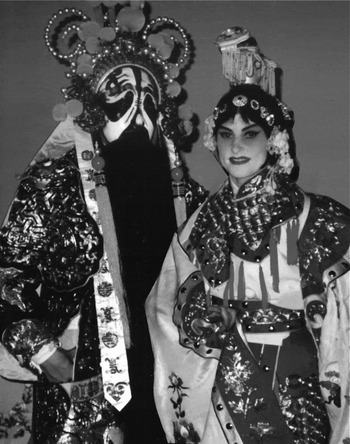
In 2000, UKBOS was invited to perform famous scenes from two staple plays of the Jingju repertoire: The White Snake (Baishezhuan)Footnote 11 and The King Bids Farewell to His Favourite (Bawang Bieji).Footnote 12 These were performed in venues across London, including the Purcell Room at the Southbank Centre and the School of Oriental and African Studies. By this time, the troupe consisted of two actors (British Meyer and Chinese Zhang) and eight musicians (four British and four Chinese). Arguably, the society's highest-profile performance took place at the Millennium Dome (now the O2 Arena) in East London. Invited to perform there by the Chinese Embassy as a part of ‘China Week’ in April 2000, the society gave four performances of The King Bids Farewell to His Favourite on the ‘Our Town Stage’Footnote 13 alongside acrobatic troupes visiting from the Chinese mainland. The show featured Meyer in the role of the concubine Yu Ji and Zhang Kewei in the role of Xiang Yu, the King of Chu (see Fig. 1). The decision to perform this play was partly based on the expertise of available actors and musicians (Meyer had studied the play intensively in Beijing), and partly on the high-profile international success of Chen Kaige's 1993 film Bawang Bieji (known in English as Farewell My Concubine), which weaves the performance of the same play into the life story of two Jingju actors as they struggle through the turbulent politics of twentieth-century China.
Zhang Kewei as Xiang Yu (left) and Ione Meyer as Yu Ji (right) in the UKBOS production of The King Bids Farewell to His Favourite (Bawang Bieji) at the Millennium Dome in 2000. Photo courtesy of Zhang Kewei.

By staging The King Bids Farewell to His Favourite to a mainly British audience already familiar with the play, UKBOS attempted to position their work in a pre-existing transglobal ‘Chinese’ culture. Yet in its exotic depiction of China's recent history, it could be argued that Chen Kaige's film was internationally successful because it confirmed the dominant Western, orientalist, view of Chinese culture.Footnote 14 Daphne Lei, in her study of transglobal Chinese theatre, comes to a similar conclusion about Chen's film, but further connects its success to the role that traditional Chinese theatre has played in constructing Chinese identity for transnational consumption. Both in and outside mainland China (and in films such as Chen's Bawang Bieji), Lei argues that traditional Chinese theatre has served as an expression of ‘Chineseness’ that has been invested with enough cultural power to render a Chinese identity visible in numerous contexts. Lei asserts that performances of Chinese theatre in the diaspora mark out Chinese identity to Chinese and non-Chinese alike, as well as providing a connection with the ‘motherland’. This analysis reveals the transcultural power that traditional forms of Chinese theatre have in constructing the supposedly authentic, always historicized, image of Chinese theatre and, by extension, of China.Footnote 15
Given the above, how are we to positively locate the performances of UKBOS within this discourse of ‘Chineseness’? The answer lies in the complex layering and recontextualization of a range of physical and cultural signifiers. The society's principal performer, Meyer, had the benefit of three years’ training with Jingju masters. Although this is a significant amount of time, it falls somewhat short of the five to eight years of training that a mainland Chinese actor would normally undertake, and this from a young age. Indeed, although the precise gestures, dance choreography, make-up and costume were performed as accurately as possible by Meyer, the citation of Jingju signifiers was Westernized by the shape of her body and, in particular, by her face. Similarly, her singing voice, while unmistakably Western in tone, signified ‘Chineseness’, both in terms of language and sonic range. In brief, the ethnicity of the actress was multilayered, rendering the performance both traditional (in so far as choreographic patterns were similar to performances found on the Chinese mainland) and unorthodox (in that it was inevitably reconfigured for a diasporic context by Meyer's own ethnicity). The audience were able to read the Jingju costume as exhibiting accepted signs of Chinese identity and at the same time understand that this was a British woman portraying a ‘Chinese’ character in a ‘Chinese’ play.
Performativity and hybridity
One might, therefore, be tempted to conclude that Meyer's performance created an explicitly hybridized body, one that reflected the diasporic context of the performance as it encompassed both ‘Chinese’ and ‘British’ ethnicities, in order to create something ‘new’. My analysis thus far supports such a conclusion. Yet how can Meyer's ‘performativity’ be positively classified as expressing the manifold hybridity of ‘British-Chinese’ diasporas? Given that Meyer is, herself, white British, can her performances have legitimacy in representing these communities? In order to tackle these issues, I turn to the theories of Judith Butler and Homi Bhabha. These enable me to demonstrate how the separation between performer and role, inherent in Meyer's performance, productively highlights the performative qualities of identity in order to set Jingju apart from its own ‘Chineseness’.
In her essay ‘Imitation and Gender Insubordination’, Judith Butler argues that gender and sexuality exist only as performed constructions which, given that an ‘original’ identity cannot be evidenced, serve to locate the notion of an original, stable, idealized identity only in the very act of its performance. Furthermore, she claims that gender performances seek legitimacy and confirmation through constructed ‘origins’ that are apparently confirmed in derivative identities (i.e. homosexuality as a product of heterosexuality, thus making heterosexuality the ‘original’). Butler points out, however, that derivatives are fundamentally inversionary since they themselves must prefigure the concept of the original, otherwise the status of ‘original’ would never need to have been claimed. Because the status of ‘original’ can only be evidenced through derivatives, gender performance constantly demonstrates its awareness of the need to verify itself as ‘original’ and, as a result, simultaneously runs the risk of being exposed as nothing more than a construction. Butler therefore argues that homosexual identities, in parodying and citing heterosexuality, demonstrate the intrinsically performative nature of all gender identity as derivative and never ‘original’.Footnote 16
Butler locates the absorption of gender imitation within early psycho-processes that suggest that identificatory mimetism pre-exists identity:
the self is from the start radically implicated in the ‘Other’ . . . The self only becomes a self on the condition that it has suffered a separation (grammar fails us here, for the ‘it’ only becomes differentiated through that separation), a loss which is suspended and provisionally resolved through a melancholic incorporation of some ‘Other’. That ‘Other’ installed in the self thus establishes the permanent incapacity of that itself to achieve self-identity; it is as it were always disrupted by that Other; the disruption of the Other at the heart of the self is the very condition of that self's possibility. Such a consideration of psychic identification would vitiate the possibility of any stable set of typologies that explain or describe something like gay or lesbian identities.Footnote 17
A reconfiguration of Butler's arguments about the self and Other into debates about constructions of ‘Chineseness’ and ‘Chinese identity’ is relatively straightforward to propose and helpful to this analysis. If the installation of the ‘Other’ within the self prevents the formation of ‘self-identity’ and calls forth the need to perform identity as an apparently stable construct (but, in doing so, inherently refers to its imminent collapse and necessary iterability), then constructs such as national identity are, like gender, merely performative acts which, through inverted imitations, are highlighted as constructions. Disruptions of self and ‘Other’, terms that in orientalism and its reverse, occidentalism,Footnote 18 pertain more precisely to geographical and cultural constructs of identity, make it possible to render explicit the derivative nature of national identities. It is a basic position of orientalism and occidentalism to outline how the ‘West’ may be considered what the ‘Orient’ is not and vice versa, and that the relationship between these conceptions of ‘self’ and ‘Other’ is key to defining self-identity. However, I would assert that the existence of diasporic communities places such derivatives in direct confrontation with each other, for communities might occupy a space which is both ‘West’ and ‘Orient’ or ‘Orient’ and ‘West’ (and yet neither at the same time), depending on political, historical, cultural and economic factors. This brings me to Homi Bhabha's conception of ‘third space’ – one in which hybridity facilitates an identification with ‘objects of otherness’ leading to a displacement of received histories.Footnote 19 It is possible, therefore, to read into Meyer's performance a hybridized body that encompasses its diasporic context by hybridizing ‘East’ and ‘West’ signifiers onto the same ‘performed’ body.
Whilst it is tempting to consider the above as celebratory of British-Chinese diasporas, the term ‘hybridity’ is, as John Hutnyk argues, problematic since it can also be bound up with the mechanism of globalized capitalism. Hybridity might be cited as a celebratory act of resistance, but it can simultaneously be exploited by the capitalist economies that seek to maintain the status quo and even erase colonial histories.Footnote 20 Although performatively hybridic, as a British-born, white, female performer, Meyer's engagement with Chinese culture might be read as an orientalist enterprise in which her own desire to learn about Jingju stems from an exotic encounter with a theatre of ‘otherness’. Indeed, whilst Meyer's hybridic performance appeared to celebrate a new level of cultural understanding between Britain and China, it might be argued that Meyer was merely indulging herself in what I call ‘acting Chinese’, a Chinese equivalent of blackface minstrelsy that was prevalent in early twentieth-century British theatre productions such as San Toy; or, The Emperor's Own (1899) and See See (1906), which offered ‘British’ perceptions of China rather than ‘Chinese’ perceptions of Britain.
Yet the above reading does a considerable injustice to Meyer's motives for trying to educate the British public about Jingju; it belies her work with many artists (especially musicians) from the British-Chinese diaspora and, further, fails to take account of the fact that Meyer was the only active Jingju actress working in Britain at the time. Whilst it must be acknowledged that Meyer's ‘third space’ is performed, temporary and vulnerable to dominant constructions of identity, the real importance of Meyer's performance lies in its challenge to the received orthodoxy that there is an ‘authentic Chinese theatre’.
The notion of the ‘authentic’ might appear an outdated one, but there is evidence to demonstrate its persistence, especially in the mainstream media. In June 2008, for instance, when the Suzhou Kunju Company (Suzhou kunju yuan) staged a performance of Peony Pavilion (Mudanting) at the Sadler's Wells Theatre in London, Judith Mackrell of the Guardian (an important national newspaper) previewed the performance as ‘authentic kunqu’Footnote 21 and a large advertisement in London's Metro newspaper, billed the performance as ‘a truly authentic taste of Chinese culture’.Footnote 22 Although one might be tempted to dismiss these as simply marketing, it remains very likely that they had an impact upon the ways in which British audiences framed the performance.
The conception of ‘authentic’ Chinese drama as coming from China has important ramifications for Meyer's performance. If a troupe from China is considered ‘authentic’ because it consists of ethnically Chinese actors, then it follows that Meyer's performance is ‘inauthentic’ because she is not Chinese. Meyer's hybridic performance instigated, to paraphrase Bhabha, a new creative ‘third’ space that challenged dominant perceptions of the homogeneity of traditional Chinese theatre.Footnote 23 For, in constructing Meyer's performance as ‘inauthentic’, what at first suggests inferiority in the face of the ‘authentic original’ actually becomes a tool of deconstruction in the best sense of ‘hybridity’. By drawing together Butler and Bhabha's perspectives, it can be argued that Meyer's hybridic performance demonstrated the performativity of ‘Chineseness’ encompassed within Chinese theatre styles such as Jingju and Kunju. By recontextualizing Jingju onto a Western body, Meyer's performance rendered the mechanics of identity citation visible via a process of deconstruction rooted in parody or, to put it another way, a highly performative ‘third space’ that implicitly critiqued the identity formations that constructed it. In Meyer's performance it was possible to read across the signifiers of Jingju that symbolize ‘Chineseness’ and recognize that they were ‘acted’.
Highlighting the performativity of ethnic identities is significant in diasporic performance contexts. Although Chinese diasporas are, themselves, decentred multiplicities with differing geographical, cultural, ethnic and linguistic heritages,Footnote 24 it is nevertheless the case that they are rendered visible within the ‘host’ country by a narrow range of signifiers grounded in the spiritual, the ancient and, especially in Britain, the culinary. This leads to a paradox in which a sense of communal identity is constructed, established and expressed through reductive orientalist signifiers for oppression by, and the consumption of, the ethnically white dominant classes. As a result, whilst the performance of Jingju in Britain might be used as a means to collectivize the ‘British-Chinese’ diaspora around an apparently stable transnational signifier of ‘Chineseness’, Meyer's own performance simultaneously deconstructed that signifier, highlighted the derivative nature of Chinese identity as fundamentally connected to the ‘Other’ within the self, and showed that identity is at the mercy of dominant modes of (orientalist) identity signification.
Meyer thus embodies an important contradiction since her performance at once disputes the natural ‘Chineseness’ of Jingju, but both asserts and refutes a fixed identity for ‘British-Chinese’ diasporic communities. This contradiction is apparent in some of the more innovative productions staged by Meyer and UKBOS. In 2001 she organized a performance of The Unicorn Purse (Suo Ling Niang) at the Purcell Room in London.Footnote 25 With a Jingju actress from China taking the leading role of Xue Xiangling, Meyer played the role of Zhou Daqi, Xiangling's son (it is not uncommon for an actress to perform the role). What was innovative about this performance was that it was staged in both Chinese and English. Normally, the character of Xiangling speaks in yunbai, a stylized form of Chinese speech frequently used in Jingju that has a greater pitch range than the standard Mandarin Chinese (Beijing) dialect, and has a musical air that lends the pronunciation of words a ‘sung’ quality.Footnote 26 Although the character of Xiangling sang in Chinese, she spoke in English and used the tonalities of yunbai pronunciation, especially the rising tone at the end of a sentence (a marked feature of yunbai), to structure how the lines were delivered. Meyer, as the son Daqi, spoke in colloquial English that corresponded to jingbai, a style of Jingju speech similar to contemporary colloquial Mandarin. In choosing to stage the play this way, Meyer empowered British (and ‘British-Chinese’) audiences to understand the techniques of Jingju performance without the language barrier. Audiences could differentiate the extremes in tone demanded by yunbai as separate from Chinese language, and as integral to the stylistic devices of the Jingju form. However, Meyer once again walked a fine line between offering a challenging hybrid and an exotic orientalist ornament. From seeing the performance myself, I felt that the contortions of ‘yunbai English’ sounded strange alongside Meyer's conventional use of colloquial English, and what might have celebrated hybridity on the one hand may, on the other, because of the audience's lack of understanding of what yunbai actually is, also have alienated and rendered Jingju exotic. Whilst such an ambitious approach to staging is by no means unique,Footnote 27Jingju performed in English does, at least, reflect its diasporic conditions of performance. In doing so, it opens a hybridic space that situates traditional Chinese theatre apart from its own ‘Chineseness’ and calls into question the stability of markers of ethnic identity.
Constructing a community: the London Jing Kun Opera Association
In 2006, Meyer emigrated to America and UKBOS disbanded. In its wake, a younger organization was left to represent Jingju in Britain: the London Jing Kun Opera Association (LJKOA). LJKOA was formed in 2002 by Kathy Lee Hall, a Hong Kong Chinese amateur actress and theatre enthusiast who settled in Britain in 1997. Hall was instrumental in founding the Hong Kong Peking Opera Club – an organization that provided opportunities for Jingju fans to meet, watch performances and eventually train under Jingju professionals living in Hong Kong. Hall trained in the dan (female) role for a number of years and performed as an amateur. After moving to Britain, Hall came into contact with Meyer and other members of UKBOS. Although Hall had performed with Meyer in a scene from The White Snake at the Purcell Room in London in 2000,Footnote 28 she was eager to introduce a society that engendered community and enabled Jingju fans to socialize. With so few trained musicians and performers in Britain and opportunities to perform relatively scarce, it was inevitable that the performers and musicians who worked with UKBOS would also work alongside Hall and LJKOA.
LJKOA's aim is to engage British audiences in a sustained way and to challenge British perceptions of Jingju as the one and only form of traditional Chinese theatre. By staging performances of Kunju, a form that pre-existed Jingju, LJKOA set about revealing the plurality, rather than singularity, of traditional Chinese theatre. In contrast to UKBOS, which had functioned as an ad hoc network that came together solely to perform, Hall introduced a membership programme for cultural events and social networking. Members might book a few tables at a restaurant or meet at one another's houses, watch Jingju or Kunju DVDs, have a meal and organize basic actor-training rehearsals. In addition, Hall organized a schedule of educational workshops at schools and colleges initially in London, and then across the UK. With a track record of public engagement, LJKOA was able to apply for grants from publicly funded bodies, and eventually managed to establish itself as a not-for-profit arts organization. Although only occasionally funded by local councils and through one-off grants, LJKOA continues to raise funds for equipment, to hire rehearsal spaces, to import props and costumes from China and, most importantly, to pay freelance artists to work creatively with the organization.Footnote 29 Living precariously from grant to grant (typically of a kind that lasts between six months and a year), LJKOA has nonetheless managed to survive and to grow. As a measure of the association's achievement and to celebrate its fifth anniversary in September 2007, LJKOA organized a celebratory performance at the Jerwood Vanburgh Theatre at the Royal Academy of Dramatic Art in London. The event consisted of both full-scale performances by LJKOA founders (including Hall), and performances from some of the more than forty members, including Chinese, ‘British-Chinese’ and white British participants, who sang songs or enacted short excerpts from Jingju and Kunju plays.
The only ethnically British actor to participate in the fifth anniversary performance was Gareth Simpson, who performed the dan (female) role. Simpson had been interested in Jingju for a number of years before coming into contact with Hall at the Peking Opera Club during a visit to Hong Kong in the early 1990s. Hall introduced Simpson to local Jingju professionals who, after much experimentation, found that the qingyi (‘refined female’) role suited him best. Due to work commitments in Britain, training in China was limited to short annual visits with established Jingju teachers, but Simpson was nevertheless able to develop a modest repertoire of qingyi plays.
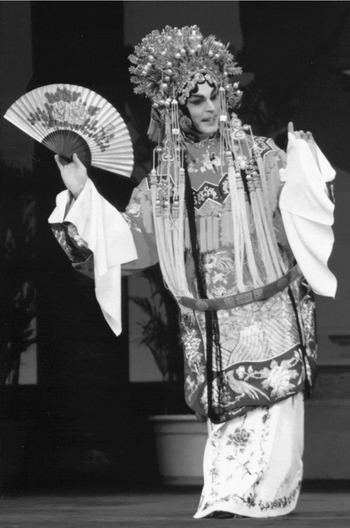
Like Meyer, Simpson's performance highlighted the performativity of ethnicity. Upon his entering the stage as Lady Guifei from The Drunken Imperial Concubine (Guifei Zuijiu), the audience (consisting of mainly ethnic Chinese) gasped and applauded. Such a reaction is a conventional part of Jingju performance on the Chinese mainland: the audience usually welcomes the actor when he/she first appears on stage, especially if they are famous. This act of welcoming highlights the extent to which the actor is read as both ‘character’ and ‘actor’. In this particular instance, the moment of welcome was also conditioned by an acknowledgement of his Western ethnicity; the audience gasped at the accuracy of the citation of Jingju on Simpson's Western body. Simpson is comparatively tall and his Western face beamed out at the audience from behind the thick layers of make-up (see Fig. 2). Thus, rather than simply applauding the actor as ‘actor’, the audience also applauded the citation of ethnicity on the actor (or the actor as ‘actor’ as ethnic ‘actor’). This display of the performativity of ethnicity was but one aspect of Simpson's ‘performative’ performance, since as an actor of the female role, he also cited gender performatively. The result was a multilayered performance at once deconstructive of ethnicity and gender, and also highly conventional within the confines of Jingju practice.
Gareth Simpson performing the role of Lady Guifei from The Drunken Imperial Concubine (Guifei Zuijiu). Photo courtesy of Gareth Simpson.

The conventions of stage transvestism, of course, differ according to the sociocultural and political context in which it is performed. In the West, onstage transvestism is normally associated with anti-naturalistic practices: the enjoyment of the transgression is predicated on the audience to some extent acknowledging the gender pretence of the actor. In mainland China, despite the emergence of female actors playing the dan role from the early twentieth century onwards, the canon of the four greatest dan actors in Jingju still consists of men.Footnote 30 In her study of the emergence of star traditional Chinese theatre actors, Isabelle Duchesne has shown how gender pretence by male actors seeped into everyday life, and how discreet homosexual favours offstage maintained the illusion perfected onstage.Footnote 31 Although the rigours of strict training demanded a blurring between art and life in order to facilitate a close connection between actor and role, Duchesne proceeds to outline how dan actors began to employ a more self-conscious artistic style in their work in the 1920s. Actors drew upon their own personality whilst considering the quality of movement for the character they would portray.Footnote 32 Implicit within this move is the conception of ‘femininity’ as an increasingly shifting performative multiplicity. The audience's belief in the actor's gender performance as ‘genuine’ was at odds with the subtle, but nevertheless discernible, discrepancy between gender performances as enacted by different (male) actors. This contradiction, rather than being a purely historical product, persists to this day, since the styles of acting established by these (male) actors continue to be used as a basis for performance, even by contemporary female dan actors.
In returning to Simpson's performance, I would argue that the reaction to his stage entrance acknowledged an important contradiction. It signalled an appreciation for the mainland tradition of transvestism and connected Jingju back to the ‘golden age’ of Mei Lanfang in the first half of the twentieth century. However, by being placed on a non-Chinese body, the intrinsically performative construction of femininity, already latent in Jingju practice per se, was more clearly discernible. It is also possible that the audience simultaneously acknowledged the ethnic pretence of Simpson's performance whilst overlooking his gender pretence as a conventional part of Jingju. Simpson could thus be seen to occupy a disjuncture between the historical and the present-day, between the conventional act of cross-dressing in Jingju's heyday on the Chinese mainland and the contemporary British diasporic context of his own performance. This made Simpson's performance ‘fragmentary’, because he elicited two opposing sets of responses.Footnote 33 This ‘rupture’ expressed a hybridic identity in which Jingju's ‘Chineseness’ was both acknowledged and reconfigured for the diaspora.
Conclusion
The emergence of white British performers of Chinese theatre can be regarded as playing a significant part in highlighting the conception of Jingju as a problematic signifier of a transnational ‘Chinese identity’ while simultaneously demonstrating how Chinese identity is, to draw once again on the work of Butler, a ‘derivative’. Indeed, Bhabha's assertion that hybridity ‘denies the essentialism of a prior given original or originary culture, [so that] we see that all forms of culture are continually in the process of hybridity’,Footnote 34 is useful in accounting for how hybridic performances seek to unsettle the status quo and undermine identity essentialisms. Whilst Jingju might be considered a ‘national art’ in China, its conception as such is intertwined with the influx of Western theatre from the early twentieth century. In turn, performances of Jingju by ethnically white British performers reflect the circumstances of their diasporic audience, encompassing Eastern and Western identity tropes into a local style of Jingju that is at once communal (functioning to affirm a ‘British-Chinese’ identity to those who choose to subscribe to it), deconstructive (highlighting identity as a performative act and asserting independence from ethnic Chinese/transnational identity stereotypes) and yet still related to dominant constructions of national identity in mainland China (Jingju as a ‘national art’).