Introduction
Lizards represent a diverse group of reptiles that interact with a great diversity of organisms and are considered key components of the ecological communities (Pianka & Vitt, Reference Pianka and Vitt2003). These vertebrates occur in several types of natural environments, in which the species have developed efficient adaptations to live under diverse ecological conditions (Otávio et al., Reference Otávio, Silva, Santos, Simões, Silva, Campelo, Melo and Freire2018) and are hosts for a wide variety of parasitic organisms, especially nematodes (Okulewicz et al., Reference Okulewicz, Kaźmierczak, Hildebrand and Adamczyk2015; Da Silva et al., Reference Da Silva, Xavier, dos Santos Carvalho, dos Anjos, Machado and Dos Reis Dias2021). Currently, about 295 lizard species have been reported in the Northeast of Brazil (Costa et al., Reference Costa, Guedes and Bérnils2021) and, although knowledge about the parasite fauna of these reptiles has improved in recent years (Lacerda et al., Reference Lacerda, Santana, de Araujo Filho and Ribeiro2023), their ecological patterns and the mechanisms behind them remain poorly understood.
It is well established that temporal variations, host body size, diet, and sexual differences, environmental conditions, and parasite transmission strategies are key factors shaping the structure of parasite communities in lizards (Aho, Reference Aho, Bush, Fernández, Esch and Seed1990; Pietrock & Marcogliese, Reference Pietrock and Marcogliese2003; Thieltges et al., Reference Thieltges, Jensen and Poulin2008; Brito et al., Reference Brito, Ferreira, Ribeiro, Anjos, Almeida, Mesquita and Vasconcellos2014a,Reference Brito, Ferreira, Ribeiro, Anjos, Almeida, Mesquita and Vasconcellosb; Araujo-Filho et al., Reference Araujo Filho, Brito, Lima, Pereira, Mesquita, Albuquerque and Almeida2017). Furthermore, parasite communities may be influenced by phylogenetic relationships among hosts, which Janovy et al. (Reference Janovy, Clopton and Percival1992) consider as the phylogenetic component of parasite assemblages. This has been observed in lizard parasite communities (Ávila & Silva, Reference Ávila and Da Silva2013), but the approach is still little explored in this group of hosts.
Lizards of the genus Ameiva Meyer, 1795 are found in Central and South America, and in the West Indies, being active foragers that occupy a great variety of environments, from open savannas to tropical forests (Hower & Hedges, Reference Hower and Hedges2003). The genus Ameivula Harvey, Ugueto & Gutberlet, 2012 in which some species of Cnemidophorus Wagler, 1830 were relocated, occurs in the Brazilian Caatinga (Silva & Ávila-Pires, Reference Silva and Avila-Pires2013), being widely distributed in the Northeastern Brazil, and contains species that are also active foragers, occupying open vegetation areas and sandy soils (da Silva et al., Reference Da Silva, Manoel, Uieda, Ávila and Da Silva2019). Tropidurus Wied-Neuwied, 1820 is a genus of lizards widely distributed in South America, comprising about 30 species, mostly with generalist habits, and some of them have restricted distribution (Lambertz et al., Reference Lambertz, Kohlsdorf, Perry, Ávila and da Silva2012). Ameiva, Ameivula, and Tropidurus have been associated with a great diversity of parasites, especially nematodes (see Lacerda et al., Reference Lacerda, Santana, de Araujo Filho and Ribeiro2023).
The parasitic fauna of the lizards Ameiva ameiva, Ameivula sp. (ocellifera complex), and Tropidurus hispidus has been extensively investigated (see Ávila & Silva, Reference Ávila, Souza and Da Silva2010; Lacerda et al., Reference Lacerda, Santana, de Araujo Filho and Ribeiro2023). However, there is no specific approach that associates the theories developed by Janovy et al. (Reference Janovy, Clopton and Percival1992) with their parasitic communities; there is only a brief comparative evaluation of the parasitic communities of these lizards, published almost 30 years ago (Van Sluys et al., Reference Van Sluys, Rocha, Bergallo, Vreibradic and Ribas1997). To better understand the influence of ecological and phylogenetic components (sensu Janovy et al., Reference Janovy, Clopton and Percival1992) on the structure of lizard parasitic communities, we evaluated the component communities of parasites of A. ameiva, Ameivula sp. (both Teiidae), and T. hispidus (Tropiduridae), in an area of Caatinga, Ceará State, Brazil, using a comparative approach.
Materials and methods
Study area
The samples were collected at the Minguiriba site (7°18′58.6″S; 39°37′22.1″W), a rural community belonging to the municipality of Crato, Ceará State, Brazil (Fig. 1), located in the eastern portion of the Chapada do Araripe, whose phytophysiognomy is characterized by xerophic vegetation, predominantly constituted by branched shrubs with large and thin stems, rarely thorny, with spaced trees, on the edge of the Araripe National Forest (FLONA-Araripe) (Figure 1). The area is within the Caatinga domain and covered by Carrasco’s peculiar phytophysiognomy, which is characterized by dry, sandy soil with low fertility and dense xerophic vegetation, consisting predominantly of branched shrubs with large, thin, rarely thorny stems, with spaced trees, composed of plants typical of the Caatinga and Cerrado, except for Cactaceae and Bromeliaceae, which are rare (Andrade-Lima, Reference Andrade-Lima1978; Araújo et al., Reference Araújo, Sampaio, Figueiredo, Rodal and Fernandes1998; Souza et al., Reference Souza, da Silva, de Menezes, Ribeiro, Bezerra and De Almeida Souza2014). The soil is dry and sandy, with low fertility, composed of deep quartz sands (Araújo & Martins, Reference Araújo and Martins1999). The climate is classified as tropical humid and dry (Souza et al., Reference Souza, da Silva, de Menezes, Ribeiro, Bezerra and De Almeida Souza2014).
Location of the collection area in the community of Minguiriba, municipality of Crato, State of Ceará (A, B, C), Northeast region of Brazil, and images (D, E) showing the type of vegetation and soil in the collection areas.

Field collections, host, and parasite processing
Collections were carried out from April to October 2021, with a sampling effort totalling 30 days. The lizards were captured using pitfall and interception traps (120 30-liter buckets, distributed in 25 Y-shaped groups each), as well as through active searches conducted during the day and night. After capture, the specimens were taken to the laboratory, euthanized with an injection of 2% lidocaine, measured (snout-vent length [SVL]), sexed, fixed in 10% formaldehyde, and preserved in 70% alcohol. In the laboratory, the lizards were necropsied, and their body cavities and respiratory and gastrointestinal tract organs were individually analysed under a stereomicroscope to search for helminth parasites. All procedures involving animals were authorized by the Chico Mendes Institute for Biodiversity Conservation (ICMBio), through the Biodiversity Authorization and Information System (SISBIO 78313-1), and access to genetic heritage registered in the National System for the Management of Genetic Heritage and Associated Traditional Knowledge (SisGen AFEBD82).
The endoparasites (from now on ‘parasites’) found were washed in saline solution, counted, and fixed in 70% ethanol. For morphological examination and taxonomic identification at the lowest possible level using light microscopy, the parasites were processed using standard parasitological techniques and then mounted on temporary slides using lactic acid (for nematodes) and acetic carmine (for cestodes) (see Yamaguti, Reference Yamaguti1959; Rêgo & Ibañez, Reference Rêgo and Ibáñez1965). Taxonomic identification of the parasites was based primarily on Vicente et al. (Reference Vicente, Rodrigues, Gomes and Pinto1993) and Anderson et al. (Reference Anderson, Chabaud and Willmott2009), and specific literature in some cases. Parasites and host carcasses were deposited in the Herpetological Collection of the Federal University of Cariri – CHERP – UFCA.
According to the recommendations of the International Code of Zoological Nomenclature, to avoid confusion in the textual identification of taxa with similar generic abbreviations, the following abbreviations were used: A. for Ameiva, P. for Pharyngodon, Pa. for Parapharyngodon, and Ps. for Physaloptera.
Ecological and statistical analysis
Since the sex and body length of lizards usually influence the structure of parasite communities (see Aho, Reference Aho, Bush, Fernández, Esch and Seed1990; Brito et al., 2014; Araujo-Filho et al., Reference Araujo Filho, Brito, Lima, Pereira, Mesquita, Albuquerque and Almeida2017), we firstly tested if lizard SVL was associated with their sex and species. For this purpose, we used a generalized linear model (GLM) Quasi-Poisson, considering SVL as dependent variable, and sex (female as reference category) and species (A. ameiva as reference category) as independent variables, with and without interaction (Dohoo et al., Reference Dohoo, Martin and Stryhn2003; Zar, Reference Zar2010). To evaluate if the independent terms of the model were adequate for the model, we used stepwise methods (in both directions) based on the Akaike information criterion (Dohoo et al., Reference Dohoo, Martin and Stryhn2003; Zar, Reference Zar2010). The odds ratios (OR) of the model and of the independent terms, with 95% confidence interval, were estimated to evaluate the relationships between dependent and independent variables, where 0 < OR < 1 indicates an antagonistic relationship, OR = 1 indicates the absence of relationship, and OR > 1 indicates a concordant relationship (Dohoo et al., Reference Dohoo, Martin and Stryhn2003).
The terminology related to parasite ecology followed the proposal of Bush et al. (Reference Bush, Lafferty, Lotz and Shostak1997). The following population descriptors were estimated: prevalence, abundance, and mean abundance (MA). The following community descriptors were estimated: species richness, diversity (measured by the Brillouin index, HB), dominance (measured by the Berger-Parker index, d), and uniformity (measured by the Piellou index, J’) (Magurran, Reference Magurran2004). The distribution of parasite species within the host populations was evaluated using the discrepancy index (D), which ranges from 0 to 1, where 0 indicates a fully random distribution and 1 a fully aggregated distribution (Poulin, Reference Poulin1993). Population and community descriptors were calculated according to each lizard host species, i.e., component populations and communities were considered according to host species.
Based on the preliminary analysis previously mentioned, we evaluated possible influences of host SVL, species, and sex in parasite richness, HB, d, and J’. In this case, we used zero-inflated GLMs, considered the parasitological descriptors as dependent variable, and host SVL, species, and sex as independent variables. The methodological details were as previously described.
For the parasite taxa that were present in more than one host species, we evaluated the differences in their abundance and prevalence according to each component population. Differences in the parasite abundance were tested using Poisson GLMs, considering the abundance dependent and host species independent. Differences in the parasite prevalence were tested using logistic regressions, considering the prevalence dependent and host species independent (Dohoo et al., Reference Dohoo, Martin and Stryhn2003; Zar, Reference Zar2010). The other methodological details were as previously described, except that the stepwise method was not used, since there was only one independent term in the models.
The similarity among parasite infracommunities was evaluated quantitatively (based on abundance transformed by log[x+1]) and qualitatively (presence/absence), using Bray-Curtis and Jaccard distances, respectively (Magurran, Reference Magurran2004). The analysis of similarities (ANOSIM) was performed, considering host species as a factor, based on Bray-Curtis and Jaccard ranked similarity matrices, with 10,000 permutations, to evaluate if the similarities among the parasite infracommunities differed according to host species (Magurran, Reference Magurran2004). To generate graphical representations of distances related to the composition of parasite assemblages (at infracommunity level) according to host species, we performed non-metric multidimensional scaling (NMDS) with fit ordinations quantified by stress value, and cluster analysis with SIMPROF test based on 10,000 permutations, using ranked Bray-Curtis and Jaccard similarity matrices (Clarke & Gorley, Reference Clarke and Gorley2006; Clarke et al., Reference Clarke, Somerfield and Gorley2008). In NMDS and cluster analysis, we excluded those hosts that were not infected by any parasite to avoid graphic distortions.
To evaluate if the host identity could discriminate the parasite communities, and which parasite taxa could be related to such discrimination, we performed canonical discriminant analysis (CDA) for the quantitative data based on parasite abundance (log[x+1] transformed), and for the qualitative data based on presence/absence of parasites (logit transformed). Box’s test was used to evaluate the homogeneity of covariance matrices (significance of p < 0.001), Wilks’ lambda was used as the test statistic of the multivariate models, and Fisher’s linear discriminant function was used to classify the parasite taxa responsible for host population identity (Bose, Reference Bose2009; Gower et al., Reference Gower, Le Roux and Gardner-Lubbe2014). We used the Mahalanobis distance because the number of host individuals per species and parasites (both abundance and presence/absence) per host were unbalanced, and the Wilks lambda was used because the Box’s test indicated homogeneity of the covariance matrices, with p < 0,001 as the significance level for greater robustness (Bose, Reference Bose2009; Gower et al., Reference Gower, Le Roux and Gardner-Lubbe2014).
Similarity analyses including calculation of Bray-Curtis, Jaccard, ANOSIM, and generation of cluster and NMDS graphics were performed in Primer 6 (Clarke and Gorley, Reference Clarke and Gorley2006). All the other analyses were performed in RStudio (interface of R software), using the packages candisk, car, FactoMineR, factoextra, ggplot2, hplots, MASS, and nnet (Venables & Ripley, Reference Venables and Ripley2002; Friendly, Reference Friendly2007; Lê & Husson, Reference Lê, Josse and Husson2008; Wickham, Reference Wickham2016; Fox & Weisberg, Reference Fox and Weisberg2018; Kassambran & Mundt, Reference Kassambara and Mundt2017; Friendly & Fox, Reference Friendly and Fox2021; Posit team, 2025). Significance level of p was 0.05, unless otherwise stated.
Results
A total of 139 lizards were collected: 67 Ameivula sp., 49 T. hispidus, and 23 A. ameiva. The preliminary analysis indicated significant differences among lizard SVL, in which A. ameiva was the largest (SVL = 125.00 ± 18.03 mm; reference category in the model), followed by T. hispidus (SVL = 88.12 ± 17.32 mm; p < 0.001, OR = 0.65, CI = 0.60–0.70) and Ameivula sp. (SVL = 60.53 ± 6.11 mm; p < 0.001, OR = 0.49, CI = 0.45–0.53). Host sex interacted only with the species T. hispidus, in which males (SVL = 97.8 ± 17.1 mm) were larger than females (SVL = 80.8 ± 13.7 mm) (p < 0.001, OR = 1.19, CI = 1.08–1.31).
Sixty-eight lizards were parasitized by at least one taxon of parasite. A total of 1,809 parasite specimens were obtained, all of them helminths: 13 belonging to the Nematoda and only 1 belonging to the Cestoda (Table 1). All parasites were adults, except Onchocercidae gen. sp., which were represented by larval stages and, along with Piratuba sp., were the only parasites in the body cavity of their hosts (Table 1). The remaining taxa were found in the gastrointestinal tract of the lizards (Table 1). The most prevalent and abundant parasite was Pharyngodon travassosi infecting A. ameiva; this species was also the most prevalent and abundant in the component community of parasites from Ameivula sp.; the second most prevalent and abundant parasite was Parapharyngodon alvarengai infecting T. hispidus (Table 1). The other parasite taxa showed low prevalences (<12.2%) and mean abundances (<1.1, mostly 0.05) (Table 1). All parasites were highly aggregated within their host populations, except P. travassosi in the population of A. ameiva, which tended to show a disperse (random) distribution (Table 1).
Host species associated with number of individuals analysed (N), parasite taxa, site of infection (SI), prevalence (P), mean abundance (MA) followed by ± standard deviation (range), and discrepancy index (D)

Bc, Body cavity; Li, Large intestine; Si, Small intestine; St, Stomach.
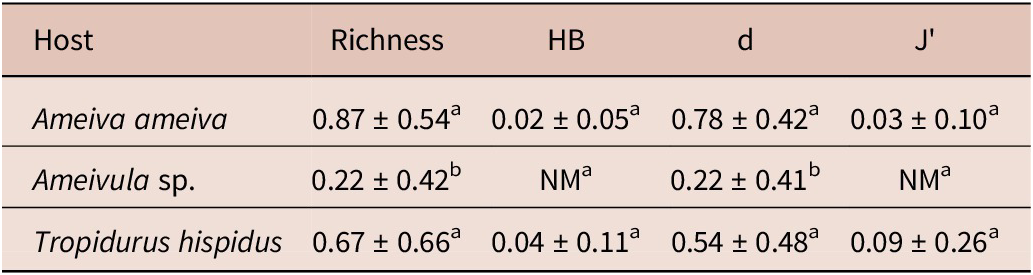
Richness and diversity of the component communities of parasites, from each lizard species, were markedly low, to the point that the mean HB of the parasite component community of Ameivula sp. tended to zero (Table 2). The richest and most diverse parasite component community was A. ameiva, followed by that of T. hispidus, and that of Ameivula sp. However, the only statistical difference was observed in the mean species richness of the parasite component community of Ameivula sp. (p < 0.001, OR = 0.25, CI = 0.14–0.44), which was the smallest when compared with that from the other two host species (Table 2). The parasite component community of A. ameiva, T. hispidus, and Ameivula sp. showed high, intermediate, and low mean dominance, respectively, and the mean evenness was low in all of them (Table 2). The dominance was statistically lower in the parasite community of Ameivula sp. (p < 0.001, OR = 0.29, CI = 0.17–0.48) when compared with that of the other two host species (Table 2). Host SVL was positively associated with parasite richness (p < 0.001, OR = 1.02, CI = 1.01–1.03) and dominance (p < 0.001, OR = 1.02, CI = 1.01–1.03).
Mean values ± standard deviation of parasite richness, diversity measured by Brillouin index (HB), dominance measured by Berger-Parker (d) index, and evenness measured by Pielou index (J'), from each component community according to host species. Different superscript letters (a, b) indicate statistical differences in values according to each column

NM: Not measured because values were too small, tending to zero.
The nematode Physaloptera retusa was the only parasite common to the three lizard species, and its prevalence was statistically higher in T. hispidus (p = 0.03, OR = 8.4, CI = 1.12–63.2), but the abundance was similar among all hosts. Pharyngodon cersarpintoi and Parapharyngodon sp. occurred in A. ameiva and T. hispidus, in which their prevalences were statistically similar, but their abundances were statistically lower in T. hispidus (p < 0.001, OR = 0.40, CI = 0.18–0.86; p < 0.001, OR = 0.07, CI = 0.02–0.22). Pharyngodon travassosi was common to A. ameiva and Ameivula sp., being less prevalent (p < 0.001, OR = 0.14, CI = 0.05–0.39) and abundant (p < 0.001, OR = 0.10, CI = 0.09–0.11) in this latter. Finally, Pa. alvarengai infected T. hispidus and Ameivula sp., showing higher prevalence (p < 0.001, OR = 37.3, CI = 23.7–99.8) and abundance (p < 0.001, OR = 58.8, CI = 14.5–238.8) in the first.
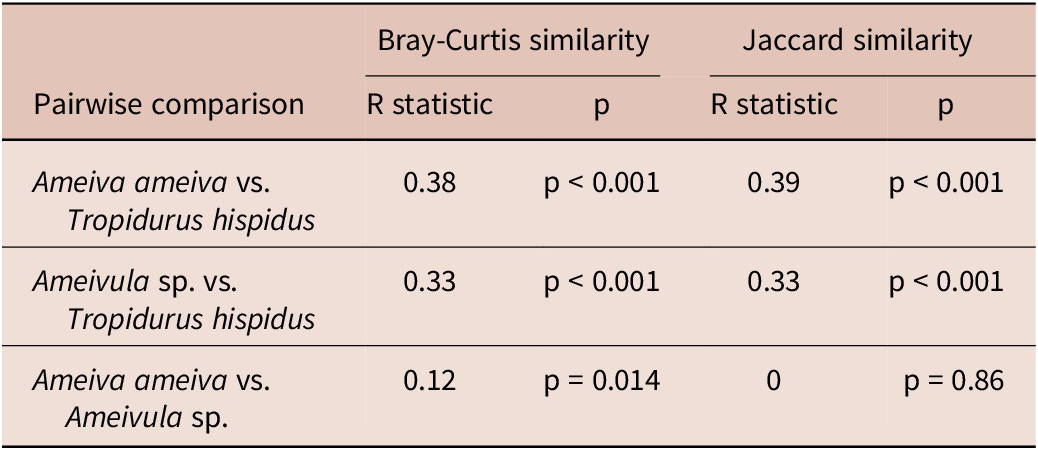
The ANOSIM indicated a general low strength of the host species as a factor in the infracommunities of parasites, considering both abundance (Global R = 0.28) and presence/absence data (Global R = 0.26); however, the similarities among the parasite infracommunities could be differentiated according to host species (p < 0.001). In this sense, the parasite infracommunities of A. ameiva and Ameivula sp. were more similar to each other when compared with those of T. hispidus, considering abundance and presence/absence data (Table 3). The graphical representations of the similarities among the parasite infracommunities indicated similar patterns to that indicated by ANOSIM, for both abundance and presence/absence data (Figs 2A, B, D, E); although some of these infracommunities were randomly distributed without grouping according to host species, regarding both abundance and presence/absence data, there was a tendency of proximity between those infracommunities of parasites from A. ameiva and Ameivula sp., whereas those from T. hispidus were more isolated and closer to each other (Figs. 2A, B, D, E).
Results of the analysis of similarities (ANOSIM) with 10,000 permutations, for qualitative (Jaccard) and quantitative (Bray-Curtis) similarities, estimated at infracommunity level and considering lizard species as factor. Level of significance is p < 0.05.

Cluster analysis (A, D), non-metric multidimensional scaling (B, E), and canonical discriminant analysis (C, F) based on abundance and presence/absence of parasites, respectively. In the cluster analysis (A, D) only significant clades (SIMPROF. p < 0.05; 10,000 permutations) are shown, percentage values indicate proportion of infracommunities from each host species in a clade. In the canonical discriminant analysis, parasite taxa that can be used as identifier of host population are indicated. Geometric figures indicate infracommunities by host species.

CDA analysis using parasite abundance indicated five taxa as identifiers of host populations (p < 0.001 of Wilks lambda; p = 0.009 of Box’s test) (Fig. 2C). The canonical correlation of function 1 was 0.72 (auto value = 1.05) and of function 2 was 0.44 (auto value = 0.24), both statistically significant (p < 0.001 of Wilks lambda). The functions 1 and 2 in group centroids of A. ameiva were 2.17 and 0.34, respectively; those of Ameivula sp. were −0.13 and −0.50, and those of T. hispidus were −0.84 and 0.52. Fisher’s linear discriminant function indicated high correlation of Strongyluris orcari and Pa. alvarengai with the population of T. hispidus, as well as high correlation of Ph. travassosi, Pharyngodon sp., and Onchocercidae gen. sp. with the population of A. ameiva (Figure 2C). No parasite taxa could be correlated with the population of Ameivula sp. (Figure 2C), according to Fisher’s linear discriminant function. Similar to the results of NMDS and cluster analysis, CDA based on abundance displayed a tendency for parasite infracommunities of A. ameiva and Ameivula sp. to be closer in relation to those of T. hispidus, and a few infracommunities were randomly displaced (Figure 2C). The accuracy and sensitivity of CDA based on parasite abundance were 96.2% and 94.7%, respectively.
CDA analysis using qualitative data (presence/absence) indicated four parasite taxa as identifiers of host populations (p < 0.001 of Wilks lambda; p = 0.006 of Box’s test) (Figure 2F). The canonical correlation of function 1 was 0.65 (auto value = 0.73) and of function 2 was 0.37 (auto value = 0.16), both statistically significant (p < 0.001 of Wilks lambda). The functions 1 and 2 in group centroids of A. ameiva were 1.54 and 0.52, respectively; those of Ameivula sp. were 0.15 and −0.41, and those of T. hispidus were −0.94 and 0.31. The results of Fisher’s linear discriminant function were similar to those in the analysis using parasite abundance, except that Pharyngodon sp. was not correlated with any host population (Fig. 2F). The parasite infracommunities according to each host population were mostly superimposed in the graphical space, and a few of them were randomly distributed (Fig. 2F). However, the accuracy and sensitivity of qualitative CDA were lower, 80.6% and 70.0%, respectively.
Discussion
The parasitic fauna of the lizards studied here was composed of endoparasites, in which nematodes were dominant, and these taxa are well known to parasitize such hosts in Brazil (see lists by Vicente et al., Reference Vicente, Rodrigues, Gomes and Pinto1993; Ávila & Silva, Reference Ávila, Souza and Da Silva2010; Lacerda et al., Reference Lacerda, Santana, de Araujo Filho and Ribeiro2023). This dominance of nematodes in the composition of the parasite community in lizards has been related to their transmission strategies (Aho, Reference Aho, Bush, Fernández, Esch and Seed1990; Araujo-Filho et al., 2017; Sowemimo & Oluwafemi, 2017; Amorim & Ávila, Reference Amorim and Ávila2019; Leung & Koprivnikar, Reference Leung and Koprivnikar2019), which are further discussed in the following text.
The diet composition of lizards can be a crucial factor that shapes the structure of their parasite communities, since several nematode species, for example, are trophically transmitted to these vertebrates (Aho, Reference Aho, Bush, Fernández, Esch and Seed1990; Leung & Koprivnikar, Reference Leung and Koprivnikar2019). However, in the present study, the most prevalent and abundant parasite taxa in the three component communities belonged to the family Pharyngodonidae, which includes nematodes that are strictly monoxenous (Anderson, Reference Anderson2000). In this case, it is plausible that all lizards studied here are accidentally infected by these pharyngodonids when preying on invertebrates in the soil, ingesting debris and parasite eggs together with them (see Pereira et al., Reference Pereira, Sousa and De Souza Lima2011). Moreover, there is the possibility of invertebrates such as arthropods, which are important part of these lizards’ diets (Sales et al., Reference Sales, Ribeiro and Freire2011; Ribeiro & Freire, Reference Ribeiro and Freire2011; Sales & Freire, Reference Sales and Freire2015), to act as mechanical vectors (phoretic hosts) for pharyngodonid eggs in the Carrasco environment. Another piece of evidence that demonstrates the importance of direct transmission of parasites in the present study, to the detriment of trophic transmission, is the fact that among the parasites of T. hispidus, Strongyluris oscari, which also has a monoxenous life cycle, showed lower prevalence and abundance than those of Pa. alvarengai.
The low prevalence and abundance of trophically transmitted parasites such as Ps. retusa and Oochoristica sp. may be a consequence of an equally low availability of arthropod intermediate hosts (see Widmer & Olsen, Reference Widmer and Olsen1967; Conn, Reference Conn1985; Anderson, Reference Anderson2000) susceptible to these helminths. The environmental factor may also be an explanation for these results. In Carrasco, soils are generally dry (Araújo & Martins, Reference Araújo and Martins1999), and it is known that, at least for Physaloptetra spp. humidity is crucial for larval survival in the egg (Anderson, Reference Anderson2000).
Although transmission of onchocercid nematodes is vector-mediated generally by mosquitoes (Anderson, Reference Anderson2000), the low infection rate of Onchocercidae gen. sp. in A. ameiva and Piratuba sp. in T. hispidus may be proportional to the low availability of intermediate hosts for these parasites, as observed for trophically transmitted helminths. Interestingly, we found only larvae (possibly late L4 or early adult) of Onchocercidae gen. sp., which may indicate recent infections or even slow development of the parasites.
Almost all helminths were highly aggregated within their respective host populations, which is typical of parasites for series of reasons (Crofton, Reference Crofton1971; Poulin, Reference Poulin2007, Reference Poulin2013; Morrill et al., Reference Morrill, Nielsen, Skírnisson and Forbes2022). The exception was P. travassosi in the population of A. ameiva, which is interesting because this lizard species was the least sampled in relation to the other. According to Poulin (Reference Poulin2013), ‘the more individual hosts are examined for parasites, the greater the chances of including one or a few of the rare hosts that harbour very high numbers of parasites’; an affirmation that perfectly explains these results.
The parasite component communities from all host species showed low richness and diversity, indicating a typical depauperate pattern that is often observed in lizard hosts (Aho, Reference Aho, Bush, Fernández, Esch and Seed1990; Leung & Koprivnikar, Reference Leung and Koprivnikar2019). Such depauperate patterns that also include generally low prevalences and abundances hindered the comparative statistical analysis using population and community descriptors. Therefore, the results related to this analysis must be evaluated carefully. Most relevant here is to observe the influence of host SVL in the parasite richness, as well as in the prevalence and abundance of monoxenous parasite taxa that infected more than one lizard species. In this sense, the largest lizards of the species A. ameiva harboured more of these parasites and showed a richer component community. The influence of host body length on parasite community structure has been extensively documented in lizard hosts, and is explained by different factors that mainly include spatial availability for parasite colonization, time of exposure to infections and energy requirements of the host (see Aho, Reference Aho, Bush, Fernández, Esch and Seed1990; Van Sluys et al., Reference Van Sluys, Rocha, Bergallo, Vreibradic and Ribas1997; Pereira et al., Reference Pereira, Alves, Rocha, de Souza Lima and Luque2012, Reference Pereira, Gomides, Sousa, de Souza Lima and Luque2013; Araújo-Filho et al., 2017).
It is interesting to note that all parasite taxa shared by more than one lizard species were more prevalent and/or abundant in larger hosts, except Ps. retusa, which was the only one among these parasites with trophic transmission. In this case, what can most influence the transmission and establishment of Ps. retusa in these different lizard species would be the specific diet composition of each one. In this case, host specificity does not appear to be a strong determinant, since Ps. retusa have been reported in a wide range of lizard taxa (Vicente et al., Reference Vicente, Rodrigues, Gomes and Pinto1993; Ávila & Silva, Reference Ávila, Souza and Da Silva2010; Alves et al., Reference Alves, Couto and Pereira2022; Lacerda et al., Reference Lacerda, Santana, de Araujo Filho and Ribeiro2023), supporting its low host specificity.
Unsing both abundance and presence/absence data, host species as a factor for analysing parasite infracommunity similarities was generally low according to ANOSIM results. Possibly, this is because A. ameiva, Ameivula sp., and T. hispidus share some similarities in diet composition and habitat use (Brito et al., Reference Brito, Ferreira, Ribeiro, Anjos, Almeida, Mesquita and Vasconcellos2014a, Reference Brito, Ferreira, Ribeiro, Anjos, Almeida, Mesquita and Vasconcellosb; Araujo-Filho et al., Reference Araujo Filho, Brito, Lima, Pereira, Mesquita, Albuquerque and Almeida2017; Oliveira et al., Reference Oliveira, Navas and Nunes2022) and are sympatric in the Carrasco.
On the other hand, when paired comparisons according to host species were performed among the similarities of parasite infracommunities, ANOSIM indicated higher similarity between parasite infracommunities of A. ameiva and Ameivula sp., and those of T. hispidus were the most dissimilar. The graphical representations using cluster analysis and NMDS illustrated what was indicated by ANOSIM as expected. At first glance, these results may suggest a strong influence of the phylogenetic component (Janovy et al., Reference Janovy, Clopton and Percival1992) on these parasite component communities, since A. ameiva and Ameivula sp. are phylogenetically closer to each other (both Teiidae) in comparison with T. hispidus (Tropiduridae). However, we cannot ignore that some parasite infracommunities were not grouped according to host species, probably due to ecological similarities among these lizards that may influence their parasite fauna (see the previous paragraph), which consequently represents the ecological component according to Janovy et al. (Reference Janovy, Clopton and Percival1992) conception.
The tendencies shown by ANOSIM, cluster analysis, and NMDS were also shown in CDA with more intensity. CDA was more accurate and sensible for abundance, although the results were not much different for presence/absence data. In general, parasite infracommunities were strongly grouped according to host species, in which those of A. ameiva and Ameivula sp. were superposed. In this sense, CDA indicated no parasite taxon responsible for identifying the population of Ameivula sp., clearly because its component community had species infecting both A. ameiva and T. hispidus, but with lower prevalences and abundances.
Four parasite taxa were the most important as discriminants for their host populations, according to CDA. There are two possible explanations for these results. The first is related to the influence of lizard SVL and those parasites with low host specificity. This is the case of Pa. alvarengai that has been reported in lizards from different families (see Ferreira et al., Reference Ferreira, Vieira, Da Silva, Ribeiro, Ferreira and Muniz-Pereira2021), infected T. hispidus and Ameivula sp., and discriminated the population of the first, which is larger. A similar case is that of P. travassosi, which, although it infects only teiids (Vicente et al., Reference Vicente, Rodrigues, Gomes and Pinto1993; Ávila & Silva, Reference Ávila, Souza and Da Silva2010; Lacerda et al., Reference Lacerda, Santana, de Araujo Filho and Ribeiro2023), was much more prevalent and abundant in A. ameiva, the largest lizard in the present study. The second relates to a certain degree of host specificity shown by S. oscari and the onchocercids. Strongyluris oscari was found only infecting T. hispidus, was indicated by CDA as an identifier of the population of this lizard, and seems to parasitize only Tropidurus spp. (Pereira et al., Reference Pereira, Luque and Tavares2017).
The Onchocercidae gen. sp. infecting A. ameiva in the present study probably belongs to Oswaldofilariinae, which is a subfamily composed of parasites exclusively of reptiles and widely reported in Brazil (Vicente et al., Reference Vicente, Rodrigues, Gomes and Pinto1993; Pereira et al., Reference Pereira, Lima and Bain2010). Representatives of this subfamily also appear to have some degree of host specificity (see Pereira et al., Reference Pereira, Lima and Bain2010) rather than the pharyngonodis and physalopterids. These results also reinforce that both ecological and phylogenetic components (Janovy et al., Reference Janovy, Clopton and Percival1992) are responsible for shaping these parasite communities in different ways.
The results presented here show that different factors, both environmental and host-related, can influence the structure of parasite communities. Factors such as host size can have a significant impact on parasite species richness and abundance, since spatial availability is an important colonization factor that can affect parasites. Environmental factors, such as climate and vegetation, which are highly characteristic of the scourge, are also likely to influence both intermediate and definitive host species, from their abundance to diversity, impacting their availability. This also affects parasite community composition, since certain parasite species are exhibited by specific hosts that, due to ecological adaptation factors, may not be present in the environment. The high aggregation of helminths in their host populations reinforces this. Most parasite species exhibit low specificity and have been reported in a wide range of hosts. In this sense, the results obtained reveal complex patterns of association between parasites and hosts, demonstrating the existence of ecological relationships shaped by specific factors.
Acknowledgements
To the Instituto de Formação de Educadores (IFE), Universidade Federal do Cariri (UFCA) and Universidade Regional do Cariri (URCA). To the entire team at Laboratório de Biologia e Ecologia de Animais Silvestres (LABEAS – IFE). To the Conselho Nacional de Desenvolvimento Científico e Tecnológico (CNPq) and Fundação Cearense de Apoio ao Desenvolvimento Científico e Tecnológico (FUNCAP).
Financial support
Fundação Cearense de Apoio ao Desenvolvimento Científico e Tecnológico (FUNCAP) by means of Programa Institucional de Iniciação Científica e Tecnológica (PIICT) of the Universidade Federal do Cariri (BP4-0172-00223.01.00/20),a Programa de Pós-Graduação em Diversidade Biológica e Recursos Naturais of the Universidade Regional do Cariri (BMD-0008-00643.01.23/21). Conselho Nacional de Desenvolvimento Científico e Tecnológico and Fundação de Amparo à Pesquisa do Estado de Minas Gerais (APQ 06620-24).