Introduction
Childhood, its stages, purpose and duration are matters of ongoing debate in many contemporary societies. While the prevailing contemporary Western notions of childhood have their origins in the 16th century (Aries, Reference Aries1962), much of the debate centres on the interpretations of childhood as a time of being (experiencing childhood in itself), becoming (preparing for the tasks and responsibilities of adulthood) or a combination of both. The varying perspectives are compounded by the rapidly evolving information age of the 21st century that offer children access to more unregulated information from multiple sources than at any time in history (Sargeant, Reference Sargeant2010). As such, the adult community is confronted by a conundrum: prepare children for their future lives as adults by equipping them with assumed skills for the future, such as information management proficiency, or seek to preserve childhood as a time that is romanticised and defined by freedom and carefree living, thereby protecting children from the dangers of media exposure, unsafe behaviour and societal immorality (Jans, Reference Jans2004; Sargeant, Reference Sargeant2007).
Studies by Sargeant (Reference Sargeant2007, Reference Sargeant, Gerber and Roberston2008, Reference Sargeant2010, Reference Sargeant2012) and others (Fattore, Mason, & Watson, Reference Fattore, Mason and Watson2009; Moore, McArthur, & Noble-Carr, Reference Moore, McArthur and Noble-Carr2008; Strazdins & Skeat, Reference Strazdins and Skeat2011) have established children's competence in articulating their views and opinions, and their ability to report on important issues in their lived experiences of childhood. However, a broader societal view of children and their capacities remains inconsistent. In many societies a paradox of childhood is apparent where children are afforded a range of attributions dependent on the context in which they are observed, for example. The body of research that investigates the perspectives or views of children often have a focus on those in their adolescent years. Such a focus suggests that the perspectives of adolescents are considered worthy of more attention than those of younger children, particularly in light of adolescents’ imminent entry into adulthood. While the perspectives of adolescents and community views of adolescents about their futures are well documented in a range of studies, there is limited research investigating community attitudes towards pre-adolescent children, a stage that has become known as the ‘tweens’. As a result, it is highly possible that the way children experience childhood, and how adults perceive it to be experienced, may result in a disjunction between the actual and the anticipated. In order to advance a policy and research agenda, whereby adults and pre-adolescent children can share their expertise, a clear understanding of the contemporary societal view of childhood is necessary. This paper presents the views of a range of adults regarding children between the ages of 8 and 12 years old (Marshall, Reference Marshall2010).
Adults’ Conceptualisations of Childhood
Children often hold a privileged, yet misunderstood, position in their community. Most times, they are protected from danger, physically provided for and emotionally nurtured (Brassard, Hyman, & Dimmitt, Reference Brassard, Hyman and Dimmitt1991; Freeman, Reference Freeman, Rix, Nind, Sheehy, Simmons and Walsh2010; Harcourt, Reference Harcourt2011). At other times, they are ignored and not considered capable of forming a valid opinion on the world in which they live. In many contexts children are not expected to ‘act’, and indeed are often prevented from ‘acting’, on their world, even while the effects of the world ‘acting’ upon them is not fully appreciated (Shanahan, Reference Shanahan2007). As adults, how much we know and understand about children and childhood from the child's perspective is pointedly limited by the extent to which we actively seek out the child's view (Lansdown, Reference Lansdown2005; Riley & Docking, Reference Riley and Docking2004).
In recent decades, childhood has been an area of intense scrutiny by researchers, professionals, parents, teachers and lawmakers. There is a plethora of research into almost all aspects of children's lives and childhood in general (Clark, Reference Clark2010; Graham & Fitzgerald, Reference Graham and Fitzgerald2010; Moore et al., Reference Moore, McArthur and Noble-Carr2008; Wyness, Harrison, & Buchanan, Reference Wyness, Harrison and Buchanan2004). Children are studied, investigated and provided for physically, emotionally and intellectually and, indeed, much of a community's resources are directed towards services for children, with varying success. However, it is also apparent that the actions taken by individuals and interest groups on behalf of children are not often premised by a shared understanding of what childhood actually is (Lundy, Reference Lundy2007; Simpson, Reference Simpson2004). Without a common definition of childhood, programmes aimed at catering to children's needs may not achieve their intended objectives.
For many, an idealised view of a carefree childhood represents a conceptualisation of what childhood is and should be. However, there also exists an alternative, less positive view of children's development, one that is more worryingly influenced by contemporary social concerns. The pessimist view suggests that the media heavily influences children towards an unhealthy need for social acceptance through material gain (Marshall, Reference Marshall2010). As a result, it is suggested that children observe the adult world and interpret it as undesirable. The resulting pessimistic outlook on the future and these negative features of a perceived adult world, researchers suggest, weigh heavily on the minds of children, particularly during adolescence. Consequently, their pessimistic view of the future directly impacts on their function as a child (Simpson, Reference Simpson2004).
With the exception of the social domain, where even very young children can exercise some autonomy through interactions with their peers, pre-adolescent children have very few opportunities to act on their own behalf. In many countries the child is not only protected, but also restricted by many laws until they reach 18 years of age (Mannion, Reference Mannion2007). By affording children these protections and restrictions, some argue that children are free to be carefree, yet a ‘carefree childhood’ remains one that is defined and determined by the will of the adults of the community (Cherney, Greteman, & Travers, Reference Cherney, Greteman and Travers2008).
The notion of a childhood that allows for freedom and a period of being carefree is a relatively recent phenomenon. In ancient times, children were taught their ‘adult’ role at a very young age (Muller, Reference Muller1969). These roles included the differentiation between men and women i.e., the women were expected to work to ensure the comfort of the men, whereas the men's role as leaders and protectors of the community was paramount. These core community values were instilled in the children at a very early age as they were prepared and trained to fulfil their gender-based roles upon maturity. As such, childhood was ‘hard work’ (Furedi, Reference Furedi2001; Gidley & Inayatullah, Reference Gidley and Inayatullah2002; Morss, Reference Morss1990; Muller, Reference Muller1969) and far from carefree. The contemporary and romanticised notion that a child should be free to grow in safety and relative freedom is flawed when considering that such a situation has probably never existed. In reality, such a notion has only been of prevalence since the mid-20th century and coincides with unprecedented population growth, technological advances and Western wealth accumulation.
Within the range of protections, provisions and considerations afforded to children, the roles and capacities of children remain contested, due to the varying conceptualisations of what it is to be a child in the 21st century. Whether developmental or sociological perspectives form these conceptualisations, the broad notion of childhood is variously defined and confounded by the range of factors that influence its construction (King, Reference King2007).
Childhood is readily conceptualised across domains such as competence, capacity, ability, vulnerability and, most often, age. Historically, children have been described in terms of innocence, fragility and immaturity, and in need of protection. Children have been described as human ‘becomings’ and, as such, in need of guidance towards ‘adult capacity’ and, until achieved, requiring firm control and discipline to set them on the right path to adulthood (Saraga, Reference Saraga and Langan1998). Increasingly, the underachievement of these criteria are attributed to modern ‘relaxed’ or friendship-oriented parenting styles (Tucci, Mitchell, & Goddard, Reference Tucci, Mitchell and Goddard2005).
In contemporary society, children's portrayal in the media has led to somewhat conflicting views of children as largely materialistic and egocentric, but at the same time fragile and in need of protection from the ‘negative inputs’ of the adult world (Eckersley, Reference Eckersley2001; Sargeant, Reference Sargeant2010). Depending on the context, children are presented as either victims or villains, which also leads to popular commentary about modern parenting practices. Such a view is presented as a new contemporary crisis of childhood and reflects two dominant perspectives that conceptualise the essence of modern childhood: the structural and the sociological views (Cohen, Manion, & Morrison, Reference Cohen, Manion and Morrison2007; Harcourt & Sargeant, Reference Harcourt and Sargeant2011; Howe & Covell, Reference Howe and Covell2010).
When representing a view of children, adults draw upon the interactions between the various contrasts that are informed by context, environment and situation. Their understanding of ‘child’, ‘children’ or ‘childhood’ is informed by interpreting the relational context (e.g., student, sibling, offspring), physical context (home, at school, in public) and situational context (e.g., verbal expression of frustration, peer interactions, interaction with adults), to form the conceptualisation of what being ‘a child’ means to them at that particular time.
Influences such as the media, social unrest, environmental uncertainty, unemployment and concerns for public safety are creating a perception that childhood is increasingly being filled with aspects that are not considered to be in a child's best interest (Sargeant, Reference Sargeant, Gerber and Roberston2008). The features of the adult world are impacting more generally and heavily on childhood, as children's lives are increasingly in danger of being consumed by the worries and difficulties that genuinely affect adults (Benson, Leffert, Scales, & Blyth, Reference Benson, Leffert, Scales and Blyth2012; Chorpita, Tracey, Brown, Colica, & Barlow, Reference Chorpita, Tracey, Brown, Colica and Barlow1997). In addition, other influences now pervade and to some extent exploit childhood, such as materialism, ubiquitous technology, online social networking, access to huge amounts of information despite their limited capacity to process and develop a deeper knowledge from that information, and the commercialisation and sexualisation of children through consumer behaviour and advertising (Jans, Reference Jans2004; Marshall, Reference Marshall2010; Rosenkoetter, Rosenkoetter, & Acock, Reference Rosenkoetter, Rosenkoetter and Acock2009; Sargeant, Reference Sargeant2010).
Listening to Children
A central philosophy underpinning much of the work within the sociology of childhood seeks an acknowledgment of the presence of children and their personal accounts as an essential element to understanding their social worlds. Mayall (Reference Mayall2006) suggested that by studying some children's lives, we may be able to develop a greater understanding of children's lives more generally. Such a position challenges the traditional notions of developmental psychology that children become someone (i.e., an adolescent or an adult). However, the wider adult community, particularly those in child-related professions, remain seemingly reticent to acknowledging or exploring children's capacities and, as such, little progress in child-focused and -inclusive policy is apparent.
Attempts to respond to the mandates offered under the United Nations Convention on the Rights of the Child (UNCRC) (United Nations, 1989) are hampered by adult conceptualisations of children and an ongoing suspicion of the intent of the UNCRC (Howe & Covell, Reference Howe and Covell2010; Lundy, Reference Lundy2007). For adults, the child's right to not only express their own view (Article 12), but to also seek information (Article 13), often presents as particularly problematic. Article 13 states:
The child shall have the right to freedom of expression; this right shall include freedom to seek, receive, and impart information . . . orally, in writing or in print, in the form of art, or through any other media of the child's choice.
A core principle of the convention asserts that all children have the right to be heard and to have their views taken seriously, including in any judicial or administrative proceedings affecting them. Under this convention, the United Nations defines a child as any person under the age of 18 years. However, much of the literature examining children's perspectives focus on children in their teens, and issues as they relate to adolescence. The children of interest in this paper are those aged between 8 and 12 years. This group of pre-adolescent children is largely ignored in the literature as they reside between the interests of early childhood research and the large body of knowledge relating to adolescence. In recent times however, this group of children has begun to draw particular interest from marketing companies and advertisers (Marshall, Reference Marshall2010).
The notion that a community can provide the structure and procedures that enable children's participation, should it view the child as a competent and capable contributor, shapes the ideas the community has about children. However, such intentions stipulated in the UNCRC bear no assurance of success if a community does not hold the view of a capable child. The wish to listen to, and involve children, can only occur in a context that leads to structures and procedures that can support the involvement of children (Langstead, Reference Langstead and Pence1994). However, a broader societal acceptance and understanding of the principles of the UNCRC that clearly articulate the equity of visibility of children's views and opinions has yet to emerge. These misunderstandings of children's rights and the UNCRC can lead to adults feeling invaded by children's rights, reiterating the divided perspectives on children's contribution to society (Howe & Covell, Reference Howe and Covell2010). The notion of children having rights is often responded to conservatively as being permissive or undermining the rights of the adult (e.g., parent, teacher, authority figure). As such, children's ‘place’ in the community remains restricted, particularly when considering opportunities to voice their view, as the Australian Human Rights Commission (2010) notes:
Children do not have an official or defined role to play in mainstream politics and policy making. It is easy, therefore, for decision makers to overlook including children in these processes. And, if children are invited to ‘sit at the table’ their voices are rarely truly heard. (p. 4)
Most professions who deal with children (i.e., education, law, health, etc.) are ‘accustomed to making assumptions about the needs of children and what is best for them’ (Smith, Reference Smith2007, p. 3). An alternative view could position professionals who work with young children as significant players in advocating on their behalf. Education professionals are in a position to play a proactive role towards the recognition of rights for all children, and respond by attempting to change the status quo through policy and practice. Child advocacy, by reason then, should involve raising the status of children, increasing their position as social agents and highlighting the accountability of any institution, agency or profession affecting them. Mannion (Reference Mannion2007) suggests reframing the discussion of children's participation towards child–adult relations.
As the research develops, we are gaining further insights into children's perspectives of their world; however, there is little research that investigates adult conceptualisations of children and childhood from a capacities perspective. To achieve this, a clear understanding of both adults’ and children's conceptualisations of what childhood entails is necessary. A key imperative to examine current perspectives of adults who work with children is apparent. In addition, a detailed examination of adults’ viewpoints of children aged 8–12 years, and the implications of adhering to/observing Articles 12 and 13 of UNCRC, is required.
It is well established that research that includes the voices of children in the tweens years is under-represented and may reflect a level of disinterest in the perspectives of this population (Fattore et al., Reference Fattore, Mason and Watson2009). Alternatively, a lack of recognition of these children's capacity to report on matters affecting them may account for the dearth of research that includes their views (Fattore et al., Reference Fattore, Mason and Watson2009). Jamrozik and Sweeney (Reference Jamrozik and Sweeney1996) noted that, ‘childhood, as an identifiable and distinct stage of a person's life, has always been a social construct, which changes as societies change, reflecting the influence of current social and economic dominant forces’ (p. 2). Studies are often about children, but are engaged from the adult perspective and, with that, can include many unacknowledged adult biases and assumptions about what children think (Benson et al., Reference Benson, Leffert, Scales and Blyth2012; Lambert, Coad, Hicks, & Glacken, Reference Lambert, Coad, Hicks and Glacken2013; Wall, Reference Wall2012). To gain a better understanding of why this may occur, an investigation into how adults conceptualise the tween child is required.
Method
An anonymous web-based survey instrument using Key Survey™ was used to collect the data. Participants were recruited using a snowball sampling method that began with distribution to existing contacts of the researcher. The participants in the initial distribution had currently or previously had involvement with children in middle childhood in a professional capacity (e.g., teacher, educator, academic, researcher). Participants were asked 12 closed questions and responded using a six-point (forced choice) Likert scale from Strongly Agree to Strongly Disagree. The final question (13) provided an opportunity for the participants to make additional comments. The closed-question data were analysed using standard statistical software (SPSS). The additional comments were analysed by an inductive method to identify common themes extant in the commentary.
The application of a forced-choice scale was chosen due to the complexities existent in the notion of childhood. It is possible that each question could be qualified based on a respondent's personal view of one or two children. As such, the respondents were asked explicitly to make a choice based on their perspective of ‘most children’ rather than specific individuals.
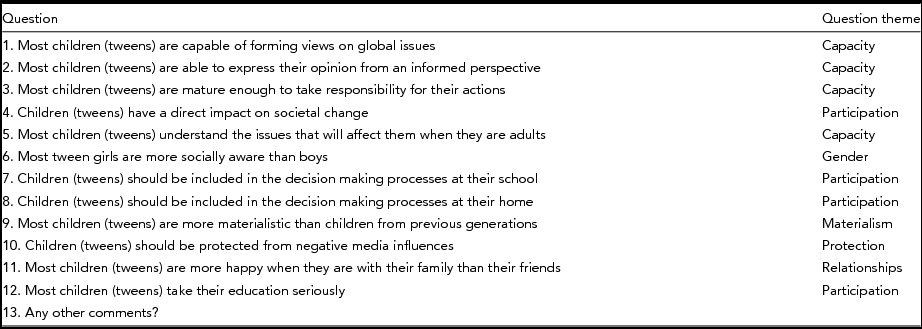
The questions (Table 1) were framed to contextualise a range of stereotypical statements beginning with ‘most children . . .’ attributed to tween children, with participants nominating their level of agreement. Within the survey instructions, in the description and in the aims of the study, the participants were reminded to focus their responses solely on the tween age group. For the purposes of analysis the questions were clustered according to six key generalised themes: capacity, participation, materialism, relationships, gender and protection. These themes represent the key debates that contextualise the range of discourses underpinning the application of the UNCRC (Graham & Fitzgerald, Reference Graham and Fitzgerald2010; Harcourt & Sargeant, Reference Harcourt and Sargeant2011; Sargeant, Reference Sargeant2010).
Survey instrument.

Results and Discussion
One hundred and twenty-four respondents (79 female, 25 male, 20 not specified) from 24 countries participated in the study. Approximately 42% of participants were 34 years of age or under, 47% of participants were between 35 and 54 years of age, and 11% were 55 years and older. Of the range of countries represented, most respondents resided in Australia, New Zealand, Canada, Sweden, Denmark and the United Kingdom. Just over 30% of participants had children aged 8–12 years of age living with them at the time of completing the survey.
In determining the extent to which respondents aligned with each of the statements, each respondent would need to draw upon their personally conceptualised notion of the tween and then provide a generalised response; a task not welcomed by the participants as many made comment to this effect within the feedback section of the survey. It is not known whether developmental or sociological perspectives informed these conceptualisations, although the commentary provided by the participants reinforced the notion that childhood itself is complex and difficult to define due to the number of variables and factors that influence its construction. As King (Reference King2007) notes:
There is no definitive or universal account of what childhood is or what children should be. All is relative and depends upon the particular constructions of childhood of different societies or of the same society at different times and the expectations associated with children (and adults) resulting from these constructions. (p. 196)
Each respondent's conceptualisation of tweens can be attributed to three main sources: experience with individuals; experience with a symbolic collective; or knowledge of the theoretical and social representations of tween communicated through a range of media, including the research literature. In addition, because the notion of ‘children’ is often situated as an ‘other’ group when described by adults, generalisations often reflect media-driven stereotypes. The respondents’ views may also be influenced by where in the broader construct of childhood they situate tweens, either as emerging adolescents with developing capacity or more proximal (in age) to the relative immaturity of early childhood.
Compounding the relative difficulty of this task, each question has the potential to cause the respondent to draw upon different representations of the tween child – the known individual (single), the known collective (group) or the broader collective – to inform each response. For instance, the participant may have been thinking about a specific tween that they knew to be particularly materialistic when responding to Question 9, relating to materialism, and the same participant may have been thinking about a different tween or group of tweens when responding to Question 12, relating to education. These conceptual understandings are also informed by attributions of tweens across other points of reference, including capacity, vulnerability, autonomy and materialism. From these conceptual understandings, an adult may express his or her view by assigning a power designation along a continuum that can either inhibit or promote a child's capacity or participatory ‘power’. The final conceptualisation of the tween that is then used to inform the response is ultimately determined by the extent to which adults acknowledge and enable children's capacity.
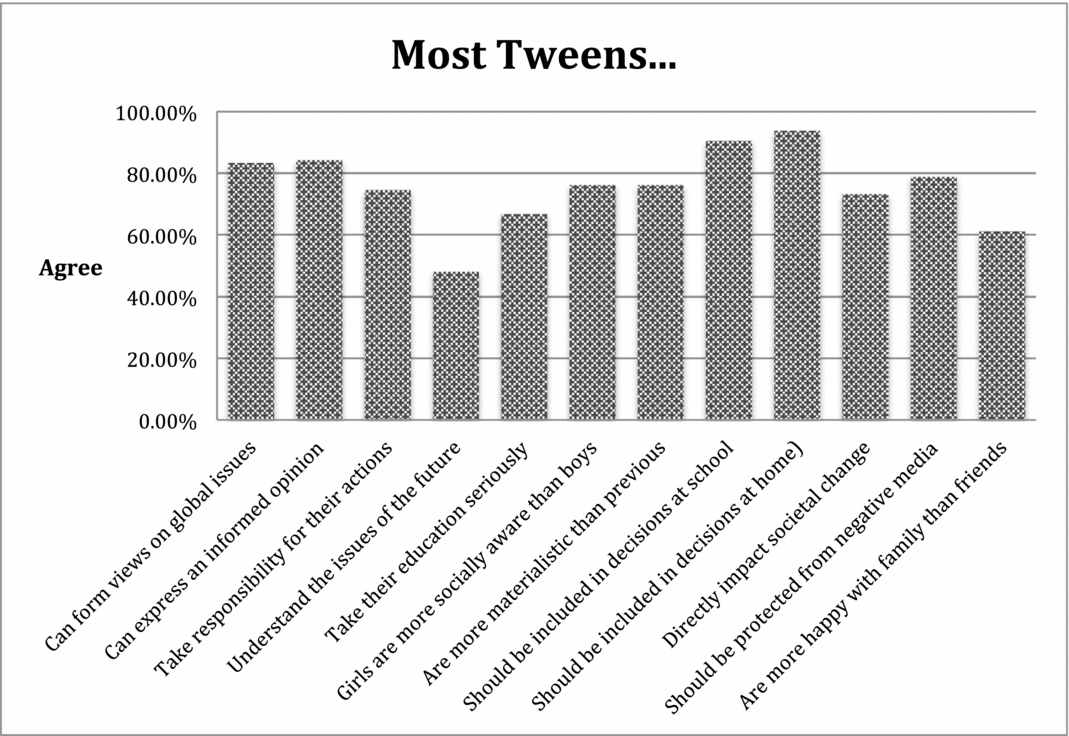
Figure 1 presents a summary of the participants’ agreement with each of the presented statements. The majority of respondents were in general agreement with each of the statements with the single exception of Question 5: ‘Most children (tweens) understand the issues that will affect them when they are adults’, where 48% of respondents were in agreement.
Summary of responses (frequency of agreement).
The majority of responses support the contention that children in their tweens have a level of capacity that allows them to consider their futures and take responsibility for their actions. The responses also suggest that adults agree that tween children actively consider their futures in the context of global issues such as unrest (war), climate change and global inequality. The respondents also supported the notion that tween children develop these views from an informed perspective.
The majority of respondents agree that the family represents the dominant relationship focus of tween children. However, as the tween years mark the transition to adolescence, where, traditionally, a marked separation from family towards the formation of bonded peer relationships begins, 39% of respondents suggest that this transition has already begun. Such observations suggest that adolescent behaviours in terms of social interactions may be beginning at a younger age. In terms of readiness to socially transit from a family-orientated focus to a peer-focused network, the respondents also agreed that girls are more socially aware than their male tween counterparts. Such a view is historically and developmentally prevalent across a range of research.
The respondents also strongly agreed with the statement that tweens are more materialistic than in previous generations, supporting much of the research that describes contemporary society in general as more materially focused (Goldgehn, Reference Goldgehn2004).
The respondents were in general agreement with the statements reflecting capacities and rights to participation. However, the same respondents also reflected somewhat paradoxically that children should be protected from negative influences of the media. Given the strong affirmation across most of the survey for children's capacity to know and understand their world and the future, and the prevailing sentiment that tween children should have a say in matters affecting them (participation), a recurrent paradox extant in the literature that conceptualises childhood also emerges in this study. In response to the question ‘Children (tweens) should be protected from negative media influences’, 79% of respondents agreed with the statement. The strength of this desire to protect children is, to a large extent, in direct contradiction to the commentary on children as capable and informed citizens. Such a divergence in recognition of children's capacity when considering the influence of the media (in all its forms), reinforces the ongoing tensions between protecting children in the present day and providing a level of freedom commensurate with their emerging capacity to develop their skills for the future. Children have few opportunities to assert personal power, except in the social domain where they can exercise some autonomy through interactions with their peers. These conceptual dilemmas persist within the community when considering the balance between protection and participatory rights of children.
Many of the additional comments offered by the participants reflected the complexity of the topic and the contrasting conceptualisations of tween children. The general statements that were offered often contained qualifying statements that nominated external attributions such as the role of parents, for example:
I believe that the ability of tweens to make life choices and have an awareness of the real world depends heavily on their parents and the amount of open discussion in the home.
and
Children in this age level are continually maturing but still have an innocence about them. Some children are willing to take on more responsibilities than others and I believe it has a lot to do with how the parents and adults interact with their children and the discussions and experiences the child has. That makes the difference.
Other respondents noted the impact of the media and modern technologies, for example:
Children are very much moulded by the environment they grow up in. Ours grow up surrounded by books, limited TV and Internet . . . and don't complain about it. Much! A cool bike was a more coveted present than a computer. They try to understand politics; they talk about the environment, endangered animals. They may not extrapolate this to a dying world or such a dramatic conclusion, but they are interested in how we can affect the world and how we coexist with other creatures. I credit my 8–12 yo's with a fair bit of consideration of such issues. And I’ve got two in that age group.
The impact of children's knowledge and awareness of adult issues and pressure to develop adult behaviours and responsibilities were also reflected in some commentaries, for example:
This range of children needs to have adult pressures removed so they can just be kids and not worry about adult problems.
and
I think tweens are trying to act older than they actually are (i.e., the way they dress and the way they talk) – I don't think they understand what it really is to be an adult, however, they are trying to act that way nowadays. Children vary greatly, not only in development, but in relation to their sibling positions. Only children have adult input, while younger children receive input from older siblings as well as adults (and now media). Their views reflect the quality of information they receive. Their apparent materialism is no more than the reflection of what is available. A bike in 1945 was just as unattainable as a Wii in 2010. Their expectations are just higher. (And I think their parents’ expectations for responsible actions may be lower. Some kids never get the chance to act responsibly.)
In forming these views of tweens, the issues of power and capacity are of particular interest as, whether intentionally or not, each of the responses reflected both a representation of tween and allocated power by the adult to the group. This power allocation, in turn, can aid in determining the extent to which the adult participant considered tweens to have capacity through their responses. Further to this, the process for adults may differ depending on the question, the context (situation) or role (power dynamic) that they apply to their understanding of tween, such as the tween as student, as sibling, as offspring as neighbour, and in context, the tween at school, at home, at sport, at the supermarket and so on.
The affirmation of children's capacities could therefore be interpreted as supportive of the participatory mandates of the UNCRC, where children have the right to be heard, yet the inclusion of tween children's perspectives on matters affecting them in many communities remains infrequent (Graham & Fitzgerald, Reference Graham and Fitzgerald2010; Harcourt & Sargeant, Reference Harcourt and Sargeant2011; Lundy, Reference Lundy2007).
Conclusion
It remains apparent that many in global communities, both adult and child, maintain a poor understanding of the UNCRC and its core principles, particularly in relation to children's participatory rights. Despite responses to questions formulated according to the key principles of the convention that express an implied support of its underpinnings, the notion of children having ‘rights’ continues to draw reactions by many in the community that children's rights encourage an overly permissive approach to discipline and education that undermines the rights of the adult (e.g., parent, teacher, authority figure) (Jans, Reference Jans2004). These views reflect a limited application of Article 42 (educating about the convention) in many national contexts.
If the prevailing belief that children are being influenced by, and drawn to, their peers at a younger age than previously thought, then the implications for parents and teachers of tween children is apparent. Their developing social skills, sense of responsibility and appropriate decision-making processes may need more guidance during the tween years than is contemporary practice. Educating 8- to 12-year-olds about the challenges and expectations of the adolescent years may need to begin in the earlier years of primary school as pre-adolescence gains more formative prominence in the preparation for the teen years. As acknowledged by the participants in this study, the tween's readiness to affiliate with more formalised social groups traditionally defined by adolescence needs careful consideration.
The views expressed by the participants in this study reveal that pre-adolescent tween children's capacity to understand local, global and societal issues are recognised by many in the adult community, yet inadequately acted upon. They also agree that tween children should be included in conversations on matters affecting them in school and at home, but within a context of guidance and protection. Such views support the drive for a more inclusive approach to tween children's perspectives in policy development and educational practice based on their demonstrated and agreed capacity; one yet to fully emerge.