INTRODUCTION
Parasites are ubiquitous and they have recently been given a central position in the functioning of ecosystems (Hudson et al. Reference Hudson, Dobson and Lafferty2006). Hence, studying the potential effects of parasites may help to understand host population dynamics and community structure, and to improve predictions on the emergence of infectious diseases (Grenfell and Dobson, Reference Grenfell and Dobson1995). Parasites have clear consequences in driving species interactions, as well as the spread and the establishment of non-indigenous species (Drake, Reference Drake2003; Prenter et al. Reference Prenter, Macneil, Dick and Dunn2004; Hatcher et al. Reference Hatcher, Dick and Dunn2006). It is generally assumed that non-indigenous species suffer less from parasitism than native species (Dunn and Dick, Reference Dunn and Dick1998; Torchin et al. Reference Torchin, Lafferty and Kuris2002; Genner et al. Reference Genner, Michel and Todd2008) as they tend to loose their native range parasites (Torchin et al. Reference Torchin, Lafferty, Dobson, Mckenzie and Kuris2003) and as the parasites from the local fauna are often less effective at infecting invading hosts (Ebert, Reference Ebert1994; Kaltz and Shykoff, Reference Kaltz and Shykoff1998; Emblidge et al. Reference Emblidge Fromme and Dybdahl2006).
The pattern of local adaptation in infectivity may suggest that parasites are not adapted to face a novel immune system or might reflect differential investment to immune defences. However, studies that focused on immune activities in a biological invasion context are scarce (but see Lee and Klasing, Reference Lee and Klasing2004; Lee et al. Reference Lee, Martin Ii and Wikelski2005). Because immune defences are costly (Bonneaud et al. Reference Bonneaud, Mazuc, Guillermo, Haussy, Chastel, Faivre and Sorci2003; but see Schmid-Hempel, Reference Schmid-Hempel2003 for a review), it has been suggested that introduced populations could evolve lower investment in resistance and could down-regulate their level of immunity as a plastic response to the absence of enemy. This would minimize the cost of immunity, and could allow the shifting of resources from defences towards growth and/or reproduction, providing further benefits to the invading populations (Kuo et al. Reference Kuo, Corby-Harris and Promislow2008). However, such an evolutionary down-regulation of immune defences among invaders might nevertheless be limited because native and invasive populations sharing the same habitat suffer from similar risks of infection, and non-indigenous species often acquire parasites from the novel environment (Colautti et al. Reference Colautti, Ricciardi, Grigorovich and Macisaac2004). Although exposed to similar infection risk, native and non-indigenous hosts should be affected differently by the infection, and understanding the host-parasite interactions could shed light on the mechanisms underlying invasion success.
Obviously, parasites are not static entities and they have in turn evolved strategies to counteract, evade and/or exploit host immune defences (Damian, Reference Damian1997; Maizels et al. Reference Maizels, Balic, Gomez-Escobar, Nair, Taylor and Allen2004). Among such parasites, helminths modulate the immune system of their hosts in order to avoid the negative effects of the immune response (damage to parasite tissues or clearance) and to survive within the host, sometimes for years. Their effects on the host immune system have intensively been investigated in vertebrates (see Maizels et al. Reference Maizels, Balic, Gomez-Escobar, Nair, Taylor and Allen2004). However, little is known on the modulatory effects of helminths in invertebrate hosts (Loker, Reference Loker1994; Humbert and Coustau, Reference Humbert and Coustau2001; Rigaud and Moret, Reference Rigaud and Moret2003). In addition, modulating primary helminth infections, by reducing or suppressing the immune responsiveness of the hosts, may increase the probability of contracting other infections (Cox, Reference Cox2001), particularly bacterial infections (Graham, Reference Graham2008), that could challenge the immunosuppressing parasite and/or increase the death probability of the hosts. Hence, in the context of local adaptation, local parasites are expected to be more effective in immunosuppressing and exploiting resources of the local hosts, compared to non-indigenous hosts. Nevertheless, if the parasite infection only decreases the local host resistance to subsequent infections, then local hosts should be penalised when in competition with invasive hosts.
Biological invasions offer a context to study local adaptation. The acanthocephalan parasite – gammarid host association provides an interesting system to investigate the impact of shared parasites on their local and non-indigenous hosts, and on invasion success. In Burgundy (Eastern France), the acanthocephalan Pomphorhynchus laevis uses 2 gammarid species as intermediate hosts: the resident Gammarus pulex and the invasive Gammarus roeseli. P. laevis alters several phenotypic traits of the resident host, G. pulex, such as immune defences (Rigaud and Moret, Reference Rigaud and Moret2003; Cornet et al. Reference Cornet, Franceschi, Bauer, Rigaud and Moret2009b) and various behavioural traits (Cézilly et al. Reference Cézilly, Grégoire and Bertin2000; Kaldonski et al. Reference Kaldonski, Perrot-Minnot and Cezilly2007), which favour host exploitation and parasite transmission to the definitive fish hosts (Lagrue et al. Reference Lagrue, Kaldonski, Perrot-Minnot, Motreuil and Bollache2007). For such a parasite, behavioural and physiological alterations of the intermediate host are strongly related to parasite success and have been shown to be more successful in the native species, G. pulex, than in the invasive species, G. roeseli (Rigaud and Moret, Reference Rigaud and Moret2003; Tain et al. Reference Tain, Perrot-Minnot and Cézilly2007).
The present study investigates the differential effects of the acanthocephalan, P. laevis, on immune defences and resource storage of both amphipod hosts, G. pulex and G. roeseli. First, we measured the level of activity of 2 major immune parameters: the activity of the phenoloxidase (PO) enzyme and the density of circulating haemocytes (Cerenius and Söderhäll, Reference Cerenius and Söderhäll2004), and the amount of energetic reserves (sugars and lipids) of G. pulex and G. roeseli, to estimate the impact of P. laevis infection on these host traits. The PO enzyme is involved in the melanization and encapsulation processes (Cerenius and Söderhäll, Reference Cerenius and Söderhäll2004). It is mainly stored in haemocytes as an inactive pro-enzyme (prophenoloxidase, ProPO), which is rapidly activated upon infection (Labbé and Little, Reference Labbé and Little2009). Both PO and haemocytes are associated with disease resistance in crustaceans (Cerenius et al. Reference Cerenius, Bangyeekhun, Keyser, Soderhall and Soderhall2003, Reference Cerenius, Lee and Söderhäll2008) and their impairment should enable acanthocephalan macroparasites to develop successfully in the host (Volkmann, Reference Volkmann1991). Second, we investigated the ecological consequences of parasite-induced immune depression on the ability and efficiency of both host species to resist an infection mimicked by the inoculation of a bacterial suspension. Because many infectious organisms are highly host specific, the evolutionarily novel pathogen faced by invading host species might lack the mechanisms producing the disease symptoms. Due to differences in the coevolutionary history between G. pulex and G. roeseli with the acanthocephalan P. laevis, no significant physiological alteration induced by the parasite is expected in G. roeseli, this could confer a competitive advantage to the invasive species when invading native G. pulex populations.
MATERIALS AND METHODS
Study system
The acanthocephalan P. laevis is a macroparasite that uses an amphipod crustacean as intermediate host, and a fish as definitive host. In the study area, chubs Leuciscus cephalus are preferred definitive hosts of the parasite. Gammarids are orally infected when ingesting parasite eggs. The acanthor (mature egg) hatches and passes through the gut wall to the haemocoel where it undergoes successive growth events until it reaches the cystacanth stage (infectious for the next host). Transmission is achieved via predation of the gammarid by the definitive host. In the fish, the parasite attaches to the intestines by embedding its proboscis in the tissue. The parasite becomes mature and reproduces, with females releasing eggs into the digestive tract that are then released with the faeces (reviewed by Kennedy, Reference Kennedy2006).
G. pulex is a resident amphipod species in France whereas G. roeseli has colonized Western European streams during the last century. The spread of G. roeseli from Central Europe or perhaps Minor Asia (Karaman and Pinkster, Reference Karaman and Pinkster1977; Jazdzewski and Roux, Reference Jazdzewski and Roux1988) to Northern and Western Europe was facilitated by the development of a canal network between watersheds (Jazdzewski and Roux, Reference Jazdzewski and Roux1988). Interestingly, G. roeseli infections by P. laevis have been recorded in several areas of the Danube area (Moret et al. Reference Moret, Bollache, Wattier and Rigaud2007).
Sampling
Gammarids were collected using a kick sampling method in the River Ouche at Dijon in 2007. A total of 2303 gammarids were sampled to estimate the prevalence of infection by P. laevis in both species. As this sampling did not provide enough infected individuals for experimental comparisons, additional parasitized G. pulex and G. roeseli were actively sought. Infected gammarids could easily be identified as the parasite appeared as yellow-orange dots through the cuticle of the host. Animals were maintained in the laboratory under standard conditions (15°C±1°C, light:dark cycle 12:12h) in well-aerated tanks filled with dechlorinated UV-treated tap water and fed with elm leaves. At the end of the experiments (immune defence, energy reserves, bacterial clearance assays), individuals were measured by linear dimension (size of the fourth coxal plate) using a stereoscopic microscope (Nikon SMZ-10A) and a video-analysis system (VTO 232, Linkam Scientific Instruments). Gammarids were then dissected to check for infection and parasite intensity and bodies were frozen for later measurements of their lipid and sugar contents. All individual gammarids were measured for the level of immune defences, lipid and glycogen contents.
Haemolymph collection, haemocyte concentration and activities of the ProPO system
Haemolymph extracts were taken by wounding gammarids near the 7th dorsal segment with very fine forceps (Cornet et al. Reference Cornet, Franceschi, Bauer, Rigaud and Moret2009b). Three μl of haemolymph were collected into a sterile, pre-chilled glass capillary and flushed into 20 μl of cold phosphate-buffered saline (PBS: 8·74 g NaCl, 1·78 g Na2HPO4⋅2H2O, 1 L dH2O, pH 6·5). Ten μl were immediately used for the determination of haemocyte concentration and the remainder was then frozen in liquid nitrogen and stored at −80°C for later phenoloxidase assays. Haemocyte concentration was determined using a Neubauer counting chamber as the number of cells counted in 0·1 μl and reported relative to 1 μl of pure haemolymph.
The activity of naturally activated phenoloxidase (PO) enzymes only (therein after called PO activity) and the activity of the pro-enzymes (ProPO) in addition to that of the PO (therein after called total activity) were measured for each individual haemolymph extract using a spectrophotometric assay (see the detailed protocol in Cornet et al. Reference Cornet, Franceschi, Bauer, Rigaud and Moret2009b). The assay was performed using 5 μl of haemolymph extract added to a microplate well containing 20 μl of PBS buffer and either 140 μl of dH2O to measure PO activity only or 140 μl of chymotrypsin solution (Sigma C-7762, 0·07 μg ml−1 of dH2O) to measure total activity. After an incubation period of 4 min, 20 μl of L-dopa solution (Sigma D-9628, 4 mg ml−1 of dH2O) was added and the reaction was followed in a microplate reader (Versamax, Molecular Devices) for 40 min at 490 nm. Enzyme activity was analysed using the software SOFT-Max®Pro 4·0 (Molecular Devices) and measured as the slope (Vmax value) of the reaction curve and reported relative to the activity of 1 μl of pure haemolymph.
Immune challenge and bacterial clearance
Gammarids were exposed to a bacterial pathogen to assess the efficiency of the immune system to clear an infection (Cornet et al. Reference Cornet, Franceschi, Bauer, Rigaud and Moret2009b). We used a bacterial strain of E. coli (strain CIP 103410, Pasteur Institute, Paris, France) resistant to tetracycline. Crustacean exposure to bacterial infection was done by injection. Gammarids were briefly immobilized on sticky gum. A small hole was made laterally on the animal third dorsal segment using a fine needle. Then 0·5 μl of a bacterial suspension at a concentration of 8×10⁴ bacteria μl−1 (for details see Cornet et al. Reference Cornet, Franceschi, Bauer, Rigaud and Moret2009b) was injected into the animal haemocoel using a Hamilton syringe equipped with a fine needle (gauge 33). After injection, gammarids were kept at controlled temperature (15°C±1°C) for 8 h before haemolymph extraction. Each individual provided 2 μl of haemolymph that were flushed into 198 μl of PBS buffer. After homogenization, 100 μl of the mixture were spread on agar Petri dishes containing 20 μg ml−1 tetracycline. Petri dishes were incubated overnight at 37°C and colonies (colony-forming unit, CFU) were counted. The number of colonies is expected to be inversely proportional to the immune defence level.
Lipid and sugar contents
Both lipid and sugar (glucose) contents were quantified using a colorimetric assay following the protocol of Lemaître et al. (Reference Lemaître, Rigaud, Cornet and Bollache2009) modified from Rivero and Fergusson (Reference Rivero and Ferguson2003). Gammarids were crushed using a micro-centrifuge tube pestle into 100 μl of a solution of sodium sulphate 2% and 750 μl of a chloroform/methanol (1/2) solution. Samples were centrifuged (4°C, 1500 g, 4 min) and 2 fractions of 350 μl each were extracted and separated into clean culture tubes for lipid and sugar analyses respectively. Samples were placed into a water bath at 95°C to enable solvent to evaporate.
For lipid determination, 40 μl of sulphuric acid were added and samples were reheated for 2 min at 95°C and then 960 μl of vanillin-phosphoric acid reagent were added. Samples were mixed and 150 μl were transferred into a 96-microplate well and optical density was read at 525 nm in a microplate reader (Versamax, Molecular Devices) and analysed using the software SOFT-Max®Pro 4·0. Lipid concentration was obtained from a standard curve ranging from 1 to 64 μg ml−1 of a commercial vegetable oil.
For sugar determination, residues after evaporation were heated for 15 min at 95°C with 1 ml of anthrone reagent. After cooling, 150 μl were transferred into a 96-microplate well and optical density was read at 625 nm. Sugar concentration was obtained from a standard curve ranging from 3 to 192 μg ml−1 of a glucose solution.
Statistics
Data on haemocyte concentration were square-root transformed and data on phenoloxidase activities (PO and total activity), animal body size, colony counts, lipids and sugars were natural-log transformed to meet assumptions for parametric tests.
The prevalence of infection between species was compared using a Chi-square test. Overall, variation in immune and energy parameters was investigated using a multivariate analysis of covariance (MANCOVA, Pillai's trace) with respect to ‘host species’, ‘status of infection’, their interaction and ‘size’ as covariate. Then, variation within host species was analysed with respect to ‘status of infection’, ‘sex’ and ‘size’ and their interactions. Gender did not explain any variation in the dependent variables either as main effect or interactions with other factors and was therefore removed from the statistical models. The best models were searched by a stepwise procedure that removed non-significant higher interaction terms. Data from the experiment of resistance to a bacterial infection were analysed with the same method.
All tests were performed using JMP v5.0 for Windows (SAS Institute, Cary, USA) and referred to two-tailed tests with significant differences considered at the level of P⩽0·05.
RESULTS
Prevalence of Pomphorhynchus laevis
In total, 2303 gammarids were analysed. The native species G. pulex was predominant (70·13%), and G. roeseli individuals represented one third of the animals (29·87%). The prevalence of P. laevis in the river Ouche did not differ between G. pulex (2·17%, n=1615) and G. roeseli (2·99%, n=688, χ21=1·13, P=0·287). We found G. pulex harbouring 1 (n=29) and 2 (n=10) cystacanths of P. laevis whereas all G. roeseli (n=21) were infected by a single parasite only. There was no gender effect upon the prevalence of infection, neither in G. pulex (χ21=0·85, P=0·3575) nor in G. roeseli (χ21=0·001, P=0·9852).
Levels of immune defences
No effect of parasite load on G. pulex immunological parameters was detected (PO activity F1,37=0·06, P=0·8042; total activity F1,37=1·44, P=0·2385; haemocyte concentration F1,37=1·46, P=0·2342). Data from all infected G. pulex were therefore pooled and compared to data from uninfected animals for further analyses.
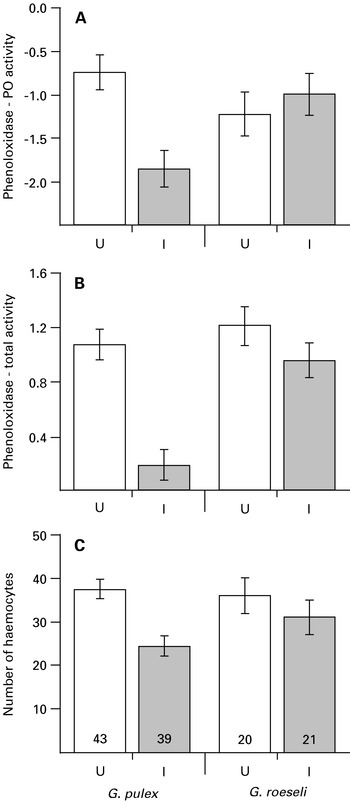
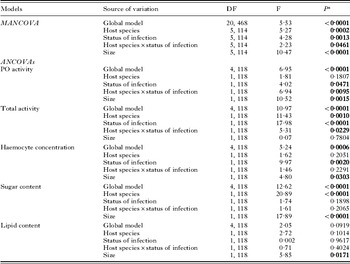
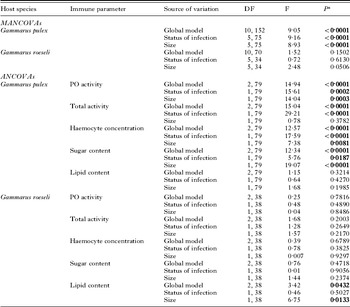
The variation of immune functions was related to animal body size, especially for PO activity and haemocyte concentration (Table 1). This global size effect was mostly due to the impact of size on immune parameters in G. pulex (Table 2). Overall, immune activities were influenced by the host species, the parasite infection status and the interaction (Table 1). Whereas PO activity and haemocyte concentration were found to be similar between native and invasive species (non-significant effect of ‘host species’ on its own, Table 1), G. roeseli had a greater total activity (Table 1; Fig. 1A, B, C). However, the host species effect was the product of the interaction with the status of infection. Indeed, uninfected amphipods of the two species did not differ in their total activity (for equal animal size, G. pulex 1·07±0·11, G. roeseli 1·21±0·17; F1,60=0·26, P=0·6112), whereas they did when infected (G. pulex 0·18±0·10, G. roeseli 0·95±0·14; F1,57=19·06, P<0·0001). Parasite infection had a strong effect on the level of the 3 immunological variables (Table 1), but this depended on the gammarid species as shown by the significant interaction between ‘host species’ and ‘status of infection’ (at least for PO and total activity, Table 1). The infection by P. laevis was associated with a strong decrease of all of the immune variables in parasitized G. pulex (Table 2; Fig. 1A, B, C) (differences for equally-sized individuals, uninfected vs P. laevis-infected; PO activity: −0·75±0·19 vs −1·86±0·20; total activity: 1·07±0·11 vs 0·18±0·12; haemocyte concentration: 37·56±2·13 vs 24·56±2·23). In contrast, immune effectors of the invasive host G. roeseli were not affected by the parasite (Table 2; Fig. 1A, B, C).
Comparison of the level of immune defences according to the status of infection by Pomphorhynchus laevis (U, uninfected; I, infected) in Gammarus pulex and Gammarus roeseli: (A) PO and (B) total phenoloxidase activity (natural-log transformation) and (C) number of haemocytes (square-root transformation) per μl of haemolymph, mean±s.e. Sample sizes are given within bars.

Multivariate (Pillai's trace) and univariate analyses of covariance investigating variation in immune parameters and energetic contents as a function of gammarid host species, infection by Pomphorhynchus laevis and body size

a Significant values shown in bold.
Multivariate (Pillai's trace) and univariate analyses of covariance investigating variation in immune parameters and energetic contents in Gammarus pulex and Gammarus roeseli as a function of infection by Pomphorhynchus laevis and body size

a Significant values shown in bold.
Sugar and lipid reserves
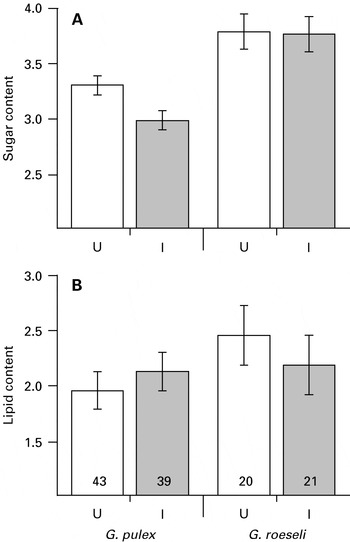
Measures of energetic reserves were correlated with animal body size, likely as a consequence of the method we used. Body size was therefore included in the models as a covariate. Gammarid species differed in their sugar contents (Table 1; Fig. 2A). Equally-sized G. roeseli had slightly more sugar than G. pulex (uninfected only, G. roeseli 3·76±0·15, G. pulex 3·32±0·10; F1,60=5·64, P=0·0208) but no difference was detected for lipid contents (Fig. 2B). Neither the status of infection nor the interaction explained a significant fraction of variation in the overall model. However, within species, we found a significant effect of infection by P. laevis on the local hosts only; parasitized G. pulex had less sugar than uninfected ones (2·98±0·09 and 3·30±0·09, respectively; Fig. 2A). Lipid content remained unaffected in G. pulex and none of the parasite effects were found in G. roeseli (Table 2; Fig. 2A, B).
Sugar (A) and lipid (B) contents (natural log-transformation) according to the status of infection by Pomphorhynchus laevis (U, uninfected; I, infected) in Gammarus pulex and Gammarus roeseli, mean±s.e. Sample sizes are given within bars.

Bacterial clearance efficiency
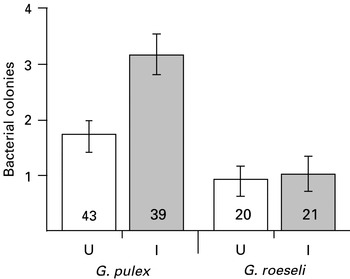
Non-significant effects (‘sex’ and ‘size’) were dropped from the model by a backward stepwise procedure. The number of bacterial colonies (inversely proportional to disease resistance) was explained by both ‘host species’ (global model, F3,73=10·64, P<0·0001; F1,73=20·39, P<0·0001) and ‘status of infection’ (F1,73=5·71, P=0·0194). The clearance of E. coli was higher in uninfected G. roeseli than in uninfected G. pulex (F1,42=4·89, P=0·0324; Fig. 3). Moreover, P. laevis had a different influence on gammarid species as shown by the ‘host species×status of infection’ interaction (F1,73=4·20, P=0·0439). Infected G. pulex were less able to clear the bacteria as shown by the greater number of developing colonies compared to uninfected animals (F1,40=9·13, P=0·0044; Fig. 3). No difference in the ability to clear the bacterial infection was detected in G. roeseli (F1,33=0·07, P=0·7903; Fig. 3).
Comparison of live bacteria (number of colonies per μl of haemolymph, natural-log transformation) after infection by Escherichia coli according to the status of infection by Pomphorhynchus laevis (U, uninfected; I, infected) in Gammarus pulex and Gammarus roeseli, mean±s.e. Sample sizes are given within bars.

DISCUSSION
Because of their major impact on the ecosystems, biological invasions have been intensively studied in the last years. Much emphasis has been put on the intrinsic characteristics of invading species to explain invasion success (Sakai et al. Reference Sakai, Allendorf, Holt, Lodge, Molofsky, With, Baughman, Cabin, Cohen, Ellstrand, McCauley, O'Neil, Parker, Thompson and Weller2001). Nevertheless, the importance of parasites should not be underestimated as they also play a great role in species interactions and in the outcome of animal invasion (Drake, Reference Drake2003; Prenter et al. Reference Prenter, Macneil, Dick and Dunn2004; Hatcher et al. Reference Hatcher, Dick and Dunn2006). In this study, we showed that despite a similar prevalence of infection between native and invasive gammarid hosts, the detrimental effects of the acanthocephalan P. laevis occurred only in the local host G. pulex. P. laevis infection was associated with a reduced immunocompetence and an energetic cost for its local host G. pulex, supporting the idea of a maladaptation of the parasite to the invasive host G. roeseli. On the contrary, G. roeseli is likely to be more tolerant, and suffers less P. laevis-induced alterations.
The ProPO system and haemocytes are general effectors of the crustacean immune system (Cerenius and Söderhäll, Reference Cerenius and Söderhäll2004) and immune depression induced by the acanthocephalan worm is likely to be a strategy developed to exploit and survive inside their gammarid intermediate hosts until transmission (Loker, Reference Loker1994). The infection in G. pulex was associated with a decrease of the activity of the ProPO system and the concentration of circulating haemocytes (Cornet et al. Reference Cornet, Franceschi, Bauer, Rigaud and Moret2009b). Since phenoloxidase enzymes are mainly synthesized and stored in haemocytes, their reduction and/or impairment may have led to a decreased concentration of proteins and enzymes involved in the melanization response. However, the mechanisms by which acanthocephalans induce depression of humoral and cellular immune defences are still unknown. In invertebrates, immune evasion often involves excretory-secretory products that affect both the number and functions of haemocytes (de Jong-Brink, Reference De Jong-Brink1995; Humbert and Coustau, Reference Humbert and Coustau2001) and interfere with plasma melanization by inhibiting the ProPO activating cascade (Shelby et al. Reference Shelby, Adeyeye, Okot-Kotber and Webb2000; Gomes et al. Reference Gomes, Feder, Garcia and Azambuja2003). Parasites also express lectin- and mucin-like molecules that are thought to be involved in the avoidance of the host immune response and the invasion of host tissues (Loukas and Maizels, Reference Loukas and Maizels2000; Theodoropoulos et al. Reference Theodoropoulos, Hicks, Corfield, Miller and Carrington2001). The reduced phenoloxidase activity and the fewer number of circulating haemocytes in the haemolymph of P. laevis-infected G. pulex may then prevent the parasite from suffering the harmful effects of the host immune response and/or melanization and encapsulation.
We showed that the impairment of immune defences observed in the local host G. pulex was absent in the invasive host G. roeseli supporting the idea that the ability to infect and induce pathogenic effects is likely to be host specific, and the result of an adaptation of the parasite to the local hosts, as previously suggested (Rigaud and Moret, Reference Rigaud and Moret2003). Even if hosts are closely related, pathogens are adapted to their local hosts and will often lack the mechanisms to produce disease symptoms in the invading host species. However, it is worth mentioning that P. laevis parasites infecting the invasive host were never found melanized (as they should be having elicited an immune response) and are able to devaginate when stimulated by fish bile extracts (a test for parasite survival; SC, personal observation). In addition, cystacanths of acanthocephalans (and especially for P. laevis) are surrounded by a membrane layer formed by microvilli, which acts as a protective barrier (Taraschewski, Reference Taraschewski2000). In Echinogammarus stammeri infected by P. laevis, haemocytes in the vicinity of the cystacanths are rare and often partially or completely disintegrated, attesting to the unsuccessful E. stammeri cellular response (Dezfuli et al. Reference Dezfuli, Simoni, Duclos and Rossetti2008). Even if the P. laevis parasite does not induce significant changes in the immune system of its invasive host (a sign of non-optimal exploitation), it might nevertheless be able to survive through other protective mechanisms.
Parasites also modify the energetic storage of their host by diverting resources to their own benefits and, as such, impose an energetic cost. For instance, mosquitoes Aedes aegypti infected with microsporidia have lower sugar, glycogen and lipid contents than uninfected conspecifics (Rivero et al. Reference Rivero, Agnew, Bedhomme, Sidobre and Michalakis2007). Here, following the same pattern observed for immune defences, sugar contents were depleted in infected local G. pulex whereas sugar contents were the same in uninfected and infected G. roeseli. Both gammarid species had similar lipid contents and P. laevis infection did not change the level in either the local nor the invasive hosts. Several studies have reported similar observations, suggesting that lipid reserves are rarely affected by parasite infection (Plaistow et al. Reference Plaistow, Troussard and Cézilly2001; Franz and Kurtz, Reference Franz and Kurtz2002; Rivero and Fergusson, Reference Rivero and Ferguson2003). Mounting an immune response is energetically costly (Schmid-Hempel, Reference Schmid-Hempel2003). In mosquitoes, Plasmodium infection induces a reduction in longevity and fecundity (Ferguson and Read, Reference Ferguson and Read2002). However, these costs are reduced when mosquitoes are reared with ad libitum access to glucose. It has been hypothesized that parasite-mediated energy depletion might be related to virulence (Rivero and Ferguson, Reference Rivero and Ferguson2003). Highly virulent parasite strains are expected to draw a larger fraction of host resources for growth and replication than less virulent ones. However, evidence for this is scarce. It was found recently that among populations of G. pulex, total phenoloxidase activity was positively correlated with sugar content (Cornet et al. Reference Cornet, Biard and Moret2009a), suggesting that sugars may fuel the activity of the ProPO system. Here, we found that the local host G. pulex infected by the parasite had depleted sugar content and impaired immune defences. We may therefore wonder whether P. laevis immunodepresses its local host by depleting sugar reserves. The comparison of the cystacanth volume, a surrogate of parasite growth rate, could reflect differential depletion of energy reserves. Since energy reserves are not depleted in G. roeseli, parasites might be less efficient in acquiring resources and this could be reflected in a reduced growth rate.
Although local adaptation has favoured parasites able to circumvent the immune defence of its local host, the reduction of the level of immunity may have some underlying costs, as suggested by the bacterial clearance experiment. Co-infections occur at a high frequency in the wild and immunodepressed hosts primarily infected by a helminth parasite are more likely to contract microparasite secondary infections (Cox, Reference Cox2001; Graham, Reference Graham2008). In the local hosts, the P. laevis primary infection and the suppression of the immune system negatively affected the ability of G. pulex to clear a secondary infection when experimentally infected by the bacteria E. coli. Both the host and the parasite may pay a cost for these opportunistic infections since it could challenge the already established immunosuppressing parasite, as well as increasing the death probability of the host by higher pathogen exploitation. However, infected G. roeseli did not suffer from a reduced resistance and the bacterial clearance was as effective in uninfected as in parasitized individuals. Such a potential consequence of the differential immunodepression may therefore provide an advantage to the invader, G. roeseli, especially when the parasitic pressure imposed by the acanthocephalan parasite is high. Other acanthocephalan species also immunodepress G. pulex (Cornet et al. Reference Cornet, Franceschi, Bauer, Rigaud and Moret2009b). If these parasites have no effect on G. roeseli immune defences, then the increased parasite-mediated disadvantage from which G. pulex suffers, compared to G. roeseli, could even be larger.
Invaders were slightly more immune competent than natives, they were found to have a higher level of total phenoloxidase activity (higher investment into the ProPO system). They were also more efficient in their response against bacteria. Nevertheless, it is hard to draw a conclusion from this result as these differences might result from fundamental differences in the physiology between the two species. Based on the differential effects of infection on immune defences, energetic reserves and bacterial resistance between native and invasive gammarids, it may be assumed that the local parasite P. laevis is not efficient in manipulating the non-indigenous species. However, G. roeseli can be infected by the local parasite in Burgundy. This might be explained by the fact that P. laevis has a wide geographical distribution (Kennedy, Reference Kennedy2006) and that the amphipod had already experienced infection with this parasite species in its area of origin or during the invasion process (Moret et al. Reference Moret, Bollache, Wattier and Rigaud2007). Although infected by P. laevis, G. roeseli suffers lower levels of damage caused by parasitism (immune depression, lower bacterial resistance, energetic budget modification) relative to the local species G. pulex, and can be maintained in the population and act as a reservoir (Kuo et al. Reference Kuo, Corby-Harris and Promislow2008). Hence, it is not surprising that infection is as prevalent in G. roeseli as in G. pulex. The acanthocephalan P. laevis also relies on parasite-induced behavioural alterations (Cézilly et al. Reference Cézilly, Grégoire and Bertin2000; Kaldonski et al. Reference Kaldonski, Perrot-Minnot and Cezilly2007) to increase the trophic transmission to fish definitive hosts (Lagrue et al. Reference Lagrue, Kaldonski, Perrot-Minnot, Motreuil and Bollache2007), but these only occur in the native hosts (Tain et al. Reference Tain, Perrot-Minnot and Cézilly2007). The absence of behavioural manipulation, as well as morphological anti-predator defences (Bollache et al. Reference Bollache, Kaldonski, Troussard, Lagrue and Rigaud2006) and habitat segregation (Kaldonski et al. Reference Kaldonski, Lagrue, Motreuil, Rigaud and Bollache2008) are likely to lead to lower predation rate of G. roeseli by fish (Lagrue et al. Reference Lagrue, Kaldonski, Perrot-Minnot, Motreuil and Bollache2007). As they suffer less parasite-induced mortality (Lagrue et al. Reference Lagrue, Kaldonski, Perrot-Minnot, Motreuil and Bollache2007), infected G. roeseli persist in the population.
To conclude, this study underlines that the local acanthocephalan P. laevis alters differentially the physiology of its native and non-indigenous hosts. Note that a primary acanthocephalan infection and the depression of the immune system will influence the host response to secondary infection. Hence, the higher exploitation of the native G. pulex is associated with costs. Recent studies suggested that immunity of introduced hosts added to the maladaptation of local parasites to face a novel host immune system provides a strong advantage to the invaders over the indigenous species (Emblidge et al. Reference Emblidge Fromme and Dybdahl2006; Genner et al. Reference Genner, Michel and Todd2008). However, in rivers of Burgundy (especially in the river Ouche) where G. pulex and G. roeseli live in sympatry, the proportion of G. roeseli does not exceed 30% of the crustacean population (also reported by Lagrue et al. Reference Lagrue, Kaldonski, Perrot-Minnot, Motreuil and Bollache2007). More work focussing on the interactions between the two species (e.g. studying the functional response to each species according to the status of infection, Bollache et al. Reference Bollache, Dick, Farnsworth and Montgomery2008) should help to understand the ecological consequences of the differential effects induced by local parasites on their local and invasive host, and the outcome of the invasion.
ACKNOWLEDGMENTS
This research was supported by the Conseil Régional de Bourgogne with a FABER grant (06512AA07579-Faber 2006-178) and doctoral grant to S. C. We thank Loïc Bollache for discussions and comments on previous drafts of the manuscript and Stephen Larcombe for helpful corrections.