Introduction
Ryegrass (Lolium spp.) is a common weed in wheat production worldwide (Trusler et al. Reference Trusler, Peeper and Stone2007; Tucker et al. Reference Tucker, Morgan, Senseman, Miller and Baumann2006). The genus Lolium comprises of eight species (Charmet and Balfourier Reference Charmet and Balfourier1994), of which Italian ryegrass and perennial ryegrass have been reported in wheat fields in the United States (Bararpour et al. Reference Bararpour, Norsworthy, Burgos, Korres and Gbur2017; Warnke et al. Reference Warnke, Barker, Jung, Sim, Mian, Saha, Brilman, Dupal and Forster2004). Of the two, Italian ryegrass has been more commonly reported as a weed in winter wheat production in the United States, with an ability to reduce wheat yields by up to 92% (Hashem et al. Reference Hashem, Radosevich and Roush1998). Italian ryegrass is a high-risk species for herbicide-resistance evolution, with resistance to eight herbicide modes of action (MOAs) already reported in the past two decades worldwide (Heap Reference Heap2019). In the United States alone, Italian ryegrass resistance to acetyl coenzyme-A carboxylase (ACCase)-, acetolactate synthase (ALS)-, 5-enolpyruvylshikimate-3-phosphate synthase (EPSPS)-, glutamine synthetase-, photosynthetic (PSI)-, and very-long-chain fatty acid (VLCFA)-inhibitors has been reported across 15 states (Heap Reference Heap2019). However, resistance in perennial ryegrass has been documented only to ALS-inhibitors in two states (California and Texas) (Heap Reference Heap2019). Both Italian and perennial ryegrass are obligate outcrossers (Terrell Reference Terrell1968), which can facilitate rapid spread of resistance.
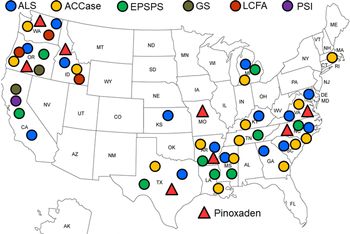
The selection for herbicide resistance in Italian ryegrass in the United States started with the use of diclofop-methyl in the 1980s (Stanger and Appleby Reference Stanger and Appleby1989). Diclofop-methyl is an aryloxyphenoxypropionate herbicide that inhibits the ACCase enzyme, which catalyzes fatty acid biosynthesis in plants (Burton et al. Reference Burton, Gronwald, Somers, Gegenbach and Wyse1989; Delyé Reference Delyé2005). Diclofop-methyl was an effective herbicide for selective control of Italian ryegrass in wheat, but its continuous use led to resistance within just a few years of its commercialization (Stanger and Appleby Reference Stanger and Appleby1989). To date, Italian ryegrass resistance to diclofop-methyl has been reported across 12 states in the United States, including Texas (Figure 1). Diclofop-methyl has been discontinued in the United States since 2014 and is no longer labelled for use in wheat.
Geographic distribution of herbicide-resistant Italian ryegrass in the United States for acetolactate synthase (ALS)-, acetyl CoA carboxylase (ACCase)-, 5-enolpyruvylshikimate-3-phosphate synthase (EPSPS)-, glutamine synthetase (GS)-, and very long chain fatty acid (VLCFA)-inhibitors, as well as photosystem I electron divertor (PS-I). There are three classes of ACCase inhibitors: aryloxyphenoxypropionates (fops), cyclohexanediones (dims), and phenylpyrazoline (den). Pinoxaden, the DEN herbicide, has limited reported cross-resistance with FOP or DIM herbicides. Colored shapes indicate resistance to a given mode of action reported within a specific state, but they do not conform to exact geographic coordinates. Information from Betts et al. (Reference Betts, Ehlke, Wyse, Gronwald and Somers1992), Chandi et al. (Reference Chandi, York, Jordan and Beam2011), Heap (Reference Heap2019), Kuk and Burgos (Reference Kuk and Burgos2007), Liu et al. (Reference Liu, Hulting and Mallory-Smith2016), Nandula et al. (Reference Nandula, Poston, Eubank, Koger and Reddy2007); Rauch et al. (Reference Rauch, Thill, Gersdorf and Price2010), Salas et al. (Reference Salas, Burgos, Mauromoustakos, Lassiter, Scott and Alcober2013), and Taylor (Reference Taylor2015). Cases of herbicide resistance in Texas include reports from the current study.

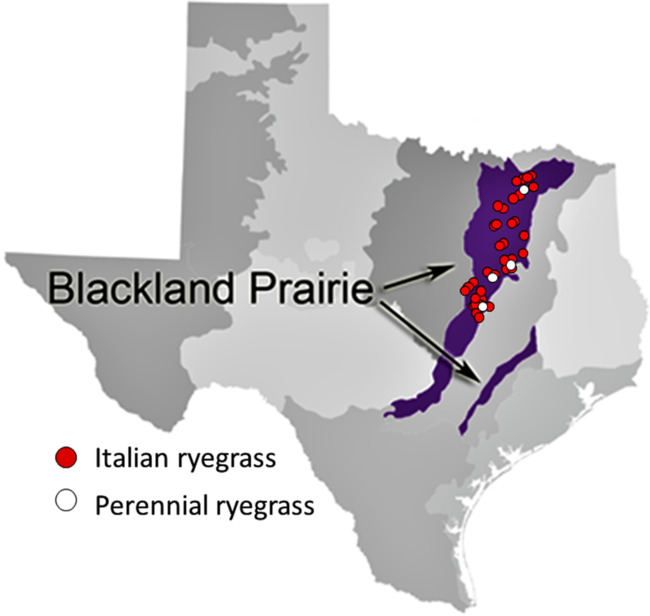
In Texas, winter wheat is planted on more than 1.8 million ha (USDA NASS 2019), and the northern Blacklands region (Figure 2) is known for high wheat productivity owing to higher soil fertility and better moisture conditions compared with other wheat growing regions in Texas (Arnold et al. Reference Arnold, Potter, King and Allen2005). The level of selection for diclofop-methyl in the Texas Blacklands winter wheat production has been relatively low, due primarily to restrictions on livestock grazing after diclofop-methyl application in the dual-purpose wheat system (Tucker et al. Reference Tucker, Morgan, Senseman, Miller and Baumann2006). This restriction has led to the heavy use of mesosulfuron and other ALS-inhibitor herbicides (Umbarger Reference Umbarger1978) as alternatives for controlling Italian ryegrass in winter wheat. Mesosulfuron-methyl provided excellent POST control of diclofop-resistant and -susceptible Italian ryegrass (Bailey et al. Reference Bailey, Wilson and Hines2003). However, reports of resistance to mesosulfuron-methyl have emerged within a few years of its introduction in the southern United States (Ellis et al. Reference Ellis, Morgan and Mueller2008; Kuk and Burgos Reference Kuk and Burgos2007). Resistance in Italian ryegrass to three ALS-inhibitor families (sulfonylureas, imidazolinones, and triazolopyrimidines) has been reported across 15 states in the United States (Figure 1). The selection for resistance to ALS-inhibitor herbicides is generally quicker compared with other herbicide MOAs (Tranel and Wright Reference Tranel and Wright2002).
Locations within the Texas Blacklands region where the ryegrass populations used in this study were collected. A total of 64 Italian ryegrass (Lolium perenne ssp. multiflorum) and four perennial ryegrass (L. perenne) populations were sampled. The base map was imported from https://tpwd.texas.gov/education/hunter-education/online-course/images-conservation/map.gif/view

Cases of multiple resistance in Italian ryegrass to ACCase- and ALS-inhibitors have also been reported extensively (Chandi et al. Reference Chandi, York, Jordan and Beam2011; Eleni et al. Reference Eleni, Tal and Rubin2000; Kuk et al. Reference Kuk, Burgos and Scott2008; Liu et al. Reference Liu, Hulting and Mallory-Smith2016). Nevertheless, pinoxaden, another ACCase-inhibiting herbicide belonging to the phenylpyrazoline family, has been used to control both diclofop- and mesosulfuron-resistant Italian ryegrass populations. Italian ryegrass resistance to pinoxaden was also documented subsequently. Kuk et al. (Reference Kuk, Burgos and Scott2008) and Salas et al. (Reference Salas, Dayan, Pan, Watson, Dickson, Scott and Burgos2012) reported that 20% and 25% of the Italian ryegrass populations, respectively, collected from Arkansas were cross-resistant to diclofop-methyl and pinoxaden. In Texas, pinoxaden is still an effective option for Italian ryegrass control, although resistance is suspected in some cases. Glyphosate is a broad-spectrum, nonselective herbicide used to control annual and perennial weeds by inhibiting the EPSPS enzyme, which catalyzes the synthesis of aromatic amino acids (Dev et al. Reference Dev, Tapas, Pratap and Kumar2012; Harring et al. Reference Harring, Streibig and Husted1998). Glyphosate has been heavily used as a burndown herbicide to control Italian ryegrass and other weeds before planting summer crops. This application effectively controlled Italian ryegrass, including the biotypes that were already resistant to other herbicides, but high selection pressure has also led to glyphosate resistance in this species. Glyphosate-resistant Italian ryegrass has so far been reported in nine states in the United States (Heap Reference Heap2019; Perez-Jones et al. Reference Perez-Jones, Park, Colquhoun, Mallory-Smith and Shaner2005; Salas et al. Reference Salas, Burgos, Mauromoustakos, Lassiter, Scott and Alcober2013).
Anecdotal evidence suggests herbicide-resistant ryegrass is a significant problem in wheat fields in Texas Blacklands, but little is known of the current distribution of herbicide-resistant ryegrass across the region. The objective of this study was to evaluate the prevalence and level of resistance in ryegrass to ACCase- (diclofop-methyl and pinoxaden), ALS- (mesosulfuron-methyl), and EPSPS-inhibiting herbicides in the Texas Blacklands region.
Materials and Methods
Surveys and Plant Materials
A field survey was conducted in late spring of 2016 and 2017 to collect mature ryegrass seed from wheat fields across the Texas Blacklands region (Figure 2). Thus, the surveys were timed during ryegrass maturity in the region, but prior to significant shattering. The surveys were designed following a semistratified survey methodology, as used by Bagavathiannan and Norsworthy (Reference Bagavathiannan and Norsworthy2016). A total of 68 ryegrass populations were obtained from inside and edges of wheat fields. Seed heads of 20 to 25 plants from each field were mixed together to represent a population, and a distance of at least 5 km was maintained between sampling sites. The sampled ryegrass populations were putatively resistant, as they might have escaped in-season herbicide applications. Collected samples were air dried on a greenhouse bench (30 C) and threshed within 30 d of collection. In fall 2017, ryegrass populations were planted in pots (15-cm diameter) filled with commercial potting-soil mix (LC1 Potting Mix; Sungro Horticulture Inc., Agawam, MA) and maintained in a greenhouse at a day/night temperature regimen of 26/22 C, with a 12-h photoperiod. The populations were classified as Italian or perennial ryegrass on the basis of morphological and taxonomic indicators (Bararpour et al. Reference Bararpour, Norsworthy, Burgos, Korres and Gbur2017), with reference to samples obtained from the Germplasm Resources Information Network of the U.S. Department of Agriculture.
Herbicide Screening
Herbicide screenings were carried out during fall 2017 at the Norman Borlaug Center for Southern Crop Improvement Greenhouse Complex located at Texas A&M University, College Station, TX. All 68 ryegrass populations were evaluated for sensitivity to two ACCase-inhibitors, diclofop-methyl (Hoelon®; Bayer Crop Science, Research Triangle Park, NC) and pinoxaden (Axial XL®; Syngenta Crop Protection, Greensboro, NC); one ALS-inhibitor herbicide, mesosulfuron-methyl (Osprey®; Bayer Crop Science); and the EPSPS-inhibitor, glyphosate (Roundup PowerMax®; Monsanto Company, St. Louis, MO). One known susceptible standard from the Blacklands region was included as a check. Herbicide applications were performed at twice the recommended label rates for mesosulfuron-methyl (1× = 14.5 g ai ha−1), diclofop-methyl (1× = 375 g ai ha−1), and pinoxaden (1× = 59 g ai ha−1), whereas the recommended label rate was used for glyphosate (868 g ae ha−1). The screening was conducted using five plants per replication, with three replications and two experimental runs. Herbicide applications were conducted at the three-leaf seedling stage using a spray chamber fitted with a flat fan nozzle (TeeJet XR110015; TeeJet Technologies, Wheaton, IL) calibrated to deliver 140 L ha−1 spray volume at 276 kPa and an operating speed of 4.8 km h−1. At 3 weeks after treatment (WAT), surviving plants were recorded, and plants were evaluated for visible injury on a scale of 0% to 100% (100% was complete death) compared with the nontreated control.
Initial herbicide screenings were followed by dose-response assays of the highly resistant population for each herbicide. The population for the dose-response assay was selected on the basis of high survival rate and least plant injury. The Italian ryegrass population IR15-01 was the most resistant to diclofop-methyl, mesosulfuron-methyl, pinoxaden, and was less sensitive to glyphosate. Dose response was conducted with eight rates (0.5, 1, 2, 4, 8, 16, 32, and 64×) for the resistant population and six rates (0.0625, 0.125, 0.25, 0.5, 1, and 2×) for the known susceptible population. All collected populations were subjected to herbicide screening, but only the most resistant Italian ryegrass population for each herbicide was used in subsequent dose-response assays. The dose-response experiment was conducted in a completely randomized design with three replications (five plants in a pot per replication), and two experimental runs using the same setup as described above. Herbicides were applied using a spray chamber as indicated above. Seedling survival (%) was documented at 4 WAT on the basis of the number of survivors out of the total number of plants treated. Visible injury on survivors was also recorded at 4 WAT and aboveground biomass was collected. The plant biomass was dried for 4 d at 55 C before weighing.
Statistical Analyses
ANOVA for herbicide screening and dose-response data was conducted using SAS, version 9.4 (SAS Institute Inc., Cary NC) to determine treatment-by-run interactions. The interactions were not significant and thus the data were pooled across the two experimental runs for final analysis, using ANOVA for the herbicide screening data and nonlinear regression for the dose-response data. Survival rates of Italian ryegrass populations to respective herbicides were plotted as modified box plot (violin plot) using JMP Pro, version 14 (SAS Institute Inc.). Dry biomass was regressed against herbicide dose using a three-parameter logistic regression equation in SigmaPlot, version 13 (Systat Software, Inc., San Jose, CA). The amount of herbicide that would cause 50% growth reduction (GR50; based on biomass) was estimated from the regression equations. Ratios of resistant to susceptible (R/S) plants were calculated from respective GR50 values of the resistant populations divided by the GR50 of the susceptible standard.
Results and Discussion
Among the 68 ryegrass populations collected during the survey, 64 were Italian ryegrass and four were perennial ryegrass. A detailed morphological and taxonomic characterization conducted in comparison with the Germplasm Resources Information Network samples confirmed that 94% of the populations collected in Texas Blacklands were variants of Italian ryegrass (Maity et al. Reference Maity, Abugho, Singh, Subramanian, Smith and Bagavathiannan2019). Similar observations have been made by Bararpour et al. (Reference Bararpour, Norsworthy, Burgos, Korres and Gbur2017) in Arkansas, wherein discriminant analysis of vegetative and reproductive traits of ryegrass populations collected in the state revealed that all populations were Italian ryegrass, though a wide range of morphological diversity was observed. Ryegrass species are highly outcrossing (Balfourier et al. Reference Balfourier, Charmet and Ravel1998), and high rates of allele exchange with compatible populations in the vicinity could account for the high levels of morphological diversity observed in these species (Wang et al. Reference Wang, Cogan, Pembleton and Forster2015).
Screening for Herbicide-Resistance
Diclofop-methyl
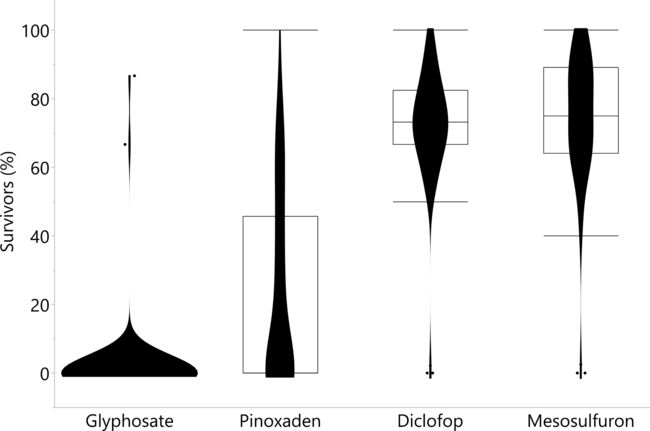
In the Texas Blacklands region, 97% (n = 62 of 64) of the Italian ryegrass populations were resistant to diclofop-methyl (an ACCase-inhibitor) when treated with twice the label recommended rate. Of the 64 populations evaluated, one was highly resistant (<20% injury), 61 showed moderate level of resistance (21% to 79% injury), and two populations were sensitive (100% injury). The seedling survival frequency was high (50% to 100%) in all resistant populations (Figure 3). In a different study conducted in Texas by Tucker et al. (Reference Tucker, Morgan, Senseman, Miller and Baumann2006), Italian ryegrass collected from 40 wheat fields in 13 central and north Texas counties were tested for response to several herbicides, including diclofop-methyl. These populations had approximately a 69% reduction in fresh weights, indicating that diclofop-methyl was still somewhat effective for ryegrass control in this region a decade ago. However, in 2013, Day (Reference Day2013) reported that feral ryegrass in northeast Texas was controlled only 14% at the 4× rate of diclofop.
Percent survival of Italian ryegrass populations in response to different herbicides. The y-axis represents the number of survivors in 64 different populations. This violin plot is a modified box plot in which the box represents upper and lower quartiles, and the central line represents the median. The violin area shows the proportion of populations with survivors for each herbicide.

Ryegrass resistance to diclofop-methyl has been reported in several other states in the United States. In Arkansas, 81% of the 35 Italian ryegrass populations collected from 13 counties were resistant to diclofop at the 1× rate (Kuk et al. Reference Kuk, Burgos and Scott2008). A survey of Italian ryegrass in Idaho and Washington revealed that 59% of the 75 populations tested were resistant to diclofop, and 25% were at the initial stages of resistance evolution (Rauch et al. Reference Rauch, Thill, Gersdorf and Price2010). Results of the present study support the postulation that resistance in ryegrass to diclofop-methyl is prevalent in many of the wheat-growing regions in the United States (Figure 1).
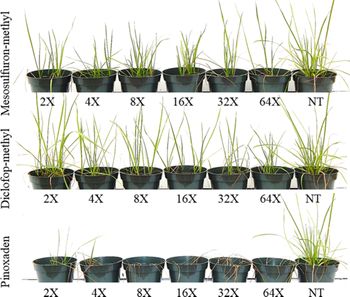
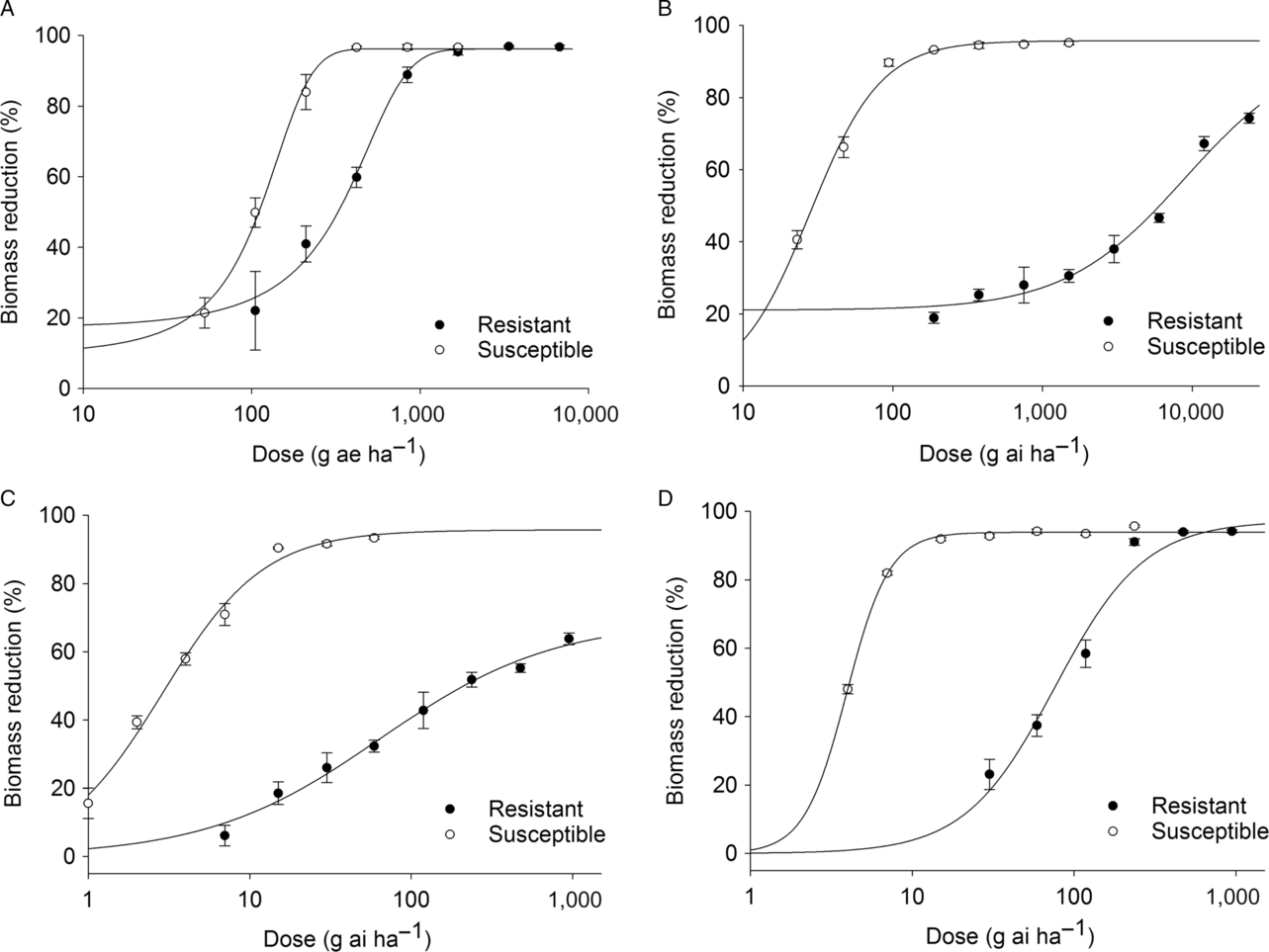
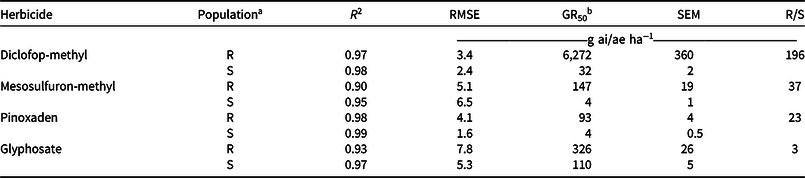
The frequency of resistant individuals within populations was also high. The Italian ryegrass population with the highest level of resistance had 100% survival even at the highest dose (64×) tested (Figure 4). The dose-response assays revealed that the GR50 values of the resistant and susceptible Italian ryegrass populations were 6,272 and 32 g ai ha−1, respectively, exhibiting 196-fold resistance compared with the susceptible standard, based on the R/S ratio (Figure 5). Ryegrass biotypes with high levels of resistance were reported previously in Tennessee (>93-fold resistance) (Betts et al. Reference Betts, Ehlke, Wyse, Gronwald and Somers1992) and Oregon (508-fold resistance) (Stanger and Appleby Reference Stanger and Appleby1989).
Response of a highly resistant Italian ryegrass population ‘IR15-01’ to herbicide rates ranging from twice to 64 times the recommended label rate of pinoxaden, diclofop-methyl, and mesosulfuron-methyl. NT, nontreated control.

Dose response of the highly resistant ‘IR15-01’ and susceptible ‘IR15-S9’ Italian ryegrass populations to (A) glyphosate, (B) diclofop-methyl, (C) mesosulfuron-methyl, and (D) pinoxaden. Biomass reduction (%) was based on dry biomass of respective treated populations compared with nontreated ryegrass.

In the current study, 75% of the four perennial ryegrass populations were resistant to diclofop-methyl (2× rate). These resistant populations were moderately resistant, showing 21% to 79% injury levels. Globally, not many cases of perennial ryegrass resistance to this family (aryloxyphenoxypropionates [“fops”]) of ACCase inhibitors have been reported. In 2016, less than five-fold resistance to clodinafop-propargyl was reported in a perennial ryegrass population in Denmark (Heap Reference Heap2019). Results from the current study illustrate that diclofop-methyl is no longer an effective option for ryegrass control in Texas.
Mesosulfuron-methyl
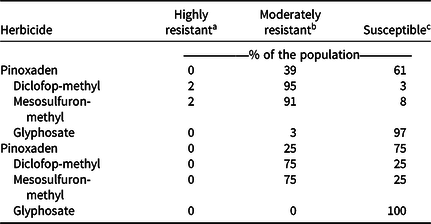
The repeated use of mesosulfuron-methyl (an ALS-inhibitor) to control diclofop-methyl–resistant biotypes has led to the selection of ALS-inhibitor resistant ryegrass in Texas and elsewhere in the United States (Kuk et al. Reference Kuk, Burgos and Scott2008). Results of our study showed that 91% of the Italian ryegrass populations (n = 58 of 64) collected from the Texas Blacklands region were moderately resistant to mesosulfuron-methyl (Table 1). Two percent (n = 1 of 64) were highly resistant and approximately 8% (n = 5) were susceptible. Furthermore, most of the mesosulfuron-resistant populations had a survival frequency of 40% to 100% (Figure 3). Dose-response assay of the highly resistant population revealed a 37-fold resistance to mesosulfuron-methyl compared with the susceptible standard (Figures 4 and 5; Table 2). In Texas wheat, mesosulfuron-resistant Italian ryegrass was previously reported in McLennan County in 2005 with less than 35% control at 120 g ai ha−1 and a 24-fold resistance (Ellis et al. Reference Ellis, Morgan and Mueller2008).
Resistance levels of ryegrass (Lolium spp.) populations collected from the Texas Blacklands region.

a Highly resistant defined as populations with 0%–20% injury
b Moderately resistant defined as populations with 21%–79% injury.
c Susceptible defined as populations with 80%–100% injury.
d Sixty-four populations of Italian ryegrass were tested.
e Four populations of perennial ryegrass were tested.
GR50 values and herbicide resistance levels in Italian ryegrass (Lolium spp.) populations collected from the Texas Blacklands.

a R, resistant population (IR15-01); RMSE, root square mean error; R/S, ratio of GR50 for the resistant and the susceptible populations; S, susceptible population (IR15-S9); SEM, standard error of the mean
b GR50 is the herbicide concentration that reduced plant growth by 50%, based on the aboveground dry biomass measured at 4 weeks after treatment. Values have been rounded off to the nearest decimal point.
Resistance in Italian ryegrass to mesosulfuron-methyl has been reported in several other states as well. Rauch et al. (Reference Rauch, Thill, Gersdorf and Price2010) reported that 27% of the Italian ryegrass populations tested in Idaho and Washington were resistant to mesosulfuron-methyl. More recent reports showed widespread occurrence of resistance in Italian ryegrass to this herbicide in various wheat production regions in the United States. For instance, a study conducted by Salas et al. (Reference Salas, Burgos, Mauromoustakos, Lassiter, Scott and Alcober2013) characterized a total of 47 Italian ryegrass populations from eight states (Arkansas, Georgia, Kansas, Mississippi, North Carolina, South Carolina, Virginia, and Washington) and observed that 83% of the populations were resistant to mesosulfuron-methyl. The high levels of resistance (37-fold) observed in the current study could be attributed to the widespread use of sulfonylurea herbicides in Texas wheat production.
With respect to perennial ryegrass, the response to mesosulfuron-methyl was similar to that of Italian ryegrass. Three of the four perennial ryegrass populations were moderately resistant (21% to 79% injury) to mesosulfuron-methyl and one was susceptible (Table 1). In Delaware, Saari et al. (Reference Saari, Cotterman, Smith and Primiani1992) reported perennial ryegrass populations with high levels of resistance to chlorsulfuron (>300-fold), imazapyr (>4,500-fold), sulfometuron-methyl (>100,000-fold), and triasulfuron (>1,250-fold), illustrating the occurrence of ALS-inhibitor resistance in this species. However, such high level of resistance may be attributed to a highly sensitive standard used in the study. ALS-inhibitor resistance in perennial ryegrass (i.e., resistance to sulfometuron-methyl) was also reported in roadside populations in California and Texas (Heap Reference Heap2019). However, resistance to ALS-inhibitor herbicides is more prevalent in Italian ryegrass than in perennial ryegrass (Heap Reference Heap2019), owing to the widespread distribution of the former in United States wheat production. Despite resistance concerns, ALS inhibitors continue to be used in tank mixes for controlling ACCase-inhibitor resistant populations, further aggravating resistance issues. This scenario has rendered the ALS inhibitors largely ineffective for controlling Italian ryegrass in Texas.
Pinoxaden
Pinoxaden, commercialized in 2006, is an ACCase-inhibitor graminicide recommended in wheat and barley (Hordeum vulgare L.) (Porter et al. Reference Porter, Kopec and Hofer2005) as an alternative to diclofop-methyl. Pinoxaden provided effective control of diclofop-resistant ryegrass because of differential binding properties within the ACCase enzyme (Hofer et al. Reference Hofer, Muehlebach, Hole and Zoschke2006) and a general lack of cross resistance. However, high reliance on pinoxaden for controlling diclofop- and mesosulfuron-resistant ryegrass has exerted high selection pressure for resistance to pinoxaden. In this study, 39% of the Italian ryegrass populations were resistant to pinoxaden when treated with twice the recommended label rate (Table 1). Results have also indicated that resistance is at the initial stage of evolution in many of these populations, based on the survival frequencies; approximately eight of the 25 resistant populations had no more than a 20% survival rate. Similar findings have been reported by Rauch et al. (Reference Rauch, Thill, Gersdorf and Price2010) in Idaho and Washington, where 12% of the 75 ryegrass populations tested were resistant to pinoxaden, and 19% (n = 14) were beginning to evolve resistance. In Oregon, Liu et al. (Reference Liu, Hulting and Mallory-Smith2016) reported poor control (40%) of two Italian ryegrass populations with a 1× rate of pinoxaden. Likewise, in Arkansas, Salas et al. (Reference Salas, Burgos, Mauromoustakos, Lassiter, Scott and Alcober2013) reported that 17% (n = 6 of 35) of the Italian ryegrass populations surveyed in the state were resistant (20% to 80% injury) when treated with a 2× rate of pinoxaden. These studies, along with ours, illustrate the emerging pinoxaden-resistance issue in Italian ryegrass across different wheat-producing regions in the United States.
In the current study, the GR50 values, based on regression equations for pinoxaden-resistant and -susceptible Italian ryegrass populations, were 93.2 and 4.1 g ai ha−1, respectively (Figure 5; Table 2), with the R/S ratio indicating a 23-fold resistance. In Italian ryegrass populations tested in North Carolina, Chandi et al. (Reference Chandi, York, Jordan and Beam2011) reported less than 50% biomass reduction at 2,000 g ha−1,which is 32× the label-recommended rate. However, such a high level of resistance to pinoxaden has not yet been reported elsewhere to our knowledge. In our study, the resistant Italian ryegrass population was completely controlled at 8× the label-recommended rate (Figures 4 and 5). For perennial ryegrass, one of the four tested populations survived pinoxaden, although injury was high (72%). To our knowledge, this is the first reported case of pinoxaden resistance in perennial ryegrass in the United States. Although the level of resistance and frequency of resistant individuals within the population were low in this study, proactive measures are vital to prevent further spread.
Glyphosate
Only two of the 64 Italian ryegrass populations tested in this study were moderately resistant (21% to 79% injury) to glyphosate (Table 1), with survival frequencies of 65% and 85%. None of the perennial ryegrass populations tested was highly resistant to glyphosate. The low occurrence of glyphosate-resistant ryegrass in Texas Blacklands could be attributed to low exposure of ryegrass to glyphosate in this region. Wheat-fallow rotation is common in the Texas Blacklands, wherein the use of glyphosate as a burndown option after wheat harvest is generally precluded to avoid additional costs. Moreover, glyphosate use is also limited before planting, because the majority of wheat in the region is planted after a conventional tillage operation.
As of now, glyphosate resistance in ryegrass is not prevalent globally (Heap Reference Heap2019). The first glyphosate resistance case in ryegrass (rigid ryegrass, Lolium rigidum Gaudin) was reported in 1998 in Australia (Powles et al. Reference Powles, Lorraine-Colwill, Dellow and Preston1998). Later, glyphosate-resistance in Italian ryegrass was confirmed in Chile in 2003 (Perez and Kogan Reference Perez and Kogan2003). In the United States, glyphosate-resistant Italian ryegrass was reported in Oregon (Perez-Jones et al. Reference Perez-Jones, Park, Colquhoun, Mallory-Smith and Shaner2005), Mississippi (Nandula et al. Reference Nandula, Poston, Eubank, Koger and Reddy2007), California (Jasieniuk et al. Reference Jasieniuk, Ahmad, Sherwood, Firestone, Perez-Jones, Lanini, Mallory-Smith and Stednick2008), Arkansas (Dickson et al. Reference Dickson, Scott, Burgos, Salas and Smith2011), Louisiana, North Carolina, and Tennessee (Heap Reference Heap2019). Statewide surveys conducted in California by Jasieniuk et al. (Reference Jasieniuk, Ahmad, Sherwood, Firestone, Perez-Jones, Lanini, Mallory-Smith and Stednick2008) revealed high prevalence (47% of the 118 populations tested) of glyphosate-resistant Italian ryegrass in the state. However, there is no reported case of glyphosate resistance in perennial ryegrass in the United States, as of this writing. The first global case of glyphosate resistance in perennial ryegrass came from Argentina, wherein the resistant population had 11-fold resistance compared with the susceptible standard (Yanniccari et al. Reference Yanniccari, Istilart, Giménez and Castro2012). In New Zealand, two perennial ryegrass populations were confirmed to have seven- and 25-fold resistance to glyphosate (Ghanizadeh et al. Reference Ghanizadeh, Harrington, James, Woolley and Ellison2015). The lack of glyphosate resistance in perennial ryegrass populations of Texas could be due to a low occurrence of perennial ryegrass combined with a general lack of selection pressure by glyphosate in the Texas Blacklands wheat production.
The glyphosate-resistant populations confirmed in this study had low levels of resistance, and the most resistant population did not survive beyond the 1× rate in the dose-response assay (Figure 5; Table 2), exhibiting a three-fold resistance compared with the susceptible standard. Perez-Jones et al. (Reference Perez-Jones, Park, Colquhoun, Mallory-Smith and Shaner2005) reported five-fold resistance to glyphosate in an Italian ryegrass population collected in an orchard in Oregon. Likewise, a three-fold resistance to glyphosate was reported by Nandula et al. (Reference Nandula, Poston, Eubank, Koger and Reddy2007) in two Italian ryegrass populations tested in Mississippi. Nevertheless, reports of Italian ryegrass populations surviving glyphosate are increasing at an alarming rate in the southern states and close monitoring is essential to address further spread of resistance.
Multiple-Herbicide Resistance
Resistance in Italian ryegrass to more than one unique herbicide MOA is prevalent in wheat production in the Texas Blacklands. Although resistance to diclofop-methyl evolved before that of mesosulfuron-methyl, the first mesosulfuron-resistant populations documented in Arkansas (Kuk and Burgos Reference Kuk and Burgos2007) and Texas (Ellis et al. Reference Ellis, Morgan and Mueller2008) did not exhibit multiple resistance with diclofop-methyl. However, in the current study, 92% (n = 59 of 64) of the populations were resistant to both diclofop-methyl and mesosulfuron-methyl (Table 3). Rauch et al. (Reference Rauch, Thill, Gersdorf and Price2010) reported that 27% of the populations originating from Idaho and Washington exhibited multiple resistance to ALS- and ACCase-inhibitors. Multiple resistance to diclofop-methyl and mesosulfuron-methyl was also reported in North Carolina (Chandi et al. Reference Chandi, York, Jordan and Beam2011).
Cross and multiple resistance in 64 Italian ryegrass populations collected from the Texas Blacklands region.

a ACCase, acetyl-coenzyme-A carboxylase; ALS, acetolactate synthase; den, phenylpyrazole family; EPSPS, 5-enolpyruvylshikimate-3-phosphate synthase; fop, aryloxyphenoxypropionate family.
b Cross-resistance refers to resistance to different herbicide families with the same mode of action; multiple resistance refers to resistance for two or more unique herbicide modes of action. Resistance was determined on the basis of plant survival (5%– 79% injury) at the recommended label rate for the given herbicide.
In the current study, 24 of the 64 Italian ryegrass populations and one of the four perennial ryegrass populations were cross-resistant to the two ACCase inhibitors (diclofop-methyl and pinoxaden) (Table 3; Figure 4). It is expected that selection for resistance to pinoxaden occurred after that of diclofop resistance, due to widespread use of the latter to control diclofop-resistant ryegrass. However, it was also speculated that the selected mutation in the ACCase gene conferring diclofop resistance may have also conferred resistance to pinoxaden (Yu et al. Reference Yu, Cairns and Powles2007). In the United States, pinoxaden-resistant Italian ryegrass has been reported in eight states (Arkansas, Idaho, Missouri, North Carolina, Oregon, Virginia, Washington, and Texas) (Figure 1), and most of them were also resistant to diclofop-methyl. In North Carolina, all populations confirmed resistant to diclofop-methyl by Chandi et al. (Reference Chandi, York, Jordan and Beam2011) were cross-resistant to pinoxaden.
In our study, the 24 Italian ryegrass populations that were cross resistant to diclofop-methyl and pinoxaden were also resistant to mesosulfuron-methyl (Table 3); one population of perennial ryegrass was also resistant to all of these three herbicides. To our knowledge, this is the first reported case of multiple herbicide resistance in perennial ryegrass in the United States. Moreover, one Italian ryegrass population showed three-way resistance to ACCase-inhibitors (diclofop-methyl and pinoxaden), an ALS-inhibitor (mesosulfuron-methyl), and an EPSPS-inhibitor (glyphosate) (Table 3). Although cases of multiple herbicide resistance up to four MOAs have been reported in Italian ryegrass from orchards in California (Heap Reference Heap2019), none of these previous multiple herbicide resistance cases involved resistance to pinoxaden. Proliferation of multiple herbicide resistance in ryegrass is a serious challenge to their sustainable management.
Overall, this study revealed the widespread occurrence of herbicide-resistant ryegrass in wheat production in Texas Blacklands. Although the distribution of perennial ryegrass was low compared with Italian ryegrass in this region, resistance was still present at considerable levels. Italian ryegrass and perennial ryegrass are obligate outcrossing species, where pollen-mediated gene flow can spread herbicide-resistance alleles. Stacking of resistance-conferring alleles through hybridization can favor rapid evolution and spread of multiple herbicide resistance, drastically reducing the herbicide options available for weed control.
The Clearfield® wheat technology (resistant to ALS inhibitors) may not be an effective alternative for this region, given the widespread occurrence of ALS-inhibitor–resistant Italian ryegrass. Inclusion of PRE herbicides such as a combination of flufenacet plus metribuzin, pendimethalin (delayed PRE), and pyroxasulfone (delayed PRE) can be viable options for Italian ryegrass control in wheat. Pyroxasulfone was reported to control weeds resistant to glyphosate and many other herbicides (King and Garcia Reference King and Garcia2008; Walsh et al. Reference Walsh, Fowler, Crowe, Ambe and Powles2011). Management of multiple resistance in Italian ryegrass requires timely application of PRE and POST herbicides. In addition, harvest weed seed control tactics have much potential for managing ryegrass in wheat by targeting weed seed during commercial grain harvest operations (Walsh et al. Reference Walsh, Newman and Powles2013; Walsh et al. Reference Walsh, Aves and Powles2017), which need to be further explored in this region.
Resistance in ryegrass species to ALS- and ACCase-inhibitor herbicides is a serious threat to wheat production, which severely limits the herbicide options available for effective control of this species. Future research will focus on understanding the molecular mechanisms responsible for herbicide resistance in these populations and informing effective management tactics.
Acknowledgements
The authors acknowledge funding support from the US Department of Agriculture National Institute of Food and Agriculture–Agriculture and Food Research Initiative Foundational Award (2016-67013-24810) and the Texas Wheat Producers Board in conducting this study. The authors declare no conflicts of interest.