Introduction
The improvement of the AA5383 alloy over the AA5083 alloy was achieved by (i) decreasing the content of iron, silicon, and other impurities to reduce their negative influence on ductility, (ii) increasing the Mg and Mn content to enhance solid solution strengthening of the Mg atoms and dispersion strengthening of the MnAl4, and (iii) increasing the Zr content to create more Al3Zr precipitation [Reference Charit and Mishra1, Reference Calcraft, Wahab, Viano, Schumann, Phillips and Ahmed2]. The resultant AA5383 Al–Mg alloy possesses better mechanical properties and thermal stability, so it has become the primary material for deck construction in the new generation of ships [Reference Deschamps, Pérone, Bréchet, Ehrström and Poizat3, Reference Lin, Wang, Chen, Hsieh, Tsai and Chiang4]. However, the AA5383 alloy can be affected by the precipitation of continuous mesh β phases (Mg2Al3) along the grain boundaries [Reference Lyndon, Gupta, Gibson and Birbilis5, Reference Huang, Li, Xiao, Liu, Huang and Ren6]. This can lead to intergranular corrosion failure and stress corrosion, which can significantly decrease the corrosion resistance performance of the alloy [Reference Yang and Allen7, Reference Gao, Wang, Seifi and Lewandowski8, Reference Jain, Lim, Hudson and Scully9, Reference Tan and Allen10]. How to effectively improve the corrosion resistance performance of the AA5383 alloy has become an important research topic.
The exposure of an Al–Mg alloy, with a Mg content higher than 3 wt%, to a corrosive seawater environment at 65–200 °C over a long period of time, can lead to the continuous formation of a large amount of coarse β phase (Mg2Al3) along the grain boundaries to form a mesh. Because the β phase works as a sacrificing anode to the Al matrix, galvanic corrosion very easily leads to selective corrosion of the β phase in the seawater environment due to galvanic corrosion [Reference Lyndon, Gupta, Gibson and Birbilis5, Reference Holroyd, Burnett, Seifi and Lewandowski11, Reference Crane and Gangloff12]. When the precipitation of the β phase at the grain boundaries is compact and develops into a continuous mesh distribution, the AA5383 alloy, originally resistant to corrosion, is transformed to become sensitive to the corrosive environment. This sensitization in the alloy can lead to intergranular corrosion and stress corrosion cracking, which can significantly shorten the ship’s life span and threaten the safety of the crew [Reference Holroyd and Scamans13, Reference Steiner and Agnew14, Reference Lim, Kelly and Scully15, Reference Zhang, Steiner, Kairy, Davies, Agnew and Birbilis16]. As indicated in the literature, adding a trace of Sc or Zr to the Al–Mg alloy acts to refine the grains and can effectively inhibit the precipitation of the coarse β phase along the grain boundaries [Reference Liu, Liang and Li17, Reference Mikhaylovskay, Mochugovskiy, Levchenko, Tabachkova, Mufalo and Portnoy18]. It has been found in other research that after cold working, the application of a stabilization treatment at 220–285 °C can produce more uniform and discontinuous precipitation at the grain boundaries and internals in the Al–Mg alloy. This allows one to achieve a dispersed precipitation of the β phase to improve the corrosion resistance performance of the alloy [Reference Kramer, Phillippi, Tack and Wong19, Reference Chen, Chu, Lai and Wu20, Reference Zhang, Zhang, Yan, Thomas, Davies and Birbilis21, Reference Yen, Wu, Chen and Lee22].
As mentioned above, although the AA5383 alloy is the primary material for the building of ship decks, it has a very high degree of sensitivity to stress corrosion. Recent studies have typically focused on the effect of the addition of trace elements on the mechanical and corrosion properties of Al–Mg alloys. There have been few in-depth studies discussing on how stabilization treatments might influence the intergranular corrosion and corrosion resistance performance of AA5383-H15 alloys. Therefore, in this work, we design three different stabilization treatments and conduct corrosion weight loss tests and stress corrosion tests to evaluate the influence of stabilization treatment on the microstructure of the AA5383-H15 alloy, as well as its stress corrosion properties.
Results and discussion
Microstructure
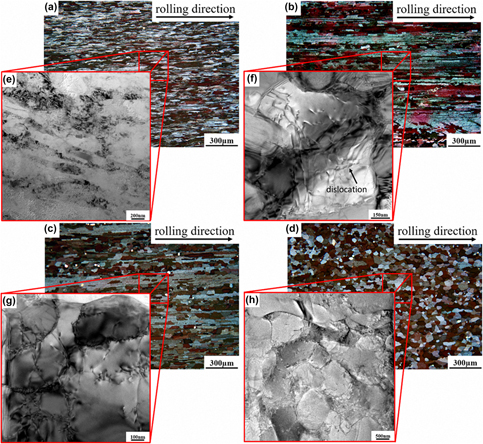
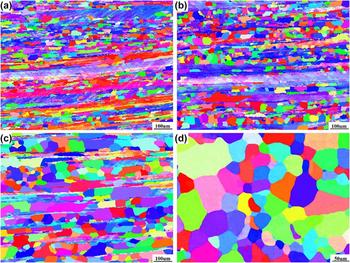
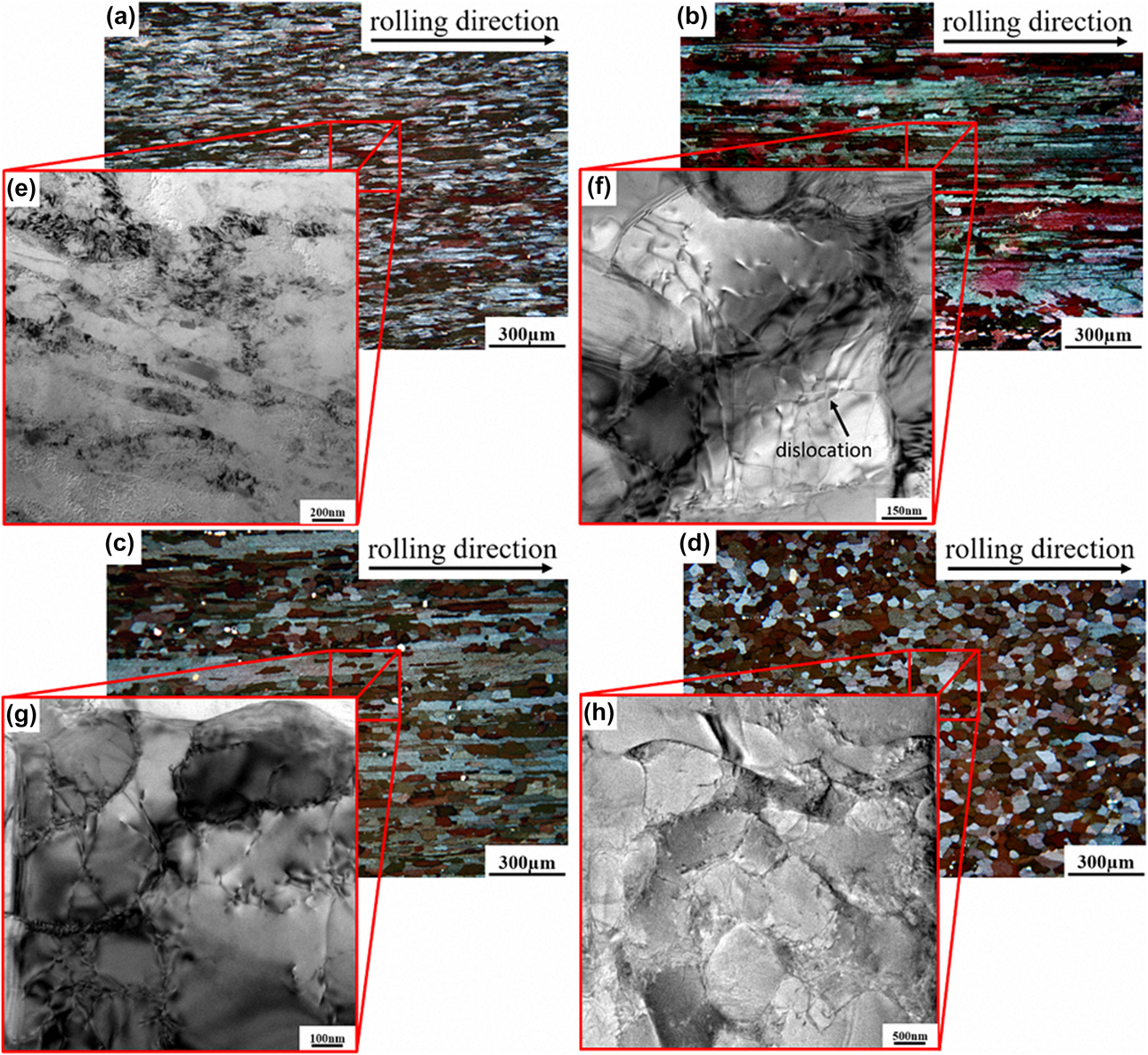
It can be observed in the AA5383-H15 alloy prepared without stabilization treatment that the grains are distributed in a fibrous structure along the rolling direction [as shown in Fig. 1(a)]. The effects on the alloys after the application of stabilization treatments at 220 °C/3 h, 250 °C/3 h, and 280 °C/3 h can be observed in Figs. 1(b), 1(c), and 1(d). As can be seen in Fig. 1(f) that the AA5383-H15 alloy matrix exposed to a 220 °C/3 h stabilization treatment contains many dislocation structures, which induced a recovery phenomenon. The application of a 250 °C/3 h stabilization treatment facilitated partial recrystallization of the matrix [as shown in Fig. 1(g)]. The application of a 280 °C/3 h stabilization treatment led to the formation of a large amount of equiaxial recrystallization grains in the alloy matrix [as shown in Fig. 1(h)]. In addition, the EBSD maps of the AA5383-H15 alloys treated with 220 °C/3 h, 250 °C/3 h, and 280 °C/3 h stabilization treatments or no stabilization treatment are shown in Fig. 2. The grain structure exhibited in the AA5383-H15 alloys treated with 220 °C/3 h and 250 °C/3 h stabilization treatments differed markedly from the equiaxed grain structure that existed in the AA5383-H15 alloy treated with a 280 °C/3 h stabilization treatment. The latter presented with an equiaxed grain structure, indicating complete recrystallization, and the results are consistent with the OM and TEM analysis as shown in Fig. 1. Therefore, the experiment shows that as the temperature of the stabilization treatment increases, the degree of recrystallization in the AA5383-H15 alloy increases.
(a–d) Optical micrograph of AA5383-H15 alloys treated with various stabilization treatments and (e–h) TEM images of the marked square in (a–d): (a, e) nonstabilization treatment, (b, f) 220 °C for 3 h, (c, g) 250 °C for 3 h, and (d, h) 280 °C for 3 h.
EBSD maps of AA5383-H15 alloys treated with various stabilization treatment. (a) Non-stabilization, (b) 220 °C, (c) 250 °C, and (d) 280 °C for 3 h.
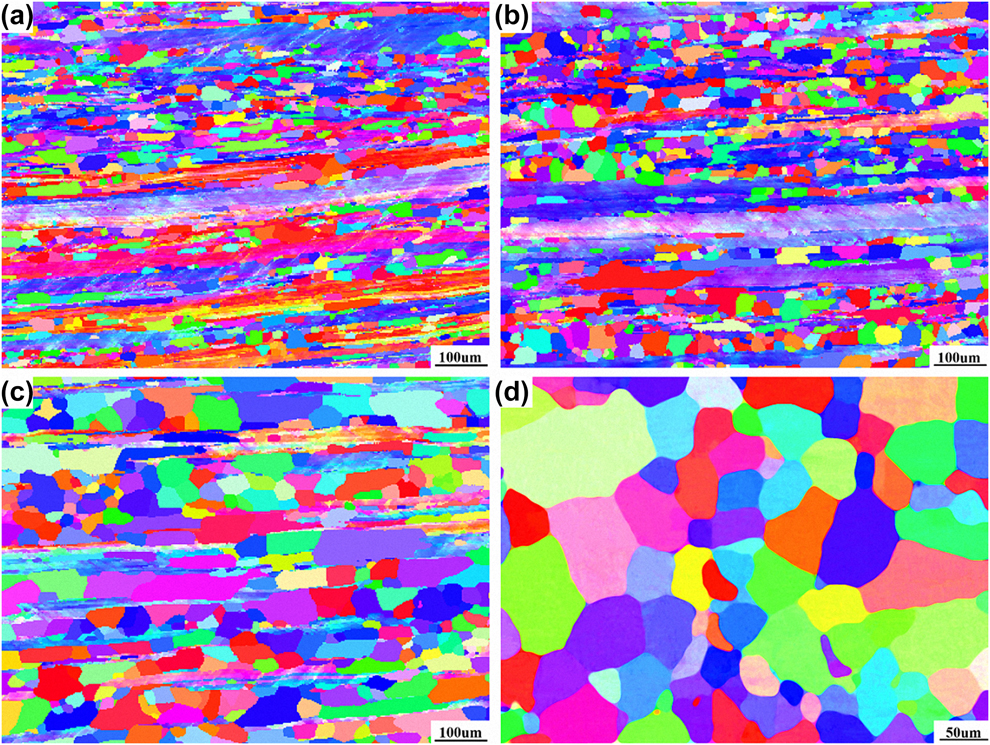
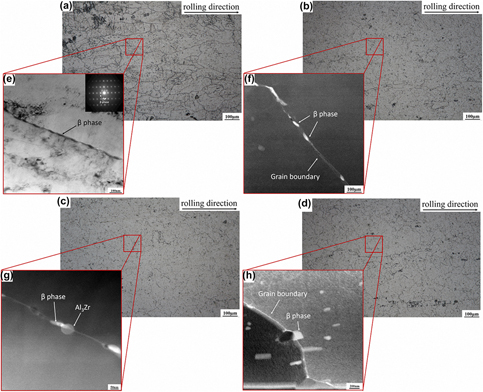
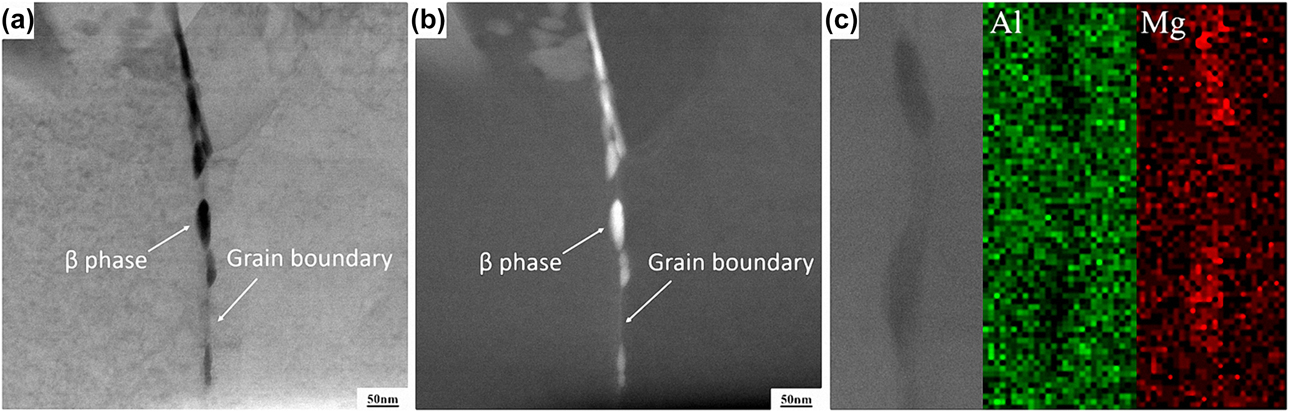
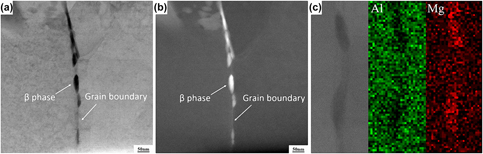
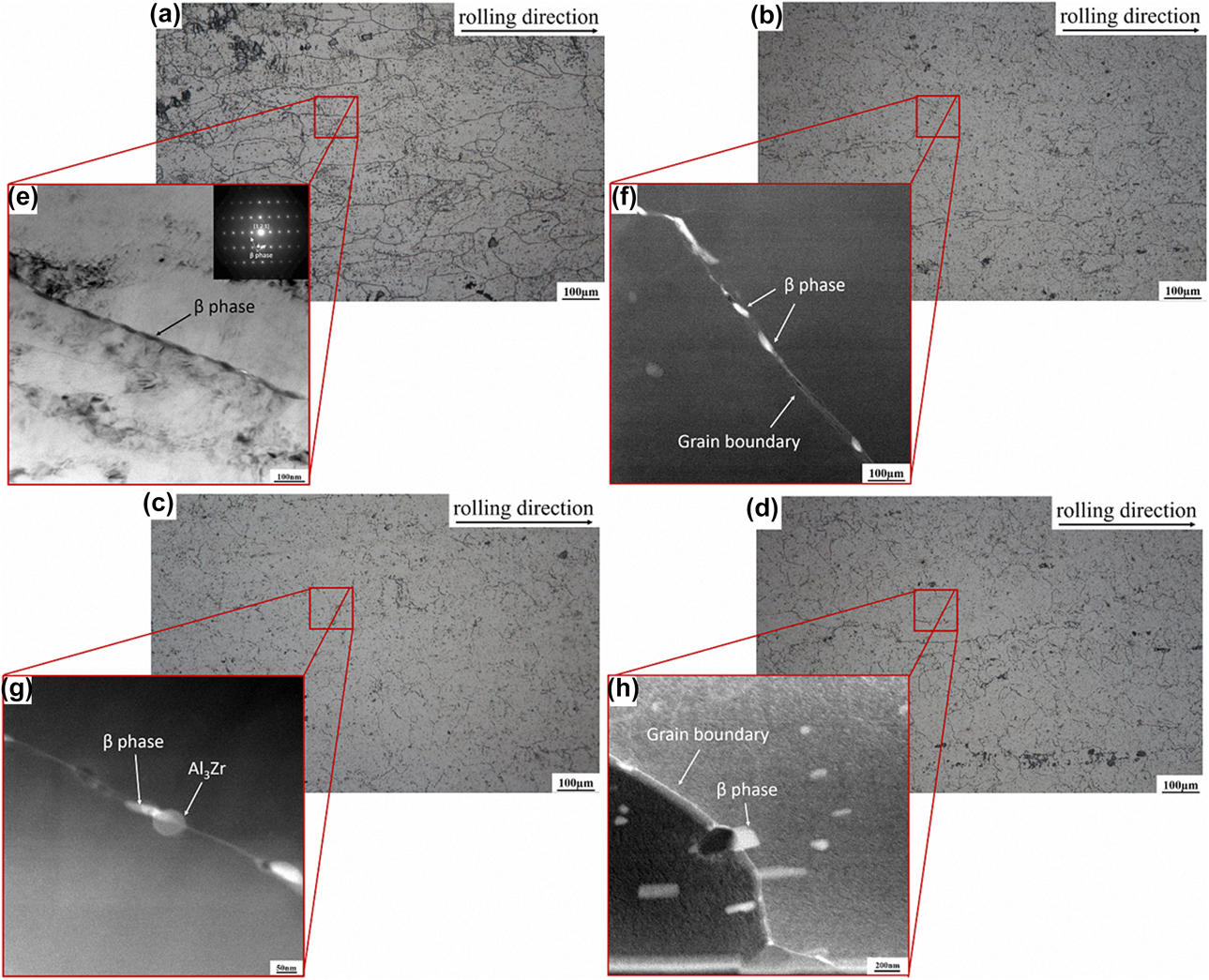
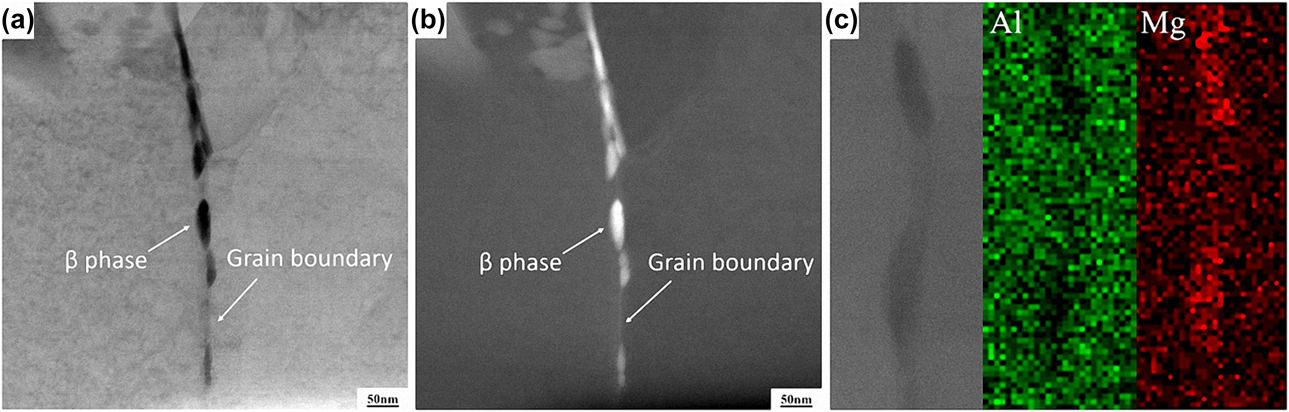
Figure 3(a) shows the microstructure of the AA5383-H15 alloy produced without stabilization treatment but after 100 °C/168 h of sensitization treatment. As can be seen in Figs. 3(a) and 3(e), there is a significant amount of the coarse β phase precipitated continuously like a mesh along the grain boundaries [Reference D’Antuono, Gaies, Golumbfskie and Taheri23]. The TEM micrographs of the β phase in Fig. 3(e) show the presence of a large quantity of platelet-like precipitates, with lengths of 50 nm, distributed along the grain boundaries, identified as the hcp structure of the Mg2Al3 phase, as shown in the [121] zone-axis SAED pattern in the inset of Fig. 3(e). During sensitization of AA5383-H15 alloys, Mg atoms preferentially diffuse to the grain boundary and form precipitation of β phase. The continuous distribution of grain boundary β phase was a primary reason for the high intergranular corrosion and stress corrosion cracking susceptibility of sensitized AA5383-H15 alloys. However, after the application of a stabilization treatment at 220 °C/3 h, 250 °C/3 h, or 280 °C/3 h to the alloy, it can be seen from the observed microstructures that the amount of β phase precipitation along the grain boundaries has greatly decreased [as shown in Figs. 3(b)–3(d)] [Reference Zhang, Gupta, Davies, Hodge, Tort, Xia and Birbilis24, Reference Zhao, Polyakov, Mecklenburg, Kassner and Hodge25]. To get further details on the β phase, the bright-field and dark-field scanning transmission electron microscopy (STEM) images of the discontinuous precipitation of β phase at grain boundary of AA5383-H15 alloy after stabilization treatment at 250 °C for 3 h and corresponding energy dispersive X-ray spectroscopy (EDS) mapping results are shown in Fig. 4. EDS X-ray mapping analysis in the STEM demonstrated that the brighter imaging phase was rich in Al and Mg and identified as the β phase [as shown in Fig. 4(c)], and the results are consistent with the SADP analysis as shown in Fig. 3(e). It is important to underline that discrete β phases are formed at the grain boundary of the sensitized AA5383-H15 alloy by applying a stabilization treatment at 250 °C for 3 h. The average length and thickness of β phases are 60 nm and 15 nm, respectively, and the distance between β phases is about 150 nm. Also, in Fig. 3(g), observation of the β phase and Al3Zr precipitates at the grain boundaries shows where the precipitated β phase is in a semicontinuous state. This indicates that the Al3Zr phase can effectively suppress recrystallization and grain growth during the stabilization treatment, which can effectively suppress continuous precipitation in a mesh shape at high-angle grain boundaries and can decrease the spreading of β phase precipitation [Reference Tzeng, Chengn, Nieh, Bor and Lee26].
(a–d) Optical micrograph of artificially sensitized AA5383-H15 alloys treated with various stabilization treatments and (e–h) TEM images of the marked square in (a–d): (a, e) nonstabilization treatment [(e) the selected area diffraction pattern of the β phase is inserted in the upper right corner], (b, f) 220 °C for 3 h, (c, g) 250 °C for 3 h, and (d, h) 280 °C for 3 h.
STEM images of β phase: (a) bright-field image, (b) dark-field image, and (c) EDS elemental mapping results for Al and Mg.
Nitric acid mass loss test
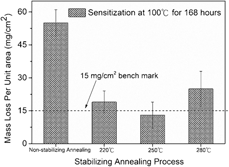
The ASTM G67 test standard divides the sensitivity of intergranular corrosion into three levels [27]: when mass loss is over 25 mg/cm2, it is sensitive to intergranular corrosion; when in the range of 25–15 mg/cm2, it has the potential for intergranular corrosion; and when less than 15 mg/cm2, it is not sensitive to intergranular corrosion. Figure 5 shows the results from the nitric acid mass loss test for AA5383-H15 alloys, which were produced using stabilization treatments at 220 °C/3 h, 250 °C/3 h, and 280 °C/3 h, respectively, followed by a 100 °C/168 h sensitization treatment. As also can be seen in Fig. 5, the mass loss of AA5383-H15 alloy without stabilization treatment is 55.2 mg/cm2, indicating that this alloy has a severe degree of sensitivity to intergranular corrosion. However, after the application of the stabilization treatment to the AA5383-H15 alloy, its sensitivity to intergranular corrosion significantly decreases. The AA5383-H15 alloy prepared using a stabilization treatment at 250 °C/3 h has the lowest mass loss rate, only 14.8 mg/cm2; this loss rate shows that the alloy is not sensitive to intergranular corrosion. According to the observations of the microstructure of Fig. 3, the stabilization treatment can effectively suppress the continuous precipitation of β phase at the grain boundaries, and the 250 °C/3 h stabilization treatment can facilitate partial recrystallization of the microstructure in the AA5383-H15 alloy. This decreases the locations for nucleation of the β phase at high-angle grain boundaries and inhibits the routes for spreading of corrosion through continuous β phase precipitation, thus making the alloy insensitive to intergranular corrosion. However, after the 280 °C/3 h stabilization treatment, recrystallization of the microstructure has already occurred in the alloy, so comparatively more nucleation sites exist for β phase precipitation. The large amount of precipitated β phase can form a large corrosive area, which can lead to peeling off of the grains and to a more severe mass loss. The mass loss of the 280 °C/3 h stabilization-treated AA5383-H15 alloy is up to 28.9 mg/cm2; this means the alloy is sensitive to intergranular corrosion.
ASTM G67 mass loss test of AA5383-H15 alloys (mg/cm2).

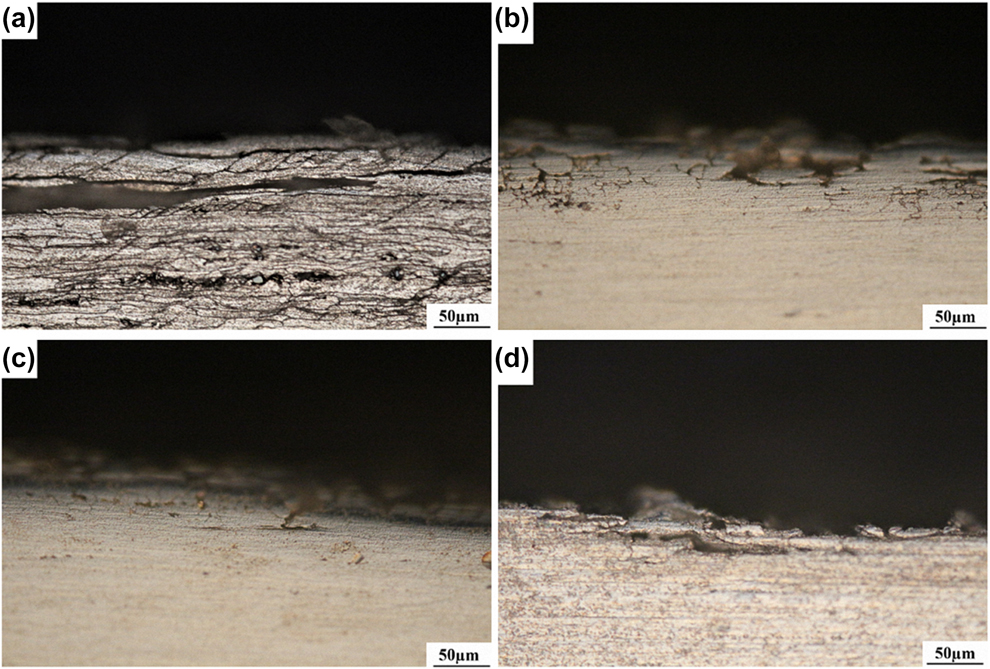
The corrosion patterns after NAMLT testing are shown on a cross section of the AA5383-H15 alloy in Fig. 6. From Fig. 6(a), it can be observed that without stabilization treatment, the AA5383-H15 alloy shows significant intergranular corrosion even after the sensitization treatment, and the depth of corrosion can reach inside the alloy. The alloy suffers severe corrosion failure, accompanied by significant grain peeling off and layer peeling. However, after the application of the 220 °C/3 h, 250 °C/3 h, and 280 °C/3 h stabilization treatment, no obvious intergranular corrosion is observed on the cross sections of the AA5383-H15 alloy, which indicates that stabilization treatment can effectively improve the alloy’s corrosion resistance performance and can decrease the amount of β phase precipitation at the grain boundaries. The AA5383-H15 alloy subjected to the 250 °C/3 h stabilization treatment has a uniform corrosion rate with no significant pitting, indicating that this treatment can effectively improve the alloy’s corrosion resistance performance. However, the alloy produced using the 280 °C/3 h stabilization treatment is sensitive to intergranular corrosion, as illustrated by some type of intergranular corrosion found on the cross section.
Morphology of ST-L surface corrosion after the application of different stabilization treatments and sensitization treatments to AA5383 alloy as shown by ASTM G67 tests for (a) nonstabilization, (b) 220 °C, (c) 250 °C, and (d) 280 °C for 3 h.

Stress corrosion properties
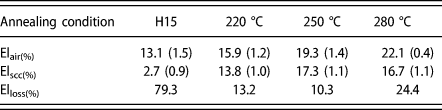
Table I lists the elongation of sensitized AA5383-H15 alloys prepared with 220 °C/3 h, 250 °C/3 h, and 280 °C/3 h stabilization treatments or no stabilization treatment after slow strain rate testing (SSRT). From Table I, it can be clearly seen that for AA5383-H15 alloy without stabilization treatment, there can be a ductility loss of up to 79.3%. Additionally, it should be noted that the application of a stabilization treatment can dramatically decrease the sensitivity of the AA5383-H15 alloy to stress corrosion. This conclusion is consistent with the mass loss tests. Among the treatments, the 250 °C/3 h stabilization treatment produces the lowest loss of 10.3%. For the 280 °C/3 h stabilization treatment, the ductility loss is 24.4%. The reason for this is that the grains of the AA5383-H15 alloy already have a recrystallized structure, so it is easy for the β phase to precipitate along the grain boundaries thereby increasing the corrosion spreading routes.
The elongation of sensitized AA5383-H15 alloys after SSRT.

Standard deviations are listed in parenthesis.
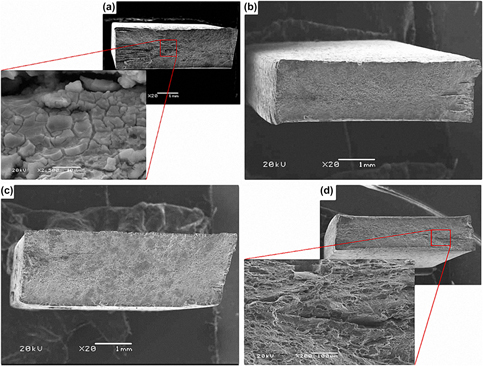
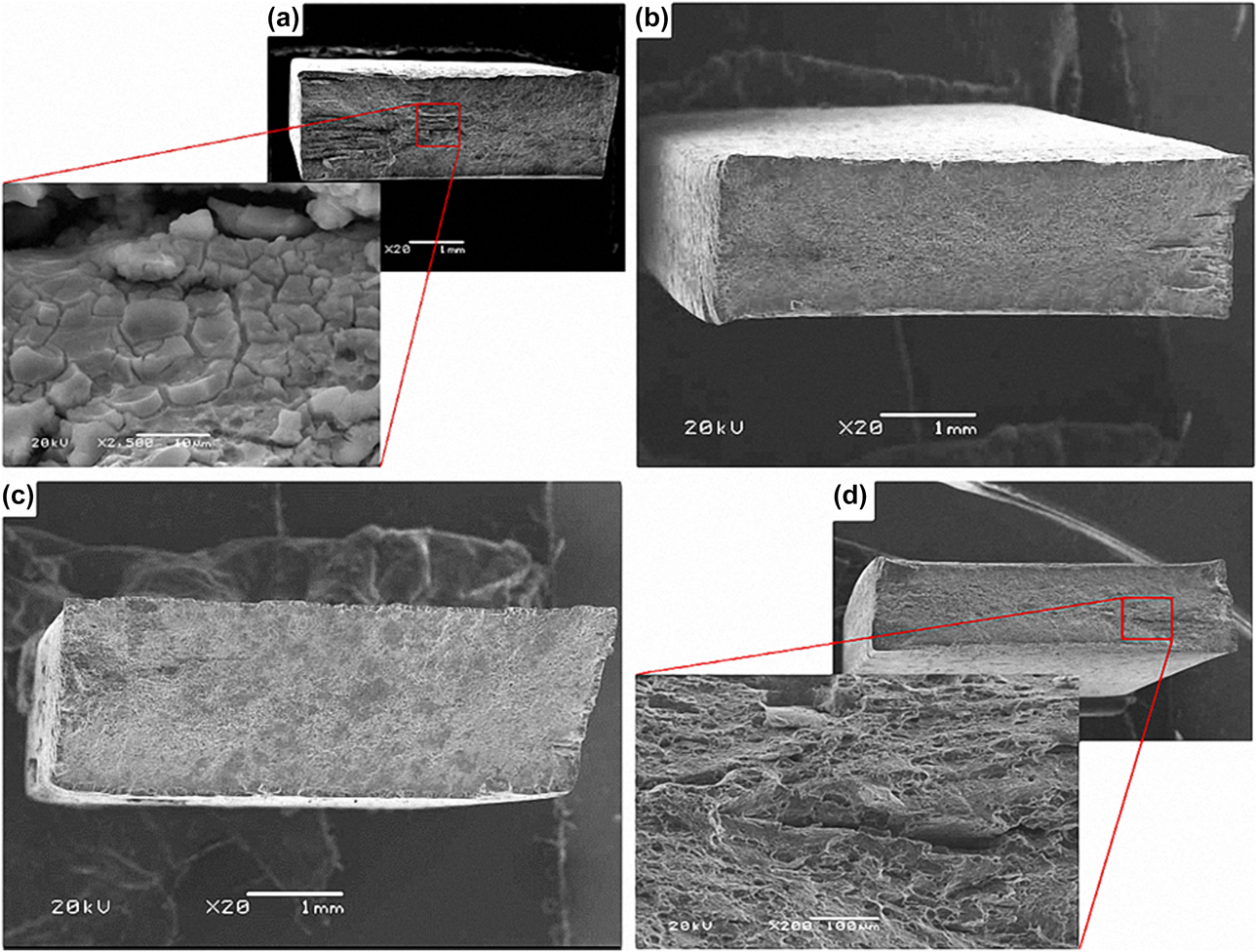
Figure 7 shows the SSRT fracture morphology of AA5383-H15 alloy samples, with and without 220 °C/3 h, 250 °C/3 h, and 280 °C/3 h stabilization treatments, were immersed after 100 °C/168 h sensitization treatment, in a 3.5 wt% NaCl solution for corrosion. Figure 7(a) shows the fracture surface of the AA5383-H15 alloy prepared without stabilization treatment. The morphology shows significant brittle fracturing with intergranular failure and transgranular cracking, which indicates a significant sensitivity to stress corrosion. When 220 °C/3 h and 250 °C/3 h stabilization treatments are applied to AA5383-H15 alloy, the fracture surface shows pit-like tensile damage. According to the TEM observations, the application of 220 °C/3 h and 250 °C/3 h stabilization treatments can facilitate recovery and partial recrystallization of the alloy structure. The β phase precipitates can then be dispersed in the matrix making the precipitation discontinuous, which can effectively decrease the alloy’s sensitivity to stress corrosion. However, for the AA5383-H15 alloy after the 280 °C/3 h stabilization treatment, the EBSD observations show that the grains have changed from a fibrous structure to a recrystallized structure, which makes it easier for the β phase to precipitate along the grain boundaries, leading to partial intergranular corrosion failure. Intergranular failure can still be observed on the fracture surface in samples prepared with this treatment. Most importantly, the continuity of β phase precipitation and its spreading routes are the main factors leading to the alloy’s sensitivity to stress corrosion. The β phase works as a sacrificial anode corresponding to the corrosion potential of the Al matrix, leading to selective corrosion of the precipitated β phase in corrosive environments [Reference Goswami and Holtz28]. The continued precipitation of the β phase along the grain boundaries provides continuous routes for corrosion, which can accelerate the phenomenon of intergranular corrosion; cracks will also grow along corrosion routes, leading to significant cracking due to intergranular stress corrosion failure of the alloy’s fracture surface. Stabilization treatments can effectively decrease the AA5383-H15 alloy’s sensitivity to stress corrosion, with samples subjected to the 250 °C/3 h stabilization treatment having the best performance.
SEM images of the SSRT fracture surface of the AA5383-H15 alloy prepared with different stabilization treatments after sensitization: (a) nonstabilization, (b) 220 °C, (c) 250 °C, and (d) 280 °C for 3 h.
Mechanical properties
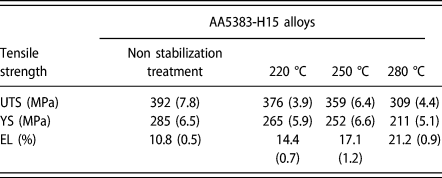
Table II lists the mechanical properties of the AA5383-H15 alloys prepared with the 220 °C/3 h, 250 °C/3 h, and 280 °C/3 h stabilization treatments or no stabilization treatment. It can be seen in Table II that the AA5383-H15 alloy prepared without stabilization treatment has the highest tensile strength, reaching an ultimate tensile strength (UTS) and yield strength (YS) of 392 MPa and 285 MPa, respectively. However, after treatment of the AA5383-H15 alloys at 220 °C/3 h, 250 °C/3 h, and 280 °C/3 h, the tensile strength showed a decreasing trend. The lowest tensile strength was obtained for the AA5383-H15 alloy prepared using the stabilization treatment at 280 °C/3 h. From TEM and EBSD microstructural analysis, it can be seen that the AA5838-H15 alloy treated at 280 °C/3 h presents an equiaxed grain structure with a grain size of about 60 μm, indicating complete recrystallization, which is the main reason for the reduction of tensile strength.
The mechanical properties of AA5383-H15 alloys prepared with 220 °C/3 h, 250 °C/3 h, and 280 °C/3 h stabilization treatments or no stabilization treatment.

Standard deviations are listed in parenthesis.
Conclusion
This article discusses the influence of different stabilization treatments on the AA5383-H15 alloy. The samples are examined by using microstructure observations, intergranular corrosion tests, and stress corrosion tests. The conclusions are summarized below.
(1) For AA5383-H15 alloys without a stabilization treatment, during sensitization the β phase can continuously precipitate like a mesh with a tendency to coarsen at the grain boundaries. This leads to severe intergranular corrosion after sensitization treatment of the alloy.
(2) AA5383-H15 alloy’s sensitivity to stress corrosion and intergranular corrosion is related to the β phase precipitation modes. When the β phase continuously precipitates at the grain boundaries, the alloy possesses a high degree of sensitivity to intergranular corrosion and stress corrosion and is vulnerable to intergranular brittle failure in corrosive environments.
(3) Applying a stabilization treatment to the AA5383-H15 alloy can suppress the continuous precipitation of the β phase along the grain boundaries during sensitization, which can improve the alloy’s corrosion resistance performance and decrease its sensitivity to stress corrosion.
(4) Furthermore the application of a 250 °C/3 h stabilization treatment to the AA5383-H15 alloy can facilitate partial recrystallization of the structure in the alloy, which can inhibit precipitation of the β phase during sensitization and effectively improve the alloy’s resistance to intergranular corrosion failure and decrease the alloy’s sensitivity to stress corrosion.
Experimental procedure
The composition of the AA5383-H15 alloy used in the experiments was analyzed by optical emissions spectrometry (OES), and the results are shown in Table III. The production procedures are as follows: Pure aluminum ingots (99.7%) were melted in an electrical resistance furnace as the raw material. The ingots were melted at 750 °C, followed by the addition of the designated content of the alloying elements, pure Mg (99.9%), a master alloy of Al–75Mn, a master alloy of Al–60Ti, and a master alloy of Al–10Zr, in order. After adequate fusion and agitation, another 40 min of degasification with pure Ar gas was applied, followed by a 30-min rest period. The melted alloy was then poured into a 125 × 100 × 25 mm preheated metallic mold. After pouring, the cast received a homogenization treatment for 8 h at 480 °C, and then was subjected to a hot rolling treatment at 450 °C to produce samples with a thickness of 4 mm. After that, a 400 °C/1 h annealing treatment in an air furnace was applied, followed by a cold rolling to a thickness of 2 mm (H15 treatment) at room temperature. Procedures for the three stabilization treatments designed in this article are as follows: The AA5383-H15 specimens were transferred to an air furnace for the application of heat treatment at 220 °C/3 h, 250 °C/3 h, or 280 °C/3 h; then, to further understand the influence of the alloy stabilization treatment on sensitization in the alloy, the sensitization treatment was applied to the stabilized alloys, including exposing the AA5383-H15 alloy to 168 h of artificial aging at 100 °C in an air furnace, and the resulting samples were called “sensitized AA5383-H15 alloy.” Barker’s reagent was used for specimens before optical microscopic examination.
Chemical composition of AA5383-H15 alloy (wt%).

An optical microscope (Olympus BX60M; Olympus, Tokyo, Japan) and scanning electron microscope (JEOL JAM-35CF; JEOL, Tokyo, Japan) were utilized to observe the microstructure and fracture surfaces. In addition, a double beam-focused ion beam system (FEI Versa 3D Dual Beam; FEI, Tokyo, Japan) was used to make the TEM samples, and the microstructure of the precipitated phase was observed by a Cs-corrected transmission electron microscope (JEOL JEM-ARM200FTH; JEOL, Tokyo, Japan). The EBSD analysis was performed using a JEOL JSM-7800F Prime field emission gun scanning electron microscope equipped with an EBSD system (JEOL JSM-7800F Prime; JEOL, Tokyo, Japan). To improve the reliability of the data, small grains comprising 5 or fewer pixels were automatically removed from the acquired maps using the grain deletion option in the TSL software. Slow strain rate testing (SSRT) was conducted according to ASTM G129; it was used to evaluate the sensitivity to stress corrosion of the AA5383-H15 alloy. A tensile specimen was cut from the raw alloy along the direction of rolling to comply with the ASTM B557M standard, for the purpose of comparing the difference between the ductility in air and a corrosive environment and the level of the specimens’ sensitivity to stress corrosion. The definition is
 $${\rm{E}}{{\rm{l}}_{{\rm{loss}}}} = {{{\rm{E}}{{\rm{l}}_{{\rm{air}}}} - {\rm{E}}{{\rm{l}}_{{\rm{scc}}}}} \over {{\rm{E}}{{\rm{l}}_{{\rm{air}}}}}} \times 100\% \quad ,$$
where Elloss is ductility loss, Elair is the specimen’s ductility in air, and Elscc is the specimen’s ductility in a corrosive environment. In the experiment, the strain rates in the atmosphere and in the 3.5% NaCl + 0.3% H2O2 solution (corrosive environment) were 2 × 10⁻⁴ s−1 and 5 × 10⁻⁶ s−1, respectively.
The alloys were immersed in a nitric acid solution (70 vol%) at 30 °C for 24 h, with the degree of sensitization to intergranular corrosion in the AA5383-H15 alloy quantified by the standard ASTM-G67, nitric acid mass loss test (NAMLT) [27].
Acknowledgments
The authors gratefully acknowledge the financial support received from the National Chung-Shan Institute of Science and Technology under Contract No. NCSIST-1164-V302. The authors thank Dr. Chun-Hung Yen for assisting microstructure analysis.