INTRODUCTION
Pontoporia blainvillei (Gervais & D'Orbigny, 1844), known as franciscana, is the most vulnerable small cetacean in South America, whose main threat is accidental capture in fishing nets (Di Beneditto & Ramos, Reference Di Beneditto and Ramos2001; Secchi et al., Reference Secchi, Danilewicz, Ott, Ramos, Lazaro, Marigo and Wang2002; Botta et al., Reference Botta, Secchi, Muelbert, Danilewicz, Negri, Cappozzo and Hohn2010). The captures occur mainly due to the overlap of the distribution of this coastal species with the main fishing grounds for the artisanal fishery in Brazil (Secchi & Wang, Reference Secchi and Wang2002; Di Beneditto, Reference Di Beneditto2003). The franciscana occurs from Itaúnas (18°25′S 30°42′W), in Espírito Santo state, South-eastern Brazil, to Chubut (42°35′S 64°48′W), in Argentina (Siciliano, Reference Siciliano1994; Crespo et al., Reference Crespo, Pedraza, Grandi, Dans and Garaffo2010; Barbato et al., Reference Barbato, Secchi, Di Beneditto, Ramos, Bertozzi, Marigo, Bordino and Kinas2012). This species inhabits coastal waters up to 50 km from the coast at depths ranging from 30 to 60 m (Jefferson et al., Reference Jefferson, Leatherwood and Webber1993; Danilewicz et al., Reference Danilewicz, Rosas, Bastida, Marigo, Muelbert, Rodriguéz, Lailson Brito, Ruoppolo, Ramos, Bassoi, Ott, Caon, Rocha, Catão-Dias and Secchi2002; Di Beneditto, Reference Di Beneditto2003). The accidental captures in fisheries are responsible for high mortality rates, which, coupled with the low reproductive potential, can decrease the population size, and consequently present risk of species extinction (Secchi & Wang, Reference Secchi and Wang2002).
Fishing communities have extensive knowledge about marine fauna, and studies based on the empirical knowledge of artisanal fishermen are important tools in the conservation of cetaceans (Souza & Begossi, Reference Souza and Begossi2007; Alves et al., Reference Alves, Zappes, Oliveira, Andriolo and Azevedo2013; Zappes et al., Reference Zappes, Gatts, Lodi, Simões-Lopes, Laporta, Andriolo and Di Beneditto2014). This is especially poignant in Brazil where independent empirical studies describing the ecological and biological aspects of franciscana are lacking and limited to Atafona's Port (21°37′S 41°01′W) and Região dos Lagos (22°52′–24°55′S 42°20′–42°30′W) in Rio de Janeiro state (Hassel, Reference Hassel2006; Rosa et al., Reference Rosa, Zappes and Di Beneditto2012), and in Babitonga Bay (26°16′S 48°41′W), Santa Catarina state (Pinheiro & Cremer, Reference Pinheiro and Cremer2003). Considering the cultural diversity and fishing, which includes artisanal fishing, there are still gaps in our understanding about the traditional knowledge of the artisanal fishing communities that share areas with the franciscanas.
Ethnoecology is a branch of ethnoscience related to the study of the knowledge of human groups in relation to their ecosystem, as well as the interactions of a community with the environment (Campos, Reference Campos, Amorozo, Ming and Silva2001). These communities usually are considered traditional, use natural resources mainly for subsistence and feature traditional knowledge based on their daily contact with the environment (Diegues, Reference Diegues2004). Artisanal fishermen are considered members of these traditional communities that exhibit an improved knowledge about artisanal fishing and pass knowledge from generation to generation to other local actors (Diegues, Reference Diegues2000).
Information about the general biology of regional species, the form of habitat usage and the effect of human activities can be obtained from studies with traditional communities if appropriate communication channels are developed (Diegues, Reference Diegues2000). Thus, traditional knowledge should be valued as a source of information for scientific research and as a tool to guide marine animal conservation (Fisher & Young, Reference Fisher and Young2007). In this way, ethnoecology can enable access to knowledge concerning the use of natural resources and activities inside or around protected areas with high biodiversity, or when it involves the capture of endangered species, such as franciscana.
In Paranaguá Estuarine Complex (PEC) (25o16′S 48o17′W), in Paraná State, Southern Brazil, there are several artisanal fishing communities (Fuzetti & Corrêa, Reference Fuzetti and Corrêa2009; Mafra, Reference Mafra2012). However, in the area where franciscana are most commonly sighted (Rosas et al., Reference Rosas, Monteiro-Filho and Oliveira2002; Santos et al., Reference Santos, Oshima and Silva2009), there are two traditional communities of fishermen caiçaras: village of Peças Island (VPI) and village of Superagui Island (VSI). Caiçara is denominated as a traditional population living from the south coast of Rio de Janeiro state to the north coast of Santa Catarina state, with indigenous, white (Portuguese, French, Spanish and Dutch) and black ancestry. This population lives on traditional fishing, hunting and subsistence farming (Diegues, Reference Diegues2000; Paes, Reference Paes2010).
The caiçara communities have artisanal fishing as the main economic activity, and they are directly affected by the rules imposed by the zoning of local conservation units (Diegues, Reference Diegues2004). Understanding ethnoecology as a tool to facilitate the dialogue and integration between traditional and scientific knowledge, the present study describes the ethnoecology of franciscana in PEC through the knowledge of artisanal fishermen in VPI and VSI, enhancing knowledge about the species in an area of important ecological interest.
MATERIALS AND METHODS
Study area
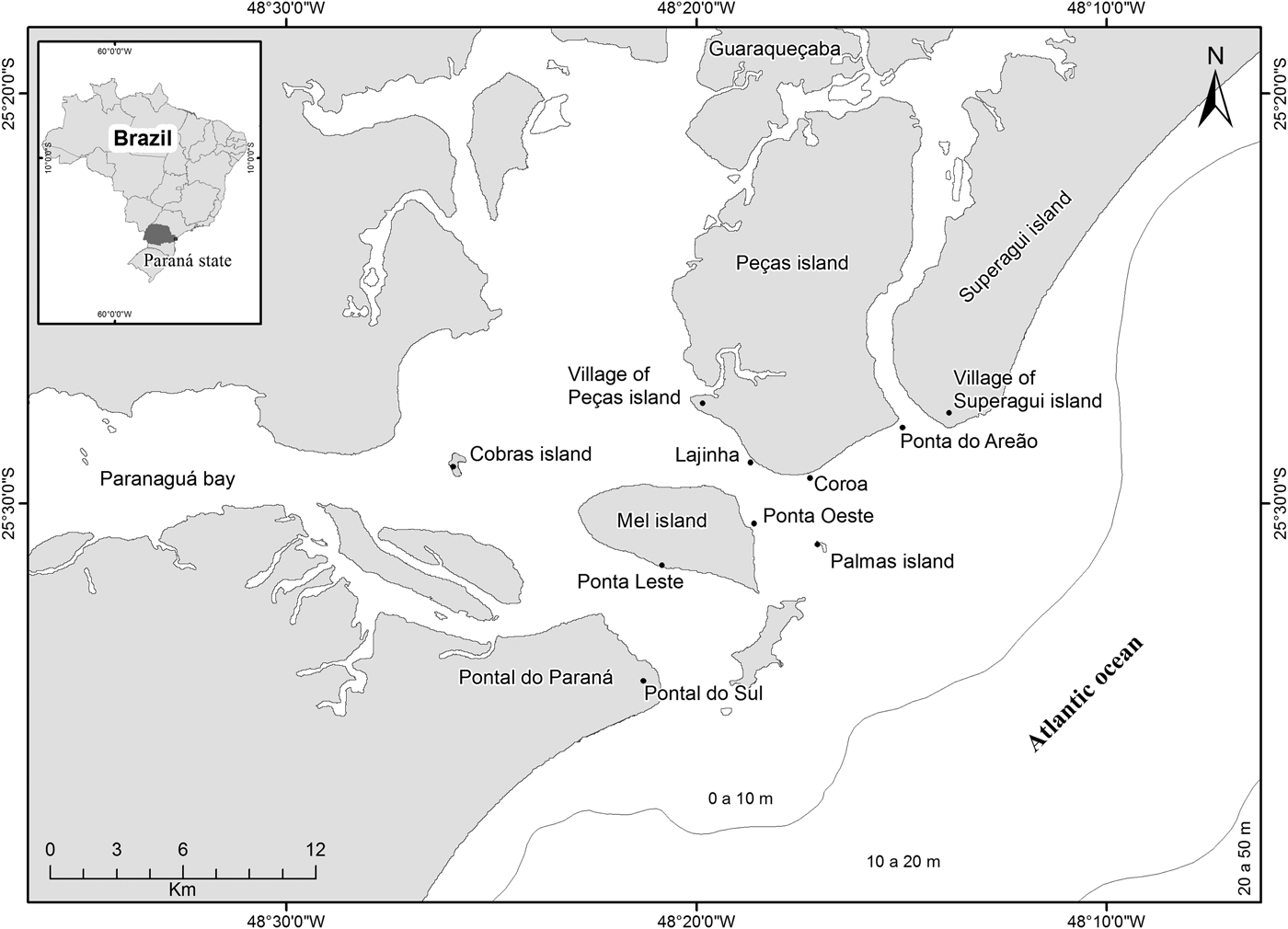
This study was conducted with the traditional fishing communities that have resided in the villages of Peças Island (VPI) (25°27′S 48°20′W) and Superagui Island (VSI) (25°28′S 48°13′W), in the municipality of Guaraqueçaba (25°18′S 48°19′W), state of Paraná, Southern Brazil (Figure 1). The area is considered a World Heritage site (UNESCO) and part of a Biosphere Reserve. The region is composed of a mosaic of conservation units that are home to endangered endemic species, and the use of local fisheries resources is permitted for the traditional communities that live nearby the PEC (Mafra, Reference Mafra2012).
Study area located in the Paranaguá Estuarine Complex, southern Brazil.

These traditional communities have lived for several decades in the PEC islands. The three largest and the most populated islands are Peças, Superagui and Mel. The fishermen from Peças and Superagui Islands have artisanal fishing as the main source of income (Diegues, Reference Diegues2004). Mel Island, in the municipality of Paranaguá, has tourism as the main economic activity (Fuzetti & Corrêa, Reference Fuzetti and Corrêa2009).
The fishermen from VPI and VSI are registered in Fishermen Colony Z-2, in Guaraqueçaba and each comprise ~62 fishermen and 41 boats in VPI, and 73 fishermen and 92 boats in VSI (Malheiros, Reference Malheiros2008; Mafra, Reference Mafra2012). These communities are located in the area surrounding Superagui National Park, created in 1989 by Federal Decree No. 97.699 as a conservation unit. Formerly, fishing in the PEC mainly focused on subsistence harvesting; but currently catches are also marketed on a small scale in urban centres (Diegues, Reference Diegues2004; Fuzetti & Corrêa, Reference Fuzetti and Corrêa2009).
Procedures
Information about the profile of fishermen, and the morphological characteristics, general ecology and behaviour of franciscana was collected between March and September 2012 using ethnographic interviews with 40 and 50 VPI and VSI fishermen, respectively. At VPI, a local resident (R. Siqueira) acted as a local guide between fishermen and researchers (R.M. Gama and C.A. Zappes), primarily to facilitate first contact with the potential respondents (following Campos, Reference Campos, Amorozo, Ming and Silva2001).
However, to preclude any confounding effects while obtaining information, the guide was not present during interviews with fishermen. When the local guide was not present, the snowball method was applied, which is an indication of a possible subsequent interview by fishermen who have already been interviewed (Biernacki & Waldorf, Reference Biernacki and Waldorf1981). In order not to interfere in the selection of respondents, the snowball method could be interrupted and merged with an approach involving opportunistic meetings among unrelated fishermen (Zappes et al., Reference Zappes, Gatts, Lodi, Simões-Lopes, Laporta, Andriolo and Di Beneditto2014). For the selection of respondents, the following criteria were established to all: (i) be an artisanal fisherman; (ii) have artisanal fishing as the main source of income; and (iii) practice artisanal fishing in the PEC region. To maintain independence among responses, interviews were conducted individually according to the availability of each interviewee.
Ethical procedures clarifying the objectives of the study and assurances that information would not be exploited in terms of producing marketable products were explained to interviewees, and also the president of Fishermen Colony Z-2 – who ultimately approved the research. Preceding the interviews, each fisherman was: (i) informed about the research objectives; (ii) asked if he/she agreed to participate in the survey; and (iii) informed that only his/her first name would be requested, so that the researchers could communicate during the interview; and (iv) informed that his/her last name was not registered. This methodology follows that proposed by Librett & Perrone (Reference Librett and Perrone2010).
The participant observation method was applied as part of the adaptation of the researcher and prior to the collection of information in the two communities (Schensul et al., Reference Schensul, Schensul and Lecompte1999). This method involves inserting the researcher into the group they wish to study to act as a participant or external observer. In this study, the researchers were hosted at two hotels owned by fishermen, which facilitated observing the daily life of communities across the full demographic. Moreover, the researchers boarded boats to participate in the fishing trips and to watch a fishing day, describing in detail the local artisanal fishing.
At the end of the participant observation period, the fishermen were approached by the methods described above. In VSI, there was no possibility of local guides assisting in the presentation to fishermen community. Thus, a trust relationship for the interviews was established between the researcher (R.M. Gama) and the community through participant observation. After this step, respondents were approached by the same methods applied in the VPI.
Interview
A semi-structured questionnaire with open (N = 14) and closed (N = 14) questions was used during interviews (cf. Schensul et al., Reference Schensul, Schensul and Lecompte1999). The interviews followed a pre-established pattern, but maintained the necessary flexibility for additional reports by fishermen (cf. Schensul et al., Reference Schensul, Schensul and Lecompte1999). The questionnaire was divided into the following categories: (1) the fisherman's profile (gender, age, fishing practice time, schooling); (2) characteristics of the fishing activity (autonomy/day boarding, fishing grounds, gear, target species and the vessel length and engine capacity); (3) morphological characteristics of observed franciscanas (i.e. colour, size, occurrence area); and (4) ecological and behavioural characteristics of adult and young (neonates and juveniles) franciscanas (i.e. diet, feeding behaviour, vocalization, size of group, behaviour near the vessel). To check the ability of respondents to identify and differentiate franciscana among other regional cetaceans, the method of visual ethnography was included as part of the interview (cf. Miranda et al., Reference Miranda, Amorozo, Govone and Daniela2007). Specifically, after the questionnaire, photos of local cetacean species (Sotalia guianensis, Tursiops truncatus and Pontoporia blainvillei) were presented. From these photos, respondents were asked to indicate which images represented the franciscana.
Data analysis
This study deals with the empirical knowledge of fishermen, and the variables are linguistic and qualitative. Accordingly, two steps were necessary to analyse the reports. In the first stage, any fishermen who recognized the franciscana as Pontoporia blainvillei were identified; in the second stage, triangulation methods were used and analysis by technique of repeated synchronous information only for the reports of fishermen who correctly identified the species (cf. Goldenberg, Reference Goldenberg1999).
First stage
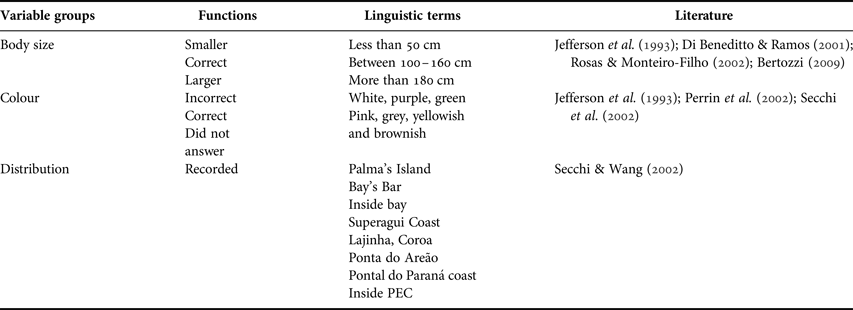
Fuzzy logic (MATLAB 7.6) analysis was applied to qualitatively label variables in the selection of interviewed fishermen who identified the franciscana as being P. blainvillei. This approach is valid for studies involving traditional knowledge because it allows qualitative analysis through the use of membership functions that are applied to the linguistic terms in the reports (see Zappes et al., Reference Zappes, Gatts, Lodi, Andriolo and Di Beneditto2010, Reference Zappes, Gatts, Lodi, Andriolo and Di Beneditto2011, Reference Zappes, Gatts, Lodi, Simões-Lopes, Laporta, Andriolo and Di Beneditto2014). Fishermen who accurately identified franciscana were those whose responses included: body size between 100–160 cm; body colour pink, grey, yellowish and brownish; and distributed across Palma's Island, bay's bar, inside bay, Superagui coast, Lajinha, Coroa, Ponta do Areão, Pontal do Sul coast and inside PEC. The reports of the selected fishermen were those whose answers about franciscana were in accordance with the ‘correct’ and ‘registered’ criteria described in Table 1.
Functions used in the selection of interviewed fishermen who identified the franciscana (Pontoporia blainvillei), in villages of Peças and Superagui Islands, Paranaguá Estuarine Complex, Southern Brazil.

PEC, Paranaguá Estuarine Complex.
Second stage
At this stage, only the reports of the fishermen selected in the first stage were used. The triangulation method and the technique of repeated synchronous information were used to cross and filter the information obtained from the ethnographic tools because the same questionnaire was administered to all respondents (Goldenberg, Reference Goldenberg1999). The data concerning the ecology and behaviour of the franciscana were compared with descriptions reported in the literature. Thus, there was the integration of quantitative and qualitative data, giving support to the questions raised by this study (according to the method described by Regan & Colyvan, Reference Regan and Colyvan2000).
In order to answer the question regarding the identification of the franciscana, the difference between the proportions of the fishermen reports that identify the species (analysis by Fuzzy Logic) was analysed. The test of difference between the proportions was applied: (1) to identify differences between the number of interviews of each village and (2) to assess whether reports that indicated the correct identification of the species and those that do not recognize the franciscana are distinct (Program Statistica vs 8.0; P ≤ 0.05). A parametric Mann–Whitney test was applied to test for differences concerning group sizes of franciscana reported between fishing communities (Program BioEstat vs 5.0; P ≤ 0.05).
RESULTS
The difference in the number of interviews for each community (VPI = 40; VSI = 50) did not interfere with the results (P = 0.69). The analysis of the reports was based only on fishermen that identify the franciscana by Fuzzy logic (Table 1), considered as the entire sampling for the analysis of results (VPI: 35 and VSI: 19).
Profile of fishermen
In VPI, the activity of marine artisanal fishing is practiced by men between 21 and 72 years of age. According to respondents, cleaning fish is done by women of the community, who are usually wives and/or daughters of the fishermen. The level of education is low, and 49.0% of respondents (N = 17) attended only elementary school (most school time = 5 years). In VSI, artisanal fishing is also practiced only by men between 15 and 77 years of age, and these men also have a low-level of education, with 58.0% (N = 11) having attended only elementary school (most school time = 5 years). In this village, as well as in VPI, the wives and daughters of the fishermen work in fish processing.
Characteristics of traditional fishing activity practiced by communities of the village of Peças Island and village of Superagui Island
The fishing practice time in VPI ranged from 14–64 years, and the operating time at sea usually takes place for ‘part time of day’ (exit and return from the sea on the same day). The preferred fishing sites are the Peças River (located in Peças Island), the coast of Peças Island, bay, estuary, Cobras Island, Ponta Leste and Oeste of Mel Island and, less intensively, in the open sea. The depth at which the artisanal fishing is practiced in the two villages ranges from the surface to 50 m depth. The fishing practice time for the VSI fishermen varies between 4–65 years, and the operating time at sea lasts between a half day to a day and a half. The fishing grounds are mainly in the open sea and the coast of Superagui Island, and less frequently in the estuarine area and bays and in the areas adjacent to the Palmas Island.
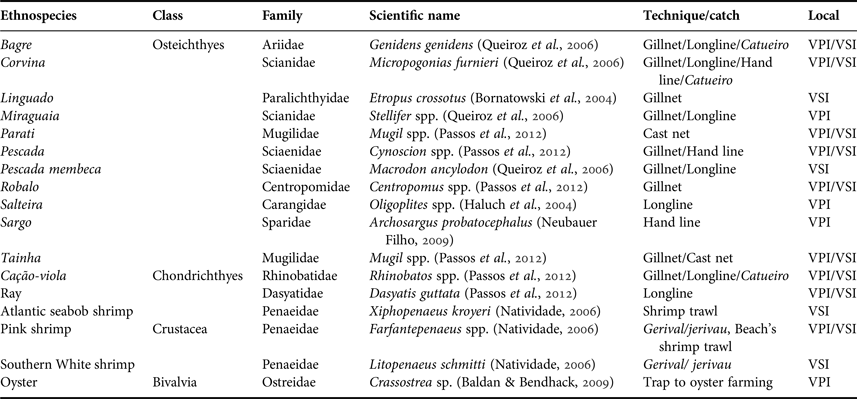
The fishing gear used, including catueiro, longline, gerival/jerivau, gillnet (caceio and fundeio), and cast net, is common to both communities. Catueiro is a line arranged vertically in the water column in which are placed hooks that are ~2 m apart; and gerival/jerivau is an artefact formed by a stick and gillnets, the mesh size varies between 2.5–3 cm, the length of the net between 3–6 m and a water depth of 0.50 to 20 m. In addition, in VPI a trap for oyster farming, a hand line and beach trawl net are used. In VSI, the use of a trawl net towed by a boat was the type of fishing more often reported. The main target species cited by fishermen are from the classes Osteichthyes, Chondrichthyes and Crustacea (Table 2).
Target species of fisheries reported by the fishermen in the villages of Peças Island and Superagui Island, Paranaguá Estuarine Complex, Southern Brazil.

VPI, village of Peças Island; VSI, village of Superagui Island.
The fishermen of VPI characterize their vessels as deck and wooden marry (10 m length and motor power: 108 HP), wooden boat (7–10 m length and motor power: 7.5–60 HP) and canoe (3–11 m length and motor power: 5–18 HP or rowing). In VSI, the vessels reported are wooden boat (6–18 m length and motor power: 7.5–60 HP), canoe (3–10 m length and motor power: 7–24 HP or rowing) and aluminium boat (4–6 m length and motor power: 15 HP or rowing).
Identification of franciscana
All fishermen in both villages demonstrated interest in the research as a means to show their knowledge of the area and its marine fauna. The presence of a guide in the VPI or the absence of this guide in the VSI apparently did not influence the local community's willingness to participate in the study. According to the analysis using Fuzzy logic, the frequency of fishermen that identified the franciscana as belonging to the species P. blainvillei was higher in the VPI compared with the VSI (P ≤ 0.01): 87.5% (N = 35) and 38.0% (N = 19), respectively. Among the 35 reports selected in VPI, 30 (85.7%) also identified the franciscana through the image contained in the photos. In VSI, this proportion is lower, only 6 (31.5%) of 19 reports indicated the recognition of the species through the images.
Ecological and behavioural characteristics of adults and young franciscana
Different classes of size/development of the franciscana were described by the fishermen, dividing the reports into two maturity categories: adult and infant (neonates and juveniles). Individual adults of franciscana are sighted by all fishermen, although the sighting of infants was reported by only 16 fishermen of VPI (46.0%) and eight fishermen of VSI (42.0%). For the group size, including adults and infant individuals, the main number of reports was for groups formed of 2–5 individuals: VPI – 40.0% (N = 14) and VSI – 58.0% (N = 11). There was no difference between the accounts of the fishermen of the two communities in relation to franciscana group size (U = 13.5; P = 0.24).
When asked about the seasonality of the occurrence of franciscana adults, the fishermen of VPI reported sightings throughout the year inside the PEC between Peças Island and Mel Island, near Palmas Island and inside Paranaguá Bay. In VSI, fishermen reported sightings of franciscana throughout the year, especially near the coast of Superagui Island; however, the sighting of infants occurs mainly in summer (December to February) and winter (July to August) in the above areas.
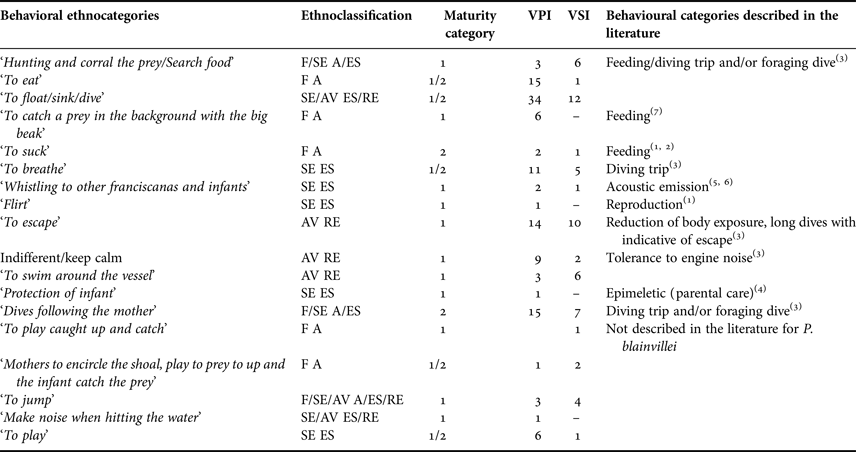
The fishermen also described behaviours exhibited by franciscana during feeding activity and the approach of the fishing vessels, as well as noise emissions. These behaviours are ordered in ethnocategories, as indicated in Table 3. The same fisherman described more than one behaviour for each of these ethnocategories; this explains why the number of answers is higher than the number of respondents.
Correspondence between the behavioural ethnocategories of franciscana described by the fishermen interviewed in the villages of Peças and Superagui Islands, Paranaguá Estuarine Complex, Southern Brazil, and the data available in the scientific literature.

F, feeding; AV, to answer to vessel; SE, sound emission.
Maturity Category (1 – adult; 2 – infant and/or juvenile). VPI (Number of reports in the village of Peças Island). VSI (Number of reports in the village of Superagui Island). References: 1 – Jefferson et al., Reference Jefferson, Leatherwood and Webber1993; 2- Rodríguez et al., Reference Rodríguez, Rivero and Bastida2002; 3- Cremer & Simões-Lopes, Reference Cremer and Simões-Lopes2005; 4- Cremer et al., Reference Cremer, Hardt and Tonello Júnior2006; 5- Cremer, Reference Cremer2007; 6- Melcón et al., Reference Melcón, Failla and Iñíguez2012; 7- Di Beneditto & Ramos, Reference Di Beneditto and Ramos2014.
Among the 17 behavioural ethnocategories related to franciscana, the most common was ‘to float/sink/dive’ (Table 3). Five ethnocategories were cited as common for adults and infants: ‘to eat’, ‘to float/sink/dive’, ‘breathe’, ‘Mothers to encircle the shoal, play to prey to up and the infant catch the prey’ (suggesting parental care related with feeding of infant) and ‘to play’. The specific ethnocategories for infants were ‘dives following the mother’ and ‘to suck’. Below are some reports of the fishermen relating to the behaviours of franciscana:
‘It floats with the beak up and then sinks, so it appears the long beak.’
Report of a fisherman of the village of Superagui Island that describes the franciscana dive.
‘The infant comes with the mother and can eat only after, when he can swallow. Before he only to suck.’
Report of a fisherman of the village of Peças Island that describes the behaviours of infant franciscana.
Regarding the acoustic behaviour of franciscana, 10 ethnocategories related to hunting were cited, including submersion, breath, whistle, reproduction and parental care (Table 3). According to the fishermen, all of these behaviours demonstrate the need for communication among the animals. As indicated in the following report:
‘The franciscana is whistling, isn't it? It is for communication with other franciscanas.’
Report of a fisherman of the village of Peças Island that describes the communication between franciscanas.
Regarding the behaviour of the franciscana in front of the vessel four ethnocategories were reported. According to respondents, the events of ‘to float/sink/dive’ and ‘to escape’ are directly related (Table 3). Descriptions of human characteristics were also cited for franciscana and relate to their behaviour in relation to the vessels; these characteristics were ‘keep calm’ and ‘indifferent’ (VPI – N = 9 and VSI – N = 2).
The fishes of the Clupeidae, Engraulidae and Mugilidae families, and the cephalopods of Loliginidae family and crustaceans of Penaidae family, were cited as prey of franciscana in the region. The prey described in both communities by the common names as part of the franciscana diet are sardinha, manjuba, parati and Atlantic Seabob shrimp. The squid was reported only by fishermen of VPI, and mullet was reported only by fishermen of VSI. The diet of infants has been described similarly in both communities. According to fishermen, infant franciscanas feed on sardinha, Atlantic Seabob shrimp and ‘mother's milk franciscana’.
During the interviews, some fishermen have compared the behaviour of franciscana with the species S. guianensis (estuarine dolphin), known locally as ‘boto’ or ‘boto-cinza’. Below are two accounts that illustrate this comparison.
‘Walking like the boto, floating. It is shyer than the boto, immerses slower, not out full of water.’
Report of a fisherman of the village of Superagui Island comparing the behaviour of franciscana and the estuarine dolphin.
‘It is not the same time immersed, as the boto. It float more, breathe more. It float with the beak up and then sinks.’
Report of a fisherman of the village of Peças Island comparing the behaviour of franciscana and the estuarine dolphin.
DISCUSSION
The results from this study support the utility of ethnoecology as a qualitative tool for characterizing the behaviour of species that would otherwise be difficult and costly to assess (Souza & Begossi, Reference Souza and Begossi2007; Zappes et al., Reference Zappes, Simões-Lopes, Andriolo and Di Beneditto2016b). In this study, ethnoecology serves to clarify the traditional knowledge of Paraná artisanal fishermen in relation to the ecology of P. blainvillei, which is threatened by human activities. Although scientific records of use of the area by this species have originated mainly from strandings, the reports of the fishermen are proof of the constant presence and frequent contact with franciscanas in the region (Rosas et al., Reference Rosas, Monteiro-Filho and Oliveira2002). In this sense, is important to understand the knowledge of fishermen about franciscana because the conservation process is easier when the species value is considered by the community (Wedekin et al., Reference Wedekin, Da-Ré, Daura-Jorge and Simões-Lopes2005).
While there were different numbers of fishermen interviewed between each community, such bias did not affect the results, because all fishermen worked across the same spatio-temporal zones within (or from) the area of interest (i.e. PEC and the Parana continental shelf). In any case, during research using traditional knowledge, the ideal sample size varies between 30 and 60 interviews (Mason, Reference Mason2010). Consequently, the sample size here might be considered appropriate.
Artisanal fishing in the PEC is practiced exclusively by men, and this is a common feature for the region (Fuzetti & Corrêa, Reference Fuzetti and Corrêa2009). Generally, in fishing communities women are engaged in the processing and trade of fish and activities on land (Martins, Reference Martins2008). The fishermen have a low level of education, which can be justified by the fact they engage in fishing activity while they are still young, hindering school attendance. In Brazil, fishing communities are in a critical socioeconomic situation, and one of the main factors responsible for this is the low level of education of the local members (Silva et al., Reference Silva, Oliveira and Nunes2007; Zappes et al., Reference Zappes, Oliveira and Di Beneditto2016a). Fishermen find in the fishery the fastest and most effective financial support for their families, but due to the unstable daily profession, it is difficult to focus on studies (Alencar & Maia, Reference Alencar and Maia2011). This lack of educational qualifications makes it difficult to search and find opportunities for better jobs. This may compel the fishermen to work in fishing to old age, which could be verified in this study because fishing is practiced for longer than 60 years.
The preferred fishing areas, artefacts and fisheries recorded in this study for VPI and VSI are also reported by Mafra (Reference Mafra2012). The diversity of fisheries areas in open or protected sites of tidal power induces a variety of headgear and types of fisheries, which prevents any homogeneity of fishing activity in PEC. The boats used in these fishing communities are small, which is a common feature of traditional fishing where vessels have limited fishing autonomy and little fish storage capacity (Mafra, Reference Mafra2012; Zappes et al., Reference Zappes, Oliveira and Di Beneditto2016a). The low autonomy of fishing vessels, as well as the artefacts and artisanal fisheries used by VPI and VSI, explain the fishermen's preference for fishing areas close to the mainland and in the internal area of the estuary.
The fishermen who resided in the VPI were more adept at identifying the franciscana compared with the fishermen of VSI. This difference probably reflects the preferred fishing areas of these fishermen and the fishing methods employed, including the types of vessels and the developed fisheries. The fishermen of VPI use the estuarine regions of the interior of the PEC as the main area of activity and make use of vessels with low engine power. The fishermen use artefacts, such as ‘catueiro’, gillnet, traps for oyster cultivation and hand lines, which do not require continuous monitoring during fishing operations, allowing time for fishermen to focus on other events occurring in the vicinity of the fishing area. This environment is considered the preferred area of this species in the coast of Paraná state (Rosas et al., Reference Rosas, Monteiro-Filho and Oliveira2002; Santos et al., Reference Santos, Oshima and Silva2009); it appears that the noise produced by the boat engines does not deter the franciscanas that display dives considered deep and group dispersion during their feeding activity (Cremer & Simões-Lopes, Reference Cremer and Simões-Lopes2005). The combination of these factors increases the potential of meeting, observation and recognition of franciscanas by the fishermen of VPI.
Conversely, while some VSI fishermen also work adjacent areas in the PEC, many prefer to fish on the coastline (and continental shelf) using trawls, which require more attention than passive gears to operate and might preclude complete awareness of their surroundings (and certainly for unrelated events such as dolphin activity). Further, there also might be fewer franciscanas across more open coastal regions, primarily because such areas impose a greater risk of predation (Santos et al., Reference Santos, Vicente, Zampirolli, Alvarenga and Souza2002). However, ongoing work is required to validate this hypothesis, considering the thaqt border regional patterns of habitat use by franciscana remain poorly understood (Danilewicz et al., Reference Danilewicz, Secchi, Ott, Moreno, Bassoi and Borges-Martins2009).
The sighting of the adult and infant franciscanas described by the two fishing communities indicates the use of the area by franciscana in different stages of development and reproductive activity. These uses of the area by the species have also been reported by studies that used sighting methods and monitored strandings (Rosas & Monteiro-Filho, Reference Rosas and Monteiro-Filho2002; Rosas et al., Reference Rosas, Monteiro-Filho and Oliveira2002; Santos et al., Reference Santos, Oshima and Silva2009). In this study, fishermen described most frequently a group size of 2–5 individuals. This information is presented in the literature for the study area (Santos et al., Reference Santos, Oshima and Silva2009) and also for other areas of species distribution (in Brazil: Rio de Janeiro state – Di Beneditto et al., Reference Di Beneditto, Ramos and Lima2001; Santa Catarina state – Cremer & Simões-Lopes, Reference Cremer and Simões-Lopes2005; Rio Grande do Sul state – Secchi et al., Reference Secchi, Ott, Crespo, Kinas, Pedraza and Bordino2001; and Argentina – Bordino et al., Reference Bordino, Thompson and Iñíguez1999).
Collectively, all fishermen at both communities noted minimal seasonal patterns in the occurrence of adult franciscana in the PEC, with sightings reported throughout the year. Continuous sightings have similarly been reported at Babitonga Bay, Santa Catarina, in southern Brazil, and along the coast of Argentina in a region where franciscana also frequent bays and estuary mouths (Bordino et al., Reference Bordino, Thompson and Iñíguez1999; Cremer, Reference Cremer2007). However, in Argentina, franciscana are mainly observed during spring to winter (Bordino et al., Reference Bordino, Thompson and Iñíguez1999).
By comparison, juvenile franciscanas were restricted to summer (December to February) and winter (June to August), which supports Santos et al.’s (Reference Santos, Oshima and Silva2009) study in the same region. Similarly, off northern Argentina, juveniles commonly have been observed in late spring and during summer (Rodríguez et al., Reference Rodríguez, Rivero and Bastida2002). These consistencies clearly support concordance among ethnoecological and ecological data describing juvenile presence.
In terms of franciscana behaviour, fishermen described feeding, vocalization and short-term movements in categories similar to those noted by Hassel (Reference Hassel2006) at the Região dos Lagos, Rio de Janeiro. The ethnocategory ‘to float/sink/dive’ was the most frequently cited for adults and infants and probably describes movements after franciscanas emerge from dives. This behaviour can be classified as ‘diving trip’, in which the long rostrum of franciscana is the first part of the body to emerge, followed by the posterior body. Also, such behaviour might be related to the so-called ‘foraging dive’, in which discrete movements performed by franciscana at the surface suggest pursuing prey (Cremer & Simões-Lopes, Reference Cremer and Simões-Lopes2005).
The ethnocategories ‘to eat’, ‘breathe’ and ‘to play’ were described as being common among adults and infants. The ethnocategory ‘to eat’ can be compared to the category of ‘foraging dives’ described by Cremer & Simões-Lopes (Reference Cremer and Simões-Lopes2005). According to Bordino et al. (Reference Bordino, Siciliano, Bastida and Cremer2002), the franciscana displays brief diving behaviours during foraging, and these dives are followed by pulmonary hyperventilation. The hyperventilation was probably identified by the fishermen as the act of ‘breathing’. The ethnocategory ‘to play’ is not yet described in the literature, although play behaviours have been suggested as being rare or non-existent for the species (Jefferson et al., Reference Jefferson, Leatherwood and Webber1993).
The specific ethnobehaviours of infants involve ‘dives following the mother’ and ‘to suck’. The first may be related to the behaviour of ‘dives trip’ or ‘foraging dives’, when the infant is always seen near an adult, possibly his mother (Cremer & Simões-Lopes, Reference Cremer and Simões-Lopes2005). The second refers to the behaviour of mammalian newborns that feed on breast milk (Pough et al., Reference Pough, Janis and Heiser2003). Protecting the infant, which was cited by only one of the fishermen, can be characterized as epimeletic behaviour related to parental care, which is described in the literature about the species (Cremer et al., Reference Cremer, Hardt and Tonello Júnior2006).
All fishermen also reported sound emission by franciscanas, possibly reflecting conspecific communication. Whistles produced by small cetaceans can be audible to humans and usually occur during feeding activity, displacement and socialization (Dos Santos et al., Reference Dos Santos, Louro, Couchinho and Brito2005). In a study off Argentina, Melcón et al. (Reference Melcón, Failla and Iñíguez2012) found that sound emitted by franciscanas was for locating individuals, feeding and identifying potential predators. However, these authors point out that the vocalization records are rare due to the small group size of the species, and their low vocal activity.
The fishermen described two ethnocategories related to diving and escape when asked about the behaviour of the species near the boat. Cremer & Simões-Lopes (Reference Cremer and Simões-Lopes2005) reported that in Babitonga Bay, state of Santa Catarina, the franciscana reduces body exposure when a boat approaches and tends to become submerged for a longer time. According to the authors, usually the franciscana moves away or escapes from the boat, and then it may return even if the boat remains in the area. Performing long dives and/or dispersal of the group are behaviours of the species when there is some disturbance and threat in the environment.
In the PEC, the fishermen interviewed described human characteristics to franciscana (‘keep calm’ and ‘indifferent’). These franciscana behaviours compared to aspects of tranquillity and indifference may be related to the fact that the species shows shy behaviour and exposes little of its body during dives and displacements (Jefferson et al., Reference Jefferson, Leatherwood and Webber1993; Cremer & Simões-Lopes, Reference Cremer and Simões-Lopes2005).
Along with most of the general behaviour noted above, the most common franciscana prey reported by the fishermen of both communities concurs with the feeding habits described in the literature for this small cetacean. Specifically, teleosts of the families Clupeidae and Engraulidae, cephalopods of the family Loliginidae and crustaceans of the family Penaeidae are common items in the diet of the adults throughout their distribution (Di Beneditto & Ramos, Reference Di Beneditto and Ramos2001; Rodríguez et al., Reference Rodríguez, Rivero and Bastida2002; Cremer et al., Reference Cremer, Pinheiro and Simões-Lopes2012).
With respect to juvenile diets, fishermen reported the presence of three main items: sardinha, Atlantic seabob shrimp and milk of ‘franciscana mother’. Franciscana young start solid food intake at between 2 and 3 months old, but still nurse until approximately 6 months of age (Ramos et al., Reference Ramos, Di Beneditto and Lima2000). Shrimps are more representative in the infants’ diet than the diet of the adults, presumably because of their size (Di Beneditto, Reference Di Beneditto2000). Again, note the concordance between the ethnoecological and ecological data about the species.
Fishermen from both communities located in the PEC made comparisons between the behaviour of the franciscana and the estuarine dolphin (S. guianensis), demonstrating the level of detail that their traditional knowledge has built. The fishermen interviewed provided details about the two species and indicated the differences between them. This type of knowledge is established from the daily fishing activity.
The traditional knowledge of fishermen that live in protected areas can help in the co-management process of the conservation of marine mammals and improvements of traditional activities such as fishing. This occurs because artisanal fishermen are active agents that can be inserted in activities related to environmental management (Sussekind, Reference Sussekind2014). The question presented in this study that involves the traditional knowledge of artisanal fishermen about franciscana can be characterized as a system actors-net (Latour, Reference Latour2012) involving managers – stakeholders – P. blainvillei in the function of conservation.
Studies about fishery activity should be linked to the environmental management of fishermen's activities and should include cultural and social rules (Zappes et al., Reference Zappes, Simões-Lopes, Andriolo and Di Beneditto2016b). This way, the managers should consider the social–ecological system in which the community is immersed (Francisco et al., Reference Francisco Cárcamo and Gaymer2013). This way, local actors are not passive objects, but stakeholders who act in environmental problems (Sussekind, Reference Sussekind2014). So, is important to promote the use of traditional knowledge together with scientific knowledge in research that involves management of natural resources (Huntington et al., Reference Huntington, Brown-Schwalenberg, Frost, Fernandez-Gimenez, Norton and Rosenberg2002).
CONCLUSIONS
In this study, the biological and ecological aspects of franciscana in the coast of Paraná state were identified through traditional knowledge. Artisanal fishermen operating in the Paranaguá Estuarine Complex are able to distinguish categories of maturity and behaviour of the species. In this sense, the results demonstrated that most of the information provided by fishermen interviewed is in accordance with the data obtained through scientific research. Ethnoecological studies can increase the knowledge of the franciscana in their distribution areas and facilitate species conservation actions through partnerships between the local population and academy.
ACKNOWLEDGEMENTS
To the fishermen for their cooperation and all residents of the villages in Peças Island and Superagui Island; to Andrielle Medeiros and Renato Pereira Siqueira for their support during the field stage, to Sérgio Carvalho Moreira for the elaboration of the map, to Matt K. Broadhurst for revision. To Laboratório de Ecologia e Conservação of Universidade Federal do Paraná.
FINANCIAL SUPPORT
This study is part of the Project ‘ProToninhas’, which was funded by Fundação O Boticário de Proteção a Natureza (Process 0894-20111). A.P.M.D.B. thanks Fundação Carlos Chagas Filho de Amparo à Pesquisa do Estado do Rio de Janeiro (FAPERJ Process E-26/201.161/2014) and Conselho Nacional de Desenvolvimento Científico e Tecnológico (CNPq Process 301.405/13-1) for fostering research. C.A.Z. thanks Comissão de Aperfeiçoamento de Pessoal do Nível Superior (CAPES Process 87414) and FAPERJ (Process E-26/102.798/2011).