INTRODUCTION
The damselfishes (family Pomacentridae) are a diverse and speciose group of tropical marine fishes which are most commonly found in the Indo-Pacific (Allen, Reference Allen1991). The family currently contains 361 species from 28 genera (Allen, Reference Allen1991) with over 140 species from all but 6 genera recorded from Australian waters (Australian Faunal Directory, 2008).
Damselfishes are hosts to a diverse range of parasites with records of gnathid (Jones et al. Reference Jones, Nagel, Hughes, Cribb and Grutter2007) and cymothoid isopods (Williams et al. Reference Williams, Williams, Waldner and Kimmel1982, Adlard and Lester, Reference Adlard and Lester1994), digenean trematodes from at least 8 families (Bray et al. Reference Bray, Cribb and Barker1993; Barker et al. Reference Barker, Cribb, Bray and Adlard1994), monogeneans (Lo, Reference Lo1999), tetraphyllidean metacestodes (Chambers et al. Reference Chambers, Cribb and Jones2000) and a microsporidian (Reimschuessel et al. Reference Reimschuessel, Bennet, May and Lipsky1987).
Myxosporeans have been recorded previously in pomacentrids. Egusa and Nakajima (Reference Egusa and Nakajima1980) described 5 pomacentrid species as reservoir hosts of Kudoa amamiensis which also infects Seriola quinqueradiata. Burger et al. (Reference Burger, Barnes and Adlard2008) further identified 2 additional Abudefduf spp. which harbour K. amamensis. Chromis chromis from the Adriatic Sea were infected with Ceratomyxa chromis (see Lubat et al. Reference Lubat, Radujkovic, Marques and Bouix1989). Moser et al. (Reference Moser, Kent and Dennis1989) reported on the presence of an unidentified Sinuolinea sp. from Chromis atripectoralis and plasmodial stage myxosporeans from the gall bladders of Pomacentrus taeniometapon, P. wardi and Chromis nitida. An Amphiprion species was used as an experimental model to evaluate a hyposalinity treatment of Enteromyxum leei (see Yokoyama et al. Reference Yokoyama and Shirakashi2007).
This paper describes the Myxosporea collected from the gall bladders of 31 species of pomacentrids with a focus on host range, locality and phylogeny. Host-parasite association is determined using small subunit (SSU) rDNA sequence data due to the difficulty in species identification based solely on morphology. Reports on host range are critically assessed, since taxonomists are reluctant to establish new species based solely on host data. One such example is that of Ceratomyxa sprenti which is reported from Lutjanus amabilis, Chaetodon aureofasciatus, Chaetodon rainfordi and Choerodon venustus at Heron Island (Moser et al. Reference Moser, Kent and Dennis1989). This suggests that C. sprenti is euryxenous, infecting a range of unrelated hosts. However, it now appears more likely that C. sprenti represents a species complex. Alternatively, if comprehensive sampling has not been undertaken a parasite species may appear to infect a single host (oioxenous) or closely related hosts (stenoxenous), whereas in reality, the true host range has not been established (particularly when negative data are seldom published).
MATERIALS AND METHODS
Host and parasite collection
Damselfishes (Pomacentridae) were collected by line fishing and localized sprays of clove oil anaesthetic from Lizard Island (14°40′S, 145°27′E) in the northern Great Barrier Reef, Heron Island (23°26′S, 151°54′E) in the southern Great Barrier Reef and North Stradbroke Island (27°23′S, 153°26′E), Moreton Bay. Fish were euthanized using neural pithing or prolonged immersion in clove oil. The gall bladders were removed from the abdominal mass, placed in a cavity block and ruptured. A drop of bile was placed on a glass microscope slide and covered with a glass cover-slip. The slide was examined using a light microscope at 400× magnification. Infected samples were preserved in 100% ethanol for DNA analysis and frozen in saline for spore measurements.
Morphological analysis of spores
Morphological measurements of spores followed the guidelines devised by Lom and Arthur (Reference Lom and Arthur1989) for species descriptions of Myxosporea. However, for characterization of ceratomyxid spores an additional measurement of the posterior spore angle was made as described by Heiniger et al. (Reference Heiniger, Gunter and Adlard2008). Thirty spores were measured from digital images taken at ×400 magnification using a Nikon Digital Sight DS-L1 (Nikon Corporation, Japan) except for C. burgerae n. sp. where only 7 mature spores were characterized due to the small number of mature spores available. Measurements were calibrated using a micrometer slide as a reference. These measurements were then used to calculate an average and standard deviation for each infection, allowing characterization of each isolate. Type specimens were deposited in the collections of the Queensland Museum (QM), Brisbane, Australia. Principle component analyses were conducted using PAST (Hammer et al. Reference Hammer, Harper and Ryan2001). Component 1 and Component 2 were plotted against each other to determine whether morphological differences were statistically significant.
Small subunit rDNA analysis
DNA of bivalvulidan spp. was extracted from 50 μl of infected bile preserved in ethanol. The sample was pelleted at 4300 g for 10 min and the ethanol removed. DNA was extracted from the pellet according to the recommended protocol for the QIAgen DNeasy Kit (QIAGEN Inc., Valencia, California). Small subunit ribosomal DNA (SSU rDNA) was amplified by PCR using the primers MyxospecF 5′ TTC TGC CCT ATC AAC TWG TTG (Fiala, Reference Fiala2006) and 18R 5′ CTA CGG AAA CCT TGT TAC G (Whipps et al. Reference Whipps, Adlard, Bryant, Lester, Findlay and Kent2003). PCR and sequencing reactions were carried out as described by Heiniger et al. (Reference Heiniger, Gunter and Adlard2008).
Phylogenetic analysis
The SSU rDNA regions from the taxa sequenced in this study were edited using BioEdit version 7.0.0 (Hall, Reference Hall1999). Selected SSU rDNA sequences were downloaded from GenBank and included all Ceratomyxa species available on GenBank, as well as all bivalvulidans from the marine clade from a recent myxosporean phylogeny (Fiala, Reference Fiala2006) together with multivalvulidan sequences representing the clade most closely related to bivalvulidans from that same phylogeny. All new sequences generated from this study were lodged in GenBank. An alignment was produced using CLUSTAL W (Thompson et al. Reference Thompson, Higgins and Gibson1994) and edited by eye and when trimmed using BioEdit version 7.0.0 (Hall, Reference Hall1999), a 1729 base alignment was produced. This was used to create a distance matrix to view nucleotide base differences and to conduct the phylogenetic analyses. Sequence alignment parameters were as recommended by Hall (Reference Hall2001). Neighbour-joining, parsimony and maximum likelihood analyses were conducted using PAUP* 4.0b 10 (Swofford, Reference Swofford2002) and Bayesian analysis conducted using Mr Bayes 3.0B4 (Heulsenbeck and Ronquist, Reference Heulsenbeck and Ronquist2001). Neighbour-joining and parsimony analyses were performed using default parameters and trees constructed. The strength of the resultant relationships was tested by bootstrap analyses with 1000 replicates. Parsimony analysis employed a heuristic search with 50 repetitions of random sequence addition and tree bisection and reconnection branch swapping. Modeltest 3.7 (Posada and Crandall, Reference Posada and Crandall1998) was used to determine the optimum evolutionary analysis to be used in the maximum likelihood analysis. Both TrN+I+G (selected by hierarchical likelihood ratio tests) and GTR+I+G (selected by Akaike information criterion) maximum likelihood analyses were preformed. Maximum likelihood analyses were given bootstrap confidence values based on 100 replicates. Bayesian analysis was conducted with 2 003 000 generations of Markov chain Monte Carlo analysis, a set at 4 simultaneous chains with burnin of 3000 trees and saving current trees to file every 100 generations.
RESULTS
Phylum Myxozoa
Class Myxosporea
Order Bivalvulida
Family Ceratomyxidae Doflein, 1899
Genus Ceratomyxa Thélohan, 1892
Ceratomyxa bryanti n. sp. ( Table 1and Figs 1and 2)
Description: Spores typical of the genus Ceratomyxa. Mature spores slightly crescent-shaped, 5·31 μm±0·6 s.d. (4·48–6·87 μm) in length and 15·12 μm±2·4 s.d. (10·15–19·42 μm) in thickness (n=30). Posterior angle slightly concave to slightly convex (150–189°). Valves roughly equal, smoothly ovoid in lateral view. Straight sutural lines visible between valves. Polar capsules spherical, 1·69 μm±0·1 s.d. (1·49–1·97 μm) in length and 1·66 m±0·1 s.d. (1·32–1·92 μm) in width (n=30).
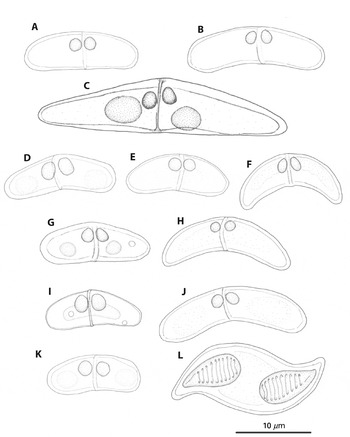
Diagrammatic illustrations of novel Ceratomyxa and Myxidium spores. (A) C. bryanti; (B) C. burgerae; (C) C. capricornensis; (D) C. cribbi; (E) C. dennisi; (F) C. falcatus; (G) C. kenti; (H) C. lunula; (I) C. moseri; (J) C. sewelli; (K) C. talboti; (L) M. queenslandicus.

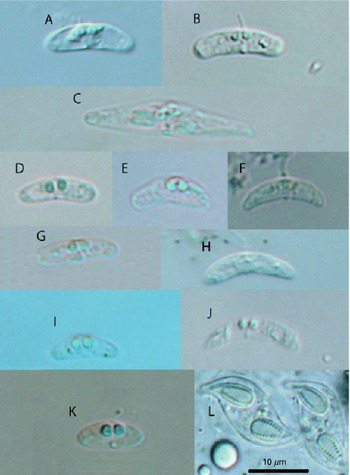
Phase-contrast micrographs of novel Ceratomyxa and Myxidium spp. spores. (A) C. bryanti; (B) C. burgerae; (C) C. capricornensis; (D) C. cribbi; (E) C. dennisi; (F) C. falcatus; (G) C. kenti; (H) C. lunula; (I) C. moseri; (J) C. sewelli; (K) C. talboti; (L) M. queenslandicus.

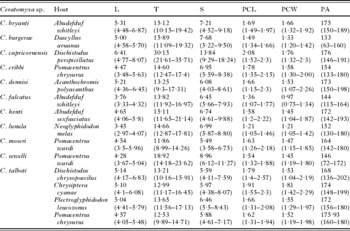
Mean spore dimensions in μm including range of Ceratomyxa spp. from their respective hosts
(L: length; T: thickness; S: sutural position; PCL: polar capsule length; PCW: polar capsule width; PA: posterior angle.)

Material: Vouchers G465057-61 (Air-dried slide stained with Giemsa) deposited in the collections of the Queensland Museum, Brisbane, Australia.
Host: Abudefduf whitleyi (Allen and Robertson, 1974), (Whitley's sergeant), Family Pomacentridae.
Prevalence: 1 of 18 confirmed by DNA sequencing.
Locality: Heron Island, Great Barrier Reef, Queensland (23°26′S, 151°54′E).
Site: Within gall bladder.
Etymology: named in honour of Malcolm Bryant, Queensland Museum, Australia.
Taxonomic affinities: Ceratomyxa bryanti n. sp. is superficially similar to C. etroplusi, C. flexa, C. opisthocentri and C. sparusaurati. Ceratomyxa bryanti n. sp. can be distinguished by having smaller polar capsules (1·69×1·66 μm) than C. etroplusi (1·9×2·6 μm), C. flexa (2·6×2·6 μm), and C. sparusaurati (2·7×2·7 μm) all 3 species, while C. bryanti n. sp. polar capsules are larger than those of C. opisthocentri (1–1·5×1–1·5 μm).
Remarks: A total of 1421 bases of SSU rDNA was generated from Ceratomyxa bryanti n. sp. The sequence of C. bryanti n. sp. differs from the aligned sequences of Ceratomyxa species at 108–286 of 1421 base pairs (similarity matrix) and was genetically most similar to C. kenti n. sp. (94·2%).
Ceratomyxa burgerae n. sp. ( Table 1and Figs 1and 2)
Description: Spores typical of the genus Ceratomyxa. Mature spores slightly crescent-shaped, 5·00 μm±0·4 s.d. (4·58–5·7 μm) in length and 15·89 μm±2·8 s.d. (11·09–19·32 μm) in thickness (n=7). Posterior angle concave to slightly concave (63–160°). Valves roughly equal, smoothly ovoid in lateral view. Straight sutural lines visible between valves. Polar capsules pyriform, 1·49 μm±0·1 s.d. (1·34–1·66 μm) in length and 1·33 μm±0·1 s.d. (1·2–1·42 μm) in width (n=7).
Material: Vouchers G464985-86 (Air-dried slide stained with Giemsa) deposited in the collections of the Queensland Museum, Brisbane, Australia.
Host: Dascyllus aruanus (Linnaeus, 1758), (whitetail dascyllus), Family Pomacentridae.
Prevalence: 5 of 8.
Locality: Lizard Island, Great Barrier Reef, Queensland (14°39′S, 145°27′E).
Site: Within gall bladder.
Etymology: named in honour of Mieke Burger, the University of Queensland, Australia.
Taxonomic affinities: Ceratomyxa burgerae n. sp. is superficially similar to C. etroplusi, C. flexa, C. opisthocentri and C. sparusaurati. Ceratomyxa burgerae n. sp. can be distinguished by having smaller polar capsules (1·49×1·33 μm) than C. etroplusi (1·9×2·6 μm), C. flexa (2·6×2·6 μm) and C. sparusaurati (2·7×2·7 μm). All the measurements for Ceratomyxa opisthocentri and C. burgerae n. sp. overlap; however, the posterior angle of the spore is more strongly convex and the valves have tapered extremities in C. opisthocentri.
Remarks: A total of 1475 bases of SSU rDNA was generated from Ceratomyxa burgerae n. sp. The sequence of C. burgerae n. sp. differs from the aligned sequences of Ceratomyxa species at 167–315 of 1475 base pairs (similarity matrix) and has maximum genetic similarity of 88·7% with C. bryanti n. sp.
Ceratomyxa capricornensis n. sp. ( Table 1and Figs 1and 2)
Description: Spores typical of the genus Ceratomyxa. Mature spores slightly crescent-shaped, 6·41 μm±0·7 s.d. (4·77–8·07 μm) in length and 30·15 μm±3·7 s.d. (21·61–35·71 μm) in thickness (n=30). Posterior angle slightly concave to slightly convex (146–191°). Valves roughly equal, smoothly ovoid in lateral view. Straight sutural lines visible between valves. Polar capsules pyriform, 2·08 μm±0·3 s.d. (1·52–2·69 μm) in length and 1·76 μm±0·2 s.d. (1·32–2·3 μm) in width (n=30).
Material: Vouchers G464987-89 (Air-dried slide stained with Giemsa) deposited in the collections of the Queensland Museum, Brisbane, Australia.
Host: Dischistodus perspicillatus (Cuvier, 1830), (white damsel), Family Pomacentridae.
Prevalence: 2 of 8.
Locality: Heron Island, Great Barrier Reef, Queensland (23°26′S, 151°54′E).
Site: Within gall bladder.
Etymology: named after the type locality on the Tropic of Capricorn.
Taxonomic affinities: Ceratomyxa capricornensis n. sp. resembles C. moenei, C. seriolae and C. undulata. C. capricornensis n. sp. may be distinguished by its smaller, more pyriform polar capsules (2·08×1·76 μm), from C. moenei (2·7×2·7 μm), C. seriolae (1·9×1·9 μm) and C. undulata (3×3 μm).
Remarks: Two identical sequences from 2 Dischistodus perspicillatus were generated for Ceratomyxa capricornensis n. sp. A total of 1410 bases of SSU rDNA was generated from C. capricornensis n. sp. The sequence of C. capricornensis n. sp. differs from the aligned sequences of Ceratomyxa species at 173–293 of 1410 base pairs (similarity matrix) and has maximum genetic similarity of 87·75% with C. choerodonae.
Ceratomyxa cribbi n. sp. ( Table 1and Figs 1and 2)
Description: Spores typical of the genus Ceratomyxa. Mature spores slightly crescent-shaped, 4·47 μm±0·4 s.d. (3·45–5·63 μm) in length and 14·61 μm±1·4 s.d. (12·47–17·4 μm) in thickness (n=30). Posterior angle convex to straight (133–180°). Valves roughly equal, smoothly ovoid in lateral view. Straight sutural lines visible between valves. Polar capsules pyriform, 1·78 μm±0·2 s.d. (1·35–2·15 μm) in length and 1·58 μm±0·2 s.d. (1·3–2·0 μm) in width (n=30).
Material: Vouchers G464990-92 (Air-dried slide stained with Giemsa) deposited in the collections of the Queensland Museum, Brisbane, Australia.
Host: Pomacentrus chrysurus (Cuvier, 1830), (whitetail damsel), Family Pomacentridae.
Prevalence: 1 of 6 confirmed by DNA sequencing.
Locality: Lizard Island, Great Barrier Reef, Queensland (14°39′S, 145°27′E).
Site: Within gall bladder.
Etymology: named in honour of Tom Cribb, the University of Queensland, Australia.
Taxonomic affinities: Ceratomyxa cribbi n. sp. resembles C. australis, C. etroplusi, C. gobiodesi and C. intexua. It may be distinguished by having smaller polar capsules (1·78×1·58 μm) than C. australis (2–2·6×1·3 μm) and C. gobiodesi (2·5–3×2·5–3 μm). The spores of C. etroplusi and C. intexua are both thicker (both 15·4 μm) than those of C. cribbi n. sp (14·60 μm).
Remarks: A total of 1409 bases of SSU rDNA was generated from Ceratomyxa cribbi n. sp. The sequence of C. cribbi n. sp. differs from the aligned sequences of Ceratomyxa species at 41–276 of 1409 basepairs (similarity matrix) and has maximum genetic similarity of 97·1% with C. talboti n. sp.
Ceratomyxa dennisi n. sp. ( Table 1and Figs 1and 2)
Description: Spores typical of the genus Ceratomyxa. Mature spores slightly crescent-shaped, 5·21 μm±0·5 s.d. (4·36–6·45 μm) in length and 16·08 μm±1·7 s.d. (9·3–17·31 μm) in thickness (n=30). Posterior angle slightly convex to slightly concave (158–198°). Valves roughly equal, smoothly ovoid in lateral view. Straight sutural lines visible between valves. Polar capsules spherical, 1·66 μm±0·3 s.d. (1·15–2·3 μm) in length and 1·53 μm±0·3 (1·07–2·26) in width (n=30).
Material: Vouchers G464993-95 (Air-dried slide stained with Giemsa) deposited in the collections of the Queensland Museum, Brisbane, Australia.
Host: Acanthochromis polyacanthus (Bleeker, 1855), (spiny chromis), Family Pomacentridae.
Prevalence: 2 of 2.
Locality: Heron Island, Great Barrier Reef, Queensland (23°26′S, 151°54′E).
Site: Within gall bladder.
Etymology: named in honour of Darren Dennis, CSIRO Marine Laboratories, Cleveland, Australia.
Taxonomic affinities: Ceratomyxa dennisi n. sp. is superficially similar to C. australis and C. obesa. C. dennisi n. sp. has smaller spore length (13·25 μm) than C. australis (13·3–15 μm) and C. obesa spores have a greater concave angle in the posterior angle than C. dennisi n. sp.
Remarks: Two identical sequences isolates from 2 Acanthocromis polyacanthus were generated for Ceratomyxa dennisi n. sp. A total of 1388 bases of SSU rDNA was generated from Ceratomyxa dennisi n. sp. The sequence of C. dennisi n. sp. differs from the aligned sequences of Ceratomyxa species at 32–267 of 1388 base pairs (similarity matrix) and has maximum genetic similarity of 97·1% with C. moseri n. sp.
Ceratomyxa falcatus n. sp. ( Table 1and Figs 1and 2)
Description: Spores typical of the genus Ceratomyxa. Mature spores crescent-shaped, 3·76 μm±0·3 s.d. (3·33–4·32 μm) in length and 13·82 μm±1·2 s.d. (9·3–17·31 μm) in thickness (n=30). Posterior angle concave (115–164°). Valves roughly equal, smoothly ovoid in lateral view. Straight sutural lines visible between valves. Polar capsules pyriform, 1·36 μm±0·2 s.d. (1·07–1·77 μm) in length and 0·97 μm±0·2 s.d. (0·75–1·34 μm) in width (n=30).
Material: Vouchers G464996-98 (Air-dried slide stained with Giemsa) deposited in the collections of the Queensland Museum, Brisbane, Australia.
Host: Abudefduf whitleyi (Allen and Robertson, 1974), (Whitley's sergeant), Family Pomacentridae.
Prevalence: 2 of 18 confirmed with DNA.
Locality: Heron Island, Great Barrier Reef, Queensland (23°26′S, 151°54′E).
Site: Within gall bladder.
Etymology: Latin for ‘sickle-shaped’.
Taxonomic affinities: C. falcatus n. sp. spores resembles those of C. australis, C. dissostichi and C. obesa. Both C. australis and C. dissostichi have larger polar capsules (2·26×1·3 μm and 2·6×1·8 μm) than C. falcatus n. sp. (1·36×0·97 μm). The spores of C. obesa are longer (4·5–5 μm) than those of C. falcatus n. sp (3·76 μm).
Remarks: A total of 1437 bases of SSU rDNA was generated from Ceratomyxa falcatus n. sp. The sequence of C. falcatus n. sp. differs from the aligned sequences of Ceratomyxa species at 65–360 of 1437 base pairs (similarity matrix) and has maximum genetic similarity of 95·5% with C. sewelli n. sp.
Ceratomyxa kenti n. sp. ( Table 1and Figs 1and 2)
Description: Spores typical of the genus Ceratomyxa. Mature spores slightly crescent-shaped, 4·65 μm±0·4 s.d. (4·06–5·8 μm) in length and 15·11 μm±1·8 s.d. (11·64–21·14 μm) in thickness (n=30). Posterior angle slightly concave to slightly convex (142–193°). Valves roughly equal, smoothly ovoid in lateral view. Straight sutural lines visible between valves. Polar capsules spherical, 1·58 μm±0·3 s.d. (1·2–2·22 μm) in length and 1·45 μm±0·2 s.d. (1·04–1·87 μm) in width (n=30).
Material: Vouchers G464999-5001 (Air-dried slide stained with Giemsa) deposited in the collections of the Queensland Museum, Brisbane, Australia.
Host: Abudefduf sexfasciatus (Lacepède, 1801), (scissortail sergeant), Family Pomacentridae.
Prevalence: 1 of 10.
Locality: Heron Island, Great Barrier Reef, Queensland (23°26′S, 151°54′E).
Site: Within gall bladder.
Etymology: named in honour of Michael Kent, Center for Fish Disease Research, Oregon State University, United States of America.
Taxonomic affinities: C. kenti n. sp. is morphologically similar to C. australis, C. etroplusi, C. gobeodesi and C. intexua. C. kenti n. sp. can be distinguished by having smaller polar capsules (1·58×1·48 μm) than C. australis (2–2·6×1·3 μm), C. etroplusi (2·6×1·9 μm), C. gobeodesi (2·5–3×2·5–3 μm) and C. intexua (1·8×1·8 μm).
Remarks: A total of 1418 bases of SSU rDNA was generated from Ceratomyxa kenti n. sp. The sequence of C. kenti n. sp. differs from the aligned sequences of Ceratomyxa species at 108–290 of 1418 base pairs (similarity matrix) and has maximum genetic similarity of 92·4% with C. bryanti n. sp.
Ceratomyxa lunula n. sp. ( Table 1and Figs 1and 2)
Description: Spores typical of the genus Ceratomyxa. Mature spores crescent-shaped, 3·45 μm±0·3 s.d. (2·97–4·07 μm) in length and 14·66 μm±1·2 s.d. (12·87–17·81 μm) in thickness (n=30). Posterior angle concave to straight (130–180°). Valves roughly equal, smoothly ovoid in lateral view. Straight sutural lines visible between valves. Polar capsules spherical, 1·21 μm±0·1 s.d. (1·05–1·46 μm) in length and 1·21 μm±0·1 s.d. (1·05–1·46 μm) in width (n=30).
Material: Vouchers G465002-04 (Air-dried slide stained with Giemsa) deposited in the collections of the Queensland Museum, Brisbane, Australia.
Host: Neoglyphidodon melas (Cuvier, 1830), (bowtie damselfish), Family Pomacentridae.
Prevalence: 3 of 8.
Locality: Lizard Island, Great Barrier Reef, Queensland (14°39′S, 145°27′E).
Site: Within gall bladder.
Etymology: Latin for ‘moon shaped’.
Taxonomic affinities: C. lunula n. sp. resembles C. dissostichi and C. intexua. However, the spores of C. lunula n. sp. are thinner (14·66 μm) with smaller polar capsules (1·21×1·21 μm) than C. dissostichi (17·8 μm and 2·6×1·8 μm) and C. intexua (15·4 μm and 1·8×1·8 μm).
Remarks: Three sequences isolated from 3 individual Neoglyphidodon melas were generated for Ceratomyxa lunula n. sp. and differed in length by 5 bases. Between 1379 and 1384 bases of SSU rDNA were generated from C. lunula n. sp. The sequence of C. lunula n. sp. differs from the aligned sequences of Ceratomyxa species at 76–257 of 1384 basepairs (similarity matrix) and has maximum genetic similarity of 94·6% with C. sewelli n. sp.
Ceratomyxa moseri n. sp. ( Table 1and Figs 1and 2)
Description: Spores typical of the genus Ceratomyxa. Mature spores slightly crescent-shaped, 4·54 μm±0·6 s.d. (3·5–5·96 μm) in length and 11·86 μm±1·3 s.d. (8·99–14·26 μm) in thickness (n=30). Posterior angle slightly concave to straight (140–180°). Valves roughly equal, smoothly ovoid in lateral view. Straight sutural lines visible between valves. Polar capsules spherical, 1·63 μm±0·2 s.d. (1·26–2·18 μm) in length and 1·47 μm±0·2 s.d. (1·15–1·85 μm) in width (n=30).
Material: Vouchers G465005-07 (Air-dried slide stained with Giemsa) deposited in the collections of the Queensland Museum, Brisbane, Australia.
Host: Pomacentrus wardi (Whitley, 1927), (Ward's damsel), Family Pomacentridae.
Prevalence: 1 of 3.
Locality: Heron Island, Great Barrier Reef, Queensland (23°26′S, 151°54′E).
Site: Within gall bladder.
Etymology: named in honour of Mike Moser.
Taxonomic affinities: Ceratomyxa moseri n. sp. is superficially similar to C. americana and C. apprica. The spores of C. moseri n. sp. are thicker (11·86 μm) than both C. americana (9·8 μm) and C. apprica (10·2 μm).
Remarks: A total of 1403 bases of SSU rDNA was generated from Ceratomyxa moseri n. sp. The sequence of C. moseri n. sp. differs from the aligned sequences of Ceratomyxa species at 32–269 of 1403 base pairs (similarity matrix) and has maximum genetic similarity of 97·7% with C. dennisi n. sp.
Ceratomyxa sewelli n. sp. ( Table 1and Figs 1and 2)
Description: Spores typical of the genus Ceratomyxa. Mature spores slightly crescent-shaped, 4·28 μm±0·4 s.d. (3·67–5·04 μm) in length and 18·92 μm±2·2 s.d. (14·18–23–62 μm) in thickness (n=30). Posterior angle concave (72–172°). Valves roughly equal, smoothly ovoid in lateral view. Straight sutural lines visible between valves. Polar capsules spherical, 1·54 μm±0·1 s.d. (1·32–1·88 μm) in length and 1·45 μm±0·1 s.d. (1·19–1·8 μm) in width (n=30).
Material: Vouchers G465017-19 (Air-dried slide stained with Giemsa) deposited in the collections of the Queensland Museum, Brisbane, Australia.
Host: Pomacentrus wardi (Whitley, 1927), (Ward's damsel), Family Pomacentridae.
Prevalence: 1 of 3.
Locality: Heron Island, Great Barrier Reef, Queensland (23°26′S, 151°54′E).
Site: Within gall bladder.
Etymology: named in honour of Kim Sewell, the University of Queensland, Australia.
Taxonomic affinities: C. sewelli n. sp. is morphologically similar to C. choleospora and C. subtilis. The polar capsules of C. choleospora are longer and wider (2×2 μm) than those in C. sewelli n. sp. (1·54×1·45 μm). While the spores of C. subtilis are shorter and thicker (3·9×21·5 μm) than C. sewelli n. sp. (4·28×18·92 μm).
Remarks: A total of 1377 bases of SSU rDNA was generated from Ceratomyxa sewelli n. sp. The sequence of C. sewelli n. sp. differs from the aligned sequences of Ceratomyxa species at 65–330 of 1377 base pairs (similarity matrix) and has maximum genetic similarity of 95·5% with C. falcatus n. sp.
Ceratomyxa talboti n. sp. ( Table 1and Figs 1and 2)
Description: Spores typical of the genus Ceratomyxa. Mature spores slightly crescent-shaped, 5·14 μm±0·6 s.d. (4·17–6·83 μm) in length and 13·21 μm±1·4 s.d. (10·16–15·91 μm) in thickness (n=30). Posterior angle slightly concave to slightly convex (136–202). Valves roughly equal, smoothly ovoid in lateral view. Straight sutural lines visible between valves. Polar capsules pyriform, 1·74 μm±0·3 s.d. (1·4–2·57 μm) in length and 1·53 μm±0·3 s.d. (1·04–2·19 μm) in width (n=30). (Measurements from type individual).
Material: Vouchers G465008-16 (Air-dried slide stained with Giemsa) deposited in the collections of the Queensland Museum, Brisbane, Australia.
Type host: Dischistodus chrysopoecilus (Schlegel and Müller, 1839), (lagoon damsel), Family Pomacentridae.
Other hosts: Chrysiptera cyanae (Quoy and Gaimard, 1825), (sapphire devil), Family Pomacentridae, Plectroglyphidodon leucozonus (Bleeker, 1859), (singlebar devil), Family Pomacentridae, Neoglyphidodon melas (Cuvier, 1830), (bowtie damselfish), Family Pomacentridae and Pomacentrus chrysurus (Cuvier, 1830), (whitetail damsel), Family Pomacentridae.
Prevalence: 1 of 2 Dischistodus chrysopoecilus, 5 of 11 Chrysiptera cyanae, 3 of 6 Plectroglyphidodon leucozonus, 1 of 8 Neoglyphidodon melas and 2 of 6 Pomacentrus chrysurus.
Locality: Lizard Island, Great Barrier Reef, Queensland (14°39′S, 145°27′E).
Site: Within gall bladder.
Etymology: named in honour of Frank Talbot, who is a former Director of the Australian Museum and founder of Lizard Island Research Station.
Taxonomic affinities: C. talboti n. sp. resembles C. australis and C. obesa. C. talboti n. sp. differs in having thinner shell valves (13·21 μm) than C. australis (13·3–15 μm). While, the spores of C. obesa have a greater posterior margin than C. talboti n. sp.
Remarks: Eight identical sequence isolates from 1 Dischistodus chrysopoecilus, 2 Chrysiptera cyanae, 2 Plectroglyphidodon leucozonus, 1 Neoglyphidodon melas and 2 Pomacentrus chrysurus were generated for Ceratomyxa talboti n. sp. For each isolate a total of 1403 bases of SSU rDNA was generated. The sequence of C. talboti n. sp. differs from the aligned sequences of Ceratomyxa species at 41–276 of 1403 base pairs (similarity matrix) and has maximum genetic similarity of 97·1% with C. cribbi n. sp.
Family Myxidiidae Thélohan, 1892
Genus Myxidium Buetschli, 1882
Myxidium queenslandicus n. sp. ( Table 2and Figs 1and 2)
Description: Spores typical of the genus Myxidium with longitudinal suture line. Mature spores smooth, sigmoid or s-shaped in the frontal view with prominent acuminated tips, 18·38 μm±2·0 s.d. (13·37–21·56 μm) in length and 7·75 μm±1·0 s.d. (6·13–9·66 μm) in thickness (n=30). Sutural line thin and slightly curved. Polar capsules pyriform; 6·24 μm±0·7 s.d. (5·30–7·66 μm) in length and 3·00 μm±0·4 s.d. (2·33–3·68 μm) in width (n=30). Measurements taken from type individual.
Mean spore dimensions in μm including range of Myxidium sp. from their respective hosts
(L: length; T: thickness; S: sutural position; PCL: polar capsule length; PCW: polar capsule width.)

Material: Vouchers G465020-25 (Air-dried slide stained with Giemsa) deposited in the collections of the Queensland Museum, Brisbane, Australia.
Type Host: Abudefduf sexfasciatus (Lacepède, 1801), (scissortail sergeant), Family Pomacentridae
Other hosts: Abudefduf vaigiensis (Quoy and Gaimard, 1825), (Indo-Pacific sergeant) Family Pomacentridae.
Prevalence: 1 of 17 A. sexfasciatus, 1 of 1 A. vaigiensis.
Type Locality: Lizard Island, Great Barrier Reef, Queensland (14°39′S, 145°27′E).
Other Locality: North Stradbroke Island, Moreton Bay, Queensland (27°23′S, 150°26′E).
Site: Within gall bladder.
Etymology: Named for the Australian state in which it was discovered.
Taxonomic affinities: Myxidium queenslandicus n. sp. is superficially similar to M. elmatbouli, M. giganteum, M. sphaericum and M. trachinorum. M. queenslandicus n. sp. can be differentiated by having a shorter and thinner spore (18·38×7·75 μm) than M. elmatbouli (20·7×10·6 μm) and M. giganteum (19·9×9·5 μm). The polar capsules of M. queenslandicus n. sp are longer than (6·24 μm) and not as wide (3·00 μm) as those in M. sphaericum (4·5×2·9 μm). Furthermore, M. queenslandicus n. sp has longer and thinner spores (18·38×7·75 μm) than M. trachinorum (17·2×9·5 μm).
Remarks: Two identical sequence isolates from 1 Abudefduf sexfasciatus and A. vaigiensis were generated for Myxidium queenslandicus n. sp. A total of 1358 bases of SSU rDNA was generated from Myxidium queenslandicus n. sp. The sequence of M. queenslandicus n. sp. differs from the aligned sequences of Myxidium species at 82–210 of 1358 base pairs (similarity matrix). However, M. queenslandicus n. sp. displays fewer base differences with members of other genera, differing in only 73 and 74 nucleotides with Zschokkella mugilis and Elipsomyxa gobii. M. queenslandicus n. sp. has maximum genetic similarity of 94·7% with Z. mugilis.
General remarks
The novel Ceratomyxa and Myxidum spp. reported here are characterized through their morphology and small subunit rDNA sequences. At least 1 sequence was generated from each host in which bivalvulidans were detected. However, due to the small size of gallbladders of many of the damselfishes, together with the presence of low intensity infections, the number of molecular samples was limited. A total of 24 sequences were generated from the 12 infected host species.
The length of the trimmed alignment of SSU rDNA varied among species. The sequence of Myxidium queenslandicus n. sp. was 1358 nucleotides in length, while sequences for the novel Ceratomyxa species ranged from 1378 to 1476 nucleotides in length. C. burgerae n. sp. had an unusually long sequence being over 50 nucleotides longer than the next longest Ceratomyxa sequence.
DISCUSSION
Damselfishes host a diverse range of gall bladder infecting bivalvulidans. The survey of 31 damselfish species from Queensland waters revealed 22% of damselfishes infected with bivalvulidans while 12 novel species were confirmed through DNA analysis. Members of the genus Ceratomyxa were the most prevalent and speciose with 47 infected individual hosts, while 2 Myxidium infections were also recorded. Descriptions of 11 new ceratomyxids and a Myxidium sp. from pomacentrids of the Great Barrier Reef and Moreton Bay are presented here. Only 1 species of bivalvulidan (a Ceratomyxa, see Lubat et al. Reference Lubat, Radujkovic, Marques and Bouix1989) has been described previously from this host family, which reflects previous research effort rather than paucity in the parasite fauna. It is predicted that there are many more species from these and other genera that infect the gall bladders of damselfishes.
Species recognition
Molecular data are becoming an essential tool for classification of myxozoans. Traditional bivalvulidan classification based on spore morphology appears not to provide sufficient resolution due to morphological plasticity of spores and the relatively limited number of defining characters at a light microscope level. Heiniger et al. (Reference Heiniger, Gunter and Adlard2008) described 4 genetically distinct species of Ceratomyxa from labrid fishes that could not be separated at a species level based on morphology alone.
Multiple sequence replicates of SSU rDNA revealed no intraspecific variation in the sequences of C. capricornensis n. sp., C. dennisi n. sp. and C. talboti n. sp. However, 0–0·36% (0–5 /1385 bp) sequence variation was observed in C. lunula n. sp. collected from 3 different individual hosts. Fiala (Reference Fiala2006) reported similar levels (0·15–0·5%) of intraspecific variation between Sphaerospora hellandi collected from 2 different hosts at 2 different locations and provided evidence that this was not a case of cryptic speciation by demonstrating that clones of the same PCR product exhibited comparable levels of intragenomic variation (0·2–0·4%).
Interspecific genetic variation between morphologically distinct ceratomyxids from damselfishes was variable and ranged between 2·30 and 19·76%. The smallest number of pair-wise base differences between species was 32 bp, observed between C. dennisi n. sp. and C. moseri n. sp. These species are genetically, morphologically and ecologically (host preference) distinct from each other and although levels higher than 2·3% of intraspecific variation have been reported within other genera, we believe the two species are distinct, while closely related phylogentically.
The next most similar pair of species was C. cribbi n. sp. and C. talboti n. sp., which both infect Pomacentrus chrysurus, their sequences differed at 41 of 1410 bases. Although both species were collected from the same host at the same location, the genetic differences supported by morphological differences led us to conclude that these species were distinct. The sequences of C. burgerae n. sp. and C. lunula n. sp. exhibited the least genetic similarity, differing at 281 of 1475 bases, of which 96 nucleotide differences can be attributed to variable sequence length. Similar levels of interspecific variation (11·89–18·10%) of 4 ceratomyxids from the labrids from Heron Island were reported by Heiniger et al. (Reference Heiniger, Gunter and Adlard2008).
Morphology
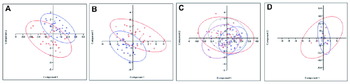
All the species of Ceratomyxa and Myxidium reported here are morphologically distinguished from each other. Principle Component Analyses (PCA) showed that morphometric differences of a single character only, can be significant species discriminators. C. cribbi n. sp. and C. talboti n. sp. are superficially similar to each other differing only in the posterior angle of the spore with the PCA based on morphometrics supporting the genetic division of the two species (see Fig. 3A). Similarly, PCA indicated significant morphological discrimination of C. moseri n. sp. and C. sewelli n. sp. (see Fig. 3B). These 2 examples are of particular significance since C. cribbi n. sp. and C. talboti n. sp. both infect Pomacentrus chrysurus at Lizard Island and C. moseri n. sp. and C. sewelli n. sp. both infect P. wardi at Heron Island. Without genetic data to support the division based on morphometrics, we would have been reluctant to establish new species based solely on these morphometric differences. Measurements of C. talboti n. sp. spores from the different damselfishes were not significantly different even though spore plasticity was observed within infections and between hosts (see Fig. 3C and Table 1).
Principle component analyses. (A) C. cribbi n. sp. (crosses) and C. talboti n. sp. (squares); (B) C. moseri n. sp. (crosses) and C. sewelli n. sp. (squares); (C) C. talboti n. sp. ex Dischistodus chrysopoecilus (crosses), Chrysiptera cyanae (squares), Plectroglyphidodon leucozonus (circles), and 2 Pomacentrus chrysurus (triangles); (D) C. burgerae n. sp. from Lizard Island (crosses) and ceratomyxid ex Dascyllus aruanus from Heron Island (squares).

Locality
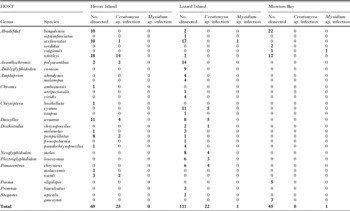
Bivalvulidans were collected at all 3 localities at varying prevalence (see Table 3). Ceratomyxids were recorded only from the gallbladders of damselfishes at Heron and Lizard Islands and at these locations were abundant. Forty-five damselfishes of 6 species have been examined from Moreton Bay, yet no ceratomyxids have been recorded. Myxidium queenslandicus n. sp. was recorded only twice in 1 fish from Lizard Island and 1 from Moreton Bay. Although this parasite species appears to be less prevalent than ceratomyxid species, it displays a broader geographical distribution, spanning over 2000 km. Given this distribution it is also likely that Myxidium queenslandicus n. sp. occurs at Heron Island.
Sample size and identity of damselfishes examined at various localities and bivalvulidan parasite infections recorded by genus

Seven damselfish species were sampled at both Heron and Lizard Islands. Only one of these species was infected with Ceratomyxa spp. at both localities. Nevertheless, low sample sizes may explain this distribution. Dascyllus aruanus is infected with C. burgerae n. sp. at Lizard Island. We cannot confirm that the identity of Ceratomyxa recorded from Heron Island specifically as C. burgerae n. sp since DNA could not be amplified from those samples due presumably to the low intensity of infection. However, based on principle component analysis, the spores from Dascyllus aruanus from Heron Island were morphologically consistent with those of C. burgerae n. sp. from Lizard Island (see Fig. 3D).
Of the remaining 6 host species sampled at both Heron and Lizard Islands, only Acanthochromis polyacanthus has sufficient data on which to base any assumptions. Two of 2 A. polyacanthus from Heron Island were infected with C. dennisi n. sp. while no infections were observed from 14 individuals examined at Lizard Island, suggesting that this species may be restricted to the southern Great Barrier Reef.
Host specificity
Ten of the 11 species of Ceratomyxa reported here have so far been found in only a single host species. The exception is C. talboti n. sp. which was recovered from Dischistodus chysopoecilus, Chrysiptera cyanae, Neoglyphidodon melas, Plectroglyphidodon leucozonus and Pomacentrus chrysurus at Lizard Island. While C. talboti n. sp. displays broad host specificity within the pomacentrids, whether it is restricted to this fish family is currently unknown. Myxidum queenslandicus n. sp. was also recovered from 2 different species of Abudefeduf from Lizard Island and Moreton Bay.
Species richness
Abudefduf whitleyi, Pomacentrus wardi, Pomacentrus chrysurus and Neoglyphidodon melas each harboured 2 species of ceratomyxids. A synopsis of the Ceratomyxa compiled by Eiras (Reference Eiras2006) lists 18 hosts infected with multiple species, with Caulopsetta scapha listed as the type host for 6 ceratomyxid species. Abudefduf sexfasciatus was host to both Ceratomyxa kenti and Myxidium queenslandicus. It is likely that more species remained undetected. The number of protozoan parasites (including Myxozoa) per piscine host, globally and in Australia, has been estimated at 2·4 and 0·6, respectively (Adlard and O'Donoghue, Reference Adlard and O'Donoghue1998) although these authors stated that the figures were likely to be grossly underestimated, a statement that our findings from this study supports.
Phylogeny
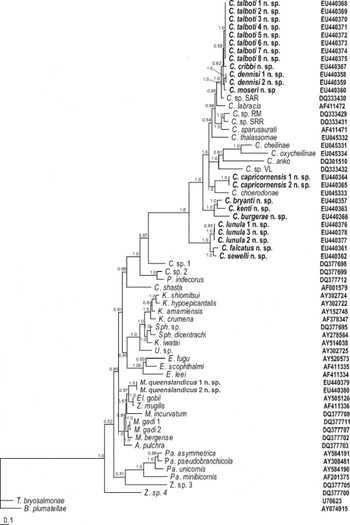
The molecular analyses included 65 myxozoan sequences, of which 24 were from bivalvulidans infecting damselfishes with the major objectives of species-level identification together with an investigation of phylogenetic relatedness. The neighbour-joining, parsimony, Bayesian and maximum likelihood (see Fig. 4) analyses revealed trees of similar topology. The only differences were that branches that had support of less than 60% in the neighbour-joining analysis collapsed in both the parsimony and maximum likelihood analyses.
Bayesian inference analysis inferred from the SSU rDNA dataset. Clade credibilities are indicated at branch nodes. Genera abbreviations as follows: A. Auerbachia; B. Buddenbrockia; C. Ceratomyxa; E. Enteromyxum; El. Ellipsomyxa; K. Kudoa; M. Myxidium; P. Palliatus; Pa. Parvivapsula; Sph. Sphaerospora; T. Tetracapsula; U. Unicapsula and Z. Zschokkella. Numbers in the right column are GenBank Accession numbers.

The 11 novel ceratomyxid species formed a monophyletic clade with other marine Ceratomyxa spp. to the exclusion of C. shasta. As observed in the phylogeny produced by Fiala (Reference Fiala2006), the phylogenetic position of C. shasta remained unresolved. The novel ceratomyxids described here from damselfishes did not form a clade to the exclusion of all other ceratomyxids from other host families. Although damselfishes commonly host ceratomyxid parasites, no significant radiation can be associated with the fish host taxon. Ceratomyxids that infect reef fishes within the Labridae similarly did not correlate with the relatedness of their hosts (Heiniger et al. Reference Heiniger, Gunter and Adlard2008).
Myxidium queenslandicus n. sp. fell into a well-supported clade containing M. gadi, M. bergense, M. incurvatum, Auerbachia pulchra, Ellipsomyxa gobii and Zschokkella mugilis, all species that infect the gall bladders of their hosts. Tissue tropism has been previously shown to correlate with genetic relatedness among morphologically distinct myxozoans (Burger et al. Reference Burger, Cribb and Adlard2007). M. queenslandicus n. sp. showed the most sequence similarity with Z. mugilis and E. gobii, even though the spores appear more similar to M. bergense, M. incurvatum and M. gadi. The distinction between Zschokkella and Myxidium is not clearly resolved due to the similarities in spore morphology as reported by Lom and Dyková (Reference Lom and Dyková1992).
In conclusion, it is clear that the bivalvulidan fauna of teleosts has a rich diversity that is now being revealed through combined morphological and molecular analyses. The presence of fixed genetic differences, whether they be a single nucleotide change or many (as in the case of this study) and the fact that they correlate with morphological and/or host differences, particularly in sympatric distribution, is compelling evidence for the characterization of new species. Robust phylogenetic analysis of this class will now be predicated upon a re-evaluation of species currently proposed only on morphological grounds, together with a dataset that includes representation from what is now emerging as a huge parasite fauna from a range of teleosts.
We thank Dr Jessica Worthington Wilmer of the Molecular Identities Laboratory, Queensland Museum for technical advice, Dr Tom Cribb for discussion on issues of sampling and species boundaries, Mieke Burger, Scott Cutmore, Rick Gleeson and Tane Sinclair-Taylor who assisted in field collection and the staff at Heron Island and Lizard Island Research Stations.