Facebook is the largest and most popular online social network, with more than 1.2 billion users throughout the world. According to Facebook data, in 2015, 102 million users were recorded in Brazil, 24 million of whom were aged between 14 and 20 years.
In Portugal, out of 5.7 million, 900,000 people fell within this age bracket. The fascination with social networking may be partly explained by the phenomenon referred to by Alberts, Elkind and Ginsberg (Reference Alberts, Elkind and Ginsberg2007) as the "personal fable". According to this developmental phenomenon, Facebook may be available to a vast audience, where youths rehearse behaviors that contribute to the construction of their identity (Cingel & Krcmar, Reference Cingel and Krcmar2014). Therefore, the self-centeredness of youths may trigger feelings of invulnerability and omnipotence, leading them to take risks as a result of their difficulty in measuring the consequences of their behaviors.
Opportunities created by Facebook.
The networks also provide opportunities which, in the case of Facebook, constitute a set of benefits that include the possibility of adolescents creating a profile that corresponds to how they wish to be seen by their peers, maintaining and/or expanding their range of social relationships and interacting by means of private messages, thus beyond the scope of adult supervision (Bargh & McKenna, Reference Bargh and McKenna2004).
Facebook fulfils adolescents’ need to be heard and understood, and allows them to express thoughts, feelings and attitudes towards life and to establish relationships with their peers (Suler, Reference Suler2004). The protection created by the computer screen lends itself to the emergence of a "benign disinhibition effect", consisting of greater ease in revealing themselves within an online context, which, in turn, leads them to express their thoughts, feelings and attitudes towards life, to identify themselves with and display solidarity towards their peers (Lapidot-Lefler & Barak, Reference Lapidot-Lefler and Barak2015; Subrahmanyam & Lin, Reference Subrahmanyam and Lin2007). This online disinhibition effect simultaneously enables the most isolated youths, ostracized for whatever reasons by their peers, to gain access to social interaction opportunities that would otherwise not be possible. Moreover, this online training may then be extended to face-to-face interaction (Green, Wilhelmsen, Wilmots, Dodd, & Quinn, Reference Green, Wilhelmsen, Wilmots, Dodd and Quinn2016).
Facebook Risks.
"Toxic disinhibition", the opposite of "benign disinhibition" may easily lead to an occurrence of risks, and is characterized by a number of hazards to which young people are exposed in an online environment, such as, for example, undesired exposure to pornographic or violent content (Lay & Tsai, Reference Lay and Tsai2016; O’Keeffe & Clarke-Pearson, Reference O’Keeffe and Clarke-Pearson2011. Although most youths know how to change the settings for added security (Comitê Gestor da Internet no Brasil, 2014), many appear not to be aware of the risks posed by social networks, possibly due to their understanding that the opportunities being offered outweigh the dangers involved, thus leading to a tendency to minimize the latter (Metzger & Suh, Reference Metzger and Suh2017).
Cultural influence on the use of Facebook
Given the scarcity of cross-cultural studies, the influence of culture on the use of Facebook is still largely unknown (OfCom, 2008). However, some studies point to the fact that the type and intensity of use, behavior and attitudes towards networks and online risks present differences depending on the cultural context (Hofstede, Reference Hofstede1980; Ólafsson, Livingstone, & Haddon, Reference Ólafsson, Livingstone and Haddon2014), while studies focusing on opportunities are still unknown. One of the dimensions of Hofstede’s model (1980) on the main lines of cultural orientation of a country or community, related to Individualism versus Collectivism, has frequently been used as a reference to explain the variability of social and online (Qiu, Lin, & Leung, Reference Qiu, Lin and Leung2012) behavior, and the relationship between individuals and their fellow citizens.
Individualism is associated with the loosening of ties among individuals from a specific social structure, while in the case of Collectivism, strong social ties are preferred, within the scope of which individuals can expect loyalty and unquestionable solidarity (Ferreira, Assmar, & Souto, Reference Ferreira, Assmar and Souto2002). Individualist cultures emphasize autonomy (Ciochinã & Faria, 2009) and the priority of personal goals above the group to which they belong. Collectivist cultures, on the other hand, value cohesion through cooperation among individuals and relationships based on interdependence and collective encouragement, thus ensuring that success is guaranteed by belonging to groups or social institutions (Ciochinã & Faria, 2009).
In the studies conducted by Hofstede (The Hofstede Center, n.d.), among the 53 countries under study, Brazil occupies an intermediate position in terms of Collectivism – Individualism. The Brazilians are collectivists when they consider the family as a broad structure that involves close and distant relatives, and when they transform their work environment, and all those within it, into a new “family” where employers and employees are united through mutual protection and loyalty obligations (Oliveira, Pereira & Oliveira, Reference Oliveira, Pereira and Oliveira2010). Portugal is collectivist, the most collectivist country in Europe according to some studies (Oliveira et al., Reference Oliveira, Pereira and Oliveira2010), even though over recent years it has become notably more individualist (Ciochinã & Faria, 2009; Ricca, Reference Ricca2009) as a result of an economic revival and concern for its own fulfilment. Notwithstanding, Portugal is a more collectivist country than Brazil. Portuguese adolescents may be observed to have a tendency towards individualism in the family, while in peer groups, collectivist attitudes are mainly generated (Ciochinã & Faria, 2009). To our knowledge, there are no studies that specifically compare Portuguese and Brazilian adolescents from this perspective.
Research has shown that in collectivist societies, the intensive use of online social networks is lower than in individualist societies, where there is greater demand for online entertainment (Ji et al., Reference Ji, Hwangbo, Yi, Rau, Fang and Ling2010).
In collectivist cultures, the importance of family, friends and groups may be partially responsible for the less frequent use of social networks, since support tends to be obtained from pre-existing social relations (Elmasry, Auter, & Peuchaud, Reference Elmasry, Auter and Peuchaud2014; Ji et al., Reference Ji, Hwangbo, Yi, Rau, Fang and Ling2010). In individualist cultures, interpersonal relations are more distant and short-lived, thus leading people to use Facebook more frequently in their search for entertainment, self-revelation and self-promotion (Elmasry et al., Reference Elmasry, Auter and Peuchaud2014; Ji et al., Reference Ji, Hwangbo, Yi, Rau, Fang and Ling2010).
Attitudes towards Facebook also appear to differ from culture to culture. A comparative study among North American and Ecuadorian youths found that the North Americans, as part of an individualist culture, displayed favorable attitudes towards social networks and used them more often, while the Ecuadorians, from a more collectivist culture, were more negative in their attitudes towards social networks and used them less frequently (Pumper, Aeger, & Moreno, Reference Pumper, Yaeger and Moreno2013).
Very few studies have focused specifically on the cultural differences in the relationship between intensity of use and risks (or opportunities) of social networks. According to the study of Ólafsson and collaborators (2014), there is a "high use, high risk" tendency in Northern European countries, while in Southern European countries, the relationship tends to be one of "low use, low risk". Portugal is regarded as a medium risk country (Ólafsson et al., Reference Ólafsson, Livingstone and Haddon2014) and, to our knowledge, there are no studies that characterize Brazil as far as this matter is concerned.
As for the order of frequency of online risks, the study of O’Keeffe and Clarke-Pearson (Reference O’Keeffe and Clarke-Pearson2011) points to similarities across all European countries. It begins with the disclosure of personal information, the most frequent risk behavior, followed by exposure to pornographic / violent / discriminatory content and becoming a victim of cyber-bullying and cyber-sexting. There is also the negative influence of groups, exposure to inappropriate content related to suicide, racist images and breach of privacy (O’Keeffe & Clarke-Pearson, Reference O’Keeffe and Clarke-Pearson2011).
A face-to-face meeting with an online acquaintance is less common, however it continues to be the most dangerous risk (Ólafsson et al., Reference Ólafsson, Livingstone and Haddon2014). In Brazil, Facebook has recorded the highest number of complaints related to racism, child pornography, incitement to crimes against life, homophobia, religious intolerance, human trafficking, xenophobia and Neo-Nazism (SaferNet Brazil, 2013).
The research data of Comitê Gestor da Internet no Brasil (2014) also highlights the risk of adding unknown people and the sending of photos / videos to unknown people.
Despite these results regarding the cultural influences on Facebook-related variables, it is still an under studied topic (mainly as far as online opportunities are concerned), particularly since there are no known studies that compare Brazil and Portugal within this scope.
Psychosocial adjustment and the use of Facebook.
The literature has also explored relations between the use of this social network and certain emotional states and mood, which are indicators of higher or lower psychosocial adjustment.
According to some authors (Błachnio, Przepiórka, & Pantic, Reference Błachnio, Przepiórka and Pantic2015; Oberst, Wegmann, Stodt, Brand, & Chamarro, Reference Oberst, Wegmann, Stodt, Brand and Chamarro2017) a number of individual vulnerability factors such as age, previous psychopathological state (depression and anxiety) and also loneliness determine the emergence of negative psychological effects of social networks. In fact, the use of Facebook by younger and/or more psychosocially maladjusted individuals contributes to this social network having a more emotionally negative impact on users with such a profile. Other studies (e.g. Błachnio et al., Reference Błachnio, Przepiórka and Pantic2015) further highlight the close connection between a more intense usage of social networks and depressive and/or emotional states, among which the Fear of Missing Out, or FOMO may be observed, namely social anxiety associated with new technologies and social networks, whereby the individual feels constantly worried about missing an opportunity for social interaction (Przybylski, Murayama, DeHaan & Gladwell, Reference Przybylski, Murayama, DeHaan and Gladwell2013). According to Beyens, Frison, and Eggermont (2016), factors such as the need to belong to a group and to be popular among other youths are behind a heightened FOMO and, consequently, the increase in Facebook usage. Youths begin to access the social network more frequently to check how many likes or comments their posts have generated. However, the more they use Facebook, the more they feel driven to use it, as a result of the FOMO, thus creating a vicious cycle. Other studies (such as those of Kross and colleagues, 2013) have also shown that the frequent and intensive use of Facebook are negatively associated with happiness and general life satisfaction. Similarly, other studies (Przybylski et al., Reference Przybylski, Murayama, DeHaan and Gladwell2013) have pointed to an increase in stress and anxiety levels in Facebook users.
In short, the findings of the various studies are not linear. While some suggest prior vulnerability factors (e.g., depression, anxiety and loneliness) are responsible for youths’ more frequent Facebook usage, others conclude that it is the frequent usage of this social network itself that triggers an increase in anxiety and depression and, consequently, a decrease in the well-being of its users. Nevertheless, most of the studies are of a correlational nature, therefore only associations between Facebook usage and some emotional states can be defined, but not causal relations.
The present study
The main goal of this study was to examine the relationship between Facebook usage habits and online risks and opportunities in young Portuguese-speaking users. From the results of the research on the relationship between the usage habits of social networks and indicators of psychosocial adjustment on the one hand, and between the usage habits of social networks and online risks / opportunities on the other, a specific goal of this study was to explore the moderating role of psychosocial adjustment in the relationship between Facebook usage habits and online risks and opportunities. Despite the availability of studies in Portugal and Brazil, some of which involve adolescents and young adults, the role of nationality and youths’ stage of development, in the relations between Facebook usage habits and online risks and opportunities, appears to be under studied and an analysis of this phenomenon is another aim of this study.
Method
Participants and Procedures
This correlational study was approved by the Ethics Committee of the Faculty of Psychology of the University of Lisbon. The criteria for inclusion were age, nationality (Portugal / Brazil) and parental consent in the case of minors. The sample was obtained by means of three procedures, which were conducted simultaneously. The collaboration of parents and youths was requested on Facebook, and parents were asked to authorize and encourage their children to access the link and answer the online questionnaire, on the freeonlinesurveys.com platform (https://freeonlinesurveys.com/#/). At the same time, an e-mail was sent to Parent Associations, secondary schools and higher education establishments (state and private) in both Portugal and Brazil, explaining the study and requesting collaboration. The documents requesting informed consent were mailed to the parents of minors and distributed and collected by the teachers at a later stage. Another email was then forwarded, providing the link to access the scale to which only the minors, whose parents had authorized their participation in the study, replied under the supervision of a teacher. Students over the age of 18 years were explained the goals of the study and their collaboration was requested. The study was available online for six months (from November 2011 to April 2012). Each participant took, on average, 20 minutes to answer the questions.
The study involved a sample of 952 youths, 500 of Portuguese nationality and 452 Brazilian, aged between 14 and 20 years (Table 1). In the Brazilian sample, the majority (81.4%) were over 18 years of age, while in the Portuguese sample, the majority of answers to the questionnaire came from minors (64%). There were slightly more female gender participants in the Brazilian sample. The highest percentage of participants were at secondary school in the Portuguese sample and in higher education in the Brazilian sample.
Sociodemografic Characterization of the Samples from Brazil and Portugal

Measures
In addition to questions on demographic variables, such as the country of origin of the participants (Portugal vs. Brazil), age ("14-17" and "18-20" years), gender and schooling (primary education, secondary education, higher education), the instrument contained the following measures:
Risks of using Facebook
Online risks were evaluated through 20 questions from the Assessment of Risks and Opportunities in Young Users of Facebook Scale (Marques, Marques-Pinto, & Alvarez, Reference Marques, Marques Pinto and Alvarez2016). These questions addressed the following issues: Undesired exposure to sexual and / or aggressive content (e.g. "Has an / ex-boyfriend /girlfriend of yours ever posted photographs of you in sensual positions or scantily dressed on a social network?"); cyber-sexting, cyber-bullying and cyber-stalking (e.g. "Has anyone ever posted an aggressive message, or an insult specifically addressed to you on your wall?"); risks arising from having joined groups / pages that encourage the practice of taking pictures in risky places (or in dangerous positions (planking/horsemaning), as well as making videos in risky situations (e.g. "Have you ever been invited to join groups / pages that encourage the publication of videos in which you are the protagonist of risky behaviors, for example: Bullfighting cars"?); joining pages that encourage the practice of xenophobia, racism, homophobia, hatred towards someone specific (e.g. "Have you ever been invited to join groups / pages that organize acts of hatred against people?"); encouragement of risky behavior (e.g. "Have you ever been invited to join groups / pages that advocate adolescent suicide?"); risks of ending relationships (e.g. "Has anyone ever ended a relationship with you through Facebook?"); risks associated with stranger harassment, adding strangers and being in contact with strangers (e.g. "Has a stranger ever sent you a friend request?"). Each risk received a risk score ranging from 0 (no involvement in the given practice) to 3 (high involvement in the given practice). The set of answers had high internal consistency, as measured by Cronbach’s alpha (α = .81), making it possible to analyze risk behavior in the use of Facebook as a general index representing the average answers to the given questions.
Opportunities created by Facebook
The opportunities arising from the use of Facebook were evaluated on the basis of six questions, also observed in the Assessment of Risks and Opportunities in Young Users of Facebook Scale (Marques, et al., Reference Marques, Marques Pinto and Alvarez2016). The contents of these questions addressed the following issues: social and cultural integration (e.g. "Has Facebook enabled you to find an internship?"); and affective and social growth (e.g., "Have you ever used Facebook to declare your love to anyone?"). Each question received a score ranging from 0 (no involvement in the given practice) to 3 (high involvement in the given practice). The set of answers had high internal consistency (α = .82), making it possible to analyze opportunities as a general index representing the average answers to the given questions.
Psychosocial adjustment
A general measure of psychosocial adjustment was created by averaging the responses to a loneliness scale and a social anxiety scale, and reversing the answers to the items of both scales to reflect absence of loneliness and absence of social anxiety This aggregate measure showed a high level of internal consistency (α = .81). Absence of loneliness was evaluated with the Social and Emotional Loneliness Scale (SELSA-S), adapted to the Portuguese population (Neto, n.d.). This version of the scale includes nine items (e.g. "Do you feel lonely when you are with your family?"; "Do you have a boy/girlfriend to whose happiness you contribute?"). Absence of social anxiety was assessed by the Social Anxiety Scale for Adolescents (SAS-A) (Cunha, Pinto Gouveia, Salvador, & Alegre, Reference Cunha, Pinto Gouveia, Salvador and Alegre2004), consisting of nine items that address the following issues: Fear of Negative Evaluation (e.g. "Do you worry about what others say about you?"), Discomfort and Social Avoidance in new Situations (e.g. “Do you get nervous when you meet new people?"), General Discomfort and Social Avoidance (e.g. "Do you feel that others make fun of you?"). The answers to each item were quantified on an answer scale ranging from 1, totally agree, corresponding to low adjustment, and 7, totally disagree, reflecting high adjustment.
Usage habits
Based on the study of Ellison, Steinfield, and Lampe (Reference Ellison, Steinfield and Lampe2007), frequency of use, time period of use and attitude towards Facebook were used as indicators of Facebook usage habits. As an indicator of frequency, the mean value of answers to four questions was taken, on the number of times (ranging from 1 = every day to 6 = never) participants performed the following actions: "Changing their profile"; " posting on their own wall"; "logging on only to read comments"; "posting comments on friends’ walls". In order to quantify the amount of time spent on the social network, we asked the youths how long they stayed on Facebook. The answer options varied from 1, zero minutes, and 5, over three hours. Attitude was assessed using the answer to six statements (e.g.: "Facebook is part of my daily routine") for which the participants chose from a 5-point scale ranging from 1, not favorable at all, to 5, totally favorable.
Analysis Procedures
T-tests were used for independent samples to compare the mean values of the variables time period of use, frequency of use, attitude to social network, online risks and online opportunities, according to country and age. In order to study the predictors of online risks and opportunities and the moderating effects, multiple linear regression analyses (enter method) with the SPPS v.21 were run. Facebook usage habits (frequency, time period of use and attitudes), psychosocial adjustment, country and age were considered predictors. Age was analyzed as a categorical variable, with a category of 14-17 years and another of 18 to 20 years. The role of psychosocial adjustment, country and age in the relationship between usage habits and online risks and opportunities was considered to analyze moderation. Thus, Model 1 included socio-demographic variables, variables related to habits and psychosocial adjustment, while in Model 2, in addition to the latter, the various moderating variables (psychosocial adjustment, country and age) were also inserted. The effect of gender and schooling was controlled in both analyses by including these variables as predictors in the regression analyses. The analyzed data did not contain extreme univariate or multivariate outliers and the residuals were shown to be normally distributed.
Results
Descriptive statistics and comparison of means
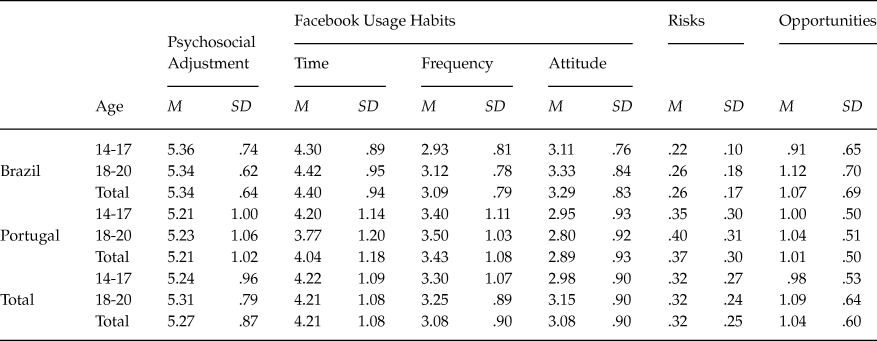
Overall, in terms of usage habits, the youths used the social network with a "medium frequency" for "quite a long time" and showed a "favorable" attitude towards Facebook (Table 2). Comparing the two countries, the Brazilian youths used the social network more frequently, t(950) = 5.64, p < .001, for longer periods of time, t(950) = –5.07, p < .001 and presented a more favorable attitude t(950) = –6.85, p < .001, than their Portuguese counterparts. No differences were found between younger and older youths in frequency or time period of use, however, significantly more positive attitudes were observed among the young adults, t(950) = – 2.83, p < .001.
Means (M) and Standard Deviation (SD) of Psychosocial Adjustment, Facebook Usage Habits, Risks and Opportunities, by Age, in the Participants from Brazil and Portugal

Overall, psychosocial adjustment (PA) proved to be "medium high" (Table 2). The Portuguese participants showed lower PA than the Brazilians, t(950) = –2.32, p < .05. In the total sample, no significant differences were found between the youths aged 14 to 17 years and those aged 18 to 20 years.
The Portuguese referred to taking more risks than the Brazilians (Table 2), with significant differences between the two samples, t(950) = 6.36, p < .001. No significant differences were encountered in terms of age, t(950) = .52, p = .611.
Both Brazilian and Portuguese youths equally enjoyed the opportunities created by this social network, and no significant differences were found between them. Regarding age, youths over the age of 18 years benefited most from the use of Facebook, t(950) = –2.88, p < .001.
Regression analyses
Online opportunities
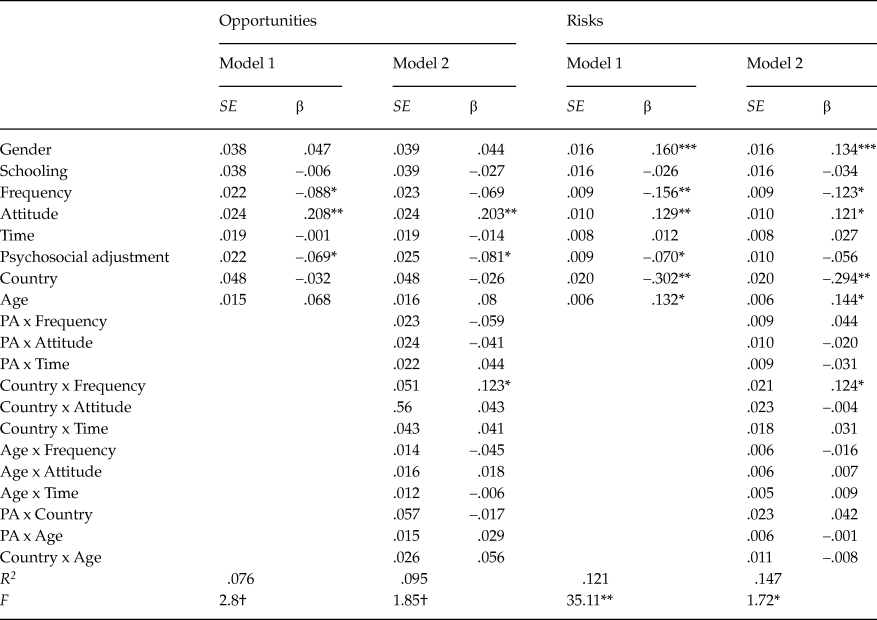
The analysis of the predictors of Facebook usage habits revealed frequency of use and attitude as significant predictors of online opportunities, and the higher the frequency of use and the more favorable the attitude, the greater the opportunities. A significant main effect of psychosocial adjustment was also found, and the lower the adjustment of the youths, the greater the opportunities (Table 3). There was also one significant interaction, namely between the frequency of Facebook usage and online opportunities, which denoted the presence of a moderating effect.
Regression Analyses in the Predictors of Risks and Opportunities

Note: PA = Psychosocial adjustment; β = standardized regression coefficients; SE = standard error.
† p <.07; * p <.05; ** p <.001.
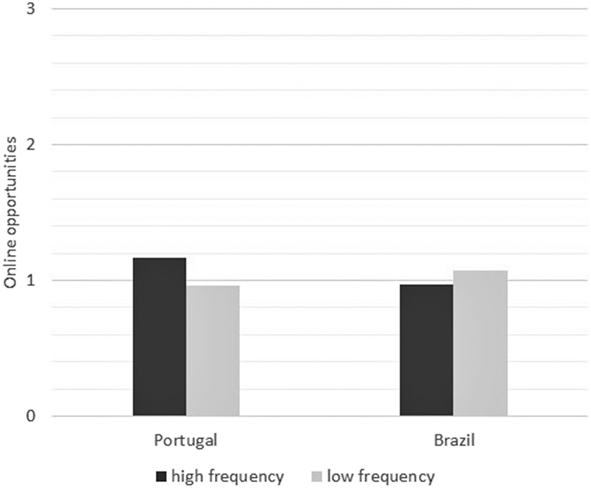
The breakdown of this interaction indicated (Figure 1) that frequency of use predicted more opportunities for youths in Portugal (b = –.103, SE = .027, t = –3766, p < .001, β = –.167), while this variable was not related to the opportunities of the Brazilian participants (b = .031, SE = .038, t = .814, ns, β = .050).
Online Opportunities according to the Frequency of Facebook Usage Moderated by Country.

Online risks
In the analysis of the risk predictors, the effects of age and country were observed as significant, with the highest risks among the older youths and the Portuguese, respectively (Table 3). In Facebook usage habits, frequency of use and attitude also proved to be significant predictors of risk, showing that the higher the frequency of use and the more favorable the attitude, the higher the risk. A significant main effect of psychosocial adjustment was also observed, namely the lower the psychosocial adjustment of the youths, the higher the risks. Additionally, the results showed one significant interaction which denoted the presence of a moderating effect, namely, the relationship between the frequency of Facebook usage and susceptibility to online risks was moderated by country.
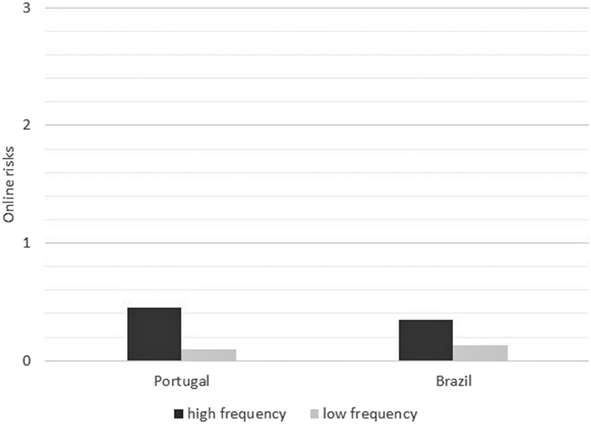
A breakdown of this interaction showed that the effect of frequency of Facebook usage on risks was only significant in Portugal (b = –.062; SE = .011, t = –5,491, p < .001; β = –.235), to such an extent that the Portuguese youths who most frequently used Facebook, exhibited a higher risk than the users with a lower frequency of use. This phenomenon did not occur in Brazil (b = .003, SE = .015, t = .169; n.s.; β = .010) (Figure 2).
Online Risks according to Frequency of Facebook Use, Moderated by Country.

Discussion
The overall results show that youths spend a considerable amount of time on Facebook on a daily basis (one to two hours), using it with average frequency (three to four times a week) and revealing a favorable attitude towards its usage. The risks are relatively low, with values close to zero, while overall results are slightly higher in terms of opportunities.
In line with previous studies (Ciochinã & Faria, 2009), we are also of the opinion that there is a lower intensity of Facebook usage in more collectivist societies. Brazil, a more individualist society than Portugal, is a prime example, presenting higher figures among youths for both frequency and time spent on Facebook. Conversely, the Portuguese use this social network less frequently and less intensely, possibly due to the fact that they are part of a collectivist society. According to Ciochinã and Faria (2009), this characteristic is more noticeable with peer groups, and tends to lead them to seek out more face-to-face encounters over online relationships.
As for the risks, the tendency is “low usage, low risk”. The fact that a lower usage rate of Facebook leading to fewer online risk situations in this specific Portuguese sample, and that solely among the Portuguese youths an interaction effect between online risks and frequency of use was observed, may also be related to factors of a cultural and social nature. Indeed, according to the findings of the study of Ólafson and collaborators (2014), in the southern countries of Europe, there is a positive correlation between the frequency of use and the emergence of online risks, pointing to a “low use, low risk" tendency.
An analysis of the predictors and moderators of risks and opportunities also revealed that the more favorable the attitude towards the use of Facebook, and the more often it is used, the greater the risks run by youths, but also the more they benefit from the opportunities created by this social network. Nevertheless, our results point to a tendency towards "high use, high opportunity" and the opportunities arise on a par with the risks. As suggested by other studies (Ricca, Reference Ricca2009; Suler, Reference Suler2004; The Hofstede Center, n.d.), the disclosure of personal information is the most frequent risk in European countries. However, this self-revelation may also enable youths to enjoy better social and cultural integration and to promote their affective and social growth, as has already been highlighted (Ólafsson et al., Reference Ólafsson, Livingstone and Haddon2014).
The less psychosocially adjusted youths, in other words, the lonelier and anxious, simultaneously put themselves most at risk and benefit most from the opportunities. The results of this study are consistent with those reported by a number of authors (e.g. Suler, Reference Suler2004) who regard this social network as a privileged means for obtaining support, especially for lonely youths with interpersonal relationship difficulties, whose levels of loneliness are subsequently decreased (Subrahmanyam & Lin, Reference Subrahmanyam and Lin2007). However, in order for these beneficial effects to emerge, there are also some associated deleterious effects.
Notwithstanding, the psychosocial adjustment indicators neither moderate the impact of Facebook usage habits on risks nor on opportunities. Therefore, lower usage frequency reduces the risks and a more favorable attitude increases them, not only in youths with good adjustment indicators, but also in the most maladjusted youths. Such is the case for opportunities. Hence, in the sample under study, psychosocial adjustment is neither a vulnerability factor for risks, nor does it foster the emergence of opportunities. These findings may derive from the specific characteristics of the non-clinical sample under study, given that overall, the youths reported a good adjustment. In future studies, it might be important to include clinical samples in order to analyze whether the usage habits indicators (frequency and attitude) have a different impact, according to the psychosocial adjustment levels. In this case, it would also be interesting to consider the possibility of (mal)adjustment being a predictor of abusive social network usage and the latter acting as a mediator, as foreseen by the Person-Affect-Cognition-Execution model for the Internet in general (Brand, Young, Laier, Wölfling, & Potenza, Reference Brand, Young, Laier, Wölfling and Potenza2016).
Age also appears to be a predictor of risk, and older youths are the most at- risk individuals, as has been reported by other studies (Biglan, Brennan, Foster, & Holder, Reference Biglan, Brennan, Foster and Holder2004). The time they spend on this social network, the frequency of use and their attitude towards Facebook indicate that it does, in fact, play an important role in the lives and development of 21st century youths. Virtual friends can take on the form of a huge fictional audience (Cingel & Krcmar, Reference Cingel and Krcmar2014), towards which young people behave differently in order to act in accordance with the behavior of other users and the social characteristics of the country (Comitê Gestor da Internet no Brasil, 2014). Thus, Facebook may contribute to the process of identity construction in youths (Cingel & Krcmar, Reference Cingel and Krcmar2014) and to their socio-cultural integration, however a more in-depth analysis of these features should be conducted in future studies.
The results of this study should be analyzed in more detail in the future by collecting a more homogeneous sample, from both countries, in terms of age, and by further adding a qualitative approach in order to clarify the cultural aspects of the differences. On a final note, given the increasing number of children and adolescents who create profiles on this social network, in addition to the amount of time they spend on it, there will certainly be some impact, not only on their daily lives, but also on their development, and these effects should be the focus of future studies.