Introduction
A complex interplay of welfare support and coercive sanctions now dominates much of contemporary social welfare (Dwyer, Reference Dwyer2004; Flint, Reference Flint and Flint2006; Harrison and Sanders, Reference Harrison, Sanders, Dearling, Newburn and Somerville2006; Phoenix, Reference Phoenix and Squires2008). With a gaze on the role of ‘agency’ and resistance in how such processes are delivered and received, this article explores configurations of vulnerability against a backdrop of welfare conditionality and the intensifying behavioural regulation of ‘problem’ groups. In the UK, the concept of vulnerability is increasingly deployed in the management and classification of individuals and groups, from benefits claims to criminal prosecutions and child protection. Special moral and legal obligations are applied to ‘vulnerable’ people, and due to links with ‘deservingness’ (see Goodin, Reference Goodin1985; Turner, Reference Turner2006) how vulnerability is imagined has significant effects on those who are considered to belong to ‘vulnerable groups’. Yet despite the powerful ethical and practical connotations attached to vulnerability, the concept has received relatively little attention from social policy commentators, especially in comparison with other similar notions, such as ‘risk’.
This article reports from qualitative research which investigated how the concept of vulnerability was operationalised in service interventions with ‘vulnerable’ young people. It provides an overview of key constructions of vulnerability as they appear in the social sciences literature, before briefly explaining the methods of the study and then discussing insights from the empirical research. Findings indicate a vulnerability zeitgeist or ‘spirit of the time’ in care and control processes for some young people; the concept of vulnerability appears as an intellectual fashion which reflects and influences certain areas of policy and practice. A close relationship between vulnerability and transgression emerges, and some of the complexities of this inter-relationship are explored. It is also evident that understandings of vulnerability differ, posing challenges in the governance of vulnerable young people's lives. The conclusions highlight that as well as helping to implement caring approaches to ‘problem’ groups, vulnerability discourses in policy and practice also serve more controlling mechanisms, perhaps more than may at first be apparent.
Configurations of vulnerability
Vulnerability appears as a significant concept in a diverse range of disciplines and has appeared in social sciences literature for several decades. In the human sciences, the notion is frequently discussed in relation to hazards or environmental concerns (Alwang et al., Reference Alwang, Siegel and Jorgensen2001; Bankoff et al., Reference Bankoff, Frerks and Hilhorst2004; Adger, Reference Adger2006) and in critical debates over the bounds of ‘health risks’ (see Peterson and Wilkinson, Reference Peterson and Wilkinson2008). Another body of literature relates vulnerability to poverty, famine and ‘natural’ disasters (Chambers, Reference Chambers1989; Watts and Bohle, Reference Watts and Bohle1993; Lindley et al., Reference Lindley, O'Neill, Kandeh, Lawson, Christian and O'Neill2011). Within the fields of philosophy and ethics, a number of writers are passionate about the potential for the notion to be utilised as a vehicle for the attainment of social justice (see Goodin, Reference Goodin1985; Kittay, Reference Kittay1999; Turner, Reference Turner2006; Fineman, Reference Fineman2008). The concept has also been used in social research (see Beckett, Reference Beckett2006; Warner, Reference Warner, Peterson and Wilkinson2008; Emmel and Hughes, Reference Emmel and Hughes2010; Hollomotz, Reference Hollomotz2011), and in more policy-based commentaries (Waiton, Reference Waiton2008; Daniel, Reference Daniel2010; McLaughlin, Reference McLaughlin2012). Across the literature, ‘vulnerability’ is characterised by plurality of meaning and it is constructed in relation to a wide range of factors (Fawcett, Reference Fawcett2009).
Two principal manifestations of the notion tend to appear in the literature (see Brown, Reference Brown2012). Vulnerability can be represented as ‘innate’, being seen as ‘enhanced’ during particular periods in the life course, such as childhood, older age and pregnancy. It is also frequently used ‘situationally’, to highlight particular circumstances where people are at elevated ‘fragility’ or ‘risk’. The concept often appears in research as an explanatory tool for referring to situations or transgressions in a way that suggests that these are not the ‘fault’ of the individual or group concerned. Writers have noted strong moral connotations attached to the term and its potential to elicit sympathy (see Goodin, Reference Goodin1985; Turner, Reference Turner2006; Mackenzie, Reference Mackenzie2009), and particularly in the field of disability research, authors have argued that vulnerability has a strong paternalistic quality (see Wishart, Reference Wishart2003; Hasler, Reference Hasler, Swain, French, Barnes and Thomas2004). Research has highlighted that it can be an effective conceptual mechanism for the transference of power from the receivers of services to professionals who design and provide them (Lansdown, Reference Lansdown and Mayall1994; Dunn et al., Reference Dunn, Clare and Holland2008; Hollomotz, Reference Hollomotz2009, Reference Hollomotz2011), with some policy commentators linking this with the ascendance of ideas about ‘risk’ (Culpitt, Reference Culpitt1999; Lupton, Reference Lupton1999; Taylor-Gooby, Reference Taylor-Gooby2000; Sarewitz et al., Reference Sarewitz, Pielke and Keykhah2003).
Indeed, where attempts have been made to theorise the dimensions of the concept of vulnerability, the ‘risk society’ thesis (Beck, Reference Beck1992) is often drawn upon (see Mizstal, Reference Misztal2011, for an overview). Beck himself (Reference Beck2009: 178) has stated that ‘vulnerability and risk are two sides of the same coin’. Unsurprisingly, writings have indicated that vulnerability discourses can be associated with ontological concerns about insecurity and powerlessness (Kemshall, Reference Kemshall and Kemshall2002; Furedi, Reference Furedi2007, Reference Furedi2008; Waiton, Reference Waiton2008). As well as risk-related theorising, a small body of work has developed which advances the idea that vulnerability should be conceptualised as ‘universal’ (Turner, Reference Turner2006; Dodds, Reference Dodds2007; Fineman, Reference Fineman2008; Anderson and Honneth, Reference Anderson, Honneth, Christman and Anderson2005), with some writers using the notion as a mechanism to emphasise the politically and economically constituted nature of human existence and disadvantage (Butler, Reference Butler2004, Reference Butler2009; Beckett, Reference Beckett2006). In their human sciences work, Watts and Bohle (Reference Watts and Bohle1993) suggest ‘causal’ structures of environmental disasters, which they call ‘spaces of vulnerability’. Deployed in social research, this is a powerful idea that has been used to develop understandings of the lived experiences of deprivation (Emmel and Hughes, Reference Emmel and Hughes2010).
Authors interested in social control have noted widening application of ideas of dependency and vulnerability (Furedi, Reference Furedi2003, Reference Furedi2008; Waiton, Reference Waiton2008; Harrison, Reference Harrison2010; McLaughlin, Reference McLaughlin2012). The notion has been seen as linked to ideas which reinforce notions of ‘acceptable’ behaviour (Harrison and Sanders, Reference Harrison, Sanders, Dearling, Newburn and Somerville2006; Scoular and O'Neill, Reference Scoular and O'Neill2007; Richards, Reference Richards2011). Analysing policies on teenage parenting, Van Loon (Reference Van Loon, Peterson and Wilkinson2008: 59) uses Foucault's (Reference Foucault1980) governmentality thesis to argue that vulnerability has a ‘cloak of concern’,which means it can be used to justify stronger controlling mechanisms. Commentators have noted complexities arising where groups may present as ‘transgressive’ at the same time as being seen as ‘vulnerable’ (see Harrison and Sanders, Reference Harrison, Sanders, Dearling, Newburn and Somerville2006; Dobson, Reference Dobson2011; Phoenix, Reference Phoenix, Carrington, Ball, O'Brien and Tauri2012a). Moon (Reference Moon2000: 241) argues that there is a ‘juxtaposition of threat and vulnerability’ in constructions of mental health service users, which Warner (Reference Warner, Peterson and Wilkinson2008: 32) frames as a ‘vulnerability/dangerousness axis’, with vulnerability used to indicate the risk posed by certain individuals as well as to them.
In relation to young people, vulnerability has long been associated with childhood (see Rousseau, Reference Rousseau and Foxley1762; Hendrick, Reference Hendrick, James and Prout1997). The concept is implicit in biological and physical developmentalism, an approach which assumes that because children are not fully mature they are rendered vulnerable to adverse influences that may disrupt the ‘normal’ completion of the ‘developmental process’ (see Bynner, Reference Bynner2001; Malin et al., Reference Malin, Wilmot and Manthorpe2002). The emergence of the sociology of childhood (James and Prout, Reference James and Prout1997, Mayall, Reference Mayall2002; Moran-Ellis, Reference Moran-Ellis2010) has called into question understandings of children as innately vulnerable, emphasising that representations of childhood and childrens’ vulnerability vary over time (see Pearson, Reference Pearson1983; Hendrick, Reference Hendrick, James and Prout1997), and may be socially constructed (see Daniel, Reference Daniel2010; O'Connell Davidson, Reference O'Connell Davidson2011). In policy arenas, representations of children as passive and vulnerable compete and overlap with notions of children as agents in, as well as products of, the social process (James and Prout, Reference James and Prout1997; Piper, Reference Piper2008; Nygard, Reference Nygard2009). This has particular implications for young people, who tend to be constructed in policy either as ‘vulnerable victims’, or as ‘dangerous wrong-doers’ with full responsibilities in situations where they transgress (Goldson, Reference Goldson2000, Reference Goldson2002; Fionda, Reference Fionda2005; Such and Walker, Reference Such and Walker2005). Although there are signs that the configuration of young people's vulnerability and transgressive behaviour is appearing as a concern on the policy horizon (see House of Commons Education Committee, 2012), attention to this in the academic literature is sparse. Useful insights can be found in the youth justice literature (Goldson, Reference Goldson2000, Reference Goldson2002; Muncie, Reference Muncie2006), but such analysis remains primarily focussed on young people involved in the criminal justice system. Generally speaking, examination of the literature related to vulnerability in the social sciences reveals the concept to be highly relevant and yet little-explored. Empirical research into how ideas about vulnerability are operationalised remains limited.
Research methods
The findings in this article are drawn from fieldwork undertaken during 2010–11 for doctoral research which investigated the concept of vulnerability and its use in the care and control of young people. The qualitative empirical element of the research involved a case study which explored how vulnerability was operationalised in services for supposedly vulnerable young people in a large English city (population around 750,000). The city had a sizable local authority and varied infrastructure aimed at supporting ‘vulnerable’ children and young people, in that certain commissioning arrangements, services and interventions were explicitly targeted at this particular group.
Twenty-five young people were interviewed, with the interviewees included on the basis that they were considered ‘vulnerable’ by their workers and that they had extended histories of receiving relatively intensive welfare and/or disciplinary interventions. Indicators for young people's status as ‘vulnerable’ were likely to be imperfect given the complexity and subjectivity of the classification, an issue under scrutiny itself, but this process provided valuable insights into how professionals measured and classified vulnerability. Young people were accessed through six ‘gatekeeper’ agencies: a service for young carers, a locality-based ‘Anti-Social Behaviour’ (ASB) project, a young people's drugs service, a ‘sexual exploitation’ project, a private education provider for young people having problems at school and a service for ‘vulnerable’ children (which supported homeless young people, ‘runaways’ and refugees/asylum-seekers). Interviewees were twelve to eighteen years old, around half were male and half female. A range of different ethnic groups were included in the sample, with seventeen participants being of White UK ethnic origin. Almost all of the young people lived in inner-city social housing estates, with the exception of three young people who lived in private rented accommodation. ‘Transgressive’ young people were deliberately incorporated into the sample; just over half of the young people had offending histories, criminal behaviours, close association with ASB and/or had been excluded from school.
Ethical considerations were of paramount concern in the design and implementation of the research. Support workers were enlisted in the process of informed consent to ensure that every effort was made to fully explain the nature of the research and its potential uses to all interviewees and their parents where appropriate. In line with standard child protection practice, young people were offered confidentiality except for in instances where risk of significant harm might be indicated, an eventuality that did not arise. In the discussion of the research findings, names have been changed for confidentiality reasons, with pseudonyms chosen by the young people.
Engaging young people who are often considered ‘difficult to reach’ was challenging, but through the use of task-based interviewing techniques (see Conolly, Reference Conolly2008) unique insights into ‘vulnerable’ young people's perceptions of vulnerability were generated. Using life-mapping activities, young people were asked about their past experiences, hopes for the future and previous/future vulnerabilities. Through discussions of video vignettes, interviewees’ views on the vulnerabilities of other young people were also sought, with this leading to conversations about their own vulnerability. Most young people in the sample were familiar with and responded to notions of vulnerability, but in some instances the word ‘vulnerability’ was discussed in terms of various proxies such as ‘difficulties’ or ‘difficult lives’. Rich ‘life stories’ data were produced which is not included here for reasons of space, but which is summarised in Appendix 1.
Fifteen semi-structured interviews were also undertaken with professionals, or ‘key informants’, who were involved in the delivery of services for vulnerable young people in the city. Informants were selected using the rationale that the sample needed to include roughly equal numbers of front-line workers, operational managers, commissioners and strategists, in order to give an adequate mix of positions of responsibility. Furthermore, reasonable coverage of agencies involved with vulnerable (and also ‘transgressive’) groups of young people was also required. The sample of key informants included five front-line workers, three commissioners and seven managers, who in some cases also had commissioning and service user-facing duties. Interviewees worked across a range of settings, some providing interventions which were more ‘compulsory’ in nature (the Youth Offending Service [YOS], Social Care and a Family Intervention Project [FIP], for example), while others worked for services which might be considered more ‘supportive’, such as third-sector youth projects working with young people who were ‘in need’ or ‘at risk’ in some way. Informants were asked about how they made use of the concept or idea of ‘vulnerability’ in their work, their understandings of the notion and how they measured and classified ‘vulnerability’. These interviews were complemented by informal data gathering through the researcher's participation in various meetings, conversations and correspondence. Such ethnographically-based approaches were especially useful in generating insights into how professionals perceived and managed young people's vulnerability.
Data were analysed using ideas taken from ‘thematic network’ approaches (Attride-Stirling, Reference Attride-Stirling2001). Attention was given to over-arching themes alongside consideration of more detailed ‘sub-themes’, exposing commonalities and differences across the two sets of interviews. Four main themes emerged in relation to the operationalisation of vulnerability: (i) the popularity and pervasiveness of the notion; (ii) a vulnerability-transgression nexus; (iii) vulnerability as a mechanism for care and control; and (iv) mismatched understandings. Each is explored in more detail below, followed by some concluding comments.
The vulnerability zeitgeist
Vulnerability featured heavily in the language and practices of service interventions with groups of young people considered as ‘in need’ of support or discipline. There was almost uniform agreement amongst key informants about its popularity and pervasiveness. Comments referred to it being a ‘buzz word’, a ‘catchphrase’ and ‘common parlance’ in professional practice. As well as the term, the idea of vulnerability also seemed significant, as one manager said: ‘it's always there at the forefront; it's always in your mind’.
Experienced professionals and earlier career practitioners alike commented that such a prevalent focus on vulnerability was a relatively new development in the provision of welfare and disciplinary services. However, discourses of vulnerability and related practices were not ubiquitous. Two informants avoided using the term in their work, and a small minority disapproved of its increased use, indicating concerns about overuse and the neglect of young people's agency.
A lack of clarity existed around understandings of how young people's vulnerability was perceived and managed. One commissioner based in the City Council's Children's Unit felt this reflected arrangements higher-up in the commissioning framework:
A number of government initiatives have used vulnerability in a different way and that's reflected in the local authority structure and the result is a lot of debate and confusion around where boundary lines are drawn around vulnerability.
Despite this, some agreement existed about more informal or tacit understandings of such processes. It was fairly standard for consideration of young people's vulnerability to form part of the assessments made by agencies; that is, the procedures which practitioners used to measure or classify young people in order to prioritise, plan and deliver interventions. The worker at the young carers’ service described this process as relatively intuitive:
from looking at referrals, we identify the children we think are most vulnerable and need seeing more urgently.
For others, the classification was more systematic, as indicated by the manager at the FIP:
it's part of our risk screening – risk and vulnerability screening processes and procedures – when we do assessments of risk, we are assessing vulnerability as well, and that's made explicit in the documentation and also in the training.
The assessment of ‘vulnerability’ also seemed significant in disciplinary processes for young people. It was described by a Youth Offending Service's (YOS) senior manager as ‘absolutely critical’ to the organisation's national screening tool, Asset. ‘Vulnerability’ was one of three key areas on which YOS interventions were based (see Youth Justice Board, 2006, Appendix 12: 7), the other two being risk to the public and likelihood of offending. The YOS senior manager explained:
having a high vulnerability rating therefore triggers actions and the intervention plan and accountability from that, and the intensity of that intervention.
Vulnerability was also drawn upon in aspects of the commissioning process and in the distribution of resources. Several commissioners in the city had the term in their job title and five key informants had been involved in administering a ‘Vulnerable Children Grant’ under New Labour (see Kendall et al., Reference Kendall, Johnson, Gulliver, Martin and Kinder2004, Brown, Reference Brown2012).
Disciplinary background was sometimes implicated in professional uses or understandings of the term, staff from agencies deploying the term more ‘officially’ (the YOS, the FIP, the housing agency and the clinical psychology service were all examples) seemed to be drawing on it in a more apparently ‘defined’ way. Yet, even where it was used in more formal processing mechanisms, vulnerability classifications were tied to discretion. The notion appeared to lend itself well to use as a conceptual basis for flexible service delivery. At the same time, the malleability of vulnerability seems to have engendered a rather ‘messy’ application in practice. A recurring theme in the interviews was that perceptions of vulnerability varied; or as one worker put it, professionals’ ideas about vulnerability depended on ‘their experiences and where they've worked’. The personal values of individual staff members were also felt to shape views of vulnerability, with the worker from the ASB project noting that disagreements about vulnerability reflected ‘differences in people's levels of acceptability’ of certain behaviours or circumstances.
Some young people also commented on the pervasiveness of the term. Sixteen year old Alicia said ‘they just give loads of kids that name in care – “vulnerable”’. Several young people recounted direct experiences of being classified as ‘vulnerable’ by workers. Sixteen-year old Keith gave an account of the way the YOS used ‘vulnerability’ in the assessment of young offenders. He recalled that he was ‘put down as vulnerable’ because his YOS worker wanted him to be incarcerated in a Secure Unit rather than a Young Offenders Institution (Secure Units are generally considered to be the less punitive sanction):
she said that I were vulnerable in certain ways. In how I were, do you know, just certain ways in my life as being, stuff like that . . . My Dad beating me up, that's what made me vulnerable, my YOS worker said.
John (16) indicated that workers had frequently applied the term to him, especially during a period before he was sectioned under the Mental Health Act:
Interviewer: Did anyone ever say you were vulnerable?
John: Yeah, all the time . . . ‘We think you're taking too many drugs’. I don't know really, they just gave me a great big lecture on how I'm ruining my life . . . I've got so many good chances going for me and all I can do is take drugs, and not look at life and just drop out of college and put myself in vulnerable situations.
Despite a lack of clarity about what vulnerability meant, it seemed to be something of a conceptual zeitgeist in contemporary welfare and disciplinary processes for young people who were seen as ‘in need’ in some way.
The vulnerability-transgression nexus
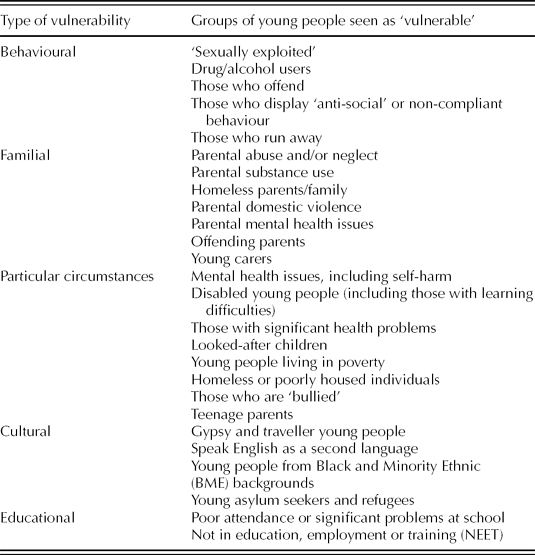
Data revealed a close relationship between ‘vulnerability’ and ‘challenging’ or ‘difficult’ behaviours, which might usefully be described as a vulnerability-transgression nexus. Empirical realities at the ‘front line’ undermined dichotomous understandings of youth seen at policy level, where young people seem to be represented as either ‘transgressive’ or ‘vulnerable’ (see Goldson, Reference Goldson2000, Reference Goldson2002; Fionda, Reference Fionda2005). For example, key informants often drew on the concept of vulnerability to describe and group together young people who had circumstances or problems in common (see Table 1), with behavioural problems often referred to alongside other adversities.
Groups of young people seen as vulnerable by key informants

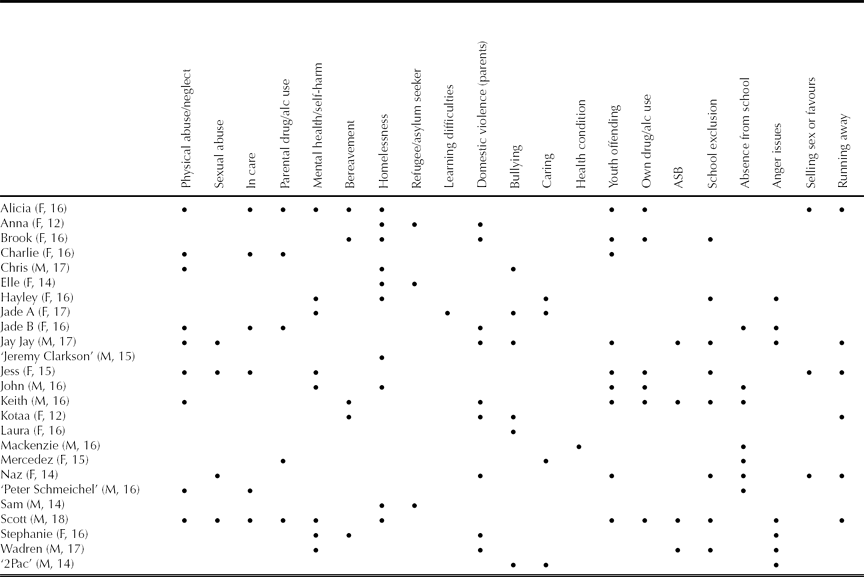
Young people's life stories echoed these groupings to some extent (see Appendix 1), with accounts highlighting that they often belonged to multiple ‘vulnerable groups’. Many recounted problems with their ‘attitude’ or behaviour alongside stories of abuse, neglect, poverty, mental health issues and multiple transitions:
In 2009, I was abused by my Dad and that was when I got my social worker. They tried to get me a foster home, but because I didn't want to stay there, my behaviour got bad. That's when I was selling sex. (Jess, 15)
Ever since then I've just been angry ‘cos I don't take it out on myself any more [by self-harming], I take it out on everybody else. So I suppose I'd rather be excluded from school than all cut up. (Hayley, 16)
Young people's narratives firmly challenged notions of vulnerability which imagine ‘the vulnerable’ as behaviourally compliant or weak. For example, Scott (18) had been served with an ASBO at the age of seventeen and had a long history of involvement with statutory Social Care agencies and with the youth justice system:
I've got big scars on my arms and that where I've been attacked with knives and stuff because, I don't know, I've been in [housing estate] and I've been on my own and I've still looked for a fight. I don't know, I like being on the floor getting booted in the head sometimes.
Eight young people discussed criminal behaviours, including drug taking, violence, criminal damage, burglary and selling drugs. The close relationship between vulnerability and transgression could pose certain problems operationally, as one Local Authority commissioner indicated:
poor behaviour and vulnerability is absolutely the hardest thing to deal with. Without question. If you're vulnerable and you're compliant . . . you know . . . vulnerable and awkward is a totally different ball game.
This vulnerability-transgression nexus is rarely recognised at policy level, where representations of young people's circumstances and behaviours tend to be more simplified and dichotomised. One illustrative example is the case of young people who are ‘sexually exploited’. Whilst this group are ‘officially’ constructed as ‘vulnerable victims’ (Department of Health and Home Office, 2000; Department for Children Schools and Families, 2009; Department for Education, 2011), empirical research has indicated that complex behavioural problems are also prevalent amongst sexually exploited young women, which often connect with interventions taking more disciplinary paths than we might imagine (Phoenix, Reference Phoenix2012b). Whilst more detailed consideration of how vulnerability and transgression intersect at policy level lies beyond the scope of this article, this has been explored elsewhere (Brown, Reference Brown2012, forthcoming).
Care, control and the performance of vulnerability
At the same time as being associated with transgression, vulnerability was generally considered by professionals to be a notion which helped frame young people's difficulties or behaviours in ‘caring’ ways. Comments referred to it being a ‘kind term’, which was ‘trying not to put blame on anybody’, and ‘an empathetic word’ that was ‘non-judgemental’. A popular perception amongst informants was that vulnerability discourses could help to shape interventions ‘positively’, as the retired commissioner recounted:
it's used subconsciously, partly to gain another agency's sympathy; you know, if you're making a referral to another agency, as a hook that people will feel more sympathy perhaps towards say a teenager who's an offender who's described as vulnerable . . . it's better than saying the child is stupid or is neglected or deviant.
Where they had direct experiences of vulnerability classifications, young people's accounts echoed that this could engender more ‘helpful’ or ‘therapeutic’ approaches, as Keith (16) described:
you did have that little bit more support than other people did have. But it wasn't as much, but that little bit more support were better than no support I thought.
That vulnerability classifications could be beneficial in provoking differential treatment is consistent with other work highlighting the potentially positive effects of ‘labels’ (see Gallagher, Reference Gallagher1976; Quicke and Winter, Reference Quicke and Winter1994; Riddick, Reference Riddick2000).
Alongside helping to implement ‘caring’ approaches, evidence of more ‘controlling’ or disciplinary elements appeared where vulnerability was operationalised. Informant interviews indicated that young people's entitlement to support was most secure where they ‘performed’ vulnerability through displaying ‘conformist’ behaviours. As the Social Care manager explained, some vulnerable young people could apparently be excluded from support due to behavioural issues:
the youngster who's constantly challenging and in your face and non-compliant with everything, you know, can be quite frustrating to work with and people can sometimes give up on them.
The account of a manager from housing services, who oversaw the allocation of properties on the basis of ‘vulnerability’, indicated that transgressive behaviour could be a factor in the withdrawal of vulnerability status:
if someone's lived at home and they're just being naughty and they keep going into prison, we wouldn't say that's vulnerability – that's just them they're not abiding by the rules and they just think it's a joke and they think it's a game . . .
Young people were more likely to be seen as vulnerable if they were willing to give information about their personal histories, and where they demonstrated contrition for transgressions. ‘Compliance’ was repeatedly referred to as one of the primary factors on which conferring vulnerability status was contingent, along with ‘engagement’ or ‘motivation for change’. Some interviewees felt that working with the most well-behaved vulnerable young people could be a way of achieving targets and outcomes more successfully, with one manager commenting that agencies who provided services to vulnerable children and young people ‘cherry-pick the easy to engage’. The retired commissioner's comments seemed to summarise the dynamics: ‘young people's attitudes do shape professional's responses, perhaps more than they should actually’.
There appeared to be a gendered dimension to performances of vulnerability. One illustrative example was given by the YOS manager, who said that if YOS staff were to imagine a ‘vulnerable’ young person, ‘we probably think about the girl that drinks before we think about the six foot three person that's done a few robberies’. The manager of the education service also commented:
aggression sometimes from young, fifteen or sixteen [year old] . . . big lads coming in can sort of make you look at them differently. It shouldn't do but it can.
Such findings resonate with Cramer (Reference Cramer2005) and Passaro's (Reference Passaro1996) work, which has highlighted the influence of behavioural expectations and gender on classifications of vulnerability within housing provision. Overall, vulnerability discourses seemed to serve a mixture of care and control processes. Alicia (16), who had been in care, used heroin, sold sex and attended a school for ‘vulnerable girls’, seemed to sum up this dualism, saying that when young people are called vulnerable:
They really are protecting them a lot more, or something like that, and they are – they don't get to do as much things – yeah.
Mismatched understandings of vulnerability
Interviews with both young people and key informants suggested that vulnerability might be a more popular notion in policy and practice than with the receivers of services themselves. Young people were largely resistant to notions of themselves as vulnerable. Only one agreed with a view of herself as ‘vulnerable’ without qualification, as she did not ‘know what's coming up next’ in relation to her parents’ heavy alcohol use. There were a small number of young people who spontaneously used the term to describe themselves at points in their past, usually when referring to transgressions, as in Scott's (18) interview:
I was vulnerable enough to do whatever I wanted, and that's what I did. I don't know. I was chillin’ with the wrong kind of people when I was in there [with foster carers] and started getting myself into robbery and stuff like that to obviously make money.
Most often though, narratives indicated that interviewees attached negative connotations to ‘vulnerability’ and distanced themselves from it. Hayley (sixteen), who was technically homeless and currently sleeping on the floor at an extended family member's house said:
vulnerable means, like, that's personal. To me, it's like, I've put myself there, where other people have done it to me. So it's like fair enough I am vulnerable, but it's not my fault.
A taken for granted tone permeated young people's perceptions of their circumstances, which often seemed related to tensions with professional views of vulnerability. Jay (17) lived with an elderly couple after physical and sexual abuse experienced whilst living with his parents, and was seen as vulnerable by his worker, but explained his attitude towards being considered as ‘vulnerable’ as follows:
I would agree and I wouldn't agree. I would because I've . . . I ain't got a lot of family behind . . . I have got a lot of family behind me, yeah, but I never hardly talk to my really close family. And I aren't vulnerable because like the people who do look after me, they're the ones what'll stick by me and don't let owt happen to me.
There could be a defiant tone when young people displayed resistance to professional views of their vulnerability, as the following extract from Charlie's (female, 16) interview demonstrates:
Interviewer: What about if workers said that you were vulnerable?
Charlie: I'd tell them to shut up.
Interviewer: Why?
Charlie: ‘Cos I'm not vulnerable. They just chat a load of shit . . . I think I'm doing well for myself, and if [social worker] just said that I was vulnerable, then it'd make me feel like I'm doing loads of things I shouldn't be.
Being positioned as vulnerable tended to be seen as an affront to young people's sense of their capacity to cope with their circumstances, as sixteen year old Brook, who lived in a hostel for adult women, explained:
no-one wants to think of themselves as vulnerable, do they? I think I'm perfectly fine . . . the word ‘vulnerable’, it sounds like you're a self-harmer or summat, doesn't it? – ‘Vulnerable’.
However, interviewees were much more receptive to the idea that they had been vulnerable at certain times in the past, or would be at points in the future, than that they might be ‘vulnerable’ in the present:
I've got to figure it out for me sen [myself], otherwise I'm not going to do it. I'm not going to do it for anyone but myself . . . I wouldn't see myself as vulnerable but if I took the time to look at it, I suppose I was. (John, 16)
For young people, vulnerability classifications were bound up with particular relationships or contexts, so were received in ways that were dynamic rather than fixed, thus giving vulnerability a temporal dimension (see Emmel and Hughes, forthcoming).
Informant interviews showed professionals’ awareness of a potential disjuncture between understandings of vulnerability. Most interviewees commented that they tended to use the term ‘vulnerability’ in environments with other professionals rather than in face-to-face work with young people. The support worker at the ‘sexual exploitation’ project felt that if she called young people vulnerable they may think ‘you don't know me, you know, I can look after myself’ and that it might ‘make that young person feel quite young’. The young carer's worker described a reluctance to use the term with her clients on the basis of a lack of ‘empowerment’, saying ‘it can be perceived like it's a weakness in them’. This raises questions about how far young people's feelings about their own identities shape and inform the systems and processes by which their lives are governed. Furthermore, it might be argued that young people resistant to the idea of themselves as vulnerable may be unlikely to ‘perform’ vulnerability in ways that ensure the most secure access to supportive interventions.
Conclusions
Vulnerability is a prominent term in social policy arenas, frequently applied during interventions targeted at those who are ‘less well off’. Empirical research revealed a close relationship between vulnerability and transgressive behaviour, and that so-called vulnerable people often behave in ways which are ‘problematic’. This presents challenges in service provision; a complexity which is often overlooked at policy level. Attention to how vulnerability is used in practice revealed that the concept can operate as a gateway to extra assistance, but also as an entry point for social control. Research into more informal processes indicated that certain behavioural conditionalities are attached to vulnerability classifications. Effective ‘performances’ of vulnerability can lead to avoidance of sanctions or enhanced levels of support, thus classifications of vulnerability may well benefit those with more ‘conformist’ behaviours and work in the direction of excluding from support those who are seen as ‘non-compliant’. Vulnerability classifications also seemed to be bound up with gendered expectations and norms.
Attention to the operationalisation of ‘vulnerability’ highlights tensions in how social worlds are understood by the providers and receivers of interventions, as has been noted in relation to other concepts such as poverty and social exclusion (see Dean and Melrose, Reference Dean and Melrose1999; Batty and Flint, Reference Batty and Flint2013). As well as focussing on the role of a particular term or organising principle within policy and practice, the research indicated something broader about the realities and lived experiences of social divisions. Receivers of services do not necessarily see their lives as problematic in the same way that policy-makers and practitioners do. Exploring ideas about vulnerability provided insights into spaces of resistance and the implementation of ‘top-down’ frameworks of ideas, raising questions as to how far the understandings of social worlds held by those with less power are subjugated by the views of those in more powerful positions.
In a policy environment where a complex array of supportive and disciplinary mechanisms are in operation, vulnerability is a notion malleable enough to serve the increasingly blurred boundaries of care and control practices. This may in part explain its popularity. However, the implications of its pervasiveness should not go unnoticed. Given close links with ‘deservingness’, notions of vulnerability in welfare services can serve a broader re-moralisation agenda in contemporary social policy, whereby the behavioural regulation and discipline of certain groups is being intensified (see Brown and Patrick, Reference Brown and Patrick2012; Harrison and Sanders, forthcoming). Although often used with good intentions, and sometimes valuable in leveraging additional support, the concept of vulnerability should also be seen as connected with conditional welfare arrangements. Unless it is used with care and defined as a state which is universally shared, vulnerability is a notion which can serve the exclusion of those who are seen as ‘deviant’, carrying the implication that it is only people with ‘acceptable’ behaviours that deserve support and assistance.
Acknowledgements
The study was undertaken as part of doctoral research funded by the University of Leeds. I am grateful to Professor Malcolm Harrison and Dr John Hudson for their guidance with the article, and to agencies and professionals who made the fieldwork possible at a time of significant struggles with resources. Special thanks go to the young people who shared their views and stories with me.
Vulnerabilities reported by young people