Introduction
The ability to generate new products continuously is essential for firms to sustain their competitive advantage in the volatile commercial environment (Song & Montoya-Weiss, Reference Song and Montoya-Weiss2001; Im & Workman, Reference Im and Workman2004; Jeong, Pae, & Zhou, Reference Jeong, Pae and Zhou2006; McNally, Cavusgil, & Calantone, Reference McNally, Cavusgil and Calantone2010). Product innovation literature recognizes that strategic orientation is important for developing new products (Jeong, Pae, & Zhou, Reference Jeong, Pae and Zhou2006; Spanjol, William, Qualls, & Rosa, Reference Spanjol, William, Qualls and Rosa2011). Because of its increasing importance, numerous scholars have focused on the relationship between strategic orientation and the performance of new product development projects, and the moderating effect of different factors on this relationship (Batt, Reference Batt2002; Joshi & Sharma, Reference Joshi and Sharma2004; Matting, Sanden, & Edvardsson, Reference Matting, Sanden and Edvardsson2004; Griffiths-Hemans & Grover, Reference Griffiths-Hemans and Grover2006; Atuahene-Gima & Wei, Reference Atuahene-Gima and Wei2011). Under a rapidly changing marketplace and short product life cycles, scholars have identified four issues. The first issue is whether strategic orientation alone is sufficient to create a sustainable competitive advantage. The second issue is whether the combined tendency to engage in product innovativeness and strategic orientation is comparatively more helpful to strategic orientation. The third area of literature suggests that strategic orientation may improve a firm’s ability to innovate new products. The fourth issue is whether this connection is related to improved performance (Atuahene-Gima & Ko, Reference Atuahene-Gima and Ko2001).
In management literature, strategic orientation is characterized by the market orientation and technology orientation (Jaworski & Kohli, Reference Jaworski and Kohli1993; Slater & Narver, Reference Slater and Narver1995; Getignon & Xuereb, Reference Gatignon and Xuereb1997; Atuahene-Gima & Ko, Reference Atuahene-Gima and Ko2001), both of which can promote a firms’ ability to innovate new products and performance (Jeong, Pae, & Zhou, Reference Jeong, Pae and Zhou2006; Spanjol et al., Reference Spanjol, William, Qualls and Rosa2011). Because strategic orientation is considered a two-dimensional construct, when combined with product innovativeness, its influence on new product performance differs. Essentially, the relationship between strategic orientation and product innovativeness, and their influence on new product performance, demands additional attention because rapidly changing technological and competitive conditions have created environments of high market and technological uncertainty. Under such operational conditions, the alignment of market orientation and product innovativeness has significant implications for a firm’s ability to survive. From a dynamic capability perspective, early capturing of this market with the launch of the innovative product obtains increased market acceptance and higher profit potential compared with its competitors (Slater & Narver Reference Slater and Narver1995; Atuahene-Gima & Ko Reference Atuahene-Gima and Ko2001; Maniak, Midler, Beaume, & von Pechmann, Reference Maniak, Midler, Beaume and von Pechmann2014). For example, Atuahene-Gima and Ko (Reference Atuahene-Gima and Ko2001) argued that for market-orientated firms, the firm’s product innovativeness is extremely important for enhancing firm performance. Li, Zhao, Tan, and Liu (Reference Li, Zhao, Tan and Liu2008) showed that product innovativeness can positively moderate the relationship between market orientation and performance in small Chinese firms. In these cases, the maximum positive effect on performance is achieved when a firm’s market orientation and product innovativeness are aligned (Slater & Narver, Reference Slater and Narver1995; Atuahene-Gima & Ko, Reference Atuahene-Gima and Ko2001; Lin, Tu, Chen, & Huang, Reference Lin, Tu, Chen and Huang2013). Thus, the theoretical contributions of this study include the identification of a relationship between market orientation and product innovativeness, and systematic explanations of the moderating effects of product innovativeness on the relationship between market orientation and new product performance.
The limited literature on how technology orientation affects new product performance suggests that product innovativeness plays a crucial role in transferring the effects of technology orientation. For example, Akgün, Keskin, Byrne, and Aren (Reference Akgün, Keskin and Byrne2008) found product innovativeness mediated the direct effect of the new product project’s openness and experimentation (a concept closely related to technology orientation) on new product performance. Lau, Yam, and Tang (Reference Lau, Yam and Tang2011) found that product innovativeness has a mediating role for product modularity (a concept closely related to low technology orientation) on the firm’s ability to innovate new products. Through our review of new product development literature, we found that product innovativeness is a mediating mechanism that transfers the effects of technology orientation to new product performance. Therefore, we selected this input-process-output framework instead of other specific approaches to describe the direct and indirect influence of technology orientation and product innovativeness on new product performance from a dynamic capabilities perspective.
In sum, this research attempts to answer two research questions. The first question this study endeavors to investigate is how do various strategic orientations (e.g., market and technology orientation) affect new product performance? The second question highlights the mediating and moderating roles of product innovativeness in these relationships differs between the two dimensions of strategy orientation and new product performance. To investigate the above two research questions, the authors empirically test how strategic orientation and product innovativeness affect the performance of the new product development projects. The remainder of the paper proceeds as follows. The next section considers the relevant literature and sets out the hypotheses of this study. Following is the methodology for the study. Then, the paper presents the results of the empirical study in achieving the goals as those set out above. Discussion and conclusions are provided in the last section.
Theoretical background and hypotheses
Strategic orientation and new product performance
Strategic orientation when developing new products reflects the firm’s innovation philosophy, which is a firmly established set of values and beliefs that guides the firm’s product innovation project (Jeong, Pae, & Zhou, Reference Jeong, Pae and Zhou2006; Spanjol et al., Reference Spanjol, William, Qualls and Rosa2011). Strategic orientation focuses on how the innovation projects should interact with external environments, such as the market and technology, when developing new products. In the context of new product development, strategic orientation may enable firms to develop dynamic capabilities in rapidly changing environments (Zhou & Li, Reference Zhou and Li2010; Akgün, Keskin, & Byrne, Reference Akgün, Keskin and Byrne2014). Therefore, a dynamic capability perspective is useful for examining the role of strategic orientation in explaining new product performance. The dynamic capability enables us to elucidate the potential effects of strategic orientation on new product performance. The dynamic capability perspective emphasizes the critical role of ‘integrating internal and external competencies to address rapidly changing environments’ (Teece, Pisano, & Shuen, Reference Teece, Pisano and Shuen1997: 516). Previous studies typically categorized strategic orientation into two elements including market and technology orientation (Jaworski & Kohli, Reference Jaworski and Kohli1993; Slater & Narver, Reference Slater and Narver1995; Getignon & Xuereb, Reference Gatignon and Xuereb1997; Atuahene-Gima & Ko, Reference Atuahene-Gima and Ko2001; Calantone, Chan, & Cui, Reference Baron and Kenny2006). These two dimensions of strategic orientation suggest that, under conditions of new product development process, firms are likely to integrate a market pull philosophy (i.e., market orientation) with a technology push perspective (i.e., technology orientation) for explaining new product performance.
Market orientation in new product projects is defined as a method for developing competitive advantages through listening to customers and conveying value and the solution to customers (Kohli & Jaworski, Reference Kohli and Jaworski1990; Deshpande, Farley, & Webster, Reference Deshpande, Farley and Webster1993; Jaworski & Kohli, Reference Jaworski and Kohli1993; Slater & Narver, Reference Slater and Narver1995). The successful introduction of new products into the marketplace through market orientation requires dynamic capabilities. The dynamic capability perspective suggests that market orientation enhances a firm’s ability to develop market-sensing and customer-linking capabilities. Because market-orientated innovation projects are likely to consider market developments and customer requirements, firms that can respond to customer needs more effectively compared with their competitors ensure the effective development of new products (Kibbeling, van der Bij, & van Weele, Reference Kibbeling, van der Bij and van Weele2013). Therefore, because innovation projects have a stronger capacity for acquiring external knowledge, they tend to provide better new product performance. When innovation projects increase market orientation, firms are more likely to develop products that customers prefer over the products already on the market, leading to superior performance compared with their rivals.
In contrast, technology orientation in this study is a technological push concept that assumes customers are attracted by excellent technological-related new products (Gatignon & Xuereb, Reference Gatignon and Xuereb1997; Wind & Mahajan, Reference Wind and Mahajan1997; Akgün, Keskin, & Byrne, Reference Akgün, Keskin and Byrne2014). Technology orientation is also believed to be beneficial to new product performance from the perspective of dynamic capability. The dynamic capability perspective indicates that new product development projects guided by technology orientation accumulate technological competence by investing heavily in R&D and collecting state-of-the-art technology information. Such competence enables projects to refine technology and various products to respond to unstable consumer preferences and reconfigure technological resources to open entirely new markets or market segments (Gatignon & Xuereb, Reference Gatignon and Xuereb1997; Ritter & Gemunden, Reference Ritter and Gemünden2004). Technology-oriented projects are more likely to introduce products that become market pioneers, have more innovative features, and are distinct from their competitors’ innovations (Day, Reference Day1994; Li & Calantone, Reference Li and Calantone1994). Building on this premise, technology orientation increases the novelty of an innovation project’s new products, delivering better products or services to customers, which distinguishes the firm from its competitors (Griffiths-Hemans & Grover, Reference Griffiths-Hemans and Grover2006; Jeong, Pae, & Zhou, Reference Jeong, Pae and Zhou2006; Schulze & Hoegl, Reference Schulze and Hoegl2006; Tang & Murphy, Reference Tang and Murphy2012). Thus, new product development projects with a high level of technology orientation achieve superior new product performance compared with projects with a low level of technological competence.
Therefore, we infer that strategic orientation in the form of market and technology orientation can positively contribute to the performance of new products. By developing effective strategic orientation, firms can experience its benefits, improving the performance of new products. Thus, we propose the following hypotheses:
Hypothesis 1a: Market orientation is positively related to new product performance.
Hypothesis 1b: Technology orientation is positively related to new product performance.
The mediating role of product innovativeness
The limited literature on how technology orientation affects new product performance (e.g., Akgün et al., Reference Akgün, Keskin and Byrne2008; Lau, Yam, & Tang, Reference Lau, Yam and Tang2011; Jean, Sinkovics, & Hiebaum, Reference Jean, Sinkovics and Hiebaum2014) suggests that product innovativeness plays an important role in transferring the effects of technology orientation. The primary reason technology orientation promotes new product performance is that technology orientation enhances a product team’s ability to create or adopt new ideas for developing new products. Briefly, this study contends that the new product performance benefits of technology orientation result from increased product innovativeness. The dynamic capabilities perspective indicates that an innovative project with technology-oriented values can facilitate the introduction of innovative and better-designed products to the market. Technology-oriented new product projects emphasize acquiring new technological expertise and using existing knowledge to establish greater product innovativeness to develop distinct products that satisfy customer needs. Thus, highly innovative products differ from existing products by providing technological breakthroughs and higher profit advantages when introducing new products, enabling innovative projects to obtain first-mover advantages and earn a significant market share (Batt, Reference Batt2002; Hatch & Dyer, Reference Hatch and Dyer2004; Joshi & Sharma, Reference Joshi and Sharma2004; Matting, Sanden, & Edvardsson, Reference Matting, Sanden and Edvardsson2004; Jean, Sinkovics, & Hiebaum, Reference Jean, Sinkovics and Hiebaum2014). Therefore, technology orientation increases the novelty of an innovative project’s new products, distinguishing it from its rivals and contributing to the performance of the new product.
Hypothesis 2: Product innovativeness fully mediates the relationship between technology orientation and new product development performance.
The moderating role of product innovativeness
Recent studies suggest that the relationship between market orientation and new product performance described previously may be moderated by product innovativeness (Olson et al., 1995; Hoffman, Reference Hoffman2000; Lee & O’Connor, Reference Lee and O’Connor2003; Lin, Chen, & Huang, Reference Lin, Tu, Chen and Huang2013), especially in eastern countries (Song & Xie, Reference Song and Xie2000). Product innovativeness is a key environmental factor that enables new product development projects to understand consumers’ desires (Joshi & Sharma, Reference Joshi and Sharma2004; Matting, Sanden, & Edvardsson, Reference Matting, Sanden and Edvardsson2004; Griffiths-Hemans & Grover, Reference Griffiths-Hemans and Grover2006; Atuahene-Gima & Wei, Reference Atuahene-Gima and Wei2011). Under higher perceptions of product innovativeness, the need to understand and anticipate customer demands increases for market-oriented innovative projects to generate new product ideas that appropriately respond to customer preferences (Batt, Reference Batt2002; Joshi & Sharma, Reference Joshi and Sharma2004; Matting, Sanden, & Edvardsson, Reference Matting, Sanden and Edvardsson2004; Kibbeling, van der Bij, & van Weele, Reference Kibbeling, van der Bij and van Weele2013). From a dynamic capabilities perspective, intense product innovativeness motivates a firm to adopt market-oriented strategies by enabling them to discover customers’ unfilled needs and monitor markets to develop new product ideas (Cannon & Homburg, Reference Cannon and Homburg2001; Verhees & Meulenberg, Reference Verhees and Meulenberg2004; Maniak et al., Reference Maniak, Midler, Beaume and von Pechmann2014). In other words, increased product innovativeness enhances the development of a new product that fully and accurately reflects customer tastes, thereby increasing the new product’s attractiveness and performance of its intended functions. Therefore, market orientation combined with product innovativeness enables new product development projects to focus on product–market innovativeness to satisfy customer needs and emphasize product design, market research, and advertizing and promotion. When product innovativeness is strategically developed with market orientation, the performance of new product projects is more likely to improve (Atuahene-Gima & Ko, Reference Atuahene-Gima and Ko2001; Lin et al., Reference Lin, Tu, Chen and Huang2013; Akgün, Keskin, & Byrne, Reference Akgün, Keskin and Byrne2014). This suggests that product innovativeness may positively moderate the relationship between market orientation and new product performance, as stated below.
Hypothesis 3: Product innovativeness positively moderates the relationship between market orientation and new product development performance.
The conceptual framework
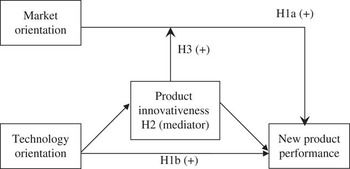
The theoretical framework selected in this study for exploring the relationships between strategic orientation, product innovativeness, and new product performance, is shown in Figure 1. The framework describes two dimensions of strategic orientation and shows how they either directly or indirectly contributed to the performance of new products. Therefore, two-directional relationships (Hypotheses 1a and 1b), one mediated relationship (Hypotheses 2), and one moderating relationship (Hypotheses 3), were hypothesized in this study to obtain further insight into how market orientation and technology orientation influence new product performance through product innovativeness. Market orientation is defined as a method of developing competitive advantages through listening and conveying value to customers (Deshpande, Farley, & Webster, Reference Deshpande, Farley and Webster1993; Slater & Narver, Reference Slater and Narver1995; Kibbeling, van der Bij, & van Weele, Reference Kibbeling, van der Bij and van Weele2013). In this study, technology orientation is a technological push concept that assumes customers are attracted by excellent new technology-related products (Gatignon & Xuereb, Reference Gatignon and Xuereb1997; Wind & Mahajan, Reference Wind and Mahajan1997). Furthermore, product innovativeness refers to a firm’s ability to innovate new or differentiated products from the customer’s perspective (Sarin & McDermott, Reference Sarin and McDermott2003; McNally, Cavusgil, & Calantone, Reference McNally, Cavusgil and Calantone2010). The conceptual framework used in this study is based on a dynamic capability perspective and supports the belief that product innovativeness acts as a mediator between technology orientation and new product performance and as a moderator of the relationship between market orientation and new product performance. New product performance is defined as the extent to which a new product meets the financial and market goals at the time of introduction (Song & Montoya-Weiss, Reference Song and Montoya-Weiss2001; Im & Workman, Reference Im and Workman2004).
The research framework and the hypotheses

Method
Research design
This study investigates the relationships among strategy orientation, product innovativeness, and new product performance in the top 5,000 Taiwanese firms listed in the China Credit Information Service Incorporation database as the survey population. Each year the database provides rankings for business in Taiwan and China based upon their revenue. All firms in the database were contacted to assess their eligibility and to determine appropriate informants for the study. For each firm, senior project managers and product champions directly involved in developing new products were chosen as the key informants for this study. Respondents were asked to specify their most recent new product project they were familiar with in their responses. The unit of analysis is the new product project. A survey methodology was used to collect the data for validating the hypotheses. The variables in the questionnaire were multi-items, including background information, strategy orientation, product innovativeness, and new product performance. To avoid the common method variance problem, the questionnaire was divided into two parts, which were answered by various people. The strategy orientation and product innovativeness items in the questionnaire were answered by the product champions, whereas the items for new product performance and background information were completed by new product project managers. Each project manager or product champions was directly mailed a letter explaining the general purpose of this study, a copy of the questionnaire, and a return envelope. Follow-up letters and e-mails were sent 3 weeks after the first mailing to appeal for participation.
For our survey, the sampling frame consisted of the top 5,000 Taiwanese firms, taken from the lists in the directory of China Credit Information Service Incorporation, which are produced by different nations’ chambers of commerce in Taiwan. A stratified random sampling method was used to divide the population into five non-overlapping groups, or strata, based on the total assets of the top 5,000 companies. For our survey, a stratified sample was randomly used to select 140 firms from the five population groups as follows: (a) rankings 1 through to 1,000; (b) rankings 1,001 through to 2,000; (c) rankings 2,001 through to 3,000; (d) rankings 3,001 through to 4,000; and (e) rankings 4,001 through to 5,000. Therefore, a random sample of 700 questionnaires was selected from each stratum equally. When the sample is a simple random sample, it is described as a stratified random sample. The sample used in this study is representative of the Taiwanese population because the sampling frame was generated by a stratified random sampling process based on firm size.
Of the 700 questionnaires distributed, 130 responses were received, of which seven were incomplete and five respondents did not have experience in new product development. The remaining 118 usable questionnaires, with a responsive rate of 16.86% (118/700), were used for quantitative analysis. Furthermore, the possibility of non-response bias was assessed by comparing the characteristics of the respondents to those of the original population sample. The calculated t-statistics for the sales (t=−0.848, p=.134), number of employees (t=−1.376, p=.336), and capital (t=−0.669, p=.459) are no statistically significant differences on any of three aspects, which suggests that non-response bias does not pose a significant threat to the study.
Measurement scales
Multi-item scales and a 7-point Likert-style response format ranging from ‘strongly disagree’ to ‘strongly agree’ were used to operationalize all constructs and variables in the study. The questionnaire was developed in English and translated into Chinese, then back-translated into English by a third party, to confirm that it was an equivalent translation. The measures were adapted from existing studies and refined based on feedback from experienced researchers and practitioners in the area of inquiry.
Dependent variable
The new product performance construct was adopted from the study by Davila (Reference Davila2003), and measured using 11 7-point scale items, to reflect firms’ satisfaction with the achievements of new product development projects (1=‘substantially lower’, 7=‘substantially higher’). These 11 items include four management items (satisfying unit cost objectives, product specifications, project budget goals, and timing goals), four market items (capturing a high market share, fulfilling customers’ needs, creating a new market, and developing a new product line), two technology items (developing new technology and enhancing skills to manage new technology), and one overall assessment item (business success). Exploratory factor analysis supports only one factor; thus, this study averages the 11 items as a new product development performance measure. Cronbach’s alpha (α=0.89) for the new product performance scale exceeds the 0.40 threshold.
Independent variables
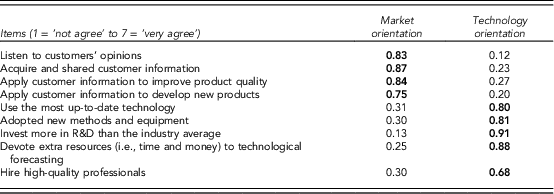
The strategy orientation construct is a nine-item scale adopted from a study by Salavou (Reference Salavou2005) that indicates how much new product projects create appropriate market and technology directions that enable a firm to achieve superior performance. As shown in Appendix, factor analysis was used to reduce the established question items into two variables that can be interpreted as market orientation and technology orientation with acceptable Cronbach alphas (0.79 and 0.84, respectively). The market orientation factor reflects the extent to which the project team listened to customers’ opinions, acquired and shared customer information, and applied customer information to improve product quality and develop new products. The technology orientation factor assesses whether the projects used the most up-to-date technology, adopted new methods and equipment, invested more in R&D than the industry average, devoted extra resources (i.e., time and money) to technological forecasting, and hired high-quality professionals. Cronbach’s alpha for the market orientation and technology orientation scales both exceeded the 0.40 threshold.
The five-item product innovativeness scale, adopted from Sarin and McDermott (Reference Sarin and McDermott2003), assessed the newness of the product under development. The five questionnaire items for product innovativeness were (1) several product-related innovations were introduced to develop the new product; (2) high-quality technical innovations were introduced to develop the new product; (3) compared with similar products developed by competitors, the product offered unique features/attributes/benefits; (4) the product introduced many entirely new features into this product class; and (5) compared with similar products developed by the company, the new product offered unique features (α=0.80). Cronbach’s alpha for the innovativeness measure exceeded the 0.40 threshold.
Control variables
This study examined the effects of strategic orientation and product innovativeness on new product performance, including in the model a range of controls to account for the project-level (such as team size), firm-level (such as firm age and firm size), and industry-level (such as industry type) effects on new product performance. These measures build on previous research of new product development efforts. The first group of the control variables relates to the project-level characteristics by obtaining the number of members of new product development team (team size) from the information provided by the questionnaire respondents. Because the raw data for team size were skewed (skewness=4.66), we recoded this variable based on a natural log transformation of the scores. Therefore, the skewness statistic of the distribution of these scores was 1.08, avoiding a violation of parametric analysis assumptions. The second group of variables was related to firm-level characteristics. This study included the operation length (age) and book value (size) of a firm in the regressions. The operation length represented the number of years the firm had operated in its major product market, and the book value represented the amount of net sales for each firm at the end of the observed year. In our model, logarithmic values were used to prevent a violation of the parametric analysis assumptions. Finally, the last group of variables refers to the industry level. Because industry differences may influence the innovation process and outcome (Hitt & Ireland, 1985), we asked the respondent firms to describe the principle industry type in which they belonged. Then, the industry sector was used as a dummy variable, with 1 representing a high-tech industry and 0 representing a low-tech industry.
Results
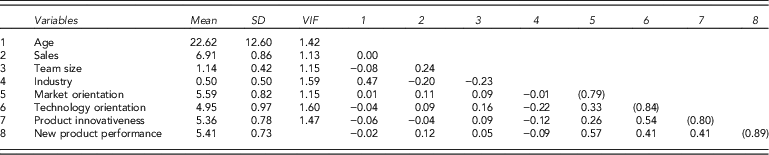
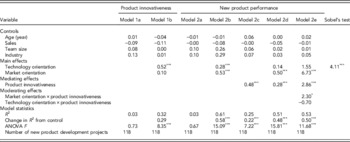
This study explored the relationships among strategy orientation, product innovativeness, and new product development performance. Table 1 displays the descriptive statistics and correlations of the variables. Variance inflation factors were used to examine the effect of multicollinearity. The variance inflation factor values associated with the predictors ranged from 1.13 to 1.60, which is within the acceptable limit (Hair, Black, Babin, Anderson, & Tatham, Reference Hair, Black, Babin, Anderson and Tatham2006), suggesting that no multicollinearity existed. Table 2 presents the hierarchical regression analysis results of estimating strategy orientation, product innovativeness, and new product performance to test the hypotheses.
Means, standard deviations, and correlations
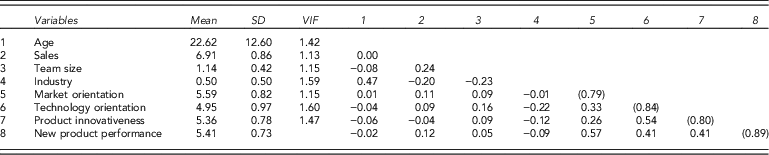
Note: Correlations greater than |.20| are significant at the.05 level and greater than |.24| are significant at the.01 level (two-tailed t-test).
Results of hierarchical regression analyses

Note: Standardized coefficients are reported.
*Significance (two-tailed) at the 0.05 level.
**Significance (two-tailed) at the 0.01 level.
***Significance (two-tailed) at the 0.001 level.
Model 2a in Table 2 is a base model that includes four control variables and a dependent variable of new product development performance. The results of this model indicate that this combination of variables does not significantly impact the dependent variable (analysis of variance (F=0.67, R 2=0.03). Model 2b captures the direct effect of strategy orientation on the dependent variable. The results are significant at the 0.001 level (F=15.09; R 2<0.61) and explain 58% more variance compared with the base model Model 2a, which only contains the control variables. As anticipated, the coefficient of two strategy orientation measures, namely market orientation (β=0.53, p<.001) and technology orientation (β=0.28, p<.001), were found to have a significantly positive impact on new product performance. Therefore, the estimation results strongly support Hypotheses 1a and 1b regarding the positive effects of market and technology orientation on new product performance.
Hypothesis 2 proposes that product innovativeness fully mediates the relationship between technology orientation and new product development performance. This study followed the four-step procedure presented by Baron and Kenny (1986) to analyze how product innovativeness mediates the effects of technology orientation on new product development performance. The first step involved examining the relationship between the independent variable of technology orientation and the dependent variable of new project development performance. As shown in Model 2b, technology orientation (β=0.28, p<.001) is positive and statistically significant for new product development performance. Next, the mediator, which is product innovativeness, was regressed on the independent variables. As shown in Model 1b, the effects of technology orientation on product innovativeness (β=0.52, p<.001) are positive and statistically significant. The third step involved examining the relationship between the mediator and the dependent variable. Model 2c shows that product innovativeness has a positive and statistically significant effect on new product development performance (β=0.48, p<.001). Finally, product innovativeness was included in the model as the mediator to examine whether it reduces the effects of the antecedents to a non-significant level. As shown in Model 2d, the coefficient for product innovativeness is positive and statistically significant (β=0.28, p<.001), demonstrating the direct effect of product innovativeness on new product development performance. Furthermore, by including product innovativeness in the equation, the effect of the technology orientation factor was reduced to a non-significant level. The regression coefficient for technology orientation was reduced from 0.28 (t=6.98, p<.001) in Model 2b to 0.14 (t=1.57, p=.12) in Model 2d. These findings indicate that including product innovativeness attenuates the effect of technology orientation on new product development performance. Thus, product innovativeness plays a mediating role between technology orientation and new product development performance. In addition, we also examined the significance of the indirect effects of the independent variables on new product development performance using a test designed by Sobel (Reference Sobel1982). As suggested by Baron and Kenny (1986), the Goodman version of the Sobel test enables a more direct assessment of the indirect effects of the independent variables on the dependent variable using the mediators. As shown in the final column of Table 2, the Sobel test z-value of 4.11 for technology orientation is statistically significant (p<.001). The result of the Sobel test further supports the significance and strength of the mediating effect, indicating that product innovativeness fully mediates the relationship between technology orientation and new product development performance. Thus, the mediation effect proposed in Hypotheses 4 is supported.
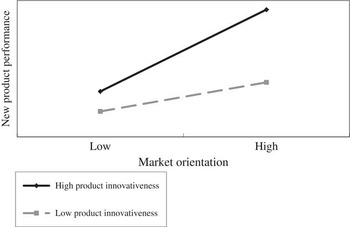
Finally, Hypothesis 3 postulates that the interaction between market orientation and product innovativeness has a positive impact on new product development performance. As shown in Model 2e in Table 2, the positive and significant coefficient of the interaction term between market orientation and product innovativeness (β=2.3, p<.05) indicates that product innovativeness positively strengthens the effects of market orientation on the new product development performance. Figure 1 shows a graph of the interaction effect of market orientation and product innovativeness on new product development performance. This graph reveals that the level of market orientation with high product innovativeness is more positively associated with new product development than with low product innovativeness. This empirical evidence supports the theoretical argument that the positive effect of market orientation on new product development performance is strengthened as the degree of product innovativeness increases. Therefore, these findings support Hypothesis 3 (Figure 2).
Interaction graph of market orientation with product innovativeness on new product development performance

Disccusion
This study examined the roles of strategic orientation and product innovativeness in explaining new product performance. The empirical results support the study framework and hypotheses. The major findings and implications of this study are discussed below. First, our results empirically support the argument that strategic orientation, including market orientation and technology orientation, positively influences new product performance. These findings contribute to existing literature by recognizing strategic orientation as an important driver of new product performance, which is a key element of dynamic capabilities. Thus, this study fills the research gap regarding how dynamic capability is developed (Lavie, Reference Lavie2006). Second, the empirical results indicate that the role of product innovativeness in relationships differs between the two dimensions of strategy orientation and new product development performance. Technology orientation has significant effects, either directly or indirectly, on new product performance. In other words, technology orientation is positively related to product innovativeness, which is consequently positively related to new product performance. The empirical evidence obtained from the procedure presented by Baron and Kenny (1986) and the Sobel (Reference Sobel1982) test both support the mediating role of product innovativeness for technology orientation and new product performance. This study also explored the moderating role of product innovativeness, which influences the relationship between market orientation and new product performance. When new product projects under higher perceptions of product innovativeness, market-orientated strategies are more likely to improve the performance of new product projects.
Because of several limitations, the findings of this study should be interpreted with caution. First, this study used a cross-sectional survey, which cannot corroborate causal effects. However, we rooted our arguments in existing theory and previous results. Future longitudinal studies can investigate whether reverse or reciprocal relationships exist. In addition, the low response rate and small sample pose other concerns. However, the sample is fairly representative of the population, which means that either the t-statistics or χ2-tests indicate that the non-response bias is not a significant issue. Regarding generalizability, the small sample size and low survey return rate still present potential limitations of this study. Furthermore, this study was based on self-reported data; the use of single informants can be considered a source of common method bias. However, using procedural remedies and statistical tests, this study did not find evidence of significant bias. Nevertheless, this issue may still exist and is noted as a potential limitation of this study. In terms of methodology, this study relies on data collected from Taiwan. Due to the limited scope of this sample, it is difficult to generalize our findings to other country. Future research should thus consider obtaining data from other region to cross-check the validity of the proposed model, and thus increase the usefulness of this study.
Implications for business marketing practice
A number of managerial implications can be concluded from our study. The relationship existing between strategic orientation and new product performance suggests that in order to increase new product performance, the project managers should dedicate efficient attention to market orientation and technology orientation.
When the project manager’s main aim is to enjoy an advantage for its new products, however, focusing all their attention on establishing market orientation and technology orientation might not be enough. The project managers would need to follow strategies to create increased product innovativeness for the customer. The role of product innovativeness must be kept in mind. Product innovativeness works by directly and by indirectly transferring the effect of strategy orientation in terms of market and technology orientation on new product performance. More specifically, market orientation only exercises a significant effect on new product performance when product innovativeness is high. In contrast, product innovativeness plays as a mediating mechanism that transfers the effects of technology orientation to new product performance. Managers responsible for the new product projects should therefore strive to establish product innovativeness if they want to differentiate themselves from their competitors by exploiting market opportunities or exploring technological trends in the firm’s strategic directions.
The efforts of the firm’s strategic directions must be seen by the customer as the new-to-the-world functions to create the product innovativeness. Only then could various dimensions of strategic orientation have different effect on the new product performance. We add new empirical evidence to the effects of product innovativeness as studied by other authors such as Lee and O’Connor (Reference Lee and O’Connor2003), Akgün et al. (Reference Akgün, Keskin, Byrne and Aren2008), Lau, Yam, and Tang, (Reference Lau, Yam and Tang2011), and Olson et al. (1995): their mediating and moderating effects at the moment of creating new product performance. This does not mean, however, that companies should focus their attention on generating product innovativeness without guiding a firm’s strategic directions.
Conclusions
Strategic orientation is a set of values and beliefs that influence the direction of the new product project. The perspectives proposed in this study highlight the different roles of product innovativeness in the relationships between two dimensions of strategy orientation (market orientation and technology orientation) and new product performance. Understanding how to integrate a market pull philosophy and technology push perspective with a firm’s ability to innovate new or differentiated products represents a critical challenge for firms to generate profits. Our research informs this intriguing topic by showing how market orientation, technology orientation, and product innovativeness influence the new product performance in Taiwan. The market and technology dimensions of strategic orientation primarily provide superior new product performance through product innovativeness. We hope that further research will contribute further by continuing to explore this important issue.
Acknowledgement
The authors would like to thank associate editors, Professor Felix Arndt’s help and two anonymous reviewers’ insightful comments and suggestions on an earlier draft of this paper.
APPENDIX
Factor analysis for strategy orientation