Introduction
In recent years, the discovery and subsequent publication of numerous Warring States Period manuscripts 戰國 (c. 453–221 b.c.e.) has significantly added to the corpus of materials available for the study of the intellectual and social history of this era.Footnote 1 The text of many of these ‘new’ manuscripts correspond to the contents of several received texts purportedly composed during the pre-Qin era, for which Song dynasty 宋 (960–1279 c.e.) woodblock print editions previously represented the earliest extant copies available for study. These discoveries have stimulated numerous debates not only over the relationship between these newly acquired manuscripts and the corpus of received texts, but also over the development of early Chinese intellectual traditions. Surprisingly few of these remarkable finds, however, have yielded contemporary copies of Warring States Period manuscripts treating one of the most prevalent topics of the era, namely warfare.Footnote 2 This changed in 1994 when the Shanghai Museum purchased a large collection of Warring States period bamboo manuscripts on the Hong Kong antiquities market.Footnote 3 Among the many texts in the collection was a heretofore unknown treatise, self-titled Cao Mie's Battle Arrays 曹蔑之陳.Footnote 4 Currently, the oldest extant Chinese politico-militaryFootnote 5 manuscript, the text records two separate conversations between Duke Zhuang of Lu 魯莊公 (r. 693–662) and Cao Mie 曹蔑 on issues of statecraft and warfare.Footnote 6 The topics covered range from methods for preserving harmony among the populace and selecting capable officials, to ways of regrouping after a defeat and capitalizing on the vulnerabilities of an enemy force. In these conversations Duke Zhuang is primarily interested to learn of methods that could be used to protect the borders of the small kingdom of Lu from foreign incursion by its larger neighbors, while still projecting some show of political and military power. An overt emphasis on defining the attributes of a good leader permeates Cao Mie's responses. In each section, he analyzes the various types of actions that leaders (good and bad) often take, and then illustrates the potential consequences of such actions. In so doing, he articulates a theory of action wherein the survival of a small kingdom is not necessarily connected to its military power or to its territorial range, but instead is causally linked to the appropriateness of actions taken by a ruler.
Remarkably, despite the fact that this is both the ‘newest’ and earliest extant Chinese politico-military manuscript, after an initial flurry of articles related to the paleography and arrangement of the manuscript, the text has been largely neglected. Few attempts have been made to fully analyze its contents or compare it to other pre-Qin texts.Footnote 7 Such neglect may be, in part, due to Li Ling's 李零 classification of this manuscript as a ‘military’ text (bingshu 兵書).Footnote 8 In his study of the text, Li Ling determined that the textual content could be divided into two main parts based upon the two different conversations recorded. The initial conversation pertains to issues of statecraft and good governance, while the much longer second section pertains to military affairs. His initial analysis emphasizes the military portions of the text at the expense of those portions on statecraft, and may have, along with the military connotations of the title of the manuscript, discouraged some authors from engaging the text with the same zeal as other manuscripts. Indeed, research on excavated manuscripts has focused greater attention on those manuscripts containing textual content similar to traditional ‘schools’ of thought such as Daoism and Confucianism. Comparatively less attention has been paid to those manuscripts dealing with administrative, legal, occult, or military matters. These latter manuscript genres are certainly replete with specialized interpretive problems, such as obscure and at times indecipherable terminology and grammar as well as complex layout and design. Yet, I believe the potential insight into early Chinese intellectual life to be gained by trying to answer such problems makes these texts deserving of study.
In this article, I clear preliminary ground to bring Cao Mie's Battle Arrays into modern intellectual debates concerning both excavated Chinese manuscripts and Warring States intellectual history. To do this, I first briefly introduce the manuscript, focusing on various paleographic and codicological issues. I then offer an overview of the individual sections of the text. Finally, through an analysis of the text's central theme of proper action, I show that the contents of the manuscript contain a wealth of information capable of broadening our understanding of the development of early Chinese theories of statecraft.
The Manuscript
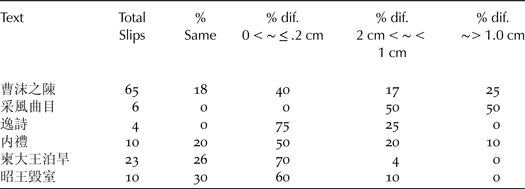
According to the initial study of the manuscript, found in volume 4 of the Shanghai Chu manuscript series, it consists of 65 bamboo slips—including 19 unbroken slips, 26 rejoined slips, and 20 un-rejoined fragments—making it one of the longest excavated texts to date.Footnote 9 The bamboo slips average 47.4 cm in length and 0.6 cm in width. They were originally bound together by three binding cords, likely made of hemp or silk, which have since deteriorated. Each complete slip typically contains between 32–34 graphs written in black ink in a calligraphic style similar to that found on Warring States Period Chu manuscripts discovered at archaeological sites such as Baoshan 包山 and Guodian郭店.Footnote 10 Due to the remarkable preservation of the manuscript and the quality of the calligraphy, we are able to distinguish a total of 1,778 individual graphs.Footnote 11 In addition to these graphs the manuscript contains several “diacritics” (biaodian fuhao 標點符號) dispersed throughout the text, also in black ink, which may serve as a range of possible reading aids, from marking a change in speaker to noting the duplication of a graph.Footnote 12
At some point in time the majority of the slips were broken in half about one graph length below the central binding marker. Thus, the deterioration of the binding cords and this large break running the full length of the manuscript left the modern editor with an immense task of rejoining the broken slips and then reordering the entire manuscript.Footnote 13 Li Ling, perhaps the foremost expert on Chinese military texts, provided the initial arrangement, transcription, and annotation. As with most other bamboo manuscripts, once Li Ling's version of Cao Mie's Battle Arrays was published there was a subsequent flurry of new reconfigurations offered by various scholars.Footnote 14 Yet, the bulk of these early rearrangements merely mix-and-match various half-slip fragments without any real radical divergence from the initial overarching sectional framework established by Li Ling. That being said, an excellent paleographic analysis and slip arrangement was published online by Chen Jian 陳劍 that corrected minor paleographic misinterpretations, contributed additional explication of graphs that Li Ling did not attempt to explain, and rearranged a few sections of the text.Footnote 15 Chen Jian's contributions are certainly helpful for reading the manuscript, and are especially important for understanding the intellectual scope of the text. Li Ling's original arrangement was predicated upon the assumption that the text contained two conceptually distinct topics: statecraft and warfare. Chen Jian's arrangement, however, reveals a textual style in which the discussion of political affairs and military affairs are interwoven, not bifurcated. Yet while Chen Jian's rearrangement certainly represents an advance in the study of this manuscript, it still contains certain flaws related to the accuracy of particular rejoinings, which overemphasize textual congruence without taking into consideration the materiality of the manuscript.
Building upon the work of Li Ling, Chen Jian, and others, a group of scholars headed by Gao Youren 高佑仁 produced a meticulous and comprehensive paleographic/codicological study of the manuscript.Footnote 16 The methodology employed in this newest arrangement resulted in a study that supersedes all previous analyses of the manuscript. In addition to very detailed paleographic explications, the study also rearranges the manuscript with a consciousness of the politico-military philosophical interplay embedded in Cao Mie's responses. More importantly, it does not rely solely on textual consistency as adequate evidence to support the rejoining of two broken slip fragments (as previous scholars did). The rejoining of slips is also based on a quantitative analysis of the length of the overall ‘rejoined’ slip in relation to the overall physical dimensions of the manuscript.Footnote 17 Such an analysis has corrected many mistakes of previous arrangements which focused less attention on the physical limitations of the bamboo slips. The importance of such a comprehensive approach can be illustrated with the following example drawn from the Cao Mie manuscript.
A common dilemma that the modern scholar of bamboo manuscripts must confront is the reliance on published photographs and context to formulate alternative arrangements, and a lack of access to the physical manuscript for determining whether or not its materiality supports such arrangements.Footnote 18 An example of this problem would be the much discussed rejoining of two fragments to form slip 8 of the Cao Mie manuscript and the possibility of whether or not the material features of the manuscript can warrant reconstruction of two separate graphs while maintaining a proper length to accord with the other slips.Footnote 19 Both Li Ling and Chen Jian believe that the two partially visible graphs should be reconstructed as yan [言] and wang [亡] and the slip should read as:
有大道焉必恭儉以得之而驕泰以失之君言亡以異於臣之言君弗盡∟臣聞之曰君
…contains the Grand Way. Certainly through reverence and austerity [one] obtains it, and through arrogance and excess [one] loses it. There is nothing in Milord's words which differs from your servant's words. Milord has not exhausted it. ∟ I have heard it said that, ‘When a lord…
In order for the above reconstruction to be plausible, one must spatially account for the addition of approximately 1.35 cm of length to complete the two graphs; that is, roughly 0.4 cm to complete the graph yan [言], of which 0.2 cm is visible and where other yan graphs in this manuscript average 0.6 cm; roughly 0.1 cm to complete the graph wang [亡], of which 0.3 cm of the graph is visible and where 0.4 cm is the average size of wang graphs in this manuscript; and finally where 0.85 cm of blank space between the graphs is the average for this particular slip. With this amount of space added to the extant fragments the rejoined slip would measure approximately 49.5 cm in length, which is 2.1 cm longer than the 47.4 cm average for the other slips. Furthermore, the binding markers on this slip would be greatly offset from others, making it difficult to bind the manuscript. Gao Youren seems to have resolved this issue by separating the slip and combining the upper fragment of slip 7 with the lower fragment of slip 8, which is physically possible and also fits the context.
…莊公曰昔池胉語寡人曰 [6] 君子得之失之天命∟今異於而言∟曹蔑曰 [7a] 亡以異於臣之言君弗盡∟臣聞之曰君 [8b]
…Duke Zhuang said, “In the past, Chi Bo informed this humble person, ‘Whether a junzi obtains it or loses it is mandated by Heaven.’ ∟ Now this differs from what you have said.” ∟ Cao Mie said, “There is nothing which differs from your servant's words. Milord has not exhausted it. ∟ I have heard it said that, ‘When a junzi…
This is but one example that serves to illustrate the necessity of careful scrutiny when dealing with publications of excavated manuscripts. In cases where it is difficult or impossible for the materiality of the manuscript to accommodate a desired reading an alternative solution should be sought.Footnote 20
The Text
Although the manuscript dates to the Warring States Period and is written in an orthography common to the kingdom of Chu, the text records two separate conversations that are purported to have occurred in the kingdom of Lu during the Spring and Autumn Period 春秋 (c. 770–453). Composed in a dialogic style similar to that of other Warring States Period texts, it depicts Duke Zhuang posing a series of questions to Cao Mie, who in turn responds to each question. I do agree with Li Ling's initial decision to divide the text into two parts based on the two dialogues; however, like Gao Youren and others, I do not consider this division to be necessarily representative of a topical dichotomy of civil/military content. Instead, I view the two dialogues as separate elements of a didactic strategy embedded within the overall discursive framework of the text. The initial conversation, which only accounts for about eleven slips, can be seen as a form of disquisition that explicates the ideological foundation or rationale for Cao Mie's promotion of positive personal action taken by the ruler, while the second, and longer, conversation examines in more detail the practical applications of the points laid out in the initial conversation. It is illustrated by the promotion of specific types of actions intermixed with warnings about inaction or improper actions. In this latter conversation, Cao Mie supports each element of his theory of action with several examples drawn from military, economic, and political contexts.
The topics covered in Cao Mie's Battle Arrays can roughly be divided into seven distinct, but interrelated subsections. Because I am not providing a full translation of the manuscript in this article, I briefly outline these subsections below.
Section 1
This is the entire first conversation and is comprised of the initial meeting in which Cao Mie attempts to convince Duke Zhuang of the causal relationship between actions taken by the ruler and the rise or fall of the kingdom. The duke is portrayed as being fully unaware of the consequences of his actions as he expends large amounts of resources for personal pleasure while the territory of Lu is gradually shrinking. After much debate between the two, it appears that Cao Mie succeeds in convincing the duke to reform his ways. Duke Zhuang ceases to live a lavish lifestyle and dedicates himself to good governance. This section lays the theoretical foundation for the entire text, emphasizing the efficacy of proper and timely action.
Section 2
This section opens with a discussion of methods used to prepare the kingdom for an offensive campaign, while simultaneously maintaining its defensive readiness in the event of retaliation. Duke Zhuang is planning to attack his rather formidable neighbor, the kingdom of Qi 齊, and asks Cao Mie to expound on battle arrays and fortifications. Interestingly, Cao Mie appears to deemphasize offensive operations by reversing the topical order in his response. That is, he provides a protracted discussion of preparations for fortification and siege defense, and when he finally comes to the topic of offense, he focuses on the preparedness of soldiers, the sharpness of their weapons, and the ability to overawe one's opponent into submission without actually going to battle. Again, it is the execution of proper actions at proper times which ensures the perpetuation of the kingdom.
Section 3
This section contains a detailed discussion of actions required to produce three socio-political conditions that must be met before a kingdom can conceivably launch a successful offensive campaign or effectively defend itself against an attack. The key to this section is the establishment of harmony (he 和) within the kingdom, armies, and individual battle arrays. To obtain harmony within the kingdom, the ruler must treat both the populace and his ministers with magnanimity and without bias. For the army and battle array, this notion of harmony is articulated from an organizational perspective. It becomes the ruler's duty to appoint capable leaders to command the forces and ensure that the battle arrays are properly formed. Establishing harmony in this manner will guarantee that orders and commands given on the battlefield are executed properly.
Section 4
This section contains a discussion of four particular opportune moments (ji 機) in which one army will be considerably disadvantaged vis-à-vis its enemy, and includes actions to be taken either to capitalize on one's enemy falling into such a situation or to avoid falling victim oneself. Central to this section is the appointment of a perspicacious commander capable of discerning what action is required and when it would be most advantageous to act.Footnote 21
Section 5
Four scenarios are depicted wherein an army has been defeated, or a stalemate occurs, and yet the ruler/general wishes to reengage the enemy. Cao Mie offers instruction as to actions the ruler/general can take to ensure his men will fight again. It must be noted that this section of the manuscript suffered the worst damage and it also appears that many slips are missing. Any attempt to decipher its meaning at this point is at best tentative.
Section 6
This very brief, and quite fragmented, section contains a discussion between Duke Zhuang and Cao Mie over the attributes associated with those rulers/commanders considered adept at both offensive operations and defensive measures. Even when discussing those adept at attacking, Cao Mie constantly reiterates the necessity for solid defensive preparations, including fortifications, physical barriers, and sufficient supplies.
Section 7
Cao Mie lists three social conditions (endearment, qin 親, harmony, he 和, and appropriateness, yi 義) that can only be obtained through positive action by the ruler, and which are essential for the preservation of the kingdom. The ruler must endear himself to the people by visibly acting on their behalf. This includes personally adjudicating the legal disputes of commoners and carefully considering all the evidence. The second condition is harmony and, as before, the ruler can ensure harmony by treating members of the populace as well as the ministers equally. The third condition requires the ruler to appoint people capable of properly administering others in such a way as to benefit both the ruler and the government.
Historical Context
As mentioned above, this manuscript has received very little attention since its first publication several years ago. The bulk of studies that do discuss the manuscript do so primarily from the perspective of paleographic analysis. That is, the manuscript of Cao Mie's Battle Arrays is valued more by early China specialists for its contribution to our understanding of the Chu script and language than for the potential of its textual content to expand our knowledge of Warring States political philosophy. This is perhaps either a reflection of a methodological tendency to disassociate texts labeled as ‘military’ from discussions of early Chinese statecraft, or a tendency of scholars with paleographic training to focus their attention on those excavated manuscripts that correlate more closely to well-known classics associated with Daoist or Confucian thought.Footnote 22
A close reading of Cao Mie's Battle Arrays, however, reveals that while some of the manuscript's contents certainly pertain to military strategy and tactics, the bulk of the text contains valuable theoretical discussions on methods of statecraft articulated from the perspective of a small kingdom. It is on the topic of statecraft that the manuscript's broader contribution to the intellectual milieu of the Eastern Zhou is most evident. This era saw the continued dwindling of Zhou-held centralized power over the various kingdoms, a marked escalation in inter-kingdom warfare, and the extermination of several individual kingdoms. Within the kingdoms, powerful ministerial families continually vied for greater power through various intrigues and palace coups resulting in a significant decrease in internal stability and an increase in external vulnerability. Texts attributed to ministers and philosophers of the era frequently articulate various methods of rulership capable of responding to the perils of either inter- or intra-kingdom instability, or sometimes to both.
Mirroring this tendency, Cao Mie's own instructions touch on inter-kingdom relations, civil-military relations, and domestic politics, and are designed to ensure the survival of smaller kingdoms surrounded by larger, more militarily-powerful kingdoms. Such methods would have been extremely valuable to a tiny and embattled kingdom such as Lu. A brief overview of the historical background of these conversations will enable us to contextualize the potential contributions of Cao Mie's theory of action from the perspective of smaller kingdoms.Footnote 23
Duke Zhuang, the third duke of the kingdom of Lu recorded in the Chun qiu 春秋, ruled for thirty-two years. During this time, Lu was by no means a large kingdom. It was precariously situated between larger neighbors, with Qi to the east, Yan 燕 to the north, and Chu 楚 to the south. Its shared border with the much larger and typically bellicose Qi meant that their affairs were often intertwined. During Duke Zhuang's reign, Qi's political power among the Zhou kingdoms continually grew and with the decline of the kingdom of Zheng 鄭, “Qi became the primary leader in the politics of the Zhou states.”Footnote 24 Furthermore, successive military campaigns, resulting in the annexation of many of its smaller neighbors, provided Qi with a vast territory and extensive resources. Therefore, Duke Zhuang was frequently confronted with political situations which, if they were to have escalated to warfare, could have potentially threatened the very existence of Lu.
Of the thirty-two years of Duke Zhuang's reign recorded in the Chun qiu and the Zuo zhuan 左傳, twenty-four years contain reference to interactions with the kingdom of Qi. The initial years were marked by amicable relations with records of various meetings between the rulers of both kingdoms, some joint military campaigns against other kingdoms, and even a joint hunting expedition. This amicability faded, however, when Duke Zhuang interfered with the internal affairs of Qi. In 686, the Qi ruler, Duke Xiang 齊襄公 (r. 697–686), was murdered by Wu Zhi 無知, leaving Qi without a ruler for many months.Footnote 25 In the following year, Duke Zhuang arrived in Qi with his armies in order to appoint his own chosen heir to rule Qi, yet he was too late, as another descendant, Xiao Bai 小白/齊桓公 (r. 685–643), had already taken up the post. Duke Zhuang's audacious move incited the first of several battles between the two kingdoms, which nevertheless ended in a humiliating defeat of the Lu armies at Ganshi 乾時 (685).Footnote 26 One year later, they once again met on the battlefield, this time at Changzhuo 長勺, and Lu successfully routed the Qi forces thanks to the tactical assistance of Cao Gui 曹劌 (a.k.a. Cao Mie).Footnote 27 During the thirteenth year of Duke Zhuang's reign (681), Lu and Qi initiated a covenant at Ke 柯, and with the exception of a brief conflict with Qi in the nineteenth year of Duke Zhuang's reign (674), relations between the two states remained relatively stable. This seems to be the result of Lu's efforts to mollify the increasingly powerful Qi ruler. Evidence for this can be found in the many instances recorded in the Chun qiu and Zuo Commentary where Duke Zhuang personally went to meet the Qi ruler, agreed to perform multiple covenants with Qi, and also agreed to marry a daughter of the Qi ruler in his twenty-fourth year (669).Footnote 28
Cao Gui (a.k.a. Cao Mie) plays a prominent role in two of the aforementioned incidents. His first appearance comes just before the battle of Changzhuo. After seeking an audience with the duke, Cao Gui proceeds to warn him of the dangers of going to battle without the support of the people. He instructs the duke of the proper actions to be made by a ruler on behalf of his people so as to gain their support. Successful execution of such actions are said to strengthen the kingdom internally, as well as provide a solid foundation for defense should an enemy attack. Duke Zhuang is not dissuaded from attacking Qi, so Cao Gui further asks to accompany the duke to the battlefield. Once there, Cao Gui's tactical decision-making aids the smaller Lu forces in routing the Qi troops.Footnote 29 Both the narrative progression and philosophical emphasis on the interconnectedness of political and military affairs of this passage are quite similar to what we find in the Cao Mie manuscript.
His second appearance in the Zuo zhuan also demonstrates his awareness of the consequences of improper action. In his twenty-third year, Duke Zhuang proceeds to the kingdom of Qi to witness the she 社 sacrifices.Footnote 30 Cao Gui remonstrates, stating that the ruler should not leave his kingdom, for such an action contravenes ritual-propriety (li 禮). He argues that “it is with ritual-propriety that the populace is ordered,” 夫禮所以整民 and goes on to list those actions deemed appropriate. If the ruler were to disregard such rules of conduct, then it would set a poor example to those below, as well as to the ruler's descendants.
In each of these two Zuo zhuan representations, Cao Gui is portrayed as calm, cautious, and wise, and his strength always lies in his ability to assess a given situation and discern the proper action required to bring about the most advantageous result when a small kingdom is confronted by a larger one.
There is, however, an alternative, more sinister portrayal of Cao Mie found in other received sources, such as the Lüshi chunqiu 呂氏春秋, Gongyang zhuan 公羊傳, Guanzi 管子, and Shi ji 史記, which depict him as less a sage and more a scoundrel. These texts contain an elaborated version of the covenant at Ke in which Cao Mie and Duke Zhuang rather unceremoniously seize Duke Huan of Qi at knife-point on the covenant altar and force him to return lands formerly held by Lu. Within this particular storyline, Cao Mie is characterized as being a poor military strategist, ill-tempered, and deceitful. Indeed, the polemics surrounding the attack on Duke Huan seem to have informed Sima Qian's decision to include Cao Mie's biography along with those of the “Assassin Retainers” in the Ci ke lie zhuan 刺客列傳.Footnote 31
Cao Mie is portrayed in the Cao Mie manuscript, however, as a wise minister and brilliant strategist. For each question posed by Duke Zhuang, Cao Mie responds with carefully crafted answers that evince a cautious and calculating mind. This is a far cry from the crafty and conniving minister noted in texts such as the Lüshi chunqiu or Shi ji. Indeed, the similarity of the character and actions attributed to the Cao Gui of the Zuo zhuan and the Cao Mie of the manuscript, in contrast to the negative portrayals of other texts, does suggest a potential polemic and/or source link between the two texts; however, given the materials currently available for analysis, it is impossible to definitively establish such a link. In what follows, I will translate sections of the manuscript dealing with Cao Mie's central theme of action/consequence and relate his theories of statecraft to those espoused by his contemporaries.
Cao Mie's Central Theme: The Peril and Promise of Action
Promoting the Efficacy of Action
The manuscript Cao Mie's Battle Arrays opens with an episode known from the received literature and often attributed to the text Shenzi 慎子. It is here that Cao Mie attempts to convince the duke that his personal actions do indeed have significant consequences for his kingdom.
魯莊公將為大鐘型既成矣曹蔑入見曰昔周室之邦魯∟東西七百南北五百非 【1】 山非澤亡有不民∟今邦彌 小而鐘愈大君亓圖之昔堯之饗舜也食於土塯欲(欱?)於土鉶 【2】 而撫有天下此不貧於媺而富於悳歟昔周… 【3】
Duke Zhuang of Lu prepared to make a large bell. Its mold had already been completed. Cao Mie entered the court and stated: ‘In earlier times, the Zhou house enfeoffed Lu ∟ east to west 700 [li] and north to south 500 [li].Footnote 32 Where there was not (1) a mountain and was not a marsh, no place was not populated.∟ Now the state is ever smaller, yet the bells are increasingly larger. Will milord please consider this?Footnote 33 In earlier times, Yao hosted Shun eating from earthen bowls and drinking from earthen pitchers (2) and soothed all under Heaven. This is a case of not lacking in beauty and being rich in virtue, is it not? In earlier times, the Zhou…(3)
The above text portrays the ruler as expending vast resources for the production of a massive bronze bell set, while the kingdom of Lu was shrinking and its population dwindling. Cao Mie used this opportunity to admonish the ruler by raising to the duke's attention the potential negative relationship between increasingly extravagant bell sets and the shrinking state lands. He asks the duke to consider this for himself, in hopes of leading the ruler into a self-realization of the potential consequences of his actions. To further emphasize his point, as well as offer a positive alternative, Cao Mie utilizes a historical example by evoking images of the sage king Yao, a paragon of virtue and wise rule, who was able to serve Shun with humble earthenware bowls and pitchers, yet still maintain control over tianxia. In doing this, Cao Mie has created the initial link between personal action and the kingdom by illustrating the way in which selfish aims of the ruler can potentially lead to loss of lands and population, while frugality or selflessness can aid in their maintenance.
Duke Zhuang, however, seems to doubt this logic and presses Cao Mie by posing the question “Now, the junzi of the world being able to know this, who then could annex/take other's people?” ⋯莊公曰【41】 今天下之君子既可知已孰能幷兼人 【4】 哉⋯【5 partial】. The duke seems to take Cao Mie quite literally, and by shifting the focus away from mere maintenance of the kingdom to actually increasing the population, he has attempted to show the logical impossibility of population growth by incorporation of neighboring lands and people vis-à-vis Cao Mie's formula. Indeed, the duke's argument points out that if all junzi would similarly rule their kingdom in the manner Cao Mie described, then neither side would be capable of increasing the size of their population. Whereas the actions criticized in the opening lines were related to the ruler's own person, here Cao Mie illustrates how the appropriate actions, carried out for the betterment of the government and populace, can provide a foundation for population growth.
…臣聞之曰鄰邦之君明則不可以不修政而善於民不然任亡焉【5 partial】 鄰邦之君亡道則亦不可以不修政而善於民不然亡以取之… 【6 partial】
…Your humble servant has heard it said that, ‘If the lord of a neighboring kingdom is enlightened, then one cannot not improve the government and do well towards the populace. To do otherwise would encourage desertion from it [i.e., the kingdom]. (5) If the lord of the neighboring kingdom is without the Way, then one still cannot not ameliorate the government and do well towards the populace. To do otherwise one would lack the means to obtain/take them.” (6)
Again, Cao Mie argues through juxtaposed examples for the necessity of action on the ruler's part, as well as cautions against the dangers of inaction, by demonstrating the potential causal relationship between action and the increase or decrease of the population. Central to this argument is the requirement of continual betterment of his government and people. Cao Mie emphasizes this necessity on two levels. First, he extends the link between the ruler's actions and the condition of the kingdom by shifting the target of the actions away from the ruler's own person and towards the government and people. Whereas the previous link concerned merely the selfish nature of an action, here the utility of appropriate action by the ruler is illustrated by claiming that if such actions are aimed outward towards the government and the populace, the ruler will create the potential for population growth. In doing this, Cao Mie provides a framework through which the duke can prevent his current residents from fleeing, while simultaneously creating an inviting kingdom for those living in other kingdoms with bad rulers.
Second, Cao Mie preempts rebuttals predicated upon the personal character of the rulers in neighboring kingdoms that would call into question the necessity of continual action for improvement of the government and the people. For Cao Mie such continual action is necessary irrespective of whether neighboring rulers are good or bad. When confronted with an enlightened neighboring ruler, Duke Zhuang's failure to act to improve the government and the lives of the populace would practically ensure the flight of his own people to that enlightened neighbor. This demonstrates for the duke both the power of appropriate action to increase the population and the dangers of inaction. Concomitantly, inaction on the part of Duke Zhuang when bordered by a ruler who is ‘without the way,’ would preclude the possibility that the people of this neighboring kingdom would be enticed to immigrate since there is no visible evidence that the other ruler is any better than their own.
Duke Zhuang does not desist, however, and argues against the causal link between a ruler's actions and the population as advocated by Cao Mie. In doing so, he quotes Chi Bo, a contemporary of Cao Mie known from references in the Guo yu 國語 and also an advisor to the duke.
⋯莊公曰昔池胉語寡人曰 【6 partial】君子得之失之天命∟今異於而言∟⋯【7 partial】
Duke Zhuang said, “Previously, Chi BoFootnote 34 informed this deficient person saying (6) ‘Whether a junzi obtains them or loses them is mandated by Heaven.’ ∟ Now this differs from your words.” ∟ (7)
Thus we find the potential source of Duke Zhuang's ambivalent attitude towards the consequences of his actions. He appears to have interpreted the argument previously put forth by his minister Chi Bo in a way that completely absolves him, Zhuang, of any fault related to the decline of his state as a consequence of his own actions, and instead completely relegates the flux of a population and the condition of his kingdom to the caprice of Heaven. Yet Cao Mie quickly rebuts this, stating:
…曹蔑曰【7a partial】亡以異於臣之言君弗盡∟臣聞之曰君 【8b】子以賢稱而失之天命∟以亡道稱而沒身就死亦天命不然君子以賢稱害有弗 【9】得以亡道稱 害有弗失∟… 【10 partial】
Cao Mie said, (7a) “There is nothing that differs from your servant's words. Milord has not exhausted it. ∟ I have heard it said that, ‘When a junzi (8b) is said to be worthy, yet loses it, [it] is mandated by Heaven. ∟ When [a junzi] is said to be without the Way, yet lives a full life before dying, [it] is also mandated by Heaven. If it were not so, how else could a junzi said to be worthy not (9) obtain it and [one] said to have lost the Way not lose it?” ∟ (10)
This final argument seems to be enough for the duke who quickly responds:
⋯曼才哉吾聞此言∟乃命毀鐘型而聼邦政不晝 【10 partial】 ⋯寢 不酓= (酓酒)不聼樂居不褻文食不貳羹【11】 □□□□□□□□□□ 兼愛萬民而亡有私也⋯[12 partial]
“Excellent! I hear (and shall follow) these words.” ∟ Thereafter, he ordered the destruction of the bell mold and attended to the state's government. [He] did not nap in daytime,(10) nor drink wine=or listen to music. When residing, he did not indulge in refinement. When eating, he did not [require] two gruels (11)…missing…he cherished the myriad people and did not have any selfishness.(12)
In many ways, the initial arguments put forth above by Cao Mie are quite similar to those contained in other Warring States period texts that touch on issues of statecraft and rulership. Such similarities belie the view that the Cao Mie manuscript is merely a military text. For example, Cao Mie's concerns over Duke Zhuang's extravagant lifestyle are mirrored in sections of the Daode jing 道德經which proffer advice to would be sage-rulers urging frugality and simplicity. Chapter 59 states that “In administering others and attending to Heaven, nothing compares to parsimony” 治人事天莫若嗇.Footnote 35 Likewise, of the three treasured attributes of a ruler advocated by Laozi in Chapter 67, the second is frugality (jian 儉).Footnote 36
Interestingly, however, it is the arguments against fatalism laid out in the Mozi 墨子 which most closely resonate with the opening dialogue of the Cao Mie manuscript. The three chapters collectively titled “Against Fate” 非命 contain a systematic critique of rulers and ministers who absolve themselves from any responsibility for their actions by claiming that all outcomes are predetermined by fate. For Mozi, fatalists are those who say:
“If prosperity is fated, then there will be prosperity; if poverty is fated, then there will be poverty; if multitudes are fated, then there will be multitudes; if few are fated, then there will be few; if order is fated, then there will be order; if chaos is fated, then there will be chaos; if longevity is fated, then there will be longevity; if an early death is fated, then there will be an early death. Fate, although one might be stout and resilient, what benefit is there?”Footnote 37
These statements are strikingly similar to the argument advanced above by Chi Bo when he informed Duke Zhuang that the survival or demise of a kingdom is determined solely by Heaven. Mozi, like Cao Mie, warns that such fatalistic beliefs are detrimental to the proper administration of government and the well-being of society. Drawing upon specific historical personages as evidence of a causal link between a ruler's actions and the wellbeing of kingdom, Mozi states that “The orderliness of all under Heaven resulted from the efforts of Tang and Wu. The chaos of all under Heaven resulted from the sins of Jie and Zhou. If one were to view this, then peace, peril, orderliness, and chaos exist within the government of those above. Therefore, how is it possible to claim there is Fate?”Footnote 38 For both Mozi and Cao Mie, the survival or demise of a kingdom is inextricably linked to the quality of actions taken by the ruler.
From Theory to Praxis
Having impressed upon Duke Zhuang the efficacy of personal action, Cao Mie retires only to be recalled by the duke in the following year in order to offer advice on a proposed military offensive against the kingdom of Qi. This meeting is represented by the second, longer dialogue, and it is here that Cao Mie reiterates the necessity of proper action by the ruler and goes further to offer specific examples, both military and civil, which illustrate both the perils and promise of action. Below I will analyze five such examples.
DEFLECTING AN OFFENSIVE SUGGESTION
還年而問於曹【12】蔑曰吾欲與齊戰問陳奚如守邊城奚如曹蔑答曰臣聞之有固謀而亡固城【13】 有克政而亡克陳三代之陳皆廌(存)或以克或以亡且臣聞之小邦處大邦之閒敵邦 【14】 交地不可以先作怨疆地毋先而必取□焉所以拒邊∟毋愛貨資子女以事亓 【17】 便嬖所以拒內城郭必修繕甲利兵必有戰心以守所以爲長也【18 partial】
The following year [Duke Zhuang] asked of Cao (12) Mie saying: “I desire to go to war with Qi. Let me hear how to array for battle, and how to defend borders and citadels.” Cao Mie replied, “Your humble servant has heard that there are secure plans, yet there are no secure citadels; (13) there is a government that is able to conquer, but there is not a battle array that is able to conquer. The battle arrays of the three dynasties all survive. At times they were a means to conquer; at times they were a means to perish. Furthermore, your humble servant has heard that when a lesser kingdom is positioned between greater kingdoms and the enemy kingdom (14) shares borders, [one] cannot first provoke enmity. The demarcation of borders ought not precede, yet must seize…missing... It is through this that one can defend/resist at the borders. ∟ [One] ought not to be stingy with material goods or men and women and employ [them] to serve their [i.e. the enemy's] (17) favored ministers. It is through this that one can resist internally. The city walls must be repaired. Mend the armor, and sharpen the weapons. There must be a battle-oriented mind in order to defend. It is this that is considered paramount. (18)
It is interesting that Cao Mie offers a rather ambivalent response to the question of battle arrays, from which we may infer a silent admonition of, or reluctance to support, a proposed offensive campaign against a strong neighbor that could potentially place Lu into a disastrous situation. Cao Mie subtly critiques this aggressive approach by pointing out that while battle plans are easily made, the proper defense of a city is more difficult. Furthermore, he alludes to the fact that a kingdom is not truly conquered by a battle array, but that it is the strength of the government which is paramount. Again drawing on historical examples, Cao Mie attempts to illustrate Duke Zhuang's misplaced confidence in battle arrays. He notes that while the battle arrays (likely, military tactics) of previous dynasties Xia, Shang, and Zhou are still known, one should be aware that they were employed with varied success. Despite the quality of their battle arrays, each of these dynasties eventually fell as a result of poor leadership and ineffective government policies. The point being made here is that the value of a formerly successful battle array is significantly less than the value of good governance. The successful deployment of a battle array is, therefore, always dependent upon the quality of the government that deploys it.
He thus focuses the attention away from offensive strategies—even going so far as to opine that a small kingdom should not antagonize a larger neighbor—and advocates pursuing policies of a more defensive, internal nature. Cao Mie particularly specifies that these policies require specific actions from the duke in order to be successful. Among these are logistical policies related to defensive structures and armaments required to properly defend the city. Cao Mie also argues for espionage and psychological measures such as bribing the high-ranking ministers of one's enemy, and also ensuring that the people of the city are all mentally prepared and dedicated to defending the city.
Although one can argue that this particular section is primarily of a military nature, it nevertheless clearly links military success to good domestic governance. The subsequent section even more clearly illustrates the commingling of issues of good governance and warfare in early politico-military texts.
PROMOTING HARMONY
且臣之聞之不和【18 partial】於邦不可以出豫不和於豫(舍)不可以出陳不和於陳不可以戰是故夫陳者三教之【19】末君必不已則由亓本虖莊公曰爲和於邦如之何曹蔑答曰毋獲民時毋奪民利【20】紳功而食刑罰有辠而賞爵有悳凡畜羣臣貴賤同等祿毋倍詩於有之曰豈【21】弟君子民之父母此所以為和於邦∟莊公曰為和於豫(舍)如何曹蔑曰三軍出君自率【22】必有二將軍無將軍必有數獄夫=(大夫)無嬖夫=(大夫) 必有數大官之師公孫公子凡有司 率長【25】□□□□□□□□□□□□□□ 期會之不難所以為和於豫(舍)莊公或問【23b】為和於陳如何答曰車閒容俉= (伍,伍)閒容兵貴【24a】
Furthermore, I have heard that when there is discord (18) within the kingdom, then one cannot dispatch the forces.Footnote 39 When there is discord within the forces, then one cannot deploy the battle formations. When there is discord within the battle formations, then one cannot do battle.Footnote 40 Therefore, it is the battle formation which is the tip of the three teachings [i.e. of least consequence]. (19) If milord necessarily will not desist, then should he not proceed from the root? Duke Zhuang asked: “To create harmony within the kingdom, what is this like?” Cao Mie replied, “[One] ought not misappropriate the people's time, nor seize the people's profits. (20) Extend merit and feed. Punish and fine the guilty. Reward and ennoble the virtuous. In general, ministers of high and low rank under one's care should be equally treated and their emoluments ought not be doubled. Within the Odes it has this: “How (21) happy is the junzi, mother and father of the populace.’ It is through this that one creates harmony within the kingdom.” ∟ Duke Zhuang said, “How does one create harmony within the forces?” Cao Mie said, “When the three armies are deployed, the ruler personally commands. (22) One must have two generals. If one does not have generals, then one must have several penal grandees.=If one does not have lesser grandee,Footnote 41=then one must have several captains of the Grand Official and noble grandsons and sons. In general, the officers command sergeants…missing text…(25)…missing text… A lack of difficulty at the time of deployment is the means to create harmony within the forces.” Duke Zhuang further inquired, (23b) “How does one create harmony within the battle array?” [Cao Mie] replied, “Amongst the chariot [units] there are squads [of foot soldiers]; amongst the squads=are the weapons…missing text…(24a)
From the above portions of text we see that when Cao Mie finally turns to the issue of battle arrays, he does not directly address the issue. Instead, he attempts once again to draw the duke's attention to issues internal to the kingdom of Lu. In Cao Mie's proposed hierarchical trichotomy of harmony, he deemphasizes the battle array by considering it the least significant of the three, and instead attempts to convince the duke that stability and harmony are the foundations (or roots) through which one can muster a successful army and then deploy that army successfully. Cao Mie names several actions crucial to gaining and maintaining harmony at the levels of kingdom, military, and battle array. For the kingdom, these actions involve dealing with the population on two levels. On the first level, the ruler needs to be respectful of the time-requirements of the general populace. This is likely a warning not to require services at times that disrupt seasonal activities such as the planting or harvesting of crops. The ruler must also refrain from seizing too much of the people's profits. Overburdening the population with taxation (possibly on harvest produce) and leaving them with little to survive on would likely result in an increased hostility toward the government and a decrease in defensive efficiency. Furthermore, the ruler should make a public display of good governing techniques by ensuring that the people have plenty to eat, that good deeds are visibly rewarded and bad deeds openly punished. These actions will in turn promote a sense of increased social wellbeing and engender a willingness to fight in defense of the kingdom. On the second level, the ruler should deal with the bureaucracy and aristocracy in a manner which promotes harmony, likely understood as creating an environment not overly conducive of competition which could threaten the stability of the government.
As for the military forces, Cao Mie seems to understand harmony as the result of good organization and the promotion of good leadership, which precludes the possibility of chaos when preparing for battle and therefore is the keystone to successful campaigns. Interestingly, Cao Mie recommends that the ruler personally command the three armies. When taken with the following line, this implies that the ruler should retain supreme command of all the forces as well as personal command of the central forces, while two generals command the flanking armies. Harmony arises when the hierarchy of command is firmly established.
Unfortunately, the section dealing specifically with the battle array is heavily damaged and it is difficult to reconstruct. From what remains, it is possible that the focus of this section, like the previous one, promoted proper organization of the battle array so as to ensure the appropriate battle field conduct.
THREE NECESSARY QUALITIES OF GOOD RULE
…使人不親則不敦不和則不輯不義則不服莊公曰為親如【33 partial】何答曰君毋憚自勞以觀卡(上下)之情偽匹夫寡婦之獄訟君必身聼之有知不足亡所【34】不中則民親之莊公或聞為和如何答曰毋嬖於便嬖毋長於父兄賞均聼中則民【35】和之莊公或問為義如何答曰紳功尚賢能治百人使長百人能治三軍思率【36】又知舍有能則民宜之且臣聞之卒有長三軍有率邦有君此三者所以戰∟是故長【28】
…If in deploying others one is not endearing, then they will not be constant; if one is not harmonious, then they will not be unified; if one is not proper, then they will not submit. Duke Zhuang said, “How does one act endearing?”(33 partial) [Cao Mie] replied, “The ruler ought not fear personally laboring to observe the truth and perfidy of those above and below. The ruler must personally adjudicate the suits of the common man and single woman. When there is insufficient knowledge to never (34) not take the middle course, thus the people see him as endearing.” Duke Zhuang further asked, “How does one act harmoniously?” [Cao Mie] replied, “[The ruler] ought not pander to favored ministers; ought not assume precedence over father and elder brother. His rewards are measured, and adjudications are centered. Thus the people (35) see him as harmonizing. Duke Zhuang further asked, “How does one act justly?” [Cao Mie] replied, “Extend merit and esteem worthiness. Those able to administer 100 people, cause them to lead 100 people. Those able to administer the three armies, consider them to command (36) [those] with intelligence, give shelter to those with ability; thus the populace conformsFootnote 42 to him. Further, your humble servant has heard that, the company has a leader, the three armies have a commander, and the kingdom has a ruler. It is these three with which one goes to war.=Therefore, the leaders…(28)
In the previous section, Cao Mie lists three harmonious social conditions that must be met in order to increase a small kingdom's probability of survival, and he also provides examples of actions to be taken by the ruler that will bring about such desired conditions. The present passage lists three negative conditions and their negative consequences for the stability of the kingdom. In keeping with his central theme of action, Cao Mie directly and causally links the production of these negative conditions with specific actions taken by the kingdom's ruler. Interestingly, he does this by offering a program of positive action that will stave off societal devolution into these undesirable conditions with the implication that non-action or non-conformity to these practices will provoke the negative conditions mentioned earlier.
The first program of action is to produce a familial sense within society to combat its undesirable opposite, a lack of social constancy. The ruler can induce this familial sense through actions designed to bring him into close contact with the common people and showing himself as concerned with their wellbeing. Many of these actions relate to the legal realm, particularly proper application of adjudicatory principles. For Cao Mie, an outgrowth of the ruler properly applying laws and visibly working for his people is the production of social stability. The second program of action requires the production of harmony, which will stave off disunity. Here, Cao Mie's required actions are, of course, very similar to those actions related to creating the harmony in the kingdom mentioned in the above section on “Promoting Harmony.” Proper actions are designed to maintain equal treatment of ministers, thus producing bureaucratic/administrative harmony; observe the proper familial hierarchy, thus preserving traditional family structures; and produce just rewards and deserving punishments. Thus, Cao Mie sees the production of harmony within the governmental and social spheres as directly contributing to the increased sense of unity among the populace. The final course of action is designed to create a consensus that the ruler's actions are just, and primarily concerns the appointment of officials. This makes sense when considering the fact that Cao Mie links the social acknowledgement of just action with the willingness of the populace to submit to the ruler's authority. If the ruler were to appoint unqualified and inept administrative personnel on the basis of nepotism or favoritism and not merit, then Cao Mie fears that the population will question the legitimacy of the ruler's actions, as well as his right to rule. From this passage, it is clear that Cao Mie is consistent in directly linking the fate of a kingdom with the actions of its ruler.
PROPER ACTION IN MILITARY CONTEXT
To this point I have emphasized the non-military examples utilized by Cao Mie to contextualize his theory of action. I have purposively done this to illustrate the value of the text as a political document capable of informing the decisions of a ruler regarding his everyday activities and actions related to state affairs. Yet, because I label this manuscript a politico-military text, I would be remiss were I to focus solely on the political content and not include some examples from those sections of the manuscript that deal with military affairs. As will be seen below, the content and structure of these examples are carefully crafted to conform to Cao Mie's overall theory of action. In each, the actions of a ruler are directly and causally linked to subsequent events, especially the success or failure of various forms of military engagement.
The first example comes from a section of the manuscript that modern editors label “Opportune Moments.” Because the kingdom of Lu was quite small compared to its bellicose neighbors, Cao Mie is noted for frequently discouraging the offensive military operations that Duke Zhuang desired. Yet, understanding that the duke would not be dissuaded on all occasions, in this manuscript Cao Mie offers military advice stressing the quick and decisive exploitation of four strategically advantageous situations, typically emerging from poor decision-making on the part of enemy commanders or rulers.
Interestingly, this section can be read from two strategic perspectives. The first is a direct reading wherein Cao Mie advises Duke Zhuang of four key situations in which his forces will command a potentially advantageous position vis-à-vis an enemy force. The second way is to read the text as a warning to Duke Zhuang not to make the same mistakes as the enemy leaders described by Cao Mie lest his own forces find themselves in a strategically disadvantaged position due to the poor actions of their ruler/commander.
⋯莊公曰既成教矣出師有機虖答曰有臣聞之三軍出【40 partial】 亓將卑父兄不廌(存)由邦御之此出師之機 ⋯【42 partial】
…Duke Zhuang said: “… Are there opportune moments for the forces to be deployed?” [Cao Mie] replied: “There are. Your humble servant has heard that when the three [enemy] armies are deployed, (40) if their general is inferior; [his] father and elder brother are not living;Footnote 43 or the government manipulates him, these are the opportune moments for the deployment of [our] forces. (42)
The theory of action advocated by Cao Mie in the first example can be divided into two parts. The first action concerns the selection of proper military leaders. An opportune moment for sending out one's forces arises when the enemy ruler selects a commanding officer who is inferior. Such an officer, whether hindered by inexperience or ineptitude, will not necessarily make proper strategic or tactical decisions on the battlefield. Likewise, if the commander's father and elder brother are both deceased, then as the oldest male in the family the responsibilities for maintaining the family sacrifices and perpetuating the family name will be his. The psychological implications of this position would certainly affect the tactical decisions of the commander who might be more hesitant or less adventurous in battle. Finally, a ruler who constantly manipulates a commander after the campaign risks placing his forces at a serious disadvantage. The dangers of such manipulation are frequently cited in other politico-military texts, such as the Sun Bin bingfa and the Liu tao. Both advocate the necessity of a military policy wherein the ruler invests total control of the military to his selected commander, after which he does not further intrude in military planning or operations.Footnote 44 To do so would undermine the appointed commander's authority. Further, for the ruler, sitting in his own court away from the battlefield, to alter aspects of a commander's military plans would severely limit the effectiveness of an overall strategy and potentially throw the armies into chaos. Though the qualifications and actions of the commander are the focus in this example, the actual blame for the situation is not solely placed on the commander's shoulders, but is instead directed at the initial act of selection executed by the ruler and any actions taken once the selection process is finalized.
ACTIONS TO COPE WITH DEFEAT
The final example comes from the section of the manuscript that suffered the greatest damage and contains the largest number of textual lacunae. We are able to ascertain that Cao Mie and Duke Zhuang discuss ‘the ways’ of three types of battles. Unfortunately, paleographic problems and the damage to the manuscript greatly complicate our understanding of what these battle types are and what methods Cao Mie prescribes for them. Below I offer the most complete portion of this section dealing with the way to recover from a serious defeat. Like the other sections of the manuscript, this example also clearly illustrates the importance of proper action, as well as the consequences of negative actions.
公或問曰復敗戰有道虖答曰有三軍大敗【46a】[死]者收之傷者問之善於死者為生者∟君【47】乃自過以悅於萬民,弗□危地,毋火食【63】□□□□□□□□□□□□□□毋誅而賞毋辠百姓而改亓將君如親率 【27】必聚羣有司而告之二斯三子勉之過不在子在【23a】寡人吾戰敵不順於天命,返師將復戰【51b】
Duke [Zhuang] further inquired stating: “Is there a way to reengage after a defeat in battle? [Cao Mie] replied saying, “There is. When the three armies have been greatly defeated (46a) [the dead]Footnote 45 should be recovered and the wounded inquired about. Show compassion for the dead for the benefit of the living. ∟ The lord (47) therefore, blames himself in order to placate the ten-thousand people. [He] does not venture into dangerous locales, and ought not eat warm food. (63)…[missing text]…ought not punish, but reward. Ought not censure the hundred-names, but change their general. If the ruler personally commanded (27) he must convene the group of officers and proclaim to them, ‘You all encouraged them! Fault is not with you, but with (23a) this humble person. Our battle with the enemy did not accord with Heaven's will. Go back to the troops and prepare to return to battle. (51b)
In this passage, Duke Zhuang inquires about the types of actions that will allow an army to return to battle after being seriously defeated. A ruler in such a situation would most likely find many of his troops dead on the battlefield, many more severely injured, and all those still capable of fighting painfully demoralized. For Cao Mie, the issue of morale is the key to returning to battle, and the restoration of troop morale is dependent upon the ruler's actions. In the present passage, Cao Mie states that morale can be restored by showing compassion for the living and the dead. Furthermore, the ruler should put forth an image of austerity and humbleness by not consuming lavish meals that the defeated troops would certainly not share. Cao Mie also urges the ruler not to blame officers or soldiers for the loss, but to blame himself. As the commander of the forces, the ruler must accept that the result of the initial battle was primarily the consequence of his own decisions and actions.
Similar to arguments made by other ministers and philosophers of the Eastern Zhou, Cao Mie's theory of action continually links specific actions in certain contexts to their consequences. In doing so, he prescribes a series of actions (civil and military) through which a ruler can not only protect his kingdom from extermination/annexation at the hands of another kingdom, but can also increase his kingdom's population.
Conclusion
The potential contributions of Cao Mie's Battle Arrays to the fields of early Chinese intellectual and military history are numerous and exciting. As China's oldest extant politico-military treatise, it provides the scholarly world with its first contemporary manuscript copy of a text discussing one of the most prevalent socio-political issues of the aptly named Warring States period, namely warfare. It allows the genre of politico-military writings to enter into modern debates over the role of excavated manuscripts as sources for our understanding of the intellectual milieu of pre-Qin China. From a military perspective, we can now compare and contrast the strategic and tactical insights contained in received texts, such as the Sunzi bingfa, Wuzi, and Liu tao, with the responses Cao Mie offers to Duke Zhuang's questions. Yet more than that, the present article has shown that despite its ‘martial’ title and strategic/tactical contents, the text also furthers our knowledge of early Chinese political philosophy by theorizing solutions to many of the most prevalent issues of statecraft debated by various pre-Qin philosophers, including Laozi and Mozi. Furthermore, its theories of statecraft are articulated from the unique perspective of a small kingdom. The political methods outlined in the text are designed for small kingdoms, where the ruler is struggling to maintain his kingdom's territorial integrity and his own sovereignty within an unstable and bellicose geo-political realm. For Cao Mie, the solution to such problems, and indeed the very fate of a kingdom, does not originate in offensive military campaigns, but instead depends solely on the ruler's capacity to perform specific actions designed to insure internal stability, social cohesion, and defensive preparedness. He warns that overly belligerent inter-kingdom policies will not necessarily meet with military success, and will more likely have catastrophic results. Military action should be defensive at best, or counter-offensive as a last resort. It is better to produce an internal environment in which the population is well cared for, the government is acknowledged as being well administered, and the ruler is recognized as just and caring. Within such a kingdom, the people will be united and willing to defend their territory. It is quite clear that Cao Mie's Battle Arrays provides ample research opportunities for broadening our understanding of the relationship between politics and warfare, the nature of action, and role of the ruler in early Chinese thought. This article is not intended to resolve all the paleographic, historical, or textual issues associated with this manuscript or to thoroughly analyze each and every example contained therein. It is simply my hope that this short introduction has kindled some interest in the manuscript's contents, and how they contribute to greater debates concerning early Chinese thought.