




%20--%3e%3c!DOCTYPE%20svg%20PUBLIC%20'-//W3C//DTD%20SVG%201.0//EN'%20'http://www.w3.org/TR/2001/REC-SVG-20010904/DTD/svg10.dtd'%3e%3csvg%20version='1.0'%20id='Layer_1'%20xmlns='http://www.w3.org/2000/svg'%20xmlns:xlink='http://www.w3.org/1999/xlink'%20x='0px'%20y='0px'%20width='64px'%20height='64px'%20viewBox='5.5%20-3.5%2064%2064'%20enable-background='new%205.5%20-3.5%2064%2064'%20xml:space='preserve'%3e%3cg%3e%3ccircle%20fill='%23FFFFFF'%20fill-opacity='0'%20cx='37.785'%20cy='28.501'%20r='28.836'/%3e%3cpath%20fill='%23595959'%20d='M37.441-3.5c8.951,0,16.572,3.125,22.857,9.372c3.008,3.009,5.295,6.448,6.857,10.314%20c1.561,3.867,2.344,7.971,2.344,12.314c0,4.381-0.773,8.486-2.314,12.313c-1.543,3.828-3.82,7.21-6.828,10.143%20c-3.123,3.085-6.666,5.448-10.629,7.086c-3.961,1.638-8.057,2.457-12.285,2.457s-8.276-0.808-12.143-2.429%20c-3.866-1.618-7.333-3.961-10.4-7.027c-3.067-3.066-5.4-6.524-7-10.372S5.5,32.767,5.5,28.5c0-4.229,0.809-8.295,2.428-12.2%20c1.619-3.905,3.972-7.4,7.057-10.486C21.08-0.394,28.565-3.5,37.441-3.5z%20M37.557,2.272c-7.314,0-13.467,2.553-18.458,7.657%20c-2.515,2.553-4.448,5.419-5.8,8.6c-1.354,3.181-2.029,6.505-2.029,9.972c0,3.429,0.675,6.734,2.029,9.913%20c1.353,3.183,3.285,6.021,5.8,8.516c2.514,2.496,5.351,4.399,8.515,5.715c3.161,1.314,6.476,1.971,9.943,1.971%20c3.428,0,6.75-0.665,9.973-1.999c3.219-1.335,6.121-3.257,8.713-5.771c4.99-4.876,7.484-10.99,7.484-18.344%20c0-3.543-0.648-6.895-1.943-10.057c-1.293-3.162-3.18-5.98-5.654-8.458C50.984,4.844,44.795,2.272,37.557,2.272z%20M37.156,23.187%20l-4.287,2.229c-0.458-0.951-1.019-1.619-1.685-2c-0.667-0.38-1.286-0.571-1.858-0.571c-2.856,0-4.286,1.885-4.286,5.657%20c0,1.714,0.362,3.084,1.085,4.113c0.724,1.029,1.791,1.544,3.201,1.544c1.867,0,3.181-0.915,3.944-2.743l3.942,2%20c-0.838,1.563-2,2.791-3.486,3.686c-1.484,0.896-3.123,1.343-4.914,1.343c-2.857,0-5.163-0.875-6.915-2.629%20c-1.752-1.752-2.628-4.19-2.628-7.313c0-3.048,0.886-5.466,2.657-7.257c1.771-1.79,4.009-2.686,6.715-2.686%20C32.604,18.558,35.441,20.101,37.156,23.187z%20M55.613,23.187l-4.229,2.229c-0.457-0.951-1.02-1.619-1.686-2%20c-0.668-0.38-1.307-0.571-1.914-0.571c-2.857,0-4.287,1.885-4.287,5.657c0,1.714,0.363,3.084,1.086,4.113%20c0.723,1.029,1.789,1.544,3.201,1.544c1.865,0,3.18-0.915,3.941-2.743l4,2c-0.875,1.563-2.057,2.791-3.541,3.686%20c-1.486,0.896-3.105,1.343-4.857,1.343c-2.896,0-5.209-0.875-6.941-2.629c-1.736-1.752-2.602-4.19-2.602-7.313%20c0-3.048,0.885-5.466,2.658-7.257c1.77-1.79,4.008-2.686,6.713-2.686C51.117,18.558,53.938,20.101,55.613,23.187z'/%3e%3c/g%3e%3c/svg%3e)
%20--%3e%3c!DOCTYPE%20svg%20PUBLIC%20'-//W3C//DTD%20SVG%201.0//EN'%20'http://www.w3.org/TR/2001/REC-SVG-20010904/DTD/svg10.dtd'%3e%3csvg%20version='1.0'%20id='Layer_1'%20xmlns='http://www.w3.org/2000/svg'%20xmlns:xlink='http://www.w3.org/1999/xlink'%20x='0px'%20y='0px'%20width='64px'%20height='64px'%20viewBox='5.5%20-3.5%2064%2064'%20enable-background='new%205.5%20-3.5%2064%2064'%20xml:space='preserve'%3e%3cg%3e%3ccircle%20fill='%23FFFFFF'%20fill-opacity='0'%20cx='37.637'%20cy='28.806'%20r='28.276'/%3e%3cg%3e%3cpath%20fill='%23595959'%20d='M37.443-3.5c8.988,0,16.57,3.085,22.742,9.257C66.393,11.967,69.5,19.548,69.5,28.5c0,8.991-3.049,16.476-9.145,22.456%20C53.879,57.319,46.242,60.5,37.443,60.5c-8.649,0-16.153-3.144-22.514-9.43C8.644,44.784,5.5,37.262,5.5,28.5%20c0-8.761,3.144-16.342,9.429-22.742C21.101-0.415,28.604-3.5,37.443-3.5z%20M37.557,2.272c-7.276,0-13.428,2.553-18.457,7.657%20c-5.22,5.334-7.829,11.525-7.829,18.572c0,7.086,2.59,13.22,7.77,18.398c5.181,5.182,11.352,7.771,18.514,7.771%20c7.123,0,13.334-2.607,18.629-7.828c5.029-4.838,7.543-10.952,7.543-18.343c0-7.276-2.553-13.465-7.656-18.571%20C50.967,4.824,44.795,2.272,37.557,2.272z%20M46.129,20.557v13.085h-3.656v15.542h-9.944V33.643h-3.656V20.557%20c0-0.572,0.2-1.057,0.599-1.457c0.401-0.399,0.887-0.6,1.457-0.6h13.144c0.533,0,1.01,0.2,1.428,0.6%20C45.918,19.5,46.129,19.986,46.129,20.557z%20M33.042,12.329c0-3.008,1.485-4.514,4.458-4.514s4.457,1.504,4.457,4.514%20c0,2.971-1.486,4.457-4.457,4.457S33.042,15.3,33.042,12.329z'/%3e%3c/g%3e%3c/g%3e%3c/svg%3e)
%20--%3e%3c!DOCTYPE%20svg%20PUBLIC%20'-//W3C//DTD%20SVG%201.0//EN'%20'http://www.w3.org/TR/2001/REC-SVG-20010904/DTD/svg10.dtd'%3e%3csvg%20version='1.0'%20id='Layer_1'%20xmlns='http://www.w3.org/2000/svg'%20xmlns:xlink='http://www.w3.org/1999/xlink'%20x='0px'%20y='0px'%20width='64px'%20height='64px'%20viewBox='5.5%20-3.5%2064%2064'%20enable-background='new%205.5%20-3.5%2064%2064'%20xml:space='preserve'%3e%3cg%3e%3ccircle%20fill='%23FFFFFF'%20fill-opacity='0'%20cx='36.924'%20cy='28.403'%20r='28.895'/%3e%3cpath%20fill='%23595959'%20d='M37.442-3.5c8.99,0,16.571,3.085,22.743,9.256C66.393,11.928,69.5,19.509,69.5,28.5c0,8.992-3.048,16.476-9.145,22.458%20C53.88,57.32,46.241,60.5,37.442,60.5c-8.686,0-16.19-3.162-22.513-9.485C8.644,44.728,5.5,37.225,5.5,28.5%20c0-8.762,3.144-16.343,9.429-22.743C21.1-0.414,28.604-3.5,37.442-3.5z%20M12.7,19.872c-0.952,2.628-1.429,5.505-1.429,8.629%20c0,7.086,2.59,13.22,7.77,18.4c5.219,5.144,11.391,7.715,18.514,7.715c7.201,0,13.409-2.608,18.63-7.829%20c1.867-1.79,3.332-3.657,4.398-5.602l-12.056-5.371c-0.421,2.02-1.439,3.667-3.057,4.942c-1.622,1.276-3.535,2.011-5.744,2.2%20v4.915h-3.714v-4.915c-3.543-0.036-6.782-1.312-9.714-3.827l4.4-4.457c2.094,1.942,4.476,2.913,7.143,2.913%20c1.104,0,2.048-0.246,2.83-0.743c0.78-0.494,1.172-1.312,1.172-2.457c0-0.801-0.287-1.448-0.858-1.943l-3.085-1.315l-3.771-1.715%20l-5.086-2.229L12.7,19.872z%20M37.557,2.214c-7.276,0-13.428,2.571-18.457,7.714c-1.258,1.258-2.439,2.686-3.543,4.287L27.786,19.7%20c0.533-1.676,1.542-3.019,3.029-4.028c1.484-1.009,3.218-1.571,5.2-1.686V9.071h3.715v4.915c2.934,0.153,5.6,1.143,8,2.971%20l-4.172,4.286c-1.793-1.257-3.619-1.885-5.486-1.885c-0.991,0-1.876,0.191-2.656,0.571c-0.781,0.381-1.172,1.029-1.172,1.943%20c0,0.267,0.095,0.533,0.285,0.8l4.057,1.83l2.8,1.257l5.144,2.285l16.397,7.314c0.535-2.248,0.801-4.533,0.801-6.857%20c0-7.353-2.552-13.543-7.656-18.573C51.005,4.785,44.831,2.214,37.557,2.214z'/%3e%3c/g%3e%3c/svg%3e)
%20--%3e%3c!DOCTYPE%20svg%20PUBLIC%20'-//W3C//DTD%20SVG%201.1//EN'%20'http://www.w3.org/Graphics/SVG/1.1/DTD/svg11.dtd'%3e%3csvg%20version='1.1'%20id='Layer_1'%20xmlns='http://www.w3.org/2000/svg'%20xmlns:xlink='http://www.w3.org/1999/xlink'%20x='0px'%20y='0px'%20width='64.000977px'%20height='64px'%20viewBox='0%200%2064.000977%2064'%20enable-background='new%200%200%2064.000977%2064'%20xml:space='preserve'%3e%3cg%3e%3ccircle%20fill='%23FFFFFF'%20fill-opacity='0'%20cx='32.064453'%20cy='31.788086'%20r='29.012695'/%3e%3cg%3e%3cpath%20fill='%23595959'%20d='M31.943848,0C40.896484,0,48.476562,3.105469,54.6875,9.314453C60.894531,15.486328,64.000977,23.045898,64.000977,32%20s-3.048828,16.457031-9.145508,22.513672C48.417969,60.837891,40.779297,64,31.942871,64%20c-8.648926,0-16.152832-3.142578-22.513672-9.429688C3.144043,48.286133,0,40.761719,0,32.000977%20c0-8.723633,3.144043-16.285156,9.429199-22.68457C15.640137,3.105469,23.14502,0,31.943848,0z%20M32.060547,5.771484%20c-7.275391,0-13.429688,2.570312-18.458496,7.714844C8.381836,18.783203,5.772949,24.954102,5.772949,32%20c0,7.125,2.589844,13.256836,7.77002,18.400391c5.181152,5.181641,11.352051,7.770508,18.515625,7.770508%20c7.123047,0,13.332031-2.608398,18.626953-7.828125C55.713867,45.466797,58.228516,39.353516,58.228516,32%20c0-7.3125-2.553711-13.484375-7.65625-18.513672C45.504883,8.341797,39.333984,5.771484,32.060547,5.771484z%20M44.117188,24.456055%20v5.485352H20.859863v-5.485352H44.117188z%20M44.117188,34.743164v5.481445H20.859863v-5.481445H44.117188z'/%3e%3c/g%3e%3c/g%3e%3c/svg%3e)
1. Introduction
Massive stars play a critical role in galactic evolution, influencing their surroundings through ionizing radiation, stellar winds, and supernova explosions. Among their fundamental parameters, rotation strongly affects stellar evolution, internal mixing, and final fate.
Observations reveal a bimodal distribution in projected rotational velocity (
 $v\sin{i}$
) among O-type stars: a dominant slow-rotator population (
 $40 \!-\! 100 \,\mathrm{kmp\,s}^{-1}$
) and a secondary group of fast rotators above
 $200\,\mathrm{kmp\,s}^{-1}$
(Ram rez-Agudelo et al. 2013; Holgado et al. Reference Holgado, Simón-Daz, Herrero and Barbá2022). The origin of this high-velocity tail is usually associated with spin-up interaction processes in binaries, such as tidals and mass transfer (Sana et al. Reference Sana, de Mink and de Koter2012; de Mink et al. Reference de Mink, Langer, Izzard, Sana and de Koter2013).
Cygnus OB2, located within the Cygnus X complex, hosts hundreds of OB-type stars at various evolutionary stages, providing a natural laboratory for probing massive star formation and evolution.
2. Rotational velocity distribution for Cygnus OB2
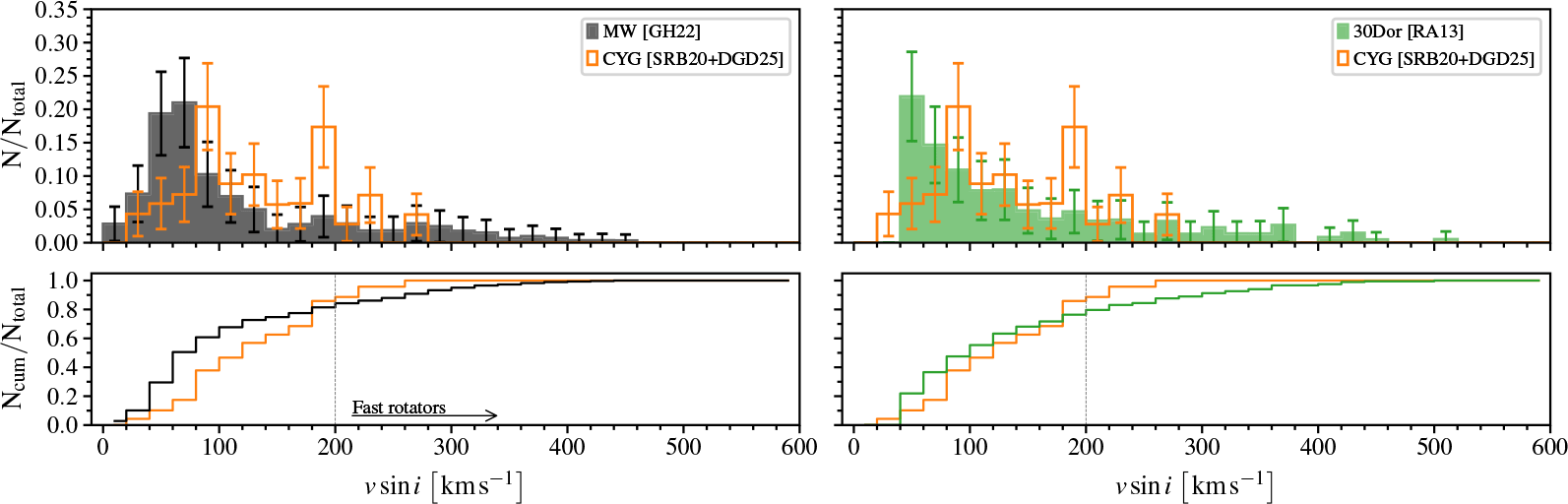
Through a comprehensive spectroscopic campaign, we analyzed the projected rotational velocities of a sample of 70 O-type stars in the core of Cygnus OB2. Our dataset includes both new observations (Galán-Diéguez et al. Reference Galán-Diéguez, Berlanas and Herrero2025) and stars previously studied by Berlanas et al. (Reference Berlanas, Herrero and Comerón2020). We derive projected rotational velocities (
 $v\sin{i}$
) using the iacob-broad tool, which combines the Fourier Transform and Goodness-of-Fit methods to disentangle rotational and macroturbulent broadening. The results show:
-
• Only
 $\!\sim\! 9$
O-type stars exceed
$200\,\mathrm{kmp\,s}^{-1}$
.
-
• None exceed
$300\,\mathrm{kmp\,s}^{-1}$
. -
• The expected
$\sim\!10\%$
of rapid rotators predicted by binary interaction models is missing.


Figure 1 compares Cygnus OB2 with other regions (Galán-Diéguez et al. Reference Galán-Diéguez, Berlanas and Herrero2025). While the Milky Way population (Holgado et al. Reference Holgado, Simón-Daz, Herrero and Barbá2022) and 30 Doradus (Ram rez-Agudelo et al. 2013) exhibit a pronounced fast-rotator tail, Cygnus OB2 emerges as an outlier. Surprisingly, the O-type population in Cygnus OB2 does not follow this trend: the expected fast-rotating tail is missing.
Bootstrapped distributions of projected rotational velocities for O-type stars from various regions within the local Universe (adapted from Galán-Diéguez et al. Reference Galán-Diéguez, Berlanas and Herrero2025). The histograms in black and green illustrate the
 $v\sin{i}$
measurements for Galactic stars in the solar neighborhood (Holgado et al. Reference Holgado, Simón-Daz, Herrero and Barbá2022), and 30 Doradus (Ram rez-Agudelo et al. 2013), respectively. The orange histogram depicts the rotational velocity distribution for Cygnus OB2, including O-type stars from Berlanas et al. (Reference Berlanas, Herrero and Comerón2020) and those lately reclassified from the B0 sample (Galán-Diéguez et al. Reference Galán-Diéguez, Berlanas and Herrero2025). The error bars indicate the standard deviation in each velocity bin derived from the bootstrap analysis.

This result is especially unexpected given that massive stars are thought to form predominantly in multiple systems, with a large fraction expected to experience binary interactions (Sana et al. Reference Sana, de Mink and de Koter2012). Such processes are predicted to generate a substantial population of fast rotators (de Mink et al. Reference de Mink, Langer, Izzard, Sana and de Koter2013), yet their absence in Cygnus OB2 poses a challenge to current models of massive star formation and evolution.
3. Scenarios for the lack of fast rotators in Cygnus OB2
The lack of fast rotators in Cygnus OB2, contrary to the predictions of binary evolution theory and evidence from other massive clusters, remains a puzzling result. Several non-exclusive explanations may help to account for this anomaly: Young evolutionary stage: Binary interaction, in particular mass transfer, is the dominant channel for producing rapid rotators. Since Cygnus OB2 is very young (1-6 Myr, Berlanas et al. Reference Berlanas, Herrero and Comerón2020), many systems may not yet have undergone such episodes. However, other clusters of comparable or younger ages – such as 30 Doradus – exhibit populations of fast rotators. This suggests that youth alone cannot fully explain the deficit of a high-velocity tail in Cygnus OB2.
Runaway scenario: Stars spun up through binary interaction may have been expelled from the association as runaways, either by supernova explosions or by dynamical encounters. For instance, a star moving at
 $30\,\mathrm{kmp\,s}^{-1}$
would leave the central 1
 $^\circ$
of Cygnus OB2 in less than 1 Myr. Some of the missing fast rotators may therefore lie outside the surveyed region.
Molecular cloud properties: The star-forming environment in Cygnus OB2 may have favored slower initial spins or reduced the binary fraction. These would naturally leading to a lack of a fast-rotating tail in the present-day population.
4. Conclusions
Our spectroscopic analysis of 70 O-type stars in Cygnus OB2 reveals a striking absence of rapid rotators, with no stars exceeding
 $300\,\mathrm{kmp\,s}^{-1}$
and only a small fraction surpassing
 $200\,\mathrm{kmp\,s}^{-1}$
. This contrasts sharply with other massive star-forming regions, such as 30 Doradus or the Galactic field, where a pronounced high-velocity tail is observed.
The deficit of fast rotators in Cygnus OB2 challenges current expectations from binary evolution models, which predict that
 $\sim$
10% of O-type stars should appear as rapid rotators as a consequence of mass transfer or mergers. Several scenarios may contribute to this discrepancy, including the youth of the association, the possible ejection of spun-up systems as runaways, and environmental effects related to the natal molecular cloud.
Further progress will require extending the spatial coverage of the survey to search for high-velocity runaways, and performing detailed binary population synthesis tailored to the Cygnus OB2 environment. Together, these efforts will help to clarify whether the absence of fast rotators reflects a transient evolutionary stage, an observational bias, or a genuine environmental imprint on the rotational properties of massive stars.
Acknowledgements
The authors acknowledge support funding from the Ministry of Science, Innovation and Universities (MCIU) through the Spanish State Research Agency (AEI) via grant PID2021-122397NB-C21 (cofunded by the European Regional Development Fund, FEDER) and the Severo Ochoa Program 2020-2023 (CEX2019-000920-S). SRB also thanks financial support from NextGeneration EU/PRTR and MIU (UNI/551/2021) through grant Margarita Salas-ULL. MAM project received support from the “La Caixa” Foundation (ID 100010434) under the fellowship code LCF/BQ/PI23/11970035. This work is partially based on observations made with the three following telescopes: (i) we thank the Nordic Optical Telescope, owned in collaboration by the University of Turku and Aarhus University, and operated jointly by Aarhus University, the University of Turku and the University of Oslo, representing Denmark, Finland and Norway, the University of Iceland and Stockholm University at the Observatorio del Roque de los Muchachos, La Palma, Spain, of the Instituto de Astrofisica de Canarias. The data presented in this work were obtained in part with ALFOSC, which is provided by the Instituto de Astrofisica de Andalucia (IAA) under a joint agreement with the University of Copenhagen and NOT; (ii) the Gran Telescopio Canarias is installed at the Spanish Observatorio del Roque de los Muchachos of the Instituto de Astrofísica de Canarias, on the island of La Palma. GTC data was obtained with the instrument OSIRIS, built by a Consortium led by the Instituto de Astrofísica de Canarias in collaboration with the Instituto de Astronomía of the Universidad Autónoma de México. OSIRIS was funded by GRANTECAN and the National Plan of Astronomy and Astrophysics of the Spanish Government; (iii) the Isaac Newton Telescope and its service mode are operated on the island of La Palma by the Isaac Newton Group of Telescopes in the Spanish Observatorio del Roque de los Muchachos of the Instituto de Astrofísica de Canarias. This work has made use of data from the European Space Agency (ESA) mission Gaia (https://www.cosmos.esa.int/gaia), processed by the Gaia Data Processing and Analysis Consortium (DPAC, https://www.cosmos.esa.int/web/gaia/dpac/consortium). Funding for the DPAC has been provided by national institutions, in particular the institutions participating in the Gaia Multilateral Agreement. During the spectroscopic data reduction we used PyRAF, a Python environment for IRAF. IRAF is distributed by the National Optical Astronomy Observatories, which is operated by the Association of Universities for Research in Astronomy, Inc. (AURA) under cooperative agreement with the National Science Foundation. In addition to the codes explicitly cited in the text, this paper makes use of the following packages: matplotlib (Hunter Reference Hunter2007), numpy (Harris et al. Reference Harris, Millman and van der Walt2020), and scipy (Virtanen et al. Reference Virtanen, Gommers and Oliphant2020).
 vsini

 Open access

