Introduction
As reported in the Tbilisi Declaration, environmental education is vital to the development of individuals’ knowledge, attitudes, and behaviour related to solving environmental problems (UNESCO-UNEP, 1978). Environmental education during early childhood promotes holistic development, improving knowledge about the natural world and also incorporating emotions, dispositions, relationships and skills (NAAEE, 2010); in particular, it promotes certain feelings among children such as an appreciation of the natural world, respect for other creatures and a closeness to nature (NAAEE, 2010). Developing the connection between the human and the natural worlds is among the most important goals of environmental education in early childhood (Barrable, Reference Barrable2019).
Palmer and Neal (Reference Palmer and Neal1994) defined environmental education as education about the environment, education in the environment or in nature, and education for the environment. Education in nature emphasises the idea that learning should ideally occur outside the classroom. This study focuses on nature-based teaching. Focusing on nature and the environment is one of the key characteristics of environmental education in early childhood. Nature pedagogy in early childhood education puts nature at the heart of the education programmes and supports, as noted above, learning in nature, about nature, and for nature (NAAEE, 2019). Nature-based teaching provides children with the opportunity to learn in nature and develops their meaningful experiences therein. The aim of environmental education in early childhood is to build the bond between the child and nature (NAAEE, 2010), which can be most easily achieved through nature-based teaching. Positive experiences during childhood in such environments develop children’s sensitivity to nature and improve their environmental attitudes (Jeronen, Jeronen, & Raustia, Reference Jeronen, Jeronen and Raustia2009). These experiences often then continue into adulthood, fostering adults’ commitment to nature (Bento & Dias, Reference Bento and Dias2017; Chawla & Cushing, Reference Chawla and Cushing2007; Collado, Staats, & Corraliza, Reference Collado, Staats and Corraliza2013), and laying the foundations for the environmental literacy, skills, and motivation needed to find the solutions to environmental problems (Torquati, Cutler, Gilkerson, & Salver, Reference Torquati, Cutler, Gilkerson and Sarver2013).
To promote children’s experiences in nature, the number and scope of nature-based early childhood programmes have been significantly increased and broadened worldwide. Thus, nature-based teaching has been included in schools’ curricula, and the number of nature-based pre-schools has accordingly increased in various countries such as Denmark and Germany (Barrable, Reference Barrable2019). However, by comparison with such countries, it can be said that Turkey is currently in its infancy. The Turkish early childhood education curriculum currently provides only limited support for the implementation of nature-based activities at the pre-school level (Gülersoy, Reference Gülersoy2013; Kahyaoğlu, Reference Kahyaoğlu2015), and the knowledge of outdoor activities and their importance to children’s development is, to say the least, limited (Yılmaz, Reference Yılmaz2016). The outdoor spaces in Turkish pre-schools are not used effectively (Yıldırım & Özyılmaz-Akamca, Reference Yıldırım and Özyılmaz-Akamca2017). Early childhood teachers should be properly and thoroughly prepared to support children’s experiences in nature. Although studies typically identify the effectiveness of outdoor learning environments for children (e.g., Collado, Staats, & Corraliza Staats, & Corraliza, Reference Collado, Staats and Corraliza2013; Jose, Patrick, & Moseley, Reference Jose, Patrick and Moseley2017), there are still barriers to the use of natural settings in early childhood programmes, particularly in Turkey.
Teachers are subject to the demands and limitations of their job, such as taking safety precautions, managing classes outside, and, generally, a lack of administrative support (Jose, Patrick, & Moseley, Reference Jose, Patrick and Moseley2017). As such, Turkish pre-school teachers demonstrate a rather insufficient knowledge and awareness of risk management skills regarding nature-based education (Parlakyıldız & Aydın, Reference Parlakyıldız and Aydın2004). Early childhood teachers need to be exposed to nature-based teaching experiences to gain sufficient confidence and self-efficacy in such activities and to develop a comprehensive understanding of this approach (Broom, Reference Broom2017; Lindemann-Matthies, & Knecht, Reference Lindemann-Matthies and Knecht2011; Temiz & Karaarslan-Semiz, Reference Temiz and Karaarslan-Semiz2019).
Our focus in this study is the empowerment of early childhood pre-service teachers with regard to nature-based teaching because the decision to take children outside and the implementation of nature-related activities are typically the responsibility of the teacher (McClintic & Petty, Reference McClintic and Petty2015). In this context, the purpose of this study is to develop eight Turkish early childhood pre-service teachers’ perceptions and practices related to nature-based teaching during their professional experience course and to identify the barriers and challenges specific to nature-based teaching in public early childhood educational settings (ECE) in Turkey that they encountered.
Literature Review
Nature-based teaching during early childhood has recently gained considerable attention as it fosters children’s educational development and connectedness to nature (Cordiano, et al., Reference Cordiano, Lee, Wilt, Elszas, Damour and Russ2019; Stevenson, Mannion, & Evans, Reference Stevenson, Mannion, Evans, Cutter-Mackenzie-Knowles, Malone and Barratt Hacking2020). In nature-based studies, nature has mostly been viewed as a learning environment and natural materials have been used as teaching resources (e.g., Gerrish, Reference Gerrish2014; MacQuarrie, Nugent, & Warden, Reference MacQuarrie, Nugent and Warden2015). However, this view has been criticized as being anthropocentric and thus in need of reconsideration (Taylor, Reference Taylor2013). Accordingly, a new nature movement that includes new theoretical approaches has been recommended to deconstruct humankind’s place in nature (Malone, Reference Malone2016). For instance, Malone (Reference Malone2016) proposes reimagining child, nature, body, and place relationships by considering both the new nature movement and the post-humanism approach to environmental education. This approach views humans, other organisms, water, air, and rocks as interrelated, and young people are not separated from nature but rather are positioned as part of it (Logan, Reference Logan, Cutter-Mackenzie-Knowles, Malone and Barratt Hacking2020). Being aware of one’s place in nature is the key point to an understanding of childhoodnature, which is an emerging concept in recent literature (Cutter-Mackenzie-Knowles, Malone, & Whitehouse, Reference Cutter-Mackenzie-Knowles, Malone, Whitehouse, Cutter-Mackenzie-Knowles, Malone and Barratt Hacking2020). In other words, young people may understand why and how people are part of nature like all other living and non-living beings in the Earth’s systems, and their appreciation of their connection to nature is the essence of childhoodnature (Logan, Reference Logan, Cutter-Mackenzie-Knowles, Malone and Barratt Hacking2020).
Experiences in nature are important to the promotion of children’s connection with the natural environment (Carr & Luken, Reference Carr and Luken2014; Chawla, Reference Chawla1998; Cheng & Monroe, Reference Cheng and Monroe2012; Louv, Reference Louv2008). Teachers who have chosen to embrace nature-based education consider nature to be a learning environment (Dawson & Beattie, Reference Dawson and Beattie2018; Ernst & Tornabene, Reference Ernst and Tornabene2012; Nazir & Pedretti, Reference Nazir and Pedretti2015). Teachers have an important responsibility to establish a learning environment, deliver the curriculum and assess students’ needs and progress (Bohling, Saarela, & Miller, Reference Bohling, Saarela and Miller2015). Therefore, teachers play a critical role in supporting learning in nature and fostering children’s development and connection with it (Welz, Reference Welz2014). In the literature, several studies have examined early childhood teachers’ attitudes, beliefs, practices, and experiences of nature-based teaching, and also the barriers and support they encountered in enacting nature-based education programmes (e.g., Blatt & Patrick, Reference Blatt and Patrick2014; Dietze & Kashin, Reference Dietze and Kashin2019; Ernst, Reference Ernst2014b; Ernst & Tornabene, Reference Ernst and Tornabene2012; Lindemann-Matthies and Knecht Reference Lindemann-Matthies and Knecht2011; Little, Sandseter, & Wyver, Reference Little, Sandseter and Wyver2012; Miller, Reference Miller2007; Nah, Reference Nah, Waller, Ärlemalm-Hagsér, Sandseter, Lee-Hammond, Lekies and Wyver2017; Otto & Pensini, Reference Otto and Pensini2017; Sandseter, Reference Sandseter2009). Such studies have provided various socio-cultural perspectives of nature-based teaching; for instance, in her study, Nah (Reference Nah, Waller, Ärlemalm-Hagsér, Sandseter, Lee-Hammond, Lekies and Wyver2017) reported that although South Korean teachers consider outdoor play to be vital to children’s health and wellbeing, for the most part, they do not implement outdoor activities due to safety concerns. Several researchers have reported that Norwegian educators are more supportive of risky outdoor play compared to their counterparts in other countries (e.g., Little, Sandseter, & Wyver, Reference Little, Sandseter and Wyver2012; Sandseter, Reference Sandseter2009). However, Sandseter and Sando’s study (2016) revealed that Norwegian early childhood educators’ restrictions on children’s risky play have begun to increase in line with increasing safety concerns. Similar to Korean teachers, Norwegian teachers currently have safety concerns about outdoor play.
In other studies (e.g., Bundy, et al., Reference Bundy, Luckett, Tranter, Naughton, Wyver, Ragen and Spies2009; Lindemann-Matthies & Knecht, Reference Lindemann-Matthies and Knecht2011; Sandseter, Reference Sandseter2009), it was reported that Norwegian, Swiss, and Australian early childhood teachers did not view weather conditions, parents, the educational system, or associated workload as obstacles to teaching in nature. However, in countries such as South Korea, Slovenia, and Turkey, teachers see cold and rainy weather as barriers to going outside, effectively preventing children from spending time outside during the winter months (Kos & Jerman, Reference Kos and Jerman2013; Nah, Reference Nah, Waller, Ärlemalm-Hagsér, Sandseter, Lee-Hammond, Lekies and Wyver2017; Yalçın, Reference Yalçın2015). Based on socio-cultural perspectives, teachers’ concerns about and perceived barriers to taking children outside might thus change from country to country.
Early childhood teachers are typically uncomfortable with taking children into natural areas (Torquati & Ernst, Reference Torquati and Ernst2013). Not all teacher education programmes train new teachers to understand the role of nature in education or how to use nature in their approach to teaching (Ferreira, Grueber, & Yarema, Reference Ferreira, Grueber and Yarema2012; Parlo & Butler, Reference Parlo and Butler2007). Teachers’ lack of knowledge about the benefits of nature-based teaching, and their perceptions, attitudes and beliefs about nature and learning in a natural setting influence their commitment to and practice of nature-related activities (Blatt & Patrick, Reference Blatt and Patrick2014; Chakravarti, Reference Chakravarthi2009; Ernst & Tornabene, Reference Ernst and Tornabene2012; Gerrish, Reference Gerrish2014; Shume & Blatt, Reference Shume and Blatt2019). As Ernst (Reference Ernst2014b), Ernst and Tornabene (Reference Ernst and Tornabene2012), and Gerrish (Reference Gerrish2014) have emphasised, these barriers could clearly hinder the effective use of natural settings in teaching. Besides, teachers may not find much support or guidance in their attempts to implement the kind of nature-related activities that facilitate children’s curiosity and connection to nature (Blanchet-Cohen & Elliot, Reference Blanchet-Cohen and Elliot2011; Davis, Reference Davis2009; Waller, Reference Waller2014). Possible reasons for this are related to the fact that pre-service teachers rarely take outdoor-based science courses and generally have limited experience of learning and teaching in nature (Blatt & Patrick, Reference Blatt and Patrick2014; Marcum-Dietrich, Marquez, Gill, & Medved, Reference Marcum-Dietrich, Marquez, Gill and Medved2011). Therefore, it is important that early childhood programmes include strategies for managing risk and that they empower teachers to facilitate children’s engagement with nature-related play (Little, Sandseter, & Wyver, Reference Little, Sandseter and Wyver2012; Cevher-Kalburan, Reference Cevher-Kalburan2015). In teacher education programmes, pre-service teachers could accordingly be given an increased number of opportunities and valuable guidance to apply nature-based activities in their teaching practices (Shume & Blatt, Reference Shume and Blatt2019). Teachers could become role models and mentors for children in terms of increasing their nature-related experiences (Gerrish, Reference Gerrish2014). Dietze and Kashin (Reference Dietze and Kashin2019) also emphasised that it is important to increase early childhood teachers’ awareness about the benefits of learning in nature and of outdoor play, improve their confidence and change their perceptions of and attitudes towards outdoor play and nature. We should hear early childhood teachers’ voices advocating change in policies and practices related to nature-based teaching.
In Turkey, the concept of nature-based teaching in early childhood education is still in its infancy. Although interest in applying nature-related activities has recently begun to increase, there are no relevant standards for philosophy, educational content, and assessment of applying nature-based education in early childhood education. (Tantekin-Erden & Güner-Alparslan, Reference Tantekin-Erden, Güner-Alparslan, Waller, rlemalm-hagsér, Sandseter, Lee-hammond, Lekies and Wyver2017). Therefore, it can be stated that early childhood teachers in Turkey need more support to develop their knowledge and skills with regard to nature-based teaching (Güler, Reference Güler2009; Güzelyurt & Özkan, Reference Güzelyurt and Özkan2018; Kandır, Yurt, & Cevher-Kalburan, Reference Kandır, Yurt and Cevher-Kalburan2012) and to overcome barriers to implementing risky play outside (Cevher-Kalburan, Reference Cevher-Kalburan2015).
In this context, we investigated eight Turkish pre-service ECE teachers’ perceptions and practices relating to the integration of nature-based teaching into their regular teaching over a 10-week practice course. Clarke and Peterson’s (1986) model of teachers’ thoughts and actions guided this study in its attempt to understand pre-service teachers’ perceptions and practices during nature-based teaching. The study addressed the following research questions:
-
(1) How do Turkish pre-service ECE teachers’ perceptions and self-confidence regarding nature-based teaching change over the professional experience course?
-
(2) How do Turkish pre-service ECE teachers describe the benefits of nature-based teaching to children’s development?
-
(3) What barriers to the implementation of nature-based teaching can Turkish pre-service ECE teachers identify?
-
(4) How do Turkish pre-service ECE teachers plan and apply nature-based activities within the professional experience course?
Theoretical framework
This study is based on the research and theory related to teachers’ general perceptions, practices, and self-confidence. According to the literature, teachers’ beliefs, perceptions, and experiences guide their actions and practices (e.g., Blatt & Patrick, Reference Blatt and Patrick2014; Chakravarthi, Reference Chakravarthi2009; Ernst Reference Ernst2014a; Shume & Blatt, Reference Shume and Blatt2019). Pajares (Reference Pajares1992) discussed the strong relationship between teachers’ educational beliefs, perceptions, and their planning and classroom practices. Several authors have previously indicated that pre-service teachers’ self-confidence can be improved through teaching practices, namely through specifically designed programmes and teaching methods (e.g., Dyment, et al., Reference Dyment, Davis, Nailon, Emery, Getenet, Mccrea and Hill2014; Malandrakis, Reference Malandrakis2018). The framework that guided this study was Clark and Peterson’s (Reference Clark, Peterson and Wittrock1986) model of thought and action. This model reflects the link between teachers’ thoughts (beliefs, perceptions, etc.) and their teaching practices and takes into account opportunities and barriers encountered during the instruction and emphasises that these factors are important to understand teachers’ thoughts and practices. According to the authors, the process of teaching can be best understood when the two dimensions of teachers’ thoughts and actions are simultaneously examined. Chakravarthi (Reference Chakravarthi2009) applied Clark and Peterson’s (Reference Clark, Peterson and Wittrock1986) model to outdoor education to explore teachers’ beliefs and practices in outdoor settings, exploring how teachers’ beliefs have an effect on their teaching practices in natural outdoor settings.
Clark and Peterson’s (Reference Clark, Peterson and Wittrock1986) model is important in terms of revealing how early childhood teachers’ nature-based practices can be supported, and how their perceptions and beliefs regarding experiences in natural settings can be influenced (Ernst, Reference Ernst2014a). We have applied this theory to nature-based teaching in a similar manner to Chakravarthi (Reference Chakravarthi2009), who used the theory as applied to outdoor education. In this study, early childhood pre-service teachers prepared and implemented nature-based activities with children, and in this way, they both gained nature-based experiences and developed their perceptions of and self-confidence in nature-based teaching. Jordan and Chawla (Reference Jordan and Chawla2019) noted that teachers’ thoughts and practices are critically important to the effective implementation of nature-related activities; that is to say, understanding how teachers value to nature-based teaching and integrate it into their schools will have an effect on teacher preparation and professional development programmes. Effective implementation of nature-based teaching is also related to an understanding of the barriers that pre-service teachers face related to the application of nature-based activities (Jordan & Chawla, Reference Jordan and Chawla2019). Clark and Peterson’s (Reference Clark, Peterson and Wittrock1986) model indicates not only the relationship between teachers’ thoughts and practices but also the opportunities and barriers that teachers encounter in the course of their work. Ernst (Reference Ernst2014a) also suggested that it might be possible to reduce perceptions of difficulty and barriers to using natural outdoor settings and thus encourage early childhood teachers to use natural places. Based on the theory and literature, in the current study, we examined the perceptions and practices of early childhood pre-service teachers and the barriers they encountered during the implementation of nature-based teaching.
Methodology
This study is based on a qualitative case study methodology, in which an understanding of a topic is developed using a case, or cases, as a particular illustration. Case studies consider various aspects of a real environment and provide an understanding of the phenomenon in question in a holistic manner within pre-established boundaries (Stake, Reference Stake1995). With this study, we investigated how participants put their constructed knowledge into practice. An instrumental case study (Stake, Reference Stake1995) was chosen as the study design to understand pre-service ECE teachers’ perceptions about nature-based teaching. As this study is concerned with the perceptions and practices of pre-service teachers and includes in-depth interviews with its participants on the subject of nature-based teaching at the pre-school level, the case study methodology seemed most appropriate. The study context was identified as the pre-school where the pre-service teachers conducted nature-based activities, and pre-service teachers were chosen as the case in this instance. Yin (Reference Yin2014) and Stake (Reference Stake1995) have both suggested that a case study should have appropriate boundaries to indicate the depth and scope of the study and that a case can be bounded by time and place (Creswell, Reference Creswell2007), by activity (Stake,Reference Stake1995) and by definition and context (Miles & Huberman, Reference Miles and Huberman1994). In this study, the case was bounded by one term of data collection in a pre-school with the focus on the use of nature-based teaching. According to Yin (Reference Yin2014), a case study should focus in particular on answering ‘how’ and ‘why’ questions. When framing our research questions, we asked ‘how’ questions to explore participants’ perceptions of nature-based teaching and how they planned and applied nature-based activities. Using a case study approach allowed us to conduct an in-depth analysis of participants’ interview responses and their activity plans as data sources for the study. Utilizing multiple data sources in a case study is important to increase data credibility (Yin, Reference Yin2014).
Context and participants
This study was conducted during the 2017–2018 spring semester. Before commencing the study, the researchers obtained ethical permission from the Ministry of National Education. Then, they informed pre-service teachers taking the professional experience course about the aim of the study, and they sought a pre-school with a large garden that would be suitable for nature-related activities. Once the pre-school in which the pre-service teachers would carry out their field practice had been selected, the researchers explained the aim of the study to the head of the school to receive support. The selected pre-school is a public pre-school that provides education for children from relatively low socio-economic backgrounds. All public ECE schools in Turkey are affiliated with the Ministry of National Education. This pre-school had 1 class of 3-year-olds with 15 children, 3 classes of 4-year-olds with around 15 children, and 4 classes of 5-year-olds with around 18 children in each. The pre-service teachers implemented teaching practice in one of the above classes.
The professional experience course consisted of 6 hours of field practice in the pre-school and 2 hours of theoretical courses in the Faculty of Education every week for a period of 10 weeks. The second author was the course instructor, and she supported and guided the pre-service teachers while preparing their activity plans. Each week, before the pre-service teachers implemented their activities, the researchers examined their plans and shared their comments and suggestions. Based on these, the pre-service teachers would revise their activity plans if necessary. In the theoretical courses, the pre-service ECE teachers were encouraged to read, think, discuss and explore the means by which they could integrate nature and natural materials into their activity plans. In the first 2 weeks of the theoretical course, the researchers explained the importance of nature-based teaching and its benefits for children and further described various kinds of nature-based schools and their programmes. The researchers later provided examples of activities that could integrate natural materials and the natural environment into early education settings. For example, in one of the lectures, the researcher asked the pre-service teachers to go outside and walk around the campus area. They were asked to collect different natural materials and engage in an art study as creatively as possible.
Sixteen pre-service teachers in the last year of their teacher education programmes were taking the professional experience course in the Department of Early Childhood Education in the spring term of 2017. However, eight pre-service ECE teachers (five female, three male) who were taking the course participated in this research. They expressed their willingness to participate and signed a consent form that included a description of the purpose of the study, the extent of their involvement required, and their rights as participants. All the participants were in their senior year of the early childhood teacher education programme. The ages of the participants ranged from 22 to 24 years. Subsequently, these eight pre-service teachers conducted nature-based activities, while the remainder of the pre-service teachers conducted their usual activities according to the curriculum. Those eight pre-service teachers prepared activity plans related to nature-based teaching. Before the pre-service teachers implemented their activities with the children, the researchers gave feedback on each plan to ensure they were appropriate to nature-based teaching. The pre-service teachers then applied their activities in the school.
Data collection
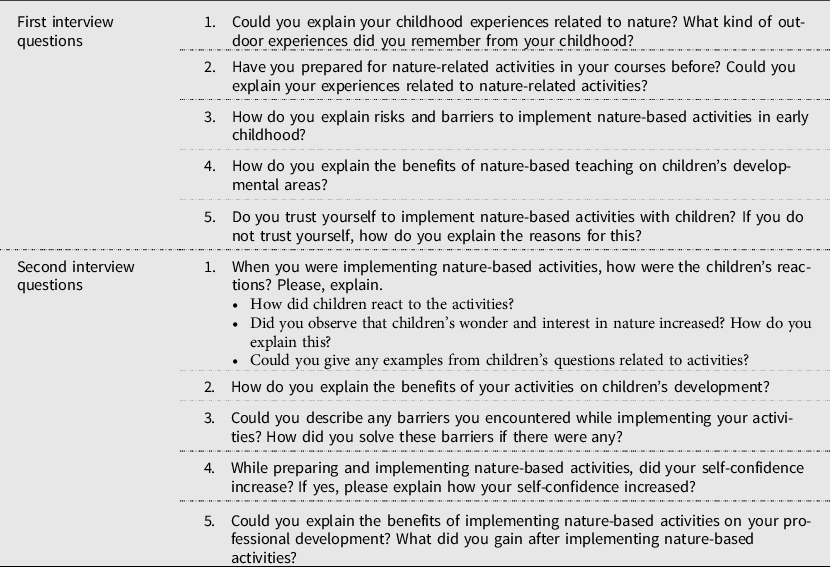
Data was collected by means of interviews and activity plans. Eight pre-service teachers enrolled in the professional experience course were interviewed before and after implementing the nature-based teaching activities in the school. The interview questions were developed by the researchers and examined by two experts on environmental education to ensure clarity and validity. The first round of interviews featured 12 questions about the participants’ academic backgrounds and perceptions of nature-based teaching. The second round involved 13 questions related to participants’ perceptions and practices after implementing the nature-related activities. Sample interview questions are presented in Table 1. In addition, the pre-service teachers prepared activity plans over a period of 10 weeks that were subsequently examined by the researchers. These plans were integrated into the research methodology to provide a comprehensive picture of the pre-service ECE teachers’ experiences about the application of the nature-based teaching activities.
Example interview questions

Data analysis
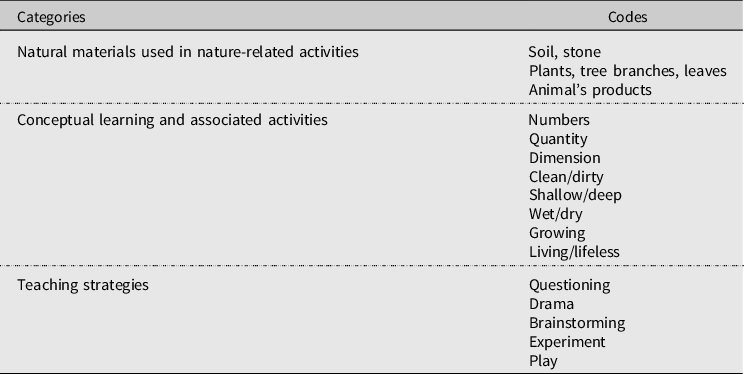
When analysing the interviews, codes, and categories were created through both inductive and deductive thematic analyses as this approach represents a more flexible qualitative data analysis method (Braun & Clarke, Reference Braun and Clarke2006). To apply both analyses, the data were first coded without trying to fit them into the theoretical framework. In so doing, it was possible to increase the scope of and possibilities relating to the themes that could emerge from the data (Braun & Clarke, Reference Braun and Clarke2006). When the pre-determined codes and categories were identified, a deductive analysis was conducted to reveal themes and categories that were developed based on the theory and literature. During this process, the previous literature and frameworks related to teachers’ perceptions of nature-based teaching and barriers to the implementation of nature-based activities were also examined (e.g., Blatt & Patrick, Reference Blatt and Patrick2014; Clark & Peterson, Reference Clark, Peterson and Wittrock1986; Ernst, 2014a; Reference Ernst2014b; Gerrish, Reference Gerrish2014; Malandirakis, Reference Malandrakis2018). The activity plans were analysed to reveal any evidence that the participants integrated nature-based teaching into their plans. The content analysis technique was used as it generally focuses on the written content of communication (Frankel & Wallen, Reference Frankel and Wallen2003). More specifically, the activity plans were analysed based on three components: the natural materials used, the concepts taught during the activities, and the teaching strategies employed. These components were derived from the activity plan formats pre-service teachers used while planning their activities, which they did prior to implementation, and the researchers examined each plan with due consideration for the three components mentioned above.
Trustworthiness
To demonstrate the trustworthiness of this study, data were collected over an extended period of time, namely before and after the 10-week practice teaching course. The activity plans were also examined to triangulate the qualitative data. A second coder coded each transcribed interview independently to ensure inter-rater reliability. To ensure confidentiality, the participants signed a consent form prior to participation, and their names were not used in the study; instead, they were presented as P-1, P-2, etc. For member checking, the interview transcripts were sent to the participants, all of whom affirmed that the transcribed interviews accurately reflected their perceptions, feelings, and experiences.
Results
The results are presented according to two main categories, as per the sections below. In the first, the interview results are given, while in the second the results of the activity plans are presented.
Interviews
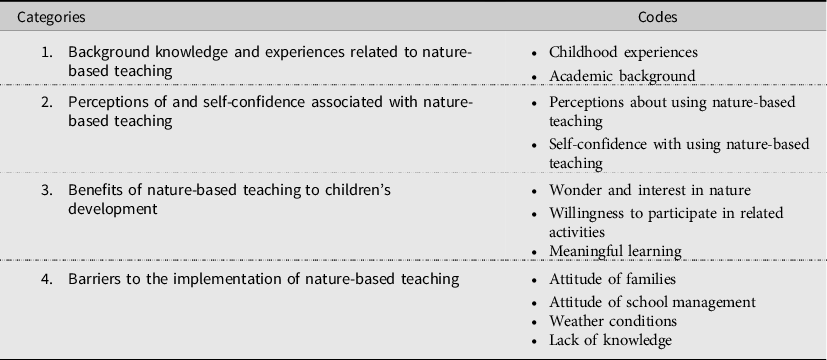
To reveal the participants’ perceptions of nature-based teaching, a coding scheme was created. The codes and categories were identified according to the literature (e.g., Ernst, Reference Ernst2014a, Reference Ernst2014b; Gerrish, Reference Gerrish2014; McClintic & Petty, Reference McClintic and Petty2015), the aim of the research, and the data collected. Table 2 lists the codes and categories determined based on the analysis of the interviews.
Categories and codes determined in the interviews

Background knowledge and experiences related to nature-based teaching
Six of the eight pre-service ECE teachers stated that they spent their childhood in rural towns, whereas two grew up in cities. They all remembered their childhood experiences with nature and said that they mostly played outside during their childhood. They also stated that they did not take any courses related to nature-based teaching during their early childhood teacher education programmes. Five of the participants stated that they had never prepared a nature-based teaching activity in their practice teaching courses. Three teachers reported that they used natural materials, especially in their science-related activities. They usually prepared activities such as growing plants or observing leaves outside, as exemplified by P-1:
P-1: In the first term in my practicum school, I took children outside and we observed the leaves that fell off the trees in autumn and we discussed those leaves and autumn.
As the pre-service teachers observed, the mentor teachers did not take children outside or implement nature-based activities within their schools. Teachers at pre-schools sometimes used natural materials in the classroom when performing science or art activities such as planting, collecting leaves, and observing nature. Nevertheless, the pre-service teachers implied that they were unable to find the opportunities to observe and apply nature-related activities in their education.
Perceptions of and self-confidence associated with nature-based teaching
During the initial interviews, the pre-service teachers stated that curricular activities could be linked to the natural environment and provided some examples of how to do so. For example, P-8 noted that:
P-8: If we say two trees, this is maths. If we do pressing with leaves, this is art. And if we talk about why leaves are green, this is science. Thus, we could create nature-related activities.
Although the pre-service teachers were aware of the importance of nature-based activities in early childhood settings, they lacked the knowledge and experience. According to the initial interview results, four participants stated that they felt confident about preparing nature-based teaching activities in the context of ECE because they grew up in rural areas and spent time in nature during their childhood. Conversely, four pre-service teachers reported that they felt they would require educational support to develop their skills of and experiences in nature-based teaching. After the 10-week practice teaching course, the pre-service teachers described how their perceptions and self-confidence changed while implementing nature-based activities. All of the participants stated that they felt more motivated and confident about implementing nature-related activities in ECE. An illustrative quotation from the second round of interviews is presented below:
P-6: I learned how to manage outdoor activities by finding and organizing materials and how to increase children’s interest in nature. I felt more confident about teaching outside the classroom.
The participants also learned how to implement nature-related activities and realized that their knowledge of and interest in nature was accordingly increased:
P-2: My interest in nature and nature-related activities increased. When I am walking outside, I pay more attention to nature and natural materials and think about how to integrate them into my activities. In the future, I want to write an activity book related to nature-based teaching.
Benefits of nature-based teaching to children’s development
During the initial interviews, all the pre-service teachers expressed the belief that the pursuit of nature-based activities during early childhood provides positive contributions to children’s social, psychological, and cognitive development. Two participants noted that nature-based activities provide meaningful learning experiences and increase children’s interest in the environment. P-2 mentioned that:
P-2: Learning in nature develops children’s cognitive and psychomotor learning and provides meaningful learning.
After the professional experience course had been completed, the pre-service teachers were asked about the impact of nature-based teaching activities on children’s learning and development. The pre-service teachers noted that these contributed to children’s emotional and cognitive development; more specifically, according to their observations, nature-related activities increased children’s wonder, reasoning abilities, interest in nature and their willingness to participate in related activities. For instance, two participants expressed how children’s wonder and interest in nature increased, as presented below:
P-4: Children explored their environment during the activities. For example, they realized how the soil was formed. Both my own interest and their interest in nature increased. They were more curious about nature. Also, their creativity and self-confidence increased. When I asked them to do artwork with natural materials, they produced very creative work.
The pre-service teachers also observed that children’s willingness to participate in the activities increased, and that children’s questions changed during the activities in that they started to ask more ‘how’ and ‘why’ questions:
P-2: I realized that the children really enjoyed themselves during the activities and they were highly willing to participate in them. I also realized that the type of questions they asked changed. They asked more cause-and-effect type questions. For instance, they asked questions like “Why do we prune the trees?”
Barriers to the implementation of nature-based teaching
Before the professional experience course started, the pre-service teachers were asked to describe some of the barriers to the implementation of nature-based teaching in pre-schools. They were all aware that cultural factors were the main such barriers; more specifically, they explained that the reactions of the children’s families and bad weather conditions were potential barriers to implementing nature-based activities in ECE. One of the participants mentioned the possible reactions of Turkish families:
P-3: Families could have a negative reaction to going outside and learning in nature. This is the worst thing. They might think that their children could get dirty and become ill while working in nature.
At the end of the term, the pre-service teachers were asked about the barriers they encountered while implementing the nature-related activities. They described similar factors to those mentioned in the initial interviews. In addition to the attitudes of families, the participants all stated that the attitude of school management (managers and mentor teachers) was a barrier to implementing nature-related activities. Two of the participants also cited poor weather conditions, their lack of knowledge and lack of materials with which activities could be implemented as barriers during the professional experience course. The following quotations effectively present the views of the teachers:
P-7: The school management sometimes had a negative attitude towards the nature-related activities. I wanted to take children outside on a cold day. They did not allow me to do this because they believe that only sunny days are suitable to take children outside.
P-3: First, I needed some knowledge about nature-based teaching. Therefore, very often I did some research on the Internet and checked whether the information I found was correct or not. For example, when I was explaining the concepts of biodiversity and the food chain, I was sometimes afraid not to give a satisfactory answer to children’s questions.
P-4: I was staying in the dormitory and I was having problems finding materials for my activities. Thanks to the course, I learned how to use natural materials.
Activity plans
Teachers’ theories, beliefs, knowledge and perceptions have an influence on their planning (Clark & Peterson, Reference Clark, Peterson and Wittrock1986). Therefore, this study incorporated pre-service ECE teachers’ thoughts and plans into an actual instructional event. It is universally advocated that planning for instruction is an essential prerequisite skill for effective teaching. Systematic planning might smooth teachers’ way while deciding on goals, objectives, instructional activities, classroom management, assessment, and evaluation strategies. Systematically prepared lesson plans include information about the aim and objectives of the lesson, the activities to be performed, class organization, and assessment strategies (Griffey & Housner, Reference Griffey and Housner1991; Tyler, Reference Tyler1950). In this study, the pre-service ECE teachers prepared 106 activities related to nature-based teaching. These were examined and analysed in the current study. The codes and categories determined for the activity plans are listed in Table 3.
Categories and codes determined in the lesson plans

Natural materials used in nature-related activities
The pre-service teachers chose to use materials that existed in their immediate environments, such as stones, leaves, soil and tree branches. In addition, some of the materials that the participants used in their teaching activities were rather unusual in the context of early childhood education, such as bones, hair, sheep’s wool and manure. When these materials were offered to children as teaching materials, the children showed great interest in them provided that they were offered in a developmentally appropriate manner. For instance, in a maths activity related to measurements with non-standard units, the children measured the sizes of leaves with beans:
P-12: The pre-service teacher lets children go outside and they collect various leaves. The children bring leaves into class and the pre-service teacher gives them some beans. The children try to cover their leaves with beans and compare the number of beans on their leaves.
Some of the pre-service teachers used materials that the researchers did not expect. The following activities exemplify the fact that natural materials are not restricted to stones, trees and soil:
P-4: The pre-service teacher brings a bag into the classroom and asks children to predict what is in the bag. After listening to their guesses, the pre-service teacher opens the bag and shows some bones to the children (the pre-service teacher has disinfected the bones). The pre-service teacher asks the children “What are these?”, “What do they belong to?”, and “Are they similar?”. Then they go into the garden and make different shapes and forms using the bones. The pre-service teacher breaks the bones with a hammer and the children investigate the broken bones. They bury some of the bones and decide to dig them up again three months later.
Not only did this study help children to interact with various materials, but it also gave them the chance to be involved in different authentic experiences, such as pruning:
P-2: The pre-service teacher talks about hair with the children. Our hair gets damaged over time and we need to have our hair cut. It is necessary for hair health. Then, the pre-service teacher shows a big tree branch to the children (it was pruned) and says, “The tree’s small branches also need to be cut to remove diseased or damaged branches”. The pre-service teacher shows them how to prune branches with a branch shearer and they decide which branches need to be pruned. After that, the pre-service teacher lets the children try to prune branches under supervision.
Conceptual learning and associated activities
The main concepts in the Turkish ECE curriculum (MoNE, 2013) are colour, geometric shapes, dimensions, quantity, direction–location, numbers, senses, emotions, time and antonyms, and the pre-service teachers included these in their activities. They also increased children’s wonder and interest in nature through nature-based activities. The most common concepts used in such activities were numbers, colours, textures, antonyms and shapes. By means of their different shapes, textures and sizes, natural materials could be used in various ways. Also, to increase children’s engagement with their environment, their attention should be drawn towards using their senses. Sensory activities in particular stimulate the perceptual skills of young children and may result in permanent learning (Barton, Reichow, Schnitz, Smith, & Sherlock, Reference Barton, Reichow, Schnitz, Smith and Sherlock2015). In the activity below, children felt the size, texture and dimensions of branches and used more than one sense to grasp these concepts. The following quotations exemplify the concepts preferred by the pre-service teachers while teaching:
P-14: The children go into the garden and collect tree branches. The children gather all the branches on a table in the class. The pre-service teacher asks them to order branches from thin to thick, and short to long. Then they organise the branches from smooth to rough.
In the following example, a pre-service teacher used a sandpit, which had never previously been used for educational purposes.
P-6: The pre-service teacher does activities about squares, triangles, and circles with the children. Then they go to the sandpit and draw these shapes in the sand. As the pre-service teacher expected, these shapes were not drawn well enough. The pre-service teacher gives the children templates and the children again try to draw squares, triangles, and circles.
Natural materials are also suitable for combining different activities. In the following example, a pre-service teacher presented an environmental activity.
P-5: Each animal has his or her own nest. They make their nests to protect themselves from predators, rain, cold, sun, and wind, and to have somewhere where they can rest. The pre-service teacher shows children different pictures of houses belonging to varying climates and nest pictures belonging to various animals. Then, the pre-service teacher gives the children pictures of ants, bears, birds, and squirrels and puts their corresponding nest pictures on the table. The children match the pictures of the animals with the appropriate nest. The pre-service teacher asks the children “Why do birds make their nests in trees?”, and “Why do ants prefer underground?”. Then the pre-service teacher says, “Let’s make birds’ nests and hang them in trees”. The pre-service teacher provides the children with twigs, leaves, straw, and soil.
Teaching strategies
The pre-service teachers’ play activities were mostly focused on mathematical skills associated with numbers, classification and series. They also focused on certain science process skills including observation, measurement, inferring, classifying, predicting and communication. The pre-service teachers provided children with a variety of natural materials with which to practice their science process skills. For instance, children could learn that water is a solvent while playing with it. In this study, children were involved in various science activities related to animals, earth and plants, as described below:
P-4: The pre-service teacher shows a basket of walnuts and almonds to the children. Then, the pre-service teacher divides the children into two groups. One of the groups has seven almonds and the other has eight walnuts. Then, the pre-service teacher shows the children a video about how crows hide their walnuts. The pre-service teacher tells the children “It’s your treasure”. The children hide their almonds and walnuts in the garden, like crows do, and draw a map of how to find their treasure. The groups try to find each other’s treasures by following the maps.
Another game about erosion made a positive contribution to children’s learning:
P-3: The children are scattered around the playground. One child is chosen to play the role of ‘Wind’, and another is given the role of ‘Tree’. ‘Wind’ tries to touch the children in the playground, and ‘Tree’ tries to prevent him/her. If ‘Wind’ touches a child, s/he cries out “I’ve been eroded!” and crouches down on the floor. After the activity, the pre-service teacher conducts an erosion experiment with children.
In addition to play, the pre-service teachers used drama, experiments, brainstorming, questioning and modelling in their activities. In the following activity, the pre-service teacher used seeds as a teaching material and then conducted a drama activity with the children to make seed growth more meaningful to them:
P-1: The pre-service teacher brings various seeds to the class. All the seeds are of different shapes, sizes, and textures. Some of them are even as small as grains of sand. After investigating the seeds and guessing which plants they are from, they go outside and scatter the seeds in the garden. The pre-service teacher tells the children “Let’s imagine that we are seeds and are in the soil for the first time and it rains. We are all wet now. Oh! We are swelling up. We are germinating. Oh, my word! Something is coming out from inside. I can’t stop myself from growing. I am growing so fast. I am coming out of the ground. I am a beautiful sprout now.”
Discussion
In this study, the pre-service ECE teachers implemented nature-based activities for the first time and learned how to prepare and apply such activities with children. The researchers supported and guided the pre-service teachers to help them apply their activities in an outdoor setting. Prior to this study, the pre-service teachers had not taken any courses related to nature-based teaching and did not know how to conduct nature-related activities. The reason for this is that Turkish early childhood teacher education programmes do not provide adequate opportunities to pre-service teachers to apply nature-related activities within practice teaching courses. Yılmaz (Reference Yılmaz2016) noted that the Turkish early childhood curriculum places little emphasis on the use of natural materials and the implementation of nature-based activities. The international literature states that many teachers complete their teacher education programmes without ever having learnt how to implement nature-based activities in schools (e.g., Dietze & Kashin, Reference Dietze and Kashin2019; Ferreira et al., Reference Ferreira, Grueber and Yarema2012; Parlo & Butler, Reference Parlo and Butler2007). Şahin, Kartal, and İmamoğlu (Reference Şahin, Kartal and Imamoğlu2013) revealed that in Turkish pre-service ECE teachers’ opinions, there might be more practice-based courses in their programme rather than theoretical courses. Pre-service teachers might be provided with more practice courses related to nature-based teaching in their teacher education programmes, and thus their self-confidence and experiences in the application of nature-based teaching can be developed.
Through this study, the pre-service teachers’ perceptions and self-confidence related to nature-based teaching changed, and they learned how to manage outdoor activities and use natural materials in their teaching practice. A number of researchers have emphasised the idea that teachers’ beliefs, perceptions and experiences regarding nature-based teaching influence their teaching practices (Blatt & Patrick, Reference Blatt and Patrick2014; Chakravarthi, Reference Chakravarthi2009; Ernst & Tornabene, Reference Ernst and Tornabene2012; Gerrish, Reference Gerrish2014; Shume & Blatt, Reference Shume and Blatt2019). Clark and Peterson’s (Reference Clark, Peterson and Wittrock1986) theoretical model addressed the link between teachers’ thought process (their beliefs, perceptions) and their actions and helped us to understand the relationship between pre-service teachers’ perceptions and their teaching practices.
Studies have also demonstrated that pre-service teachers’ teaching experiences and their self-confidence with regard to teaching environmental and sustainability education could be improved through specially designed courses (Dyment et al., Reference Dyment, Davis, Nailon, Emery, Getenet, Mccrea and Hill2014; Malandrakis, Reference Malandrakis2018). Furthermore, Gerrish (Reference Gerrish2014) noted that pre-service teachers who are equipped with the knowledge and skills to apply nature-based activities can significantly influence the children they teach. Therefore, it is important that the professional development of both pre-service and in-service teachers is effectively supported through the use of natural outdoor settings in their teaching (Ernst, Reference Ernst2014a; Ernst & Tornabene, Reference Ernst and Tornabene2012; Gerrish, Reference Gerrish2014).
Another outcome of this study was that the pre-service ECE teachers’ own wonder and interest in nature increased as they prepared and implemented nature-related activities. Bohling, Saarela, and Miller (Reference Bohling, Saarela and Miller2015) also described the benefits of a nature-focused programme for teachers. These authors explored how a nature-focused education programme developed early childhood teachers’ values and attitudes towards learning in and increased their connection with nature. As White (Reference White2004) described, experience in nature shapes one’s attitudes towards it. Teachers’ attitudes towards and interest in nature-related experiences influence their commitment to conducting nature-based activities with children.
In this study, the participants’ interview responses indicated that nature-based teaching practices developed children’s wonder and interest in nature and increased their willingness to participate in related activities. Besides, the pre-service teachers noted that children were more creative and imaginative while participating in nature-based activities. As demonstrated in previous studies, outdoor environments support children’s creativity, imagination, curiosity and connection to nature (e.g., Carr & Luken, Reference Carr and Luken2014; Cheng & Monroe, Reference Cheng and Monroe2012; Ernst, Reference Ernst2014a; Jrgensen, Reference Jrgensen, Waller, rlemalm-hagsér, Sandseter, Lee-hammond, Lekies and Wyver2017; Wight, Kloos, Maltbie, & Carr, Reference Wight, Kloos, Maltbie and Carr2016). Jrgensen (Reference Jrgensen, Waller, rlemalm-hagsér, Sandseter, Lee-hammond, Lekies and Wyver2017) reported that experiences in natural outdoor spaces arouse children’s curiosity about the natural environment and develop an ecological understanding of and respect for other living creatures. As described by Clark and Peterson (Reference Clark, Peterson and Wittrock1986), teacher behaviour affects student behaviour and, in return, student behaviour affects teacher behaviour and later student achievement. Both pre-service teachers and children in this study had positive experiences related to learning in nature. In future studies, pre-service teachers might provide children with both structured and unstructured activities with which to explore nature and thus help children appreciate nature more.
Clark and Peterson’s (Reference Clark, Peterson and Wittrock1986) model indicates that it is not possible to achieve a complete understanding of the teaching process without understanding the barriers and opportunities that influence teaching itself. During the interviews, the pre-service ECE teachers described some of the barriers they encountered when implementing the nature-based activities. The most frequently cited of such was the negative attitudes of families and the school management to such activities. Although the researchers made appropriate arrangements with the head of the school prior to the study, the head occasionally prevented the children from going outside because of the weather conditions. In such situations, the pre-service teachers instead brought natural materials into the classroom. Sometimes, indoor and outdoor areas can be combined, and children may be able to move their indoor activities to outdoors and outdoor activities to indoors (Nah, Reference Nah, Waller, Ärlemalm-Hagsér, Sandseter, Lee-Hammond, Lekies and Wyver2017). In the current study, the reason for bringing natural materials into the classroom might purely have been because the teachers and the head of the school were not accustomed to taking children outside to teach subjects. Some families were possibly somewhat overprotective of their children. Therefore, early childhood teachers may need to influence family attitudes by providing information about how learning in nature supports children’s development (Dietze & Kashin, Reference Dietze and Kashin2019).
Again, there is a common belief in Turkey that one must not take children outside in cold, rainy weather. Alat, Akgümüş, and Cavali (Reference Alat, Akgümüş and Cavali2012) also described similar perceptions in the Turkish context in that children could only be taken outside in good weather. According to Stibbe (Reference Stibbe2015), the common idea that only sunny weather is good and other kinds of weather are bad prevents people from enjoying where they live and alienates them in some ways from nature. When parents and teachers discourage children from going outside in poor weather, the children themselves may adopt the same attitude. Some researchers also noted the factors of parental concern and weather as the principal barriers to learning in natural outdoor spaces (e.g., Alat, Akgümüş, & Cavali, Reference Alat, Akgümüş and Cavali2012; Dietze & Kashin, Reference Dietze and Kashin2019; Little, Wyver, & Gibson, Reference Little, Wyver and Gibson2011; McClintic & Petty, Reference McClintic and Petty2015; Nah, Reference Nah, Waller, Ärlemalm-Hagsér, Sandseter, Lee-Hammond, Lekies and Wyver2017). In Turkey in particular, there is a strong need to educate teachers, principals and families about the importance of nature-based teaching practices for children.
Another barrier to attempting to implement nature-based learning was the general lack of associated knowledge. During the interviews, some of the pre-service teachers stated that they did not feel that they have sufficient knowledge about the environment; therefore, they required additional support for appropriate professional development. To meet this need, new courses and activities related to nature and the environment should be offered in ECE teacher education programmes.
Finally, the pre-service teachers not only prepared activity plans but also implemented these activities with the children. The analysis of the activity plans revealed that the pre-service teachers combined a number of subjects with nature-based teaching. The pre-service teachers also realised that nature provided diverse opportunities for children to study curricular-related topics. Several researchers have suggested that all the major disciplines – such as maths, science, art and languages – could be taught with natural materials and in natural environments (Civelek, Reference Civelek2016; Plevyak & Mayfield, Reference Plevyak, Mayfield, Bodzin, Klein and Weaver2010). Also, Cooper (Reference Cooper2015) noted that children can develop maths, science, arts and language abilities through nature-based teaching activities. This study has well demonstrated implications.
As a further study, nature-related programmes could be designed for both families and children together, and for heads of schools and teachers. In recent years, there has been a movement towards nature-based teaching in the ECE in Turkey. For instance, forest school education programmes have recently been designed especially for early childhood teachers in Turkey (Kahriman-Pamuk & Ahi, Reference Kahriman-Pamuk and Ahi2019). Teachers should accordingly be encouraged to participate in these educational programmes. To challenge weather concerns, teachers should be informed that they can engage in different kinds of activities under any weather conditions, provided that the children wear appropriate protective clothing. The Turkish early childhood curriculum should include risk management strategies to minimise the barriers to learning in nature and empower teachers to support children’s learning in natural environments.
Early childhood teachers are becoming increasingly interested in integrating nature and environmental studies into the curriculum. For this reason, nature and environmental education programmes need to be developed and integrated into the curriculum (Meier & Sisk-Hilton, Reference Meier and Sisk-Hilton2017). Learning in nature is the central theme for the Environmental Education programmes in Early Childhood (NAAEE, 2019). Therefore, early childhood teachers should provide opportunities for children to experience peace, joy and love of nature (NAAEE, 2010). Fortunately, the ‘Environmental Education in Early Childhood’ course was added to the teacher education programme in Turkey in 2018 (Higher Education Council, 2018). Interestingly, while writing this article, the Turkish National Education Ministry announced a new in-service education programme for teachers, a part of which included the reading and discussion of Richard Louv’s book Last Child in the Woods. This represents very important progress towards nature-based teaching in Turkey. Therefore, this study might guide teacher educators towards a more comprehensive implementation of nature-based activities in environmental education courses.
Conclusion
According to Clark and Peterson’s (Reference Clark, Peterson and Wittrock1986) model of thought and action, teachers’ thoughts (beliefs, perceptions, etc.) and their teaching practices should be examined in relation to each other. The current study explored pre-service teachers’ perceptions, self-confidence and their practices related to nature-based teaching over a particular period of time. In this study, we explored whether teaching practices influence pre-service teachers’ perceptions of and self-confidence with regard to nature-based teaching. The study revealed that when pre-service ECE teachers receive appropriate support, resources and encouragement, their self-confidence to conduct nature-related activities increases considerably. In this study, the pre-service teachers’ own curiosity about and interest in nature also increased as they prepared and implemented nature-related activities with children. Nevertheless, they reported several of the barriers they encountered while implementing the nature-related activities, the principal ones to the implementation of nature-based education being the negative attitudes of families and the school management, and weather conditions. Thus, not only teachers but also families and principals need to be educated about the importance of nature-based teaching practices to children. As a conclusion, to guide future studies and education programmes, it is important to listen to pre-service teachers’ voices related to the benefits and challenges of nature-based teaching. It is recommended that pre-service ECE teachers be provided learning and training opportunities related to nature-based teaching, thus helping them to develop their knowledge, self-confidence and experience to plan and implement nature-related activities.
A limitation of this study was working with only eight participants in a professional experience course over a limited period of time in a particular context. Yin (Reference Yin2014) suggests that in case studies the replication of the same findings by conducting a second or third case study can strengthen the generalisation. This case study can be applied and transferred to other cases in future studies. Although this research was conducted in the Turkish educational context, it may interest readers from other countries as teacher–educators could design practice teaching courses related to nature-based teaching. The findings of this study could inspire educators and researchers to conduct teaching activities in natural environments and could cause pre-service teachers to have more positive perceptions and practices about nature-based teaching.
Acknowledgements
None.
Financial Support
This research received no specific grant from any funding agency, commercial, or not-for-profit sectors.
Conflict of Interest
None.
Güliz Karaarslan Semiz is an assistant professor in the Department of Mathematics and Science Education at Ağrı İbrahim Çeçen University. Semiz’s research focuses on environmental education, education for sustainability, teacher education, systems thinking and outdoor learning.
Zeynep Temiz is an associate professor in the Department of Elementary and Early Childhood Education at Karamanoğlu Mehmet Bey University. Temiz’s research focuses on teacher education, bilingual education and bilingualism, beginning teachers and learning in nature.