Introduction
Driving cessation refers to the process of stopping driving (Ragland et al., Reference Ragland, Satariano and MacLeod2005), and may be undertaken voluntarily, e.g. due to financial reasons or moving to a new residence where a car is not practical or necessary, or be required due to a medical condition such as dementia (Liddle et al., Reference Liddle, Bennett, Allen, Lie, Standen and Pachana2013). Driving cessation is associated with a range of negative consequences, including increased depressive symptomatology (Windsor et al., Reference Windsor, Anstey, Butterworth, Luszcz and Andrews2007), less engagement in out-of-home activities (Marottoli et al., Reference Marottoli, Mendes de Leon, Glass, Williams, Cooney and Berkman2000), reduced social involvement and feelings of social isolation (Liddle et al., Reference Liddle, Gustafsson, Bartlett and McKenna2012), restricted access to community services (Johnson, Reference Johnson2008), higher risk of long-term care placement (Freeman et al., Reference Freeman, Gange, Munoz and West2006), increased risk of mortality (O'Connor et al., Reference O'Connor, Edwards, Waters, Hudak and Valdés2013), and concerns and feelings about being a burden on family members or caregivers (Finlayson and Kaufert, Reference Finlayson and Kaufert2002).
Evidence from Australian and international studies indicates that driving cessation in later life is associated particularly with depression (Fonda et al., Reference Fonda, Wallace and Herzog2001; Windsor et al., Reference Windsor, Anstey, Butterworth, Luszcz and Andrews2007). Windsor and colleagues (Reference Windsor, Anstey, Butterworth, Luszcz and Andrews2007) found in their data that a decreased sense of control among older drivers who had ceased driving was associated with higher levels of depression. Older women are more likely to stop driving (Hakamies-Blomqvist and Wahlström, Reference Hakamies-Blomqvist and Wahlström1998; Gallo et al., Reference Gallo, Rebok and Lesikar1999) and also to cease driving pre-maturely (Hakamies-Blomqvist and Wahlström, Reference Hakamies-Blomqvist and Wahlström1998; Wilkins et al., Reference Wilkins, Stutts and Schatz1999). This may be related to a perceived lack of confidence in their driving ability (Wilkins et al., Reference Wilkins, Stutts and Schatz1999; D'Ambrosio et al., Reference D'Ambrosio, Donorfio, Coughlin, Mohyde and Meyer2008). Interestingly, a qualitative study focusing on women's perceptions of themselves after ceasing to drive suggests that continuing to drive may be an effective way of guarding against the idea of growing older, and potential perceived increased dependency (Siren and Hakamies-Blomqvist, Reference Siren and Hakamies-Blomqvist2005). In a study by Oxley et al. (Reference Oxley, Charlton, Scully and Koppel2010), older Australian women who were still driving reported the fear of increased depression as a consequence of stopping driving.
Depression in older adults is associated with declines in quality of life and physical health and increased morbidity and mortality (DiNapoli and Scogin, Reference DiNapoli, Scogin, Pachana and Laidlaw2014). Depression in later life has also been shown to negatively impact on cognitive functioning (Kohler et al., Reference Kohler, Thomas, Lloyd, Barber, Almeida and O'Brien2010). The prevention of declining mental health in later life is therefore of importance, as is understanding various potentially modifiable factors associated with depression in later life.
Previous studies have examined the impact of driving cessation on social integration and perceived social support in older adults. Mezuk and Rebok (Reference Mezuk and Rebok2008) reported that former drivers had poorer health and lower Mini-Mental State Examination scores (indicative of poorer cognitive functioning) relative to continuing drivers, as well as a reduced network of friends irrespective of their ability to use public transportation. They found there was no relationship between driving cessation and perceived social support from family and friends. Driving cessation may restrict opportunities for social interaction, thus negatively impacting the number of social network contacts. Findings on the impact of driving cessation on social support and engagement are mixed with studies showing no effect (Marottoli et al., Reference Marottoli, Mendes de Leon, Glass, Williams, Cooney and Berkman2000; Mezuk and Rebok, Reference Mezuk and Rebok2008) or a reduction in out-of-home activities (Marottoli et al., Reference Marottoli, Mendes de Leon, Glass, Williams, Cooney and Berkman2000; Harrison and Ragland, Reference Harrison and Ragland2003). Being female was consistently associated with increased social integration, potentially due to increased resilience (Mezuk and Rebok, Reference Mezuk and Rebok2008), although this has not been directly tested. Another variable that was associated with social support included living arrangements; living alone was associated not only with having a smaller network of relatives but also with increased contact with friends.
The current study sought to examine the relationship between social support and driving cessation, specifically whether social support buffers declines in mental health reported after driving cessation. It could be that those who develop depression after ceasing driving either (a) lack a social support network or (b) fail to engage in social activities. The role of engagement in social activities is of particular interest in the current analyses. Using a prospective longitudinal study, we aim to examine women at baseline who are driving and follow them through subsequent surveys to compare the level of mental health between those who continued to drive and those who stopped driving. An additional aim is to see whether social support factors (levels of social support, living alone, and engagement in social activities) could buffer the negative effects of driving cessation on older women's mental health.
Methods
Participants
The ALSWH is a prospective nationwide study investigating the health and well-being initially of three cohorts of women who were aged 18–23 years (1973–1978 birth cohort), 45–50 years (1946–1951 birth cohort), and 70–75 years (1921–1926 birth cohort) when recruited in 1996. Women were selected from the Australian National Health Insurance Database (Medicare), which includes all citizens and permanent residents. Stratified random sampling was used with intentional over-sampling of women from rural and remote areas. Details of the cohorts and recruitment methods have been described elsewhere (Lee et al., Reference Lee2005). The ALSWH uses mailed questionnaires to collect self-report data every three years. Participants for this study were drawn from surveys 3 to 6 (2002–2011) of the 1921–1926 cohort.
Data on driving status were only collected at surveys 3–6, and data on social interactions at follow-up were only collected at surveys 4 and 6. Thus, we have included two baseline measures at survey 3 and survey 5, and paired them with follow-up surveys at survey 4 and survey 6. All baseline and follow-up variables of interest were included within each pair of surveys (3 and 5, and 4 and 6). Consequently, survey 3 and survey 5 data were combined to form the baseline survey, while survey 4 and survey 6 data were combined to form the follow-up survey. Therefore, each participant could contribute to the data with one (if they responded to survey 3 and survey 4, or survey 5 and survey 6) or two observations (if they responded to survey 3 and survey 4, and survey 5 and survey 6). From the initial sample of 12,432 women, there were 10,676 participants with responses from survey 3 and survey 4, and/or survey 5 and survey 6. From this, data were included if there was a response to the driving question (82%). Then, the data were included only if the women were driving at baseline (56%) in order to compare women who continued to drive against women who stopped driving. Lastly, participants were included if complete data were available across all variables of interest (83%). As a result, the final number of participants included in the analysis was N = 4,075.
Measures
The mental health status of the women was the outcome variable and was measured at each survey using the MHI of the SF-36 (Ware et al., Reference Ware, Snow, Kosinski and Gandek1993). The MHI measures psychological health over the preceding four weeks and has sufficient criterion validity with respect to depression and is significantly correlated to major depression in older adults (Friedman et al., Reference Friedman, Heisel and Delavan2005). The responses to items are summed and linearly transformed to produce scores ranging from 0 to 100 with higher scores indicating better mental health.
Driving status was measured by asking “What is your main transport?” Participants who reported “Drive car” at the baseline and follow-up surveys were defined as “Continued to drive.” Participants who reported “Drive car” at baseline but not at follow-up surveys were defined as “Stopped driving.”
Demographic characteristics examined included age, country of birth, area of residence, management on income, marital status, and general health, due to their expected associations with the main variables of interest. Age at baseline was categorized as “76–81 at survey 3” and “82–87 at survey 5”. Country of birth at baseline categories was “Australia,” “Other English-speaking countries,” and “Other non–English-speaking countries.” Area of residence at follow-up, measured by ARIA+, was categorized as “Major cities,” “Inner regional,” “Outer regional,” “Remote,” and “Very remote”; the latter were combined due to small numbers. Management on income at baseline categories was “Impossible,” “Difficult always,” “Difficult sometimes,”,“Not too bad,” and “It is easy.” Marital status at follow-up was categorized as “Not partnered” and “Partnered.” General health at baseline was measured by a question that asked “In general, would you say your health is,” and responses were “Excellent,” “Very good,” “Good,” “Fair,” and “Poor.”
Social support factors at follow-up were social interaction, living alone status, and engagement in social activities. Social interactions were measured by a subscale of the Duke Social Support Index (DSSI) (Koenig et al., Reference Koenig, Westlund, George, Hughes, Blazer and Hybels1993). This scale is based on four items that measure the number of persons in the local area: do you feel you can depend on or feel very close to, number of times in the past week spent with a person not living in the same residence, number of times in the past week spoken to another person on the telephone, and number of meetings of organizations or groups attended in the past week. Scores ranged from 1 to 12, with higher scores indicating more social contacts. The summed scores were dichotomized by conducting a median split; scores 4–8 categorized as “Lower” and scores 9–12 categorized as “Higher.” Living alone status was measured by a question that asked participants to indicate who they lived with and categorized as “Living alone” and “Not living alone.” Social engagement activities were measured by a question that asked “In the past month, have you: gone to the movies, theatre, concerts, lectures; gone to a sporting event; played cards, bingo, pool, or some other game; eaten out at a restaurant; attended a religious service; attended a class or course; used a computer/internet?” Participants who did at least one of these social activities were considered as having engaged in social activities.
Statistical analysis
Driving status was compared by demographic characteristics and social support variables, with χ 2 tests. Mean levels of mental health were compared by driving status, demographic characteristics, and social support factors using one-way ANOVAs for bivariate analyses.
In the multivariate analysis, a mixed model was used to estimate levels of mental health predicted by driving status, participant characteristics, and social support factors. The analysis was conducted in SAS (v9.2) using PROC GLM. The outcome variable was mental health scores. The main predictors were driving status, social interaction, living alone status, and social activities. Interaction effects tested included driving status by social interaction, driving status by living alone status, and driving status by social activities. The analyses were conducted controlling for participant demographic characteristics, which included age, country of birth, area of residence, management of income, marital status, and general health. Least square means were requested for predicting the population margins to compare on interactions as well as main effects. Statistical significance was set at p < 0.05.
Results
Descriptive statistics
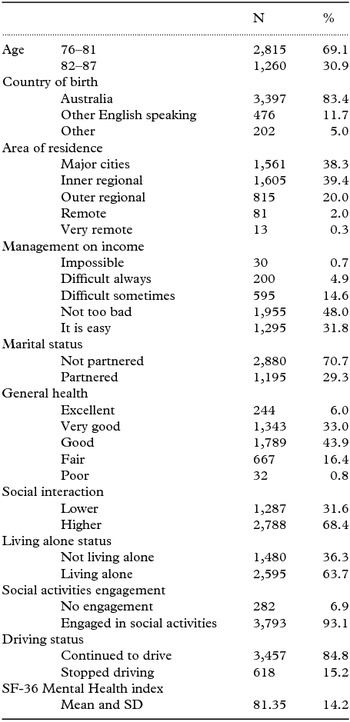
Characteristics of participants are presented in Table 1. At follow-up (surveys 4 and 6), 85% of the older women continued to drive. The older women had good levels of mental health overall (M = 81.4, SD = 14.2). Sixty four percent of the older women were living alone. Most of the older women actively engaged in social activities.
Characteristics of the older women (N = 4,075)

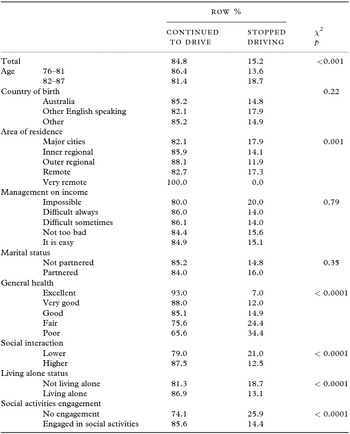
χ 2 test results are presented in Table 2. Driving cessation was associated with older age, living in major cities, and poorer general health. Older women who were living alone were less likely to have stopped driving compared to those who were not living alone. In addition, driving cessation was associated with lower levels of social interaction and non-engagement in social activities.
χ 2 tests results presenting driving status by characteristics and social support factors (N = 4,075)

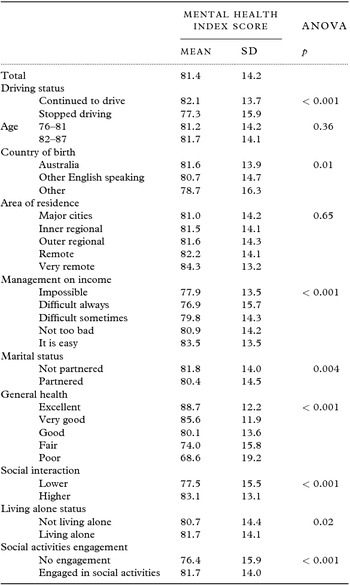
ANOVA results are presented in Table 3. Older women who continued to drive had significantly better levels of mental health than those who stopped driving, with a moderate effect size (Cohen's d = 0.32). Lower levels of mental health were associated with poor management on income and poor general health. Higher levels of social interaction and engagement in social activities were associated with significantly higher levels of mental health, with a moderate effect size (Cohen's d = 0.39 and 0.35, respectively).
ANOVA results presenting levels of mental health by driving status, characteristics, and social support factors (N = 4,075)

Driving cessation, social variables, and mental health
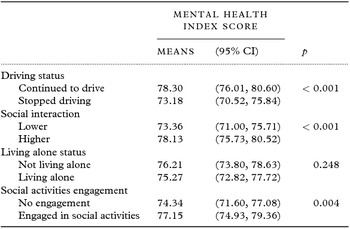
The main effects results of mental health predicted by driving status and social support factors are presented in Table 4. The overall model was statistically significant (F (234,051) = 29.74, p < 0.001), indicating that the variables together significantly predicted mental health. As expected, older women who stopped driving had significantly lower levels of mental health compared to those who continued to drive. Women with higher levels of social interaction had significantly higher levels of mental health compared to those with lower levels of social interaction. Mental health did not differ between women who were living alone compared to women not living alone. Women who engaged in social activities had significantly better mental health than women who had no engagement in social activities.
Multivariate mixed model results presenting least square mean levels of mental health by driving status, social support, living alone status, and social activities engagement

Controlled for participant characteristics, which included age, country of birth, area of residence, management of income, marital status, and general health.
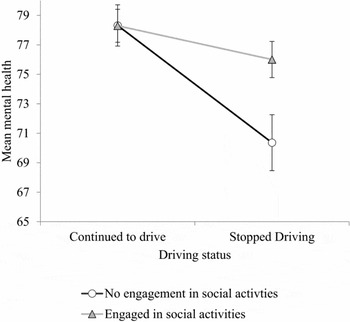
There was a significant interaction effect of driving status by social activities engagement on mental health. This interaction is plotted in Figure 1. Driving cessation had a negative effect on the women's level of mental health. However, women who remained active in social activities were able to maintain a higher level of mental health despite driving cessation. There was no significant interaction effect of driving status by social interaction or driving status by living alone status on mental health.
Interaction effects of driving status and engagement in social activities on levels of mental health.

Discussion
Findings indicated that women who ceased driving reported poorer mental health than those who continued. However, those with higher levels of social interactions and engagement in social activities after driving cessation were able to maintain good levels of mental health. These findings support the role of social support as a buffer to declining mental health in older women who cease driving.
Cessation of driving in late adulthood is associated with a range of negative outcomes and may signal a reduction in independence for older adults. In particular, older women are more likely to be widowed and thus unable to rely on a spouse to provide access to transport. The role of friends and family to provide both transport options and social support may become increasingly important, as borne out by the findings of this paper.
The need for older adults to cease driving in the face of physical and cognitive decline is a potential risk to maintain mental health and social engagement. It is generally accepted that the people affected by dementia are likely to need to cease driving at some stage in the disease process (Breen et al., Reference Breen, Breen, Moore, Breen and O'Neill2007). Interventions to improve outcomes for older adults with and without cognitive impairment who need to cease driving include participation in structured driving cessation programs (Liddle et al., Reference Liddle, Bennett, Allen, Lie, Standen and Pachana2013; Reference Liddle, Haynes, Pachana, Mitchell, McKenna and Gustafsson2014). However, interventions aimed at keeping older adults engaged in social activities, and in the maintenance of social networks, prior to having to contemplate or enact driving cessation, may have a positive effect on maintaining mental health in the face of such a change.
There are a number of limitations that should be noted in this paper. The findings may not relate to men as studies have shown gender differences in factors related to driving cessation (D'Ambrosio et al., Reference D'Ambrosio, Donorfio, Coughlin, Mohyde and Meyer2008; Choi et al., Reference Choi, Mezuk, Lohman, Edwards and Rebok2012). The older women in the ALSWH are relatively in good health; therefore, results may not be generalizable to individuals with more severe disabilities (Lee et al., Reference Lee2005). Because not all relevant questions were included at each survey, combining survey responses into baseline and follow-up does not account for temporality associated with driving cessation. For example, there may be a period of adjustment immediately following cessation in which mental health and social factors decline, but which then rebounds to pre-driving cessation levels as the women adjust and replace their ability to drive with other modes of transport. The analyses also do not account for government-funded interventions that provide driving services for women who are unable to drive. Data on reasons for ceasing driving (e.g. recent move or health or financial issues) as well as date of driving cessation were not collected in ALSWH. Nor do the surveys include questions about the role of friends or family in providing alternatives to self-driving. Some authors have described friends as being more important providers of instrumental support to older adults than family members (Warburton and McLaughlin, Reference Warburton and McLaughlin2005). Regardless of the source, this paper clearly describes the maintenance of social interactions and engagements as important buffers to the decline of mental health in older women who no longer drive.
Conflict of interest
None.
Description of authors’ roles
N. Pachana designed the study; J. Leung, P. Gardiner, N. Pachana, and D. McLaughlin were responsible for statistical design and J. Leung was responsible for carrying out the statistical analysis. All authors contributed to writing the manuscript.
Acknowledgments
The Australian Longitudinal Study on Women's Health was conceived and developed by groups of interdisciplinary researchers at the Universities of Newcastle and Queensland. We thank all participants for their valuable contribution to the study. This work was supported by the Australian Government Department of Health and the Australian National Health and Medical Research Council – Australian Research Council (Dementia Research Development Fellowship to Paul Gardiner #1103311).