Introduction
Seed reserves play vital roles in seed germination, seedling growth and survival of individuals which directly determine if the population can regenerate successfully (Lamont and Groom, Reference Lamont and Groom2013; Cheng et al., Reference Cheng, Cheng and Wang2015). The physiological and morphological processes of seed germination depend highly on seed reserves (Soltani et al., Reference Soltani, Gholipoor and Zeinali2006; Bewley et al., Reference Bewley, Bradford, Hilhorst and Nonogaki2013; Cheng et al., Reference Cheng, Cheng and Wang2015). Carbon (C), nitrogen (N) and phosphorus (P) are indispensable elements for plant growth (Bu et al., Reference Bu, Jia, Qi, Liu, Xu, Ge and Wang2018). C is the main element to form dry matter and energetic materials, N is strongly associated with protein content, and P is an indication of the level of nucleic acids (McGinley and Charnov, Reference McGinley and Charnov1988; Elser et al., Reference Elser, Sterner, Gorokhova, Fagan, Markow, Cotner, Harrison, Hobbie, Odell and Weider2000; Soriano et al., Reference Soriano, Orozco-Segovia, Márquez-Guzmán, Kitajima, Gamboa-de Buen and Huante2011). C, N and P allocation of plant roots, stems and leaves have been widely investigated (Jackson et al., Reference Jackson, Mooney and Schulze1997; Kerkhoff et al., Reference Kerkhoff, Fagan, Elser and Enquist2006; Reich et al., Reference Reich, Tjoelker, Pregitzer, Wright, Oleksyn and Machado2008; Rong et al., Reference Rong, Liu, Cai and An2015), but has been rarely studied in seeds (Lamont and Groom, Reference Lamont and Groom2013; Bu et al., Reference Bu, Jia, Qi, Liu, Xu, Ge and Wang2018).
As another important trait associated with nutrient allocation of seeds, seed mass has been associated with germination strategy, soil seed bank composition, seedling growth, etc. (Peco et al., Reference Peco, Traba, Levassor and Sánchez2003; Kidson and Westoby, Reference Kidson and Westoby2000; Turnbull et al., Reference Turnbull, Philipson and Purves2012; Zhang et al., Reference Zhang, Willis and Burghardt2014). In many studies it has been argued that smaller seeds germinate more rapidly, have higher percentage of germination, represent a larger proportion in the permanent soil bank, and produce smaller seedlings with rapid relative growth but lower survival rate (Susko and Lovettdoust, Reference Susko and Lovettdoust2000; Poorter and Rose, Reference Poorter and Rose2005; Turnbull et al., Reference Turnbull, Philipson and Purves2012). Thus, seed mass and seed reserves might influence seed germination and early seedling growth with different nutrient elements playing parts in it. The question then arises if the differences in seedling growth and survival between larger and smaller seeds are caused by differences in C, N and P allocation of seeds.
The accumulation of C, N and P in seeds is influenced by diverse environmental factors, such as CO2 (He et al., Reference He, Flynn, Wolfe-Bellin, Ffang and Bazzaz2005), drought (Dornbos and Mullen, Reference Dornbos and Mullen1992), light (Mathew et al., Reference Mathew, Herbert, Zhang, Rautenkranz and Litchfield2000), temperature (Nayyar et al., Reference Nayyar, Bains, Kumar and Kaur2010; Xu et al., Reference Xu, Singh, Barnaby, Buyer, Reddy and Sicher2016), and latitude (Frenne et al., Reference Frenne, Kolb and Graae2011). The environment at different altitudes varies strongly in temperature, light, precipitation, and CO2 concentration (Li and Yuan, Reference Li and Yuan2012). This environmental variation will exert selective pressure on plant growth, survival, physiological regulation, and result in adaptive evolution (Lord, Reference Lord1994). In our previous studies, seeds collected from the study site in this paper showed a decreasing tendency in weight with increasing altitude (Bu et al., Reference Bu, Chen, Xu, Liu, Jia and Du2007). Baker (Reference Baker1972) suggested that the lighter seeds might be the result of a short growing season at high altitude which provides inadequate time for plants to produce and stock nutrient materials. Thus, nutrient allocation of seeds across species might be influenced by altitude and seed mass for their close connection with plant growth and survival.
In addition, Lord et al. (Reference Lord, Westoby and Leishman1995) hypothesized that species from the same ancestor tend to have similar attributes and appear at similar habitats. Phylogenetic history has a strong limitation on the variation of plant traits to adapt independently to the environment (Lord, Reference Lord1994). Many studies have addressed the constraint of phylogeny on plant traits, such as seed mass, fleshy-fruit traits, seed germinability and flowering phenology (Grime et al., Reference Grime, Mason, Curtis, Rodman and Band1981; Jordano, Reference Jordano1995; Jia et al., Reference Jia, Bayaerta, Li and Du2011; Qi et al., Reference Qi, Guo and Chen2014). However, few studies have addressed the phylogenetic limitation on C, N and P allocation of seeds (Bu et al., Reference Bu, Jia, Qi, Liu, Xu, Ge and Wang2018). Many studies have indicated that the nutrient allocation of seeds might be controlled by phylogenetic history. For example, seeds from Brassicaceae have higher oil content and those from Fabaceae have higher protein content (Salisbury et al., Reference Salisbury, Potter, Gurung, Mailer and Williams2018; Dornbos and Mullen, Reference Dornbos and Mullen1992). Thus, the variation in nutrient allocation of seeds collected from an alpine meadow was predicted to be controlled by the phylogenetic groups. In view of the fact that plants within a lineage might be shaped by diverse environmental factors during evolution, the evolutionary direction of nutrient allocation of seeds across species with different clade age should be considered.
Here, the evolutionary correlation between seed mass and altitude on C, N and P allocation of seeds from 253 species was tested. The following questions were addressed: (1) Do seed mass, altitude and phylogenetic history influence nutrient allocation of seeds? (2) If yes, are the effects of altitude and seed mass affected by phylogenetic history? Do altitude and seed mass have independent and interactive effects on nutrient allocation of seeds?
Materials and methods
Study area
The study area is situated on the northeastern edge of Qinghai-Tibet plateau in China (100°44′–104°45′ E, 33°06′–35°34′). The main vegetation types include alpine meadow, shrub and forest, where it is altitudinal (altitude: 2000 to 4200 m) and cold (annual average temperature of 1.2°C and annual average 270 frost days) with annual precipitation of 450–780 mm and short growing season (from late May to late September) (Zhang et al., Reference Zhang, Willis and Burghardt2014; Bu et al., Reference Bu, Wang, Zhou, Chen, Wang, Xu and Liu2016).
Data set
Mature seeds of 253 species (40 families) were all collected from an alpine meadow from August to September in 2015. Seeds of all species were collected randomly and seeds from over 30 plants (at site within 50 m altitude difference) of each species were mixed. Intact seeds were screened out and stored in envelopes and oven-dried to constant weight after which seed mass and nutrient content were measured. Seed mass of each species was defined as the average hundred-seed weight of three samples from the same site. Dry combustion was used to measure C and N content whereas the molybdenum blue method was used to measure P content as described in Bu et al. (Reference Bu, Jia, Qi, Liu, Xu, Ge and Wang2018). The C, N and P contents (percentage) were used to estimate the nutrient allocation of seeds.
Statistical analysis
Altitude, seed mass and C, N and P contents were log-transformed. Bivariate correlations were used to estimate if nutrient allocation of seeds changed with increasing altitude (Spearman's correlation coefficient) and seed mass (Pearson's correlation coefficient). The partial correlations were used to determine the interactions or associations between seed mass and altitude on nutrient allocation.
Considering phylogenetic limitations on seed mass and nutrient allocation, Pagel's lambda (Pagel, Reference Pagel1999) was used to test the phylogenetic signals in C, N and P allocation of seeds. Phylogenetically independent contrasts (Felsenstein, Reference Felsenstein1985) were conducted to assess the net correlations between C, N and P allocation and seed mass (or altitude). Lambda values were tested using likelihood ratio tests, P values showing maximum likelihood values of lambda were significantly greater than 0. Furthermore, the linear correlation between C, N and P allocation and age of clade (genus-level age) calculated by PICs (log-transformed) was determined to evaluate the evolutionary history of nutrient allocation of seeds.
Based on the Phylomatic tree R20120829 for plants with APG Ш (2009), PICs were conducted by Phylocom version 4.2 (Webb et al., Reference Webb, Ackerly and Kembel2008). Phylogenetic signal and analysis was conducted through the package ‘picante’ of R statistical software v3.3.1 (R Development Core Team, 2016). The bivariate and partial correlations were analysed by SPSS 17.0.
Results
In this study, we observed great variations in C, N and P allocation of seeds among species and even among families (seed supplement file). C, N and P contents of seeds across 253 species varied from 39.46 to 76.68%, from 1.25 to 9.49% and from 0.09 to 1.47%, respectively. The coefficients of variation in C, N and P contents among species were 12.3, 35.2 and 42.9%, and those among families were 12.2, 26.3 and 37.0%, respectively.
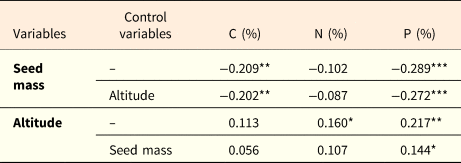
The smaller seeds tended to have higher C and P contents, and seeds from higher altitude tended to have higher N and P contents (Table 1). The partial correlations indicate that altitude and seed mass had interactive effects on the contents of C, N and P (Table 1). When altitude was kept constant, the correlation coefficients between nutrient contents (C, N and P) and seed mass decreased by 3.3, 14.7 and 5.9%, whereas the correlation associated with altitude decreased by 50.4, 33.1 and 33.6% when seed mass was kept constant (Table 1).
Correlations between the C, N and P allocation of seeds and altitude (or seed mass), and partial correlations between them when altitude or seed mass was kept constant among 253 species

*Significant at P < 0.05, **significant at P < 0.01, ***significant at P < 0.001, unmarked is not significant.
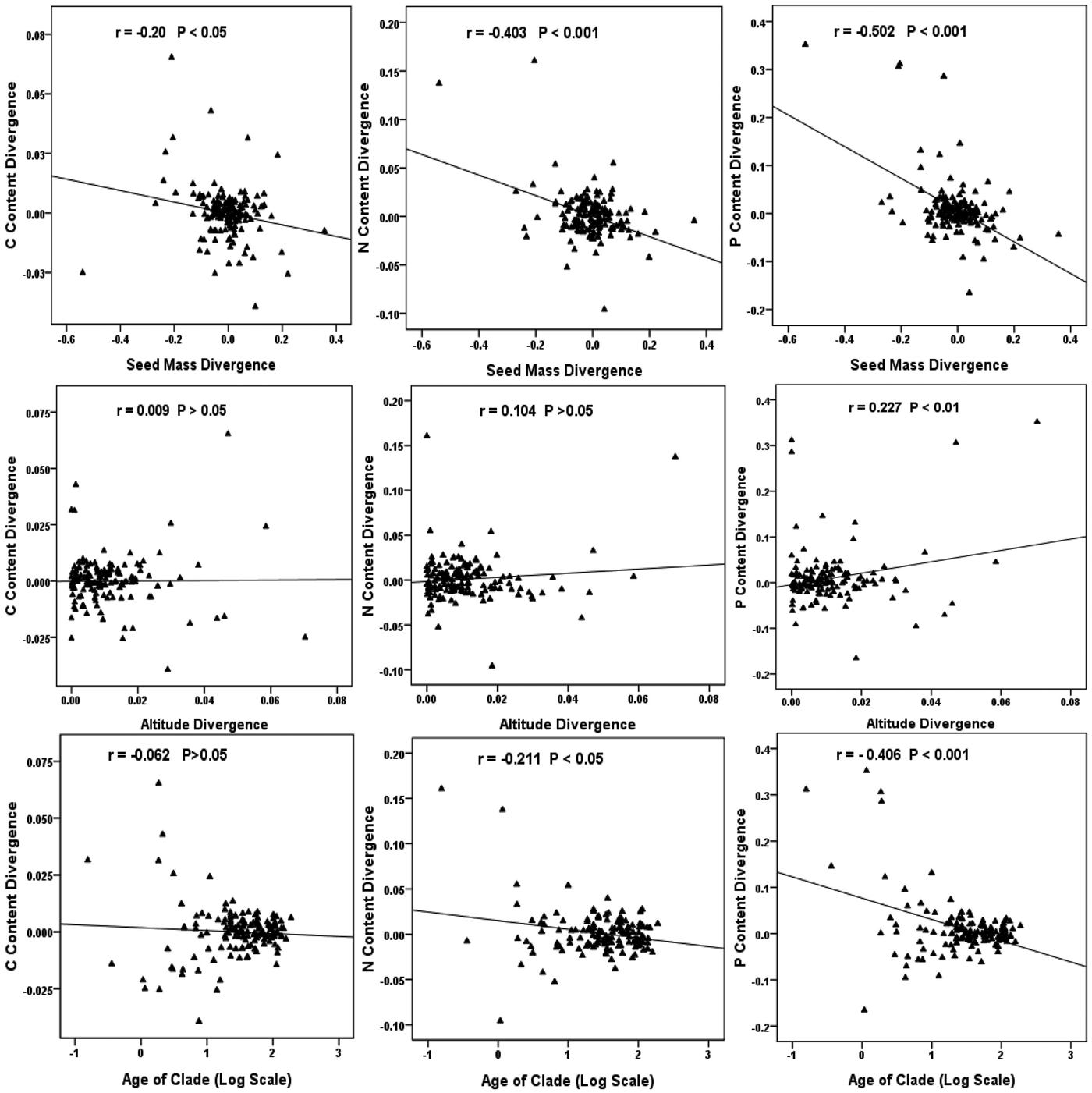
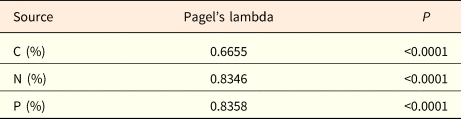
Significant phylogenetic signals in nutrient allocation of seeds were found (Table 2). PIC analyses produced 148 nodes. Pearson's correlations between the standardized independent contrasts of each node indicated that the influence of altitude and seed mass on nutrient allocation of seeds was independent of phylogeny (Fig. 1). When phylogeny was taken into consideration, C and N contents had no significant variation tendency with altitude, but a significant positive correlation between P content and altitude was found (Fig. 1). Interestingly, the effect of seed mass on C, N and P allocation was greater when the effect of phylogeny was removed. C, N and P allocation of seeds all correlated significantly negatively with seed mass. In addition, the N and P contents correlated significantly negatively with age of clade, whereas the C contents displayed no significant correlation.
Divergence in C, N and P contents (log scale) correlated with divergence in seed mass, altitude and age of clade (log scale) for 148 nodes produced by PIC analysis. Three of the 253 species (only at family level) were not considered in PIC analyses.

Phylogenetic signals of the C, N and P allocation of seeds across 253 species; three of the 253 species (only at family level) were not considered in the analysis

Discussion
Seed mass correlations
Storage materials of seeds play a crucial role in a plant's history because seeds must provide sufficient nutrients for seed germination and primary growth until seedlings become autotrophic and established (Suda and Giorgini, Reference Suda and Giorgini2000; Ichie et al., Reference Ichie, Ninomiya and Ogino2001; Soltani et al., Reference Soltani, Gholipoor and Zeinali2006; Bewley et al., Reference Bewley, Bradford, Hilhorst and Nonogaki2013; Cheng et al., Reference Cheng, Cheng and Wang2015). Here, C and P contents decreased with seed mass irrespective of altitude and phylogeny (Table 1). This result was consistent with that of Grubb and Burslem (Reference Grubb and Burslem1998). Carbohydrates, lipids and proteins are three main nutrient components of seeds (Soriano et al., Reference Soriano, Orozco-Segovia, Márquez-Guzmán, Kitajima, Gamboa-de Buen and Huante2011). The C content of the three nutrients are in the order: carbohydrates, proteins and lipids. Thus, the higher C content in smaller seeds might represents higher contents of lipids which contain more than twice the energy of non-structural carbohydrates or proteins (Soriano et al., Reference Soriano, Orozco-Segovia, Márquez-Guzmán, Kitajima, Gamboa-de Buen and Huante2011). A higher lipid content may provide more energy for primary growth which is especially important to species with smaller seeds. Compared with larger-seeded species, smaller-seeded species have a weaker competitive capacity because the primary growth of seedlings completely relies on seed reserves (Soriano et al., Reference Soriano, Orozco-Segovia, Márquez-Guzmán, Kitajima, Gamboa-de Buen and Huante2011). Many studies report a negative correlation across species of seedling relative growth rate and seed mass (Paz and Martínezramos, Reference Paz and Martínezramos2003; Poorter et al., Reference Poorter, Wright, Paz, Ackerly, Condit and Ibarra-Manríquez2008). Thus, the rapid growth of seedlings from smaller seeds was expected to be caused by the difference in nutrient contents compared with larger seeds. In addition, as an essential material for cell differentiation and plant growth, P content reflects nucleic acid content but is also important for the synthesis of sugar-phosphate intermediates of photosynthesis and respiration (Slot et al., Reference Slot, Palow and Kitajima2013). Many studies also implicate that higher P content in smaller seeds could provide sufficient ribosomes for fast seed germination and rapid initial growth (Nedel et al., Reference Nedel, Ullrich and Pan1996; Elser et al., Reference Elser, Acharya, Kyle, Cotner, Makino, Markow, Watts, Hobbie, Fagan, Schade, Hood and Sterner2003; Soriano et al., Reference Soriano, Orozco-Segovia, Márquez-Guzmán, Kitajima, Gamboa-de Buen and Huante2011). Therefore, higher C and P content in smaller seeds may point to adaptive selection of species for survival and preservation.
Altitude correlations
Storage materials of seeds may vary temporally and spatially with the environmental conditions experienced by the mother plant (Oluwatosin, Reference Oluwatosin1997; Soriano et al., Reference Soriano, Orozco-Segovia, Márquez-Guzmán, Kitajima, Gamboa-de Buen and Huante2011; Xu et al., Reference Xu, Singh, Barnaby, Buyer, Reddy and Sicher2016). For example, Dornbos and Mullen (Reference Dornbos and Mullen1992) found that drought and high temperature increased protein content and decreased oil content of soybean; Sakla et al. (Reference Sakla, Ghali and El-Farrar1988) found that soybean from lower altitude had higher content of carbohydrates and lower protein content; Wardlaw and Dunstone (Reference Wardlaw and Dunstone1984) suggested that drought and low temperature induced seeds to accumulate soluble sugar. Here, altitude had an indistinct impact on C content but displayed significant positive effects on the contents of N and P, but especially on the variation of P content. Irrespective of phylogeny and seed mass, seeds from higher altitude tended to have higher P content (Table 1, Fig. 1). With increasing altitude, the climate becomes more adverse and unstable, which is risky for plant growth and survival, especially for initial growth (Giménez-Benavides et al., Reference Giménez-Benavides, Escudero and Iriondo2008; Poll et al., Reference Poll, Naylor, Alexander, Edwards and Dietz2009). Furthermore, the short growth season of high altitude areas causes species to have less chance of population regeneration and higher risk of discontinuing their life cycle (Zhang et al., Reference Zhang, Du and Chen2004). If species from high altitude areas had rapid initial growth, they would take the opportunity to recruit seedlings and, subsequently, spread population. Hence, the high content of P in seeds of species from high altitude areas might be the result of natural selection for rapid initial growth.
In the present study, partial correlations between altitude and seed mass showed overlapping effects on nutrient allocation of seeds (Table 1). The relationship between nutrient allocation and seed mass were affected only slightly by altitude. Whether the effect of altitude was considered or not, seed mass correlated significantly negatively with seed C and P contents (Table 1). Thus, higher C and P contents in smaller seeds might be more important to plant growth than alteration of the environment caused by altitude. Furthermore, when the effect of seed mass was considered, the relationship between seed N contents and altitude became indistinct, yet altitude had a significant positive effect on P content (Table 1). Therefore, the higher P content might be an adaptive selection to species from higher altitude.
Phylogenetic history correlations
Here, C, N and P allocation across species showed significant phylogenetic signals that suggest strong effects of ancestors (Table 2). In other words, lineage history forced limitations on variability in nutrient allocation of seeds within a clade. However, C, N and P allocation showed large variation across species among families and even within a family. For example, the seed N content of Ranunculaceae ranged from 1.52 to 5.17%, the C content from 52.12 to 72.58%, and the P content from 0.09 to 0.82%. Similarly, seeds from other families also showed significant variation in nutrient contents (see supplementary material). One possible reason for the large variation in nutrient contents across species might be due to natural selective pressure and co-evolution of traits. Although progeny of each species tends to maintain their ancestral traits (Lord et al., Reference Lord, Westoby and Leishman1995), many studies found that plant traits, such as seed germination, flowering phenology and seed size, may be shaped by habitat conditions (Jordano, Reference Jordano1995; Giménez-Benavides et al., Reference Giménez-Benavides, Escudero and Iriondo2008; Qi et al., Reference Qi, Guo and Chen2014) and co-evolve with other traits (Grime et al., Reference Grime, Mason, Curtis, Rodman and Band1981; Zhang et al., Reference Zhang, Du and Chen2004; Jia et al., Reference Jia, Bayaerta, Li and Du2011; Qi et al., Reference Qi, Guo and Chen2014). In this study, when the effect of phylogeny was removed (PIC analyses), contents of C and N were indistinct but P content was still significantly affected by altitude (Fig. 1), whereas the effects of seed mass on C, N and P contents were all enhanced significantly. Hence, adaptive selection or coevolution of characteristics played a part in the variation of nutrient allocation of seeds although phylogeny imposed strong constraints to maintain the traits inherited from ancestors. In addition, N and P contents showed significant negative correlations with age of clade among the 253 species. In other words, species from younger phylogenetic groups had higher N and P contents. As mentioned earlier, higher N and P contents are beneficial to improve the vigor, growth rate and survival of seedlings (Elser et al., Reference Elser, Acharya, Kyle, Cotner, Makino, Markow, Watts, Hobbie, Fagan, Schade, Hood and Sterner2003). Thus, species with higher N and P contents of seeds might be more likely to be preserved because they have a better chance of survival and stronger competitive capacity. However, each nutrient is irreplaceable and each is important to seed germination and seedling growth, thus there should be a trade-off among various nutrients. The optimal C:N:P ratio of seeds will be investigated in future studies.
Supplementary material
To view supplementary material for this article, please visit https://doi.org/10.1017/S0960258518000387.
Author ORCIDs
Hai-Yan Bu 0000-0001-9944-475X.
Acknowledgements
This work was supported by the National Key R&D Program of China (2017YFC0504801) and the Nature Science Fund of China (41171046, 31600329, 31670437).