Introduction
Corporate philanthropy has become an increasingly salient topic in strategic management research (Brammer & Millington, Reference Brammer and Millington2008; Marquis & Tilcsik, Reference Marquis and Tilcsik2016; Porter & Kramer, Reference Porter and Kramer2002; Wang, Choi, & Li, Reference Wang, Choi and Li2008). Philanthropic donations often involve the direct diversion of financial resources away from core business activities and are viewed as discretionary expenditures (Gautier & Pache, Reference Gautier and Pache2015). Consistent with this characterization, prior research mainly portrays the relationship between financial performance and philanthropic donation intensity as positive and linear, with well-performing firms contributing more and underperforming firms contributing less (McGuire, Sundgren, & Schneeweis, Reference McGuire, Sundgren and Schneeweis1988; Preston & O’bannon, Reference Preston and O’bannon1997). Stakeholders similarly expect well-performing firms to devote more resources to philanthropic activities, whereas firms performing poorly are expected to allocate their limited resources to strengthening core business operations rather than discretionary social initiatives (Hong, Kubik, & Scheinkman, Reference Hong, Kubik and Scheinkman2012; Koh, Qian, & Wang, Reference Koh, Qian and Wang2014).
However, these insights from previous studies may not fully capture the complexity of the relationship between financial performance and philanthropic donation intensity. Although previous studies consider stakeholder expectations as a form of legitimacy pressure driving firms’ philanthropy engagement, the role of competitive pressure has been relatively overlooked. This omission is important because well-performing firms may simultaneously encounter heightened competitive pressure due to aspirational economic expectations to continuously maintain their competitive position and avoid performance decline, consistent with the Red Queen effect (Mishina, Dykes, Block, & Pollock, Reference Mishina, Dykes, Block and Pollock2010; Shinkle, Reference Shinkle2012; Wiengarten, Fan, Pagell, & Lo, Reference Wiengarten, Fan, Pagell and Lo2019). In such an environment, the fear of performance decline may lead firms to prioritize resource allocation toward initiatives directly linked to sustaining or enhancing financial returns, potentially crowding out discretionary investments in philanthropic donations.
Our study thus develops a framework that integrates both legitimacy and competitive pressures to explain the influence of financial performance on philanthropic donation intensity. We suggest that the joint influences of legitimacy and competitive pressures may shape the nonlinear relationship between financial performance above aspiration and philanthropic donation intensity. We focus on financial performance above aspiration because stakeholder expectations and the pressures they exert are typically shaped through comparisons with referent firms rather than assessments of absolute performance (Krishnan & Kozhikode, Reference Krishnan and Kozhikode2015; Mishina et al., Reference Mishina, Dykes, Block and Pollock2010). Absolute performance captures a firm’s internal efficiency, but fails to account for the fact that legitimacy and competitive pressures are socially constructed in reference to others.
Specifically, we argue that as firms begin to surpass their aspiration levels, philanthropic donation intensity tends to rise, primarily because superior performance heightens visibility and intensifies legitimacy pressure from stakeholders who expect successful firms to ‘give back’ to society. As performance continues to improve, however, competitive demands to sustain or surpass prior results increasingly redirect resources toward core operations, slowing the growth of philanthropic donation intensity. Yet this crowding-out influence does not fully eliminate the increasing trend of corporate philanthropy. We thus propose that the joint influences of legitimacy and competitive pressures may result in a log-linear, rather than inverted U-shaped, relationship between financial performance above aspiration and philanthropic donation intensity. Due to the institutionalized and obligation-based nature of philanthropy, legitimacy pressure remains dominant, ultimately resulting in a pattern of growth at a decreasing rate. This institutionalized character is also evident in our context of China, where philanthropic donation is not merely discretionary but is widely regarded as a social obligation. For instance, after the 2008 Wenchuan earthquake, Vanke faced backlash and was branded ‘wealthy but lacking benevolence’ for its modest donation, forcing it to increase contributions. Similarly, during COVID-19, Alibaba and Tencent, China’s most prominent e-commerce and technology companies, were widely expected to donate heavily, with delays or limited gestures drawing public and regulatory criticism.
To further elucidate the influences of legitimacy and competitive pressures, we examine two moderators: state ownership, which tends to amplify legitimacy pressure while dampening competitive pressure, and level of market competition, which is likely to intensify competitive pressure and attenuate legitimacy pressure. We suggest that for firms with state ownership, philanthropic donation intensity increases with financial performance above aspiration at a faster pace and levels off more slowly. In the Chinese institutional context, such firms are expected to align closely with government priorities for social welfare (Greve & Zhang, Reference Greve and Zhang2017; Marquis & Qian, Reference Marquis and Qian2014; Wang, Jia, Xiang, & Lan, Reference Wang, Jia, Xiang and Lan2022). As a result, they are more attuned to legitimacy pressure to increase philanthropic donation intensity and less preoccupied with the risk of performance decline. By contrast, we argue that for firms operating in more competitive markets, philanthropic donation intensity increases with financial performance above aspiration at a slower pace and levels off more quickly. Under greater market competition, firms are more sensitive to competitive pressure, as sustaining superior performance becomes more challenging. Moreover, under this condition, stakeholders may temper their expectations for philanthropic contributions, acknowledging that firms should prioritize core business operations to preserve their market position.
Our study makes several contributions. First, our study extends the view on the relationship between corporate financial performance and philanthropic donation intensity by problematizing the dominant assumption of a linear and positive linkage (Hong et al., Reference Hong, Kubik and Scheinkman2012; Surroca, Tribó, & Waddock, Reference Surroca, Tribó and Waddock2010; Waddock & Graves, Reference Waddock and Graves1997). We argue that the previous view overlooks the countervailing role of competitive pressure that accompanies superior performance. Second, we contribute to the emerging literature on financial performance above aspiration. Our study moves beyond the conventional view that financial performance above aspiration simply reflects excess resources that facilitate slack search (Blagoeva, Mom, Jansen, & George, Reference Blagoeva, Mom, Jansen and George2020; Cyert & March, Reference Cyert and March1963; Xu, Zhou, & Du, Reference Xu, Zhou and Du2019). Instead, we develop a legitimacy-competition dual pressure framework, which integrates institutional legitimacy demands with market-based competitive forces to theorize how firms respond when surpassing their performance benchmarks. In doing so, we provide a more comprehensive understanding of the behavioral implications of financial performance above aspiration, particularly in relation to firms’ socially oriented actions.
Theoretical Background and Hypotheses Development
The Relationship Between Corporate Financial Performance and Philanthropic Donation Intensity
The relationship between corporate financial performance and philanthropic donation intensity has attracted extensive scholarly attention in the strategic management and corporate social responsibility (CSR) literature. Prior research has examined whether and how a firm’s financial outcomes influence its philanthropic donation intensity, producing a substantial body of evidence across various contexts (Seifert, Morris, & Bartkus, Reference Seifert, Morris and Bartkus2004; Waddock & Graves, Reference Waddock and Graves1997). This stream of research generally converges on the view that corporate financial performance serves as a critical antecedent of philanthropic donation intensity, positioning philanthropy as a discretionary strategic action that is sensitive to resource availability and stakeholder expectations (Margolis, Elfenbein, & Walsh, Reference Margolis, Elfenbein and Walsh2009).
A predominant view within this literature posits a positive association between corporate financial performance and philanthropic donation intensity. Scholars adopting a legitimacy perspective argue that well-performing firms face heightened normative pressure and institutional pressure to contribute to societal welfare (Suchman, Reference Suchman1995). From an institutional theory standpoint, superior financial results enhance a firm’s visibility, thereby increasing public scrutiny and stakeholder expectations regarding its social contributions (Brammer & Millington, Reference Brammer and Millington2008). This visibility heightens the firm’s need to maintain or strengthen legitimacy by demonstrating social responsibility through philanthropic donation intensity (Bansal & Clelland, Reference Bansal and Clelland2004). Additionally, slack resources theory offers a complementary explanation: strong financial performance generates excess resources that can be allocated to non-core but strategically beneficial activities, such as philanthropy (Cyert & March, Reference Cyert and March1963; Waddock & Graves, Reference Waddock and Graves1997; Zhang, Li, Jiang, Zhang, Hu, & Liu, Reference Zhang, Li, Jiang, Zhang, Hu and Liu2018). These discretionary resources allow firms to respond to institutionalized norms of corporate citizenship without jeopardizing operational efficiency. In other words, profitable firms possess greater latitude to engage in philanthropy, which not only reinforces their legitimacy but also fosters stronger stakeholder relationships, augments reputational capital, and mitigates potential regulatory or activist pressures (Godfrey, Reference Godfrey2005; Luo & Bhattacharya, Reference Luo and Bhattacharya2006). Empirical studies grounded in these perspectives have consistently found that firms with stronger financial outcomes tend to exhibit higher levels of philanthropic donation intensity (Hong et al., Reference Hong, Kubik and Scheinkman2012; Waddock & Graves, Reference Waddock and Graves1997). Taken together, most prior work aligns around the view that good financial performance facilitates philanthropic donation intensity by providing both the resources and the legitimacy incentives for philanthropic engagement.
Importantly, the salience of legitimacy pressure is not uniform across institutional contexts. In the Chinese institutional environment, corporate philanthropy is embedded in broader state–society relations and carries stronger normative and political expectations than in many market-based economies. Philanthropic engagement is often regarded as an implicit social obligation associated with corporate success and responsible citizenship. Consequently, firms that achieve superior financial performance are subject not only to market scrutiny but also to heightened societal and governmental expectations regarding their contributions to public welfare. These institutionalized expectations increase the reputational and political costs of insufficient philanthropic engagement, thereby strengthening the influence of legitimacy considerations on firms’ resource allocation decisions. As a result, legitimacy pressure in China may exert a more salient and stable influence on corporate philanthropy than the discretionary logic assumed in prior research.
Despite these insights, the prevailing legitimacy-based explanation may provide only a partial account of the influence of corporate financial performance on philanthropic donation intensity. Prior studies largely emphasize legitimacy and slack resources while overlooking the potential role of competitive pressure. Firms with superior financial performance, particularly those performing above reference points, often face intensified expectations to sustain or exceed prior results. Consistent with the Red Queen effect, such competitive dynamics require firms to continuously invest in core operational and strategic initiatives to maintain their relative position, which may redirect managerial attention and resources away from discretionary activities such as philanthropy. These competitive demands may therefore crowd out corporate philanthropy, suggesting that the relationship between financial performance and philanthropic donation intensity may not be strictly linear. Therefore, we address this limitation in previous studies by incorporating competitive pressure. As will be elaborated in the subsequent sections, we suggest a log-linear relationship between financial performance above aspiration and philanthropic donation intensity.
Financial Performance Above Aspiration and Philanthropic Donation Intensity
Through the lens of legitimacy pressure, firms with financial performance above aspiration may face heightened expectations from stakeholders (Deephouse & Carter, Reference Deephouse and Carter2005; Suchman, Reference Suchman1995). These stakeholders tend to view such firms as possessing not only greater capacity but also greater responsibility to contribute to societal welfare (Bansal & Clelland, Reference Bansal and Clelland2004; Margolis & Walsh, Reference Margolis and Walsh2003). In this sense, financial performance above aspiration amplifies legitimacy pressure by signaling both capability and obligation for prosocial conduct (Godfrey, Merrill, & Hansen, Reference Godfrey, Merrill and Hansen2009; Jeong & Kim, Reference Jeong and Kim2019; Wang & Qian, Reference Wang and Qian2011). At the same time, firms with financial performance above aspiration may also contend with mounting competitive pressure that constrains their philanthropic donation intensity. From the perspective of competitive pressure, financial performance above aspiration does not merely signal success but also sets a new benchmark that firms are expected to sustain, or even surpass (Barnett & Hansen, Reference Barnett and Hansen1996; Mishina, Pollock, & Porac, Reference Mishina, Pollock and Porac2004). This expectation gives rise to the Red Queen effect, wherein firms must invest relentlessly in innovation, efficiency, and strategic repositioning simply to preserve their competitive standing (Barnett & Pontikes, Reference Barnett and Pontikes2008). Firms with financial performance above aspiration may be compelled to allocate more resources toward strengthening core business activities, thereby limiting philanthropic donation intensity (Adams & Hardwick, Reference Adams and Hardwick1998; Galaskiewicz, Reference Galaskiewicz1997; Jeong & Kim, Reference Jeong and Kim2019; Marquis & Lee, Reference Marquis and Lee2013).
Taken together, the legitimacy pressure and competitive pressure may lead to a nonlinear relationship between financial performance above aspiration and philanthropic donation intensity. Specifically, when a firm initially exceeds its aspiration level, legitimacy pressure (i.e., stakeholder expectations for ‘giving back to society’) is significantly stronger than competitive pressure, thereby driving rapid growth in philanthropic investment. As performance continues to outpace peers, competitive pressure (i.e., the need to reinvest in core operations to maintain advantages) gradually increases. However, this counterbalancing effect does not fully suppress philanthropic spending when performance is substantially above aspiration. Due to the institutionalized and obligation-based nature of philanthropy, legitimacy pressure remains dominant, ultimately resulting in a pattern of growth at a decreasing rate. This institutionalized character is clearly evident in the Chinese context, where philanthropic donation is not merely discretionary but is widely regarded as a social obligation (Ji, Huang, & Li, Reference Ji, Huang and Li2021; Li, Song, & Wu, Reference Li, Song and Wu2015). Firms with financial performance above aspiration are therefore evaluated not only based on their market achievements but also on the extent to which they contribute to societal welfare. Consequently, even under heightened competitive strain, legitimacy pressure remains sufficiently strong to prevent philanthropic donation intensity from declining, leading to a log-linear relationship. Accordingly, we predict:
Hypothesis 1(H1): Philanthropic donation intensity increases at a decreasing rate with a corporation’s financial performance above aspiration.
As aforementioned, we suggest that the joint effects of legitimacy pressure and competitive pressure result in the hypothesized log-linear relationship between financial performance above aspiration and philanthropic donation intensity. However, the relative salience of these two pressures is likely to vary across firms. We examine two important contingencies, including state ownership and market competition, in the following sections.
Legitimacy Pressure: The Moderating Effect of State Ownership
State ownership is one of the most salient institutional characteristics among firms in China, reflecting the embedded exchange relationship between businesses and the state (Bai, Lu, & Tao, Reference Bai, Lu and Tao2006; Peng & Luo, Reference Peng and Luo2000; Zhang, Marquis, & Qiao, Reference Zhang, Marquis and Qiao2016). Firms with state ownership often benefit from privileged access to critical resources and government protection, including regulatory support and favorable treatment in product markets (Musacchio & Lazzarini, Reference Musacchio and Lazzarini2014; Zhang, Zhou, & Lyles, Reference Zhang, Zhou and Lyles2023; Zhou, Gao, & Zhao, Reference Zhou, Gao and Zhao2017). They function as extensions of the state, tasked with carrying out government policies and advancing public objectives (Xiang, Jia, & Zhang, Reference Xiang, Jia and Zhang2022). As quasi-governmental actors, they are not merely motivated by profit but are also bound by political and social obligations that transcend market considerations.
We posit that for firms with higher levels of state ownership, philanthropic donation intensity increases with financial performance above aspiration at a faster pace and levels off more slowly. First, state-owned firms are more likely to internalize state priorities in their strategic decision-making and face heightened legitimacy expectations to align with national development agendas and broader societal goals (Lin, Fu, & Fu, Reference Lin, Fu and Fu2021). This dual position – as both beneficiaries of state support and agents of state mandate (Chizema, Liu, Lu, & Gao, Reference Chizema, Liu, Lu and Gao2015; Greve & Zhang, Reference Greve and Zhang2017) – renders state-owned enterprises particularly sensitive to legitimacy pressure emanating from social expectations at large (Duan, Xue, Chen, & Liu, Reference Duan, Xue, Chen and Liu2025; Zhong, Ren, & Wu, Reference Zhong, Ren and Wu2024). Further, we suggest that the countervailing effect of competitive pressure tends to be weaker for firms with state ownership. Prior research suggests that state ownership grants firms access to critical resources and government protection and acts as an important bridge between firms and governments (e.g., Kalasin, Cuervo-Cazurra, & Ramamurti, Reference Kalasin, Cuervo-Cazurra and Ramamurti2020; Kalasin, Cuervo-Schuler, Shi, Hoskisson, & Chen, Reference Kalasin, Cuervo-Schuler, Shi, Hoskisson and Chen2017). As noted by Zhou et al. (Reference Zhou, Gao and Zhao2017: 376), ‘governments are among the most salient institutions in emerging economies, with critical influence on regulatory policies and control over scarce resources, so they profoundly shape firms’ competitive environment’. Thus, due to institutional support and policy protection, state-owned enterprises are often buffered from intense market rivalry and face less pressure to reinvest aggressively to maintain their performance edge (Kalasin et al., Reference Kalasin, Cuervo-Cazurra and Ramamurti2020; Kalasin et al., Reference Kalasin, Cuervo-Schuler, Shi, Hoskisson and Chen2017). We thus predict that the increasing trend of the impact of financial performance above aspiration on philanthropic donation intensity will level off more slowly. Accordingly, we propose the following:
Hypothesis 2 (H2): For firms with state ownership, philanthropic donation intensity increases with financial performance above aspiration at a faster pace and levels off more slowly.
Competitive Pressure: The Moderating Effect of Market Competition
Market competition reflects the number and aggressiveness of rivals operating within the same strategic domain (Keats & Hitt, Reference Keats and Hitt1988; Palmer & Wiseman, Reference Palmer and Wiseman1999). Competitive intensity may manifest through price wars, heavy advertising, product diversification, and enhanced service offerings, all of which increase the difficulty for any single firm to secure and sustain a superior market position (Porter, Reference Porter1985). As competition escalates, industry-level information becomes more transparent and readily available, lowering imitation costs and accelerating the diffusion of best practices. This process erodes the distinctiveness of strategic resources and contributes to greater homogeneity across firms (Li, Poppo, & Zhou, Reference Li, Poppo and Zhou2008; Peng, Reference Peng2003). In such highly contested environments, firms face continuous threats to their competitive standing, and the demands of sustaining performance advantages become more difficult.
We posit that when market competition is high, philanthropic donation intensity increases with financial performance above aspiration at a slower pace and levels off faster. Under intense market competition, firms with financial performance above aspiration face a stronger salience of performance vulnerability and are compelled to prioritize resource deployment toward defending market position (Duanmu, Bu, & Pittman, Reference Duanmu, Bu and Pittman2018; Im & Xie, Reference Im and Xie2025). This pressure constrains the conversion of performance surpluses into discretionary philanthropy. Meanwhile, market competition may attenuate legitimacy pressure for philanthropic donation intensity. Stakeholders are not monolithic in their demands; rather, they adapt expectations in response to contextual contingencies. In highly competitive environments, stakeholders often recognize the elevated operational complexities and performance risks firms face, and thus lower their expectations for philanthropic engagement (Hambrick & Finkelstein, Reference Hambrick and Finkelstein1987; Tang, Qian, Chen, & Shen, Reference Tang, Qian, Chen and Shen2015). In this case, stakeholders may view managerial prioritization of core business operations and investment as rational and acceptable (Koh et al., Reference Koh, Qian and Wang2014). Synthesizing these arguments, we thus propose the following:
Hypothesis 3 (H3): For firms facing higher market competition, philanthropic donation intensity increases with financial performance above aspiration at a slower pace and levels off faster.
Methods
Data and Sample
Our initial sample included publicly listed Chinese firms on the Shenzhen and Shanghai Stock Exchanges. Our data stemmed from several databases. Philanthropic donation intensity data were collected from the China Stock Market and Accounting Research (CSMAR). CSMAR is one of the largest databases of publicly listed Chinese firms and a primary source of information about listed firms in China. Data on religion were collected from the Spatial Data CenterFootnote 1, which provides information on religious institutions in China. We used this database to construct our religion-related variables. This database also belongs to the China Data CenterFootnote 2 (CDC) at the University of Michigan. The CDC was founded in 1997 to serve as a high-quality international data center for advanced studies related to China. This center has integrated historical, social, and natural science data into its geographic system. The geographic distribution with the latitude and longitude of religious institutions can be found through the geographic system. In addition, our study controlled for the regional institutional environment. We also specifically collected the market development index (the proxy for institutional development) from the National Economic Research Institute (Wang, Fan, & Yu, Reference Wang, Fan and Yu2017), which was widely used in previous studies (Du, Reference Du2013). Other financial and corporate governance data were obtained from CSMAR. We then merged relevant data from these databases to generate the final sample for testing our hypotheses. Following typical practices of previous studies, observations from banking, insurance, and other financial industries were excluded because of the incomparability of financial sheet structure with other industries (Amir, Kama, & Livnat, Reference Amir, Kama and Livnat2011; Singh & Davidson, Reference Singh and Davidson2003). In addition, the Ministry of Finance of the People’s Republic of China issued the accounting standard for financial industries (related to banks, insurance companies, securities companies, etc.) in 2001. This accounting standard for financial industries differs from that for other industries. The inclusion of observations from finance-related industries may bias our results. Observations with missing data were also removed (Qian, Gao, & Tsang, Reference Qian, Gao and Tsang2015). The resulting data period is 2003–2012. This period is widely regarded as marking a new stage in the development of Chinese corporate philanthropy, a span during which corporate philanthropy was affected by socialism and market coalitions. Ultimately, our final sample comprised 5,041 firm-year observations.
Measures
Dependent variable
Philanthropic donation intensity was measured as corporate philanthropic donations scaled by total assets. Scaling operationalization enables us to control for the effects of firm size because large firms can generally involve larger philanthropy contributions than small firms (Wang et al., Reference Wang, Choi and Li2008).
Independent variable
Financial performance above aspiration
Following prior research (Arrfelt, Wiseman, & Hult, Reference Arrfelt, Wiseman and Hult2013; Mishina et al., Reference Mishina, Dykes, Block and Pollock2010), we utilized the spline function to capture financial performance relative to aspiration based on the difference between firm performance and performance of relevant referent group members (Greene, Reference Greene2003; Greve, Reference Greve2003). Specifically, the spline function was employed to isolate the influences of performance aspiration and investigate the different influences of performance above and below aspiration on philanthropic donation intensity. We used return on assets (ROA) to operationalize the aspiration measure (Harris & Bromiley, Reference Harris and Bromiley2007; Mishina et al., Reference Mishina, Dykes, Block and Pollock2010; Xiang, Zhang, Wang, & Du, Reference Xiang, Zhang, Wang and Du2026). To this end, we introduced the variable of financial performance above aspiration, which is measured as a firm’s ROA minus the financial performance aspiration. To have a better manifestation of the coefficient, we multiplied the financial performance above aspiration by 100. Following the methodology of Martin, Swaminathan, and Mitchell (Reference Martin, Swaminathan and Mitchell1998), we took the natural logarithm of financial performance above aspiration, that is, financial performance above aspiration (LN) in the regression, in order to test the hypothesized log-linear relationship with philanthropic donation intensity. Furthermore, our study focused on the sample with positive financial performance above aspiration because we aimed to investigate how legitimacy pressure and competitive pressure jointly affect philanthropic donation intensity. This joint effect cannot be observed within the sample with negative financial performance above aspiration. In our study, aspiration was defined as ‘the performance of a relevant comparison group’ (Greene, Reference Greene2003; Greve, Reference Greve2003; Mishina et al., Reference Mishina, Dykes, Block and Pollock2010: 707). Previous studies suggested that the two-digit industry classification of a firm’s primary industry was a sound indicator of a relevant comparison group (Porac, Wade, & Pollock, Reference Porac, Wade and Pollock1999). We chose peer firms from the industry with the same two-digit industry classification as the relevant comparison group. Theoretically, competitive pressure in our study was mainly associated with the comparison between a firm and its competitors. This result suggested that peer firms are more informative as a reflection of competitive pressure. We defined the relevant peer group as firms in a given year that had the same two-digit industry classification code as a focal firm (excluding the focal firm). Therefore, aspiration equals the average financial performance of industrial peers.
 \begin{equation*}Aspiratio{n_{it}} = \frac{{\mathop \sum \nolimits_{i \ne j} RO{A_{jt}}}}{{N - 1}}\end{equation*}
where t is the fiscal year, i is the focal firm, j is firms in the same industry (based on two-digit industry classification) as firm i, and N is the total number of firms in the industry. Accordingly, to compute financial performance above aspiration, we subtracted the aspiration level (i.e., the industry peer average ROA) from each focal firm’s ROA. A positive value indicates that a firm is performing above its aspiration level. For interpretability, we multiplied this value by 100 and then took the natural logarithm to capture the hypothesized nonlinear relationship with philanthropic donation intensity. For example, if a focal firm has an ROA of 6%, and the aspiration is 4%, then the financial performance above aspiration is (6% − 4%) = 2%. We multiply this by 100 to obtain 2.0, and take the natural logarithm to yield approximately 0.693 as the final value used in regression analysis.
In addition, we acknowledged that some studies considered the performance of the relative comparison group (social aspiration) and the firm’s past performance (historical aspiration) (e.g., Greve, Reference Greve2003; Harris & Bromiley, Reference Harris and Bromiley2007). They combined the social and historical aspirations into a composite measure. To ensure the robustness of our results, we also ran a set of additional analyses in the section on supplementary tests. The findings suggested that our results are robust to the alternative measure of aspirations.
Moderators
State ownership was a dummy variable coded as 1 if a firm’s ultimate owner was the Chinese government, and 0 otherwise (Marquis & Qian, Reference Marquis and Qian2014; Qian et al., Reference Qian, Gao and Tsang2015; Wang et al., Reference Wang, Choi and Li2008).
Market competition was measured as the natural logarithm transformation of one minus the four-firm concentration ratio scaled by the same ratio (Palmer & Wiseman, Reference Palmer and Wiseman1999; Tang et al., Reference Tang, Qian, Chen and Shen2015). The four-firm concentration ratio was operationalized as the total sales of the four firms with the largest sales in an industry (based on the two-digit industry classification code) divided by the total sales of that industry. The logic behind the formulation is that a low sales concentration indicates high market competition (Keats & Hitt, Reference Keats and Hitt1988).
Control variables
A comprehensive array of control variables was included in our models. First, we controlled for firm size (Jia, Xiang, & Zhang, Reference Jia, Xiang and Zhang2019; Orlitzky, Reference Orlitzky2001; Wang & Qian, Reference Wang and Qian2011), which was measured as the natural logarithm of the total assets of each firm. According to prior research, large firms may increase their philanthropic donation intensity. We controlled for board independence, which was measured as the ratio of the number of independent directors to the board size (Walls, Berrone, & Phan, Reference Walls, Berrone and Phan2012; Zhang, Ruan, & Tong, Reference Zhang, Ruan and Tong2024). Board gender diversity was included to control for its influence on philanthropic donation intensity (Jia & Zhang, Reference Jia and Zhang2013), which was measured as the percentage of female directors on the board (Zhang, Ruan, Tang, & Tong, Reference Zhang, Ruan, Tang and Tong2021). In addition, we controlled for the female CEO to further consider the gender effect (Zhang et al., Reference Zhang, Guo and Nurdazym2023). Moreover, Masulis and Reza (Reference Masulis and Reza2014) found that executives may engage in corporate philanthropic donations that benefit their interests at the expense of shareholders. Thus, we controlled for the managerial ownership (Oh, Chang, & Kim, Reference Oh, Chang and Kim2018), measured as the director-owned share scaled by the firm’s total number of shares. We also controlled for stakeholder-related variables, including employee salary, analyst recommendations, customer concentration, and government subsidies. Employee salary was measured as the average annual salary of employees. Analyst recommendations captured analysts’ reactions, coded as 2, 1, 0, −1, and −2 for Buy, Outperform, Neutral, Underperform, and Sell, respectively (König, Mammen, Luger, Fehn, & Enders, Reference König, Mammen, Luger, Fehn and Enders2018). Analyst recommendations were then calculated as the mean value across all analysts covering the firm. Customer concentration was measured as the proportion of total sales accounted for by the top five customers (Zhong et al., Reference Zhong, Ma, Tong, Zhang and Xie2021). Government subsidies were measured as the natural logarithm of the total subsidies received. In addition, we also controlled historical aspiration of financial performance to ensure that financial performance above aspiration was appropriately defined relative to the firm’s own prior benchmarks. This variable was calculated as the difference between current financial performance and historical aspiration, where historical aspiration was measured using an exponentially weighted moving average of past performance (Greve, Reference Greve2003).
Furthermore, we controlled for institutional development, which was the market index compiled by the National Economic Research Institute (Wang et al., Reference Wang, Fan and Yu2017)Footnote 3 to rule out the influence of regional institutional development heterogeneity on philanthropic donation intensity. In line with Tang et al. (Reference Tang, Qian, Chen and Shen2015), we controlled for the effects of firm slack because firms with many slack resources can increase their engagement in corporate philanthropic activities. Firm slack was measured as a firm’s cash holding relative to its equity. Firm age was calculated as the number of years since a firm became publicly listed (Wang & Qian, Reference Wang and Qian2011). Religious atmosphere was operationalized as the number of religious institutions, including Buddhist monasteries and Taoist temples, within a radius of 100 km around a firm (Du, Reference Du2013). We initially identified the longitude and latitude information of each religious institution that was reported in the Spatial Data Center database. We employed the GIS equation (Rising, Reference Rising2000) in Stata to calculate the distance between a firm and each surrounding religious institution. Then, we counted the number of religious institutions within a radius of 100 km around the firm as a proxy for the religious measure. Finally, the year and industry dummies (two-digit) were included to control for macro-environmental forces (Wang & Qian, Reference Wang and Qian2011) because the effects of aspiration vary across industries, which may affect philanthropic donation intensity. Meanwhile, financial performance above aspiration is constructed relative to the average performance of firms in the same industry and year. As a result, observations within the same industry-year cell are mechanically linked through the aspiration benchmark and are also likely to share common industry-level conditions and time-specific shocks. We therefore use robust standard errors clustered by industry-year to neutralize the impact of industry clustering and time trends in the financial performance above aspiration. All control and independent variables were lagged by one year, ensuring that they preceded the decision on corporate philanthropic donation to reduce severe causality concerns (Cuypers, Koh, & Wang, Reference Cuypers, Koh and Wang2016) and that corporate executives had enough time to analyze information and signals conveyed by the distance between firm financial performance and aspiration level and had responded in terms of corporate philanthropic donation (Wang & Qian, Reference Wang and Qian2011; Wu, Wang, Tong, & Zhang, Reference Wu, Wang, Tong and Zhang2025). To deal with the outlier issues, we winsorized all variables with the exclusion of binary variables at 1% and 99% (He & Tian, Reference He and Tian2013).
Descriptive statistics and correlations

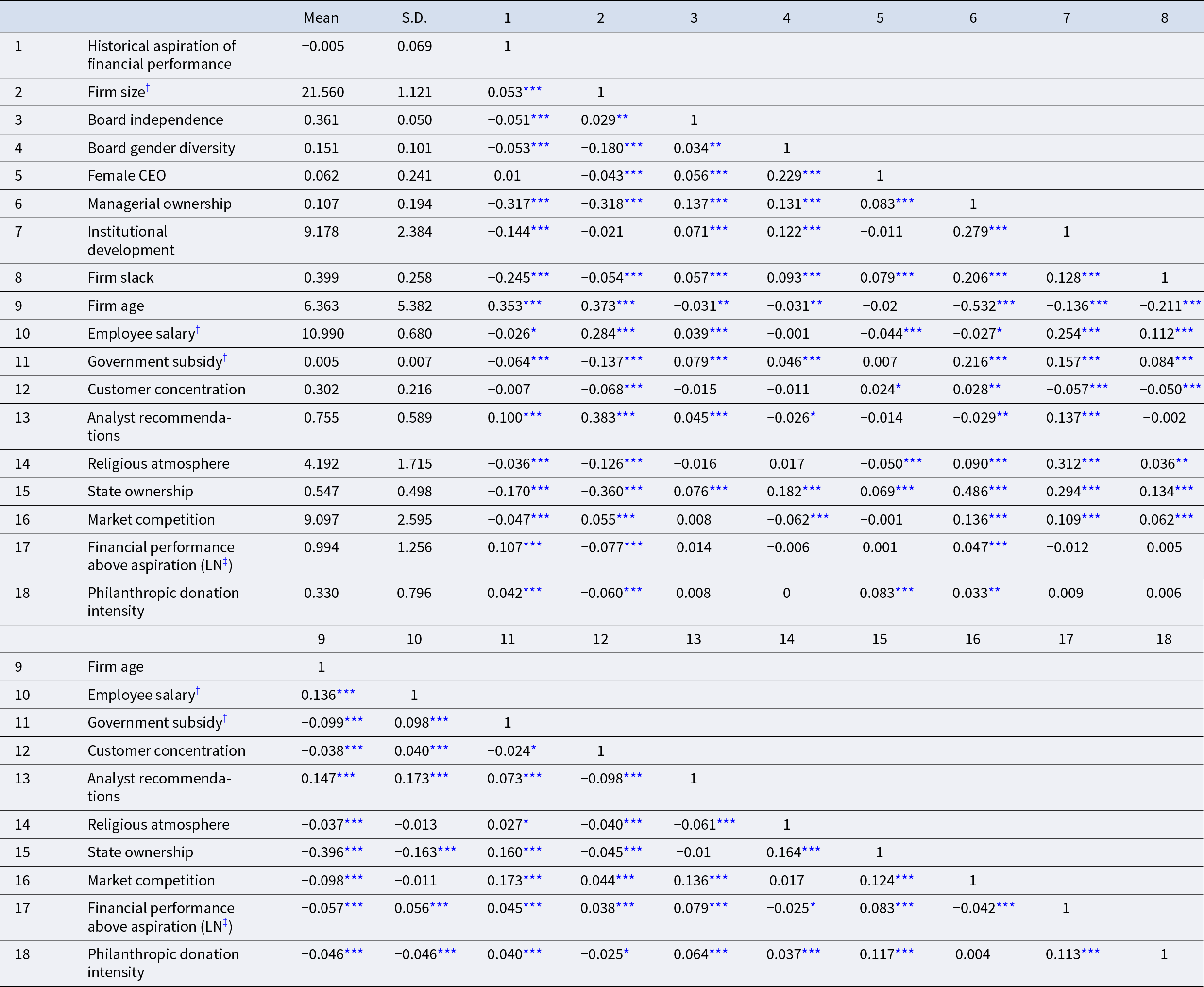
Table 1 Long description
Descriptive statistics (means and standard deviations) and a Pearson correlation matrix are reported for 18 variables including aspirations, governance, ownership, environment, performance above aspiration, and philanthropic donation intensity. Donation intensity has small positive correlations with financial performance above aspiration (r=0.113), state ownership (r=0.117), female CEO (r=0.083), and analyst recommendations (r=0.064), and small negative correlations with firm age and employee salary (both r=−0.046) and customer concentration (r=−0.025). Financial performance above aspiration is weakly related to historical aspiration (r=0.107) and is slightly negative with firm size (r=−0.077). The strongest association in the table is between firm age and managerial ownership (r=−0.532), indicating older firms tend to have lower managerial ownership. State ownership is moderately positively correlated with managerial ownership (r=0.486) and moderately negatively correlated with firm size (r=−0.360) and firm age (r=−0.396). Most other correlations are small in magnitude, so relationships should be interpreted as associations rather than causal effects.
*** Notes: N = 5,041; , **, and * indicate the significance levels below 1%, 5%, and 10% (two-tailed).† Natural logarithm. ‡ Our goal is to test whether philanthropic donation intensity increases at a decreasing rate with the financial performance above aspiration. We follow the methodology based on logarithmic function introduced by Martin et al. (Reference Martin, Swaminathan and Mitchell1998: 585) to test such relationship.
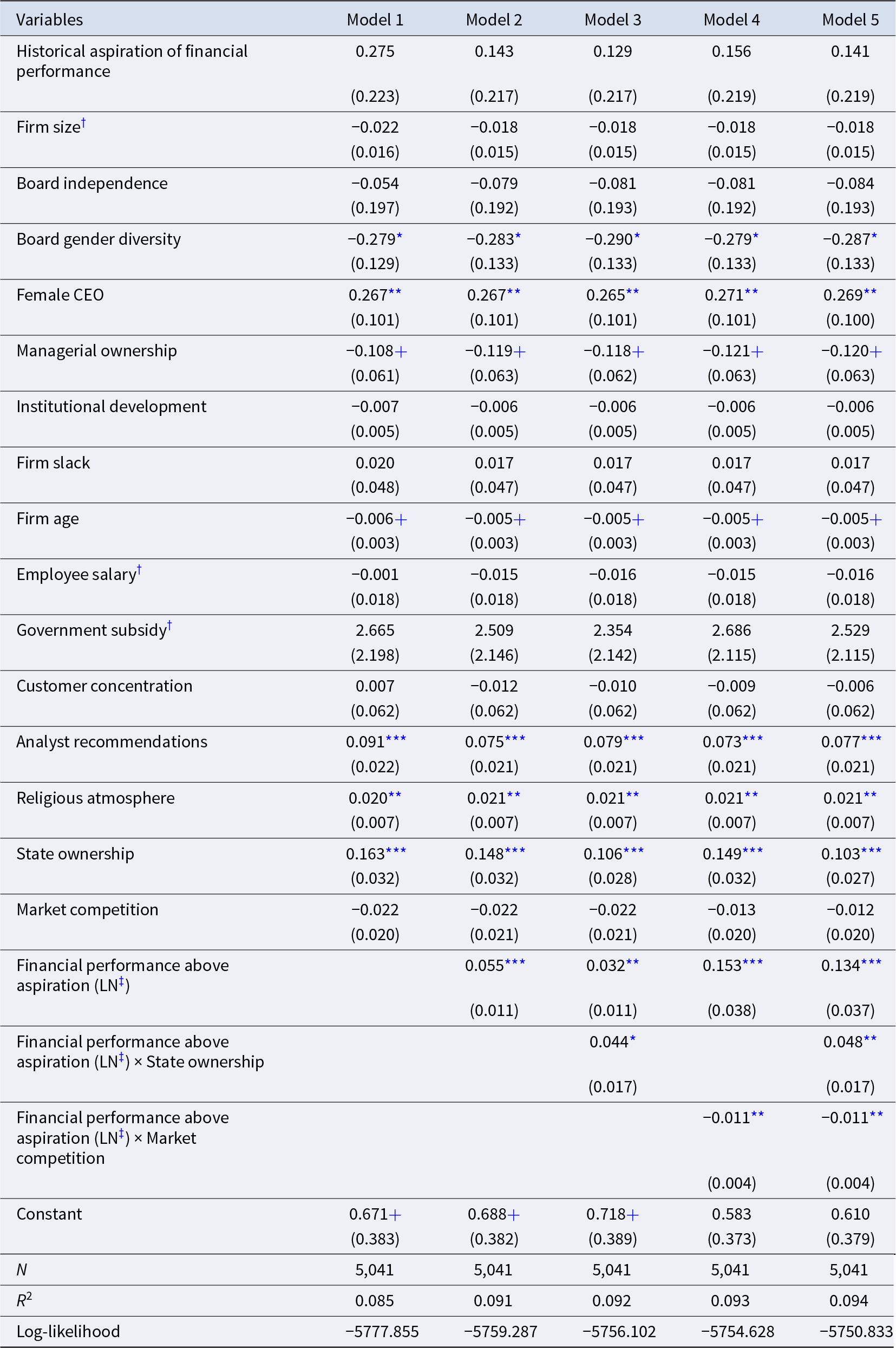
Regression analysis of financial performance above aspiration on philanthropic donation intensity

*** Notes: Standard errors in parentheses; , **, *, and + indicate the significance levels below 0.1%, 1%, 5%, and 10% (two-tailed). † Natural logarithm. ‡ Our goal is to test whether philanthropic donation intensity increases at a decreasing rate with financial performance above aspiration. We follow the methodology based on the logarithmic function introduced by Martin et al. (Reference Martin, Swaminathan and Mitchell1998: 585) to test such a relationship. Year and industry dummies are included.
Results
Table 1 presents the descriptive statistics and correlations for the variables. Female CEO is positively associated with philanthropic donation intensity, suggesting that females are more active in social issues (e.g., McGuinness, Vieito, & Wang, Reference McGuinness, Vieito and Wang2017). The positive correlation between the financial performance above aspiration (LN) and philanthropic donation intensity also indicates the generally positive trend of philanthropic donation intensity, along with the increase in the financial performance above aspiration. Table 2 presents the regression analysis of financial performance above aspiration (LN) on philanthropic donation intensity. Model 1 includes all control variables and moderators. Results show that several control variables are significant. Specifically, firms with a female CEO increase philanthropic donation intensity, and the religious atmosphere is also an important impetus of philanthropic donation intensity, as shown in Model 1. In Model 2, we find that the relationship between financial performance above aspiration (LN) and philanthropic donation intensity is positive and significant (β = 0.055, p < 0.001). This finding suggests a natural logarithmic relationship (i.e., philanthropic donation intensity increases at a decreasing rate with the financial performance above aspiration). Thus, H1 is supported. For the effect size of financial performance above aspiration (LN) on philanthropic donation intensity, when holding all other variables at their mean values, a one standard deviation increase in above-aspiration financial performance (LN) from its mean corresponded to a 20.91% increase in philanthropic donation intensity.
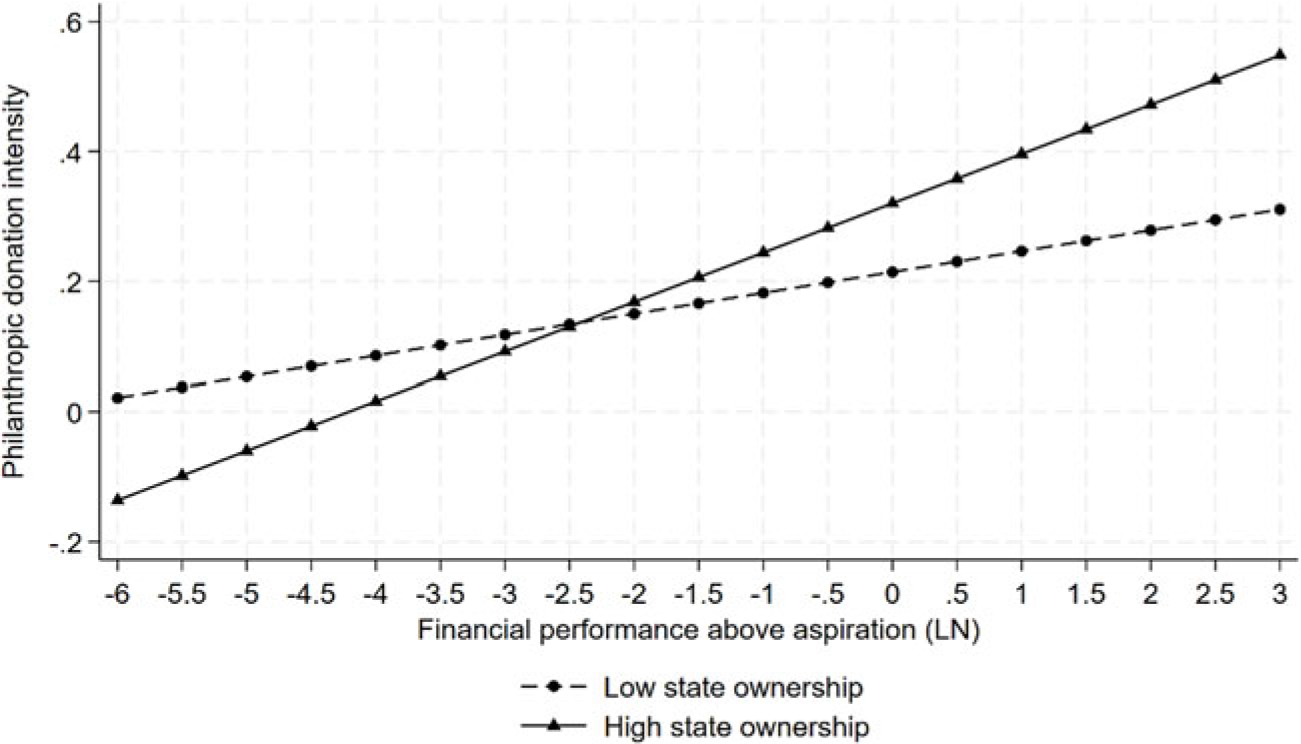
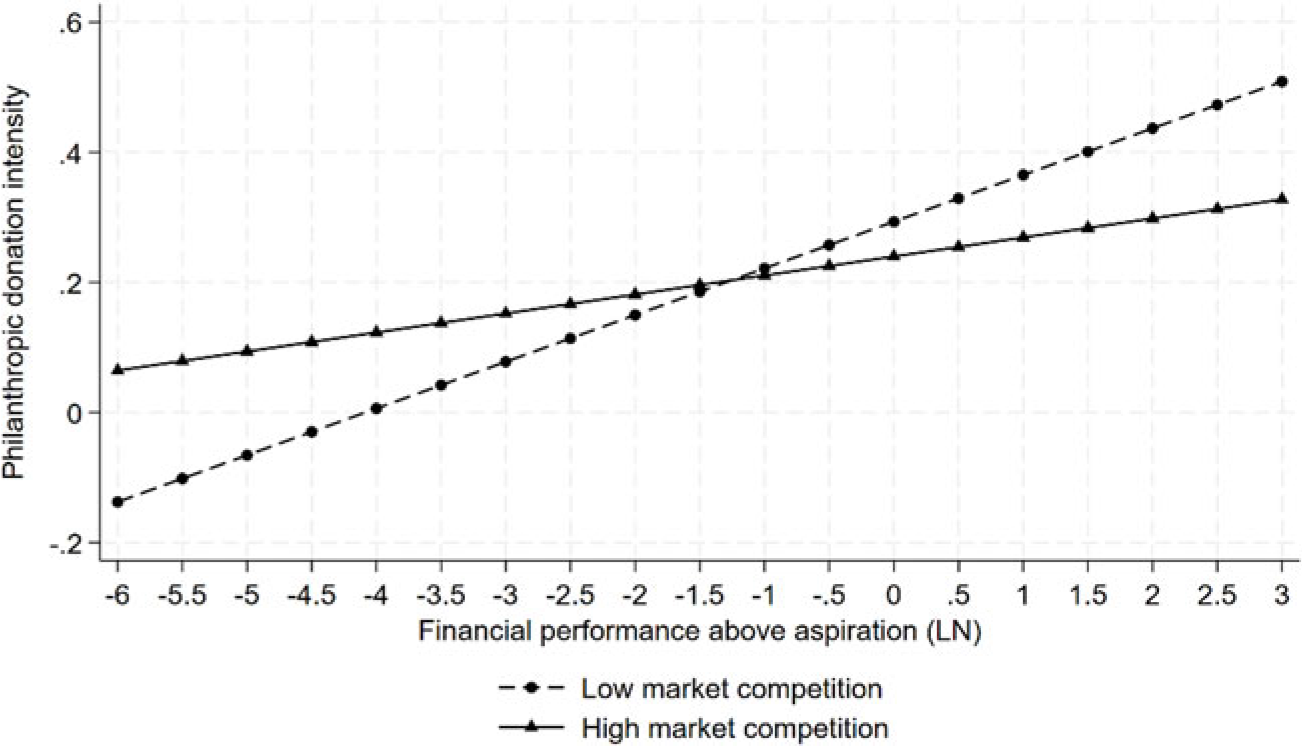
Furthermore, we test the moderating effects as shown in Models 3–5 in Table 2. The interaction terms are added progressively. In Model 3, we tested the moderating effect of state ownership on the relationship between financial performance above aspiration (LN) and philanthropic donation intensity. The coefficient is positive and significant (β = 0.044, p < 0.05), which is consistent with our hypothesis. Figure 1 depicts the impact of financial performance above aspiration (LN) on philanthropic donation intensity, distinguishing between high and low levels of state ownership. Holding all other variables at their means, when state ownership was at a low level, financial performance above aspiration (LN) increased by one standard deviation above its mean value, resulting in around a 16.26% increase in philanthropic donation intensity, whereas the variable increased by 24.31% when state ownership was at a high level. In Model 4, we find a negative and significant moderating effect of market competition on the relationship between financial performance above aspiration (LN) and philanthropic donation intensity (β = − 0.011, p < 0.01). The two interaction terms are also significant in Model 5, supporting our predictions. Similarly, Figure 2 shows the impact of financial performance above aspiration (LN) on philanthropic donation intensity, distinguishing between high and low levels of market competition. Holding all other variables at their means, when market competition was at a low level, financial performance above aspiration (LN) increased by one standard deviation above its mean value, resulting in around a 24.73% increase in philanthropic donation intensity, whereas the variable increased by 13.81% when market competition was at a high level.
Moderating effect of state ownership

Moderating effect of market competition

Figure 2 Long description
The x- axis represents Financial performance above aspiration (LN) from minus 6 to 3 in increments of 1. The y- axis represents Philanthropic donation intensity from minus 2 to 6 in increments of 2. A legend below the plot lists two lines: Low market competition and High market competition. Low market competition line: The plotted points rise from about (minus 6, minus 1) to about (3, 5). High market competition line: The plotted points rise from about (minus 6, 1) to about (3, 3). The two lines intersect at about (minus 1, 2).
In summary, the results are generally consistent with our hypotheses. The main effect of financial performance above aspiration (LN) on philanthropic donation intensity (H1) is supported. The moderating effects of state ownership and market competition are also significantly supported (H2 and H3).
Supplementary Tests
To ensure the robustness of our results, we have performed a set of robustness checks.
A combined measure of social and historical aspirations
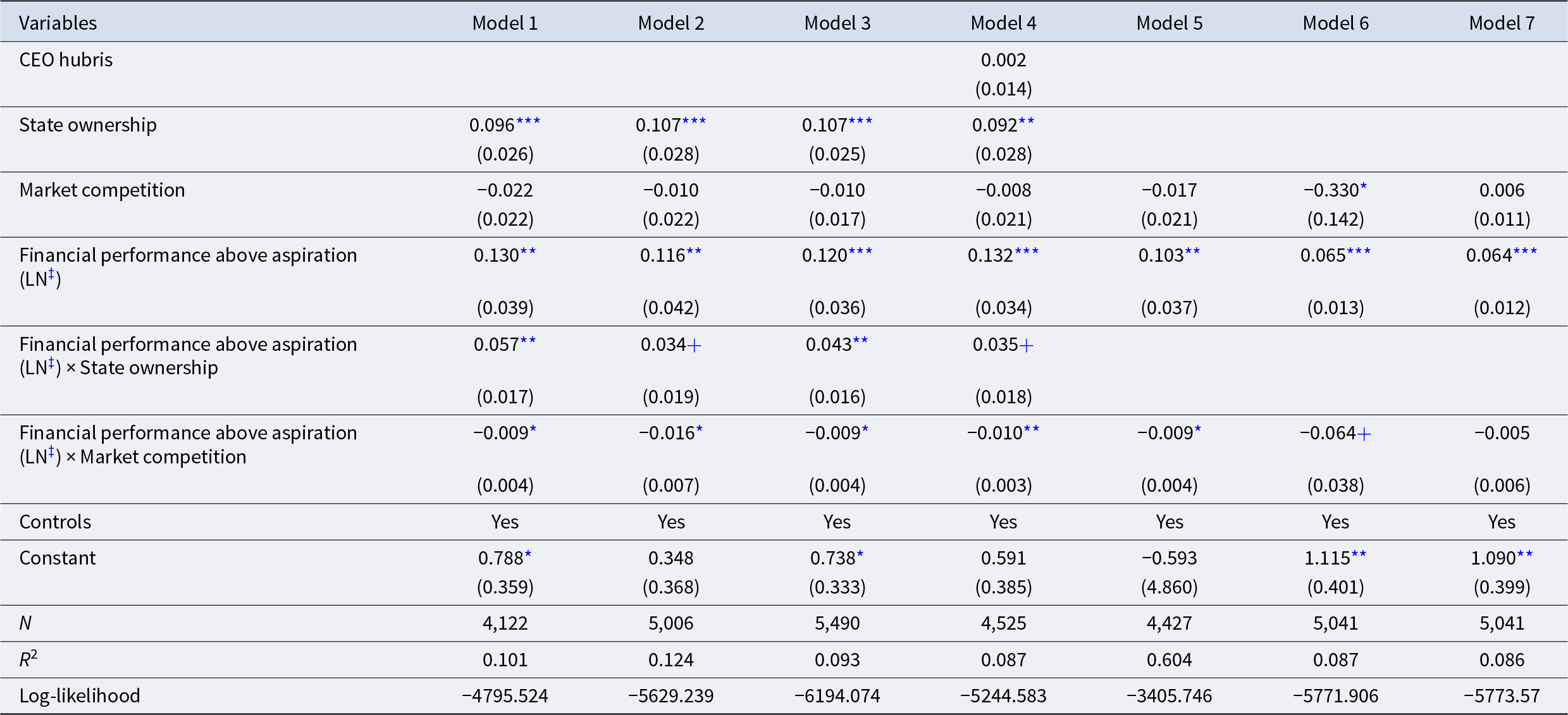
So far, we have used industry peers to identify the referents to construct the aspiration measures of social aspiration, which has a better fit with our study because our key mechanism of competitive pressure is based on the threat of firms falling behind peer firms (also applies to legitimacy pressure but to a lesser extent). However, we also recognize that historical aspiration is another often adopted referent in previous studies on performance aspiration. Therefore, in another robustness analysis, we follow the technical procedures of Greve (Reference Greve2003) to construct a combined measure of social and historical aspirations.Footnote 4 We search for the best-fitting weights by checking all parameter values by increments of 0.1 and taking the combination producing the highest model ‘log-likelihood’. Results show that the best model specification (i.e., the largest log-likelihood) is when  ${a_1}$ takes a value of 0.9 and
 ${a_2}$ takes a value of 0.2. Using this new composite measure, we find that our results are still highly consistent with the findings in our main analyses, as shown in Model 1 of Table 3.
Robustness checks

Table 3 Long description
Regression results from seven robustness models estimate how philanthropic donation intensity relates to financial performance above aspiration, state ownership, market competition, and their interactions. Financial performance above aspiration (log form) is positive and statistically significant in every model (coefficients 0.064 to 0.132), indicating higher donations as performance exceeds aspiration. The interaction of performance above aspiration with market competition is negative in most models and often significant (about −0.009 to −0.016 in Models 1–5; −0.064 in Model 6; not significant in Model 7), suggesting competition weakens the positive performance effect. State ownership is positive and significant where included (about 0.092 to 0.107), and the interaction of performance above aspiration with state ownership is positive but weaker (significant in Models 1 and 3; marginal in Models 2 and 4). Market competition alone is mostly not significant, except Model 6 where it is negative and significant (−0.330). CEO hubris is included only in Model 4 and is near zero and not significant (0.002). Sample sizes range from 4,122 to 5,490; R-squared is around 0.086–0.124 in Models 1–4 and 6–7, but much higher in the firm fixed-effects Model 5 (0.604), so fit is not directly comparable across specifications.
*** Notes: Standard errors in parentheses; , **, *, and + indicate the significance levels below 0.1%, 1%, 5%, and 10% (two-tailed); We follow the methodology based on the logarithmic function introduced by Martin et al.(Reference Martin, Swaminathan and Mitchell1998: 585) to test such a relationship. Year and industry dummies are included. Detailed results for non-core control variables are available from the authors upon request. Model 1 shows the results of the combined measure of social and historical aspirations. Model 2 shows the results of using the three-digit instead of our current two-digit industry classification to identify the relative comparison groups. Model 3 shows the results of the inclusion of observations from banking, insurance, and other financial industries. Model 4 shows the results that include CEO hubris. Model 5 represents the results of firm fixed-effects model. Models 6 and 7 show the results of alternative measure for the market competition. † Natural logarithm. ‡ Our goal is to test whether philanthropic donation intensity increases at a decreasing rate with financial performance above aspiration.
Three-digit industry classification
To further ensure that the results are not sensitive to the particular industry classification, we re-run the regressions using the three-digit instead of our current two-digit industry classification to identify the relative comparison groups. We find a significant positive relationship between financial performance above aspiration (LN) and philanthropic donation intensity. The moderating effect of state ownership is qualitatively robust to this alternative industry classification, while that of market competition is significantly negative, as expected. Thus, our results are generally consistent with results in the main analyses, shown in Model 2 of Table 3.
Inclusion of observations from banking, insurance, and other financial industries
To ensure that our results are not sensitive to specific industries, we re-run the regressions by including observations from banking, insurance, and other financial industries. We find that our results still hold without the exclusions. The relationship between financial performance above aspiration (LN) and philanthropic donation intensity is significantly positive. The moderating effects are also highly consistent with the main analyses. The results are shown in Model 3 of Table 3.
Test for CEO hubris effect
Our main finding has an alternative explanation, that is, a high level of financial performance above aspiration may trigger CEO hubris, which, in turn, may affect the tendency for managers to engage in philanthropy (e.g., Tang et al., Reference Tang, Qian, Chen and Shen2015). To test whether our results are robust to this factor, we include a measure of CEO hubris in our regression models. In particular, following the practice of Mishina et al. (Reference Mishina, Dykes, Block and Pollock2010), we include the pay gap between the CEO and the second-highest-paid officer (Hayward & Hambrick, Reference Hayward and Hambrick1997) to capture the influence of CEO hubris. Our results are still robust to the inclusion of CEO hubris. Specifically, the relationship between financial performance above aspiration (LN) and philanthropic donation intensity is significantly positive. The moderating effects are also found to be significant with the expected signs. The results are shown in Model 4 of Table 3.
Firm fixed-effects model
The firm fixed-effects model may efficiently address potential concerns associated with unobserved heterogeneity and endogeneity. Hence, we use the model in another robustness check. In applying the model, the variables that were stable over time, including state ownership and religious atmosphere, were dropped. Thus, we are not able to test H2. Meanwhile, using firm-fixed effects resulted in the exclusion of 614 singleton observations, which represent a substantial portion of our dataset (about 12%). Model 5 of Table 3 shows consistent support for H1 and H3.
Alternative measure for the moderating variables
As an additional robustness check, we construct an alternative measure of market competition. Following prior studies, we first employ the Herfindahl–Hirschman Index (HHI), calculated as the sum of squared market shares (Giroud & Mueller, Reference Giroud and Mueller2011; Zhang, Reference Zhang2018). Accordingly, we incorporate both HHI investment as proxy variables for market competition. As shown in Model 6 of Table 3, the results remain consistent with our main findings. Furthermore, to capture the dynamic dimension of market competition, we also use corporate patents as a proxy, measured as the natural logarithm of the number of total patents. As shown in Model 7 of Table 3, the results show that the moderating effect of corporate patents on the relationship between financial performance above aspiration (LN) and philanthropic donation intensity is negative and insignificant. This may be because the patent counts capture innovative output rather than actual competitive pressure and are unevenly distributed across industries and regions, leading to potential measurement bias (Lerner & Seru, Reference Lerner and Seru2022).
Concern for endogeneity
Although our study has applied year-lagged variable methodology (i.e., control and independent variables are lagged by one year), there is still room for further mitigating potential endogeneity issues. In a robustness check, we conduct a two-stage estimation using the adoption of product quality management systems and industry-level research and development (R&D) expenditure (scaled by total assets) as instrumental variables for relative financial performance in the first stage. These two variables are chosen as instruments because, theoretically, they are expected to have important impacts on firm financial performance (above aspiration), but are unlikely to have a direct influence on philanthropic donation intensity.
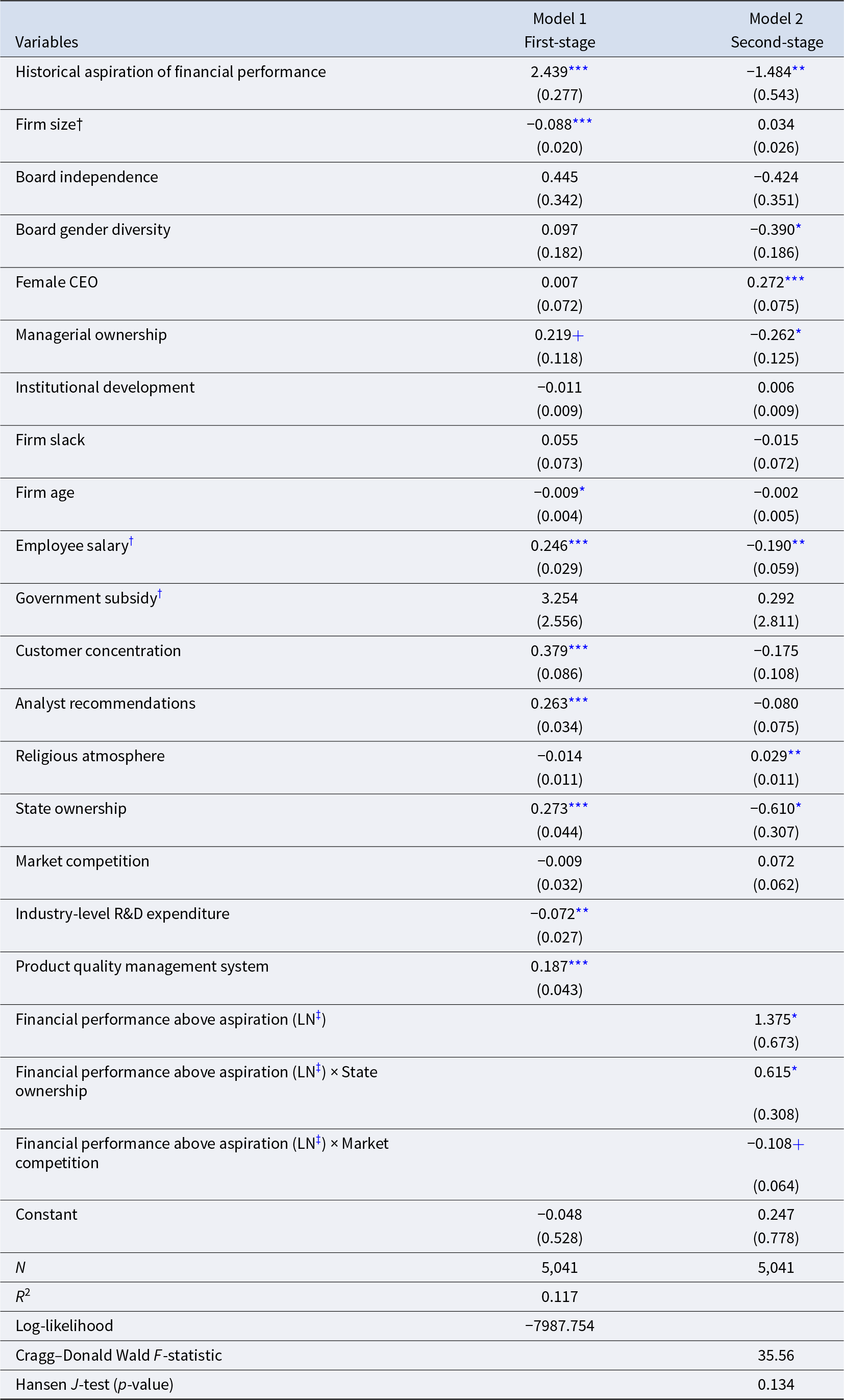
Table 4 reports the two-stage least squares regression results. In the first stage (Model 1), the adoption of a product quality management system exhibits a significant positive effect on the key independent variable (i.e., financial performance above aspiration) at the 0.1% significance level. Conversely, industry-level R&D expenditure shows a significant negative effect on financial performance above aspiration at the 1% significance level. In the second stage (Model 2), after accounting for potential endogeneity, financial performance above aspiration significantly increases philanthropic donation intensity (β = 1.375, p < 0.05), reinforcing the robustness of our findings.
The results of endogeneity test

Table 4 Long description
Two-column regression table reports a first-stage model (Model 1) and a second-stage model (Model 2) with coefficients and standard errors in parentheses, using 5,041 observations. In the second stage, financial performance above aspiration (log form) is positively associated with the outcome (1.375, p<0.05). The interaction with state ownership is also positive (0.615, p<0.05), indicating a stronger effect in state-owned firms, while the interaction with market competition is negative (−0.108, marginal significance), indicating the effect weakens as competition increases. Several controls are significant in Model 2: historical aspiration is negative (−1.484, p<0.01), female CEO is positive (0.272, p<0.001), board gender diversity is negative (−0.390, p<0.05), managerial ownership is negative (−0.262, p<0.05), employee salary (log) is negative (−0.190, p<0.01), religious atmosphere is positive (0.029, p<0.01), and state ownership has a negative main effect (−0.610, p<0.05). In the first stage, historical aspiration is strongly positive (2.439, p<0.001) and multiple predictors are significant, including firm size (−0.088, p<0.001), employee salary (0.246, p<0.001), customer concentration (0.379, p<0.001), analyst recommendations (0.263, p<0.001), state ownership (0.273, p<0.001), industry R&D (−0.072, p<0.01), and product quality management system (0.187, p<0.001). Instrument/identification diagnostics shown for the second stage include a Cragg–Donald Wald F-statistic of 35.56 and a Hansen J-test p-value of 0.134. Model 1 reports R-squared 0.117 and log-likelihood −7987.754; Model 2 does not report R-squared or log-likelihood in the table.
*** Notes: Standard errors in parentheses; , **, *, and + indicate the significance levels below 0.1%, 1%, 5%, and 10% (two-tailed). We follow the methodology based on the logarithmic function introduced by Martin et al. (Reference Martin, Swaminathan and Mitchell1998: 585) to test such a relationship. Year and industry dummies are included. † Natural logarithm. ‡ Our goal is to test whether philanthropic donation intensity increases at a decreasing rate with financial performance above aspiration.
To assess instrument strength, we report the Cragg–Donald Wald F-statistic. The value of 35.56 exceeds the 10% critical value of 19.93 from the Stock–Yogo weak identification test, indicating that the adoption of a product quality management system and industry-level R&D expenditure are not weak instruments. Furthermore, the Hansen J-test for overidentifying restrictions yields a p-value of 0.134, which exceeds the 0.10 threshold. This result suggests that the null hypothesis of instrument exogeneity cannot be rejected, supporting the validity of the instrumental variables.
Interview evidence on legitimacy pressure and competitive pressure
To test the theoretical mechanisms of legitimacy pressure and competitive pressure, we conducted follow-up interviews with five senior managers from diverse industries, including manufacturing, information technology, and retail. Each interview was conducted in Mandarin and lasted approximately 30 minutes. The interviews were semi-structured: we prepared a set of guiding questions for the managers while allowing time for open-ended discussion. Two interviewers took detailed notes in real time and transcribed them immediately after each interview. These notes were then translated into English (with back-translation procedures employed to ensure accuracy). Among the five interviewees, two indicated that high financial performance above aspiration had a negative influence on their firm’s philanthropic decisions, whereas three managers emphasized that superior performance heightened social expectations for philanthropic donation intensity. Due to space constraints, we present two representative responses here:
One manager at Alibaba emphasized that firms with high profitability face heightened public expectations to demonstrate philanthropic responsibility:
When our firm achieves a high level of financial performance compared to competitors, we would indeed increase our contributions to society. Strong financial performance often raises stakeholder expectations. If we only focus on growth and ignore society, we may face reputational penalties, being seen as ‘wealthy but lacking benevolence’. By giving back, we maintain legitimacy, build trust with customers, regulators, and partners, and secure our social license to operate.
Another manager from a leading IT company admitted that when a firm significantly outperforms its peers, competitive pressure intensifies:
When our firm significantly outperforms its peers, it’s true that the competitive pressure actually becomes more intense. Rivals pay closer attention, and the bar for sustaining superior performance is raised. In this context, we have to be very cautious about how we allocate resources. While strong financial results do provide us with more capacity to donate, we cannot automatically increase social spending in a proportional way, because much of our capital must be reinvested in innovation, talent, and market defense. This tendency is especially salient in highly competitive market environments, where corporate philanthropy engagement is likely to be reduced.
Tests of inverse U-shape relationship
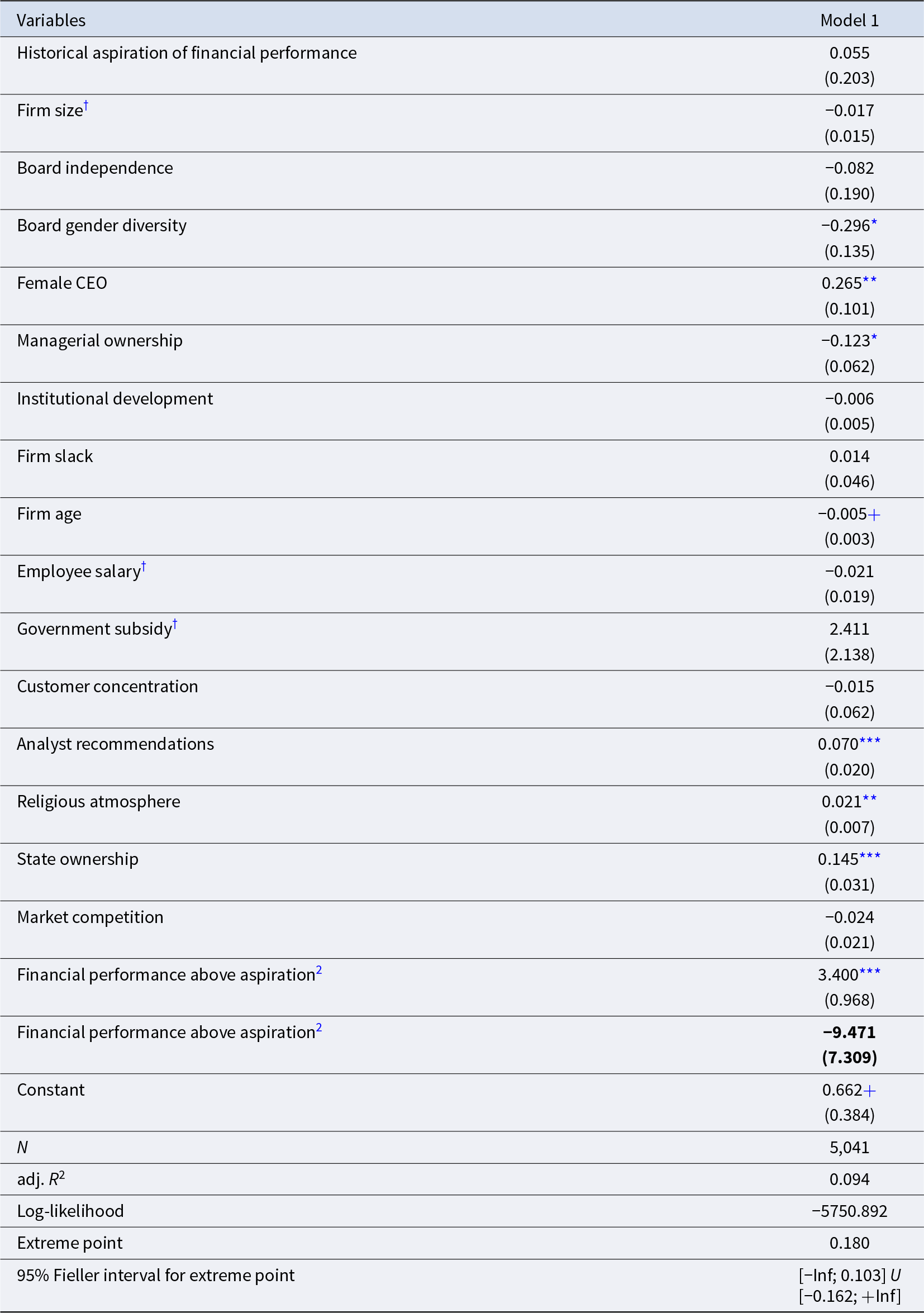
We use the raw values of financial performance above aspiration (i.e., without logarithmic transformation) and estimate an inverted U-shaped model to examine its effect on philanthropic donation intensity (Table 5). Following the three-step procedure outlined by Haans, Pieters, and He (Reference Haans, Pieters and He2016), we first find that the coefficient for financial performance above aspiration is significantly positive (β = 3.400, p < 0.001), whereas the coefficient for its squared term is negative but statistically insignificant (β = −9.471, p = 0.197). Second, we assess whether the slope is sufficiently steep at both ends of the data range by jointly testing the significance of the linear and squared terms using the utest command in Stata (Lind & Mehlum, Reference Lind and Mehlum2010). The results show a positive slope at both the lower and upper bounds of financial performance above aspiration. Third, we determine whether the turning point lies within the observed data range. The estimated turning point (0.180) falls outside the range of financial performance above aspiration [0.003, 0.147], with the 95% Fieller interval confirming it lies beyond the observed values. These results do not support an inverted U-shaped relationship.
The result of inverse U-shaped relationship between financial performance above aspiration and philanthropic donation intensity

Table 5 Long description
Regression results (Model 1) estimate how firm and governance factors relate to philanthropic donation intensity, with coefficients and standard errors reported. Financial performance above aspiration is positively associated with donation intensity (3.400, SE 0.968, p<0.01), while the squared term is negative but not statistically significant (−9.471, SE 7.309), weakening support for an inverse U-shaped pattern. The calculated turning point is 0.180, but the Fieller interval is unbounded and includes values outside the observed range, so the turning point is not reliable for the sample. Other significant predictors include analyst recommendations (0.070, SE 0.020, p<0.01), religious atmosphere (0.021, SE 0.007, p<0.05), and state ownership (0.145, SE 0.031, p<0.01). Board gender diversity is negatively related (−0.296, SE 0.135, p<0.10), while having a female CEO is positively related (0.265, SE 0.101, p<0.05) and managerial ownership is negative (−0.123, SE 0.062, p<0.10). Sample size is 5,041 with adjusted R-squared 0.094 and log-likelihood −5750.892.
*** Notes: Standard errors in parentheses; , **, *, and + indicate the significance levels below 0.1%, 1%, 5%, and 10% (two-tailed). Year and industry dummies are included. For 95% Fieller interval for extreme point, this interval does not include the actual range of financial performance above aspiration in the sample [0.003, 0.147], thus not supporting an inverted U-shaped relationship. † Natural logarithm. 2 represents the square of Financial performance above aspiration.
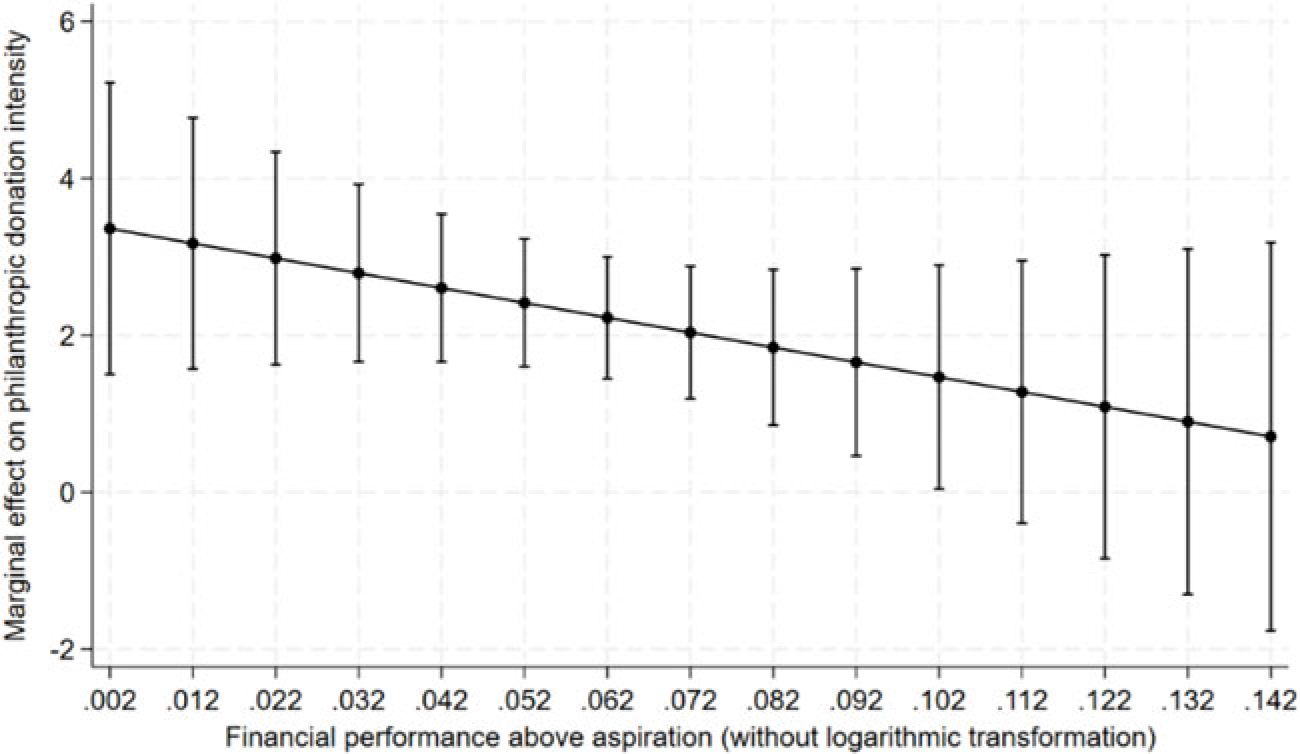
To further illustrate the nonlinear pattern, we include marginal effect plots. Figure 3 illustrates the marginal effect of financial performance above aspiration on philanthropic donation intensity. The x-axis was the level of the financial performance above aspiration, and the y-axis was the marginal effect with its 95% confidence interval. The marginal effect on philanthropic donation intensity is positive at lower levels of financial performance above aspiration, with the 95% confidence intervals excluding zero. However, as financial performance above aspiration increases, the magnitude of this positive marginal effect diminishes and eventually becomes statistically indistinguishable from zero, as indicated by confidence intervals that include zero. It showed that the marginal effects of financial performance above aspiration at different levels of philanthropic donation intensity were significantly different, which visually confirms that philanthropic donation intensity increases at a decreasing rate as financial performance above aspiration rises, consistent with our theoretical proposition.
Average marginal effects of philanthropic donation intensity across various levels of financial performance above aspiration (without logarithmic transformation) with 95% CIs

Figure 3 Long description
Marginal effect on philanthropic donation intensity (without logarithmic transformation) The x-axis is labeled financial performance above aspiration (without logarithmic transformation). The labeled ticks are 0.002, 0.012, 0.022, 0.032, 0.042, 0.052, 0.062, 0.072, 0.082, 0.092, 0.102, 0.112, 0.122, 0.132, 0.142. The y-axis is labeled Marginal effect on philanthropic donation intensity. The labeled ticks are minus 0.2, 0.0, 0.2, 0.4, 0.6. A single black line with circular markers slopes downward from left to right. Each marker has a vertical error bar. The plotted marker values decrease across the x-axis, starting near 0.4 at x equals 0.002 and ending near 0.25 at x equals 0.142. The error bars are shorter around the middle x-values and longer toward the right side, with the rightmost error bars extending from below 0.0 to above 0.4.
Discussion
This study examines how a firm’s financial performance above aspiration influences its philanthropic donation intensity. By integrating the perspectives of legitimacy pressure and competitive pressure, our empirical evidence suggests a log-linear relationship between financial performance above aspiration and philanthropic donation intensity, that is, philanthropic donation intensity increases with financial performance above aspiration, but at a decreasing rate. A decreasing growth rate refers to a situation in which a firm continues to expand, but at a slower pace than in previous periods. In our study, the decreasing growth rate is not merely a statistical trend but represents a strategic inflection point shaped by the interaction of legitimacy pressure and competitive pressure. Specifically, as financial performance rises above aspiration levels, legitimacy pressure intensifies, prompting firms to increase philanthropic donation intensity to meet stakeholder expectations that those with greater capacity should contribute more to society. We further theorize that a performance threshold exists: when a firm’s financial performance surpasses a certain level relative to its peers, the influence of competitive pressure becomes stronger, slowing the rate of increase in philanthropic donation intensity. This threshold marks the point at which firms begin to shift their strategic priorities, leading to a decreasing marginal effect of financial performance on philanthropic donation intensity.
In addition, we examine two contextual factors that capture the extent of legitimacy pressure and competitive pressure. Our results show that for state-owned firms, the Chinese government’s ‘common prosperity policy’ reflects strong expectations for contribution and philanthropy. Because these firms are highly dependent on the state for resources and are obliged to fulfill political responsibilities, the legitimacy pressure from the government is particularly strong. Under such conditions, philanthropic donation intensity increases with financial performance above aspiration at a faster pace and levels off more slowly. By contrast, for firms operating in highly competitive markets, competitive pressure is more salient while legitimacy pressure is weaker. In these cases, philanthropic donation intensity increases with financial performance above aspiration at a slower pace and levels off more quickly.
Theoretical Contributions
This study contributes to the literature in several ways. First, it contributes to the extant research on the relationship between corporate financial performance and philanthropic donation intensity. Most scholars argue a positive and linear relationship between the two, and they mainly apply the arguments of legitimacy pressure and financial resource availability to explain the motivation of well-performing firms’ philanthropic engagement (Hong et al., Reference Hong, Kubik and Scheinkman2012; Surroca et al., Reference Surroca, Tribó and Waddock2010; Waddock & Graves, Reference Waddock and Graves1997). However, our study highlights what the literature has overlooked, which is the potentially mounting competitive pressure with an increase in firm financial performance, caused by increasing stakeholder expectations for well-performing firms to improve their performance continuously. In addition, to unpack the joint effects of legitimacy and competitive pressures, our study considers a firm’s financial performance relative to aspiration (Krishnan & Kozhikode, Reference Krishnan and Kozhikode2015; Mishina et al., Reference Mishina, Dykes, Block and Pollock2010), rather than its absolute level of financial performance.
Second, our study contributes to the literature on financial performance above aspiration. Prior research suggests that when firms perform above their aspiration levels, they typically experience a surplus of resources, which has often been theorized to trigger slack search, strategic experimentation, or risk-taking behavior (Cyert & March, Reference Cyert and March1963; Greve, Reference Greve2003). This view emphasizes the role of performance feedback in facilitating innovation or adaptive responses by reducing organizational constraints. We extend this work by integrating a legitimacy–competition dual pressure framework to explain how firms interpret and act upon financial performance above aspiration in the domain of philanthropic donation intensity. Rather than treating above-aspiration performance as a uniformly enabling condition, we argue that it also raises competitive pressure to sustain or exceed that performance, thereby necessitating strategic reinvestment and resource conservation. These dual pressures create a tension in how firms allocate discretionary resources, particularly toward socially oriented actions such as philanthropic donation intensity. Thus, by theorizing the joint influence of legitimacy pressure and competitive pressure, we show that the behavioral consequences of exceeding performance benchmarks depend not just on internal resource availability but also on the external expectations such performance engenders.
Practical Implications
In addition to its contributions to academic research, the study also has important practical implications. Firms with high financial performance relative to peers should develop a strategic philanthropy roadmap. Specifically, when performance first exceeds aspirations, they could moderately increase their philanthropic donation to respond to legitimacy pressure. As performance strengthens further, firms could integrate philanthropy with core business operations to ensure long-term sustainability and reduce resource trade-offs with competitive investments. Approaches such as embedding social value into products and services or developing social enterprise initiatives can facilitate this integration.
For the government and policymakers, with a better understanding of both the legitimacy pressure and competitive pressure, the government can show more tolerance and avoid exerting extra pressure on firms for philanthropic donations. In addition, given that the government is a key actor whose regulations and rules shape not only social and institutional norms but also public and investor expectations for firms, we suggest that the government can play a more active role in guiding rational stakeholders’ expectations. For instance, the government can establish unified and explicit standards for charity information disclosure, such as specifying the amount of donations, their purposes, beneficiary groups, and project outcomes. This would reduce the ‘blind suspicion’ caused by information asymmetry and, in turn, alleviate the pressure arising from the public’s lack of understanding of philanthropic donation. Meanwhile, the government can leverage tax policies, such as profit reinvestment tax deferral, to alleviate investor pressure on corporate profitability. For firms in intensely competitive industries, policymakers can introduce targeted incentives, such as enhanced tax deductions for charitable donations or R&D-linked social investment credits. For state-owned enterprises, the government can formally incorporate philanthropic performance into multidimensional assessment references, thereby reinforcing their initiative to fulfill institutional obligations.
Limitations and Future Research Directions
Akin to other studies, our study has some limitations, offering opportunities for future research. The first is related to the mechanisms underlying our key arguments involving legitimacy pressure and competitive pressure when firms have a high level of financial performance above aspiration. We argue that these two pressures jointly influence philanthropic donation intensity. However, although we have carefully selected moderators that may reflect the mechanisms and have utilized the interviews to capture the mechanisms, they are not direct measurements of the constructs (e.g., legitimacy pressure and competitive pressure) in the mechanisms. Future research can further explore and verify the underlying mechanisms by adopting research designs (for example, experimental methods) that allow for direct measurement of the two types of pressure.
Second, we merely focus on philanthropic donation intensity as one of the main components of CSR. Future research may verify the generalizability of our key arguments by examining whether they also apply to other dimensions of CSR (Tong, Wang, & Xia, Reference Tong, Wang and Xia2020; Wang, Tong, Takeuchi, & George, Reference Wang, Tong, Takeuchi and George2016), such as those related to the environment, products, employees, community activities, and other categorizations of CSR, including internal and external CSR (Hawn & Ioannou, Reference Hawn and Ioannou2016) and discretionary and essential CSR (Shi, Reference Shi2015). For example, some essential dimensions of CSR, such as those related to employees and products, have more significant and direct influences on firm financial performance. An increase in competitive pressure may not reduce firm engagement in such essential CSR activities as much, compared with philanthropic donation, which is more discretionary and generally considered a diversion of firm resources and financial performance.
Third, as an emerging economy with greater government intervention, China is a good context for examining the relationship between financial performance above aspiration and philanthropic donation intensity, particularly in terms of the dominant role of legitimacy pressure over competitive pressure in influencing this relationship. Such a context may also induce concerns about external validity. Future researchers may consider testing these arguments using data from other contexts, such as those from other emerging and developed countries. In addition, our data are limited to publicly listed firms. Although such firms represent an important group of corporations in the Chinese capital market, our findings may only be applied to the unique operating and social environment surrounding listed Chinese companies. Future research can attempt to confirm these results in other types of firms, such as family firms or privately-owned enterprises.
Fourth, although we followed common practices of previous studies to use the primary industry information to identify the social referents and calculate social aspiration (e.g., Greve & Zhang, Reference Greve and Zhang2017; Mishina et al., Reference Mishina, Dykes, Block and Pollock2010), our methodology still has limitations because some firms may operate in more than one industry. Future researchers may incorporate multi-industry business operations into performance feedback measures. In addition, although we have adopted multiple approaches to mitigate issues related to endogeneity, they may not fully address the concerns due to data and research context limitations. Future research can explore potential new data and contexts that allow more robust solutions to endogeneity, such as a difference-in-difference approach or regression discontinuity analysis.
Conclusion
In conclusion, we document that, within the Chinese institutional background, there is a log-linear relationship between financial performance above aspiration and philanthropic donation intensity such that philanthropic donation intensity increases at a decreasing rate with the level of relative financial performance. We further demonstrate that the presence of legitimacy pressure and competitive pressure affects this relationship. Our findings have theoretical contributions to scholars and practical implications for managers and the government. We hope that our study will be an important step toward a better understanding of the relationship between ‘doing well’ and ‘doing good’.
Data availability statement
The data supporting the findings of this study are openly available on the Open Science Framework (OSF) at https://osf.io/vyskf/
Acknowledgements
The authors wish to thank the editors and anonymous reviewers for their constructive and useful comments.
Funding statement
This study was supported by the Humanities and Social Science Project of the Ministry of Education of China (Grant Nos. 25YJC630196; 21YJC630128; 23YJC630195), the National Natural Science Foundation of China (Grant Nos. 72102184; 72102003; 72402170; 72572004; 72532010; 72372072), and China Postdoctoral Science Foundation (Grant No. 2023M742773).
Ying Zhang (zhangyingnwpu@163.com) is an associate professor of management at the School of Management, Northwestern Polytechnical University, China. Her main research topics include ESG, corporate environmental strategy, and corporate internationalization. She has published in international journals such as the Journal of Business Ethics, Journal of Management Information Systems, and Management and Organization Review.
Li Tong (litong2020@gsm.pku.edu.cn) is an associate professor of management at the Guanghua School of Management, Peking University, China. His research interests include corporate social responsibility, corporate M&A strategy, and corporate governance. He has published in the Academy of Management Journal, Strategic Management Journal, Journal of Management Information Systems, Management and Organization Review, and Journal of Business Ethics.
Yi Xiang (xiangyi@xjtu.edu.cn) is an assistant professor of management at the School of Management, Xi’an Jiaotong University, China. His research focuses on corporate innovation, ESG, and digital transformation. He has published in international journals, including the Journal of Management, Journal of Management Studies, Journal of Business Ethics, and Journal of Management Information Systems.
Yuting Guo (gty2022@mail.nwpu.edu.cn) is a PhD candidate at the School of Management, Northwestern Polytechnical University, China. Her current research projects focus on women’s leadership, corporate social responsibility, and green innovation.