Introduction
Aphids cause substantial economic loss to farmers in Europe and the US, with estimated annual yield losses ranging from 10 to 250 million US$ in North America (Brewer & Elliott, Reference Brewer and Elliott2004). Generalist predators contribute to aphid suppression (Symondson et al., Reference Symondson, Sunderland and Greenstone2002), a conclusion supported by several negative correlations between pest numbers and predator abundance in field surveys (Chambers et al., Reference Chambers, Sunderland, Stacey and Wyatt1986; Winder, Reference Winder1990; Östman et al., Reference Östman, Ekbom and Bengtsson2003). The impact of generalist predators may be critically important in systems under organic farming (Zehnder et al., Reference Zehnder, Gurr, Kühne, Wade, Wratten and Wyss2007), where reduced pesticide application may enhance densities of generalist predators, thereby potentially strengthening their contribution to pest control (Thorbek & Bilde, Reference Thorbek and Bilde2004; Hole et al., Reference Hole, Perkins, Wilson, Alexander, Grice and Evans2005; Schmidt et al., Reference Schmidt, Roschewitz, Thies and Tscharntke2005). Early in the growing season aphids occur at low abundance within relatively distinct patches in arable fields (Östman, Reference Östman2002; Birkhofer et al., Reference Birkhofer, Scheu and Wise2007). It has been suggested that generalist predators are most efficient in suppressing aphids during those early colonization stages (Edwards et al., Reference Edwards, Sunderland and George1979; Chiverton, Reference Chiverton1986).
Spiders are among the most abundant arthropod predators in temperate agroecosystems (Wise, Reference Wise1993; Nyffeler & Sunderland, Reference Nyffeler and Sunderland2003). Laboratory experiments provided evidence that aphids can be low-quality or even toxic prey for spiders (Toft, Reference Toft2005). In contrast, immunological and molecular techniques suggest that web-building (Harwood et al., Reference Harwood, Sunderland and Symondson2004) and cursorial (Harwood et al., Reference Harwood, Sunderland and Symondson2005) spiders consume aphids in the field. Reducing generalist-predator abundance (including spiders) in field experiments caused higher aphid numbers in some studies (Holland & Thomas, Reference Holland and Thomas1997a; Lang, Reference Lang2003; Schmidt et al., Reference Schmidt, Thewes, Thies and Tscharntke2004) but not in others (Holland & Thomas, Reference Holland and Thomas1997b; Lang et al., Reference Lang, Filser and Henschel1999).
We combined a factorial field experiment that analyzed the impact, separately and together, of two spider functional groups (web-building and non-web-building (cursorial) spiders) on aphid population growth, with a molecular approach to determine species-specific aphid consumption rates. With these two complementary approaches, we determined the effectiveness of the two functional groups, alone and together, in suppressing aphid population growth. We hypothesized that: (i) web-building and non-web-building spiders are each less effective in suppressing aphid numbers than when together in an assemblage; (ii) spider assemblages prevent aphid outbreaks during early stages of aphid colonization; and (iii) foliage-dwelling, non-web spiders consume aphids at higher rates than web-building or ground-active cursorial species.
Methods
Experimental design
In a winter wheat field close to Darmstadt, Germany, we conducted a 2×2 randomized-block experiment using 36 closed cages placed in groups of four (nine blocks, each cage 3 m apart within a block and 12 m from the field edge), which were installed March 29, 2006. The 0.7 m2 cages consisted of a 50-cm high, round, plastic barrier that was inserted 10 cm in the soil (cage diameter, 95 cm). The cage sides were extended an additional 90 cm with gauze (mesh width <1 mm) that was held by three upright wooden poles and was closed on top by tying the gauze in a knot. The interface between plastic barrier and gauze was sealed with duct tape. All cages were closed March 29 and only opened for predator removal, introduction of aphids and spider functional groups and tiller counts.
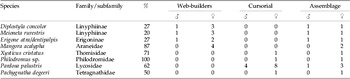
Between April 2 and 17, spiders were removed from the enclosures by means of two pitfall traps without preservative (emptied daily) and six visual searches per cage, each lasting six minutes. Other predaceous arthropods trapped by pitfall traps were released daily outside the cages (primarily carabid and staphylinid beetles). No naturally occurring aphids were found in cages during predator removal. All removed spiders (N=493) were kept in the laboratory at 20°C, 10-h photoperiod, and were fed two Drosophila melanogaster (curly, b.t.b.e. Insektenzucht GmbH, Germany) every two days. On 18 April, 24 laboratory-reared, immature aphids (Sitobion avenae, Katz Biotech AG, Germany) were introduced in groups of 12 on two opposing tillers per cage. One day later, spider functional-group treatments were established in a 2×2 factorial design: two single-functional group treatments (web-building or cursorial spiders), an assemblage treatment (both functional groups) and a spider-free treatment (control). The choice of species for the functional-group treatments was based on guild definitions (Uetz et al., Reference Uetz, Halaj and Cady1999) and relative species abundances of spiders removed from the cages by pitfalls and visual inspection. Table 1 shows the species frequency within the family/subfamily as estimated from spider-removal and the functional-group assignment. Spiders needed in excess of the number removed from the cages were captured in the same wheat field. The standardized number of spiders used for the functional-group treatments was estimated from the mean number of spiders removed from each cage and the upper 95% confidence interval (15 individuals) as a proxy for natural high abundance of spiders early in the season (N≥15, sampled from 17 cages). Because our goal was to uncover the impact of realistic spider densities on aphid populations, we established all treatments, including the assemblage, with identical numbers of individuals.
Number of immature (Philodromus sp.) and adult (all other species) individuals per species in spider functional-group treatments per cage.

The number of removed individuals per species is given as a proportion (%) of the total number of spiders removed from the same family/subfamily.
After five weeks (May 16, first interval), we estimated total aphid abundance in each enclosure non-destructively by visually inspecting all tillers for four minutes per cage. One week later, all cages were sampled by removing 12 tillers per cage to obtain counts of aphids on individual tillers (second interval); densities were too high for a total count of all aphids at this date. Total aphid numbers for the last count (second interval) were estimated by multiplying the average aphid number per 12 tillers with the number of tillers per cage. Both counts, therefore, provide a reliable estimate of aphid numbers per cage. Aphid growth rates were calculated by dividing the cage specific aphid numbers from the first estimate by the initial density of aphids (N=24) for the first interval and by dividing aphid numbers from the second estimate by cage specific estimates from the first estimate for the second interval. After the final tiller count, pitfall traps were opened for one week and emptied daily to trap surface-active spiders. An estimate of web-building spider abundance was made by visually inspecting all cages twice (two minutes each search) during the final week. The number of spiders removed by pitfall traps and during the visual inspection provided an estimate of treatment effects over time. To estimate effects of caging on air temperature at the soil level, temperature loggers (Tinytag Talk 2, Tinytag, UK) were placed in three randomly chosen cages and three nearby, unenclosed spots. The experiment lasted nine weeks.
No pesticides were applied to the wheat field in 2006 prior to, or during, the experiment. In Darmstadt, the average monthly rainfall between April and May 2006 was 72.9 mm with an average air temperature of 12.7°C (long-term averages for April–May 1999–2004 were rainfall: 46.9 mm and air temperature, 12.5°C).
Molecular analysis
After the final tiller count, we removed individuals of three spider species from different functional groups by hand searching all cages to avoid contamination with DNA from potential prey species. The spiders were individually stored in cooling boxes (approximately 14°C) and transferred to the laboratory shortly after collection. A minimum of ten individuals of each species was stored at −24°. We analyzed females of the orb-weaver (Araneidae) Mangora acalypha (Walckenaer, 1802) as a common web-building species, females of the crab spider (Thomisidae) Xysticus cristatus (Clerck, 1757) as a foliage-dwelling cursorial spider, and females of the wolf spider (Lycosidae) Pardosa palustris (Linnaeus, 1758) as a representative ground-dwelling cursorial species (Nyffeler & Breene, Reference Nyffeler and Breene1992; Bogya & Marko, Reference Bogya and Marko1999). Additionally, five individuals of each species were starved for seven days before freezing at −24°C to test the primer's reactivity to starved spiders. We did not test a linyphiid species, as we were not able to sample the minimum of 15 adult individuals of one species with the required hand-searching technique. DNA of all spiders, including the starved controls, was extracted using a DNeasy Tissue Kit (QIAGEN) by following the manufacturer's instructions with slight modifications. After an incubation step at 56°C, 10 μl RNAse A (100 μg μl−1; QIAGEN) were added to the samples, which were then incubated at room temperature for 5 min. For further extraction steps, 50 μl (Mangora acalypha), 70 μl (Pardosa palustris) and 100 μl (Xysticus cristatus) were used.
The primer pairs S102 and A103 were used to amplify a 316-bp fragment of the mitochondrial cytochrome oxidase subunit I (COI) gene of Sitobion avenae. Both primers were developed and tested in a laboratory feeding trial (von Berg et al., Reference von Berg, Traugott, Symondson and Scheu2008); further cross-reactivity tests under field conditions could improve the applicability to field experiments (Admassu et al., Reference Admassu, Juen and Traugott2006). The PCR was carried out in 10 μl containing 0.25 mm dNTP (fermentas), 1 μm of each primer, 1 μl 10× buffer, 3 mm MgCl2, 2.5 μg bovine serum albumin (BSA), 0.5 μl DMSO, 1.5 U Taq DNA polymerase (invitrogen) and 4.45 μl of DNA extract. Distilled water samples were included in each PCR reaction as a negative control to check for contamination. PCRs were carried out in a master cycler gradient (Eppendorf) with initial denaturation at 94°C for 2 min, followed by 40 cycles of 94°C for 15 s, 63°C for 45 s, 72°C for 45 s, and a final extension step at 72°C for 2 min. PCR products were checked on an agarose gel stained with ethidium bromide. To test the ability of the primer pair to amplify the DNA of S. avenae in the presence of predator DNA, we diluted aphid DNA with DNA of the three spiders in ratios 1:20.
Data analysis
Treatment effects on spider numbers at the end of the experiment, and on aphid population growth rates during the experiment, were analyzed by permutational analysis of variance (PERMANOVA (v. 1.6): Anderson, Reference Anderson2001; McArdle & Anderson, Reference McArdle and Anderson2001). The Bray-Curtis dissimilarity distance measure was used to calculate distances among observations in similar treatment groups versus those in different groups. Permutation runs (N=4999) of the observed data were used to generate probability values for the null hypothesis of no difference between groups. Effectiveness of the manipulations in altering the spider community was evaluated by permutational two-way MANOVA, with numbers of web-builders and non-web-builders sampled from cages at the end of the experimental period as the two response variables and the two manipulated spider functional groups as fixed factors. Permutational MANOVA was also used to evaluate spider treatment effects on aphid population growth rates. To further differentiate between effects of treatments on aphid population growth rates during the first and second part of the experiment, separate permutational one-way ANOVAs were performed on aphid growth rates from the 1st to 2nd and the 2nd to 3rd dates. Permutational one-way ANOVA was further used to estimate treatment effects on absolute aphid numbers. Differences in mean, minimum and maximum air temperature between cages and unenclosed field areas were analyzed by permutational one-way MANOVA. The species-specific detection rate for aphid DNA was compared between subsets by performing Fisher's exact test for comparison of proportions. Permutational ANOVAs were performed using PERMANOVA v. 1.6, and all other analyses were performed using Statistica 7.1 (StatSoft, Germany); means are given with SE.
Results
Mean, minimum and maximum air temperatures at the soil level did not differ significantly between cages and surrounding, unenclosed areas in the wheat field (permutational MANOVA, F1,5=1.74, P=0.252). We removed an average of 13.7±0.6 spiders per cage (N=493 spiders) prior to introducing aphids and establishing the functional-group treatments. Linyphiids comprised 65% of all removed spiders (Linyphiinae, 50%; Erigoninae, 15%) and only wolf spiders had comparably high densities (18%). All other families were represented by less than 10% of the total number of spiders (Araneidae, 6%; Thomisidae, 3%; Philodromidae, 2%; Tetragnathidae, 2%; and five other families together, 4%).
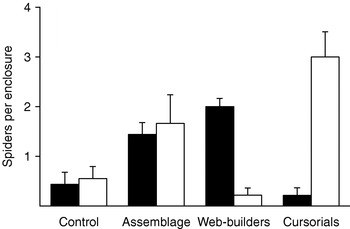
The manipulation of functional groups altered the abundances of cursorial and web-building functional groups at the end of the experiment (permutational MANOVA, effect of web-building species: F1,35=15.70, P<0.001; permutational MANOVA, effect of cursorial species: F1,35=11.49, P<0.001). Both functional groups responded to the experimental manipulation. Web-building spiders were 5.3 times more abundant in the web-building and assemblage treatments compared to the cursorial and spider-free treatments (fig. 1; permutational ANOVA: F1,35=20.10, P<0.001). In a similar fashion, surface-active spiders were six times more abundant in the cursorial-spider and assemblage treatments compared to the web-builder and spider-free treatments (fig. 1; permutational ANOVA: F1,35=13.53, P<0.001). Removal of one functional group did not affect the abundance of the other group (interaction term (cursorial×web-builders), permutational MANOVA: F1,35=1.67, P=0.183).
Persistence of differences in spider numbers in the four spider functional-group treatments. Shown is the number of hand-collected (black bars) web-building and (white bars) cursorial spiders in the specific treatments after the last estimate of aphid numbers (May 23); means are given with SE.

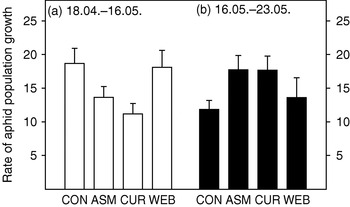
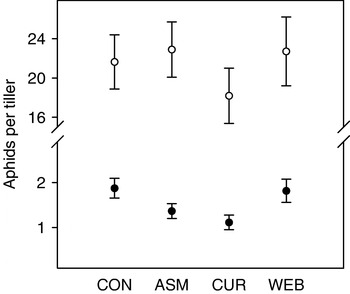
Functional groups affected aphid growth rates differently during the first and second half of the experiment (permutational MANOVA: F3,35=3.02, P=0.020). Cursorial spider presence had a negative impact on aphid population growth during the first five weeks (fig. 2a; permutational ANOVA: F3,35=1.88, P=0.036). During the last week in May, there was no negative effect of cursorial spiders on aphid growth rate; in fact, rates of aphid population growth were marginally higher in the presence of cursorial spiders (fig. 2b; permutational ANOVA: F3,35=2.76, P=0.060). This response of aphid populations to spider functional-group treatments resulted in aphid densities that differed significantly after the first four weeks (fig. 3; permutational ANOVA: F3,35=2.20, P=0.045) but not at the end of the experiment (permutational ANOVA: F3,35=0.47, P=0.784).
Rate of aphid population growth between (a) April 18 and May 16 and (b) May 16 and May 23 in different spider functional-group treatments. CON, spider-free control; ASM, Assemblage (both functional groups); WEB, Web-builders only; CUR, cursorial spiders only; means are given with SE.

Aphid density per tiller in different spider functional-group treatments on (●) May 16 and (○) May 23. For abbreviations see legend of fig. 2; means are given with SE.

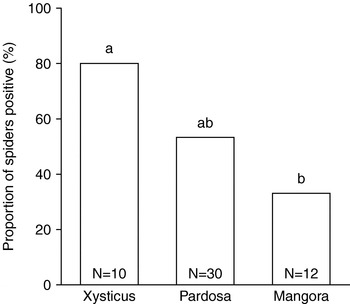
Xysticus cristatus was the species with the highest proportion of individuals that tested positive for S. avenae DNA (fig. 4). Significantly more individuals of this species contained aphid remains compared to M. acalypha (Fisher's exact test: P=0.014), with no significant difference between other combinations of species. The primer pair showed no amplifications when tested on the three spider species that had been starved for one week. DNA of S. avenae was amplified in the presence of spider DNA.
Proportion of analyzed individuals (Xysticus cristatus, Pardosa palustris and Mangora acalypha) that tested positive for Sitobion avenaeDNA. Different letters indicate significant differences (Fisher's exact test).

Discussion
At equal densities, surface-active cursorial spiders, but not web-builders, reduced the initial growth of aphid populations. Holland and Thomas (Reference Holland and Thomas1997a, Reference Holland and Thomasb) suggested that generalist predators may control aphids during early stages of crop colonization, when pests occur at low densities. Therefore, a generalist predator population that is already established early in the season may be an important prerequisite for successful aphid suppression (Scheu, Reference Scheu2001). In the present experiment, an initial aphid density of 0.1 aphids per tiller was established early in the growing season, a density well below the suggested thresholds at which aphids may cause economic damage in Germany (1–6 per tiller: Larsson, Reference Larsson2005). Our standardized spider densities were within the range of estimates of the number of spiders in wheat early in the growing season (Nyffeler & Sunderland, Reference Nyffeler and Sunderland2003). Our results, therefore, support the hypothesis that cursorial spiders retard the growth of aphid populations when aphid densities are low. As a single component of the natural-enemy community, however, cursorial spiders may not be sufficient to prevent aphid outbreaks under all conditions, particularly since their effect is most pronounced during the early stages of crop colonization (fig. 3). Larsson (Reference Larsson2005) estimated peak densities of Sitobion avenae of 3–40 individuals per tiller during a seven year study in wheat. Aphids reached comparably high densities in our study with a mean of 21 aphids per tiller, independent of treatment. In fact, it appears that the reduced aphid growth rate in the cursorial-spider treatment during the first part of our experiment may have led to a higher growth rate in this treatment during the second part (fig. 2a, b), possibly due to reduced competition or density-dependent predation.
Earlier manipulations of overall spider numbers (web-building and cursorial spiders combined) in experimental plots in wheat did not uncover any significant effect of spider removal on aphid numbers (Lang, Reference Lang2003). Spider activity-density and aphid densities were higher in our enclosures than in Lang's experiment, perhaps because the cages in his experiment were not closed and emigration was possible. An additional explanation for generally higher aphid numbers in closed cages may be the altered microclimate. Sitobion avenae populations grow faster at higher temperature (Acreman & Dixon, Reference Acreman and Dixon1989), but differences between cages and unenclosed areas were small in our study. However, we cannot exclude a positive impact of closed cages on aphid population growth, as Sitobion avenae populations suffer considerable mortality by rainfall (Mann et al., Reference Mann, Tatchell, Dupuch, Harrington, Clark and McCartney1996), and closed cages may weaken this effect. Open cages may further allow parasitoids to attack aphids inside cages, a condition that may have contributed to the fact that aphid numbers in Lang's study never reached densities comparable to those in our field experiment. Indeed, Schmidt et al. (Reference Schmidt, Lauer, Purtauf, Thies, Schaefer and Tscharntke2003) demonstrated that parasitoids may be more effective in aphid suppression than generalist predators. Thus, parasitoids may either mask effects of aphid predation by generalist predators, or the exclusion of parasitoids may artificially enhance the impact of cursorial spiders.
Web-building spiders consume aphids, with both orb-weavers (Araneidae: Nyffeler & Benz, Reference Nyffeler and Benz1979) and sheet-web-weavers (Linyphiidae: Sunderland et al., Reference Sunderland, Fraser and Dixon1986) potentially reducing aphid numbers. However, in our experiment, the web-building spider community did not affect aphid population growth, suggesting limited predation by this functional group. Further support is given by the lower proportion of web-building spiders that contained aphid remains, as compared to non-web-building species (Xysticus cristatus and Pardosa palustris). Web-building spiders (primarily linyphiids) in European cereal fields usually have a lower body mass than common cursorial species (primarily lycosids) but occur at higher densities and may, therefore, still contribute to aphid suppression even at a lower per capita aphid feeding rate.
As intraguild predation between spiders is frequent (Wise, Reference Wise2006), secondary predation might have inflated rates of detecting aphid DNA (Sheppard et al., Reference Sheppard, Bell, Sunderland, Fenlon, Skervin and Symondson2005). Scavenging, although not common among spiders, may have further affected detection rates (Juen & Traugott, Reference Juen and Traugott2005). However, our results and previous studies (Nyffeler & Benz, Reference Nyffeler and Benz1988; Nyffeler & Breene, Reference Nyffeler and Breene1990) indicate that Xysticus cristatus and Pardosa species consume a considerable amount of aphids. Attracting these species to edge areas of arable fields before aphids arrive may significantly improve aphid control, with different factors affecting the strength of this interaction (e.g. alternative prey: Birkhofer et al., in press). We conclude that during early stages of aphid colonization in wheat, cursorial spiders contribute more to aphid suppression than do web-building spiders. Management practices that specifically support cursorial species (e.g. mulching: Rypstra et al., Reference Rypstra, Carter, Balfour and Marshall1999; organic fertilization: Birkhofer et al., submitted) may, therefore, be particularly useful in enhancing pest suppression by generalist predators.
Acknowledgements
We thank the subject editor and two anonymous referees for helpful comments and suggestions. We further thank Stefan Ruckelshaußen, who allowed us to work on his farm. Bernhard Klarner assisted during field work and we are grateful for his help. This research was supported by a grant from the German Research Foundation to K.B. and by a grant from the American Arachnological Society (AAS Research fund) to E.G.-R.