Introduction
During the late Paleozoic, the global climate changed from the ‘icehouse-climate’ of the Carboniferous to the ‘greenhouse climate’ of the middle and late Permian, and these climatic changes were accompanied by changes and shifts in the vegetation (e.g., Gastaldo et al., Reference Gastaldo, DiMichele and Pfefferkorn1996; Montañez et al., Reference Montañez, Tabor, Niemeier, DiMichele, Frank, Fielding, Isbell, Birgenheier and Rygel2007). Such changes occurred also on western Gondwana, e.g., in the Paraná Basin, where glaciers existed into the early Permian followed by a transition to a semiarid climate in the late Permian (e.g., Christiano-de-Souza and Ricardi-Branco, Reference Christiano-de-Souza and Ricardi-Branco2015). These climatic changes resulted in severe paleoenvironmental and floristic changes in this region (Iannuzzi, Reference Iannuzzi2010, Reference Iannuzzi2013; Christiano-de-Souza and Ricardi-Branco, Reference Christiano-de-Souza and Ricardi-Branco2015). However, to be able to interpret relationships between climate and vegetation change and even possible evolutionary consequences, it is necessary to have solid taxonomic data concerning the vegetation, especially when dealing with plant groups that are usually underrepresented in the fossil record.
The Quitéria outcrop, located in the municipality of Encruzilhada do Sul, Rio Grande do Sul, Brazil, is one of the most important sources of information about vegetation from wet biomes in the early Permian Rio Bonito Formation in the southern part of the Paraná Basin (e.g., Jasper et al., Reference Jasper, Menegat, Guerra-Sommer, Cazzulo-Klepzig and Souza2006, Reference Jasper, Uhl, Guerra-Sommer and Mosbrugger2008; Guerra-Sommer et al., Reference Guerra-Sommer, Cazzulo-Klepzig, Jasper, Kalkreuth, Menegat and Barboza2008; Boardman et al., Reference Boardman, Souza, Iannuzzi and Mori2012). Several taxonomical studies dealing with lycophytes (Jasper and Guerra-Sommer, Reference Jasper and Guerra-Sommer1999; Salvi et al., Reference Salvi, Jasper, Ricardo-Branco, Bernades-De-Oliveira and Guerra-Sommer2008), conifers (Jasper et al., Reference Jasper, Ricardi-Branco. and Guerra-Sommer2005), glossopterids (Boardman et al., Reference Boardman, Tybusch, Iannuzzi, Dutra and De Lima2006), and the putative liverwort Hepaticites iporangae Ricardi-Branco, Faria, Jasper, and Guerra-Sommer, Reference Ricardi-Branco, Faria, Jasper and Guerra-Sommer2011 (Ricardi-Branco et al., Reference Ricardi-Branco, Faria, Jasper and Guerra-Sommer2011) have been carried out in the past two decades at this locality. The latter finding has been regarded as being of significant importance for the diversity of liverworts (Ricardi-Branco et al., Reference Ricardi-Branco, Faria, Jasper and Guerra-Sommer2011) as Paleozoic records of this group are rather scarce, especially in Gondwana (Pant and Bhowmik, Reference Pant and Bhowmik1998).
However, recent discoveries of larger and more complete specimens from its type locality, partly with casts of tracheid remains in situ at the position of the assumed midrib (sensu Ricardi-Branco et al., Reference Ricardi-Branco, Faria, Jasper and Guerra-Sommer2011), question the taxonomic position of these remains, as well as the interpretations of these findings as remains of liverworts. Here we present an analysis of the new findings, together with a reanalysis of the type material of Hepaticites iporangae, demonstrating that it is in fact a tracheophyte and that it can best be compared to the genus Rhodeopteridium Zimmermann, Reference Zimmermann1959, of uncertain systematic position, although an unequivocal assignment to this taxon is not possible at the moment.
Geological setting
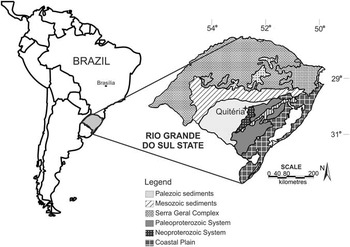
The Paraná Basin is a 1,400,000 km2 intracratonic subsidence basin covering part of southern Brazil, Paraguay, Uruguay, and Argentina (Fig. 1). Basin floor subsidence and Paleozoic and Mesozoic sea-level changes, created a six second-order sequence deposited from the Ordovician to Late Cretaceous, divided by regional unconformities (Milani et al., Reference Milani, Melo, Souza, Fernandes and França2007). The coal-bearing Rio Bonito Formation, from which the material studied here originates, integrates part of two third-order depositional sequences of the Carboniferous–Early Triassic second-order sequence, named S2 and S3 (Holz et al., Reference Holz, França, Souza, Iannuzzi and Rohn2010).
Simplified geological map of the Paraná Basin in Brazil with major tectonic elements and geographic references; location of the Quitéria outcrop is indicated by the star (based on Guerra-Sommer et al., Reference Guerra-Sommer, Cazzulo-Klepzig, Jasper, Kalkreuth, Menegat and Barboza2008).

The Rio Bonito Formation includes coal deposits adjacent to siliciclastic paralic deposits (i.e., estuarine, deltaic, backshore, foreshore, and shore-face sediments) deposited in back-barrier environments (Holz et al., Reference Holz, França, Souza, Iannuzzi and Rohn2010). Tissue preservation and gelification index of coals indicate deposition in coastal swamp environments (Alves and Ade, Reference Alves and Ade1996). The deposition occurred in a cool temperate climate at a paleolatitude around 50° south (Rees et al., Reference Rees, Gibbs, Ziegler, Kutzbach and Behling1999; Scotese, Reference Scotese2000; Torsvik and Cocks, Reference Torsvik and Cocks2011).
The Quitéria outcrop is located in the southeastern part of the Paraná Basin at the Rio Bonito Formation outcropping area, Rio Grande do Sul state, southern Brazil (Fig. 1). It is an isolated and fragmented exposure preserved in a collapsed block following the northwest direction, immediately overlying the granitic basement.
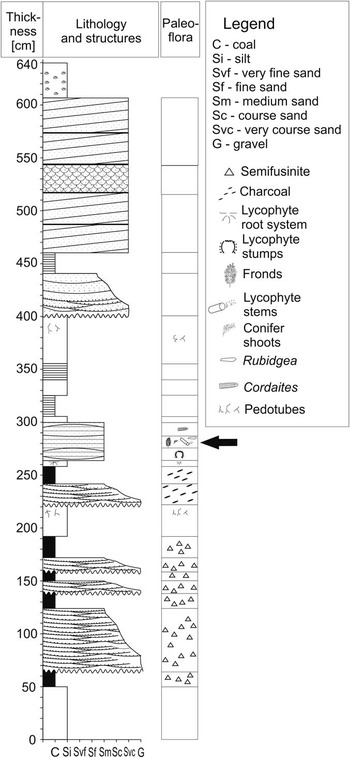
A vertical facies succession (Fig. 2) can be observed throughout the outcrop, representing nine cycles of relative variations of the water level in a lagoon (Jasper et al., Reference Jasper, Menegat, Guerra-Sommer, Cazzulo-Klepzig and Souza2006). The basal part of the section corresponds to coaly shale interbedded with thin coal layers of hypautochthonous origin. According to Jasper and Guerra-Sommer (Reference Jasper and Guerra-Sommer1999), it represents a coastal depositional environment associated with a restricted lagoon protected by a barrier island in microtidal conditions. Macroscopic charcoal studies were carried out on this level by Jasper et al. (Reference Jasper, Uhl, Guerra-Sommer and Mosbrugger2008) confirming the occurrence of paleowildfires during the deposition of the Rio Bonito Formation. The upper section is traditionally interpreted as a roof shale with records of a unique megaflora, consisting of the herbaceous lycophyte Lycopodites riograndensis (Salvi et al., Reference Salvi, Jasper, Ricardo-Branco, Bernades-De-Oliveira and Guerra-Sommer2008), in situ stems with leaves of the subarborescent lycophyte Brasilodendron pedroanum (Jasper et al., Reference Jasper, Guerra-Sommer, Cazzulo-Klepzig and Menegat.2003, Reference Jasper, Menegat, Guerra-Sommer, Cazzulo-Klepzig and Souza2006), the pteridophyll Botrychiopsis valida (Jasper et al., Reference Jasper, Guerra-Sommer, Cazzulo-Klepzig and Menegat.2003), the conifer Coricladus quiteriensis (Jasper et al., Reference Jasper, Ricardi-Branco. and Guerra-Sommer2005), and the glossopterid Glossopteris browniana (Boardman et al., Reference Boardman, Tybusch, Iannuzzi, Dutra and De Lima2006).
Columnar section of the Quitéria outcrop, from Jasper et al. (Reference Jasper, Uhl, Guerra-Sommer and Mosbrugger2008). The arrow indicates the layer from which the material studied here originates.

From the analyses of palynoassemblages preserved in the basal level, a correlation with the Hamiapollenites karrooensis palynostratigraphic subzone of Souza and Marques-Toigo (Reference Souza and Marques-Toigo2003) has been established (Jasper et al., Reference Jasper, Menegat, Guerra-Sommer, Cazzulo-Klepzig and Souza2006), corresponding to the Sakmarian according to the criteria defined by Guerra-Sommer et al. (Reference Guerra-Sommer, Cazzulo-Klepzig, Santos, Hartmann, Ketzer and Formoso2007).
Materials and methods
This study was based on the original material of Hepaticites iporangae by Ricardi-Branco et al. (Reference Ricardi-Branco, Faria, Jasper and Guerra-Sommer2011) as well as new material collected from the type horizon and locality, the Quitéria outcrop in Rio Grande do Sul, Brazil.
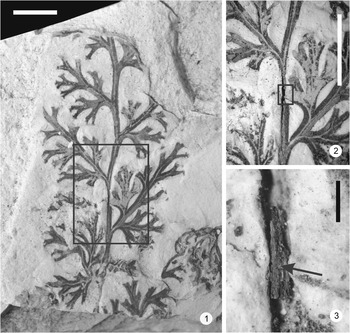
Structures that seemed to belong to conducting tissues were visible in the supposed midrib portion of one large specimen (MCNPbU 254, part and MCNPbU 255, counterpart; see Fig. 6 in Systematic paleontology). Fragments of those structures were mechanically extracted with the aid of preparation needles and tweezers. Subsequently, they were mounted on standard stubs with adhesive tabs for anatomical analysis under a scanning electron microscope (SEM; Zeiss EVO LS15).
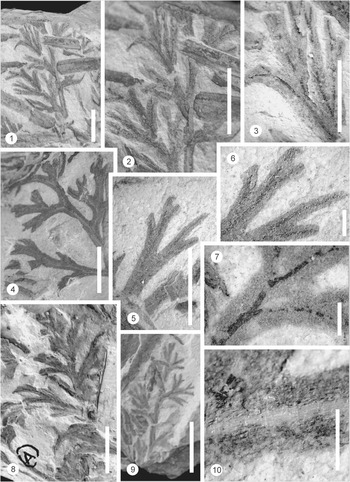
Due to the new anatomical data, which have led to a new interpretation of the systematic affiliation of Hepaticites iporangae, the morphology of the plant fragments had to be reinterpreted. To clarify our new morphological interpretation, we provide a schematic sketch of the leaf/frond based on the largest specimen MCNPbU 254 (Fig. 3). In addition, we provided two figures (Figs. 4, 5) already figured in Ricardi-Branco et al. (Reference Ricardi-Branco, Faria, Jasper and Guerra-Sommer2011) as visual support for our reinterpretation.
Schematic sketch of a frond fragment of ‘Rhodeopteridium’ iporangae n. comb. to clarify the descriptive terms used here (based on MCNPbU 254; Fig. 6.1). Pinnae on the right side are colored dark grey; rachis of the frond and pinnae on the left side are colored in black; pinnatifid pinnules on left side are colored in light grey.

Photographs of ‘Rhodeopteridium’ iporangae n. comb. (from Ricardi-Branco et al., Reference Ricardi-Branco, Faria, Jasper and Guerra-Sommer2011, fig. 2). (1) Holotype MCNPbU 259, showing 2 (4) deeply dissected pinnatifid pinnules. (2) Detail of holotype MCNPbU 259 showing details of forking. (3) Detail of apical portion of holotype MCNPbU 259 showing lamina margins. (4) MCNPbU 246, lamina margins and central vein of the apical segments. (5) MCNPbU 244, showing portion of lobes with rounded tips and evident central veins. (6) Detail of MCNPbU 244 showing central veins with several rows of cells. (7) MCNPbU 259a, showing central vein with several parallel rows of cells, with thick cell walls at the point of branching. (8) MCNPbU 86, showing pinnatifid pinnule with five branchings with conspicuous central vein. (9) MCNPbU 269, showing pinnatifid pinnule with seven branchings. (10) MCNPbU 259, showing central vein cells of the lamina. (1, 2, 8, 9) Scale bars=10 mm; (3–5) scale bars=5 mm; (6, 7) scale bars=1 mm; (10) scale bar=0.5 mm.

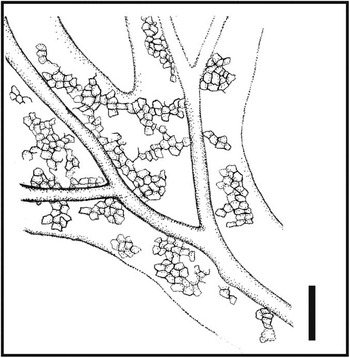
Line drawings of epidermal cell pattern of ‘Rhodeopteridium’ iporangae n. comb. (from Ricardi-Branco et al., Reference Ricardi-Branco, Faria, Jasper and Guerra-Sommer2011, fig. 4.4), holotype MCNPbU 259: detail of lamina showing polymorphic epidermal cells. Scale bar=0.25 mm.

All measurements were taken from calibrated images with the aid of the software package ImageJ (Rasband, 1997–Reference Rasband2014).
Repositories and institutional abbreviations
The material is stored in the Setor de Botânica e Paleobotânica doMuseu de Ciências Naturais da UNIVATES, under the acronym MCNPbU.
Systematic paleontology
Division Tracheophyta Sinnott ex Cavalier-Smith, Reference Cavalier-Smith1998
Class Incertae sedis
Order Incertae sedis
Family Incertae sedis
Genus Rhodeopteridium Zimmermann, Reference Zimmermann1959
Type species
Rhodeopteridium fasciaeformis (Presl in Sternberg, Reference Sternberg1838) Zimmermann Reference Zimmermann1959, from the upper Carboniferous of Radnice, Bohemia, Czech Republic, by original designation.
Diagnosis
Pteridophyll with sphenopterid pinnules, in contrast to the genus Sphenopteris pinnae dissected into very narrow laminar lobes, with only a single vein (translated from Zimmermann, Reference Zimmermann1959, p. 727). Originally in Latin: “Pteridophyllum sphenopterideum; differt a genere Sphenopteris segmentis anguste linearibus, uninervibus” (Zimmermann, Reference Zimmermann1959, p. 727).
‘Rhodeopteridium’ iporangae (Ricardi-Branco, Faria, Jasper, and Guerra-Sommer) new combination
Photographs of ‘Rhodeopteridium’ iporangae n. comb. (1) MCNPbU 254, largest specimen with 7 (9) deeply dissected narrow laminar lobed pinnatifid pinnules; box indicates position of (2). (2) MCNPbU 254, box indicates position of (3). (3) MCNPbU 254, enlargement of central area from which casts of tracheids were extracted (arrow). (1, 2) Scale bars=10 mm; (3) scale bar=0.5.

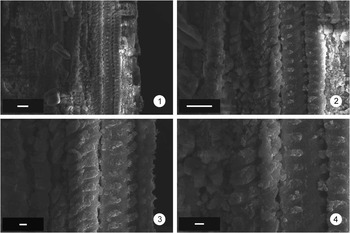
SEM photographs of casts of tracheids extracted from specimen MCNPbU 254. (1, 2) Scale bars=10 µm; (3, 4) scale bars=2 µm.

2011 Hepaticites iporangae Reference Ricardi-Branco, Faria, Jasper and Guerra-SommerRicardi-Branco et al., p. 363, fig. 2.1.
Holotype
Fragment of frond (MCNPbU 259, Fig. 4.1) from the Rio Bonito Formation, early Permian, Quitéria outcrop (30°17'S, 52°11'W), municipality of Encruzilhada do Sul, state of Rio Grande do Sul, Brazil (Ricardi-Branco et al., Reference Ricardi-Branco, Faria, Jasper and Guerra-Sommer2011).
Diagnosis
Frond with pinnae, consisting of deeply dissected pinnatifid pinnules with narrow±laminar lobes. Pinnules branching repeatedly and dichotomously in laminar lobes up to 1.6 mm in width. Lobes with entire margins, epidermal cells polymorphic (?), varying from 50 to 110 µm in diameter. Lobes of pinnules rather short with rounded tips. Central portion of rachis, pinnae, pinnules, and lobes with a single, rather thick vein at least vein of rachis composed of tracheids with helical thickenings on cell walls. Individual laminar lobes are shorter than in all other species of the genus.
Occurrence
Quitéria outcrop (30°17'S, 52°11'W) Rio Bonito Formation, early Permian; municipality of Encruzilhada do Sul, state of Rio Grande do Sul, Brazil.
Description
Fourteen specimens were studied. Pinnatifid pinnules deeply dissected into very narrow laminar lobes, alternating with angles between 25° and 90° (Figs. 4.1–4.4, 4.8, 4.9, 6.1). The pinnae are differentiated in up to nine pinnatifid pinnules with one to five narrow ± laminar lobes (Fig. 6.1). Pinnules are 13 to 23 mm long and around 10 to 17 mm wide (Figs. 4.1–4.10, 6.1, 6.2). Lobes repeatedly bifurcated, up to 5 mm long, with 0.5 to 1.59 mm very narrow lamina (Figs. 4.1, 4.8, 4.9, 6.1, 6.2). Epidermal cells polymorphic (?), varying from 50 to 110 µm in diameter (Figs. 4.10, 5). The midvein is up to 0.5 mm wide, running up to the tips (Figs. 4.1–4.9, 6.1). Tips rounded (Fig. 4.5, 4.6). Conducting tissue of rachis composed of tracheids with helical thickenings on cell walls (Fig. 7.1–7.4), 9–12 tracheids wide in proximal portions of pinnae (Fig. 4.6, 4.7, 4.9) and 6–8 tracheids in more distal portions (Fig. 4.10). Lumina of tracheids 9–11 µm wide (Fig. 7.1–7.4).
Materials
MCNPbU 086a, 086b, 086c, 130, 244a, 244b, 246a, 246b, 246c, 246d, 254, 255, 259, 269b, and 269c.
Occurrence
Quitéria outcrop (30°17'S, 52°11'W) Rio Bonito Formation, early Permian; municipality of Encruzilhada do Sul, state of Rio Grande do Sul, Brazil.
Remarks
The presence of tracheid casts with helical thickenings has to be seen as undisputable evidence that Hepaticites iporangae is in fact not a liverwort as previously assumed by Ricardi-Branco et al. (Reference Ricardi-Branco, Faria, Jasper and Guerra-Sommer2011) but a tracheophyte. Following the recognition that the material does not represent a liverwort, we assigned the material provisionally to the genus Rhodeopteridium, following the views concerning the validity of this genus presented by Pšenička and Schultka (Reference Pšenička and Schultka2009). Due to this reinterpretation, we provided an emended diagnosis for the species based on a reinterpretation of the description by Ricardi-Branco et al. (Reference Ricardi-Branco, Faria, Jasper and Guerra-Sommer2011) and data from new specimens. Unfortunately, it is not possible to compare the epidermal structures seen in the material from the Quitéria outcrop with information from other Rhodeopteridium species (e.g., Pšenička and Schultka, Reference Pšenička and Schultka2009). This is because neither SEM images (cf. Ricardi-Branco et al., Reference Ricardi-Branco, Faria, Jasper and Guerra-Sommer2011, fig. 3.1, 3.4) nor camera lucida drawings (cf. Ricardi-Branco et al., Reference Ricardi-Branco, Faria, Jasper and Guerra-Sommer2011, fig. 4.1–4.4; partly refigured here as Fig. 5) of the epidermal impressions on the rock surface allowed detailed insights into epidermal anatomy of the specimens investigated.
Although it has repeatedly been argued that Zimmermann (Reference Zimmermann1959) used Rhodeopteridium as an illegitimate substitute for the genus Rhodea (e.g., Stepanek, Reference Stepanek1987; Ameron and Kabon, Reference Amerom and Kabon1999), this view is not generally accepted (e.g., Josten and Ameron, Reference Josten and Amerom2003; Pšenička and Schultka, Reference Pšenička and Schultka2009). A resolution of this nomenclatural problem is beyond the scope of the present contribution.
Most species assigned so far to the genus Rhodeopteridium are known from the Mississippian, but some occur in Pennsylvanian strata (e.g., Presl in Sternberg, Reference Sternberg1838; Pšenička and Schultka, Reference Pšenička and Schultka2009; Hübers et al., Reference Hübers, Bomfleur, Krings, Pott and Kerp2014). Because many remains that may be assigned to this morphologically ‘simple’ taxon are rather fragmentary, many authors avoid assigning such material formally to the genus Rhodeopteridium (or Rhodea; Hübers et al., Reference Hübers, Bomfleur, Krings, Pott and Kerp2014) by using informal expressions like ‘cf. Rhodea sp. foliage type’ (e.g., Meyer-Berthaud and Rowe, Reference Meyer-Berthaud and Rowe1997) or rhodeopterid frond (e.g., Boardman et al., Reference Boardman, Souza, Iannuzzi and Mori2012). For comparable material from the Rio Bonito Formation of the Paraná Basin, the generic assignment to Rhodeopteridium has repeatedly been used (e.g., Guerra-Sommer and Cazzulo-Klepzig, Reference Guerra-Sommer and Cazzulo-Klepzig1993; Jasper et al., Reference Jasper, Guerra-Sommer, Cazzulo-Klepzig and Menegat.2003, Reference Jasper, Ricardi-Branco. and Guerra-Sommer2005; Ianuzzi, Reference Iannuzzi2010; Boardman et al., Reference Boardman, Souza, Iannuzzi and Mori2012), unfortunately without any in-depth morphological analysis and discussion of the respective specimens as well as their taxonomic treatment.
We also decided to place the species from Quitéria provisionally into the genus Rhodeopteridium, although there are other late Palaeozoic genera that include species with a comparable frond morphology, i.e., Zeilleria Kidston and Palmatopteris Potonié. However, Zeilleria is mostly classified as a true fern (e.g., Pšenička, Reference Pšenička2005), but there is no evidence that the specimens from the Quitéria outcrop represent remains of a fern; thus, we decided against such an affiliation. The genus Palmatopteris also includes fern-like species with sphenopterid pinnules, which are differentiated into very narrow laminar lobes. However, this genus is characterized by a double dichotomy of the main rachis (Potonié, Reference Potonié1892). As the specimens from the Quitéria outcrop are rather small and show no signs of such a double dichotomy, we decided against such an affiliation. As it is, the material from the Quitéria outcrop fits well within the generic diagnosis provided by Zimmermann (Reference Zimmermann1959), although some doubts remain due to the relatively small size of all fragments.
The provisional reassignment of Hepaticites iporangae to ‘Rhodeopteridium’ reduces the overall diversity of plants known from the Quitéria outcrop but increases the taxonomic robustness of the generic placement of this material with Rhodeopteridium. At the moment such a generic affiliation seems at least provisionally justified as the material fits well within the generic diagnosis presented by Zimmermann (Reference Zimmermann1959) and used by previous authors (e.g., Pšenička and Schultka, Reference Pšenička and Schultka2009). However, compared to other species in this genus, the individual laminar segments are rather short (a diagnostic character that distinguishes this species from all other species in the genus). At the moment, this difference does not justify erecting a new genus for the material from the Paraná Basin, considering the stratigraphic distribution of most taxa so far assigned to Rhodeopteridium and the fragmentary nature of the material from the Quitéria outcrop, which lacks meaningful information about epidermal (cuticular) anatomy. It is, however, possible that in the future new and more complete material will be recovered, which may fully justify assignment into Rhodeopteridium or may lead to changing the generic position of this material again.
Acknowledgments
The authors thank M. B. Horn (UNIVATES) for help with SEM facilities, as well as FAPERGS (Brazil), CAPES (Brazil), CNPq (Brazil), and Alexander von Humboldt Foundation (Germany) for funding.