

Introduction
The first post-anaesthesia care unit (PACU) was set up in 1923. The main reason for establishing these units was to reduce post-operative morbidity and mortality. The patient’s clinical condition after surgery, the type of anaesthesia and the type of surgery dictated the patient’s post-operative care and monitoring requirements [Palvin et al, Reference Palvin, Kapp and Polissar1998; Waddle et al, Reference Waddle, Evers and Piccirillo1998]. It was also necessary to estimate the immediate impact of the anaesthesia regarding deviations or medical pathologies occurring immediately after the anaesthesia/surgery. Today, the PACU is set up next to operating rooms as a standard requirement.
Patient post-operative length of stay (LOS) in the PACU is an important component in managing treatment and has significant implications for patient safety and quality of care. There is no consensus in the literature regarding the ‘Gold Standard’ for patient discharge from the PACU [Waddle et al, Reference Waddle, Evers and Piccirillo1998], but some studies focus mainly on PACU LOS as a secondary outcome when comparing different anaesthetic methods among patients with similar characteristics and surgery types. The study of Waddle et al [Reference Waddle, Evers and Piccirillo1998] was among the first studies to describe PACU LOS while classifying the LOS into two types: actual LOS and the LOS appropriate for the post-operative stabilisation of the patient. The assumption is that the PACU LOS is composed of factors relating to the patient’s clinical condition and external factors related to managing PACU care. The appropriate LOS was determined in this study by the clinical judgement of the researcher, which was to some extent subjective. However, this study provided a framework for examining the term ‘length of stay’, and it constitutes a basis for continued research using empirical tools to evaluate the patient’s condition.
Over the years, changes have occurred in the mix of hospitalised patients and surgeries. New technologies have increased the number of surgeries per day and also the use of the PACU. Since there is no medical consensus regarding the criteria for keeping a post-operative patient in the PACU, the PACU LOS depends on two main components: the patient’s clinical condition and the care management set-up. The question that therefore arises is: what is the gap between the patient’s actual PACU LOS and the appropriate LOS? The factors influencing actual and appropriate LOS need to be identified.
The patient’s PACU LOS is described by two terms: Actual LOS, and Appropriate LOS [Waddle et al, Reference Waddle, Evers and Piccirillo1998; Panagiotis et al, Reference Panagiotis, Poulopoulou, Papahatzi and Panagiotis2005]. Actual LOS is defined from the moment of admittance to the PACU up to the time of transfer to a hospital ward. The influencing factors are external and patient-related. Bruce [Reference Bruce2000] examined the factors delaying the discharge of patients from the PACU. His findings showed that the PACU nurse–patient ratio, the availability of beds in the ward and waiting for instructions from the anaesthesiologist were the main reasons for the delay. Other reasons included complications after starting the epidural and transfer problems during shift changes. Marcon et al [Reference Marcon, Kharraja, Smolski, Luquelt and Viale2003] calculated the number of PACU positions required in relation to the number of surgeries. They found that the highest bed rotation was between 8 a.m. and 12 p.m. They compared three factors influencing the delay in discharge during the morning, for non-medical reasons: nurse overload, the availability of beds in the ward and the availability of orderlies. They found that the availability of transport assistance was 20–40 minutes.
Appropriate LOS is defined as the time required for the patient to achieve a stable physiological condition after the anaesthesia. The type and duration of anaesthesia and the quantity of liquids the patient received during surgery were found by Waddle et al [Reference Waddle, Evers and Piccirillo1998], to predict the appropriate PACU LOS. Their work was supported by Bothner et al [Reference Bothner, Georgieff and Schwilk1999], who classified the types of anaesthetic complications (IECs – Incidents, Events and Complications) into four levels. The severity levels were standardised by patients’ age, sex, clinical condition prior to surgery and length of anaesthesia. The average difference in PACU LOS was between 6% and 26%, according to the degree of severity of IECs. Other studies show that patients’ body temperature influences PACU LOS. The definition of appropriate LOS is mainly based on objective criteria that enable an evaluation of patient health prior to discharge from the PACU. Over the years, objective tools have been developed to evaluate the patient’s condition at discharge, including the Post-anaesthetic Aldrete and Kroulik Recovery Score.
The Post-anaesthesia Recovery Score used in Israel and at the Kaplan Medical Center is by Aldrete and Kroulik [Reference Aldrete and Kroulik1970]. The original tool is based on five components:
• Respiration – the patient’s ability to breathe autonomously and cough;
• Circulation – the patient’s blood pressure is stabilised;
• Consciousness – the patient’s level of consciousness or alertness;
• Color – the patient’s color;
• Activity – muscle function tested by the patient’s ability to move limbs spontaneously or on request.
Each component is scored on a 0–10 scale, based on identical objective criteria, 10 being the highest score. Researchers consider the cut-off point for discharge to be 8 or above. Monitoring is performed upon the patient’s admission to PACU and after 60 minutes. This tool has been modified, and it is now normal to monitor every 30 minutes. This tool takes into account the patient’s age, sex, pre-surgical clinical condition, surgery type and anaesthesia duration. The type of anaesthetic and medication are also examined. This tool will be used to evaluate appropriate LOS. The studies described above also found pain level and vomiting to be additional indices for determining post-operative and post-anaesthetic clinical condition prior to patient discharge.
Methods
The study was conducted in Israel, at the Kaplan Medical Center, which has 540 beds. A total of 11,000 surgeries are performed here each year.
Sample
The sample included post-operative patients aged 18 or over, who had received general or regional anaesthesia, randomly chosen according to the types of surgery conducted during the week.
Inclusion criteria: patients aged 18 or over; patients who had surgery with general or regional anaesthesia; patients transferred to the PACU; patients who had surgery during the morning shift up to 2 p.m. (start of the surgery); patients from the following wards: general surgery, ENT, urology, orthopaedics, eyes, hand surgery, gynaecology, plastic surgery, blood vessels (except fistulae).
Exclusion criteria: patients aged under 18; patients transferred directly to general emergency (ICU) or to the ward; patients whose surgery started after 2 p.m.; patients who had surgery during weekends or holidays; patients kept for observation overnight (unstable).
Procedure
After receiving the Helsinki committee approval, the data were gathered from patient records, anonymously, for about 6 months (prospectively).
Research tool
The study used a validated tool from research literature that had a pilot trial prior to use. The statistical analysis used Statistical Package for the Social Sciences (SPSS) software, including regressions and comparisons between groups.
Independent variables: demographics (age and sex); surgery type and duration (minutes); anaesthesia type and duration (minutes); time of PACU admission, decision to discharge and actual discharge; clinical condition in PACU (Aldrete score, pain level, vomiting, urination).
Interfering variables: patient’s pre-operative clinical/medical condition, based on anaesthesiologist’s examination (ASA tool to evaluate anaesthesia risks; IECs tool to evaluate anaesthesia complications; chronic diseases); clinical condition during surgery (quantity of liquid received, blood loss); reasons for delaying discharge.
Dependent variables: actual LOS; appropriate LOS.
Research hypotheses
1. The appropriate PACU LOS will vary according to the type of surgery and type of anaesthesia. General anaesthesia and complex surgery will require longer PACU LOS compared with regional anaesthesia and minor surgery.
2. Appropriate LOS will be lower than actual LOS.
3. A link will be found between actual LOS and factors related to care management (time of anaesthesiologist’s arrival, time of transport assistance arrival, etc.).
Results
Research population characteristics
The sample included 580 patients, 329 women (57%) and 242 men (43%). Average age: 52 ± 18 years. Ninety-six per cent of surgeries were planned surgeries. The most common surgeries were: hernia (19%) and caesarean (18%). About 35.3% of surgeries were of the general surgical department, 25% of the gynaecology department, 11.2% of the orthopaedic department and the rest of other surgical departments such as ENT, eyes and plastic surgery.
Characteristics related to pre-operative clinical/medical condition
Evaluating anaesthesia risk (using ASA, scale of 1–5): 85% of patients were evaluated at a low anaesthesia risk level (2 or lower); 63% of patients had chronic diseases that were not counter-indicated for the surgery; 45% took medication regularly. Potential anaesthesia complications: anaesthesiologist’s evaluation based on IECs (scale of 1–4): 63% were defined as Airway class 2, and 31% as Airway class 1 (low complication potential).
Anaesthesia duration
About 72% of the surgeries were conducted under general anaesthetic and 28% under regional anaesthetic (of which 90% spinal). Average anaesthesia duration: 1.22 ± 0.47 hours. Average general anaesthesia time: 1.30 ± 0.50 hours. After 90 minutes, 60% of general anaesthetics are completed. Average regional anaesthesia time: 1.01 ± 0.29 hours. After 90 minutes, 84% of regional anaesthetics are completed. There was a significant difference in anaesthesia duration between general and regional anaesthesia: t(471) = 8.476, p < 0.001.
Surgery duration
Average surgery duration: 0.56 ± 0.40 hours. After 90 minutes, 84% of surgeries are completed. There was a significant difference in surgery duration between types of surgery, F(5,313) = 45.111, p < 0.001.
Determining LOS
A hierarchical regression was performed to determine LOS. The first model included anaesthesia type and the second model included the variables: vomiting, urination, pain level.
• Anaesthesia type had a significant percentage of explained variance: F(1,495) = 68.6, R 2 = 0.12, p < 0.001.
• After introducing the other variables (vomiting, urination, pain level): F(5,491) = 36.0, R 2 = 0.26, p < 0.001.
PACU LOS: average LOS was 1.28 ± 0.51 hours.
Evaluating appropriate LOS
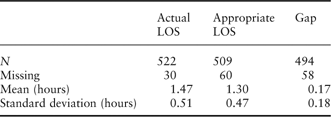
Average appropriate LOS (interval between PACU admission and achieving stability conditions enabling discharge, according to physician): 1.30 ± 0.47 hours (Table 1).
Appropriate post-anaesthesia care units length of stay

Significant differences were found in appropriate LOS between anaesthesia types (general/regional), t(494) = 8.114, p < 0.001. Appropriate LOS was higher when the anaesthesia type was regional. The most common surgeries leading to an appropriate LOS of over 90 minutes were: Caesarean Surgery (CS), colon, prostate and cholecystectomy. Significant differences were found between LOS and various surgery types: F(5,275) = 21.1, p < 0.001.
Actual LOS
Average actual LOS (interval between PACU admission and actual discharge, when patient stable): 1.47 ± 0.51 hours (Table 2).
Actual post-anaesthesia care units length of stay

A significant difference was found between anaesthesia type and actual LOS, t(508) = 7.716, p < 0.001. The actual LOS was higher when the anaesthesia type was regional. The most common surgeries leading to an actual LOS of two hours and over were: CS, colon, prostate and cholecystectomy. Significant differences were found in actual LOS between different surgery types, F(5,290) = 25.8, p < 0.001.
Gap between actual and appropriate length of stay
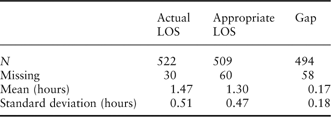
Gap between actual and appropriate LOS
The average gap between actual and appropriate LOS: 0.17 ± 0.18 hours (Table 3). In about 50% of cases, the reason for the delay was noted (Table 4).
Gap between appropriate and actual length of stay, noting of delay reason

Causes of the gap between actual and appropriate LOS
The most common reason for the delay was waiting for transport assistance (55%). Another common reason was the need to complete treatment/medication (29%). The average waiting time for anaesthesiologist was close to 0. Only in 5% of cases was the waiting time for the anaesthesiologist over ten minutes.
A significant difference was found between the reasons for the delay and the duration of the delay, F(2,206) = 3.774, p < 0.05. The average waiting time for transport assistance was 0.22 ± 0.16 hours. The average wait for transport assistance between 12 p.m. and 1 p.m. was 0.32 ± 0.21 hours. The average waiting time for completion of treatment was 0.25 ± 0.28 hours. Completing treatment/medication included: analgesia (34), giving insulin (2), giving blood (2), giving Fusid (2), giving Zofran (1), monitoring bleeding (1), repeat surgery (1).
Discussion
The patient’s PACU LOS is determined arbitrarily in each hospital based on the anaesthesiologist’s consideration. The decision is usually based on the type of anaesthesia and the post-operative and post-anaesthetic clinical condition, since there is no Gold Standard [Waddle et al, Reference Waddle, Evers and Piccirillo1998; Panagiotis et al, Reference Panagiotis, Poulopoulou, Papahatzi and Panagiotis2005]. Support for this was also found in the Israeli Ministry of Health’s procedure (April 1999, clause 6.10), stating that the appropriate PACU LOS is at least 30 minutes without reference to the type of anaesthesia.
This study examined the LOS of 580 patients who had surgery under general or regional anaesthesia in the morning (planned surgery schedule). One purpose of this study was to estimate the appropriate LOS. This was achieved in two stages. The first stage located the factors predicting the appropriate LOS. For this purpose, we conducted a hierarchical regression to locate the factors that might influence appropriate LOS. The first model included the type of anaesthesia, and the second model included the following variables: vomiting, urination and pain level. A significant percentage of explained variance was found between anaesthesia types. This finding supports the studies of Waddle et al [Reference Waddle, Evers and Piccirillo1998] and of Bothner et al [Reference Bothner, Georgieff and Schwilk1999].
The second stage examined the study population’s characteristics, both demographic and clinical, as data that might influence the evaluation of appropriate LOS. The findings showed that most patients were in the age range 31–70, 96% of the surgeries were planned and their distribution was in proportion to the size of the hospital departments. The clinical/medical background characteristics were within the norm, and no deviation was reported that would indicate heterogeneity of the study population in terms of anaesthesia risk (ASA) or risk of anaesthesia complications (IECs).
In light of these findings, the appropriate LOS was determined by anaesthesia type among the entire study population. The findings showed that the appropriate LOS was about 30 minutes higher in regional anaesthesia than in general anaesthesia. This finding is interesting, since the common opinion is that general anaesthesia requires longer monitoring. This finding disproved the study’s first research hypothesis. The explanation for this is that 90% of the regional anaesthesia cases were spinal. In spinal anaesthesia cases, apart from haemodynamic monitoring, it is also necessary to monitor sensory and motor limb mobility [McGrath and Chung, Reference McGrath and Chung2003]. Also, the clearance of anaesthetics after spinal anaesthesia is longer than that of general anaesthetics. The longer clearance of anaesthetics in spinal anaesthesia influences the sensory/motor deficiency, depending on the type, volume and concentration of injected medication [Imarengiaye et al, Reference Imarengiaye, Song, Prabhu and Chung2003; Strichartz and Berde, Reference Strichartz, Berde and Miller2005]. This difference may be expressed in the appropriate LOS, which depends on the patient’s limb mobility. The anaesthesiologist and the nurse examine the patient’s clinical suitability for PACU discharge, including, apart from haemodynamic condition, an evaluation of limb mobility (using the Aldrete Score), which explains the later decision that the patient is stable and may be discharged to the ward in regional anaesthesia compared with general anaesthesia [Imarengiaye et al, Reference Imarengiaye, Song, Prabhu and Chung2003]. This is despite the duration of general anaesthesia being longer than regional anaesthesia (1.30 hours compared with 1.01 hours, respectively).
The average appropriate LOS evaluated in this study was 1.20 hours in general anaesthesia, compared with 1.56 hours in regional anaesthesia. This gap was maintained in the actual LOS (average 1.30 hours in general anaesthesia compared with 1.47 hours in regional anaesthesia). This finding supports the study’s second research hypothesis.
Another factor included in the third objective was examining the reasons for the delay (the gap between the actual and appropriate LOS). Only in about 50% of cases was a delay in discharging the patient from the PACU noted. The main reason for delay was waiting for transport assistance (55%), followed by extending stay for continued care.
Several studies have examined the reason for delay by reporting only (without comparing actual and appropriate LOS as this study has done). Bruce [Reference Bruce2000] reported that the main reasons for delay were: PACU nurse–patient ratio, bed availability in ward and waiting for instructions and/or discharge by anaesthesiologist. Marcon et al [Reference Marcon, Kharraja, Smolski, Luquelt and Viale2003] calculated the number of stations required compared with the number of surgeries found that the highest PACU bed rotation was between 8 a.m. and 12 p.m. They compared three factors that could influence discharge delay during the morning, for non-medical reasons: nurse overload, bed availability in wards and transport assistance availability. They found that stretcher-bearer availability was the main reason for discharge delays. Waiting time for transport assistance was 20–40 minutes. In this study, the average waiting time for transport assistance was 22 minutes (mainly during lunchtime), and average waiting time for care completion (medication) was 25 minutes. The gap between appropriate and actual LOS did indeed result from reasons not related to the patient but to care management, as predicted in the third hypothesis.
Conclusions
According to this study, appropriate LOS is influenced by anaesthesia type. In regional anaesthesia, LOS was higher than in general anaesthesia (average gap of 17 minutes). This study is a pioneer, and further studies are required, on larger scales and in several hospitals, in order to determine an evidence-based standard for appropriate PACU LOS for post-operative patients based on anaesthesia type. An evidence-based standard could reduce variance among medical staff and prevent discharge decisions being taken for non-medical reasons, if they exist. The standard is important in maintaining patient safety and effective patient care.
This study provides additional support to other research conducted on patient PACU LOS beyond the appropriate due to various reasons that delay discharge. The main reason was waiting for transport assistance. Another reason was the need to complete medication, which is essential for the patient’s condition. Waiting for the anaesthesiologist was not a significant cause of delay. This study’s findings show that hospital procedures could be improved by allocating transport assistance to the PACU. This would solve the problem and reduce the PACU overload, enabling bed availability for additional post-operative patients, especially at busy times. The busy times are mainly during lunchtime when patient numbers increase both due to the completion of surgery and due to previous delays in discharging to wards. Transport assistance allocation would help improve quality of care, patient well-being and would make work processes more efficient.