


%20--%3e%3c!DOCTYPE%20svg%20PUBLIC%20'-//W3C//DTD%20SVG%201.0//EN'%20'http://www.w3.org/TR/2001/REC-SVG-20010904/DTD/svg10.dtd'%3e%3csvg%20version='1.0'%20id='Layer_1'%20xmlns='http://www.w3.org/2000/svg'%20xmlns:xlink='http://www.w3.org/1999/xlink'%20x='0px'%20y='0px'%20width='64px'%20height='64px'%20viewBox='5.5%20-3.5%2064%2064'%20enable-background='new%205.5%20-3.5%2064%2064'%20xml:space='preserve'%3e%3cg%3e%3ccircle%20fill='%23FFFFFF'%20fill-opacity='0'%20cx='37.785'%20cy='28.501'%20r='28.836'/%3e%3cpath%20fill='%23595959'%20d='M37.441-3.5c8.951,0,16.572,3.125,22.857,9.372c3.008,3.009,5.295,6.448,6.857,10.314%20c1.561,3.867,2.344,7.971,2.344,12.314c0,4.381-0.773,8.486-2.314,12.313c-1.543,3.828-3.82,7.21-6.828,10.143%20c-3.123,3.085-6.666,5.448-10.629,7.086c-3.961,1.638-8.057,2.457-12.285,2.457s-8.276-0.808-12.143-2.429%20c-3.866-1.618-7.333-3.961-10.4-7.027c-3.067-3.066-5.4-6.524-7-10.372S5.5,32.767,5.5,28.5c0-4.229,0.809-8.295,2.428-12.2%20c1.619-3.905,3.972-7.4,7.057-10.486C21.08-0.394,28.565-3.5,37.441-3.5z%20M37.557,2.272c-7.314,0-13.467,2.553-18.458,7.657%20c-2.515,2.553-4.448,5.419-5.8,8.6c-1.354,3.181-2.029,6.505-2.029,9.972c0,3.429,0.675,6.734,2.029,9.913%20c1.353,3.183,3.285,6.021,5.8,8.516c2.514,2.496,5.351,4.399,8.515,5.715c3.161,1.314,6.476,1.971,9.943,1.971%20c3.428,0,6.75-0.665,9.973-1.999c3.219-1.335,6.121-3.257,8.713-5.771c4.99-4.876,7.484-10.99,7.484-18.344%20c0-3.543-0.648-6.895-1.943-10.057c-1.293-3.162-3.18-5.98-5.654-8.458C50.984,4.844,44.795,2.272,37.557,2.272z%20M37.156,23.187%20l-4.287,2.229c-0.458-0.951-1.019-1.619-1.685-2c-0.667-0.38-1.286-0.571-1.858-0.571c-2.856,0-4.286,1.885-4.286,5.657%20c0,1.714,0.362,3.084,1.085,4.113c0.724,1.029,1.791,1.544,3.201,1.544c1.867,0,3.181-0.915,3.944-2.743l3.942,2%20c-0.838,1.563-2,2.791-3.486,3.686c-1.484,0.896-3.123,1.343-4.914,1.343c-2.857,0-5.163-0.875-6.915-2.629%20c-1.752-1.752-2.628-4.19-2.628-7.313c0-3.048,0.886-5.466,2.657-7.257c1.771-1.79,4.009-2.686,6.715-2.686%20C32.604,18.558,35.441,20.101,37.156,23.187z%20M55.613,23.187l-4.229,2.229c-0.457-0.951-1.02-1.619-1.686-2%20c-0.668-0.38-1.307-0.571-1.914-0.571c-2.857,0-4.287,1.885-4.287,5.657c0,1.714,0.363,3.084,1.086,4.113%20c0.723,1.029,1.789,1.544,3.201,1.544c1.865,0,3.18-0.915,3.941-2.743l4,2c-0.875,1.563-2.057,2.791-3.541,3.686%20c-1.486,0.896-3.105,1.343-4.857,1.343c-2.896,0-5.209-0.875-6.941-2.629c-1.736-1.752-2.602-4.19-2.602-7.313%20c0-3.048,0.885-5.466,2.658-7.257c1.77-1.79,4.008-2.686,6.713-2.686C51.117,18.558,53.938,20.101,55.613,23.187z'/%3e%3c/g%3e%3c/svg%3e)
%20--%3e%3c!DOCTYPE%20svg%20PUBLIC%20'-//W3C//DTD%20SVG%201.0//EN'%20'http://www.w3.org/TR/2001/REC-SVG-20010904/DTD/svg10.dtd'%3e%3csvg%20version='1.0'%20id='Layer_1'%20xmlns='http://www.w3.org/2000/svg'%20xmlns:xlink='http://www.w3.org/1999/xlink'%20x='0px'%20y='0px'%20width='64px'%20height='64px'%20viewBox='5.5%20-3.5%2064%2064'%20enable-background='new%205.5%20-3.5%2064%2064'%20xml:space='preserve'%3e%3cg%3e%3ccircle%20fill='%23FFFFFF'%20fill-opacity='0'%20cx='37.637'%20cy='28.806'%20r='28.276'/%3e%3cg%3e%3cpath%20fill='%23595959'%20d='M37.443-3.5c8.988,0,16.57,3.085,22.742,9.257C66.393,11.967,69.5,19.548,69.5,28.5c0,8.991-3.049,16.476-9.145,22.456%20C53.879,57.319,46.242,60.5,37.443,60.5c-8.649,0-16.153-3.144-22.514-9.43C8.644,44.784,5.5,37.262,5.5,28.5%20c0-8.761,3.144-16.342,9.429-22.742C21.101-0.415,28.604-3.5,37.443-3.5z%20M37.557,2.272c-7.276,0-13.428,2.553-18.457,7.657%20c-5.22,5.334-7.829,11.525-7.829,18.572c0,7.086,2.59,13.22,7.77,18.398c5.181,5.182,11.352,7.771,18.514,7.771%20c7.123,0,13.334-2.607,18.629-7.828c5.029-4.838,7.543-10.952,7.543-18.343c0-7.276-2.553-13.465-7.656-18.571%20C50.967,4.824,44.795,2.272,37.557,2.272z%20M46.129,20.557v13.085h-3.656v15.542h-9.944V33.643h-3.656V20.557%20c0-0.572,0.2-1.057,0.599-1.457c0.401-0.399,0.887-0.6,1.457-0.6h13.144c0.533,0,1.01,0.2,1.428,0.6%20C45.918,19.5,46.129,19.986,46.129,20.557z%20M33.042,12.329c0-3.008,1.485-4.514,4.458-4.514s4.457,1.504,4.457,4.514%20c0,2.971-1.486,4.457-4.457,4.457S33.042,15.3,33.042,12.329z'/%3e%3c/g%3e%3c/g%3e%3c/svg%3e)
The adoption of the 1982 UN Convention on the Law of the Sea (UNCLOS)Footnote 1 and the steady development of international environmental law in the twentieth century shaped the marine environment as an object of legal protection. However, the exponential growth of substantive obligations to protect the marine environment, conserve marine biodiversity, and prevent marine pollution, has been largely ineffective due to lack of enforcement. Unmanned aerial vehicles (UAVs) deployed for marine environmental protection are seen, in scholarship and policy, as a means to close the enforcement gap, thereby revolutionizing the field by significantly increasing states’ maritime awareness.Footnote 2 In contrast, our tentative analysis shows that while UAVs can translate complex environmental concerns into data readily available for analysis and action, such datafication of marine environments comes with high risks. More specifically, datafication enables multiple uses of gathered data, including for surveillance, military, and commercial purposes. These concerns tend to fall outside current debates on the international regulation of the use of UAVs in marine environments. In our essay, we explore whether international law recognizes the possibilities and risks involved in deploying UAVs into the marine environment. We draw on doctrinal and posthuman feminist legal approachesFootnote 3 to analyze how UAVs interact with the wider context of “marine ecosystem bodies” in terms of international law, as well as how those terms may need to be reconfigured to accommodate the complexity of the many actors, agents, and materials of marine ecosystems.
Terminology
UAVs can be anything from drones, balloons, remote unmanned systems, and gliders to airplanes and rotorcrafts. They are sometimes referred to as unmanned aerial systems or remotely piloted aircraft,Footnote 4 and as eco-drones or conservation drones when deployed for environmental protection. The terminology conveys the vehicle's characteristics, equipment, size, intended use, and level of automation, ranging from those that require human assistance to those that are fully autonomous and have decision-making capacities.Footnote 5 In this essay, we refer to UAVs or conservation drones as unmanned aerial vehicles, irrespective of the automation level.
The UAVs we consider in this essay are those that interact in marine environments with a range of entangled entities, including oceanic, surface, and air bodies—all of which we understand as a larger marine ecosystem—interweaving the legal spaces of sub-surface ocean, surface, and air, as well as technological, biological, human- and non-human entities. This is what we call “marine ecosystem bodies.”Footnote 6
The Rise of the Benevolent Drone
UAVs are strongly associated with warfare. Commercial and civil product developments of UAVs are often side-effects of military developments of military technologies. Driven by these military and security developments, civil applications of UAVs continue to multiply and gain social traction. Civil service “benevolent” drones deliver food and medicines to those in need, transmit meteorological data, and contribute to the conservation of terrestrial and marine environments.Footnote 7 Conservation drones appear as cost-effective devices, able to access remote sea areas and reduce human labor and, most importantly, human error.Footnote 8 In a sense, UAVs outdo human abilities in reach and sensing. For example, conservation drones can collect high-resolution images on a scale and at places humans cannot reach. Conservation drones may also be equipped with thermal sensors to detect marine species. Even as these are more-than-human abilities, the human quality of multiple sensing—seeing, hearing, smelling—and analyzing any information gathered from and about a marine ecosystem body is lost because it reduces complex environmental systems and concerns into “data bits.” The specificity of UAVs adds precision to data while depleting analyses of breadth, critical potential, and embodied care of the marine ecosystem bodies they interact with.
UAVs’ perceived benevolence has prompted their swift accommodation in existing international, regional, and national aviation legal regimes to facilitate their deployment.Footnote 9 The rationale for such accommodation is that data gathered by “benevolent” UAVs may be used primarily for non-military, non-surveillance, and non-commercial purposes. Yet, experience and scholarship on big data and data protection point to data extraction, data refurbishing, and data repurposing for commercial gain as well as military surveillance purposes, going hand in hand. The regulatory accommodation also aims at curbing the disruptive effects of this novel technology on existing legal frameworks, but it leaves behind issues concerning datafication. In particular, important environmental problems are left outside of analyses if those problems cannot find solutions through data analysis.Footnote 10 For example, our knowledge of the deep seabed is dependent on technological mediation, to wit, sonars, satellites and unmanned vehicles. This remote sensing is subject to asymmetrical data collection.Footnote 11 Additionally, the data is fragmented and not commonly shared, ultimately limiting its usability to regions with economic, technological, and institutional capacity to deploy this sensing technology.Footnote 12
Moreover, the use of UAVs as an exteriorization of “the human” recalls transhuman desires of human augmentation.Footnote 13 Does a further expansion of human control through UAV data extraction into marine ecosystem bodies really enhance marine protection or rather human control and capacities? The history of international law provides some clues: the dressing up of human extractivist practices in the international legal-linguistic tropes of “conservation” and “protection” has only nominally, in colonial as well as present iterations, covered up the real meaning of “grabbing” of commercially valuable “resources” through international law.Footnote 14 This extractivism also extends to surface, air, and, not least, data harvesting. In this context, posthuman feminist legal theory acts to reposition the environment, rather than the human, as the telos of regulatory and enforcement efforts.Footnote 15 Protecting marine ecosystem bodies from commercial and surveillance exploitation is key in the context of rethinking the regulatory framework in which an expansive deployment of UAVs for “conservation” and “protection” is taking place.
Conservation Drones: In and Between Laws and the Marine Environment
Under international law, UAVs are “aircraft” defined by the International Civil Aviation Organization as “any machine that can derive support in the atmosphere from the reactions of the air other than the reactions of the air against the earth's surface.”Footnote 16 In their commercial variations, they become objects of international law mainly when transiting through air space over the territory of more than one state.Footnote 17 In the airspace above the high seas and the exclusive economic zone, UAVs, like any other aircraft, are subject to the Convention on International Civil Aviation (the Chicago Convention).
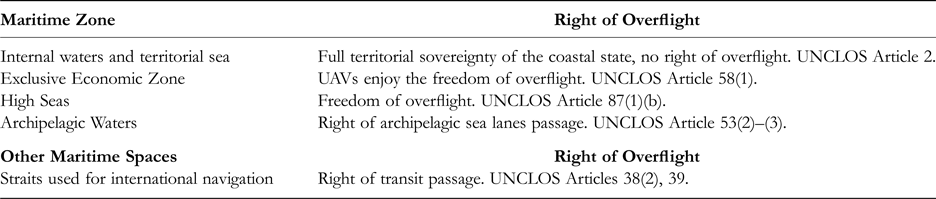
From a law of the sea perspective, the classification of UAVs as aircraft is relevant for asserting overflight rights in the air space above maritime zone, as summarized in the following table:
UAVs in the Air Space Above the Marine Environment

States and civil society actors rely on overflight rights to collect data for marine environmental purposes. Yet, we argue that surveillance and data collection are not necessarily included in these rights. More importantly, aviation is concerned with transit from point A to B. By contrast, UAVs’ primary purpose is not aerial navigation but rather surveillance and data collection. Therefore, the regulation of UAVs as aircraft obscures the purpose of these autonomous vehicles.
The deployment of UAVs further complicates and crowds the marine ecosystem bodies in which UAVs become yet another entangled entity, adding a layer of datafication, inviting security concerns and informal enforcement. The multitude of purposes for data collection is also problematic in terms of the right to conduct marine scientific research under the law of the sea, which is extensive but precludes activities for resource exploration or exploitation purposes. Moreover, the use of conservation drones is not limited to state authorities. There is an emerging trend of civil society organizations acting as conservation vigilantes.Footnote 18 When used by vigilantes, drones can easily escape the sovereign control of the state. Civil society organizations needless to say do not have jurisdiction, but drones, like any commercial aircraft, enjoy certain overflight rights over the marine environment. In internal waters and territorial seas, express authorization is needed.Footnote 19 The same authorization is needed where transit passage and sea lanes passage apply since a constituent element of these overflight rights is the continuous and expeditious transit over straits used for international navigation or archipelagic waters.Footnote 20
Aircraft enjoy the freedom of overflight in the exclusive economic zone and the high seas.Footnote 21 Yet, in the exclusive economic zone, the coastal state has jurisdiction regarding marine environment conservation. In this sense, it is possible to argue that the coastal state can authorize or deny the deployment of conservation drones in its exclusive economic zone. However, transit is just one constitutive element of the freedom of the airFootnote 22 and it includes other lawful uses, e.g., mid-air refueling and aerial reconnaissance.Footnote 23 Still, it is uncertain whether this freedom includes the collection of data, e.g., through sensors or aerial photography.
State authorities can also deploy UAVs as tools falling within their jurisdiction in areas within and outside national jurisdiction. They do so for a variety of purposes, often combining environmental protection with security, surveillance, and military purposes. For instance, French authorities have requested the support of the European Maritime Safety Authority to deploy conservation drones equipped with cameras and emission measurement sensors.Footnote 24 While this may seem like a wholly “benevolent” use of UAVs, it coincides with an increase in the state's ability to perform migration control practices, including “pushbacks” of migrants at sea.Footnote 25 In fact, there is a growing tendency to use conservation drones for surveilling people while at the same time producing securitized spaces and borders.Footnote 26 This dual use of data gathered by UAVs invites questions of what the UAVs are an extension of —what body are they entangled with? Are they part of the state's body through border and migration control, of commercial extractionist bodies performing ocean floor grabbing, of military-masquerading-as-civilian bodies, of bodies of unidentified concerns, or a problematic mix of all the above?
States can also enter into cooperation agreements or act through a competent international organization to jointly deploy UAVs in areas within their jurisdiction and establish shared data systems. The EU's common information-sharing environment for the maritime domain is a case in point. This system allows maritime surveillance actors to share information across several sectors, including marine environmental protection.Footnote 27 It receives information from varied sources, including UAVs.Footnote 28 This shared information system is a voluntary initiative, representing a turn to informality in maritime surveillance. Yet, even as informality may represent a necessary stage in the development of practices and knowledge about conservation drones, it also invites concerns about multiple uses of data in steps severed from conservation or otherwise “benevolent” purposes.Footnote 29 Data is a highly valuable commodity both commercially and militarily, so much so that it is described by some scholars seen as “the new oil.”Footnote 30 The large-scale accumulation and informal setting of its storage and sharing opportunities thus raises significant concerns: For whom is this information-gathering practice executed? The UAV at sea emerges as a modern version of a high-tech panopticon amid marine ecosystem bodies. But what or who is being surveilled, and for what purposes? The answers are not obvious.
Overall, conservation drones are a “biopolitical regime”Footnote 31 that reflects the anthropocentric desire to govern and control nature with an almost omnipresent sight from above. Irrespective of whether state authorities or civil society organizations deploy UAVs, it is apparent that conservation drones are simultaneously used for repression and protection. While conservation drones may appear to pursue legitimate objectives, they are also exploited to increase the policing of vulnerable groups, including migrants,Footnote 32 and to promote the securitization of the marine environment. Progressively, UAVs are becoming part of a larger marine ecosystem. This ecosystem is pervaded, for example, by significant scientific uncertainty concerning the effects of UAVs’ noise and shadow on the behavior of several marine mammals and other marine species.Footnote 33
Concluding Remarks
We began this essay by asking whether international law recognizes the possibilities and risks involved in deploying UAVs into the marine environment. Drawing on doctrinal and posthuman feminist legal approaches, we analyzed how UAVs interact with marine ecosystem bodies under international law. Our analysis prompts us to argue that, rather than revolutionizing environmental protection of marine environments, UAVs do three related things in and to marine ecosystem bodies. First, by adding yet another layer of datafication of marine environments, they extend and augment extraction opportunities for state, commercial, and security actors. This leaves marine environments potentially even more vulnerable to exploitation than they already are. It promotes the securitization and commercialization of the marine environment and evokes new concerns about data extraction. Second, UAVs increase informal enforcement activities resulting in further fragmentation of state jurisdiction and enforcement. Third, and flowing from the two concerns above, the deployment of UAVs into marine environments evokes new questions about how international law can better regulate the multifaceted risks involved in marine data collection, so that UAVs may be deployed for purposes less invasive to the ecosystem bodies they become part of—marine or otherwise.

 Open access

