For some time, there has been growing interest in the field of academic motivation in understanding how, when, and why people adopt behaviors that help them anticipate and manage the emotional consequences of the outcomes of their actions. Contributions from authors like Covington (Reference Covington1992) highlight that in human nature, there is a need to preserve belief in one’s self-worth, so in achievement contexts, failure becomes a serious threat. That would largely explain why instead of adopting a success orientation when confronted with schoolwork, some students focus on avoiding failure, or more specifically, avoiding the negative emotional consequences that emanate from failure. Thwarted by fear of failure (De Castella, Byrne, & Covington, Reference De Castella, Byrne and Covington2013), and fear that failure is a symptom of low personal competence, these failure avoiders tend to purposefully engage in some type of mechanism that enables them to ignore, avoid, or attenuate sources of anxiety and negative emotions.
Strategies like overworking and defensive pessimism meet that description, too, but self-handicapping strategies best reflect the clear commitment, cognitive or behavioral, to failure avoidance (Martin, Marsh, & Debus, Reference Martin, Marsh and Debus2001a). Jones and Berglas (Reference Jones and Berglas1978) define self-handicapping as a strategy that consists of creating a real or fictitious impediment that noticeably lowers the individual’s chance of success in a task, just to have a convincing excuse in the event of failure. Under that pretense, the individual is freed of any doubts about their personal ability, suggesting other factors are primarily to blame in the event of low achievement, and bolstering self-worth in the event of success. Based on that premise, deliberately expending less effort doing a task, procrastinating, multi-tasking, and alleging fatigue, illness, or anxiety problems could become obstacles that students use strategically, anticipating and emotionally protecting themselves from potentially disappointing outcomes.
Researchers have proposed a set of factors identified as important determinants of the self-handicapping tactics some students use. Achievement goals figure prominently among them (see Rhodewalt & Vohs, Reference Rhodewalt, Vohs, Elliot and Dweck2005 for a review).
Many reasons might push students to engage in their learning, but traditionally, academic achievement goal theories have distinguished between two major types (i.e. Dweck, Reference Dweck1986): mastery goals and achievement goals. The former are adopted by students who are avid about learning and developing competency. The second are prototypical of pupils who want to demonstrate their ability, but not so much increase it. The current thinking is that these two motivational orientations can also be guided by avoidance tendencies (Elliot & McGregor, Reference Elliot and McGregor2001) to the extent that some students’ highest aspiration is to not appear incompetent to others (achievement avoidance), and others are compeled by fear of not learning, or of losing previously held competencies (mastery avoidance). Nonetheless, the mastery avoidance goal construct has so far received little empirical corroboration (see Moller & Elliot, Reference Moller, Elliot and Mitel2006).
A growing body of research, however, proposes that this 2x2 achievement goal framework cannot capture the enormous motivational diversity that exists in academic contexts, considering some students seem to show no interest in learning, or in comparing themselves to classmates (Elliot, Reference Elliot1999). With that in mind, the existence of a third type of goals has been empirically demonstrated, though still not extensively, and they are independent of and less adaptive than mastery and achievement goals (see King & McInerney, Reference King and McInerney2014): work avoidance goals. Students with this type of goal orientation are characterized by systematic rejection of schoolwork.
Shifting our attention now to the relationship between academic goals and self-handicapping, most studies suggest the achievement goal orientation is the one that promotes these self-worth protection strategies, but there is some debate about the direction of the relationship. Thus, while some studies maintain that students who tend to avoid this goal orientation engage in more self-handicapping tactics (Martin, Marsh, & Debus, Reference Martin, Marsh and Debus2001b; Midgley & Urdan, Reference Midgley and Urdan1995; Schwinger & Stiensmeier-Pelster, Reference Schwinger and Stiensmeier-Pelster2011), other studies have related them positively to achievement approach goals (Rhodewalt, Reference Rhodewalt1994; Valle et al., Reference Valle, Núñez, Cabanach, Rodríguez, González-Pienda and Rosário2007). Authors such as Akin (Reference Akin2014) maintain that achievement avoidance would positively predict the use of self-handicapping, while achievement approach would negatively predict it. Elliot and Church (Reference Elliot and Church2003), conversely, link these self-protection strategies to both tendencies (approach and avoidance), whereas Tannenbaum (Reference Tannenbaum2007) has found no consistent relationship between achievement goals and self-handicapping.
Regarding mastery goals, the negative relationship between mastery approach and self-handicapping seems to have been sufficiently tested (i.e., Akin, Reference Akin2014; Elliot & Church, Reference Elliot and Church2003, Martin et al., Reference Martin, Marsh and Debus2001b; Valle et al., Reference Valle, Núñez, Cabanach, Rodríguez, González-Pienda and Rosário2007), though at least one study found no such connection (i.e., Tannenbaum, Reference Tannenbaum2007). Fewer studies have explored mastery avoidance goals, but Akin’s (Reference Akin2014) recent study found evidence that mastery avoidance positively predicts self-handicapping. Tannenbaum (Reference Tannenbaum2007), in contrast, found no sign that those variables are related. Instead, incipient research associating work avoidance goals to the use of self-handicapping strategies (Tannenbaum, Reference Tannenbaum2007; Valle et al., Reference Valle, Núñez, Cabanach, Rodríguez, González-Pienda and Rosário2007) seems to suggest those variables are positively related.
According to our review, there is an undeniable, consistent connection between achievement goals and self-handicapping in the academic context, yet very few studies conducted in university students have analyzed this relationship taking into account the difference between behavioral and claimed self-handicapping.
In effect, given the variety of forms self-handicapping can take, different taxonomies have been proposed to establish some sort of criterion to organize them. The most widely accepted is Leary and Shepperd’s (Reference Leary and Shepperd1986) proposal, which differentiates between behavioral and claimed handicaps. The former refers to any direct action undertaken by the individual to serve the purpose of obstruction. These are, thus, active self-handicapping strategies. In claimed handicapping, on the other hand, the individual merely says there was some impediment to obtaining a desirable outcome; that statement is not accompanied by self-limiting external behaviors. That distinction is important in that, according to those authors, behavioral self-handicapping strategies are more maladaptive than claimed self-handicapping. The first always entails self-sabotage, whereas claimed self-handicapping does not necessarily compromise the individual’s performance.
As a result, it would be interesting to determine if the types of self-handicapping differ in terms of their connection to academic goals. What little research has been done on that front has yielded inconsistent results. Lovejoy and Durik (Reference Lovejoy and Durik2010); Ntoumanis, Thogersen-Ntoumani, and Smith (Reference Ntoumanis, Thogersen-Ntoumani and Smith2009), agree that achievement avoidance correlates positively with behavioral self-handicapping. Conversely, while Ntoumanis et al. (Reference Ntoumanis, Thogersen-Ntoumani and Smith2009) report that both approach tendencies (mastery and achievement) decrease the use of claimed handicaps, Lovejoy and Durik sugget achievement approach encourages behavioral self-handicapping. Chen, Wu, Kee, Lin, and Shui (Reference Chen, Wu, Kee, Lin and Shui2009), for their part, found that ego-oriented goals were significantly related to both types of self-handicapping: positively with achievement avoidance, and negatively with approach. At the opposite end of the spectrum, mastery approach correlated negatively with behavioral self-handicapping.
Important differences between these studies in terms of research design, operationalization of academic goals, and assessment context could explain the discrepancies in the results. In studies by Ntoumanis et al. (Reference Ntoumanis, Thogersen-Ntoumani and Smith2009) and Lovejoy and Durik (Reference Lovejoy and Durik2010), participants’ academic goals were induced experimentally. Chen et al. (Reference Chen, Wu, Kee, Lin and Shui2009), in contrast, evaluated students’ self-set goals using a non-experimental design, but in the context of athletic achievement.
Furthermore, in the studies reviewed, participants hardly differed in terms of age (M = 19–20 years; SD = 1.3) or gender (similar proportion of the two sexes), but it is possible that other characteristics, like year in school or cultural context, had an impact on the results. For example, Ntoumanis et al. as well as Lovejoy and Durik studied first-year university students only, the academic year in which students tend to temporarily experience low perceived control (Fisher, Reference Fisher1984). Furthermore, in a study by Chen et al. (Reference Chen, Wu, Kee, Lin and Shui2009), participants’ cultural context (Taiwanese students) may have conditioned the scope of their findings considering, it has been suggested, that members of Eastern cultures are more susceptible to fear of failure (Eaton & Dembo, Reference Eaton and Dembo1997).
In summary, past research has not provided a sufficiently clear and unequivocal view of the relation between students’ achievement motivations, and their engagement in behavioral and claimed self-handicapping mechanisms. The present study aims to contribute to knowledge in this area by exploring to what extent these two types of self-handicapping relate to university students’ self-set academic goals in the academic context.
Unlike past research, this study will try to control the effect of variables like degree and year in school. Not in vain, some studies have reported higher levels of behavioral and claimed self-handicapping in students pursuing degrees in Health compared to Education (Ferradás, Freire, Rodríguez, & Piñeiro, Reference Ferradás, Freire, Rodríguez and Piñeiro2015a), and in third-year students compared to first-years (Ferradás, Freire, Rodríguez, & Piñeiro, Reference Ferradás, Freire, Rodríguez and Piñeiro2015b). In addition, an effort will be made to control for the effect of gender, since many studies have suggested behavioral self-handicapping is a strategy used predominantly by men (i.e., McCrea, Hirt, & Milner, Reference McCrea, Hirt and Milner2008). Another important contribution of this study will be its analysis of the connection between work avoidance goals and behavioral and claimed self-handicapping, which as far as we know, has never been done. This study will also analyze how the two types of self-handicapping relate to achievement goals (approach as well as avoidance) and mastery approach goals. Nevertheless, in keeping with earlier studies linking achievement goals to self-handicapping (i.e., Schwinger & Stiensmeier-Pelster, Reference Schwinger and Stiensmeier-Pelster2011; Valle et al., Reference Valle, Núñez, Cabanach, Rodríguez, González-Pienda and Rosário2007), we elected not to include the mastery avoidance tendency in the present research in light of its meager empirical validity.
In keeping with some of the aforementioned studies, it is hypothesized here that:
H1: There is a positive relation between avoidance goals (achievement and work) and self-handicapping strategies, whether behavioral or claimed.
H2: There is a negative relation between approach tendencies (mastery and achievement) and both types of self-handicapping.
Method
Participants
The initial sample was comprised of 1087 students at the University of A Coruña pursuing degrees in the fields of Education Sciences (Early Childhood Education, Primary Education, Social Education, and Speech-language Pathology) and Health Sciences (Nursing, Physical Therapy, and Podiatry). Participants were selected through cluster sampling, respecting their natural groupings. Each class was considered a cluster, made up of students who voluntarily collaborated in completing the questionnaires (sample who agreed).
An initial review of the data set showed that some students stopped responding to a large number of items on the questionnaire, so they were eliminated from the database (56 cases, 5.15%). In cases with a small amount of missing data (under 20%), those item scores were replaced by the means in SPSS. Next, outliers in terms of age were eliminated based on students’ typical age during each year of their degree programs (91 cases, 8.83%). As such, the data-producing sample was ultimately comprised of 940 students in total (86.5% women) ranging in age from 18 to 25 years (M = 20.44; SD = 1.73). Taking into consideration the degree variable, 668 participants (71.1%) were completing studies under the umbrella of Education Sciences, and 272 (28.9%) Health Sciences. As far as year in school, 350 participants (37.24%) were first-years, 306 (32.55%) second-years, and 284 (30.21%) third-years.
Measurement Instruments
Academic goals
Skaalvik’s Goal Orientation Scale (Reference Skaalvik1997) was used to measure students’ academic goals. That 21-item instrument evaluates four types of reason or purpose for engaging in schoolwork: mastery approach, achievement approach, achievement avoidance, and work avoidance. The scale was previously adapted and used in the Spanish context with university students (i.e., Suárez, Cabanach, & Valle, Reference Suárez Riveiro, Cabanach and Valle Arias2001; Valle et al., 2013), and showed adequate validity and reliability for assessment of academic goals (α between .73 and .90). In the present study, exploratory factor analysis yielded evidence of the same four-factor structure proposed by the scale’s authors. Mastery approach is evaluated by six items (i.e., “es importante para mí aprender cosas nuevas en clase” [“it is important for me to learn new things in class”]) (α = .79). Achievement approach has five items (i.e., “intento conseguir notas más altas que otros compañeros” [“I try to get better grades than other students”]) (α = .85). Six other items (i.e., “en clase me preocupa que me pongan en ridículo” [“In class I worry about making a fool of myself”]) tap achievement avoidance (α = .80). Finally, work avoidance is evaluated by four items (i.e., “en clase prefiero hacer lo menos posible” [“I like to do as little work as I can in class”]) (α = .76). The total instrument’s reliability is α = .85. Participants gave their answers on a Likert scale from 1 (Nunca [Never]) to 5 (Siempre [All the time]).
Self-handicapping
Self-handicapping was evaluated using Martin’s (Reference Martin1998) Self-Handicapping Scale. That instrument, which covers two forms of self-handicapping – active and claimed – had adequate internal consistency (α ≥ .90), consistent with the results of earlier studies of students in secondary school and higher education (Martin, Reference Martin1998; Martin et al., Reference Martin, Marsh and Debus2001b).
Since no previous studies were conducted using the Spanish validation of that scale, we used data collected in this study to analyze its factor structure. Exploratory factor analysis (principal components analysis; oblimin rotation with Kaiser normalization) supported the existence of two factors, which we labeled claimed self-handicapping (16 items) (i.e., “les digo a los demás que estoy más agotado de lo que realmente estoy cuando tengo que hacer tareas o exámenes, así que, si no lo hago tan bien como esperaba, puedo decir que esa es la razón” [“I tell other people I’m more tired than I really am when I have to do homework or take tests so if I don’t do as well as I hope, I can say that’s why”]) and behavioral self-handicapping (9 items) (i.e., “tiendo a no intentar hacer las tareas, así tengo una excusa si no lo hago tan bien como esperaba” [“I tend not to try when I do work so I have an excuse if I don’t do it as well as I hoped”]), which together explained 42.18% of total variance. Two of the original instrument’s 27 items were excluded because their factor loadings were under .40. The total scale’s internal consistency (α = .92), and that of the two factors that comprise the construct (claimed self-handicapping, α = .91; behavioral self-handicapping, α = .84), corroborate this instrument’s reliability. Participants answered the instrument’s various items on a Likert scale ranging from 1 (Nunca [Never]) to 5 (Siempre [All the time]).
Procedure
Data relating to the study’s variables were collected at each school attended by the students participating in this research. Data collection was conducted in the classroom during school hours. Participants were instructed in how to fill out the questionnaires, emphasizing how important it was for them to answer all questions honestly. Furthermore, they were told that participating in the study was completely voluntary and anonymous. In order to ensure the confidentiality of their responses, students were asked for their consent in writing and their data were always treated globally (never individually).
Data Analysis
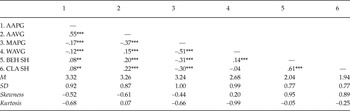
The data analysis strategy to testing our hypotheses was as follows. First, an important condition for conducting multivariate analyses later on, we tested the study’s variables to see if they were normally distributed. Based on Finney and DiStefano’s (Reference Finney, DiStefano, Hancock and Mueller2006) criterion for normal distribution, which places maximum values of skewness and kurtosis at ±2 and ±7 respectively, it was concluded that this study’s variables were sufficiently normally distributed (see Table 1). Second, to test the hypotheses, a MANCOVA was carried out, entering academic goals as a between-groups factor (with three levels: high, medium, low), and behavioral and claimed self-handicapping strategies as dependent variables. The research design included degree, year in school, and gender as covariables in order to statistically control their effect.
Means, Standard Deviations, Skewness, Kurtosis, and Correlations Matrix

Note: AAPG (Achievement Approach Goals); AAVG (Achievement Avoidance Goals); MAPG (Mastery Approach Goals); WAVG (Work Avoidance Goals); BEH SH (Behavioral Self-Handicapping); CLA SH (Claimed Self-Handicapping).
All variables were measured on the same scale (1 = Nunca [Never], 2 = Alguna vez [Rarely], 3 = Bastantes veces [Sometimes], 4 = Muchas veces [Often], 5 = Siempre [All the time]).
*p < .05; **p < .01; ***p < .001.
The high, medium, and low groups based on academic goals were established according to tertile reference scores: scores under the 33rd percentile (low group); scores between the 33rd and 66th percentile (medium group); and scores above the 66th percentile (high group).
Between-groups comparisons were carried out using the Scheffé or Games-Howell tests, according to whether or not homogeneity of variance could be assumed in each case. In all the comparisons applied, a significance level of p ≤ .05 was assumed. The magnitude of differences was estimated using the partial eta-squared coefficient (large effect size when η p 2 is over .138; medium effect size when it falls between .059 and .138; small effect size when η p 2 is between .01 and .059; insignificant effect size when η p 2 is under .01). All analyses were carried out in the SPSS 21 statistical package for Windows.
Results
Descriptive Statistics
In a first look at the relationships among academic goals and self-handicapping, Table 1 presents correlational coefficients, means, standard deviations, skewness, and kurtosis for the variables examined in this study.
According to the matrix of correlations, most were statistically significant (14 out of 15), many at the level of p < .001. From a statistical standpoint, the results of Bartlett’s test of sphericity indicate the variables are sufficiently intercorrelated (χ2(15) = 1449.28; p < .001), an important condition for carrying out subsequent multivariate analyses. Moreover, the skewness and kurtosis data indicate the variables are normally distributed.
As for the specific relationship between variables, the four academic goals correlated significantly with the two forms of self-handicapping, except for the work avoidance-claimed self-handicapping pairing, which were minimally correlated (r = –.04; d = 0.08). Behavioral self-handicapping, on the other hand, did show a positive, significant correlation, though small, with work avoidance (r = .14; d = 0.28). In addition, both types of self-protection strategy were positively related to achievement goals. In the case of achievement avoidance tendency, the effect size was medium, both for behavioral self-handicapping (r = .20; d = 0.41) and claimed self-handicapping (r = .22; d = 0.45). The relation between both forms of self-handicapping and achievement approach was small (r = .08; d = 0.16). As for mastery approach goals, their relation with behavioral self-handicapping (r = –.31; d = 0.65) and claimed self-handicapping (r = –.30; d = 0.63) was negative and moderate.
Multivariate Analyses
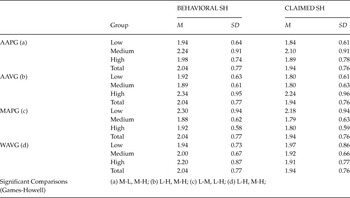
The results of MANCOVA revealed significant differences in self-handicapping as a function of different levels of achievement approach goals (λWilks = .969, F(2, 937) = 7.49, p < .001, η p 2 = .016), the effect size being small. The covariables degree and year in school were not found to be statistically significant, but gender was (p < .001, η p 2 = .015). Regarding the results according to type of self-handicapping, we concluded that the differences in mean between groups with achievement approach goals were significant on behavioral (F(2, 937) = 15.92, p < .001, η p 2 = .029) as well as claimed self-handicapping (F(2, 937) = 11.14, p < .001, η p 2 = .020), with a small effect size in both cases. As depicted in Table 2, medium achievement approach levels were associated with greater use of behavioral and claimed self-handicapping.
Means and Standard Deviations Obtained for the Different Groups Formed According to Academic Goals and Two Forms of Self-handicapping

Note: AAPG (Achievement Approach Goals); AAVG (Achievement Avoidance Goals); MAPG (Mastery Approach Goals); WAVG (Work Avoidance Goals); BEHAVIORAL SH (Behavioral Self-Handicapping); CLAIMED SH (Claimed Self-Handicapping); L (Low group); M (Medium group); H (High group); Self-handicapping measurement scale: 1 = Nunca [Never], 2 = Alguna vez [Rarely], 3 = Bastantes veces [Sometimes], 4 = Muchas veces [Often], 5 = Siempre [All the time].
Regarding differences in self-handicapping as a function of different levels of achievement avoidance goals, after controlling for the effect of degree, year in school, and gender, the results of MANCOVA revealed statistically significant differences between the three groups of participants (λWilks = .906, F(2, 937) = 23.56, p < .001, η p 2 = .048), the effect size being moderate. In this case, both degree and gender turned out to be significant covariables (p = .001, η p 2 = .01; and p = .001, η p 2 = .014, respectively), whereas year in school explained an insignificant portion of variance. Considering the results separately for each type of self-handicapping, statistically significant differences were found as a function of the level of achievement avoidance goals, both in the case of behavioral self-handicapping (F(2, 937) = 36.15, p < .001, η p 2 = .072) and claimed self-handicapping (F(2, 937) = 40.11, p < .001, η p 2 = .079). In both cases, the effect size was moderate. As readers can observe in Table 2, the highest levels of achievement avoidance were associated with greater use of the two types of self-handicapping.
Regarding mastery approach goals, after controlling for the effects of covariables (degree, year in school, and gender), statistically significant differences were observed between the different levels of this variable in terms of the use of self-handicapping (λWilks = .919, F(2, 937) = 20.09, p < .001, η p 2 = .041), with a moderate effect size. The covariables degree and gender turned out to be significant (p = .004, η p 2 = .012; and p < .001, η p 2 = .016, respectively), and year in school insignificant. Results pertaining to each type of self-handicapping showed statistically significant differences as a function of mastery approach level, both in behavioral self-handicapping (F(2, 937) = 31.54, p < .001, η p 2 = .063) and claimed self-handicapping (F(2, 937) = 32.56, p < .001, η p 2 = .065), with a moderate effect size in both cases. According to this study’s findings, the lowest mastery approach levels were associated with the greatest use of the two forms of self-handicapping (see Table 2).
Finally, having controlled for the effect of degree, year in school, and gender, MANCOVA results suggest there were statistically significant differences in the use of self-handicapping as a function of the level of work avoidance goals (λWilks = .962, F(2, 937) = 9.09, p < .001, η p 2 = .019). The effect size was small. As in the cases above, the covariables degree and gender were found to be significant (p = .028, η p 2 = .008; and p = .002, η p 2 = .013, respectively), while year in school was not. Regarding the results pertaining to the two types of self-handicapping, statistically significant differences were found as a function of work avoidance goal levels in the variable behavioral self-handicapping (F(2, 937) = 8.73, p < .001, η p 2 = .018; small effect size), but not in claimed self-handicapping. According to the results in Table 2, the highest levels of work avoidance goals were associated with the greatest use of behavioral self-handicapping mechanisms.
Discussion
The study of self-worth protection strategies has received considerable attention in recent decades. Particularly self-handicapping has been presented in research findings and empirical data as an issue that directly affects students’ quality of learning and psychological wellbeing. With that in mind, this paper aimed to analyze whether there is a connection between students’ self-set academic goals, and adoption of self-handicapping mechanisms. Specifically, we approached the question by differentiating between behavioral and claimed self-handicapping, a distinction that has practically never been made in studies of self-handicapping and academic goals in university contexts. In a remarkable contribution to the body of research, the present study expanded on the classical three-dimensional framework of academic achievement goals by examining the role of work avoidance goals, which had previously never been done. In doing so, we controlled for the effects of potentially important variables like degree, year in school, and gender.
Regarding the strategic maneuvers of anticipating and protecting oneself from negative outcomes, previous studies maintained that people engage in self-handicapping primarily in response to the fear that failure can instill (i.e., De Castella et al., Reference De Castella, Byrne and Covington2013). The leitmotif of these strategies, thus, is avoidance of adverse results that compromise personal competency. Accordingly, it was expected that students who exhibit a clear avoidance orientation – achievement as well as work avoidance – would be especially vulnerable to behavioral and claimed self-handicapping.
Our results effectively indicate that there are hidden motivations behind these tactics, especially achievement avoidance. This suggests that when students greatly fear appearing incompetent or less capable than others, the temptation to engage in active and alleged self-handicapping tactics can be high. And vice versa; we are led to conclude that when achievement avoidance is not prominent, the propensity to adopt these strategies drops considerably. These results are consistent with past findings (i.e., Akin, Reference Akin2014; Chen et al., Reference Chen, Wu, Kee, Lin and Shui2009; Lovejoy & Durik, Reference Lovejoy and Durik2010; Martin et al., Reference Martin, Marsh and Debus2001b; Midgley & Urdan, Reference Midgley and Urdan1995; Ntoumanis et al., Reference Ntoumanis, Thogersen-Ntoumani and Smith2009; Schwinger & Stiensmeier-Pelster, Reference Schwinger and Stiensmeier-Pelster2011), and lead us to consider, as Midgley and Urdan (Reference Midgley and Urdan1995) argue, that achievement avoidance motivations (i.e., to avoid looking stupid) are the main determining factor in self-handicapping.
The desire to avoid engagement in academic work also seems to encourage self-handicapping attempts, which is consistent with the results of other studies (Tannenbaum, Reference Tannenbaum2007; Valle et al., Reference Valle, Núñez, Cabanach, Rodríguez, González-Pienda and Rosário2007). According to our data, however, evidence of this relationship was found in the case of behavioral, but not claimed self-handicapping. As expected, when this motivational pattern is strong, students are significantly more likely to take actions that are incompatible with academic work, actions that would justify a predicted failure. Furthermore, like in the case of achievement avoidance motivations, when there is less interest in avoiding academic work, the predisposition to engage in self-handicapping behaviors is also markedly reduced.
The case of claimed self-handicapping was otherwise. Results indicated that form of self-handicapping is not significantly associated with work avoidance goals. That motivational tendency did not seem to favor alleged self-handicapping mechanisms. In our view, this finding has important psychoeducational implications; it seems to indicate that students who habitually tell significant people in their lives that some impediment is making achievement more difficult are not completely disconnected from their academic work. With that in mind, we can assume, as Leary and Shepperd (Reference Leary and Shepperd1986) argued, that claimed self-handicapping is not as maladaptive as behavioral.
On another note, contrary to our hypotheses, the data indicate that adopting both forms of self-handicapping is favored by a certain ego-offensive motivation. That finding may indicate, as Covington (Reference Covington2000) suggests, that some students who seek to outperform others are also driven to avoid failure, or more to the point, failure’s negative impact on self-worth. Dweck and Leggett (Reference Dweck and Leggett1988) likewise suggest that when students pursuing achievement goals (both forms – approach and avoidance) experience prolonged stress (i.e., coping with continual, challenging work), they redirect their priorities to focus on achievement avoidance goals. For such students, as the results of this and other studies can attest (i.e., Lovejoy & Durik, Reference Lovejoy and Durik2010; Midgley & Urdan, Reference Midgley and Urdan1995; Valle et al., Reference Valle, Núñez, Cabanach, Rodríguez, González-Pienda and Rosário2007), self-handicapping becomes an attractive alternative.
Finally, as predicted in the present study and in line with the findings of some past research (Akin, Reference Akin2014; Chen et al., Reference Chen, Wu, Kee, Lin and Shui2009; Elliot & Church, Reference Elliot and Church2003; Martin et al., Reference Martin, Marsh and Debus2001b; Ntoumanis et al., Reference Ntoumanis, Thogersen-Ntoumani and Smith2009; Schwinger & Steinsmeier-Pelster, Reference Schwinger and Stiensmeier-Pelster2011; Valle et al., Reference Valle, Núñez, Cabanach, Rodríguez, González-Pienda and Rosário2007), mastery approach motivation does not promote self-handicapping tendencies. Accordingly, the more a person is interested in mastering the content they are learning, the lower their behavioral and claimed self-handicapping will be. That finding seems consistent with considering mastery approach to be a protective factor in self-handicapping (c.f., Schwinger & Steinsmeier-Pelster, Reference Schwinger and Stiensmeier-Pelster2011). Conversely, when their desire to learn is low, there is a clear risk that certain students will engage in these self-protective tactics, whether active or claimed.
Clearly, any conclusions derived from the results of this study should take into consideration its inherent limitations, which suggest caution should be exercised in interpreting and generalizing about them. The study’s foremost limitation is the fact that the sample consisted of students in only two areas of study (Education and Health). Although we controlled for the effect of that variable, it would be risky to extrapolate the results to the entire university population. In addition, the research design limited the statistical power of the results. In future research, combining methodologies to include classroom observations, surveys, and student interviews would greatly increase our understanding of the phenomenon of academic self-handicapping; that understanding would be further enhanced by conducting longitudinal research. Moreover, though statistically significant, the effect size of means differences was small for two of the goals analyzed (achievement approach and work avoidance). Considering the large sample size used in this study and the small magnitude of between-groups differences observed, future studies could analyze whether or not such differences are tied to the sample size used in this research.
Another limitation has to do with the instrument utilized to assess self-handicapping, for which a Spanish validation is currently lacking. However, in earlier studies of university students in other contexts, it did show adequate psychometric properties. Finally, the fact that data about participant achievement was not available – self-reported nor corroborated – constitutes another limitation of this study. With that information, we could have analyzed how that variable is associated with the two forms of self-handicapping, and with the academic goals students adopt.
Perhaps the most important direction for future research is to try and examine how the learning context leads students to protect their worth. In the specific case of self-handicapping, those strategies’ reason for being is apparently fear of failure. Thus, if researchers and educators could identify the factors that elicit heightened fear, especially the ones that have a clear negative impact on learning, interventions could be developed to help break the vicious cycle of self-handicapping – low effort – low achievement – self-handicapping (Zuckerman, Kieffer, & Knee, Reference Zuckerman, Kieffer and Knee1998). One piece of data that is especially important in that sense, and which the present research results corroborate, is the fact that self-handicappers “still care enough to want to appear able to others…(which is) a hopeful sign” (Midgley & Urdan, Reference Midgley and Urdan1995, p. 407) insofar as educators can leverage that motivation toward more adaptive ends.
One thing is certain, according to recent achievement goals research (i.e., Valle et al., 2013), that student use of achievement and mastery goals need not be mutually exclusive. Adopting a multiple-goal perspective, future studies should investigate the possible relationship between different combinations of goals, and self-handicapping strategy adoption. On the other hand, our results suggest that variables like gender and degree, the effects of which were controlled in the current research, are significantly related to both types of self-handicapping. Future studies could follow that line of inquiry in greater depth, especially the relation between academic degree and self-handicapping, which has hardly if ever been examined.