


1. INTRODUCTION
Public resources devoted to enhancing military capacity have been one of the main spending items of European state budgets throughout most of the modern period. Although intra-European wars became less frequent during the 19th century than before, the new kind of military mobilisation and the industrialisation of war that emerged in that period demanded substantial resources to fund the armies both in times of peace and war. The rising international tension during the last quarter of the 19th century and the subsequent outbreak of the two World Wars increased the financial pressures to keep military spending high. The Cold War, owing to the permanent military tension between both blocks, also had a similar effectFootnote 1 . Therefore, even though the relative weight of military spending within national budgets has diminished throughout the modern period (mainly in favour of productive and social expenses), it has remained substantial both in absolute and relative termsFootnote 2 .
The importance of military spending has been widely recognised by the defence economics literature. Born in the context of the high military expenditure ratios achieved in most western countries during the early Cold War decades, defence economics has analysed the evolution of historical and present military spending figures and their potential determinants in depth. One of its main areas of study has been the effect of political regimes on military spending, in which most studies have found a negative relation between democracies and the military burden (defined as military spending as a share of GDP). This result might be explained by the traditional liberal claims: citizens, when free to choose, prefer educational and social expenditures rather than military spending. Furthermore, the cost of war (both in terms of resources and in terms of human loss) would constrain their wish to get involved in violent conflicts. Consequently, democratic leaders would be concerned about the potential effects of arms races on warfare dynamics. All in all, democracies would constrain their military burden in comparison with non-democratic regimes.
For instance, Sprout and Sprout (Reference Sprout and Sprout1968) point out that the extension of suffrage and increased political participation in Great Britain after the First World War pushed down military spending as a percentage of the total public budget. Other authors, such as Goldsmith (Reference Goldsmith2003) and Fordham and Walker (Reference Fordham and Walker2005), find similar results when analysing the relationship between democracy and the military burden in large international panel data sets from 1886 to 1989 and from 1816 to 1997, respectively. Interestingly, Fordham and Walker (Reference Fordham and Walker2005) find more significant results when they analyse only the major powers than when they consider all countries. Similarly, Dunne et al. (Reference Dunne, Nikolaidou and Mylonidis2003), Dunne and Perlo-Freeman (Reference Dunne and Perlo-Freeman2003) and Dunne et al. (Reference Dunne, Perlo-Freeman and Smith2008) present the same results for different samples of developing countries during the second half of the 20th century, whereas Lebovic (Reference Linz, Montero and Ruiz2001) observes the same relation between both variables in a sample of several Latin American countries from 1974 to 1995. Finally, Töngür et al. (Reference Töngür, Hsu and Elveren2015) and Brauner (Reference Brauner2015) also obtain the same results when analysing large country samples during the last four decades of the 20th century.
The intensity of democracy has been also discussed in Rota (Reference Rota2011), who analyses the effects of the democratisation wave and the subsequent return towards totalitarianism during the period 1880-1938 in a sample of several OECD countries. According to his results, restricted democracies (non-full democracies in Rota’s words, in which political participation was based on census suffrage) tended to spend more resources on the military than democracies and autocracies. This is explained in terms of the equilibrium between the high fiscal capacity and low regulatory constraints prevailing in restricted democracies, in contrast with the other two types of political regimes (which do not share both features at the same time). Similarly, in their analysis on dyadic militarised disputes, Baliga et al. (Reference Baliga, Lucca and Sjöström2011) argue that limited democracies are more aggressive than other regimes (particularly during the period before the Second World War), whereas dyads (pairs of countries in conflict) consisting of two democracies are the least conflict-ridden ones.
Despite widespread consensus on the negative relation between democracy and military spending, some authors have recently questioned this. For instance, Goldsmith (Reference Goldsmith2007) analyses the spending behaviour of political regimes in times of war and peace in an international panel data set from 1885 to 1997. The author concludes that democracies bear a lower military burden than other political regimes in times of peace owing to the social preferences of voters, and a higher military burden in times of war, owing to their higher fiscal capacity and their social legitimacy to go to war. This would be mainly explained by the executive constraints of democratic governments and their willingness to ensure victory in a context of political competition. These results are also in line with Schultz and Weingast (Reference Schultz and Weingast2003), who argue that democratic governments would be more able to borrow more money in times of war than other kinds of governments owing to their financial reputation. Therefore, the expected negative relation between democracy and the military burden might be altered by the international military scenario.
From a theoretical perspective, Acemoglu et al. (Reference Acemoglu, Ticchi and Vindigni2010) suggest that non-consolidated democracies may have greater incentives than other oligarchic regimes to make concessions to the military in order to ensure their loyalty. According to these authors, given that transitional democracies cannot commit to not reform the military (as a large army devoted to repression is not needed anymore), they may pay higher wages to the military than oligarchic regimes, in order to avoid coups d’état. In addition, the involvement in international disputes during transitional periods (when the army becomes necessary for national defence) may help democratic institutions to maintain a strong military structure while facilitating the democratic transition. As a consequence, democracies may even sustain higher military expenditures than autocratic regimes during transitional periodsFootnote 3 .
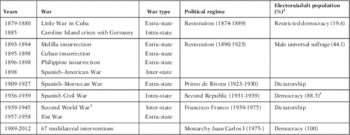
This paper aims to contribute to this debate by analysing Spanish military spending from 1876 to 2009. Spain provides an interesting case to study the political determinants of military spending from a historical perspective. Since the end of the Third Carlist War (1872-1876), Spain has been ruled by several political regimes, including three long-lasting and fairly stable ones: a restricted democracy during the Restoration (1874-1923), the dictatorship of Francisco Franco (1939-1975) and the present democratic regime (1977-nowadays). It therefore provides an interesting scenario to study the military policies of different political regimes and their potential impact on military spending. The dictatorship of Primo de Rivera (1923-1930) and the democratic Second Republic (1931-1939) may also allow us to study the effect of short-lived political regimes on military spending policies.
To this purpose, this paper analyses a new long-run military expenditure database for Spain that has been estimated according to North Atlantic Treaty Organization’s (NATO) methodological criterion. In line with the Alliance’s statistics, the new data set provides total military spending estimates, as well as disaggregated figures on military personnel, pensions, investment (military equipment and infrastructure) and operational expenditures. Disaggregated data provide relevant information to understand the evolution of total military expenditure. However, given that most quantitative analyses are based on international panel data sets, which generally only offer aggregate figures, little attention has been paid to the political determinants of military expenditure composition so far. The paper tries to fill this gap by providing a long-term analysis of the evolution of both aggregate and disaggregated data on military expenditures in SpainFootnote 4 .
Despite the relevance of military spending within the Spanish public budget in modern times, long-term analyses of its evolution and main determinants are extremely scarce. To my knowledge, only Gadea and Montañés (Reference Gadea and Montañés2001) have studied this topic from a long-run approach, although they do not provide an analysis of the composition of expenditureFootnote 5 . These authors analyse the political and strategic determinants of the total Spanish military spending for the period 1850-1995 through a cointegration analysisFootnote 6 . According to them, neither political regimes nor the international military scenario have significantly affected the evolution of military spending since the mid-19th century; by contrast, they consider GDP (once wartimes and other outliers are controlled for) as its main driving force. In this context, this paper aims to address specifically the effects of political regimes on the evolution of the Spanish military burden by applying a more comprehensive methodological approach on the basis of new disaggregated dataFootnote 7 .
The paper proceeds as follows. Sections 2 and 3 describe the main features of Spanish military policies from the mid-19th century to the present, and the new military spending data that are used in the analysis. Section 4 analyses the incidence of political factors on the level and composition of the Spanish military burden, and Section 5 concludes.
2. MILITARY POLICIES IN MODERN SPAIN
According to the military historian Puell de la Villa (Reference Puell de la Villa2001), military policy in Spain has experienced two major changes in modern times. The first began with the military reforms initiated in 1844 by Nárvaez, president of the government during the liberal monarchy of Isabel II (1833-1868). The military structure was redefined in order to use the army exclusively to protect the national territory, to defend the external prestige of the monarchy and to guard the state’s internal constitution, whereas the fight against banditry and customs surveillance were transferred entirely to the police and paramilitary corps. The second major shift in the nature of the army did not arrive until the democratic period initiated in the second half of the 1970s. The new defence policy reoriented the army to external missions, whereas the jurisdiction on internal control was transferred to the police corps. This shift implied a profound restructuring of military forces (including personnel, infrastructure and equipment endowments), in which democratic governments tried to achieve a smaller but better-equipped army.
In between these two major transformations, the Spanish army and military policy experienced several other significant (although less fundamental) changes. For instance, the Restoration Regime initiated in 1874, which reestablished the Bourbons’ monarchy after the Revolutionary Period (1868-1874), led to a military withdrawal based on a neutral policy in the main international conflicts (López Garrido Reference López Garrido1982; Ballbé Reference Ballbé1983; Cardona Reference Cardona1983)Footnote 8 . It was not until the defeat in the 1898 war against the United States (which implied the loss of the last overseas colonies in America and the Pacific, and the destruction of the Spanish navy) that a new expansionist Spanish policy in North Africa took place (Torre del Río Reference Torre del Río2003). The 1909 war in Melilla started a period of discontinuous military interventions that lasted until 1927 with the defeat of the Moroccan insurgency by the Spanish and French armies. This expansionist policy went along with the growth in domestic social conflict (mainly led by the workers’ movement and peripheral nationalist claims) during the interwar period, and the beginning of the corporatist interventions by the army (clearly seen in the so-called Juntas de Defensa), which ended in 1923 with the establishment of Primo de Rivera’s military dictatorship (Cardona Reference Cardona1983; Puell de la Villa Reference Puell de la Villa2001).
In line with these shifts in external policy, the first decades of the 20th century were also characterised by an encouragement of the national military industry (Velarde Fuertes Reference Velarde Fuertes2000). It was mostly based on the modernisation plan implemented by the Minister of the Navy, José Ferrándiz, in 1907 (designed to modernise the navy yards, construct new warships and acquire new weapons and equipments), the Royal Order passed in 1926 (on extraordinary works and services on infrastructure, equipment and general material costs for the three armies) and the acquisition of military airplanes during the late 1910s and the 1920s (San Román López Reference San Román López1999). This industrial policy would be reinforced in the 1940s and the 1950s during the autarkic period of Franco’s dictatorship (1939-1975).
The Second Republic (1931-1939) established after Primo de Rivera’s dictatorship (1923-1930) tried to change the former military policies by reducing the presence of the military in domestic conflicts and establishing a new neutral and pacifist international policy (especially during the first 2 years of left-wing governments). Its major success was the Spanish participation in the International Conference for Disarmament and the creation of the Group of Eight in 1932. The first governments of the Republic also tried to transform the military budget in favour of better military equipment and endowments (a consortium of military industries was even established in 1932 in order to promote national military production)Footnote 9 , whereas maintaining the most ambitious plan to reduce the number of chiefs and officialsFootnote 10 . However, the conservative governments established after the 1934 election reversed most of these new policies in favour of the former military model (Cardona Reference Cardona1983; Puell de la Villa Reference Puell de la Villa2000; Pereira Reference Pereira2003).
The establishment of the dictatorship of Francisco Franco after the military uprising against the Republican government (and the subsequent Civil War of 1936-1939) gave way again to an army mainly focussed on internal threats, except for the early attempts to become involved in the Second World War together with the Axis powers (Olmeda Gómez Reference Olmeda Gómez1988; Cardona Reference Cardona2008). However, despite this continuity in the army’s domestic orientation, the dictatorship changed the character of the military policy. First, the army handed over the majority of domestic control functions to the police and paramilitary corps, keeping only the last resort actions (such as fighting the guerrillas in the mountains, especially until 1947) and military trials on public order turmoilFootnote 11 . Second, the military agreement with the United States in 1953 (renewed periodically thereafter) granted technical assistance and military and economic aid to Spain in exchange for the establishment of several U.S. military bases in the Iberian Peninsula (owing to the geostrategic position of Spain in the Mediterranean Sea in the context of the Cold War). Therefore, the domestic orientation of the army has since then been associated with the security provided by the United StatesFootnote 12 .
As has been said before, the democratic transition of the second half of the 1970s involved a profound transformation of the military policy. The new democratic governments reoriented the army to external missions and reinforced the military agreement with western countries, mainly through Spain’s membership of the NATO in 1982 (although incorporation to its military structure had to wait until the end of the 1990s) and in the Western European Union (WEU) in 1984 (and as a full right member in 1990) (Puell de la Villa Reference Puell de la Villa2001; Pereira Reference Pereira2003)Footnote 13 . This recent international orientation went along with the acquisition of new military equipment and the modernisation of military forces. In this regard, although some preliminary efforts to modernise the army had already been undertaken in the late 1960s, it was the new democratic regime, which provided the major impulse to these reforms. According to Gómez Castañeda (Reference Gómez Castañeda1985), it was not until 1965 when the dictatorship passed the first legislation to programme the acquisition and construction of new military equipment (Law 85/1965), and it was only in 1971 that an 8-year plan for investments, maintenance and reposition of material and major equipment (Law 32/1971) was designedFootnote 14 . However, owing to the high inflation rates of the mid-1970s (which reduced the purchasing power of the 1971 programme), major investments in new equipment had to be supported by Royal Order 5/1977 and several subsequent laws during the early democratic period (Puell de la Villa Reference Puell de la Villa2001; García Alonso Reference García Alonso2007)Footnote 15 .
These military policies were accompanied by several plans aimed at reorganising the military structure and reducing military personnel (particularly in the land forces), such as Law 20/1981, which reduced the number of officials, the General Plan for the Modernization of the Army (META, Spanish acronym) in 1983, the Plan for the Reorganization of the Army (RETO) in 1990, the Plan for the New Organization of the Army (NORTE) in 1994, and more recently, the reorganisation of the army set out in Royal Order 416/2006. This reorganisation took place in line with the objective of professionalisation of the army; in this regard, Law 17/1999 suspended the mandatory military service leading, in 2002, to an army fully composed by professional soldiers. These plans were initially accompanied by increases in voluntary recruitment (in order to compensate for the reduction in the number of conscription months) and growing retributions to military personnel, which finally led to Royal Order 359/89 to put military retributions at the same level as civil ones (Puell de la Villa Reference Puell de la Villa2000; Pérez Munielo Reference Pérez Munielo2009). According to Narcís Serra, Minister of Defence from 1982 to 1991, these modernisation policies (including the new investments in military equipment and the external reorientation of the army) and the aforementioned increases in military retributions were both part of a «military transition to democracy» and the subsequent military democratic consolidation. These processes would have taken place from 1975 to 1989Footnote 16 and were aimed at more competitive armed forces and involving them with the newly democratic institutions, in order to avoid military attempts to restore the former dictatorial regime (Serra Reference Serra2008)Footnote 17 .
3. THE SPANISH MILITARY BURDEN (1876-2009)
The analyses of the political determinants of the military burden that are presented in the next section are based on a new data set on total military spending in Spain and its economic composition from 1876 to 2009Footnote 18 . The series have been elaborated following NATO’s methodological criterion, which is one of the most comprehensive and widespread criteria on military spending and is used by several international institutes and organisations such as the Stockholm International Peace Research Institute, the Arms Control and Disarmament Agency (now part of the U.S. Department of State) and the International Institute of Strategic Studies. According to NATO, defence expenditure is defined as payments made by a national government specifically to meet the needs of its armed forces or those of allies. It mainly includes salaries and social benefits to military personnel, operational and maintenance expenditures, procurement expenditures on equipment and other goods, expenditures on infrastructure construction, research and development, military aid to other countries and contributions to international organisations. Unlike other standard criteria, NATO also includes pensions to military personnel (also to civil personnel devoted to military activities), procurements on credit, the United Nations peacekeeping missions and humanitarian and disaster reliefFootnote 19 .
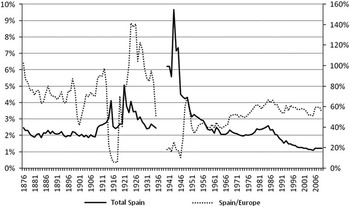
Figure 1 presents the evolution of Spanish military spending as a percentage of GDP (military burden) from 1876 to 2009 (solid line). The series shows some severe fluctuations during the period before the Civil War of 1936-1939, such as those of the early 1910s and 1920s, in which the military burden reached levels close to 5 per cent of GDP. After the war, the military burden reached its historical maximum near 10 per cent of GDP, which was followed by a rapid decrease during the 1950s and the 1960s. The lowest ratios of the whole period were reached in the 1990s and the 2000s, when they stabilised at a level well below 2 per cent of GDP.
SPANISH MILITARY SPENDING/GDP (LEFT AXIS) AND SPANISH MILITARY BURDEN/EUROPEAN AVERAGE MILITARY BURDEN (RIGHT AXIS) (1876-2009) Notes: Spanish military expenditure could not be estimated for the Civil War period (1936-1939) owing to the lack of available data. Concerning the sample of European countries, there are no data for France in 1944-1949, Italy in 1942-1950 and Germany in 1914-1924 and 1939-1952. In those cases (all of them related to wartimes and post-war periods), the European average is estimated on the basis of the available data. Sources: For Spanish military burden, my own estimates from 1876 to 1986; from 1987 on, NATO data (http://www.nato.int). Military spending data for the sample of European countries (except for Portugal) come from Hobson (Reference Hobson1993) for the period 1876-1913, from the Correlates of War Project for 1914-1948 and from the NATO database for 1949-2009. Data for Portugal come from Valério (2001) for 1876-1948 and from the NATO database for 1949-2009. The figures on nominal GDP and exchange rates for the period 1876-1948 are from the databases of Global Finance (http://eh.net/databases/Finance/), Historical National Accounts (http://www.ggdc.net/databases/hna.htm), Measuring Worth (http://www.measuringworth.com/) and Jones-Obstfeld (http://www.nber.org/databases/jones-obstfeld/).

Figure 1 additionally shows the Spanish military burden compared with the average burden in a sample of European countries (France, Germany, Italy, Portugal and United Kingdom). As can be seen in the graph, the two World Wars were associated with very sharp decreases in the Spanish relative effort, reaching <20 per cent of the European average. By contrast, the 1920s appear to be the only period with higher ratios in Spain than in the sample of European countries (except for the higher ratio also achieved in 1876). Finally, a process of convergence of Spain with the European average started in 1950 (mainly owing to the gradual reduction of the military burden in the European countries), although it was interrupted in the late 1980s, when the Spanish military burden was ca. 75 per cent of the European average.
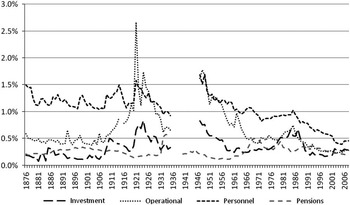
In line with the NATO accounts, the new data set provides not only total military spending estimates but also its economic disaggregation among personnel (payments to active personnel and pensions), military investment (major equipment and infrastructure costs) and operational expenditures (which includes other goods and services such as food, clothes, fuel, munitions, maintenance of equipment, etc.)Footnote 20 . My series additionally provide another further disaggregation by recording the pensions received by the militaries and their families, which are usually included by NATO within the personnel budget, in a separate category. Figure 2 presents the evolution of the different categories of Spanish military spending as a percentage of GDP for the period 1876-2009. It clearly shows the prominence of personnel expenses for most of the period, only approached (or even surpassed) by operational and investment expenditures in periods with high spending volatility.
ECONOMIC DISAGGREGATION OF SPANISH MILITARY SPENDING/GDP (1876-2009) Notes: military expenditure composition could not be estimated for the Civil War period (1936-1939) owing to the lack of available data. In addition, figures on personnel, operational and investment expenditures could not be estimated for the period 1940-1946 owing to the lack of enough information in the original sources; data for operational and investment expenditures could not be estimated for 1915 for the same reason. Sources: From 1876 to 1986, my own estimates. From 1987 on, NATO data (http://www.nato.int).

4. THE EXPLANATORY FACTORS OF THE EVOLUTION OF SPANISH MILITARY SPENDING (1876-2009)
This section presents two different analyses aimed at studying whether political regimes significantly determined the patterns of military expenditure in Spain over the long run. First, I run a breaking point test based on Ben-David and Papell (Reference Ben-David and Papell2000) and Vogelsang (Reference Vogelsang1997) for both total and disaggregated military burden series (military spending as a share of GDP). This test identifies the main statistical shifts in the series (regardless of whether a unit root is present) and allows us to test whether political changes match the major shifts in the military spending patterns throughout the period. Second, I carry out a regression analysis for every military spending series to find out the aggregated effect of each political regime on Spanish military burden when controlling for the influence of other potentially conditioning factors (apart from political changes).
4.1 Structural Breaks in Spanish Military Spending (1876-2009)
Following Ben-David and Papell (Reference Ben-David and Papell2000), the breaking points analysis is based on an extension of the SupF t test developed by Vogelsang (Reference Vogelsang1997). The Vogelsang test for linear trending data involves estimating the following regression for every possible break point:
 $$y_{t} =\mu {\plus}\theta _{1} DU_{{1t}} {\plus}\beta t{\plus}\gamma _{1} DT_{{1t}} {\plus}\sum_{{j\,=\,1}}^{k} c_{j} y_{{t{\minus}j}} {\plus}{\varepsilon}_{t} $$
where DU 1t =1 if t>T B1, 0 otherwise, and DT 1t =t – T B1 if t>T B1, 0 otherwise, being T B1 every possible breaking point in the series. Equation [1] is estimated sequentially for each possible break year. The SupF t statistic is the maximum, over all possible trend breaks, of twice the standard F-statistic for testing θ 1=γ 1=0. The null hypothesis of no structural break is rejected if SupF t is greater than the critical value. For each choice of T B1, the value of the lag length k is selected according to the criteria suggested by Campbell and Perron (Reference Campbell and Perron1991). Following Ben-David and Papell (Reference Ben-David and Papell2000), I have set the upper bound of k at 8 and the criterion for significance of the t-statistic on the last lag has been set at 1.60.
Ben-David and Papell (Reference Ben-David and Papell2000) extended this procedure to allow for multiple breaking points. The equation to be estimated is the same as equation [1] but allowing for additional dummy variables:
 $$y_{t} =\mu {\plus}\sum_{{i\,=\,1}}^{m} \theta _{i} DU_{{it}} {\plus}\beta t{\plus}\sum_{{i\,=\,1}}^{m} \gamma _{i} DT_{{it}} {\plus}\sum_{{j\,=\,1}}^{k} c_{j} y_{{t{\,\minus\,}j}} {\plus}e_{t} $$
where m is the number of breaking points. When m=1, the expression is the same as the Vogelsang equation. When m=2, the procedure becomes a test of one-break null against a two-break alternative. This time, DU 2t =1 if t>T B2, 0 otherwise, and DT 2t =t–T B2 if t>T B2, 0 otherwise, and T B1 is fixed by the year chosen by estimation of the one-break models. Equation [2] is estimated sequentially for each potential break year (T B2), and the SupF t statistic is calculated as described above. Critical values have been taken from Ben-David and Papell (Reference Ben-David and Papell2000), who account for up to five breaks with 120 observationsFootnote 21 . As usual in stability tests, the first and last years of the sample have not been included in the testing procedure. Here, I have limited the sample to 0.1T<T Bm <0.9T, with a required separation between break dates of at least 5 years. Following Ben-David and Papell (Reference Ben-David and Papell2000), the significance of the individual coefficients of every breaking point are also reported. Positive signs on coefficients θ reflect positive changes in the levels of the series, whereas positive signs on coefficients γ reflect positive changes in the slope of the series (and the opposite with negative signs).
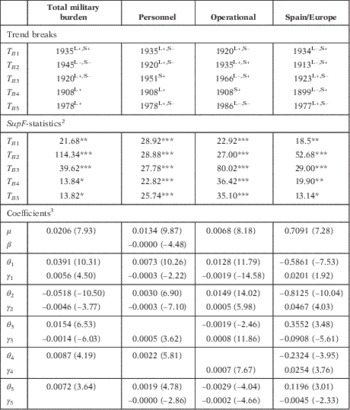
Table 1 shows the results. The series of total military spending and of personnel and operational expenditures have five breaking points, most of them common across different series, whereas investment and pension expenditures do not show any significant break. Before the Civil War (1936-1939), all structural changes seem to be related with the long-lasting Moroccan war (1909-1927) and the modernisation policies prevailing since the late 1900s. Concretely, the beginning of the war and the intensification of the military operations in the Moroccan Rif region fairly correspond to the breaking points found in 1908 and in 1920 (most of them positive in levels) in both the total military burden and the personnel and operational expenditures. In the case of the 1920 break, the negative coefficients γ capture the beginning of the decreasing path of spending during the last stages of the war (see Figures 1 and 2).
SEQUENTIAL TREND BREAK TESTS (1876-2009)Footnote 1

Notes:
1 L+(−) refers to positive (negative) changes in level; S+(−) refers to positive (negative) changes in slope.
2 ***Rejection of the null hypothesis at the 1 per cent significance level; **rejection of the null hypothesis at the 5 per cent significance level; *rejection of the null hypothesis at the 10 per cent significance level.
3 t-statistics in parenthesis.
Source: See text.
These results suggest that neither the establishment of Primo de Rivera’s dictatorship (1923-1930) nor the advent of the Second Republic (1931-1939) can explain the major structural changes of the Spanish military spending series. As has been stated in previous historical studies, Primo de Rivera did not set up many significant changes in the army, but carried on the war of Morocco (intensifying operations in 1924) and the modernisation plans initiated during the previous decade (particularly by increasing the aeronautical endowments). On the other hand, the reforms initiated by the first left-wing government of the Second Republic were rapidly interrupted after the political shift of the 1933 elections; in addition, the first democratic governments partially sustained the modernisation efforts initiated well before, in the late 1900s. Therefore, the Second Republic had similar military burden ratios to those achieved during the late 1920s. The short-lived nature of these two political regimes, as well as the troubled international atmosphere, might explain the observed continuities in the military policies and the lack of structural changes in the series.
The next structural changes of Spanish military spending series, in 1935 and 1945, are the last ones directly related to wartimes. The former, which affects the total military burden and the two budgetary items, reflects the impact of the Spanish Civil War (1936-1939) and the immediate post-war years. Although military spending is not available for the 4 years of conflict, the positive sign on the level of the break reveals the high military resources demanded by the war. In addition, the positive result on the slope seems to be the result of Spanish participation in the Second World War and the violent domestic opposition to the new dictatorial regimeFootnote 22 . On the other hand, the 1945 break in the total military burden (with negative signs on both the level and the slope) marks the beginning of a long-lasting decreasing path, most likely owing to the end of the Second World War and the weakening of the violent domestic turmoil.
In contrast to the former war-led results, the 1978 break in total military burden coincides approximately with the end of Franco’s dictatorship and the establishment of the present democratic regime. It marks the beginning of a short-lived increase in the ratio levels (from 1978 to the second half of the 1980s) and a subsequent long-lasting decreasing trend (leading to the minimum levels of the whole period under study). This military spending pattern seems partially led by the operational expenditures series (although their initial increase in levels started earlier, in 1966, most likely owing to the modernisation plans designed in 1965 and extended afterwards). Similarly, personnel expenditures gradually decreased since the end of the 1970s, after a previous (slight) increase in levels. These patterns might be the result of the aforementioned plans of the transitional governments to achieve a better-equipped army and to increase military retributions, which may have initially mitigated the democratic pressure to push down the military burden.
In summary, wars seem to explain the main military burden structural changes, particularly until the mid-1940s. On the other hand, the change in the political regime in the 1970s would help to explain some of the main structural changes of military expenditure afterwards. In contrast to these results, the test does not find any significant break on investment expenditures and military pensions, showing the lack of significant shifts in their long-term evolution (regardless of non-permanent changes in both series). In any case, beyond the structural changes, Figure 2 shows that investment expenditures have experienced several short-lived shocks that seem largely related with the formerly mentioned historical events. First, both the Moroccan wartime and the early years of Franco’s regime also show high investment burden levels. The Moroccan wartime investment levels might also be related to the modernisation plans initiated in 1907 by the Minister of the Navy, José Ferrándiz, and subsequently reinforced by the Royal Order of 1926 and the subsequent military aircraft acquisitions. Second, the period from the second half of the 1970s to the late 1980s show again a short-lived increase in investment levels (even higher than those of operational and personnel expenditures), which suggests that investment expenditures may also have led the contemporary increase in the total military burden. As has been said before, this seems to be the result of the efforts to modernise the army during the transition to democracy.
The fourth column of Table 1 reinforces these conclusions by showing the results found for the series of Spanish military burden expressed as a percentage of the European average. The 1913 and 1934 breaks (both negative in levels) seem to reflect the outbreak of the two World Wars and the increasing international military tension prevailing during the second half of the 1930s, which led to an enormous divergence between the Spanish military burden and that of the sample of European countriesFootnote 23 . By contrast, the 1923 break (positive in levels) reflects the increasing military effort made by Spain in a context of international disarmament. This suggests that the increasing Spanish ratios during the 1920s were not driven by international military tension but by other domestic factors, such as the military intervention in Morocco in 1924. Finally, the last break in 1977 (also positive in levels) suggests, once more, that the short-term increase during the transition from dictatorship to democracy was not driven by international military tensions but by domestic factors, such as the aforementioned plans of the transitional governments to modernise the army and to increase military retributions.
4.2 The Explanatory Factors of Spanish Military Spending (1876-2009)
The breaking point test only provides preliminary evidence on the impact (or lack thereof) of political changes on Spanish military spending. A more comprehensive analysis of this issue would be provided by the estimation of the following equation:
 $$MB_{t} =\alpha _{0} {\plus}\alpha _{1} POLITICAL_{t} {\plus}\alpha _{2} Z_{t} {\plus}{\varepsilon}_{t} $$
where MB t is the military burden in time t, POLITICAL t the kind of political regime in time t and Z t stands for a group of control variables usually included in the analysis of military expenditure determinants. This analysis can also be carried out for each of the military spending components, as in equation [4]:
 $$ECONCOMP_{t} =\alpha _{0} {\plus}\alpha _{1} POLITICAL_{t} {\plus}\alpha _{2} Z_{t} {\plus}{\varepsilon}_{t} $$
where ECONCOMP t is each component of the military expenditure (personnel, pensions, investment and operational expenditures) in time t, expressed as a percentage of GDP and as a percentage of total military spending.
According to Collier and Adcock (Reference Collier and Adcock1999), there is not a single correct way to define and characterise political regimes, so every research project needs to choose the empirical strategy that best fits its analytical purposes. Given that the main goal of this paper is to explore the spending behaviour of different political regimes, I define the variable POLITICAL t following the «sharper differentiation» strategy defined by Collier and Adcock (Reference Collier and Adcock1999), which accounts for different categories that group together similar cases. This approach has at least two major benefits. First, it allows for a certain gradation beyond the all-or-nothing dichotomous variables, which has been proved relevant in several previous analysesFootnote 24 . Second, it also prevents the problems of inference associated with continuous variablesFootnote 25 . Therefore, although acknowledging the valuable possibilities offered by continuous and dichotomous measures of democracy to the study of certain issues, a «sharper differentiation» strategy seems to be the most appropriate option for our purposes.
Given that there are no data sets from 1876 to 2009 based on the aforementioned approach, the Spanish political regimes are categorised as follows. First, democratic regimes are identified following Boix et al. (Reference Boix, Miller and Rosato2012), which provide a long-term database on a dichotomous measure of democracy. The authors define democracies as those countries that meet high standards on political contestation (decisions to govern the state are taken through free and fair voting procedures) and participation (with a minimal level of suffrage). According to this criterion, the democracy dummy variable accounts for the Second Republic (from 1931 to 1936) and the current democracy (from 1977 to the present day). On the other hand, the residual that remains in Boix et al. (Reference Boix, Miller and Rosato2012) is further divided between those regimes that do not allow for multiparty national elections and those that allow for them but do not reach the Boix, Miller and Rosato’s democratic standardsFootnote 26 . The first category includes the Primo de Rivera’s dictatorship, from 1923 to 1930, and Franco’s dictatorship from 1939 to 1975 (called here «dictatorships», as generally referred by most historians). The second category accounts for the Restoration regime (1876-1923), which allowed for some degree of political contestation, but retained corrupted voting procedures and restricted suffrage. The dummy variable on this second type of regime (here called «restricted democracy») stays as the reference category for the analysis, so the coefficients of the dummy variables must be interpreted relative to this category.
As for the control variables (Z t in equations [3] and [4]), the explanatory factors of military spending usually considered by the literature are related with the outbreak of wars, the international military scenario and the economic environment. To account for the former, I use a dummy variable for the main wars in the Moroccan protectorate (the military contingencies in Morocco from 1909 to 1927 and the Ifni war in 1957) and the military intervention in European conflicts (Spanish participation in the Second World War)Footnote 27 . As expected, all studies indicate a strong correlation between wars and military spending, both for civil and international contestsFootnote 28 .
Regarding the international scenario, the military threats posed by potential external enemies and the effects of military alliances are the most frequent variables in the literature. In the case of external threats, the Security Network theory suggests that military spending is affected by the spending behaviour of both the neighbouring countries and other countries of relevance in the international scenarioFootnote 29 . As some of the past and present threats for European countries come from non-formal groups and cannot be measured (for instance, in the case of Spain, insurgency groups in the overseas colonies and in the Morocco protectorate represented some of the main threats during the second half of the 19th and early 20th century), I use military spending data on the aforementioned sample of European countries in order to capture the systemic risk in the international scenario.
On the other hand, the incidence of military alliances (usually defined as a group of nations bound to provide protection to all members from aggression by common enemies) is generally included in order to capture either potential free-riding scenarios or social pressures to push up the members’ military spendingFootnote 30 . To control for these potential effects, I use the military burden of the NATO countries from 1982 to nowadays, as well as a dummy variable for the alliance with the United States since 1953. In the first case, I use the military burden of the allied countries in order to capture the influence of the allied military policies in every year. On the other hand, regarding the U.S. alliance, I use a straightforward dummy variable in order to control for the mere presence of the American support. In this case, the annual variation of the allied military strength was much less important than the support itself received by the superpower.
Among economic factors, income level and openness are often included in this kind of study, although the results on the incidence of these factors are not conclusive. Some authors suggest a negative relation between income per capita and the military burden, owing to a trade-off with other more productive expenditures; by contrast, others suggest a positive relation on the basis of the neorealist theory. According to the latter, the ruling anarchy in the international arena forces states to devote the maximum available resources to national security (implying that countries can spend more resources as a share of GDP when income per capita is higher)Footnote 31 . Similarly, the expected effect of economic openness is not clear. A negative correlation between openness and military spending would be associated to the higher benefits that politicians can obtain from economic competition, rather than from military conflict (Rosh Reference Rosh1988). Alternatively, the neorealist theory argues that deeper contacts between states can encourage conflict and, therefore, boost military spending (Waltz Reference Waltz1982). In line with this literature, I include both GDP per capita and the sum of exports and imports in terms of GDP as control variables.
Beyond these commonly used variables, I also include in the analysis the level of internal military repression exerted annually by the Spanish government as a control variable. This variable is aimed at capturing the effects of domestic turbulences in public order throughout the whole period; this is especially important in the Spanish case, as the army has been recurrently in charge of repression tasks, together with the police and the paramilitary corps. This factor is approached through a variable that accounts for the percentage of days that were annually under a state of war (locally and nationally declared). A state of war was declared in times of domestic turmoil in order to transfer the public order responsibility directly to the army. Other minor exceptional states, such as the precaution state and the alarm state, have not been included, because they did not involve the transfer of repression tasks from civil to military hands. Finally, a dummy variable on the professionalisation of the army since 2002, which aims to capture the potential effects of this major institutional change, is also included in the analysis.
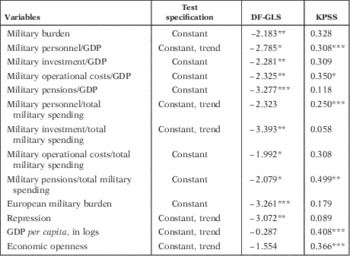
The time series analysis requires the data to be first tested for stationarity. The KPSS test specifies the null hypothesis of stationarity, whereas the Dickey−Fuller Generalized Least Squares test postulates the presence of a unit root as the null. Table 2 shows the results of applying both tests to all the variables considered in the analysis. The null hypothesis of a unit root can be rejected for all dependent variables except for military personnel/total military spending. The presence of a unit root cannot be rejected in the case of per capita GDP and economic openness. The KPSS test rejects stationarity for military personnel/GDP, military operational costs/GDP, military personnel/total military spending and military pensions/total military spending, per capita GDP and economic openness. On the basis of these results, the regression analysis is only carried out with the stationary variablesFootnote 32 . The military personnel/GDP, military operational costs/GDP and military pensions/total military spending variables are also used assuming weak stationarity (as they are stationary according to one of the tests but not the other), but their coefficients must be interpreted with caution.
DICKEY−FULLER GENERALIZED LEAST SQUARES (DF-GLS) AND KPSS TEST (1876-2009)

Notes: The lag length selection for the DF-GLS is based on SIC/BIC criterion. ***Rejection of the null hypothesis at the 1 per cent significance level; **rejection of the null hypothesis at the 5 per cent significance level; *rejection of the null hypothesis at the 10 per cent significance level.
Source: See text.
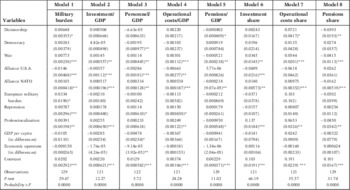
Table 3 shows the regressions results of the OLS estimation of equations [3] and [4]. As can be seen in Model 1, which tests the effect of political, strategic and economic variables on total military burden, democracy does not seem to have any significant effect on total military burdenFootnote 33 . Although the present democratic period has achieved the lowest military burden ratios of the whole series (during the 1990s and the 2000s), the relatively high levels reached during the Second Republic (1931-1936) and by the transitional governments of the late 1970s and early 1980s may explain this lack of significance. According to Models 2-5, which provide the results for investment/GDP, personnel/GDP, operational/GDP and pensions/GDP ratios, respectively, personnel expenditures contributed most to pushing down the military burden during democratic periods, mainly owing to the effort to reduce the costs of chiefs and officials during the Second Republic and to the reorganisation plans developed during the present democratic period (although the former was initially mitigated by increases in salaries). By contrast, democracy does not show any significant negative effect on investment and operational costs, which reflects the priority given to material expenditures rather than personnel endowments, particularly during the transitional period from Franco’s dictatorship to the contemporary democracy. Similar results are found in Models 6-8, which provide additional insights on the effects of political regimes on investment, operational expenditures and pensions expressed as a percentage of total military spending.
REGRESSION RESULTS FOR MILITARY SPENDING IN SPAIN (1876-2009)

Notes: Following Wooldridge (Reference Wooldridge2003), I use Newey-West standard errors (with two lags) in order to control for the presence of heterokedasticity and autocorrelation in the residuals. Time trends effects not reported in the table. ***Rejection of the null hypothesis at the 1% significance level; **Rejection of the null hypothesis at the 5% significance level; *Rejection of the null hypothesis at the 10% significance level.
Sources: See text.
The theoretical framework provided by Acemoglu et al. (Reference Acemoglu, Ticchi and Vindigni2010) helps to explain these results. According to the authors, transitional democratic governments would need to provide economic concessions to the military, as well as to involve them in international affairs, in order to ensure the loyalty of the army. As has been identified by military historians, these policies were indeed part of the Spanish military transition from the Franco dictatorship to a consolidated democracy. As a result, the military burden grew during the early democratic governments, which helps to explain the non-significant impact of democracy on the military burden found in Model 1. This kind of coup-proofing strategy has frequently been suggested to explain the usual positive relation between dictatorship and military burdenFootnote 34 . Nevertheless, in the light of the Acemoglu, Ticchi and Vindigni’s theoretical framework, this paper complements this literature by arguing that economic concessions might also push up the military burden during democratic political transitions.
The former set of results also allows us to conclude that the newly international orientation of the Spanish army set up under the early democratic governments led to relatively high capital/labour ratios in military expendituresFootnote 35 . This finding is consistent with the literature that has explored the mechanisation of armed forces. For instance, Caverley (Reference Caverley2009) argues that democracies favour capital over labour military allocations owing to the median voter’s willingness to replace troops on the ground by military technology. By contrast, Sechser and Saunders (Reference Sechser and Saunders2010) consider that investments in military mechanisation are more related to strategic factors than to political regimes. These authors suggest that domestic threats might force governments to favour labour over capital resources in order to better confront internal insurgency. The Spanish experience indicates that democratisation and strategic factors might jointly help to explain the evolution of the military capital/labour ratio: the shift in the Spanish military strategy from domestic to international threats undertaken by transitional democratic governments came along with an enforced prominence of capital allocationsFootnote 36 .
This trend to a capital-intensive army could also have been strengthened by the international military doctrines, which have arisen from the 1970s onwards with the emerging information technologies and the new military systems. According to some military historians and analysts, these new doctrines would have led western countries to a new «revolution in the military affairs» that favoured capital investmentsFootnote 37 . Nevertheless, the increase in the capital/labour ratio is not a general feature of this period. As shown in Bove and Cavatorta (Reference Bove and Cavatorta2012), the military transition from conscript armies to all-voluntary armed forces in a set of NATO countries from the 1980s onwards (which is part of the aforementioned revolution in the military affairs) has not always gone together with an increasing share of equipment expenditures in the total military budget. For instance, Belgium, Italy and the Netherland showed declining shares of equipment expenditures after adopting the all-voluntary armed forces system.
Returning to Table 3, it can also be seen that dictatorships had a (slightly significant) positive impact on the military burden (Model 1). Regarding the economic expenditure composition, the effect of dictatorship was also positive (but not significant) on material costs. These findings are in line with previous literature, which reports high levels of military burden in both the European interwar dictatorships and the current autocratic regimes. For instance, Eloranta et al. (Reference Eloranta, Svetlozar and Osinsky2014) argue that autocracies (particularly the Nazi regime) jumped into the arms race of the 1930s more quickly than democracies. On the other hand, Models 5 and 8 show a negative correlation between dictatorships and military pensions. This result agrees with other studies on social spending, which argue that dictatorships have a negative impact on public social provision. The military nature of the pensions does not seem to modify this negative linkage (Lindert Reference Lebovic2004; Espuelas Reference Espuelas2012).
The effect of the alliance with the U.S. government, established since 1953 by the Franco regime, provides additional insights on the military nature of the Spanish dictatorship. According to Model 1, the alliance had a significant negative effect on the Spanish military burden. This is consistent with the idea that the U.S. military agreement was used by Franco’s dictatorship to grant national security, whereas reducing the resources invested in the military. Its prominent impact on investment and operational costs reflects the army’s withdrawal from the international arena and its concentration on domestic threats (where material expenses were less relevant). Moreover, the U.S. military aid provided the Spanish army with modern military equipment (although it came from second-hand models), reducing the need of the Spanish government to invest in its own military equipment.
Lastly, the negative impact of democracy on personnel expenditures, as well as the negative (but non-significant) effect of dictatorship, seem to suggest that the Restoration governments (which are the reference period in the analysis) devoted more resources to personnel payments than the other regimes, whereas providing fewer resources to material military endowments. These results are fairly consistent with a Restoration army with relatively low equipment endowments, mainly focussed on domestic threats and public order tasks (even though the modernisation plans were initiated in the late 1900s). In contrast with the conclusions found by previous literature on restricted democracies, the Spanish Restoration did not follow more aggressive international policies than the following dictatorial and democratic regimes and did not sustain higher military expenditure than dictatorships.
In the case of the control variables, as could be expected from the results of the structural break analysis, wars exerted a significant and positive effect on both the military burden and most of its components. Its effects are higher on operational expenditures than on personnel and equipment, as the former account for most wartime costs. The European military expenditures also had a positive and significant incidence on total military burden, although no clear effects are found on the economic composition of expenditure. This probably captures the relatively high military burden levels achieved from the mid-1910s to the 1960s, more than half a century with high military tension in Europe. On the other hand, the alliance with NATO had a positive impact on the total military burden, probably owing to the modernisation efforts required by the alliance. Its higher coefficients on operational and investment costs suggest that the international military orientation of democratic Spanish governments favoured capital over labour endowments, as capital intensity might have been more appropriate to deal with international military threats and missions.
The professionalisation of the army had a positive impact on investment and operational expenditures, which also reflects the aforementioned modernisation efforts of recent democratic governments. On the other hand, repression had a significant and positive effect on the total military burden and the personnel and operational burden. This reflects the domestic-repressive orientation of the Spanish army, particularly in the conflictive final decades of the Restoration regime and during the 1940s, after the civil war, when the regime confronted substantial internal turmoil. Finally, the economic variables have in general a negligible effect on the military spending variables.
5. CONCLUSIONS
Defence economics literature has analysed in depth the political determinants of military spending on the basis of several international panel data sets. According to most studies, democracies exert a negative influence on military burdens owing to the social preferences for other public expenditures. This paper challenges this conclusion by analysing a new Spanish military expenditure series from 1876 to 2009. Both the structural breaks test and the OLS analysis allow us to conclude that the democratic push to reduce the military financial burden may have been partially compensated by the restructuration and modernisation of the Spanish army carried out by transitional governments during the late 1970s and the early 1980s and by the modernisation policies prevailing during the interwar period. These policies favoured capital over labour endowments, as it might be more appropriate to confront international military threats. Further analyses of transitional periods and modernisation patterns in international panel data sets could address the question of the extent to which this conclusion can be generalised.
On the other hand, and in accordance with defence economics literature, Spanish dictatorships had a positive effect on military spending. The results on the economic composition of expenditure seem to reflect the military priority given by Franco to domestic threats, particularly since the military pacts with the United States passed in 1953 and the subsequent entrance into multilateral international organisations. Similarly, the analysis of military expenditure composition seems to reflect the domestic orientation of the Restoration’s army (1874-1923), mainly focussed on increasing personnel costs rather than investment and operational expenditures. Finally, my results differ from those of Gadea and Montañés (Reference Gadea and Montañés2001), according to whom the Spanish military burden was almost entirely driven by GDP evolution (once wartimes and other outliers were excluded). As has been said, both the political and the international military factors seem to have had significant effects on the Spanish military burden evolution.