Ductus arteriosus closure is an important step during the transition from fetal to extrauterine life. After birth, the ductus usually constricts within several hours – early functional closure – and undergoes a subsequent remodelling – definite anatomic closure.Reference Hamrick and Hansmann 1 However, especially in preterm infants, the ductus frequently fails to close. Known as patent ductus arteriosus, this condition can be associated with several complications such as left ventricular dysfunction and volume overload, possibly leading to the development of pulmonary oedema, chronic lung disease, and heart failure.Reference Sallmon, Koehne and Hansmann 2 Cyclooxygenase inhibitors – ibuprofen and indomethacin – are a mainstay of patent ductus arteriosus therapy and facilitate ductal closure in ~70% of all very low birth weight infants, with similar efficacies being reported for both drugs.Reference Sallmon, Koehne and Hansmann 2 The molecular and cellular mechanisms that lead to physiologic and/or pharmacologic ductal closure are incompletely understood. An increasing oxygen tension and decreasing prostaglandin levels are involved in early ductal closure after birth,Reference Hamrick and Hansmann 1 , Reference Sallmon, Koehne and Hansmann 2 while several growth factors, such as vascular endothelial growth factor,Reference Clyman, Seidner and Kajino 3 , Reference Weber, Rheinlaender and Sarioglu 4 and cellular mechanisms involving platelets contribute to definite anatomic closure of the ductus arteriosus.Reference Echtler, Stark and Lorenz 5 , Reference Sallmon, Weber and Hüning 6
We recently developed a protocol for primary cell culture from fetal rat allowing for the separate ex vivo cultivation of endothelial cells, vascular smooth muscle cells, and fibroblasts in order to elucidate cell-specific mechanisms involved in ductal closure.Reference Weber, Gratopp and Akanbi 7 The aim of this study was to investigate the effects of ibuprofen and indomethacin treatment on the expression of vascular endothelial growth factor and its receptors in ductus arteriosus endothelial cells by using this primary rat cell culture.
Methods
Animals and endothelial cell culture
The primary cell culture used for this study has been previously reported in detail.Reference Weber, Gratopp and Akanbi 7 In brief, Wistar rats, timed-pregnant 21 day (E1=plug date), were killed, the fetuses were removed and killed by decapitation, and the thoracic cavity was opened by a midline incision. The following micropreparation steps were performed under a dissection microscope (Leica M690, lens 10445170, 10×21B; Leica Mikrosysteme Vertriebs GmbH, Bensheim, Germany). The pericardium was opened and the situs was rinsed with phosphate-buffered saline (PBS) (pH 7.4, 4°C). The Ductus arteriousus and the aorta were dissected and placed in medium (Dulbecco’s Modified Eagle’s Medium, 3.7 g/L NaHCO3, 15% fetal calf serum (FCS), 1% penicillin/streptomycin, 1% L-glutamine, No. F0405; Biochrom AG, Berlin, Germany). The tissues were transferred to a 1.5-ml centrifuge tube containing 1 ml of collagenase 1 mg/ml (collagenase:aqua dest. – 1:4; Biochrom AG) and incubated at 37°C for 7 minutes. Digestion was stopped by adding 2 ml of EC medium (Medium 199 EARLE, 2.2 g/L NaHCO3, 20% FCS, 1% penicillin/streptomycin, 1% L-glutamine, No. F0615; Biochrom AG). Thereafter, the cell suspension was centrifuged for 5 minutes (1000 rpm, 4°C) and the pellet was resuspended in EC medium. Next, the cell suspension was filtered through a 40-µm metal mesh once, and cells were disseminated into gelatin-coated cell culture flasks (Falcon, Becton Dickinson, Heidelberg, Germany) in EC medium containing 1% fibroblast growth factor 1. All the cells isolated were subjected to magnetic labelling and separation. For magnetic-activated cell sorting, the confluent adherent cells were rinsed with PBS (pH 7.4, 20°C) once and incubated with 1 ml of accutase (5 minute, 37°C). The digestion was stopped by adding 2 ml of medium. The cells were detached and resuspended in medium. Then the cells were isolated by passing them through a 22-gauge needle for 10–15 times and cell concentration was determined. After an additional washing step (PBS, pH 7.4, 20°C), cells were resuspended in 1 ml of RPMI medium (20°C, 5.5 g/L NaCl, 5 mg/L phenol red, 2.0 g/L NaHCO3, 25 mM HEPES, 0.532 g/L L-glutamine, No. 0972 G; Biochrom AG) and filtered through a 40-µm metal mesh. The cells were incubated with the primary antibody [5 µg/200,000 cells, IgG rabbit anti-rat von Willebrand factor (vWF) polyclonal, No. ab 6994; Abcam, Cambridge, England] at 20°C for 30 minutes. After washing and resuspension in 80 µl of magnetic-activated cell sorting buffer (PBS, 5% BSA, and 2 mM ethylenediaminetetraacetic acid), cells were incubated with magnetic beads (20 µL, goat anti-rabbit IgG, No. 486–02; Miltenyi Biotec, Auburn, California, United States of America), according to the manufacturer’s instructions. Magnetically labelled vWF+ cells were isolated using a magnetic column (LS magnetic-activated cell sorting separation columns; Miltenyi Biotec). The cultured cells were then treated with either ibuprofen or indomethacin at doses of 250 and 10 µg/ml, which correspond to the upper limits of therapeutically achieved plasma levels in infants.Reference Sallmon, Koehne and Hansmann 2 After preliminary dose-finding experiments, we decided to use doses in the upper ranges achieved under in vivo conditions to avoid inefficiency caused by potential underdosing and artificial effects caused by potential overdosing.
Flow cytometry
Experiments were performed using a FACScan™ flow cytometer (Becton Dickinson) as previously described. We used anti-rat vWF (15 µg/50,000cells, rabbit IgG, No. ab 6994; Abcam) as the primary antibody and fluorescence-labelled goat anti-rabbit IgG-FITC as the secondary antibody (7.5 µg/50,000 cells, No. FI-1000; Vector Laboratories, Burlingame, California, United States of America).
Immunofluorescence staining
Immunofluorescence staining for vascular endothelial growth factor and its receptors 1 and 2 on rat ductus arteriosus and aorta was performed as previously describeld4 using the following primary antibodies: vascular endothelial growth factor (Sc-7269, Santa Cruz Biotechnology, Dallas, Texas, United States of America; 1:500), vascular endothelial growth factor receptor 1 (no. 124442, Dianova; 1:500), and vascular endothelial growth factor receptor 2 (no. 12463, Dianova, Hamburg, Germany; 1:100). Secondary fluorescent goat anti-mouse and anti-rabbit antibodies (Alexa Fluor 488; MoBiTec GmbH, Goettingen, Germany) were each applied at a dilution of 1:1000. Slides were counterstained and mounted with aqueous 4,6-diamidino-2-phenylindole containing mounting medium (Vectashield; Vector Laboratories). Microscopic analysis was performed under an epifluorescence microscope (AxioPlan2 e; Imaging System, Carl Zeiss, Oberkochen, Germany). Photographs were taken with a digital camera (AxioCAM MRc; Carl Zeiss) using the AxioVision 4.2 software (Carl Zeiss).
Quantitative real-time polymerase chain reaction
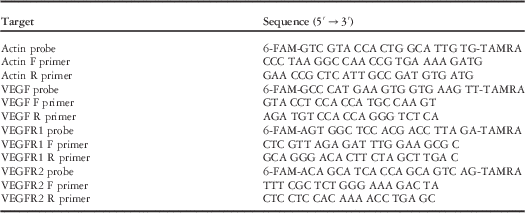
RNA was extracted by using the isopropanol precipitation method. Reverse transcription was performed with a commercial qPCR Core Kit (Eurogentec, Cologne, Germany) according to the manufacturer’s instruction. The primer pairs and probes for real-time polymerase chain reaction (BioTEZ, Berlin, Germany) are shown in Table 1. RNA expression differences were calculated using the ΔCT method with actin serving as endogenous control.
Primer and probe sequences used for quantitative real-time polymerase chain reaction.

VEGF=vascular endothelial growth factor; VEGFR1=vascular endothelial growth factor receptor 1; VEGFR2=vascular endothelial growth factor receptor 2.
Statistics
Comparisons between groups were made by ANOVA. p values<0.05 were considered statistically significant.
Results
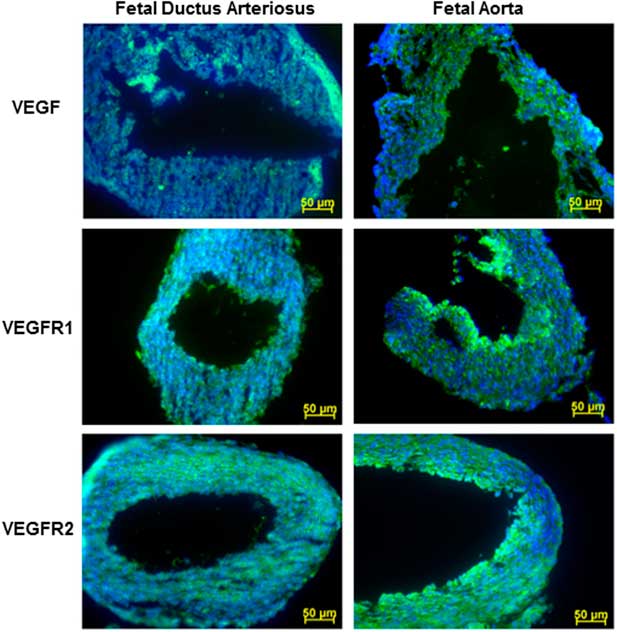
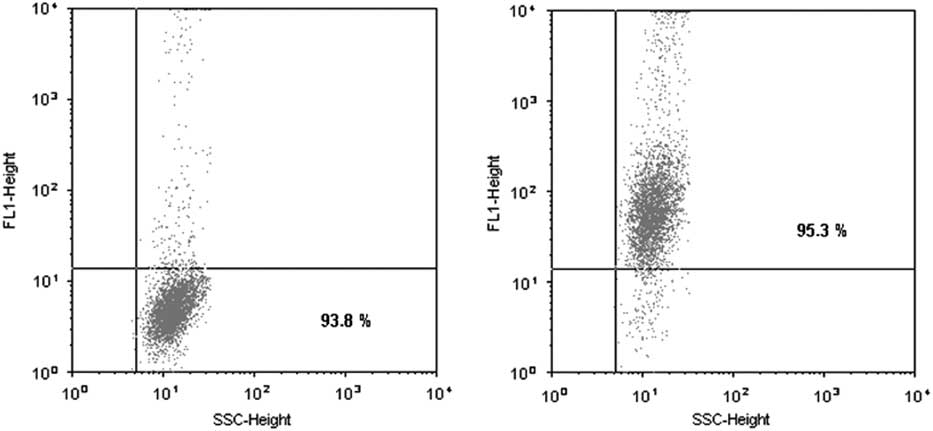
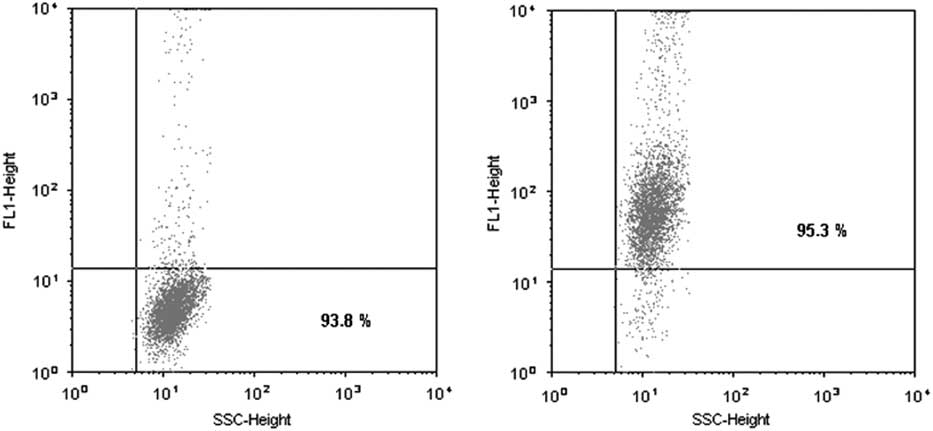
In a first step, we evaluated whether both vessels used in our study exhibit protein expression of vascular endothelial growth factor and its receptors 1 and 2. By means of immunofluorescence staining, we confirmed protein expression of the three molecules in slices of native fetal rat ductus arteriosus, and aorta, with the ductus showing morphologic features of immaturity (Fig 1). In a next step, following the preparation of the vessel, mixed cell culture, and immunomagnetic cell sorting of endothelial cells, we investigated cell purities of the resulting endothelial cell cultures. By means of flow cytometry, we could show that all endothelial cell cultures achieved purity levels of >90% (Fig 2).
Immunofluorescence staining of fetal ductus arteriosus and aorta. Positive expression of vascular endothelial growth factor (VEGF), vascular endothelial growth factor receptor 1 (VEGFR1), and vascular endothelial growth factor receptor 2 (VEGFR2) was found in rat fetal ductus arteriosus and aorta at day 21 of development (green). Cell nuclei were counterstained with 4,6-diamidino-2-phenylindole (blue).

Flow cytometry of ductus arteriosus endothelial cell culture. Representative dot blots of endothelial cells (right) and isotype controls (left) are shown with an endothelial cell culture purity of 95.3%. FL=fluorescence intensity; SSC=side scatter light.
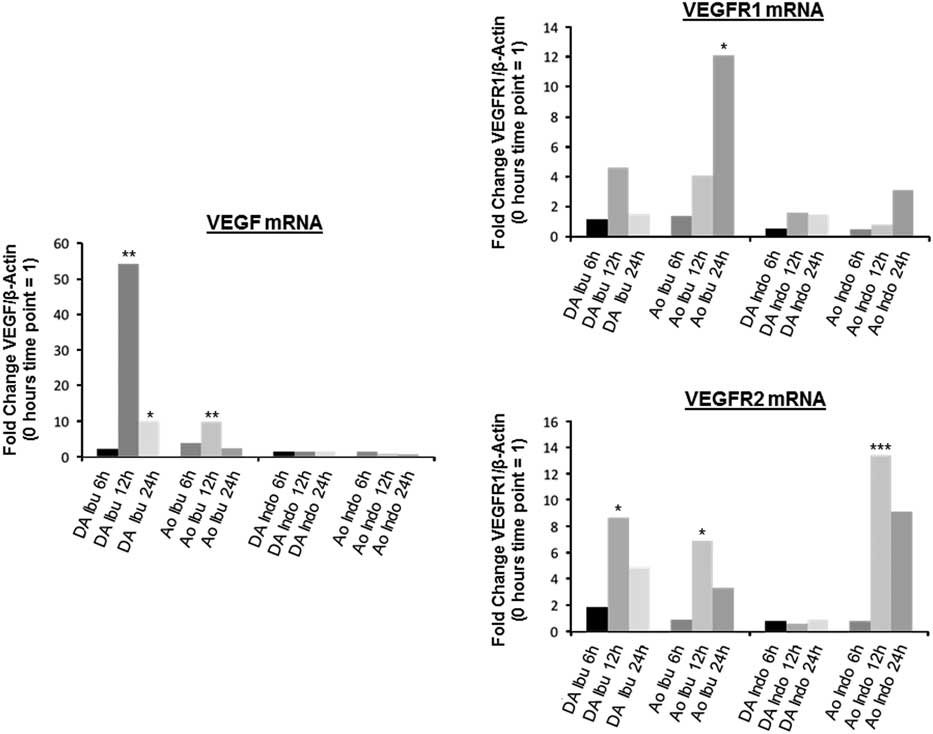
To evaluate the effects of cyclooxygenase inhibitors on the expression levels of vascular endothelial growth factor and its receptors, the endothelial cell cultures were treated with either ibuprofen (250 µg/ml) or indomethacin (10 µg/ml). Quantitative real-time polymerase chain reaction analyses were performed after 6, 12, and 24 hours. In ductus-arteriosus-derived endothelial cells, ibuprofen significantly induced vascular endothelial growth factor mRNA expression levels after 12 and 24 hours and vascular endothelial growth factor receptor 2 mRNA expression levels after 12 hours. Vascular endothelial growth factor receptor 1 mRNA expression levels were not affected by ibuprofen. Of note, we did not observe any effect of indomethacin on the mRNA expression levels of either vascular endothelial growth factor or its receptors in ductus endothelial cells (Fig 3).
Differential regulation of vascular endothelial growth factor (VEGF), vascular endothelial growth factor receptor 1 (VEGFR1), and vascular endothelial growth factor receptor 2 (VEGFR2) by ibuprofen and indomethacin. Quantitative real-time polymerase chain reaction analyses from endothelial cell cultures of either rat ductus arteriosus or aorta – both day 21 of development – for VEGF, VEGFR1, and VEGFR2 mRNA expression levels were performed after 6, 12, and 24 hours of treatment with either ibuprofen (250 µg/ml) or indomethacin (10 µg/ml). All experiments were conducted n=5. Each n represents pooled data from 1 litter (5–8 individuals). All data are given as fold change compared with the 0-h time point (=1). β-Actin served as the endogenous control. Ao=aorta; DA=ductus arteriosus; Ibu=ibuprofen; Indo=indomethacin. *p-value<0.05; **p-value<0.01; ***p-value<0.001.

In addition, we investigated the effects of cyclooxygenase inhibitors using fetal rat aortal endothelial cell cultures. Here, in contrast to our findings from the ductal endothelial cultures, ibuprofen significantly induced mRNA expression levels of vascular endothelial growth factor and of both of its receptors 1 and 2 after 12, 24, and 12 hours, respectively. Indomethacin treatment significantly increased vascular endothelial growth factor receptor 2 after 12 hours, but did not alter vascular endothelial growth factor or vascular endothelial growth factor receptor 1 mRNA expression levels (Fig 3). Of note, expression levels of all investigated targets were consistent between the 0-h time point and all other time points under basal conditions – that is, treatment with solvents which were supplied by the drug manufacturers – in both vessel types – data not shown.
Discussion
The molecular and cellular mechanisms that control physiologic or pharmacologically induced ductal closure are incompletely understood. Ibuprofen and indomethacin are widely used in preterm infants with patent ductus arteriosus. Both drugs are unselective cyclooxygenase inhibitors and are thought to achieve their effects by inhibiting prostaglandin synthesis.Reference Sallmon, Koehne and Hansmann 2 Besides prostaglandins, several growths factors, such as vascular endothelial growth factor, play important roles in ductal closure.
Vascular endothelial growth factor and its receptors have been shown to be expressed and functional in endothelial cells of the ductus and other vessel types.Reference Clyman, Seidner and Kajino 3 , Reference Weber, Rheinlaender and Sarioglu 4 , Reference Liu, Cox, Morita and Kourembanas 8 , Reference Christou, Yoshida and Arthur 9 The role of the vascular endothelial growth factor system in ductal closure has been well established in previous in vivo studies. Treatment of premature baboons with anti-vascular endothelial growth factor antibodies did not alter the degree of ductus constriction, tissue hypoxia, or vascular endothelial growth factor expression. However, antibody treatment produced a significant reduction in ductus vasa vasorum ingrowth and neointima formation owing to both a decrease in luminal endothelial cell proliferation and a decrease in smooth muscle cell migration into the neointima. Furthermore, the neutralising antibodies decreased ductus neointimal expansion by reducing the number of endothelial cell layers and by completely blocking the influx of nonendothelial cells into the subendothelial zone of the neointima, and also blocked VLA-4, CD14, and CD163 mononuclear cells from migrating into the outer muscle media, a process that has been shown to be pivotal for ductal closure.Reference Clyman, Seidner and Kajino 3 , Reference Waleh, Seidner and McCurnin 10 We have previously shown that the expression levels of vascular endothelial growth factor and its receptors in the human ductus arteriosus change during gestation. We observed a decreasing endothelial expression of vascular endothelial growth factor receptor 1 throughout gestation, whereas vascular endothelial growth factor receptor 2 expression remained stable in the ductus endothelium and increased in the media, suggesting a role for vascular endothelial growth factor receptor 2 during late human ductus arteriosus maturation.Reference Weber, Rheinlaender and Sarioglu 4 The exact mechanisms that control these developmental changes are unclear.
The results from this investigation indicate differential effects of ibuprofen and indomethacin on the expression levels of the vascular endothelial growth factor system in ductus arteriosus endothelial cells. Furthermore, our results indicate vessel-specific differences between ductal and aortic endothelial cells in their response to different cyclooxygenase inhibitors. In this regard, Beharry et al reported differential effects of ibuprofen and indomethacin on the vascular endothelial growth factor system in the newborn rat retina, where they could show an inhibition of vascular endothelial growth factor action by high-dose ibuprofen via vascular endothelial growth factor receptor 2 downregulation, which was not seen with indomethacin.Reference Beharry, Modanlou and Hasan 11 These results further highlight the vessel-specific regulation of the vascular endothelial growth factor system.
The optimal treatment time points and strategies for patent ductus arteriosus therapy are subject to ongoing debates,Reference Heuchan and Clyman 12 – Reference Reese and Laughon 14 and the impact of the different therapeutic options on neonatal outcomes needs to be considered.Reference Liebowitz and Clyman 15 – Reference Weisz, Mirea and Rosenberg 17 To provide patient-specific (“tailored”) therapies, a full mechanistic understanding of drug action during development is highly warranted.Reference Ment, Peterson and Meltzer 18 Both cyclooxygenase inhibitors, ibuprofen and indomethacin, achieve ductal closure in about two-thirds of cases; however, differences exist in regard to their adverse and off-target effects. Although ibuprofen, compared with indomethacin, is associated with a lower risk of necrotising enterocolitis and renal failure, early indomethacin has been associated with a decreased risk of intraventricular haemorrhage.Reference Sallmon, Koehne and Hansmann 2 In addition, ibuprofen use has been associated with a high rate of pulmonary hypertension in preterm neonates.Reference Kim, Shin and Kim 19 As the vascular endothelial growth factor system is known to play important roles during pulmonary endothelial and parenchymal development,Reference Christou, Yoshida and Arthur 9 , Reference Voelkel, Vandivier and Tuder 20 future studies are needed to investigate whether pulmonary dysregulation of the vascular endothelial growth factor system by ibuprofen might contribute to this observation.
Our findings indicate a tissue-specific differential regulation of the vascular endothelial growth factor system by indomethacin and ibuprofen. Importantly, this study has not been designed to examine the biological in vivo effects of the vascular endothelial growth factor system during ductal closure, and it does not allow for investigating the effects of altered vascular endothelial growth factor system expression levels on the different cell types involved in ductal closure – for example, smooth muscle cells, mononuclear cells, and so on. In addition, it remains unclear whether the observed time courses of expression changes in our experiments can also be observed under in vivo conditions. However, ex vivo cell cultures, as used in this investigation, provide the opportunity to study cell-type-specific regulatory mechanisms under controlled conditions that cannot be achieved in in vivo experiments. Nevertheless, further in vivo studies are needed to elucidate the biological significance of these findings for ductal closure, but also for the effects of cyclooxygenase inhibition on other developing organs including the brain.
Acknowledgements
The authors thank Boris Metze (Berlin) for his expert statistical assistance.
Financial Support
Petra Koehne was supported by a Lydia–Rabinowitsch Scholarship (Charité University Medical Center Berlin).
Conflicts of Interest
None.
Ethical Standards
Experiments were performed according to the institutional guidelines and German animal protection laws and have been approved by the Charité-Universitätsmedizin Berlin Animal Care and Use Committee (project number T0259/04).