Internetworking took the world by storm in the late twentieth and early twenty-first centuries. Historians remain in the very early stages of documenting and making sense of its emergence. Familiar elements in histories of the Internet include the invention of packet switching (early 1960s), the successful deployment of the U.S. Advanced Research Projects Agency Network (ARPANET) (1969), the invention of the World Wide Web (1989), the commercialization of the Internet's infrastructure and subsequent dot-com boom (1990s), and the rise of social media and so-called Big Tech (2000s). The common threads that weave together all of these fragments are technical standards: documents that specify interoperability and facilitate the movement of data across diverse kinds of devices and networks. As with networks, platforms, and infrastructures in any modern industry, digital networks simply could not exist without common standards.
In the second half of the twentieth century, as digital technologies transformed the communications and computing industries, methods for creating and adopting standards in these industries were also transformed. These changes have been mapped by historians, who have described how standardization fits within the broader outlines of political economy in the twentieth century, such as the movements toward deregulation, liberalization, global flows of knowledge and commerce, and Schumpeterian forms of competition and creative destruction. The trajectory that historians of Internet standards and governance describe can be summarized briefly: At the dawn of the digital age, telecommunications standards were produced by monopoly or “national champion” firms, government regulators, and international intergovernmental bodies such as the Consultative Committee for International Telephony and Telegraphy (CCITT). By the end of the twentieth century, these traditional gatekeepers had lost their grip and were displaced by nimbler, less formal, more responsive institutions.Footnote 1
Standards for computer networks arose from a competitive landscape and not only from investments from the Advanced Research Projects Agency (ARPA) or from collegial discussions among like-minded engineers. In particular, entrepreneurial firms and individuals played key roles in the creation of standards for digital networks. They brought new knowledge and a sense of urgency to the process that were not always matched by incumbent firms, and they did so as part of their strategies to make deals, build alliances, and sell products to meet customer needs and demands. Only then—with the widespread sale and use of actual products, such as modems and routers—could customers realize the benefits of “network effects.”Footnote 2
Our purpose here is to provide a clearer picture of why standards mattered for businesses that were building digital networks—especially companies that were building products that could interconnect diverse networks. After all, it was companies such as Codex, 3Com, Ungermann-Bass, and Cisco that were, in the end, responsible for implementing standards into working products, manufacturing those products at competitive prices, and introducing those products into the marketplace.
In what follows, we provide an overview of some of these companies from the perspective of the executives, managers, and engineers who were sailing through uncertain waters. This account draws on our book, Circuits, Packets, and Protocols: Entrepreneurs and Computer Communications, 1968–1988, published by ACM Books. The foundation of our analysis is interviews and market data collected by James L. Pelkey, who was an investor during the 1980s. This was a time when the demand for internetworking was rising and competition to produce modems and routers was intensifying—but there were no universal product standards. To satisfy his curiosity, and to help inform his investment strategies, Pelkey collected market data from leading industry publications, attended trade shows and industry events, interviewed over eighty industry leaders in 1988 and 1989 about their experiences, and self-published an online book to document what he learned.Footnote 3
Our analysis uses Pelkey's data and interviews to cast the history of the Internet—and the development of internetworking standards—in a new light. This evidence illustrates how standards are outcomes of contests and collaboration among entrepreneurs, businesses, promoters in the public and private sector, and engineers working within the constraints of available knowledge, facilities, and equipment. It is unusual for historians to have access to industries at this embryonic phase, before the winners can write history, dictate their version to journalists and historians, and deposit their papers in archives. Thanks to Pelkey's inquisitiveness and foresight, we are able to reconstruct this history with richer and more diverse sources than can be collected from the shadows of hindsight. The sources we use are especially rich for supporting two lines of inquiry, namely, the uncertainty that market actors encountered and the extent to which representatives from private firms—especially young firms and start-ups—injected energy and direction into the standards process.
Internetworking emerged at the end of a process of digital convergence that took place over roughly two decades. At the beginning of this period, in the late 1960s, American communications and computing were dominated by two massive firms: AT&T in communications, and IBM in computing. Both firms devoted some energy to computer communications, but they also had significant legacies to sustain and defend in the face of competitive and regulatory pressures. Neither devoted significant resources or expertise to building the new paradigm of open standards, interoperability, and modular, multivendor networks that took shape in the 1970s and 1980s.Footnote 4
Between the mid-1960s and the late 1980s, computer-communications products populated three distinct markets: data communications, networking, and internetworking. The first market, data communications, emerged between 1967 and 1971 to enable remote connection to mainframe computers. The growth of the data communications market came from many factors: customer demand, changes in regulation, new entrants in timesharing, advances in semiconductor technology, availability of venture capital, and hot IPO markets. Modem standards were set by the CCITT every four years, which provided the framework for relatively orderly development of new products in the early to mid-1970s.
The second market we examine, networking, began to emerge in the late 1970s, in the wake of the boom in minicomputer sales. Three companies joined an alliance to back Robert Metcalfe's proposal for an Ethernet standard and capture the benefits for their respective lines of business. These companies were Xerox, Metcalfe's employer, which was building products that integrated hardware and software; Intel, maker of microprocessors; and DEC, maker of minicomputers. This DEC-Intel-Xerox (DIX) vertical alliance brought its Ethernet proposal to a newly formed standards committee, organized under the auspices of the Institute of Electrical and Electronics Engineers (IEEE) Standards Association. The committee, IEEE 802, evaluated Ethernet and two competing proposals; unable to pick a single winner, the IEEE published three incompatible standards for local area networking—Ethernet, token bus, and token ring—and left the choice to market participants. The competitive phase of networking, in the early 1980s, was particularly intense as over one hundred firms announced products. The networking market exploded with the introduction of personal computers, and battles over standards and network topologies raged in committees and boardrooms.
The third market, internetworking, emerged from the conditions of networking. Corporations in the mid-1980s discovered they had an increasing number of disparate networks that they could not interconnect. Their focus turned to joining their network islands into larger, enterprise-wide networks. Their needs were anticipated by two competing, incompatible approaches: the Transmission Control Protocol/Internet Protocol (TCP/IP) standards sponsored by the U.S. Department of Defense, and the Open Systems Interconnection (OSI) framework designed within committees of the International Organization for Standardization (ISO). A new breed of internetworking firms, including SynOptics, Retix, Cabeltron, Chipcom, StrataCom, Wellfleet, and Cisco Systems, emerged in the 1980s. By the late 1980s, the market for internetworking equipment—bridges, gateways, and routers—exhibited signs of dramatic and highly profitable growth. Promoters in the private and public sectors touted the capabilities of their products at trade shows and expositions with names like Autofact (1985), Interop (1988), and Enterprise Networking Event (1988).Footnote 5 This market remained unsettled and unordered until products that implemented the TCP/IP “Internet” protocols triumphed in the early to mid-1990s. Along the way, a new standards body, the Internet Engineering Task Force (IETF), rose to prominence and embodied a new approach for approving standards, which the computer scientist David D. Clark summarized in a 1992 speech: “We reject: kings, presidents, and voting. We believe in: rough consensus and running code.”Footnote 6
The entrepreneurial and unorthodox approaches to standards for networking and internetworking worked well enough to provide the foundations for astonishing market growth. Table 1 and Figure 1 depict the immense growth and profitability of the computer communications market near the end of the period we study, between 1982 and 1988.Footnote 7 Our detailed data ends in 1988, after which the internetworking market exploded, in the 1990s, evident in Cisco's overwhelming success after its founding in 1984 and IPO in 1990. In March 2000, near the peak of the dot-com bubble, Cisco's market capitalization exploded to $569 billion, making it the most valuable company on earth.Footnote 8
Composition of the computer communications market, 1982–1988. (Sources: Dataquest Inc., “Local Area Network Equipment,” “Modems,” “Statistical Multiplexers,” “Data PBX,” Sept.-Nov. 1989.)

The Computer Communications Market, 1982–1988

Sources: Dataquest Inc., “Local Area Network Equipment,” “Modems,” “Statistical Multiplexers,” “Data PBX,” Sept.-Nov. 1989.
A recurring theme that stands out from our research is the close relationship between entrepreneurship, standards making, and the creation of network effects. Sellers of networking equipment were successful to the extent that they could meet demand that existed in large organizations. The most successful were those that understood how these organizations—especially large manufacturers, government agencies, and universities—could adopt and use computer communications at a time when they were purchasing and using computers in unprecedented ways.Footnote 9 Indeed, when Cisco went public on February 16, 1990, its IPO document cited over four thousand systems that had already been installed “by over 400 customers in the industrial, financial, government and university markets, including Aetna Life and Casualty Co., AT&T, Ford Motor Company, General Electric Company, Harvard University, The Hewlett-Packard Company, [and] Morgan Stanley & Co. Inc.”Footnote 10
As in other industries, computer communication markets grew significantly once variation gave way to standardization, and companies implemented standards from a variety of sources into products such as routers, modems, cables, and computers that, in combination, constituted a dominant design for internetworking.Footnote 11 Entrepreneurial firms played a more important role in building this outcome than has been recognized. The consequences for the global economy are difficult to overstate: the creation of new platforms for digital commerce, and the enabling of an entrepreneurial multiplier that is generating wealth—albeit in profoundly unequal ways—throughout the entire world.Footnote 12
Data Communication: From Monopoly to Competition
In the early 1960s, there were few indications that computer communications would be a vibrant and competitive market. The monopoly Bell System created the first commercial modem, the key technology for transmitting digital information over telephone lines. And with the commercial success of the System/360 in the mid to late 1960s, IBM was the dominant force in the American (and indeed global) computer industry. These two companies had prestigious corporate labs with deep pockets, and both had skillfully used political connections and legal heft to navigate government attempts to constrain their power.
The methods for producing technical standards differed between the communications and computer industries. In communications, international standards were set by the CCITT, an activity of the International Telecommunication Union, which was itself a specialized agency of the United Nations. At the time, telecommunications in most nations was controlled and operated either by national governments or regulated national monopolies, like AT&T in the United States. As a result, telecommunications standards were often backed by the force of national laws. The computer industry, in contrast, was younger than telegraphy and telephony, and standards for programming languages and operating systems—to the extent that they existed at all—were promulgated by professional societies and adopted on a voluntary basis. Or, de facto standards emerged when market participants adopted standards from powerful firms, such as IBM, as a matter of their own self-interest.Footnote 13
For the communications industry, decisive first steps down a path toward competition were taken by Bernard Strassburg, a lawyer who was chief of the Common Carrier Bureau at the Federal Communications Commission (FCC). Starting in the mid-1960s, Strassburg began to take a broader view of the FCC's public-interest mandate in light of developing trends in communications. His thinking was based in part on the research of staff economist Manley Irwin, a professor at the University of New Hampshire who had identified that communications and computing technologies—two completely different sectors—were converging. Even though “computers” were not part of the FCC's statutory jurisdiction, Strassburg and Irwin thought the commission should not ignore computer technologies.
Strassburg believed that the public interest would best be served by enabling innovation from outside of established companies. Strassburg was able to mobilize the FCC to support his point of view, evident in FCC proceedings and decisions in the late 1960s and beyond. The FCC sought to compel AT&T to publish clear technical criteria that would enable any party to attach devices—including private mobile systems, data modems, and devices to amplify or muffle sounds—at the ends of the telephone network. This goal was realized in 1975, with the publication of Part 68 of the FCC's rules that defined technical standards for customer-premises equipment.Footnote 14 As the leading champion for this change, Strassburg proved to be an effective policy entrepreneur—someone who acted with vision and foresight to create new technological and business opportunities. In an area that was heavily regulated, policy entrepreneurship enabled entrepreneurship in business, which, thanks to the support of the American legal system, served as a lever to pry open competitive markets for data communication.Footnote 15
Once AT&T's monopoly was opened to “foreign attachments,” competitors rushed in to get access to the huge installed base of telephone users. One entrepreneur, Mark Smith, founded a modem company called UDS. In a 1988 interview, Smith told Pelkey that he was “looking for some kind of opportunity that would make sense.” He recalled the moment when he learned that AT&T's modem was “more expensive and five times as big as the other units that were starting to show up on the market,” without any corresponding advantages in performance. Smith continued, dryly, “I figured that this might be a good business opportunity.”Footnote 16
Two companies, Codex and Milgo, established early leadership in the leased-line modem market. Dozens of other companies would follow. Codex was founded in 1962, when electronics researchers Jim Cryer and Arthur Kohlenberg believed they could win federal funding as entrepreneurs. They started with the Air Force, which was seeking better error-correcting codes for digital transmission over telephone lines, as well as modems that could support higher transmission speeds.Footnote 17 Cryer and Kohlenberg approached Robert Gallagher, then a young professor at MIT, and learned that it was possible to build a high-speed 9,600 bits per second (bps) modem—four times faster than the fastest commercial modem then available from AT&T. Intrigued, Cryer and Kohlenberg convinced themselves that such a modem would give Codex a competitive product for business development outside the fickle markets for government contracts.
To complement the rapid changes in technology and the new opportunity for firms to compete with AT&T, technology-based companies were performing well compared with the usual suspects listed on the Dow Jones Industrial Average. Over-the-counter stocks were soaring in 1968 and 1969, leading to one of the hottest new issues markets ever. Nearly one thousand small companies offered their stocks to the public. Underwriting of small company stocks reached $1.4 billion. Opportunities to invest in early-stage private companies and to cash out in public offerings seemed endless. It was a propitious time for entrepreneurs interested in data communication technologies.Footnote 18
Codex went public on December 23, 1968, raising $2.1 million, with a post-money valuation of $12.5 million. In early 1969, Codex used money from its public offering to fund a promotions campaign for its new AE-96 modem. Mindful that they would equal all of its sales in the previous year if they could sell fifty modems in the coming year, they were both stunned and ecstatic when they received eight thousand inquiries. It seemed as though all they had to do was scale up manufacturing and begin filling orders. That was until they had experience with customers using their modem. The AE-96 was unreliable in the field, resulting in expensive service calls. Codex was quickly depleting its cash. Salvation came with an insight from Dave Forney, who earned his PhD in information theory at MIT and had virtually no modem experience. Forney quickly and cleverly conceived of how to detect and correct phase jitter errors to stabilize the performance of the AE-96. Forney's fix raised the cost of each modem by $2,000 and rescued the company.Footnote 19
Codex continued with its strategy of developing leased-line modems with market-leading technology. In December 1970, at the fall Joint Computer Conference trade show in Houston, Texas, Codex introduced its 4,800 bps modem based on a new modulation method called quadrature amplitude modulation (QAM). It was an immediate hit. Once Codex began demonstrating the 4800 on customer telephone circuits, it seemed that no matter how bad the circuits were, the modem worked perfectly. Codex began shipping the 4800 in January 1971 and could not build units fast enough to meet demand. Compared to a rough 1970, when $1.1 million in sales represented a nearly 50 percent drop from 1969, Codex posted 1971 sales of $2.5 million, up 120 percent.Footnote 20
Between 1968 and 1972, the modem market boomed. Data communications went from domination by one firm, AT&T, offering a minimal number of products, to nearly one hundred firms and over two hundred products. As of year-end 1972, AT&T continued to dominate data communications, although its estimated share of the modem market had dropped to 70 percent. The leading independent modem firm, Milgo, had sales of $12 million—more than 25 percent of all modem sales and more than 50 percent of high-speed modem sales. Codex had captured the role of technological leader with the introduction of its QAM-based 4,800 bps modem.
Entering 1973, most experts expected the robust growth of data communication revenues to continue at 40 percent to 50 percent per year. Lower prices and increased competition were seen as driving demand, especially in the high-speed modem category, where AT&T had finally introduced products. But by 1974, a sagging economy and merciless competition had firms struggling to break even. In the absence of blockbuster product innovations, sales of modems were projected to be flat. Within a few years, many new and thinly capitalized entrants would fail. Up to 70 percent of the firms in data communications would be gone by the end of the decade.
Codex's ascendance to global technical leadership was conferred in the realm of international standards. For many decades, AT&T was the global technology leader in communications. When it started making modems, its 300, 1,200, and 2,400 bps modems were adopted as global standards through the CCITT.Footnote 21 But throughout the mid-1970s, Codex persisted with a strategy of building the highest-performing products. At the fall 1975 Interface trade show, Codex, with fanfare befitting the accomplishment, introduced its L series modems. It caught the world by surprise: here was a 9,600 bps modem (LSI 9600) the size of a shoebox and priced at only $8,500. Codex president Art Carr remembers with excitement: “We expected we were in a death race with Milgo. In fact, we went to the show sure we would see theirs, and we were going saying: ‘Whew, at least we're going to be in the same show,’ and they didn't have anything for over a year after that, and we just—I mean, it just wiped them out.”Footnote 22
Codex could formally claim bragging rights from AT&T in 1976, when the CCITT approved Codex's QAM-based 9,600 bps modem as the international standard. By this time, innovation by start-ups had achieved a much faster product development cycle than that of AT&T, which, given its longer history and vast scale and scope, had far more structure for cycles of equipment innovation and depreciation. As a result, start-ups brought an increasing number of newer and faster modems to market. Development of modem standards proceeded for the most part in conjunction with technological advancements. Unlike the previous standards, which were defined simply by compatibility with AT&T products, vendors would present new technologies to the CCITT and testing would determine the best performance, leading to standards for that new technological milestone. Many of the innovations in modem technology were initially marketed as proprietary and protected by patents, including Codex's QAM modems. Patent protection served to preserve a company's competitive advantage for the early life of the product in the market, where speed and reliability, especially over widely varying line quality, were often more important than interoperability between vendors. Lawsuits over patent infringement were common. With its designation as an international standard, Codex had to agree to make its QAM technology public, thus inviting imitation and competition. The challenge for Codex would be to convert into product sales this newfound prestige and its existing mastery of QAM technology.Footnote 23
By the mid-1970s, the application of integrated circuits to modem and multiplexer design led to new product innovations and a revitalized data communication market. The evolution from point-to-point data communications to multipoint, distributed data-processing networks, with management and diagnostics, fitted perfectly with the needs of customers installing more and more computers. Sales of modems in 1976 were reported as $184 million, far surpassing the $67 million forecast in 1972. Sales of high-speed modems alone reached $91.7 million. Little wonder Milgo and Codex were so successful.Footnote 24 But success came with a price. On February 7, 1977, Motorola announced an agreement in principle to acquire Codex in an exchange of stock valued at more than $80 million. On February 23, Racal acquired Milgo for $62 million. The two leading independent data communication firms, and long-time foes, now placed their bets on extending market leadership with funding from their new parent organizations.
Overall, the slow and orderly model of CCITT standards worked well for traditional telecommunications services and also for early modem technology through 1976.Footnote 25 But the CCITT and its four-year planning cycles were ill suited for the dynamism fueled by widespread adoption of mainframes and microcomputers, microprocessors that were smaller and more powerful, and new applications using packet-switched network design. Little surprise, then, that entrepreneurs sought out new forums and approaches for making standards.
Transition to Networking
New standards and devices for networking developed during the late 1970s and matured in the 1980s. They came in two waves. The first was led by established data communication firms, who made incremental improvements to speed up existing products. But these products reached the speed and performance limitations of their underlying circuit-switched technologies—and customers wanted more. Soon, they were able to purchase a new wave of products based on local area network (LAN) technologies. As personal computers became more common in the 1980s, LANs proved to be the preferred solution.
Standards for networking emerged from the collision of three interrelated developments. First was the pace of technological change, specifically, the ever-increasing capabilities of microprocessors that fueled more powerful and cost-efficient computers. Second, antitrust cases against AT&T and IBM limited their growth opportunities. Third, entrepreneurs in start-ups and existing companies mobilized investment capital and developed organizational capabilities to manufacture devices and meet customer needs—with some of the most lucrative opportunities in large organizations with enterprise-wide voice and data communications needs.Footnote 26
The introduction of the IBM personal computer (PC) in August 1981 forever changed the fortunes of the networking companies. Once every corporate desktop became the likely home of a personal computer, a flood of software and hardware drove the demand for higher communication speeds among computing devices. The first attempts by data communications companies, called data PBX (private branch exchange), were designed for the slower speeds of computer terminals and inadequate for the faster speeds of PCs. But the fact that they would be the losing technologies would not be obvious until the mid-1980s. Until then, the various incarnations of data PBXs muddled customer decision-making, consumed investment capital and entrepreneurial talents, and slowed market growth.
The seeds of a different approach appeared in the early 1970s, as diverse kinds of computers and computer networks proliferated. Commercial and university networks used traditional data communication products like modems and multiplexers, but government agencies and corporate research labs also funded more advanced networking designs, such as Token Ring, led by David Farber (funded by the National Science Foundation); the ALOHAnet, led by Norm Abramson (funded by the Defense Advanced Research Projects Agency [DARPA]); and Ethernet, led by Robert Metcalfe (funded by Xerox PARC). All of these researchers had strong connections to the ARPANET, the hugely influential packet-switched network sponsored by the U.S. Department of Defense, operational as of 1969.Footnote 27
An educational forum in 1979 validated the market for products in the dawn of the LAN market. In May of that year, the National Bureau of Standards (NBS) and MITRE, a nonprofit intermediary for federally sponsored research and development, organized a symposium on networking technologies. Having identified the growing need for networking technology among government agencies, the NBS and MITRE now needed companies to step up and deliver the goods. In turning to private companies to fulfill government procurement, the symposium demonstrated that the government needed networking products. It was not unrealistic to imagine a similar need among large corporations. Entrepreneurs responded. In June of 1979, one month after the event, three LAN start-ups were founded: 3Com, Ungermann-Bass, and Sytek.
One predictable outcome of technological convergence and market competition was the proliferation of different technologies and products for networking. By 1980, more than forty firms were selling LAN products.Footnote 28 The major problem for all of these companies was the lack of technical standards for LANs; without standards, it was difficult to convince semiconductor companies to make the necessary investments to develop chips. And without dedicated chips for LAN products, there was no chance that LAN companies could drive costs down low enough to compete with data PBXs or stimulate mass adoption. The breakthrough for networking standards ultimately emerged from a vertically integrated manufacturing alliance that facilitated the production of cheaper components. Such were the motivations of DEC, Intel, and Xerox, as Xerox PARC's David Liddle told Pelkey in 1988:
Well, [DEC VP of engineering] Gordon Bell used a great phrase. In the first meeting I met with him he said, “You get these smaller companies committed to just making components and pieces and driving the price down, and if you can do that, if you can create those little ball bearings, then the industry can roll on those.” So that was the sole reason that I wanted to do it. It was the sole reason for the Blue Book activity.Footnote 29
Liddle and his peers recognized that the complexity and cost of LAN technologies called for more coordination of effort than in modems.Footnote 30 In modem technology, the main goal was to find faster ways to send information over an existing physical medium so widespread acceptance of a standard was not as essential as performance. This permitted individual firms to offer their own advances in modem and multiplexer products and to protect these technologies with patents, defending them in court. With networking, the need for cooperation in manufacturing and the advantage to the consumer of compatibility outweighed the individual firms’ motivation to keep their innovations proprietary. But a comprehensive product architecture, to be successful, first needed basic standards.
In late 1979, DEC, Intel, and Xerox formed the so-called DIX alliance. Metcalfe was an important catalyst: he was an inventor of Ethernet technology at Xerox PARC, had good connections at Intel, and consulted for DEC and the NBS. After some preliminary discussions, including assurances from lawyers that their alliance would not be violating antitrust rules, they agreed to license the results of their collaboration as a freely available open standard. This agreement was the result of a strategic decision: that it would be more profitable to grow the LAN market than to try to deploy a proprietary solution. Their 1980 publication of the “Blue Book” specification for Ethernet was a major milestone for networking standards, publishing details of Ethernet for other companies to use and, in the process, building a new template for industry-wide cooperation around emerging standards.
The DIX alliance soon brought Ethernet technology to a standards committee led by Maris Graube. Graube was an engineer at an electronics company, the Oregon-based firm Tektronix. In the late 1970s Graube became involved in research activities to promote “data highways” for commercial environments—across longer distances and at higher speeds. He soon found himself as the leader of a new group working under the auspices of the IEEE, a professional society with a significant portfolio of standardization projects. Graube's committee was called IEEE 802, or “Local Network for Computer Interconnection,” with its purpose being “to provide compatibility between devices of different manufacture so that hardware and software customization necessary for effective communication is minimized or eliminated.”Footnote 31 Urs von Burg, the IEEE Computer Society History Committee, and others have documented the negotiations in that committee in detail. The brief version of the story is that the DIX alliance submitted a proposal, and participants in the standards-making process engaged in a multistep process complete with long discussions and give-and-take among committee members. IEEE 802 debated the merits of various approaches before publishing three different standards—Ethernet, Token Ring, and Token Bus—and leaving companies to decide which standards to use in their products.Footnote 32
Entrepreneurs placed their bets about what was commercially viable. In a 1988 interview, Paul Severino explained how the early success of Ungermann-Bass, and the recent publication of the Blue Book, had convinced him to start a new company in 1981. The company, called Interlan, sold Ethernet adapters. Severino recalled, “I started to think about computer networks, but I couldn't see it until I saw the first Blue Book. The biggest problem you have doing something proprietary from a small company is that nobody wants to buy it. So, if this thing really looks like it could be a standard, this is the place to do it. And there was only really one company that was visible in LANs and that was Ungermann-Bass.”Footnote 33 Ralph Ungermann and Charlie Bass created Ungermann-Bass, or U-B, in 1979. Ungermann was an accomplished chip designer, a veteran of microprocessor manufacturers Intel and Zilog, a company he cofounded. Bass earned his PhD in electrical engineering at the University of Hawaii, where he worked on the ALOHAnet. U-B's strategy was to build products that could accommodate all three of the fledgling LAN standards: Ethernet, Token Ring, and Token Bus. Investors liked this strategy, judging from the fact that U-B was the first LAN company to go public, raising $28.5 million of cash on June 23, 1983, with a valuation of $288 million. But in the years between its founding and IPO, U-B executives disagreed about the best market segment to attack. Ungermann did not want to get into the business of making products for personal computers. His reasoning, as Bass recalled, was that “it didn't make any sense to attach a PC to a network. People were still trying to figure out if it made any sense to buy a PC.”Footnote 34
Bass and Jim Jordan, who was in charge of marketing at U-B, saw things differently than Ungermann. Jordan wanted to build a product with “no real intelligence on it, a pretty straight-forward solution, and keep the price down as much as [we could]. That was what I wanted to do. Charlie wanted to do it on an absolute Rolls-Royce.” U-B never did resolve this tension, and Jordan recalled that “one of the knocks against the company in the financial community was that Ungermann-Bass did too many different things, too many different technologies.” Despite its near-term successes, U-B failed to become an enduring market leader; it waffled between competing standards and put out overly complex products. U-B was sold for $260 million in February 1988—$28 million less than its post-IPO valuation nearly five years earlier.Footnote 35
Another LAN start-up, 3Com, started slower but ultimately proved to be much more successful. Founded by Metcalfe and Gregory Shaw on June 4, 1979, 3Com's first challenge was to transition from a consulting firm to a product company. Metcalfe used consulting contracts to hire some talented employees, helping to build his reputation for finding and working with exceptional individuals. (Metcalfe was friendly with Ungermann and Bass—he was Bass's racquetball partner around this time—but they did not go into business together. As Bass recalled, “Ungermann-Bass, that name was bad enough. There was no way you were going to have an Ungermann-Metcalfe-Bass, you know. There was just too much ego.”)Footnote 36 Metcalfe's team landed 3Com's first product contract with Exxon. Bill Krause, a rising star executive at Hewlett-Packard, jumped to 3Com to become its president, with Metcalfe moving to CEO. Three venture capital funds—Mayfield, New Enterprise Associates, and Melchor Venture Capital—invested $1.1 million on February 27, 1981.
Together, Metcalfe and Krause charted a strategy to bring Ethernet products to a mass market, at an affordable cost. In May 1982, 3Com's revenues from the previous fiscal year had grown to $1.8 million. Metcalfe moved to be the head of sales and marketing, where he could best leverage his reputation as the inventor of Ethernet. Sales continued to climb in in 1983, and 3Com went public on March 21, 1984. Behind an affordable, standards-based product, 3Com's revenue grew from $16.6 million in 1984 to $251.9 million in 1988.
The explosive growth in sales of IBM PCs (and clones from other companies) made LANs an attractive option for users. Yet the enduring approach to LAN technology would not be clear until somebody resolved the standards impasse between Ethernet and the IBM-backed token ring. Then, and only then, did corporate buyers feel that they were not risking their careers or their firms’ computer futures. As Table 2 shows, when LAN buying accelerated, sales skyrocketed from $63 million in 1982 to nearly $1 billion in 1986. IBM dominated the sales of personal computers during this period but did not ship any LAN products until 1984. By that point, IBM's long-anticipated token ring LAN had fallen behind the LAN technology that worked and kept getting cheaper every year: Ethernet.
1984 Product Category Projections ($ Millions)

Note how severely analyst predictions missed the movement to LANs and movement away from data communications products. (Sources: “Modems” Dataquest Inc, TCIS, Oct. 1989, 16; “Statistical Multiplexers” Dataquest Inc, TCIS, Sept. 1989, A1; “Data PBX” Dataquest Inc, TCIS, Nov. 1989, 6; “Data PBX” Dataquest Inc, TCIS, Oct. 1987, 14; “Local Area Network Equipment” Dataquest Inc, TCIS, Oct. 1989, 40.)
Start-ups like 3Com captured a good share of the windfall, although some start-ups fell short. U-B struggled to bring viable products to market, and Interlan, the company founded by Severino, was bought by Micom for $65 million in 1985 after Severino concluded that Interlan lacked sufficient talent and resources to go public. The three companies that contributed most decisively to the winning Ethernet technology—DEC, Intel, and Xerox—likewise followed different paths. DEC, a leader in minicomputers, failed to replicate its success with microcomputers, personal computers, workstations, or file servers. Eventually DEC was acquired by Compaq, which in turn was acquired by Hewlett-Packard. Xerox became infamous as a cautionary tale of “fumbling the future”—a place that developed breakthrough technologies but failed to capitalize on them.Footnote 37 Intel was the most successful of the DIX alliance, thanks to its core competencies in semiconductor and microprocessor manufacturing and its ability to adapt to various changes in supply chains, market demand, and trends in industry standards. Intel's adaptable approach, described by its cofounder Andy Grove in Only the Paranoid Survive, became enshrined in Silicon Valley lore and business school case studies.Footnote 38
During the 1980s, industry consortia became increasingly prominent—not just in computer networking but also in the broader fields of telecommunications, computing, and electronics. Professionals in a variety of areas found the consortium to be a flexible organizational form that could facilitate collective action. Examples included SEMATECH (for the semiconductor industry), IDCMA (Independent Data Communications Manufacturing Association), and the Corporation for Open Systems. One analysis from 1995 noted, “Consortia come in many flavors. They may be horizontal (among competitors), vertical (between integrators and suppliers), or comprised of firms providing complementary products and services. They may develop specifications, patentable technology, or tools and platforms. They may be structured as stock companies, exclusive non-profit organizations, open trade associations, or ad hoc interest groups.”Footnote 39 For industry participants, consortia—such as the DIX alliance to promote Ethernet—offered clear advantages over formal standards bodies, since they could facilitate cooperation outside of or prior to standards development organizations. Engineers and entrepreneurs also quicky learned that they could use consortia to bypass established standard-setting organizations altogether—a strategy that would take center stage with the battle over standards for internetworking.
Transition to Internetworking
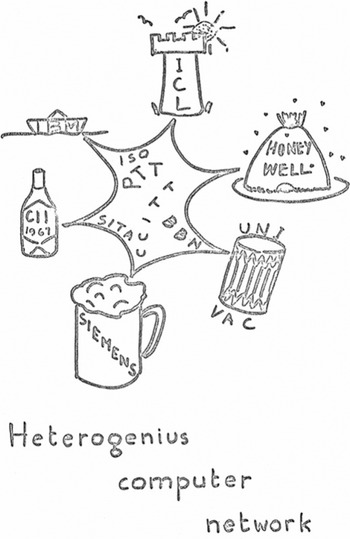
Computer internetworking was a product of the early 1970s, when the most notable experiments were funded by governments in the United States and France. A project in France, the Cyclades network, was sponsored by IRIA, a state agency responsible for computer science research.Footnote 40 The founder of Cyclades was Louis Pouzin, a charismatic and respected computer scientist. Pouzin was an inspirational leader who rallied his small team around a vision of “heterogenius” computer networks, capable of connecting machines from different manufacturers and using different operating systems (see Figure 2). He later described himself as having an “instinctive, probably genetic” revulsion toward monopolies. He certainly possessed what we would recognize as an entrepreneurial spirit, in the broad sense of the term that describes someone who takes risks in order to initiate projects.Footnote 41
Pouzin's “Heterogenius” computer network. Note the diverse manufacturers such as IBM, CII (France's Compagnie internationale pour l'informatique), and Siemens, some depicted with nationalist imagery, as well as the various organizations that were building network protocols. (Source: Louis Pouzin, INWG Note #49, “Network Architectures and Components,” box 1, Alexander McKenzie Collection of Computer Networking Development Records. Courtesy of the Charles Babbage Institute, University of Minnesota, Minneapolis.)

For French authorities, Pouzin's strong personality cut two ways. On the one hand, it was useful for achieving a major goal of French industrial policy, which was to resist the incursion of IBM products. On the other hand, Pouzin's approach undermined French efforts to bolster the company CII as the “national champion” of French computing and, more harmfully, contributed to a standoff with the French telecom monopoly that ultimately led to Pouzin's ouster and the suffocation of the Cyclades project by the late 1970s.Footnote 42
Pouzin's ideas about packet-switched networking persisted beyond the Cyclades experiment, as has been documented elsewhere.Footnote 43 In brief, his technical ideas were incorporated into the work of DARPA scientists Vint Cerf and Robert Kahn, and his close colleague Hubert Zimmerman played a leading role in the International Organization for Standardization (ISO) committee on Open Systems Interconnection. Participants driving the work in OSI came from computer companies, telecommunication companies (including national monopolies in Europe), and organizations like industrial corporations or national governments that saw the vast strategic potential of internetworking to simplify and enhance their operations. American computer scientist John Day noted that “rules had changed substantially” for standards and a leisurely approach was no longer viable. “There was big money involved, and everybody knew it. . . . Everybody realized that how we did the technical solutions determined market lines, determined economics, determined money in somebody's pocket. It was no longer this nice old-boys club.”Footnote 44 Within a few frenetic years, ISO approved the group's work as a milestone international standard, ISO 7498: The Basic Reference Model for Open System Interconnection.
In contrast, the standardization path for DARPA-backed internetworking protocols fell well outside conventional industry processes. Cerf, Kahn, and ARPANET researchers, who had ample access to funding and technology, turned inward. They chose to focus their effort on the development and implementation of TCP for their military patrons and stopped meaningful participation in the international meetings hosted by ISO. In July 1977, they ran a successful “internetworking” demonstration that sent packets across DARPA's satellite network (SATnet), a radio network (PRnet), and a land-based network (the ARPANET).Footnote 45 In 1977, Cerf and two other DARPA-funded researchers, Danny Cohen and Jon Postel, decided to split the functions of the Transmission Control Program into two protocols, the Transmission Control Protocol and the Internet Protocol, that worked together and became known as TCP/IP. These protocols were published as Department of Defense standards in 1980—a step that paved the way for their inclusion in the potentially massive market for procurement of defense equipment.Footnote 46
The subsequent standardization process for TCP/IP was unusual, to say the least. Emboldened by their mandate from DARPA, Cerf and Kahn ignored established standards-setting organizations like ISO and IEEE and built their own standards development and governance institutions. These groups included the Internet Configuration Control Board (ICCB), founded by Cerf in 1979 to be his “kitchen cabinet,” and the Internet Advisory Board (IAB), created in 1984 as the ICCB's successor. In 1986, a Department of Defense official served as the first chair of a committee of the IAB called the Internet Engineering Task Force, which has remained the steward and champion of Internet standards ever since. This structure—under the watchful eyes of the Defense Department and its contractors—was purpose-built to stabilize and promote TCP/IP and affiliated protocols.Footnote 47
How did companies engage with these sprawling efforts—at times competing, at times cooperating—to promote standards for internetworking? Their actions fell into three general categories: the production of standards; decisions about purchasing internetworking equipment; and the manufacture and sale of internetworking equipment. As noted above, many companies—incumbents and start-ups alike—committed resources and people to both efforts to create standards. Valued employees took the substantial time required to attend meetings, draft and review documents, and lead committees. Standards work fed into corporate strategies for purchasing and manufacturing information-processing equipment. Examples abound, both from large companies like IBM, which sent dozens of engineers to standards committees, guided by Joseph Di Blasi, who served as IBM's director of standards from 1976 to 1988, and from smaller companies such as Linkabit and Proteon, whose employees participated in the first meetings of the IETF in 1986.Footnote 48
Substantially less attention has been devoted to explicating the links between standards setting and the two other types of company activity mentioned above, namely, purchasing and making equipment. We will discuss these in turn.
Uncertainty over the best networking equipment to purchase was the single defining characteristic of company decision-making in this era. Interconnecting LANs throughout large corporations with distant facilities introduced problems that differed from local interconnection. The communication speeds of LANs could not be supported by modems, and different vendors used different LAN standards—recall that IEEE published three standards in 1983–1984. Moreover, users were looking for new features and capabilities. Corporate users were most enticed by protocols that engineers called “higher level”—that is, those that went beyond mere connectivity to supply new capabilities such as electronic mail, directory lookups, and the automation of common manufacturing and office tasks.
These higher-level services were so important to large companies that two of them—General Motors and Boeing—took the initiative to build on the OSI framework and create implementations of higher-level protocols: Manufacturing Automation Protocol (MAP) and Technical and Office Protocol (TOP). MAP, envisioned as a step toward factory automation, addressed the problem of multivendor compatibility in numerical controllers, robotics, sensors, and computers.Footnote 49 TOP, released in 1986, was designed to complement and extend MAP, including support for new and emerging applications for database management, word processing, document exchange, and business analysis. This conglomeration of features and corporate supporters was far more ambitious than anything attempted by champions of the TCP/IP “Internet” protocols. For many investors and executives, it was a clear choice to invest in MAP and TOP—illustrated by the many companies and government agencies supporting these efforts, including General Motors, Boeing, DuPont, Ford Motors, Proctor & Gamble, Eastman Kodak, and the NBS, among many others. The inclusive and iterative process followed by ISO, as well as the developers of MAP and TOP, facilitated the involvement of potential users into the process for designing and building standard implementations.
Finally, a vibrant group of companies jumped into the manufacture of internetworking equipment. Some of these companies were active in networking; others were start-ups that saw themselves as well positioned to compete in internetworking. Many tried to hedge their bets (and mitigate confusion) by building products that could comply with a variety of protocols. But they faced tremendous complexity: products such as bridges, gateways, and routers were difficult to engineer, and it was unclear how they should manage the wide variety of network protocols in use and in development. In 1987, market research firms first began reporting on this new market sector, which they called internetworking. Eventually, as many readers will recognize, the dominant design for internetworking would feature TCP/IP and Ethernet—protocols that, in all likelihood, enable connectivity in your office and home. But, as Table 3 illustrates, this dominant design had not been settled by 1989. In the meantime, the first router vendors, such as Proteon and Cisco, placed their bets on a multiprotocol router—a device that could automatically move packets across networks that used different protocols.
Router vendors and product types, 1989.

(Source: Network World, 7 Aug. 1989, 34–38.)
Cisco Systems provides an especially compelling example of an internetworking start-up. Cisco Systems was founded by Leonard Bosack and Sandy Lerner, a husband-and-wife team who met at Stanford and worked in its computer science department and business school, respectively. Stanford, like many large organizations, struggled in the early 1980s to create a unified campus network. Bosack and Lerner worked with Bill Yeager, an engineer at Stanford Medical School, to cobble together an Ethernet-based solution. Bosack and Lerner assembled routers in their living room and were soon overwhelmed with requests from users. The Stanford Office of Technology Licensing did not offer a rapid alternative to convert their “skunk works” into a profitmaking venture, so Bosack and Lerner formed a company in December 1984.Footnote 50 Revenue growth was slow over the next eighteen months, so Bosack and Lerner sought venture capital to help. They spoke to nearly one hundred firms before finding one, Sequoia Capital, willing to invest. The financing closed in December 1987. By that time, Cisco did not have significant revenue compared with other internetworking companies, but it had launched a solid product in 1986, the AGS multi-protocol router.
Cisco also was the beneficiary of a stumble by networking market leader 3Com, which had enjoyed triple-digit growth rates between 1982 and 1985 thanks to its Ethernet products. But some strategic missteps, combined with an awkward 1987 merger with Bridge Communications, left the company in poor shape. Many employees left and moved to companies like Cisco, which benefited greatly from the know-how and experience of former Bridge and 3Com employees once internetworking took off.Footnote 51
3Com was not the only company tripped up by the uncertainty of computer communications—and of the OSI-Internet standards war that raged throughout the 1980s. Even though OSI had broader support, including from established standardization bodies, TCP/IP had features that Cisco and other vendors were using to their advantage: it was simpler, easier, cheaper, and widely deployed in hardware and operating systems. As Ralph Ungermann noted in 1988,
Well, the reason that TCP is a force is that, for various reasons, connectivity through it became available on lots of machines, so overnight, even though no vendor was proposing it as THE standard to use, all of a sudden people looked around and said: “Hey, look at this. We can do this, we can do that.” . . . They used it, and then everybody recognized that: “Hey, there is real strong connectivity here, and this is a good standard to jump on.”Footnote 52
The commercial availability of TCP/IP was no accident. Rather, it was the result of a strategy to move control of TCP/IP out of the shadow of the Department of Defense and into the marketplace. Among the many individuals who contributed, Dan Lynch stands out for his crucial role in devising and executing this strategy. Lynch was a longtime member of the TCP/IP community, first as director of computing facilities at DARPA contractor SRI International and later at the University of Southern California's Information Sciences Institute. At USC, Lynch led the effort to convert the ARPANET to TCP on the “flag day” of January 1, 1983—sometimes celebrated as the Internet's birthday. Lynch offered a simple description of his career with the community: “To make it work. I ran the computer centers for the R&D, for the computer science researchers, so I basically ran the boiler room for the boiler room designers.”Footnote 53 Lynch remembers worrying about his friends and colleagues in the summer of 1985: “I looked around and I said: ‘Gee, whiz. The world is really jumping on this TCP/IP stuff, it works for them. It's providing them some multi-vendor interoperability.’ But it was clear these vendors didn't see a bigger picture. They were technically adept at a lot of things, but they didn't have the marketing picture.”Footnote 54 Lynch decided he needed to get the “apostles” of TCP “to come out of their ivory towers” and be more effective at marketing.
The dozen or two dozen who actually built this stuff, I went to them and said: “You guys have failed. You built this beautiful thing, and the world is starting to use it, and they're abusing it, and you have failed to communicate to them what its real potency is, where it's really headed, what problems it's really headed to solve. They're just using it for these little small things, and you've got to go awaken them.” And they did. They loved that. [. . .] So I put together a conference [in Monterey in August 1986], invitation only. . . . That was an outrageously successful conference.Footnote 55
The leaders of the TCP/IP research community joined representatives from sixty-five vendors at the first “TCP/IP Vendors Workshop” on August 25, 26, and 27, 1986. The Internet Activities Board—a private group that grew out of the Defense Department's Internet Advisory Board—was the event's chief sponsor. The meeting, though successful in some ways, left bigger questions unanswered: there was no certification or conformance testing process, and no “official” industry standards for TCP/IP.Footnote 56 Confusion reigned, as a marketing manager at Ungermann-Bass summarized in 1987: “At the OSI side there's no product. At MAP, GM has funded a very large technical staff. Then look at TCP/IP with its number of customers and vendors. It's five to six times more dense or populous than OSI, and you've got Dan Lynch and his answering machine.”Footnote 57
Nevertheless, Lynch's entrepreneurial spirit, industry experience, and belief in TCP/IP pushed him along. He founded a newsletter, Connexions: The Interoperability Report, which he described as an “attempt to satisfy the need for information exchange between users, vendors, and the R&D community.” The newsletter itself explained the various technical concepts and listed over 140 vendors that were offering or developing TCP/IP products.Footnote 58 Lynch also continued organizing vendor conferences to promote TCP, including two TCP/IP Interoperability Conferences in 1987. As he planned a meeting for 1988, he debuted a new, catchier title: Interop.
Lynch knew he was playing catch-up to the OSI marketing machine—evident in the fact that Interop was the second large internetworking trade show of 1988. The first event, promoting OSI technologies, took place in Baltimore in early June. Sponsor booths at the Enterprise Networking Event (ENE) focused on large-scale manufacturing: GM, Boeing, TRW, John Deere, the Air Force/Industry Coalition, and Process Industries. These companies had experienced a surge in demand for corporate networking, and GM and Boeing in particular had responded by championing the MAP/TOP protocols.
ENE was a huge event, befitting of the vast productivity improvements promised by OSI. With well over ten thousand attendees, ENE's government sponsors included the U.S. Department of Commerce's National Bureau of Standards. All the American computing giants—including IBM, HP, AT&T, Xerox, Data General, Wang, and Honeywell—were present, as well as leading European manufacturers and a number of younger internetworking and computing companies such as 3Com, Apple, SUN Microsystems, Micom, and Retix. Keynote speakers from the upper levels of the Department of Defense, Arthur Andersen, and the Commission of European Communities reinforced the message that all major stakeholders were behind the global adoption of OSI. But even as ENE fed the hopes of OSI's supporters, it also reinforced their nagging worries. Vendors were able to demonstrate OSI standards for network management and electronic mail, but the absence of certified conformance testing undermined customer confidence. Instead of products for sale, the attendees saw mostly prototype demonstrations. Even MAP 3.0, the “lightest” and most proven of the OSI profiles, was a disappointment. A MAP consultant admitted to a reporter, “I'm not bullish on the market.”Footnote 59
A smaller crowd—and a different atmosphere—was present at Interop, held in Santa Clara in late September. Interop featured a “show network” with a lot of available products: “every medium, every bridge box, every router you can imagine,” according to Peter de Vries of the Wollongong Group, which was responsible for the Interop network. The network provided connections between all of the vendors on display, as well as links to national, regional, and private networks. At Interop, vendors could participate in TCP/IP “bake-offs,” where they could check to see if their equipment interoperated with other vendors’ products. Self-appointed “net police” went so far as to hand out “tickets” to implementations that did not comply with the TCP/IP specifications.Footnote 60
In many respects, Lynch's Interop ’88 was far more successful than ENE. (See Table 4, Comparison of ENE and Interop.) It featured useful products from fifty-four vendors, slightly more than ENE. Where ENE carried the burden of expectations to provide comprehensive solutions for large-scale manufacturing, office, and government procurement, Interop focused on the immediate and narrower problems of network interconnection. In the “age of standards,” as Data Communications declared, this focus on product compatibility, interoperability, and connectivity energized the roughly five thousand attendees as well as the market for TCP/IP products.Footnote 61
Comparison of ENE and Interop

(Sources: Open: OSI Product & Equipment News 1, no. 3 [6 June 1988]; Connexions 2, no. 11 [Nov. 1988]).
By the end of 1988, the internetworking sector looked poised for growth. TCP/IP appeared to be gaining ground as an interim solution for anxious corporate users, while the world waited for OSI. But market realities undermined OSI's carefully negotiated consensus. As 3Com's Bill Carrico told Pelkey in 1988, “TCP/IP is unbelievably successful out there and TCP/IP's success is pushing out OSI's acceptance, because there's a lot of people who say: ‘What do I need OSI for? I can talk to 250 companies who have got TCP/IP implementations and know it works.’”Footnote 62 The next year, in an essay titled “Is OSI Too Late?,” OSI advocate Brian Carpenter opened on a sour note: “Despite a decade's work, it is readily demonstrated that OSI is not yet complete, and indeed probably never will be.”Footnote 63
Carpenter was right. Although the OSI seven-layer model is still used in university computer science courses, TCP/IP became the de facto global standard for internetworking. There was nothing akin to the Treaty of Versailles to end the OSI-Internet standards war, but the explosive growth during the 1990s of the commercial Internet and TCP/IP-based World Wide Web surely marked a new era of stability in computer communications.
Conclusions
The enduring success of the TCP/IP Internet and Ethernet LAN standards marked the end of an extraordinarily dynamic phase of industry growth and standards setting for computer communication, from the 1960s to the late 1980s. At the beginning of this era, domestic monopolists and a century-old international agency were in charge; by the end, a small group of plucky upstarts, backed by millions of dollars of investment from venture capital and the Department of Defense, had rewritten the rules for standards setting. The new venues included a new committee (IEEE 803) within an established industry group, as well as a standards start-up, the Internet Engineering Task Force. Formed in 1986 as an activity of the IAB, the IETF was in effect a spinoff from DARPA's massive investments. It was not beholden to long-established rules about openness or balance of interests; instead, it had a single-minded devotion to the growth of the TCP/IP Internet.Footnote 64
Amid these changes was a consistent underlying theme: entrepreneurial firms, and individual entrepreneurs working in business and policy, played central roles in standardization processes—whether key standards were set by market competition, by governmental or intergovernmental agencies, by consortia of dominant firms (such as DIX), or by established or newer private standardization bodies. Existing histories of the Internet have not adequately recognized the centrality of this entrepreneurial energy and purpose.
More generally, we have described how changes in computer communication standards unfolded across three distinct markets. First was data communication, where Codex proved that a small firm could compete against the prodigious technical resources of AT&T and Bell Labs. Patterns of standards setting shifted in the second market, which was networking. After struggling to realize a systematic vision that linked computer software and hardware, Xerox PARC leaders recognized that they needed a new supply chain that would include cables, wires, and semiconductor chips. In other words, they recognized compelling business reasons to contribute to open standards, which would sustain an industry ecosystem based on partnerships and move the industry into a phase of profitable mass production. Companies that built Ethernet-based products won market share and made millions. In the process, the institutional center of gravity shifted for the production of standards for data networks.Footnote 65
In the third market, internetworking, the same tendency toward open standards became even more pronounced. The combination of TCP/IP over Ethernet became a dominant design—and a de facto industry standard—thanks to subsidies from the Department of Defense, a relatively unambitious and simple design, and some clever marketing and promotion by Dan Lynch and the companies that developed early TCP/IP products. Their competition was OSI, which followed the established rules for making international standards by gathering all interested stakeholders—a process that proved to be too cumbersome. Once equipment companies recognized they could meet market demand by building TCP/IP products, momentum built behind their collective efforts. Start-ups like Cisco reaped the windfall, benefiting from the ever-expanding supply of chips that grew from the networking market. As we highlighted in the introduction, Cisco's market capitalization reached $569 billion by March 2000, making it not only the most valuable company in the world but also the principal beneficiary of the underlying changes in standards setting.
There is deep interest in understanding and applying lessons of the Internet's success, and for good reason. The Internet surely will be remembered as the most important piece of the digital infrastructure built in the late twentieth and early twenty-first centuries, a technological platform that deserves comparison with the foundational place of railroad technologies that sustained the massive industrialization of the nineteenth and early twentieth centuries. Elements of Internet history are often invoked as templates or precedents for strategists in business and government.Footnote 66 But we have found the story to be so complex, with so many contradictory elements, that we would counsel skepticism toward anyone who claims to be following the steps that led to the TCP/IP Internet's success.
The varied and contradictory roles of the U.S. federal government provide only one example of our caution toward the cavalier application of lessons from Internet history. DARPA sponsorship is well known, with a price tag likely in the hundreds of millions of dollars, far greater than any firm or investor could have afforded. However, as we describe in fuller detail in Circuits, Packets, and Protocols, the federal government backed both sides in the Internet-OSI standards war, essentially betting against itself and—at times—against the preferences of the American computer industry. For example, despite the Defense Department's sponsorship of TCP/IP, defense officials also promoted the development and adoption of OSI for federal networks—even endorsing a 1985 report to “move ultimately toward exclusive use” of OSI protocols and to implement OSI “as rapidly as possible.”Footnote 67 Their decision prompted Data Communications to declare in November 1985 that OSI was “heading for full bloom.”Footnote 68 If things had turned out differently, and OSI had lived up to expectations, perhaps historians and policymakers would be celebrating the wisdom of the leaders of OSI rather than their counterparts in the Department of Defense.
We have a second reason to be wary of drawing strategic lessons from the history of internetworking standards. There is some irony in the subsequent recasting of the Internet standardization process as an example—even a new paradigm—of radically “open” standards. It is true that participation in the IETF is open to anyone who signs up for its mailing lists, which is the lowest conceivable barrier to entry when compared with the membership fees required by more traditional standards bodies or industry consortia. But the IETF—like the ARPANET before it—was a product of the defense establishment of Cold War America. The success of the TCP/IP protocols came from massive federal subsidies, as well as from leaders, Cerf and Kahn, who were emboldened to bypass and undermine established mechanisms for creating and certifying industrial standards. As a result, we would caution anyone who is tempted to view the IETF as a paradigm for “open standards,” particularly if their mental model of the IETF has no analog of decades of seed funding from the U.S. Defense Department.
We are more confident in putting forth observations that pertain to historians seeking to assess the significance of standards in the global economy. Scholars often start by examining standards from the vantage point of the committees that create them—when they are fortunate enough to recover committee records.Footnote 69 Inspired by Pelkey's interviews and expansive collection of contemporary data, we see great potential for learning about standards by looking from a different vantage point, one that foregrounds companies seeking to build standards-based products. The tradeoffs between speed and consensus are well known to historians and other scholars of standards in business. But insights from the boardroom, and particularly from departments of engineering, purchasing, and marketing, can provide greater texture for understanding how standards feature into risky strategies to enable profitable innovation.