Introduction
Potato (Solanum tuberosum L.), the most important root and tuber crop worldwide, is a valuable food security and cash crop for millions of farmers in developing countries (Lutaladio et al., Reference Lutaladio, Ortiz and Caldiz2009). In Ethiopia, potato has a potential for improving the livelihood of producers because of its high yield in a short growing season, availability of suitable agro-ecological regions and labour force for its production, and accessibility of potential markets for its raw and value-added products. According to FAOSTAT (2019), in 2017, 932,701 tons of potatoes were produced in Ethiopia on 67,591 ha of land. These data indicate that potato productivity in Ethiopia (13.8 t ha−1) is lower than that in some other sub-Saharan African countries (e.g., Niger: 29.3 t ha−1, South Africa: 36.2 t ha−1, Zambia: 31.6 t ha−1). Potatoes mature in 3–4 months and can yield up to 40 t ha−1, which makes them ideal for places where land is limited and labour is abundant (FAO, 2008). However, the low productivity of potato in Ethiopia suggests the need for improving its production efficiency to achieve its potential. There are a few studies conducted to improve the productivity of potato in Ethiopia; these include the one by Ketema et al. (Reference Ketema, Kebede, Dechassa and Hundessa2016) who analysed the factors that determine the adoption of potato production technology package in eastern Ethiopia. Crop yield and productivity are not only affected by weather conditions, quality of seeds and varieties, amount of fertiliser and farming practices used but also affected by the efficiency of production (Tiruneh et al., Reference Tiruneh, Chindi and Woldegiorgis2017), which reflects the effectiveness of the farm management. Although there are some empirical studies conducted to measure efficiency of different crops and technologies in Ethiopia (e.g., maize (Kitila and Alemu, Reference Kitila and Alemu2014), wheat (Beshir, Reference Beshir2016), irrigation (Bogale and Bogale, Reference Bogale and Bogale2005; Tiruneh et al., Reference Tiruneh, Chindi and Woldegiorgis2017), and packaging technology (Ketema et al., Reference Ketema, Kebede, Dechassa and Hundessa2016)), there is no study on the analysis of technical efficiency of potato-producing farmers in Northern Ethiopia. Moreover, this study utilises principal component analysis (PCA), which is a multivariate statistical analysis method (Johnson and Wichern, Reference Johnson and Wichern2007) that allows the identification of the primary production constraints that affect the technical efficiency level of potato producers. PCA was applied to reduce the large number of factors into a smaller number of principal components (PCs). PCA often reveals relationships that were not previously suspected and thereby allows the discovery of new knowledge (Johnson and Wichern, Reference Johnson and Wichern2007). Therefore, the objectives of the study were to identify the potential production constraints that affect technical efficiency in potato production to examine the effect of productive resources on technical efficiency in potato production and to examine the extent in which technical efficiency in potato production is associated with production constraints.
Materials and Methods
Sampling method
The population about which inference is to be made (the target population of the study) was the population of potato-producing farmers’ households in Dessie Zuria woreda (district) located in Northern Ethiopia. The district has 32 kebeles (equivalent to wards) and has a total population of 178,364 (CSA, 2012). According to Dessie Zuria district agriculture office, among the 32 kebeles, potato is produced in 18 of them by 8498 farmers.
Since the population size is known to be N = 8498, the sample size was determined according to Krejcie and Morgan (Reference Krejcie and Morgan1970) using the following formula:
 $$n = {{\chi _{(0.05,1df)}^2 \times N \times P(1 - P)} \over {({d^2} \times (N - 1)) + (\chi _{(0.05,1df)}^2) \times P(1 - P))}}$$
where n is the sample size of potato producing households,
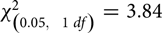 $$\chi _{\left( {0.05,\;\;\;1\;df} \right)}^2 = 3.84\;$$
obtained from the χ
2 table, N is the population size, P = desired population proportion (0.5) to minimise estimation error, and d = degree of accuracy (margin of error), and in this calculation a value of d = 5% was used, which gave a sample size of n = 368. Since farm household heads were responsible for day-to-day farming activities, they were taken as the basic sample unit in this study.
These 18 kebeles are internally heterogeneous and externally homogeneous in terms of the variables of interest, making them appropriate for cluster sampling method. But the number of households in each kebele is larger than the sample size, which means that randomly selecting one (the minimum possible) kebele and collecting data from all of them would not work. Therefore, a two-stage sampling method was used. In the first stage, six kebeles (clusters) were randomly selected to get good representation of the population. Then, in the second stage, each of the selected kebeles were stratified by their production potential (low, medium and high) and stratified random sampling with proportional allocation was used to select a total of n = 368 farmers. Then, the selected potato-producing farmers were interviewed at the end of the 2018 production season to collect data using a structured questionnaire.
Empirical model
In recent years, stochastic frontier applications use a two-stage procedure involving both stochastic frontiers and Tobit model. A technical efficiency measure obtained in the first stage is used as the dependent variable in the second stage (Tobit model). The goal of the second stage is to explore the relationships between the technical efficiency measure and other relevant variables. The Tobit model was first suggested in the Econometrics literature by Tobin (Reference Tobin1958).
A stochastic parametric method that uses the following functional form of the frontier production function was used for efficiency analysis:
 $$Y = f\left( {ChemFert,\;Pseed,\;LabDay,\;Lsize} \right) + \;\varepsilon $$
where Y represents the amount of potato produced in quintal (1 quintal = 100 kg) (Seyoum et al., Reference Seyoum, Battese and Fleming1998), ChemFert represents the amount of chemical fertiliser used in kg, Pseed represents the quantity of seed planted in kg, LabDay is family labour in man days and Lsize is size of the land in ha where potato was planted. The following linear model representation of the frontier production function was fitted and the corresponding parameters were estimated:
 $$ln{Y_i} = {\beta _0} + {\beta _1}lnChemFer{t_i} + {\beta _2}lnPsee{d_i} + {\beta _3}lnLabDa{y_i} + {\beta _4}lnLsiz{e_i} + {v_i} - {u_i}$$
where the subscript i indicates the ith household in the sample (i = 1, 2, …, 368), ln is the natural logarithm (i.e., logarithm to base e) and βs are the parameters to be estimated. The components of the error term (ε i = v i – u i ), v i and u i , represent the stochastic and the inefficiency components, respectively. In the Cobb–Douglas functional form, the parameters to be estimated (βs) represent the elasticity of output with respect to each input.
According to Jondrow et al. (Reference Jondrow, Lovell, Materov and Schmidt1982), the technical efficiency estimation is given by the mean (expected value) of the conditional distribution of inefficiency term u i given ε i and is defined by:
 $$E\left( {u{\rm{|}}\varepsilon } \right) = {{{\sigma _v} - {\sigma _u}} \over \sigma }.{{f\left( {{\varepsilon _i}\lambda /\sigma } \right)} \over {1 - F\left( {{\varepsilon _i}\lambda /\sigma } \right)}} - {{{\varepsilon _i}\lambda } \over \sigma }$$
where
 $\lambda = {{{\sigma _u}} \over {{\sigma _v}}}$
while f and F represent the standard normal density and cumulative distribution function evaluated at
 ${{{\varepsilon _i}\lambda } \over \sigma }$
. The farm-specific technical efficiency (TE) is defined in terms of ratio of observed output (Y
i
) to the corresponding frontier output (Y*) using the available technology derived from the result of the above equation as:
 $$TE = {{{Y_i}} \over {{Y^*}}} = {{E({Y_i}|{u_i},{x_i})} \over {E({Y_i}|{u_i} = 0,{x_i})}} = E({\rm{exp}}\left( { - {u_i}} \right)|{\varepsilon _i})$$
TE takes a value between 0 and 1, where a value of 1 indicates the farmer is fully efficient in the production of potato, while 0 indicates the farmer is totally inefficient. For these types of dependent variables, censored Tobit model is appropriate. The use of the Tobit model can handle the characteristics of the distribution of efficiency measures and thus can provide results that can guide policies to improve performance (Tipi et al., Reference Tipi, Yildiz, Nargeleçekenler and Çetin2009). The farm-specific inefficiency (1 − TE i ) is considered as a function of 18 different variables and the efficiency effect model is estimated as:
 $${u_i} = {\delta _0} + \mathop \sum \limits_{m = 1}^{18} {\delta _m}{Z_i} + \varepsilon $$
where δ 0 is the intercept term, δ m is the regression coefficient parameter of the mth explanatory variable, i = 1, 2, … 368 and the explanatory variables, Z 1 to Z 18, represent socio-economic, demographic, institutional and production constraint variables. The maximum likelihood estimates of the regression coefficients were obtained using STATA version 12 software.
PCA technique
The PCA included 21 variables (constraints) that can affect efficiency in potato production. For each variable, a numerical rating scale with five levels (5 = not a constraint and 1 = sever constraint) was used. By doing PCA, the number of constraints that affect the technical efficiency of potato producers was reduced to five PCs that are not correlated among themselves. The PCA was completed using SPSS version 25 software.
Hypotheses
To achieve the objectives of the study, the following null hypotheses were tested.
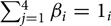
H 01: δ 1 = δ 2 = …, δ p = 0, socio-economic and institutional characteristics do not influence farm-level technical efficiency in potato production among smallholder farmers.
H 02: γ = 0, there is no inefficiency for potato production among smallholder potato farmers.
H
03:
 $\sum\nolimits_{j = 1}^4 {{\beta _i} = 1} $
i
= 1 for all j, the stochastic frontier production function in the study area is characterised by constant returns to scale (CRTS).
Results
Characteristics of the respondents
The average age of the head of the household, household size, years of schooling and number of extension agent visits are 43 years, 4 persons, 7 years and 6 visits, respectively. In terms of gender, 28% of the households were female-headed and the rest (72%) were male-headed. Seventy-seven per cent of household heads were engaged in off-farm employment for additional source of income and the remaining 23% of the household heads were not engaged in any off-farm employment; and 82% of the households were members of a farmers’ association, while the rest (18%) were not.
Using irrigation during shortage of rainfall is an important practice to boost production and productivity. Among the sampled household heads, 82% of them used irrigation, while the remaining 18% did not use irrigation. Fifty-two per cent of the households used new or improved potato varieties and 71% of the household heads received credit from banks during the previous growing season.
Characteristics of the stochastic frontier production function
The average potato yield was estimated to be 20.69 quintal ha−1 (2.07 t ha−1). Although, there are two agro-ecological zones (Weyna-Dega [middle land, 1800–2400 m a.s.l.], and Dega [highland, >2400 m a.s.l.]) in the study area, there was no significant difference between the average yields at the two zones (20.2 and 20.8 quintal ha−1, respectively). Potato yield in the study area is highly variable and ranged from 2 to 70 quintal ha−1; and the distribution was right-skewed, which suggests that the yield at the majority of the farmers was low, and that there is an opportunity to improve productivity. The average plot size of the farms was 0.48 ha and ranged from 0.03 to 3 ha.
Chemical fertiliser is an important variable and it is one of the critical inputs provided by the government. The average amount of chemical fertiliser used by the households was 42.58 kg ha−1 and varied from 5 to 200 kg ha−1. Also, 43.1% of the households used diammonium phosphate (DAP) fertiliser, while 38.75% and 18.16% of the households used only urea and both DAP and urea, respectively. Therefore, the majority of the households used DAP followed by urea.
Estimation of Cobb–Douglas stochastic frontier production function
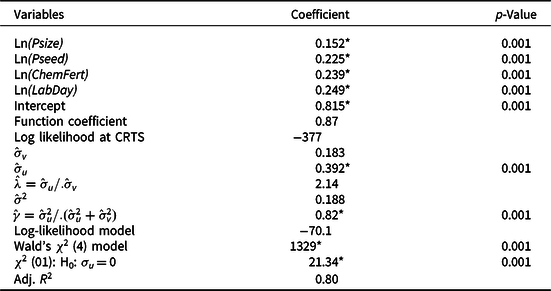
The results shown in Table 1 indicate that the calculated log-likelihood value is −70.12, which is significant at the 1% level of significance leading to the rejection of the null hypothesis, which in turn implies that the stochastic production function is more appropriate than the conventional production function, or there is a significant technical inefficiency variation among potato producers in the study area.
Cobb–Douglas stochastic frontier (maximum likelihood) estimates

* Significant at the 1% level. CRTS, constant returns to scale.
The estimated variance associated with inefficiency effect (
 $$\hat \gamma $$
) is about 82% of the total variance (Table 1), which indicates that the inefficiency component strongly dominates the total variance. This implies that the inefficiency effects were significant in determining the level and variability of output of potato producers in the study area. Therefore, the observed variations in the output of potato producers were mainly due to differences in farm practices and characteristics of the potato farmers rather than random uncontrollable factors, such as weather, pests and disease. Furthermore, the ratio of the standard deviation of u to that of v (
 $$\hat \lambda $$
) is above 1 and is statistically different from 0, which confirms good fit of the error term.
The results shown in Table 1 indicate that the log-likelihood functions at CRTS and variable returns to scale model specifications had −377 and −70.1 values, respectively, which imply that the log-likelihood ratio (LR) = −2(−377 − (−70.1)) = 613.8. The corresponding p-value is < 0.001, which implies that the null hypothesis that the Cobb–Douglas production function is characterised by CRTS in the study area is strongly rejected.
The magnitude of the coefficient of each input that represents partial elasticity is less than 1 (Table 1). This implies that output is inelastic with respect to change in inputs, which means that, on the average, when they are changed by 1%, the proportionate change in potato output is less than 1%. Furthermore, this suggests decreasing functions, indicating that input use was in stage two of the production function (i.e., the stage of economic relevance of the production function).
Technical efficiency estimates for potato producers
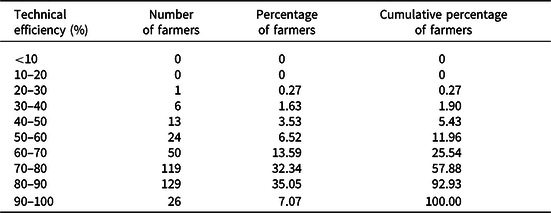
Table 2 shows the frequency distribution of technical efficiency estimates of potato producers. The average level of technical efficiency estimates of smallholder farmers in the study area was 75%, which is a bit higher than the average technical efficiency level of sweet potato production in Southern Ethiopia (66.1%) (Jote et al., Reference Jote, Feleke, Tufa, Manyong and Lemma2018); and half-way of the mean technical efficiency of rain-fed and irrigated potato farmers in Oromia region of Ethiopia (81% and 68%, respectively) reported by Tiruneh et al. (Reference Tiruneh, Chindi and Woldegiorgis2017).
Frequency distribution of technical efficiency scores

PCA as a powerful data reduction technique
PCA is a powerful data reduction technique that extracts a small number of synthetic variables, called PCs, from a large number of variables to explain a certain phenomenon. Although the numbers of PCs extracted (5) is substantially less than the number of the original variables (21), the eigen values of the retained components are greater than 1 (8.48, 5.10, 2.94, 2.32 and 1.17), which means that they meet Kaiser criterion that is commonly used for identifying the PCs (Kaiser, Reference Kaiser1960). The five PCs explain 34.7%, 19.2%, 19.1%, 11.2% and 11.0% of the variation individually and all these five PCs jointly accounted for 95.2% of the total variability in the amount of potato produced (Y).
Each PC was formed based on the loadings of the variables (constraints). The higher the loadings of a given variable, the more its influence is in the formulation of a given PC. Hence, the loadings were used to determine which variables are influential in the formation of a given PC and to assign a meaningful label for the PCs. To determine how high the loading should be for a given variable to be considered as influential in the formation of a PC, a loading of 0.50 or above was used as suggested in Sharma (Reference Sharma1996).
The identified five potential production constraints (PCs) in potato production are (i) limited access to product market (poor linkage to the market, low market price, lack of marketing information, lack of integration between producers and buyers, poor transportation to the market, and lack of storage facilities), (ii) natural factors (flood, frost, shortage of rainfall, shortage of irrigation water and pests), (iii) finance constraint (lack or absence of cash/grain reserves, high cost of improved variety, lack of incentives to purchase agricultural inputs and limited access to credit), (iv) unfavourable and corrupt government policy implementations (bribery and corruption in input distributors, lack of transparency and accountability in input distributors, and complex bureaucratic system in government agencies) and (v) weak coordination of stakeholders (lack of extension agents’ commitment to deliver necessary information and training, ill-coordination between the farmers and extension agents, and delay in agricultural input distribution), respectively.
Determinants of technical efficiency
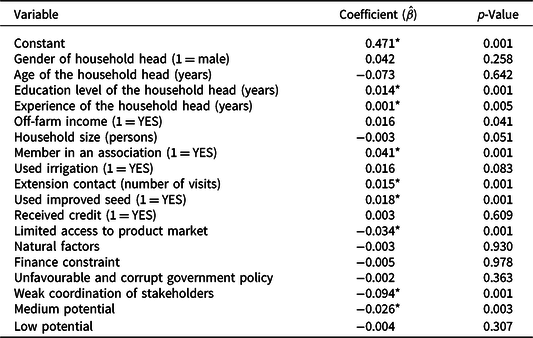
To test the null hypothesis that socio-economic and institutional factors do not influence farm-level technical efficiency, LR of the model was calculated to be 1034, which is highly significant at the 1% level of significance suggesting that the variables listed in Table 3 jointly influence inefficiency differences among the farmers.
The maximum likelihood Tobit estimates of the determinants of technical efficiency

* Significant at the 1% level.
Education was positively and significantly associated with technical efficiency of potato production in the study area. The positive relationship between education and technical efficiency indicates that an increase in years of schooling leads to an increase in technical efficiency in potato production. This result is consistent with that of Jote et al. (Reference Jote, Feleke, Tufa, Manyong and Lemma2018) and Dube et al. (Reference Dube, Ozkan, Ayele, Idahe and Aliye2018) but inconsistent with that of Tiruneh et al. (Reference Tiruneh, Chindi and Woldegiorgis2017).
Regarding the potential production constraints that affect technical efficiency of potato producers, limited access to product market (the first PC) and weak coordination of stakeholders (the fifth PC) have the strongest and significant (at 1% level) impact on technical efficiency and had values of −0.034 and −0.094, respectively (Table 3). The other three PCs do not have significant impact on technical efficiency. Therefore, the hypothesis that technical efficiency is not associated with production constraints controlling farmers’ attributes and characteristics was rejected. The variables grouped as ‘limited access to product market’ and ‘weak coordination of stakeholders’ negatively and significantly influence technical efficiency. This implies that these PCs (production constraints) are the main obstacles to technical efficiency of potato production.
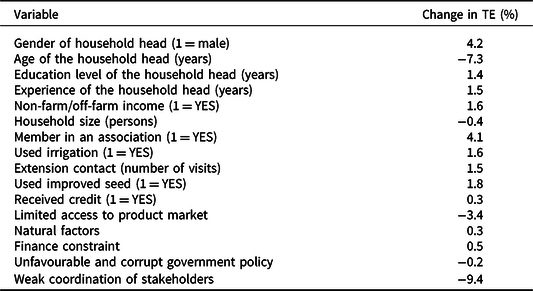
The changes in technical efficiency due to the explanatory variables shown in Table 4 indicate that an additional year of schooling would increase the probability of a farmer becoming technically efficient by 1.4%, other things remaining constant. An additional year of experience would increase the probability of a farmer to be technically efficient by 1.5%, ceteris paribus. A change in the dummy variable representing engagement in off-farm employment (generate off-farm income) from 0 to 1 would increase the probability of a farmer to fall under efficient category by 1.6%. A unit change in household size would decrease the probability of a farmer to be technically efficient by 0.4%. A change in the dummy variable representing membership in a farmers’ association, use of irrigation water, use of improved seed variety and use of credit from 0 to 1 would increase the probability of a farmer falling under efficient category by 4.1%, 1.6%, 1.8% and 0.3%, respectively (Table 4).
Percentages of changes in technical efficiency (TE) due to the efficiency variables

Discussion
The maximum likelihood parameter estimates of the frontier model showed that all coefficients (of plot size, planted seed, chemical fertiliser and labour) have positive sign and are statistically significant. However, their magnitudes are less than 1, which implies that output is inelastic with respect to changes in the inputs. The average level of technical efficiency of the farmers in the study area (75%) suggests that these potato producers have a room to increase their potato production by 25% with the existing resources and technology if inefficiency determinants are addressed. Tiruneh et al. (Reference Tiruneh, Chindi and Woldegiorgis2017) reported that the technical efficiency of irrigated potato producers in Welmera district, Ethiopia, was 81%, and Beshir (Reference Beshir2016) reported 78% technical efficiency of smallholder wheat producers in south Wollo Zone, Ethiopia. Therefore, it can be concluded that potato output can be increased by improving technical efficiency of potato production by improving market access and the coordination of stakeholders.
The estimated coefficient for the education variable (Table 3) was positive and significantly affects technical efficiency of the potato producers, which indicates that higher educational attainment would increase the technical efficiency of potato producers. This positive effect on technical efficiency of potato producers is consistent with those reported on technical efficiency of potato producers in other regions of Ethiopia (Dube et al., Reference Dube, Ozkan, Ayele, Idahe and Aliye2018; Tiruneh et al., Reference Tiruneh, Chindi and Woldegiorgis2017). However, the extent of the increase could vary depending on the specific educational model at the location of the producers. But, as reported by Anang et al. (Reference Anang, Bäckman and Sipiläinen2016) where educated smallholder rice farmers in Northern Ghana were inefficient, and by Deressa et al. (Reference Deressa, Garoma, Sekhara Reddy and Alemu2017) where educational level of a household head has a negative effect on technical efficiency in potato production in Welmera district of Oromia Regional State, Ethiopia, higher educational attainment does not necessarily increase efficiency in all crops and all locations. However, the experience of the household head has a positive and significant effect on technical efficiency, not only in this study but also in other sub-Sahara African countries (Maganga, Reference Maganga2012; Olubukola et al., Reference Olubukola, Olayemi, Adewale and Silvester2017).
Off-farm income had a positive and significant relationship with technical efficiency, which could be because farmers who participated in off-farm work use the additional income to purchase improved farm inputs. This finding is contrary to that of Beshir (Reference Beshir2016) who reported that off-farm income from off-farm employment is likely to reduce technical efficiency in wheat production in South Wollo Zone, Ethiopia. A study by Dolisca and Jolly (Reference Dolisca and Jolly2008) on technical efficiency of potato production in Haiti found negative impact of off-farm income on technical efficiency. On the other hand, Maganga (Reference Maganga2012) reported that non-farm employment positively affects the technical efficiency of Irish potato production in Central Malawi.
The number of individuals in a family had a negative and marginally significant (p-value = 0.051) impact on technical efficiency, which implies that as household size increases, technical efficiency decreases. This finding is in line with that of Okoye et al. (Reference Okoye, Abass, Bachwenkizi, Asumugha, Alenkhe, Ranaivoson, Randrianarivalo, Rabemanantsoa and Ralimanana2016) and Dube et al. (Reference Dube, Ozkan, Ayele, Idahe and Aliye2018) but opposite to that of Alam et al. (Reference Alam, Kobayashi, Matsumura, Ishida and Mohamed2012a). On the other hand, membership in a farmers’ association was positive as expected and statistically significant. This can be attributed to the fact that being a member of a farmers’ association may lead to sharing of useful information/experience on farming technologies and other practices that influence productivity. A similar finding was also reported by Anang et al. (Reference Anang, Bäckman and Sipiläinen2016) on rice production in Northern Ghana, but Okoye et al. (Reference Okoye, Abass, Bachwenkizi, Asumugha, Alenkhe, Ranaivoson, Randrianarivalo, Rabemanantsoa and Ralimanana2016) reported a negative effect of cassava farmers’ membership on technical efficiency.
Irrigation dummy variable was significant and positive as expected, suggesting that potato producers who used irrigation water were more technically efficient than their counterparts. This finding is similar to that of Anang et al. (Reference Anang, Bäckman and Sipiläinen2016) and Esham (Reference Esham2014) who reasoned out that access to irrigation enables farmers to maximise the use of other inputs such as fertiliser due to the availability of water throughout the farming season. Alam et al. (Reference Alam, Kobayashi, Matsuda, Ishida, Matsumura and Esham2012b) reported that irrigation system has a positive and significant impact on technical efficiency of potato production in Pakistan.
The impact of extension agent contact, measured by how many times potato-producing households were visited by extension agents, was positive and significant. This result confirms the finding of Mango et al. (Reference Mango, Makate, Hanyani-Mlambo, Siziba and Lundy2015) and Solís et al. (Reference Solís, Bravo-Ureta and Quiroga2009) who reported that access to extension visits can improve technical efficiency. Dube et al. (Reference Dube, Ozkan, Ayele, Idahe and Aliye2018) also reported that potato farmers who were visited by extension agents more were more efficient than those visited by extension agents less. But this result is inconsistent to that of Abate et al. (Reference Abate, Dessie and Mekie2019) who reported that extension service had a negative effect on technical efficiency of red pepper production.
The use of improved seed had significant and positive impact on technical efficiency, which could be because improved seed varieties are more productive and resistant to diseases. Wassihun et al. (Reference Wassihun, Koye and Koye2019) also reported that the production of potato using improved potato seeds was more efficient than using local seeds in Chilga district of Amhara National Regional State of Ethiopia.
Conclusions
The findings of this study revealed that education, experience, off-farm income, household size, being a member in an association, using irrigation, extension agent contact, using improved seed, limited access to product market and weak coordination of stakeholders are significantly associated with technical efficiency.
Although it is marginally significant, household size has a negative effect on the efficiency of potato production because larger household sizes have higher living expenses, which in turn limit resources available for purchasing more agricultural inputs. Encouraging appropriate use of family planning to maintain appropriate household size can reduce direct costs and improve efficiency and productivity. Farmers need to be encouraged to be a member in a farmers’ association by informing them how being a member can help them to develop new technical skills before embarking on their farming activities.
Production constraints should be alleviated through creating strong market linkage between producers and buyers and by taking appropriate measures to improve market access and coordination of stakeholders. Providing appropriate training to extension agents continuously can also improve their effectiveness.
Training farmers through different venues such as Farmer Field Schools that was launched by the Government of Ethiopia in 2010, exploring ways of utilising mass media to supplement the work of extension agents through extensive use of information and communication technology, and providing access to mobile phone services to farmers are also recommended to improve the efficiency of farmers.
Acknowledgements
The authors would like to thank Dessie Zuria district agricultural extension agents who helped during data collection from the farmers.
Funding
None.